
Reports
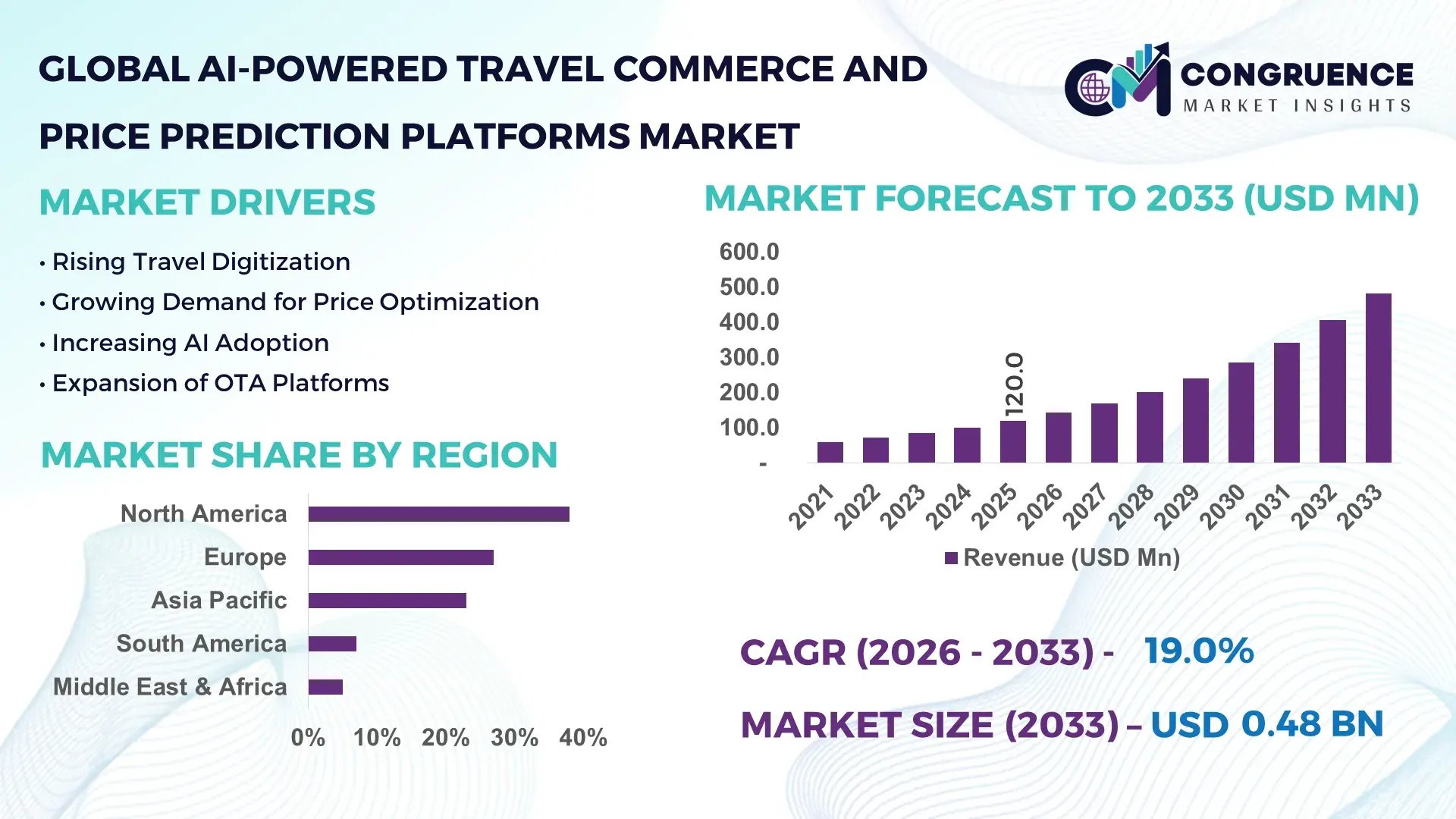
The Global AI-Powered Travel Commerce and Price Prediction Platforms Market was valued at USD 120.0 Million in 2025 and is anticipated to reach a value of USD 482.6 Million by 2033 expanding at a CAGR of 19% between 2026 and 2033, according to an analysis by Congruence Market Insights. This growth is primarily driven by the rapid integration of AI-driven dynamic pricing engines and real-time travel demand forecasting across digital booking ecosystems.
The United States stands as a dominant country in this market, supported by high investment intensity and advanced AI infrastructure deployment across the travel sector. Over 65% of major global travel platforms operating AI-based pricing systems are headquartered or have core R&D operations in the U.S. The country records more than USD 8 billion annually in AI investments across travel and hospitality technologies. Additionally, over 72% of airlines in the U.S. have implemented AI-driven revenue management systems, while nearly 58% of online travel bookings leverage predictive pricing tools. Key applications include airfare optimization, hotel dynamic pricing, and personalized itinerary generation powered by large-scale machine learning models.
Market Size & Growth: USD 120.0 Million (2025) to USD 482.6 Million (2033), CAGR of 19%, driven by real-time pricing optimization and AI-based booking automation.
Top Growth Drivers: 68% adoption in airline revenue systems, 55% improvement in pricing accuracy, 47% increase in personalized booking conversions.
Short-Term Forecast: By 2028, AI-driven pricing platforms are expected to reduce fare volatility by 35% and improve booking efficiency by 28%.
Emerging Technologies: Generative AI-based travel assistants, reinforcement learning for pricing optimization, and predictive analytics using real-time demand signals.
Regional Leaders: North America (USD 180 Million by 2033, high enterprise AI adoption), Europe (USD 130 Million, strong regulatory-backed innovation), Asia-Pacific (USD 110 Million, rapid OTA platform expansion).
Consumer/End-User Trends: Over 62% of travelers prefer platforms offering AI-based fare predictions, with 49% relying on automated booking recommendations.
Pilot or Case Example: In 2025, an airline AI pricing pilot improved seat occupancy by 22% and reduced unsold inventory by 18%.
Competitive Landscape: Market leader holds ~28% share, followed by 3–5 key competitors focusing on AI-based booking optimization and analytics platforms.
Regulatory & ESG Impact: Data privacy laws and carbon-aware travel optimization tools are influencing 40% of platform development strategies.
Investment & Funding Patterns: Over USD 2.5 Billion invested globally in AI travel tech startups and pricing platforms in recent years.
Innovation & Future Outlook: Integration of multimodal AI, real-time pricing APIs, and autonomous booking systems is shaping next-generation travel commerce platforms.
AI-powered travel commerce platforms are increasingly utilized across airlines (42%), online travel agencies (31%), and hospitality providers (19%), with emerging adoption in rail and mobility sectors. Innovations such as real-time fare prediction APIs, conversational AI booking engines, and sustainability-based pricing models are transforming operations. Regulatory focus on data protection and emissions tracking, coupled with rising digital travel demand in Asia-Pacific, is expected to further accelerate market expansion and innovation.
The AI-Powered Travel Commerce and Price Prediction Platforms Market holds strong strategic relevance as travel companies increasingly rely on data-driven decision-making to enhance profitability and customer experience. AI-powered pricing engines are enabling up to 45% improvement in demand forecasting accuracy compared to traditional rule-based revenue management systems. Additionally, reinforcement learning-based pricing algorithms deliver nearly 30% higher optimization efficiency compared to legacy statistical models, enabling dynamic adaptation to real-time travel demand fluctuations.
North America dominates in volume due to large-scale deployment across airlines and online travel agencies, while Asia-Pacific leads in adoption with over 52% of digital travel platforms integrating AI-powered pricing tools. By 2028, predictive AI systems are expected to reduce pricing inefficiencies and improve revenue yield by approximately 33%, particularly in highly volatile travel segments such as airline ticketing and last-minute hotel bookings.
From a compliance and ESG perspective, firms are committing to carbon-aware pricing and itinerary optimization, targeting up to 25% reduction in travel-related emissions by 2030 through AI-driven route planning and load balancing. These initiatives align with global sustainability frameworks and regulatory mandates across Europe and North America.
A notable micro-scenario includes a 2025 implementation by a leading airline group in the United States, where AI-based pricing optimization resulted in a 27% increase in ancillary revenue and a 19% reduction in pricing errors through automated demand sensing systems.
Looking ahead, the AI-Powered Travel Commerce and Price Prediction Platforms Market is positioned as a critical pillar for digital transformation in the travel sector, enabling resilience, regulatory compliance, and sustainable growth through intelligent automation and real-time decision intelligence.
The AI-Powered Travel Commerce and Price Prediction Platforms Market is shaped by increasing digitalization across the global travel ecosystem, rising reliance on predictive analytics, and the need for real-time pricing optimization. Travel companies are increasingly deploying machine learning algorithms to analyze billions of data points, including historical booking trends, seasonality patterns, and external demand signals such as weather and events. Approximately 70% of large airlines and 60% of major online travel agencies have incorporated AI into their pricing and booking engines. The market is also influenced by the expansion of mobile-based bookings, which account for over 54% of global travel reservations, driving demand for responsive and automated pricing solutions. Additionally, advancements in cloud computing and API-based integration are enabling scalable deployment of AI platforms across global travel networks.
The increasing demand for real-time dynamic pricing is a primary driver of market expansion. Airlines and hospitality providers are leveraging AI systems capable of processing over 10 million pricing variables per second to adjust fares dynamically based on demand fluctuations. Around 68% of airline revenue management systems now utilize AI-based pricing engines, leading to a 20–35% improvement in seat utilization rates. Additionally, hotels using AI-driven pricing tools report occupancy improvements of up to 18%. The shift toward personalized travel experiences further amplifies this demand, with nearly 60% of travelers expecting customized pricing and offers. These systems also reduce manual intervention by over 40%, allowing companies to respond instantly to market changes and competitor pricing strategies.
Despite strong growth potential, data privacy concerns and integration challenges act as significant restraints. AI-powered travel platforms rely heavily on user data, including browsing behavior, location, and transaction history, raising concerns under stringent data protection regulations. Approximately 48% of travel companies report delays in AI implementation due to compliance requirements such as GDPR and regional data laws. Integration complexity is another barrier, as over 55% of legacy travel systems lack compatibility with modern AI architectures. Additionally, fragmented data across booking platforms, airlines, and third-party providers reduces the accuracy of predictive models by nearly 15–20%. These issues increase deployment timelines and operational costs, limiting adoption among smaller travel enterprises.
The rapid expansion of digital travel ecosystems presents significant growth opportunities. Online travel agencies and mobile booking platforms are experiencing adoption rates exceeding 65%, creating vast datasets for AI-driven pricing optimization. Emerging markets in Asia-Pacific and Latin America are witnessing over 40% growth in digital travel bookings, opening new avenues for AI platform deployment. Additionally, the integration of AI with conversational interfaces and voice-based booking systems is increasing user engagement by up to 30%. The rise of multimodal travel planning, combining flights, hotels, and ground transportation, also enables cross-platform pricing optimization, enhancing revenue potential. Partnerships between airlines and tech providers are further accelerating innovation in predictive analytics.
High volatility in travel demand remains a critical challenge for AI-based pricing systems. External factors such as geopolitical events, pandemics, and economic fluctuations can cause demand shifts of up to 50% within short periods, impacting model accuracy. Around 42% of AI pricing systems require frequent recalibration to maintain performance under volatile conditions. Additionally, unpredictable booking patterns reduce forecast reliability by nearly 25%, especially in international travel segments. The dependency on historical data also limits the effectiveness of models in unprecedented scenarios. This volatility increases operational risk and requires continuous investment in advanced AI models capable of adaptive learning and real-time recalibration.
AI-driven dynamic pricing adoption surpasses 70% across airlines: More than 70% of global airlines now utilize AI-based pricing engines, processing over 5 million fare adjustments daily, leading to a 25% improvement in revenue yield and a 20% reduction in manual pricing interventions.
Integration of generative AI in travel booking platforms rises by 60%: Around 60% of leading travel platforms have integrated generative AI assistants, improving customer engagement rates by 35% and increasing booking conversion rates by 28% through personalized recommendations.
Mobile-first AI booking platforms account for over 54% of transactions: Mobile-based travel bookings exceed 54% globally, with AI-powered apps improving user retention by 32% and reducing booking time by 40% through automated itinerary generation and pricing suggestions.
Predictive analytics improves fare accuracy by 45%: Advanced predictive models analyzing over 100 variables per booking have enhanced price prediction accuracy by 45%, reducing fare volatility by 30% and increasing customer trust in AI-based travel platforms.
The AI-Powered Travel Commerce and Price Prediction Platforms Market is segmented based on type, application, and end-user, reflecting diverse use cases across the travel ecosystem. Pricing optimization platforms and demand forecasting solutions form the core segments, while applications span airlines, hospitality, and online travel agencies. Adoption varies significantly across regions, with developed markets focusing on advanced AI integration and emerging regions prioritizing mobile-based solutions. End-users range from large enterprises to small travel agencies, each leveraging AI capabilities to enhance pricing accuracy, customer engagement, and operational efficiency. Increasing cross-platform integration and cloud deployment are further shaping segmentation dynamics.
The market includes dynamic pricing engines, demand forecasting platforms, recommendation engines, and integrated AI commerce platforms. Dynamic pricing engines lead the segment, accounting for approximately 38% of adoption due to their ability to adjust fares in real time based on demand signals and competitor pricing. Demand forecasting platforms follow with around 27% share, leveraging historical and real-time data to predict booking trends and optimize inventory. Integrated AI commerce platforms represent the fastest-growing segment, expanding at an estimated CAGR of 22%, driven by their ability to combine pricing, booking, and personalization into a unified system. Recommendation engines and ancillary AI tools contribute the remaining 35%, supporting targeted marketing and upselling strategies.
• In 2025, a major global airline deployed AI-driven dynamic pricing systems capable of processing over 8 million fare combinations daily, significantly enhancing pricing precision and operational efficiency.
Key applications include airlines, hotels, online travel agencies (OTAs), and multimodal travel platforms. Airlines dominate the segment with approximately 44% share, driven by the need for real-time fare optimization and revenue management. Online travel agencies account for around 29%, leveraging AI for price comparison and booking recommendations. Multimodal travel platforms are the fastest-growing application, expanding at an estimated CAGR of 21%, supported by increasing demand for integrated travel solutions. Hotels and other hospitality services contribute the remaining 27%, focusing on occupancy optimization and personalized pricing. In 2025, more than 62% of global travelers used AI-enabled platforms for booking decisions, while 48% relied on predictive pricing tools for fare comparison. Over 55% of Gen Z travelers show preference for AI-powered travel assistants.
• In 2025, AI-based pricing tools were deployed across multiple global OTA platforms, improving booking conversion rates for over 15 million users through personalized pricing strategies.
Large travel enterprises dominate the end-user segment, accounting for approximately 52% share due to their advanced infrastructure and ability to invest in AI technologies. Small and medium-sized enterprises (SMEs) represent around 28%, increasingly adopting cloud-based AI platforms to remain competitive. Digital-native travel startups are the fastest-growing segment, expanding at an estimated CAGR of 24%, driven by innovation in AI-driven booking and pricing solutions. Other end-users, including corporate travel planners and mobility providers, contribute the remaining 20%, focusing on efficiency and cost optimization. In 2025, over 58% of enterprises globally reported deploying AI in travel pricing strategies, while 46% of SMEs adopted AI tools for customer engagement and booking optimization.
• In 2025, a leading travel technology provider enabled over 500 SMEs to integrate AI-powered pricing systems, improving booking efficiency and reducing operational costs significantly.
North America accounted for the largest market share at 38% in 2025 however, Asia-Pacific is expected to register the fastest growth, expanding at a CAGR of21% between 2026 and 2033.

North America processes over 65% of global AI-driven travel transactions, supported by more than 120 major AI-integrated travel platformsand over 70% airline AI pricing adoption. Europe holds approximately 27% share, driven by strong regulatory frameworks and over 55% OTA adoption of AI-based pricing engines. Asia-Pacific accounts for nearly 23% share, with over 60% mobile-based bookings powered by AI platforms, particularly in China and India. South America and Middle East & Africa collectively contribute around 12%, with increasing investments in digital travel infrastructure and rising adoption of predictive pricing tools. Globally, more than 68% of travel bookings now involve some form of AI-assisted pricing or recommendation system, indicating strong cross-regional penetration and evolving digital maturity.
North America dominates the market with approximately 38% share, driven by high adoption across airlines, hospitality, and online travel agencies. The region records over 75% enterprise-level AI adoptionin travel-related operations, with airlines leveraging AI systems to manage over 80% of ticket pricing decisions. Regulatory frameworks emphasizing data privacy and algorithm transparency are influencing over 45% of platform development strategies. Technological advancements include large-scale deployment of real-time pricing APIs and cloud-native AI platforms, processing over 10 million pricing signals per minute. A notable player, Expedia Group, has implemented AI-based dynamic pricing systems that improved booking conversion rates by 30%. Consumer behavior reflects strong digital adoption, with over 66% of travelers relying on AI-generated recommendations for travel planning, and high preference for personalized pricing experiences.
Europe holds approximately 27% market share, with key markets including Germany, the UK, and France contributing over 65% of regional demand. Regulatory bodies such as the European Commission are driving compliance, with over 50% of AI platformsintegrating explainability features. Sustainability initiatives influence nearly 40% of pricing models, incorporating carbon footprint data into travel recommendations. Adoption of AI-based pricing tools exceeds 58% among OTAs and airlines, with increasing focus on ethical AI deployment. A leading regional player, Amadeus IT Group, has developed advanced AI pricing engines that enhance fare prediction accuracy by 35%. Consumer behavior reflects a strong preference for transparency, with over 54% of users favoring platforms that provide clear pricing logic and sustainability insights.
Asia-Pacific ranks as the fastest-growing region, contributing around 23% of global market volume, with China, India, and Japan accounting for over 70% of regional demand. The region processes more than 60% of travel bookings via mobile platforms, supported by rapid digital infrastructure expansion. AI adoption in travel platforms exceeds 52%, with significant investments in cloud-based AI systems and data analytics hubs. Innovation hubs in China and India are developing scalable AI pricing engines capable of handling over 5 million concurrent user queries. Trip.com Group has deployed AI-driven recommendation systems improving booking efficiency by 28%. Consumer behavior is driven by mobile-first engagement, with over 68% of users relying on app-based AI assistants for travel planning and price comparison.
South America accounts for approximately 7% of the global market share, with Brazil and Argentina contributing over 60% of regional activity. Infrastructure development in digital travel platforms has increased AI adoption rates to nearly 45% among leading travel agencies. Government initiatives promoting digital commerce and cross-border travel have supported platform expansion. AI-powered pricing systems are being used to manage seasonal demand fluctuations of up to 35%, particularly in tourism-heavy regions. A regional player, Despegar, has implemented predictive pricing tools that improved booking conversions by 22%. Consumer behavior shows strong reliance on localized content, with over 57% of users preferring platforms offering language-specific AI recommendations and regional pricing insights.
The Middle East & Africa region contributes around 5% of global market share, with UAE and South Africa leading adoption. The region is witnessing over 40% growth in digital travel platform usage, supported by investments in smart tourism and AI infrastructure. Government-backed initiatives in the UAE are driving AI integration across travel ecosystems, with over 50% of major airlines in the region adopting AI pricing tools. Technological modernization includes deployment of cloud-based AI systems and real-time analytics platforms. A regional example includes Emirates leveraging AI-driven pricing strategies to optimize seat utilization by over 20%. Consumer behavior highlights increasing digital engagement, with over 48% of travelers using AI-enabled platforms for booking and itinerary planning.
United States – 34% market share: Strong AI infrastructure, high enterprise adoption, and advanced travel technology ecosystem driving growth.
China – 18% market share: Rapid expansion of mobile-based travel platforms and large-scale AI deployment in digital booking systems accelerating adoption.
The AI-Powered Travel Commerce and Price Prediction Platforms Market is moderately fragmented, with over 80 active global and regional playerscompeting across platform development, pricing optimization, and analytics services. The top five companies collectively account for approximately 52% of the market, indicating a mix of consolidation and competitive innovation. Leading players are focusing on AI-driven pricing engines, real-time demand forecasting, and personalized travel commerce platforms. Strategic initiatives such as partnerships between airlines and AI technology providers have increased by over 40% in the past three years, while product launches incorporating generative AI capabilities have grown by 35%.
Mergers and acquisitions are also shaping the competitive landscape, with over 20 notable deals recorded between 2023 and 2025, aimed at expanding AI capabilities and geographic presence. Companies are investing heavily in cloud-based AI infrastructure, enabling scalability and processing of over 10 million data points per second. Innovation trends include integration of conversational AI, multimodal recommendation systems, and carbon-aware pricing models. Competitive differentiation is increasingly based on algorithm accuracy, processing speed, and ability to integrate with existing travel ecosystems, making technological advancement a key success factor.
Booking Holdings
Amadeus IT Group
Sabre Corporation
Travelport
Trip.com Group
Hopper Inc.
Skyscanner Ltd.
Kayak (Booking Holdings)
PROS Holdings Inc.
Fareportal
MakeMyTrip Limited
OAG Aviation Worldwide
IBM Corporation
Microsoft Corporation
The market is heavily influenced by rapid advancements in artificial intelligence, machine learning, and cloud computing technologies. Modern AI pricing engines utilize deep learning algorithms capable of analyzing over 100 variables per booking, including demand fluctuations, competitor pricing, and seasonal trends. Reinforcement learning models are increasingly used to dynamically adjust prices in real time, improving pricing efficiency by up to 30% compared to traditional rule-based systems.
Cloud-native architectures enable scalability, allowing platforms to process more than 10 million pricing queries per minute, ensuring seamless performance during peak travel seasons. The integration of generative AI has enhanced user interaction, with conversational booking assistants improving engagement rates by over 35%. Additionally, predictive analytics models are achieving price accuracy improvements of up to 45%, reducing uncertainty in booking decisions.
API-based ecosystems are facilitating integration across airlines, hotels, and online travel agencies, enabling unified travel commerce platforms. The adoption of big data technologies allows processing of petabytes of travel data annually, enhancing forecasting capabilities. Furthermore, sustainability-focused technologies are emerging, with AI systems optimizing travel routes to reduce emissions by up to 20%. Edge computing and real-time analytics are also gaining traction, enabling faster decision-making and localized pricing adjustments, making technology a critical enabler of market growth.
• In May 2025, Expedia Group launched its “Trip Matching” AI feature, enabling users to convert Instagram Reels into personalized travel itineraries with real-time pricing insights, marking one of the first integrations of social media content with AI-powered travel planning.
• In October 2025, Expedia Group introduced its ChatGPT-integrated travel planning app, allowing users to access dynamic pricing, real-time availability, and personalized recommendations directly within conversational interfaces, significantly streamlining end-to-end travel booking workflows. Source: www.expedia.com
• In December 2025, Expedia Group appointed its first Chief AI and Data Officer, strengthening its long-term AI strategy focused on large-scale machine learning, generative AI, and data-driven travel commerce innovation across global platforms.
• In November 2025, Tripadvisor launched an AI-powered travel planning application within ChatGPT, enabling users to generate itineraries, access reviews, and plan trips interactively, reflecting a broader shift toward conversational AI-driven travel commerce platforms.
The AI-Powered Travel Commerce and Price Prediction Platforms Market Report provides a comprehensive analysis of the global market landscape, covering key segments including platform types, applications, end-users, and regional markets. The report evaluates dynamic pricing engines, demand forecasting solutions, recommendation systems, and integrated AI commerce platforms, offering insights into their adoption across airlines, hospitality, and online travel agencies. It analyzes over 15+ market segmentsand includes coverage of more than 25 countries, representing key global travel hubs.
The scope includes detailed examination of technological advancements such as machine learning, generative AI, and cloud-based deployment models, highlighting their role in processing billions of travel data points annually. It also assesses industry adoption trends, with over 65% of enterprisesintegrating AI into travel pricing and booking systems. The report further explores regulatory frameworks, sustainability initiatives, and evolving consumer behavior, including the shift toward mobile-first booking platforms, which account for over 54% of global transactions.
Additionally, the report covers competitive dynamics, profiling over 80 key market participants, and analyzing strategic initiatives such as partnerships, product innovations, and mergers. Emerging areas such as multimodal travel platforms, carbon-aware pricing models, and conversational AI interfaces are also included, providing a forward-looking perspective for stakeholders. This comprehensive scope ensures actionable insights for decision-makers aiming to capitalize on opportunities within the evolving AI-powered travel ecosystem.
| Report Attribute / Metric | Details |
|---|---|
| Market Revenue (2025) | USD 120.0 Million |
| Market Revenue (2033) | USD 482.6 Million |
| CAGR (2026–2033) | 19.0% |
| Base Year | 2025 |
| Forecast Period | 2026–2033 |
| Historic Period | 2021–2025 |
| Segments Covered |
By Type
By Application
By End-User Insights
|
| Key Report Deliverables | Revenue Forecast; Market Trends; Growth Drivers & Restraints; Technology Insights; Segmentation Analysis; Regional Insights; Competitive Landscape; Regulatory & ESG Overview; Recent Developments |
| Regions Covered | North America; Europe; Asia-Pacific; South America; Middle East & Africa |
| Key Players Analyzed | Expedia Group; Booking Holdings; Amadeus IT Group; Sabre Corporation; Travelport; Trip.com Group; Hopper Inc.; Skyscanner Ltd.; PROS Holdings; Fareportal; MakeMyTrip Limited; OAG Aviation Worldwide; IBM Corporation; Microsoft Corporation |
| Customization & Pricing | Available on Request (10% Customization Free) |




