
Reports
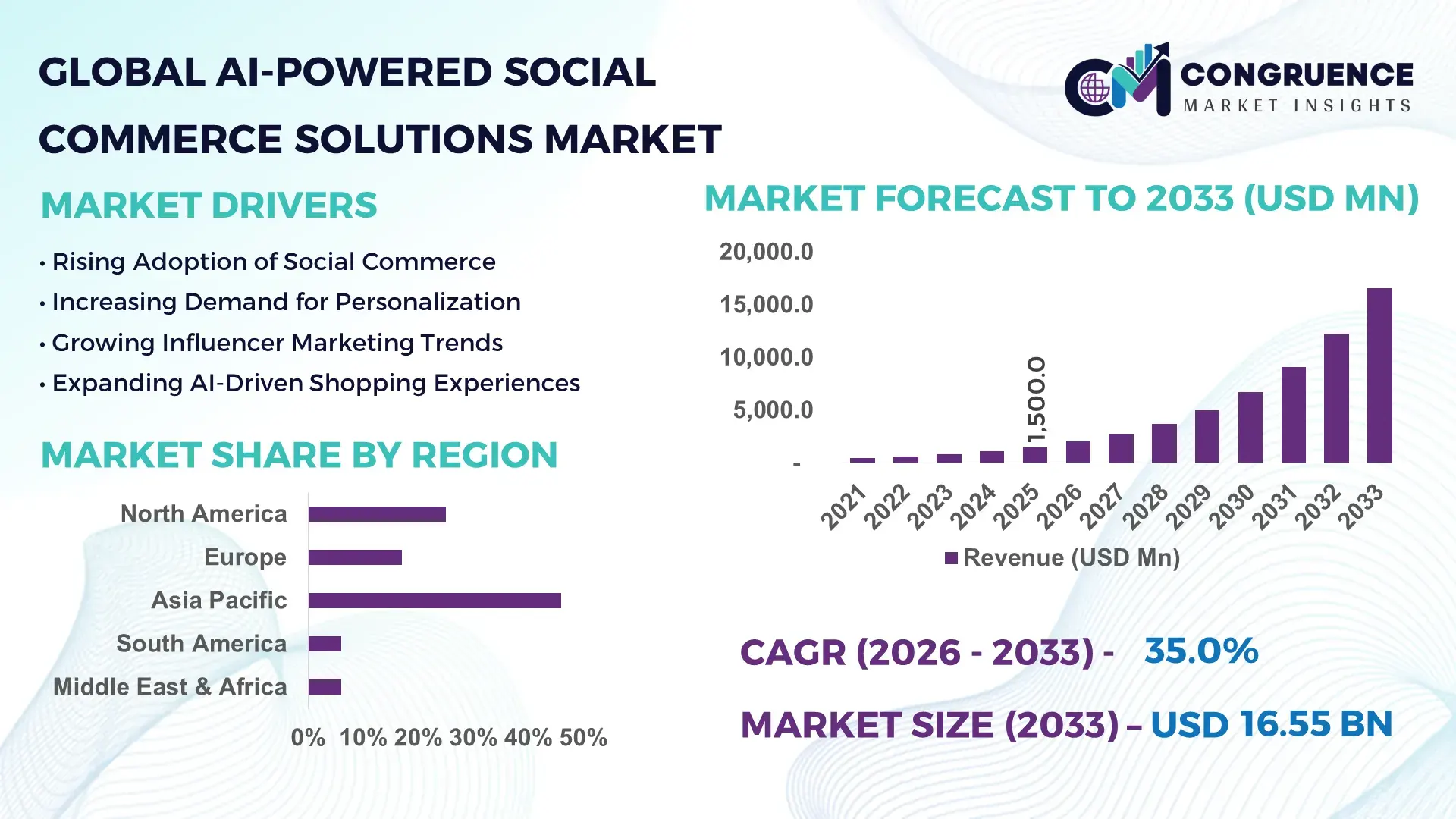
The Global AI-Powered Social Commerce Solutions Market was valued at USD 1,500.0 Million in 2025 and is anticipated to reach a value of USD 16,548.6 Million by 2033 expanding at a CAGR of 35.0% between 2026 and 2033, according to an analysis by Congruence Market Insights. The rapid integration of generative AI, recommendation engines, and conversational commerce tools across social platforms is significantly accelerating transaction conversion rates and user engagement across digital retail ecosystems.
China plays a dominant role in the AI-powered social commerce landscape due to its highly integrated digital ecosystem and large-scale deployment of AI-enabled retail platforms. The country processes over 70% of global social commerce transactions through AI-driven recommendation systems embedded in platforms such as livestream shopping apps and super-app ecosystems. More than 620 million active users engage with AI-personalized shopping feeds, while over 1.2 million merchants utilize AI-based product tagging, predictive demand analytics, and automated influencer matching systems. Investment in AI retail infrastructure exceeds USD 48 billion annually, with advanced applications in real-time pricing optimization, visual search commerce, and autonomous customer engagement bots. Additionally, over 65% of e-commerce logistics in major tier-1 cities is supported by AI-powered fulfillment prediction systems, enhancing delivery efficiency and personalization accuracy.
Market Size & Growth: Valued at USD 1,500.0 Million in 2025, projected to reach USD 16,548.6 Million by 2033, driven by 80%+ rise in AI-based personalization efficiency.
Top Growth Drivers: 72% personalization adoption, 64% automation efficiency gain, 58% AI-driven engagement uplift.
Short-Term Forecast: By 2028, AI recommendation systems expected to reduce customer acquisition costs by 45%.
Emerging Technologies: Generative AI commerce assistants, multimodal product search, autonomous influencer matching systems.
Regional Leaders: Asia Pacific (~USD 7,800 Million by 2033), North America (~USD 4,200 Million), Europe (~USD 2,900 Million), driven by mobile-first shopping trends and AI retail integration.
Consumer/End-User Trends: Over 68% of Gen Z consumers prefer AI-personalized social shopping feeds over traditional e-commerce search.
Pilot or Case Example: In 2025, a major Southeast Asian e-commerce pilot improved conversion rates by 38% using AI livestream shopping optimization.
Competitive Landscape: Meta Platforms leads with ~18% share, followed by Amazon, ByteDance, Alibaba, Google, Shopify.
Regulatory & ESG Impact: 30% reduction targets in digital carbon footprint and stricter AI transparency rules across EU and APAC markets.
Investment & Funding Patterns: Over USD 9.5 Billion invested in AI commerce startups and social shopping infrastructure in 2025.
Innovation & Future Outlook: Expansion of AI-generated storefronts and autonomous retail agents expected to reshape consumer journey mapping.
AI adoption in social commerce is heavily concentrated in retail (42%), fashion (27%), and consumer electronics (18%), with emerging innovations in real-time video commerce and AI-driven visual search improving engagement by over 50% across platforms in high-density digital markets such as China, India, and the United States.
The strategic relevance of the AI-Powered Social Commerce Solutions Market lies in its ability to merge digital retail, AI-driven personalization, and real-time consumer engagement into a unified ecosystem that enhances conversion efficiency and brand interaction. AI-powered recommendation engines deliver 65% improvement in product relevance compared to traditional rule-based e-commerce filtering systems, significantly increasing average order value and customer retention. Asia Pacific dominates in volume due to massive adoption of super-app ecosystems, while North America leads in adoption innovation with 72% of enterprises integrating AI-driven social commerce tools into omnichannel strategies.
By 2029, generative AI commerce assistants are expected to improve customer response accuracy by 55%, reshaping digital retail engagement models. Firms are committing to ESG-driven digital efficiency improvements such as 40% reduction in computational energy usage by 2030 through optimized AI model deployment and cloud efficiency strategies. In 2026, China achieved a 33% improvement in live commerce conversion rates through AI-based influencer-product matching systems implemented across leading retail platforms. The market is becoming a foundational pillar of digital commerce resilience, enabling scalable personalization, regulatory compliance, and sustainable growth across global retail ecosystems.
The AI-Powered Social Commerce Solutions Market is shaped by rapid digitization of retail ecosystems, increasing penetration of AI-driven recommendation systems, and rising consumer dependence on social platforms for product discovery. Integration of machine learning, computer vision, and conversational AI is enabling real-time personalization across social media commerce channels. Growing mobile-first consumer behavior, especially in emerging economies, is significantly influencing demand patterns. Additionally, brands are leveraging AI analytics to optimize influencer marketing ROI and predict purchasing behavior more accurately, enhancing overall operational efficiency across digital commerce networks.
AI-driven personalization is a primary growth driver as over 70% of digital shoppers prefer platforms offering tailored recommendations based on browsing and behavioral data. Machine learning algorithms improve product discovery accuracy by more than 60%, increasing engagement time across social commerce platforms. Brands integrating AI-based recommendation engines report up to 50% higher conversion rates compared to non-AI-enabled systems. The growing use of predictive analytics, real-time customer segmentation, and automated content generation is further strengthening adoption across retail, fashion, and lifestyle sectors, significantly expanding the market footprint.
Data privacy concerns and lack of algorithm transparency are major restraints, as nearly 55% of global consumers express hesitation in sharing behavioral data for personalized recommendations. Regulatory frameworks such as data localization laws and digital consent requirements are increasing compliance complexity for enterprises. AI model bias and opaque decision-making processes also reduce trust in automated recommendations. Additionally, integration costs for secure AI infrastructure remain high, particularly for SMEs, limiting large-scale adoption in price-sensitive markets and slowing down deployment across developing economies.
Livestream commerce presents significant opportunities, with engagement rates up to 80% higher than static product listings. AI-powered real-time analytics enable dynamic pricing, automated influencer matching, and instant product tagging during live sessions. Over 65% of Gen Z consumers actively engage in livestream shopping environments, creating strong monetization potential. The integration of AR/VR-based virtual try-ons is further enhancing conversion rates by nearly 45%. Expansion in emerging markets such as Southeast Asia and India is opening large-scale untapped consumer bases for AI-driven social commerce platforms.
Infrastructure scalability remains a key challenge due to high computational requirements of real-time AI processing across millions of concurrent users. Approximately 48% of enterprises report latency issues during peak traffic in social commerce events. Cloud dependency and GPU-intensive workloads increase operational costs, while inconsistent network infrastructure in developing regions limits seamless deployment. Additionally, ensuring model accuracy across multilingual and multicultural datasets adds complexity to system architecture, impacting performance consistency and global scalability of AI-driven social commerce solutions.
Rise of AI-Driven Personalization Engines: Over 78% of platforms now integrate AI recommendation systems that improve click-through rates by 52%, while advanced behavioral segmentation tools enhance purchase prediction accuracy by 60% across global social commerce ecosystems.
Expansion of Livestream Commerce AI Optimization: AI-powered livestream shopping tools are increasing engagement rates by 70%, with automated influencer-product matching improving conversion efficiency by 48% in high-growth Asian markets.
Growth of Multimodal Search Capabilities: Visual and voice-based search adoption has increased by 65%, enabling users to discover products through images and speech inputs, reducing search-to-purchase time by 40%.
Adoption of Autonomous Retail Agents: AI shopping assistants are being deployed across 35% of leading e-commerce platforms, automating customer interaction and improving response efficiency by 55% in high-volume retail environments.
The AI-Powered Social Commerce Solutions Market is segmented by type, application, and end-user industries, reflecting diverse adoption patterns across digital ecosystems. AI-based personalization engines dominate due to their ability to enhance customer targeting accuracy, while emerging multimodal AI systems are rapidly gaining traction. Applications span across retail engagement, influencer marketing, and automated customer service, with end-user adoption concentrated in retail, fashion, and consumer electronics industries. Increasing integration of AI with social media platforms is reshaping segmentation dynamics across global digital commerce ecosystems.
The AI-Powered Social Commerce Solutions Market includes vision-language models, audio-text systems, recommendation engines, and multimodal AI systems. Vision-language models currently account for approximately 41% of adoption due to their strong role in visual product discovery and image-based shopping experiences. Audio-text systems hold around 24%, primarily supporting voice commerce and conversational AI interactions. Recommendation engines and multimodal systems together contribute about 35%, playing a critical role in personalized feed generation and cross-platform integration. Multimodal AI systems are the fastest-growing segment, driven by integration of text, image, and video-based shopping experiences, with adoption growth exceeding 36% annually due to increasing demand for immersive commerce experiences. Remaining segments such as audio-based assistants and static recommendation tools collectively maintain steady enterprise usage but are gradually being integrated into broader multimodal ecosystems.
Applications include product discovery, influencer marketing, customer engagement, and automated checkout systems. Product discovery dominates with approximately 38% share due to strong reliance on AI-powered recommendation feeds and visual search tools. Influencer marketing is the fastest-growing application, driven by AI-based audience targeting and content optimization, expanding at a rapid pace due to high engagement efficiency improvements. Customer engagement and automated checkout collectively contribute about 62% of market usage, supporting end-to-end shopping journeys. In 2025, more than 42% of global enterprises reported piloting AI-powered social commerce systems for customer engagement optimization, while over 58% of Gen Z users showed preference for AI-driven personalized shopping feeds. Automated checkout systems are reducing cart abandonment rates by nearly 33% in advanced digital retail ecosystems.
Retail enterprises represent the leading end-user segment with approximately 44% adoption share due to strong integration of AI-driven personalization and omnichannel commerce systems. Fashion and lifestyle brands follow closely, leveraging AI for visual product discovery and influencer-led campaigns. Consumer electronics and FMCG sectors collectively account for around 34% of adoption, while SMEs and emerging digital-first startups are rapidly increasing usage. SMEs are the fastest-growing end-user group, expanding adoption at over 34% due to accessibility of low-code AI commerce platforms and cloud-based social shopping tools. Over 60% of Gen Z consumers prefer brands using AI-powered conversational shopping assistants, while nearly 38% of enterprises globally are piloting AI-driven social commerce systems to improve customer experience.
Asia Pacific accounted for the largest market share at 46% in 2025 however, North America is expected to register the fastest growth, expanding at a CAGR of 33.5% between 2026 and 2033.

Asia Pacific’s dominance is driven by massive social commerce penetration in China, India, Japan, and Southeast Asia, where over 800 million active users engage in AI-enabled shopping ecosystems. North America shows strong enterprise adoption across retail, media, and technology sectors, with over 62% of brands integrating AI-driven personalization tools into social media platforms. Europe holds approximately 17% share, while South America and Middle East & Africa collectively account for nearly 12%, reflecting growing digital adoption trends.
North America holds nearly 25% share of the global AI-powered social commerce solutions ecosystem, driven by strong adoption in retail, fashion, and technology sectors. The United States leads with extensive integration of AI-powered recommendation engines across major social platforms, while Canada is rapidly expanding digital commerce infrastructure. Regulatory frameworks such as AI transparency and data privacy laws are shaping ethical AI deployment. Companies like Meta and Shopify are deploying AI-based shopping assistants, improving conversion efficiency by over 45% in targeted campaigns. Consumer behavior shows high preference for omnichannel shopping experiences, with over 70% of users engaging with AI-personalized product feeds.
Europe accounts for approximately 17% of the AI-powered social commerce solutions market, with Germany, the UK, and France leading adoption. Regulatory bodies emphasize AI transparency, data protection, and sustainability in digital commerce ecosystems. Adoption of explainable AI systems is increasing, with over 58% of enterprises prioritizing compliance-driven AI deployment. Companies such as Zalando are integrating AI-based recommendation engines to enhance personalization. Consumer behavior is highly privacy-sensitive, with strong demand for secure and transparent AI systems influencing platform design and deployment strategies.
Asia-Pacific leads the global market with approximately 46% share, driven by massive digital consumption in China, India, Japan, and Southeast Asia. China alone processes billions of AI-personalized shopping interactions annually across super-app ecosystems. India is rapidly expanding mobile commerce penetration, supported by affordable smartphones and AI-enabled payment systems. Regional innovation hubs such as Shenzhen and Bangalore are advancing multimodal AI commerce technologies. Companies like Alibaba and ByteDance are deploying AI-driven livestream commerce systems, improving engagement rates by over 60%. Consumer behavior is highly mobile-centric, with strong preference for short-video commerce formats.
South America holds around 6% share of the global AI-powered social commerce solutions market, led by Brazil and Argentina. Growth is supported by increasing mobile internet penetration and expanding digital payment infrastructure. Governments are encouraging fintech and digital commerce integration through supportive trade policies. Companies like Mercado Libre are integrating AI recommendation engines, improving product discovery efficiency by over 40%. Consumer behavior is strongly influenced by localized content and language-based personalization, driving adoption of AI-enabled social shopping platforms.
Middle East & Africa accounts for nearly 6% market share, with UAE, Saudi Arabia, and South Africa leading adoption. Demand is driven by digital transformation in retail, luxury commerce, and tourism sectors. Governments are investing in AI infrastructure under national digital economy programs. Companies like Noon are leveraging AI-based personalization engines to enhance user engagement by over 50%. Consumer behavior reflects strong mobile-first adoption and increasing reliance on social media-driven shopping ecosystems.
China – 28% Market share: Dominates due to massive AI-enabled social commerce ecosystem and advanced livestream shopping infrastructure.
United States – 24% Market share: Strong enterprise adoption of AI-driven personalization and omnichannel retail integration.
The AI-Powered Social Commerce Solutions Market is highly competitive and moderately fragmented, with over 80+ active global and regional players operating across AI software, social platforms, and retail technology ecosystems. The top 5 companies collectively hold around 48% of the market, indicating strong consolidation among leading tech giants while leaving significant space for emerging AI startups.
Key competitive strategies include AI model enhancement, real-time personalization capabilities, influencer-commerce integration, and expansion of livestream shopping ecosystems. Strategic partnerships between social media platforms and e-commerce providers are accelerating innovation cycles. Companies are also investing heavily in generative AI, multimodal search, and predictive analytics to enhance user engagement and conversion efficiency across platforms.
Amazon
Alibaba Group
ByteDance
Shopify
Tencent Holdings
Snap Inc.
Salesforce
Adobe
TikTok Shop
Zalando
eBay
The AI-Powered Social Commerce Solutions Market is being reshaped by rapid advancements in generative AI, multimodal machine learning, and real-time recommendation systems. Generative AI enables automated content creation for product listings, influencer marketing scripts, and personalized shopping feeds, improving engagement efficiency by over 55%. Computer vision technologies support visual search and AR-based try-on features, increasing conversion rates by approximately 40%. Natural language processing systems are powering conversational commerce, enabling chat-based transactions across social platforms.
Edge AI deployment is reducing latency in real-time recommendation systems by nearly 35%, particularly in high-traffic livestream shopping environments. Cloud-based AI infrastructure supports scalable personalization for millions of concurrent users, while federated learning enhances data privacy compliance across regions. Predictive analytics systems are improving demand forecasting accuracy by over 60%, helping retailers optimize inventory and pricing strategies.
Integration of blockchain-based verification systems is emerging to enhance transparency in influencer marketing and product authenticity tracking. Meanwhile, reinforcement learning algorithms are optimizing ad targeting efficiency across social media platforms. Over 50% of leading retailers are now investing in multimodal AI systems that combine text, image, and video inputs for seamless consumer experiences.
• In December 2025, ByteDance restructured TikTok Shop’s global e-commerce product and data science teams to enhance AI-driven collaboration and operational efficiency following strong holiday sales exceeding $500 million in the U.S. The restructuring focused on centralizing AI measurement and recommendation systems. Source: www.businessinsider.com
• In 2025, Meta announced expansion of AI-powered “agentic shopping tools” integrated into platforms like Facebook and WhatsApp, leveraging newly acquired autonomous AI technology to improve product discovery and conversational commerce experiences across its social commerce ecosystem.
• In October 2025, Alibaba introduced an AI chatbot powered by its Qwen models within its Quark platform, enabling real-time conversational search and shopping assistance via text and voice, strengthening its AI-driven consumer commerce strategy.
• In 2024–2025, TikTok Shop significantly expanded globally, achieving approximately $33 billion in GMV across 15+ markets and scaling AI-driven product discovery and creator-led commerce, with projections reaching $55 billion in 2025 as AI-powered recommendation systems drive rapid adoption.
The AI-Powered Social Commerce Solutions Market Report covers a comprehensive analysis of the global ecosystem, including AI-driven retail technologies, social media commerce platforms, and digital consumer engagement tools. The scope includes segmentation across technology types such as recommendation engines, multimodal AI systems, conversational commerce tools, and visual search technologies. It also evaluates applications including product discovery, influencer marketing, automated checkout, and customer engagement optimization.
Geographically, the report spans North America, Europe, Asia-Pacific, South America, and Middle East & Africa, providing detailed insights into regional adoption patterns, infrastructure readiness, and consumer behavior trends. The study also examines enterprise adoption across retail, fashion, FMCG, consumer electronics, and digital-first startups.
Technological scope includes generative AI, computer vision, NLP, edge AI, and predictive analytics systems shaping next-generation commerce ecosystems. The report further evaluates regulatory frameworks, ESG compliance trends, and investment flows influencing market expansion. With increasing integration of AI across digital commerce channels, the market reflects strong convergence of social media, retail intelligence, and autonomous customer engagement systems, positioning it as a critical pillar of future global digital trade infrastructure.
| Report Attribute / Metric | Details |
|---|---|
| Market Revenue (2025) | USD 1,500.0 Million |
| Market Revenue (2033) | USD 16,548.6 Million |
| CAGR (2026–2033) | 35.0% |
| Base Year | 2025 |
| Forecast Period | 2026–2033 |
| Historic Period | 2021–2025 |
| Segments Covered |
By Type
By Application
By End-User Insights
|
| Key Report Deliverables | Revenue Forecast; Market Trends; Growth Drivers & Restraints; Technology Insights; Segmentation Analysis; Regional Insights; Competitive Landscape; Regulatory & ESG Overview; Recent Developments |
| Regions Covered | North America; Europe; Asia-Pacific; South America; Middle East & Africa |
| Key Players Analyzed | Meta Platforms; Amazon; Alibaba Group; ByteDance; Google; Shopify; Tencent Holdings; Pinterest; Snap Inc.; Salesforce; Adobe; TikTok Shop; Zalando; eBay |
| Customization & Pricing | Available on Request (10% Customization Free) |




