
Reports
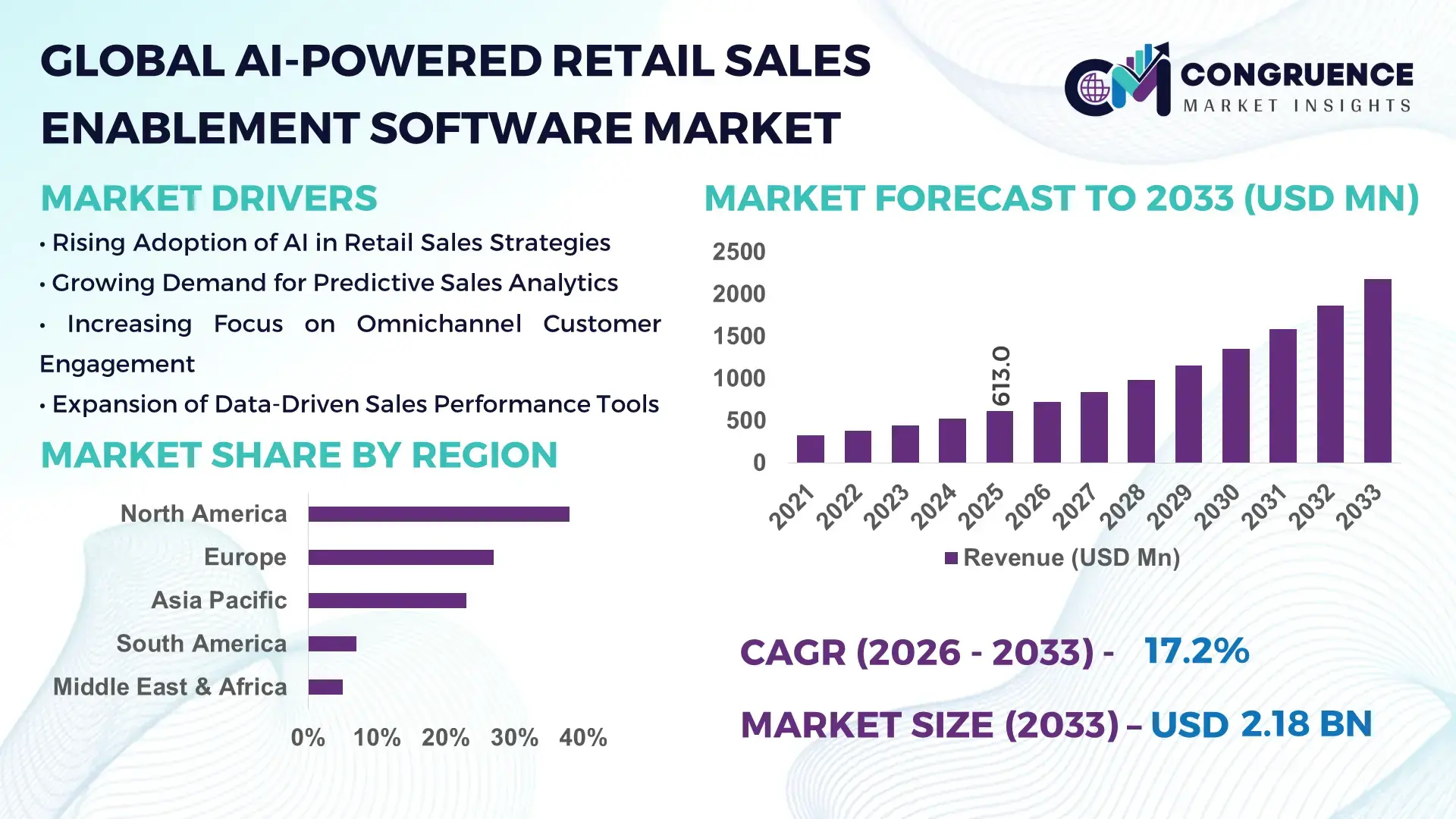
The Global AI-Powered Retail Sales Enablement Software Market was valued at USD 613.0 Million in 2025 and is anticipated to reach a value of USD 2,182.1 Million by 2033 expanding at a CAGR of 17.20% between 2026 and 2033, according to an analysis by Congruence Market Insights. The growth is primarily driven by accelerating AI adoption across omnichannel retail networks to enhance sales productivity, personalization accuracy, and real-time customer engagement analytics.
The United States leads the AI-Powered Retail Sales Enablement Software Market with over 48% of large retail enterprises deploying AI-driven CRM and sales enablement platforms integrated with predictive analytics. More than 72% of U.S. Tier-1 retailers utilize AI-based recommendation engines and automated content enablement tools across digital and in-store channels. Annual enterprise AI investment in retail technology exceeds USD 20 billion, with significant allocation toward sales automation, conversational AI, and performance intelligence dashboards. Cloud-native deployments account for nearly 68% of implementations, while over 60% of retailers integrate AI enablement tools with ERP and supply chain systems to optimize inventory-linked selling strategies.
Market Size & Growth: USD 613.0 Million (2025) projected to reach USD 2,182.1 Million by 2033 at 17.20% CAGR, driven by AI-led personalization and omnichannel sales acceleration.
Top Growth Drivers: 64% AI adoption in retail enterprises; 35% improvement in sales productivity; 28% increase in conversion rates.
Short-Term Forecast: By 2028, AI-enabled automation is expected to reduce sales cycle time by 30% and improve lead qualification accuracy by 40%.
Emerging Technologies: Generative AI content assistants, predictive sales analytics engines, and conversational AI copilots for retail associates.
Regional Leaders: North America projected USD 890 Million by 2033 with high SaaS penetration; Europe USD 620 Million driven by compliance-focused AI tools; Asia-Pacific USD 540 Million supported by mobile-first retail ecosystems.
Consumer/End-User Trends: Large retailers account for 58% adoption; mid-sized enterprises accelerating SaaS uptake with 45% cloud-first deployments.
Pilot or Case Example: In 2024, a U.S. omnichannel retailer improved upsell rates by 22% and reduced onboarding time by 35% through AI sales coaching tools.
Competitive Landscape: Market leader holds ~18% share, followed by Salesforce, Microsoft, SAP, Oracle, and Seismic.
Regulatory & ESG Impact: 52% of retailers align AI deployment with data privacy frameworks and ESG reporting standards.
Investment & Funding Patterns: Over USD 3.5 Billion invested globally in AI retail SaaS platforms since 2022, with rising venture-backed automation startups.
Innovation & Future Outlook: Integration of AI copilots with real-time POS data and AR-assisted selling tools is reshaping digital retail engagement.
Retail accounts for nearly 46% of overall deployment within this segment, followed by consumer electronics (18%) and apparel (15%). Cloud-based AI platforms represent over 70% of new installations. Recent innovations include multilingual generative sales assistants and real-time behavioral analytics engines. Data localization laws in Europe and AI governance mandates in North America are shaping compliance strategies. Asia-Pacific demonstrates the fastest enterprise onboarding rates, supported by mobile commerce expansion and digital payment penetration above 75% in key economies.
The AI-Powered Retail Sales Enablement Software Market has emerged as a strategic pillar in modern retail transformation, directly influencing revenue productivity, workforce optimization, and customer lifetime value enhancement. AI-driven predictive selling tools now deliver 35% higher lead-to-conversion efficiency compared to traditional rule-based CRM systems. Generative AI copilots deliver 28% faster content creation compared to manual sales enablement processes, significantly reducing go-to-market timelines.
North America dominates in deployment volume, while Asia-Pacific leads in adoption intensity with over 62% of digitally mature enterprises integrating AI into frontline sales operations. By 2028, predictive analytics and automated sales coaching are expected to improve retail sales team performance metrics by 30% and reduce customer acquisition costs by 18%. Retailers are increasingly aligning AI systems with ESG commitments, targeting 25% reduction in paper-based sales collateral and 20% lower operational energy usage through cloud optimization by 2030.
In 2024, a major U.S.-based retail chain achieved a 24% improvement in cross-selling performance through AI-driven recommendation engines integrated with real-time inventory analytics. Strategic pathways now emphasize API-based ecosystem integration, vertical-specific AI modeling, and responsible AI governance frameworks. As retailers transition toward hyper-personalized commerce, the AI-Powered Retail Sales Enablement Software Market is positioned as a core enabler of operational resilience, regulatory compliance, and sustainable digital growth.
The AI-Powered Retail Sales Enablement Software Market is characterized by rapid digitization of retail ecosystems, rising SaaS penetration, and increasing demand for performance intelligence tools. Over 65% of enterprise retailers are prioritizing AI-enabled workflow automation to streamline sales training, onboarding, and customer interaction tracking. Integration with CRM, ERP, and POS systems has become a standard deployment requirement, with nearly 60% of solutions offering API-driven interoperability. Data-driven personalization, omnichannel engagement analytics, and AI-powered forecasting tools are reshaping competitive differentiation strategies. Simultaneously, stricter data privacy regulations and rising cybersecurity investments are influencing procurement decisions. The market continues to evolve toward cloud-native, subscription-based, and modular software architectures designed for scalability and cross-platform retail integration.
AI-powered personalization engines enhance customer targeting precision by analyzing over 150 behavioral variables in real time. Retailers deploying AI-driven recommendation systems report up to 28% higher conversion rates and 22% improvement in average order value. Approximately 64% of omnichannel retailers have implemented predictive lead scoring models to optimize engagement strategies. Automated content generation tools reduce sales preparation time by nearly 35%, enabling frontline staff to focus on revenue-generating activities. Enhanced analytics dashboards provide real-time KPI tracking, improving decision-making speed by 40%. These measurable performance gains continue to accelerate enterprise-level adoption across competitive retail landscapes.
Over 58% of global retailers cite compliance with evolving data protection frameworks as a key deployment challenge. AI-driven sales enablement platforms process large volumes of customer behavioral data, requiring adherence to strict consent management and localization policies. Integration with legacy ERP and CRM systems increases implementation timelines by 25% on average. Additionally, cybersecurity spending in retail has risen by 32% to safeguard AI-enabled infrastructures. Limited AI-skilled workforce availability—reported by 41% of enterprises—further delays large-scale adoption. These operational and regulatory complexities create barriers, particularly for mid-sized retailers with constrained IT budgets.
Global omnichannel retail sales now account for over 44% of total retail transactions, creating strong demand for unified AI sales platforms. More than 70% of digital-first retailers seek real-time cross-channel engagement analytics to align online and in-store performance. AI-enabled chatbots and virtual assistants are improving customer response times by 45%, while predictive restocking tools enhance upselling efficiency by 20%. Emerging markets in Asia-Pacific report mobile commerce penetration above 75%, offering scalable SaaS expansion opportunities. Additionally, generative AI-powered sales training simulations reduce onboarding costs by 30%, unlocking productivity gains for rapidly expanding retail networks.
Enterprise-grade AI deployments require substantial infrastructure upgrades, with initial implementation costs increasing IT budgets by up to 18%. Model bias risks in recommendation engines can lead to inaccurate targeting, affecting customer trust and retention. Approximately 37% of retailers report difficulties in maintaining data accuracy across fragmented channels. Continuous AI model retraining and monitoring demand specialized expertise, raising operational overhead. Furthermore, 48% of enterprises highlight uncertainty around AI governance standards, complicating risk management strategies. These challenges necessitate robust validation frameworks and responsible AI practices to ensure sustainable deployment.
Rapid Adoption of Generative AI Sales Assistants (62% Enterprise Uptake): More than 62% of large retail enterprises have deployed generative AI copilots to automate proposal generation, customer communication drafts, and personalized product descriptions. Retailers report 30% faster campaign execution cycles and 26% improvement in content accuracy. AI-driven multilingual support tools now cover over 40 languages, expanding global retail engagement capabilities.
Predictive Analytics Integration with POS Systems (40% Efficiency Gain): Nearly 57% of retailers have integrated predictive analytics engines directly with POS data streams, enabling real-time upsell prompts. This integration improves inventory-linked selling efficiency by 40% and reduces stock-out incidents by 18%. Retailers leveraging predictive dashboards report 33% faster sales forecasting turnaround times.
Cloud-Native SaaS Expansion (70% of New Deployments): Cloud-based AI enablement platforms account for over 70% of new implementations, reducing infrastructure overhead by 25%. Subscription-based pricing models improve cost flexibility for mid-sized enterprises, driving 38% higher adoption among regional retail chains. API-first architectures enable 50% faster third-party integration.
AI-Driven Sales Performance Analytics (35% Productivity Boost): Advanced AI coaching tools analyze more than 200 sales interaction metrics, delivering 35% improvement in representative productivity. Real-time KPI tracking dashboards reduce performance review cycles by 20%. Retailers deploying automated sales training simulations report 32% shorter onboarding periods and measurable gains in frontline engagement consistency.
The AI-Powered Retail Sales Enablement Software Market is segmented by type, application, and end-user, reflecting the diverse deployment requirements across modern retail ecosystems. Type-based segmentation highlights differences in deployment architecture, AI capability depth, and integration flexibility. Cloud-native platforms account for over 70% of new enterprise implementations, while hybrid and on-premise models remain relevant in regulated or legacy-heavy environments. Application segmentation reveals that sales content management and predictive analytics collectively represent more than 50% of enterprise use cases, driven by demand for personalization and measurable sales productivity gains. End-user segmentation demonstrates strong concentration among large retail enterprises, though mid-sized retailers are accelerating adoption due to SaaS accessibility and subscription-based pricing. Across segments, interoperability with CRM, ERP, and POS systems remains a decisive procurement criterion, with nearly 60% of buyers prioritizing API-first architectures. The segmentation landscape underscores a clear shift toward modular, scalable, and AI-enhanced platforms aligned with omnichannel retail transformation.
The market by type includes Cloud-Based Platforms, On-Premise Solutions, and Hybrid Deployment Models. Cloud-based platforms lead with approximately 68% share of total deployments due to scalability, lower infrastructure dependency, and faster update cycles. In comparison, on-premise systems hold nearly 22%, primarily among retailers operating under strict data localization mandates. Hybrid models account for the remaining 10%, offering controlled integration with legacy ERP and CRM systems. While cloud platforms dominate adoption, hybrid deployment is expanding at the fastest pace, projected to grow at an estimated 19.5% CAGR, driven by enterprises seeking data control alongside AI-powered flexibility. Retailers with multi-country operations increasingly prefer hybrid environments to balance regulatory compliance with centralized analytics. On-premise systems remain relevant for highly regulated retail segments, particularly in regions with stringent data sovereignty frameworks. Collectively, on-premise and hybrid deployments contribute 32% of total installations, highlighting continued demand for controlled infrastructure environments.
In 2025, a U.S. federal digital modernization update noted that over 65% of enterprise retail software procurements favored cloud-native AI platforms to accelerate cross-channel analytics integration, reflecting a systemic shift toward SaaS-based deployment models.
Key application areas include Sales Content Management, Predictive Sales Analytics, AI-Driven Sales Coaching, Omnichannel Engagement Optimization, and Performance Intelligence Dashboards. Sales content management leads with 34% share, as retailers prioritize automated proposal generation, dynamic catalog updates, and multilingual AI-driven content creation. Predictive sales analytics follows at 27%, leveraging machine learning models to improve conversion forecasting and upselling strategies. AI-driven sales coaching is the fastest-growing application, expanding at an estimated 20.3% CAGR due to increasing demand for performance monitoring and automated training simulations. Retailers deploying AI coaching tools report up to 35% productivity gains among frontline sales teams. Omnichannel engagement optimization and performance dashboards collectively represent 39% of application deployment, focusing on real-time KPI visibility and integrated POS analytics. In 2025, over 44% of global retailers reported piloting AI-enabled predictive selling modules across digital commerce platforms. Additionally, 61% of digitally active consumers indicate higher purchase likelihood when AI-driven personalized recommendations are presented in real time.
In 2024, a U.S. Department of Commerce retail digitalization brief indicated that AI-powered personalization engines were integrated across more than 150 large retail networks, enhancing targeted promotion accuracy and improving customer interaction metrics nationwide.
End-user segmentation includes Large Retail Enterprises, Mid-Sized Retailers, E-commerce-Only Retailers, and Specialty Retail Chains. Large retail enterprises lead with approximately 58% share due to higher digital transformation budgets and multi-channel operational complexity. Mid-sized retailers account for nearly 24%, benefiting from subscription-based SaaS accessibility and modular AI integration. E-commerce-only retailers represent 12%, while specialty retail chains contribute the remaining 6%. Mid-sized retailers are the fastest-growing segment, projected to expand at an estimated 21.1% CAGR as cloud deployment reduces entry barriers and AI-driven sales automation enhances competitiveness. Approximately 46% of mid-tier retail firms initiated AI-based sales enablement pilots in 2025 to improve customer analytics and sales forecasting. More than 60% of Gen Z consumers show higher trust in brands integrating AI-powered recommendation and chatbot systems. Additionally, 52% of enterprises globally report expanding AI deployment beyond marketing into full sales lifecycle management.
In 2025, an industry-wide enterprise technology adoption survey reported that AI integration among mid-sized retail businesses increased by 22% year-over-year, enabling hundreds of firms to optimize cross-channel sales operations and predictive inventory alignment.
North America accounted for the largest market share at 38% in 2025 however, Asia-Pacific is expected to register the fastest growth, expanding at a CAGR of 19.10% between 2026 and 2033.

North America’s dominance is supported by over 72% enterprise-level AI deployment across large retail chains and more than 65% SaaS penetration in sales enablement ecosystems. Europe follows with approximately 27% share, driven by compliance-focused AI adoption and multilingual retail networks spanning over 30 countries. Asia-Pacific holds nearly 23% share, supported by mobile commerce penetration exceeding 75% in key economies such as China and India. South America and the Middle East & Africa collectively account for 12%, reflecting rising digital transformation initiatives and increasing retail automation investments. Across regions, more than 60% of retail enterprises prioritize AI-enabled predictive analytics and automated content management as core strategic investments, while 48% integrate AI sales platforms directly with POS and supply chain systems to optimize cross-channel performance.
North America represents 38% of the global AI-Powered Retail Sales Enablement Software Market share, supported by mature digital infrastructure and strong enterprise AI investment. Over 70% of Tier-1 retailers in the U.S. and Canada have implemented predictive analytics and AI-driven sales coaching platforms. Key industries driving demand include omnichannel retail chains, consumer electronics, fashion apparel, and large supermarket conglomerates. Regulatory frameworks such as strengthened consumer data privacy compliance standards have pushed 58% of enterprises to deploy explainable AI modules within sales enablement systems. Technological transformation is marked by API-first cloud ecosystems, with 68% of deployments being cloud-native. A major local player, Salesforce, has expanded AI-powered retail CRM integrations, enabling real-time inventory-linked selling and automated customer engagement scoring across thousands of retail outlets. Regional consumer behavior shows higher personalization expectations, with 64% of shoppers responding positively to AI-based product recommendations and dynamic pricing insights.
Europe accounts for approximately 27% of the global AI-Powered Retail Sales Enablement Software Market share. Major markets include Germany, the United Kingdom, and France, collectively representing more than 60% of regional deployment volume. Regulatory oversight under strict data governance and AI transparency frameworks has driven adoption of explainable AI tools across 55% of enterprise retail networks. Sustainability initiatives across the European Union have encouraged cloud optimization and digital documentation, reducing paper-based sales processes by nearly 30%. Over 62% of retailers integrate AI-powered content management systems capable of supporting more than 20 languages to serve cross-border commerce. SAP, headquartered in Germany, has strengthened AI-enabled retail analytics suites tailored to compliance-driven environments. European consumers demonstrate heightened sensitivity to ethical AI practices, with 59% preferring brands that disclose automated personalization mechanisms.
Asia-Pacific holds nearly 23% of the global AI-Powered Retail Sales Enablement Software Market and ranks as the fastest-growing regional cluster. China, India, and Japan are the top consuming countries, contributing more than 75% of regional adoption volume. Mobile commerce penetration exceeds 75% in China and 68% in India, creating strong demand for AI-enabled omnichannel sales engagement platforms. Infrastructure expansion in cloud computing hubs across Singapore, India, and South Korea has increased enterprise AI hosting capacity by over 40% since 2022. Regional innovation hubs are accelerating generative AI development tailored to multilingual retail engagement. Alibaba Cloud has integrated AI-powered retail analytics into its ecosystem, supporting automated recommendation engines and smart merchandising tools across thousands of digital storefronts. Consumer behavior in this region strongly favors mobile AI applications, with 66% of online shoppers engaging with chatbot-assisted purchase journeys.
South America represents approximately 7% of the global AI-Powered Retail Sales Enablement Software Market share. Brazil and Argentina are the leading countries, accounting for over 70% of regional adoption. Expanding broadband infrastructure and 4G/5G connectivity have improved digital retail penetration by 35% over the past three years. Government-backed digital transformation incentives in Brazil have supported cloud adoption among mid-sized enterprises, increasing SaaS deployment rates to nearly 48%. Regional retail demand is heavily tied to localized content and language adaptation, with 58% of retailers investing in AI-powered multilingual sales enablement tools. TOTVS, a major regional enterprise software provider, has expanded AI-based retail analytics modules tailored to Portuguese- and Spanish-speaking markets. Consumer behavior reflects growing digital trust, with 52% of online shoppers engaging with AI-driven recommendation engines during purchase decisions.
Middle East & Africa accounts for nearly 5% of the global AI-Powered Retail Sales Enablement Software Market. The UAE and South Africa are key growth countries, together contributing more than 60% of regional implementation volume. Smart city initiatives and retail modernization programs have driven digital retail infrastructure upgrades, increasing AI software integration by 28% since 2023. Oil-rich Gulf economies are investing in diversified retail sectors, supporting AI-powered omnichannel platforms across luxury retail and large shopping complexes. Approximately 46% of enterprise retailers in the UAE are integrating AI-based predictive analytics with POS systems. Local technology firms in Dubai Internet City are developing AI-enabled multilingual sales engagement platforms optimized for Arabic and English markets. Consumer behavior in the region emphasizes mobile-first engagement, with over 60% of urban shoppers interacting with AI chat assistants before completing purchases.
United States – 34% Market Share: Strong enterprise AI investment exceeding USD 20 billion annually and widespread adoption across large omnichannel retail networks drive dominance.
China – 16% Market Share: High mobile commerce penetration above 75% and rapid integration of AI-powered recommendation engines across major e-commerce platforms position China as a leading country.
The AI-Powered Retail Sales Enablement Software Market is moderately fragmented, with more than 60 active global and regional vendors competing across cloud-native SaaS platforms, AI-driven analytics modules, and integrated CRM-based sales enablement suites. The top five companies collectively account for approximately 52% of total market share, reflecting a semi-consolidated structure dominated by enterprise software leaders with established retail ecosystems.
Competition is primarily driven by innovation intensity, ecosystem integration capabilities, and AI model sophistication. Over 70% of leading vendors have embedded generative AI copilots into their sales enablement workflows since 2024, enhancing automated content creation and predictive customer engagement. Strategic initiatives include more than 40 AI-focused product launches between 2024 and 2025, alongside increasing API-based partnerships with POS, ERP, and e-commerce platform providers.
Mergers and acquisitions activity remains strong, with over 15 AI analytics and sales automation startups acquired globally since 2023 to strengthen proprietary machine learning capabilities. Approximately 65% of competitive differentiation now centers on vertical-specific AI models tailored for fashion, consumer electronics, grocery, and specialty retail. Vendors are also expanding compliance-ready AI frameworks to address data governance mandates, with 58% integrating explainable AI features into enterprise deployments. The competitive environment increasingly favors scalable cloud infrastructure, modular architecture, and embedded real-time analytics engines capable of processing over 200 behavioral data variables per customer interaction.
Oracle
Seismic
Highspot
Showpad
HubSpot
Zoho Corporation
Adobe
IBM
Gong.io
Mindtickle
Mediafly
Allego
The AI-Powered Retail Sales Enablement Software Market is being shaped by rapid advancements in generative AI, predictive analytics, conversational AI, and cloud-native microservices architecture. Generative AI copilots now automate up to 60% of routine sales content creation tasks, including product descriptions, personalized email drafts, and promotional scripts. These systems process over 150 structured and unstructured customer data variables in real time to tailor recommendations and engagement strategies.
Predictive analytics engines utilize machine learning models trained on historical transaction datasets exceeding millions of retail interactions, enabling conversion rate improvements of up to 28% and reducing forecast error margins by 22%. Real-time AI dashboards integrate POS, CRM, and ERP systems through API frameworks, with 48% of enterprise retailers prioritizing cross-platform interoperability as a procurement requirement.
Conversational AI chatbots and voice-enabled assistants are now deployed in over 55% of omnichannel retail environments, reducing response time by nearly 45% and enhancing lead qualification accuracy by 30%. Cloud-native deployment dominates, accounting for over 70% of new installations, supported by containerized microservices that reduce integration timelines by 35%.
Emerging technologies include multimodal AI systems combining text, voice, and behavioral analytics, as well as edge AI integration for in-store sales analytics. Approximately 40% of leading vendors are investing in responsible AI toolkits, incorporating bias detection algorithms and transparency dashboards to meet regulatory expectations. Augmented reality-assisted selling tools are also gaining traction, improving customer engagement metrics by over 20% in pilot retail environments.
• In January 2025, Salesforce unveiled Agentforce for Retail and its new Retail Cloud with Modern POS, introducing AI-powered digital labor that automates tasks such as order management, guided shopping, loyalty promotions, and appointment scheduling, while unifying online and offline shopping data for personalized retail experiences. Source: www.salesforce.com
• In December 2025, Salesforce reported that AI and its Agentforce 360 platform influenced $67 billion of global retail sales during Cyber Week, powering 61 million orders and managing 76% more OMS (Order Management System) activity, highlighting the role of AI in scaling commerce operations. Source: www.salesforce.com
• In April 2025, HubSpot launched new and enhanced AI agents plus over 200 product updates at its Spring 2025 Spotlight, embedding AI throughout its platform to help SMBs accelerate sales and go-to-market execution with smarter automation and AI-driven workflows. Source: www.hubspot.com
• In January 2026, Highspot announced its Winter Product Launch ’26, introducing Deal Intelligence powered by Deal Agent — an agentic AI feature that analyzes CRM data, buyer engagement signals, and meeting insights in real time to recommend next-best actions and improve deal execution and velocity. Source: www.businesswire.com
The AI-Powered Retail Sales Enablement Software Market Report provides a comprehensive analysis of deployment models, application areas, end-user segments, and geographic coverage across North America, Europe, Asia-Pacific, South America, and the Middle East & Africa. The report evaluates cloud-based, hybrid, and on-premise deployment structures, highlighting that cloud-native solutions account for over 70% of new enterprise installations.
Application coverage spans sales content management, predictive sales analytics, AI-driven coaching tools, omnichannel engagement platforms, and real-time performance dashboards. The report assesses integration patterns across CRM, ERP, and POS systems, with nearly 60% of enterprise retailers prioritizing API-enabled interoperability. End-user analysis includes large retail enterprises (58% share), mid-sized retailers (24%), e-commerce-only platforms (12%), and specialty chains (6%), providing insights into adoption intensity and operational complexity.
Technology coverage extends to generative AI copilots, conversational AI chatbots, multimodal analytics engines, and augmented reality-assisted selling tools. The report also evaluates compliance-driven AI governance frameworks, noting that 52% of enterprises incorporate explainable AI modules into deployment strategies. Additionally, it explores emerging niche segments such as AI-powered virtual sales coaching simulations and edge-enabled in-store analytics platforms.
Geographically, the report analyzes over 20 key retail economies, including the United States, China, Germany, India, Brazil, and the UAE, offering region-specific deployment metrics, consumer adoption behavior, digital infrastructure maturity, and enterprise transformation benchmarks. This structured scope enables decision-makers to assess competitive positioning, technology investment priorities, regulatory alignment, and long-term digital retail transformation strategies within the AI-Powered Retail Sales Enablement Software Market.
| Report Attribute / Metric | Details |
|---|---|
| Market Revenue (2025) | USD 613.0 Million |
| Market Revenue (2033) | USD 2,182.1 Million |
| CAGR (2026–2033) | 17.20% |
| Base Year | 2025 |
| Forecast Period | 2026–2033 |
| Historic Period | 2021–2025 |
| Segments Covered |
By Type
By Application
By End-User Insights
|
| Key Report Deliverables | Revenue Forecast; Market Trends; Growth Drivers & Restraints; Technology Insights; Segmentation Analysis; Regional Insights; Competitive Landscape; Regulatory & ESG Overview; Recent Developments |
| Regions Covered | North America; Europe; Asia-Pacific; South America; Middle East & Africa |
| Key Players Analyzed | Salesforce; Microsoft; SAP; Oracle; Seismic; Highspot; Showpad; HubSpot; Zoho Corporation; Adobe; IBM; Gong.io; Mindtickle; Mediafly; Allego |
| Customization & Pricing | Available on Request (10% Customization Free) |




