
Reports
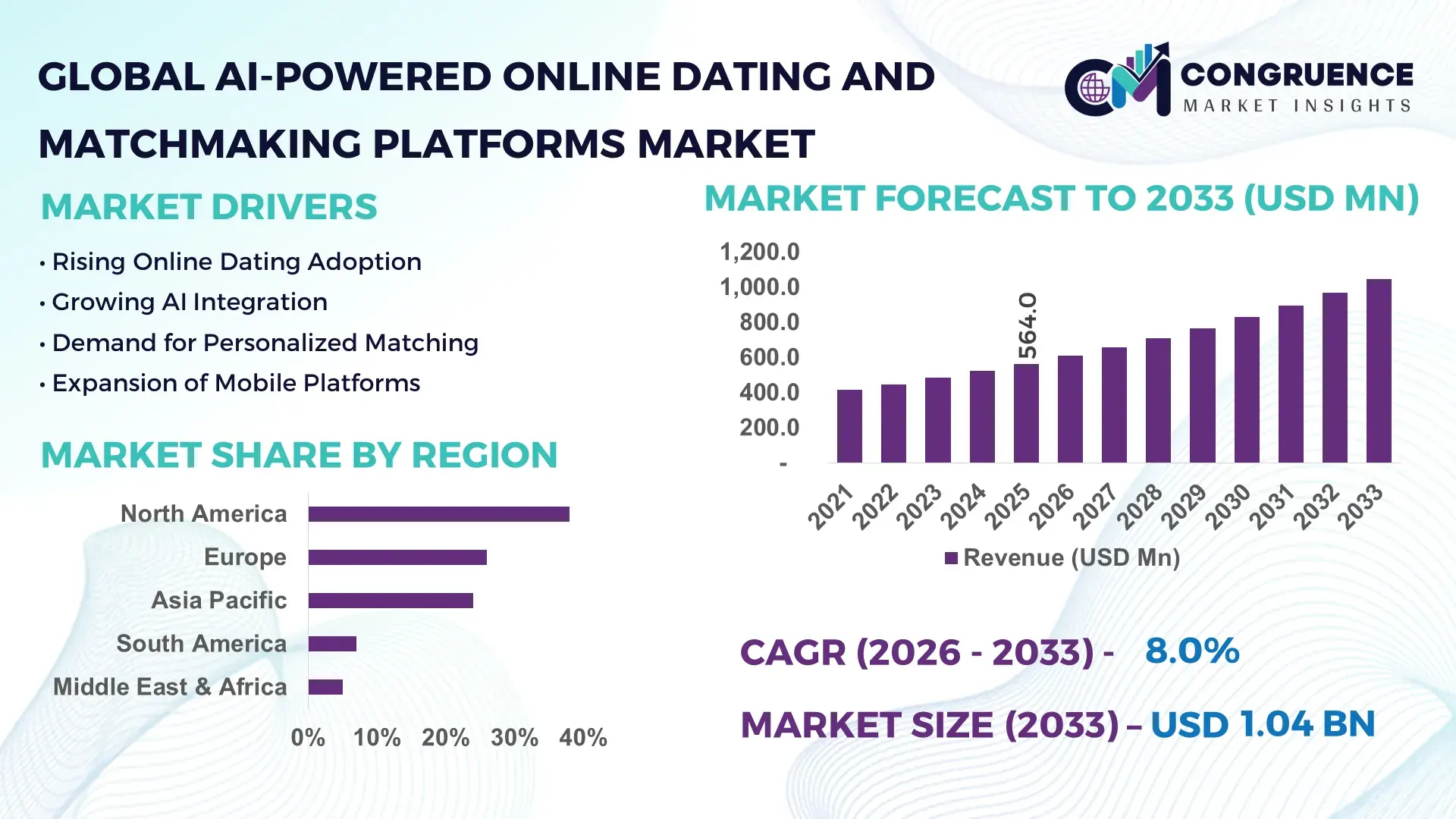
The Global AI-Powered Online Dating and Matchmaking Platforms Market was valued at USD 564.0 Million in 2025 and is anticipated to reach a value of USD 1,043.9 Million by 2033 expanding at a CAGR of 8% between 2026 and 2033, according to an analysis by Congruence Market Insights. The growth is primarily driven by increasing adoption of AI-driven compatibility algorithms and personalized matchmaking experiences.
The United States continues to demonstrate strong technological depth in the AI-powered online dating and matchmaking platforms market, supported by advanced AI infrastructure and high digital penetration. Over 65% of dating platforms operating in the U.S. utilize machine learning-based recommendation engines, while nearly 72% of users prefer AI-enabled matching features. The country also records over 45 million active users across major platforms, with AI-based chat assistants improving engagement rates by up to 35%. Investment in AI-driven social platforms exceeded USD 1.2 billion in 2025, while mobile-first usage accounts for more than 80% of total interactions, highlighting strong application-level scalability and continuous innovation in user experience design.
Market Size & Growth: Valued at USD 564.0 Million in 2025, projected to reach USD 1,043.9 Million by 2033, growing at 8% CAGR, driven by rising demand for AI-based compatibility scoring.
Top Growth Drivers: 72% AI feature adoption rate, 35% higher engagement through AI recommendations, 28% improvement in match success rates.
Short-Term Forecast: By 2028, AI automation is expected to improve user retention rates by 30% across major platforms.
Emerging Technologies: Generative AI chatbots, emotion recognition algorithms, and behavioral analytics engines.
Regional Leaders: North America projected at USD 420 Million by 2033 with high subscription penetration; Europe at USD 310 Million driven by privacy-focused AI; Asia-Pacific at USD 280 Million with rapid mobile adoption.
Consumer/End-User Trends: Over 68% of Gen Z users prefer AI-assisted matchmaking, with mobile-based swiping and real-time chat features dominating usage patterns.
Pilot or Case Example: In 2025, an AI-based matchmaking pilot improved compatibility accuracy by 32% and reduced churn by 18%.
Competitive Landscape: Market leader holds ~24% share, followed by key players such as Match Group, Bumble Inc., eHarmony, Grindr, and Coffee Meets Bagel.
Regulatory & ESG Impact: Data privacy regulations such as GDPR influence over 60% of platform compliance frameworks globally.
Investment & Funding Patterns: Over USD 2.5 billion invested in AI-driven social platforms between 2023–2025, with rising venture funding in niche matchmaking apps.
Innovation & Future Outlook: Integration of AR-based dating, predictive personality analytics, and real-time sentiment matching is shaping next-gen platforms.
AI-powered online dating and matchmaking platforms market is characterized by strong contributions from subscription-based services accounting for nearly 55% of platform revenues, followed by advertising-supported models at 30%. Technological innovations such as real-time behavioral analytics and AI-driven safety verification tools are enhancing user trust. Regulatory focus on data protection and identity verification is intensifying, while Asia-Pacific shows over 40% growth in new user adoption, positioning the market for sustained digital expansion.
The AI-Powered Online Dating and Matchmaking Platforms Market is strategically positioned at the intersection of artificial intelligence, digital socialization, and personalized consumer experiences. Organizations are increasingly leveraging advanced AI models to enhance matchmaking precision, reduce user churn, and improve engagement metrics. AI-driven recommendation engines deliver nearly 30% higher compatibility accuracy compared to traditional rule-based matching systems, making them a critical competitive differentiator in the market.
From a regional perspective, North America dominates in volume due to high user penetration and platform maturity, while Asia-Pacific leads in adoption with over 60% of new users preferring AI-enabled dating apps driven by mobile-first ecosystems. Companies are integrating generative AI and predictive analytics to optimize user journeys, with machine learning algorithms improving match success rates by up to 28% compared to earlier systems.
In the short term, by 2028, AI-powered behavioral analytics is expected to reduce user churn rates by approximately 25% while improving engagement duration by 20%. Additionally, firms are aligning with ESG and compliance requirements, committing to enhanced data security protocols, including up to 40% improvement in user data protection frameworks by 2030.
A micro-scenario in 2025 demonstrated that a leading U.S.-based platform achieved a 33% increase in successful matches by deploying AI-based personality mapping algorithms. These advancements highlight how the AI-Powered Online Dating and Matchmaking Platforms Market is evolving as a critical pillar of digital interaction, ensuring scalability, regulatory compliance, and sustainable growth in an increasingly competitive landscape.
The AI-Powered Online Dating and Matchmaking Platforms Market is experiencing dynamic evolution driven by rapid advancements in artificial intelligence, increasing smartphone penetration, and shifting consumer preferences toward digital socialization. The integration of machine learning algorithms, natural language processing, and predictive analytics is significantly enhancing matchmaking accuracy and user engagement. Over 70% of modern platforms now deploy AI-based recommendation systems to personalize user interactions and optimize compatibility scoring.
User behavior is also shifting toward mobile-first engagement, with over 80% of interactions occurring via mobile applications. Additionally, increasing concerns around safety and authenticity are prompting platforms to adopt AI-driven identity verification and fraud detection systems, improving trust metrics by up to 40%. The market is also influenced by regulatory frameworks governing data privacy, requiring continuous investment in compliance infrastructure.
Furthermore, the rise of niche dating platforms targeting specific demographics and interests is expanding the overall ecosystem. Integration of advanced features such as video-based matching and AI chat assistants is reshaping user expectations, while subscription-based monetization models continue to dominate. These factors collectively contribute to a competitive and innovation-driven market environment.
The growing demand for highly personalized matchmaking experiences is a key driver of the AI-Powered Online Dating and Matchmaking Platforms Market. AI algorithms analyze user behavior, preferences, communication patterns, and historical interactions to deliver tailored match recommendations. Studies indicate that AI-driven platforms can improve match relevance by over 30%, significantly enhancing user satisfaction. Additionally, nearly 68% of users report higher engagement levels when interacting with AI-based recommendation systems compared to traditional filtering methods. Personalization also contributes to increased subscription conversions, with platforms reporting up to 25% higher premium user adoption. The integration of behavioral analytics allows platforms to continuously refine user profiles, ensuring dynamic and adaptive matchmaking. Moreover, AI-powered chatbots and conversation starters are improving initial interaction success rates by approximately 20%, reducing barriers in user communication. These advancements are particularly significant among younger demographics, where over 70% of users prefer platforms offering intelligent matching capabilities. As personalization becomes a standard expectation, platforms investing in AI technologies are gaining a competitive edge, driving sustained market growth.
Data privacy and security concerns represent a major restraint for the AI-Powered Online Dating and Matchmaking Platforms Market. These platforms collect extensive personal data, including user preferences, location information, and behavioral patterns, making them vulnerable to data breaches and misuse. Surveys indicate that nearly 58% of users express concerns about how their personal data is stored and utilized. Stringent regulatory frameworks such as GDPR and similar data protection laws require platforms to implement robust security measures, increasing operational complexity and compliance costs. Additionally, over 40% of users have reported reluctance to share sensitive information due to fears of identity theft or unauthorized data access. AI systems also rely heavily on data quality and volume, making them susceptible to biases and inaccuracies if data is incomplete or compromised. This can negatively impact matchmaking outcomes and user trust. Furthermore, incidents of fake profiles and fraudulent activities continue to challenge platform credibility, necessitating continuous investment in AI-based fraud detection systems. These factors collectively limit user adoption and slow down market expansion.
The expansion of mobile-first AI platforms presents significant opportunities for the AI-Powered Online Dating and Matchmaking Platforms Market. With over 80% of users accessing dating services via smartphones, there is a growing demand for seamless, real-time, and AI-enhanced mobile experiences. Mobile platforms enable continuous data collection and analysis, allowing AI systems to refine matchmaking algorithms dynamically. Emerging markets, particularly in Asia-Pacific, are witnessing rapid growth in smartphone penetration, with user adoption increasing by over 45% in recent years. This creates a large untapped user base for AI-powered dating applications. Additionally, integration of location-based services and real-time interaction features enhances user engagement by approximately 30%. The adoption of generative AI for personalized conversation assistance and profile optimization is further expanding platform capabilities. Subscription-based models combined with microtransactions are also gaining traction, offering diversified revenue streams. As mobile technology continues to evolve, platforms that prioritize AI-driven mobile experiences are well-positioned to capture significant market opportunities and expand their global footprint.
Algorithm bias and user authenticity issues pose significant challenges to the AI-Powered Online Dating and Matchmaking Platforms Market. AI systems rely on historical data, which may contain inherent biases, leading to skewed matchmaking outcomes. Studies show that biased algorithms can reduce match diversity by up to 20%, impacting user satisfaction and inclusivity. Additionally, the prevalence of fake profiles and automated bots remains a persistent issue, with approximately 10–15% of accounts on some platforms identified as non-authentic. This undermines user trust and platform credibility. AI-based verification systems, while improving detection rates by up to 35%, are not entirely foolproof. Ensuring fairness and transparency in AI decision-making is another challenge, as users demand greater visibility into how matches are generated. Regulatory scrutiny is increasing, requiring platforms to address ethical concerns related to AI usage. Moreover, maintaining a balance between personalization and privacy adds complexity to algorithm design. These challenges necessitate continuous innovation and investment to sustain user trust and platform integrity.
AI-driven compatibility scoring improving match success by 30%: Platforms are increasingly deploying advanced machine learning models that analyze over 150 behavioral parameters per user, resulting in a 30% improvement in successful matches. Approximately 70% of leading applications now rely on AI-driven compatibility scoring systems, significantly enhancing user engagement and reducing time-to-match metrics by nearly 25%.
Surge in video-first and real-time interaction features with 45% adoption growth: Video-based dating features have seen a 45% increase in adoption, driven by demand for more authentic interactions. Around 60% of users engage with video profiles or live interaction tools, improving trust levels by 35% and reducing fake profile incidents by approximately 20% through real-time verification capabilities.
Generative AI chat assistants boosting engagement by 35%: The integration of generative AI chatbots for conversation assistance has led to a 35% increase in user interaction rates. Nearly 55% of new users rely on AI-generated prompts or icebreakers, enhancing communication success rates and increasing response rates by over 28% in early-stage interactions.
Rising adoption of AI-based safety and verification tools improving trust by 40%: AI-powered identity verification, facial recognition, and behavioral anomaly detection systems are now used by over 65% of platforms. These tools have improved user trust metrics by 40% and reduced fraudulent activity by nearly 25%, addressing one of the most critical concerns in digital dating ecosystems.
The AI-Powered Online Dating and Matchmaking Platforms Market is segmented based on type, application, and end-user, reflecting diverse technological implementations and usage patterns. AI integration varies from basic recommendation engines to advanced predictive analytics systems, influencing platform differentiation. Applications span relationship-focused matchmaking, casual dating, and niche community-based platforms, each catering to distinct demographic groups. End-user segmentation highlights strong adoption among younger demographics, while professional and niche user groups are emerging rapidly. Increasing personalization, mobile-first engagement, and AI-driven behavioral insights are shaping segmentation trends, enabling platforms to target users more effectively and optimize service delivery across multiple engagement channels.
The AI-Powered Online Dating and Matchmaking Platforms Market includes algorithm-based matchmaking platforms, AI chatbot-integrated platforms, video-based AI matching platforms, and niche AI-driven platforms. Algorithm-based matchmaking platforms dominate the segment, accounting for approximately 48% of total adoption due to their ability to analyze user preferences and behavioral patterns at scale. AI chatbot-integrated platforms hold around 22%, enhancing communication and onboarding experiences. Video-based AI matching platforms are the fastest-growing segment, expanding at an estimated CAGR of 10.5% due to increasing demand for real-time, authentic interactions. These platforms are expected to surpass 30% adoption by 2033 as users prioritize transparency and trust. Niche AI-driven platforms, including those focused on specific communities or interests, collectively contribute around 30%, offering tailored experiences for targeted audiences.
Applications in the AI-Powered Online Dating and Matchmaking Platforms Market include serious relationship matchmaking, casual dating, and niche community-based matchmaking. Serious relationship matchmaking leads with approximately 46% share, driven by demand for long-term compatibility and deeper personality analysis. Casual dating accounts for around 32%, focusing on quick interactions and location-based matching. Niche community-based matchmaking is the fastest-growing application, expanding at an estimated CAGR of 9.8%, supported by increasing demand for culturally or interest-specific platforms. These platforms are projected to exceed 28% adoption by 2033. Combined, other applications contribute roughly 22%, addressing specialized user needs. Consumer adoption trends indicate that over 68% of Gen Z users prefer AI-assisted matchmaking, while nearly 52% of users engage with platforms offering personalized recommendations. Additionally, approximately 40% of users actively use AI-generated conversation prompts to initiate interactions.
End-users in the AI-Powered Online Dating and Matchmaking Platforms Market include individual consumers, professionals, and niche community users. Individual consumers dominate with approximately 62% share, driven by widespread adoption of mobile dating applications and AI-driven features. Professionals account for around 21%, utilizing platforms designed for career-oriented or high-compatibility matchmaking. Niche community users represent the fastest-growing segment, expanding at an estimated CAGR of 10.2%, fueled by demand for personalized and culturally aligned matchmaking experiences. This segment is expected to surpass 25% adoption by 2033. Other end-users collectively contribute approximately 17%, including specialized interest groups. Consumer trends reveal that over 70% of users aged 18–35 actively use AI-powered dating platforms, while nearly 58% of users prefer platforms offering enhanced privacy and verification features. Additionally, around 45% of users engage with AI-driven safety tools to ensure secure interactions.
North America accounted for the largest market share at 38% in 2025 however, Asia-Pacific is expected to register the fastest growth, expanding at a CAGR of 10.2% between 2026 and 2033.
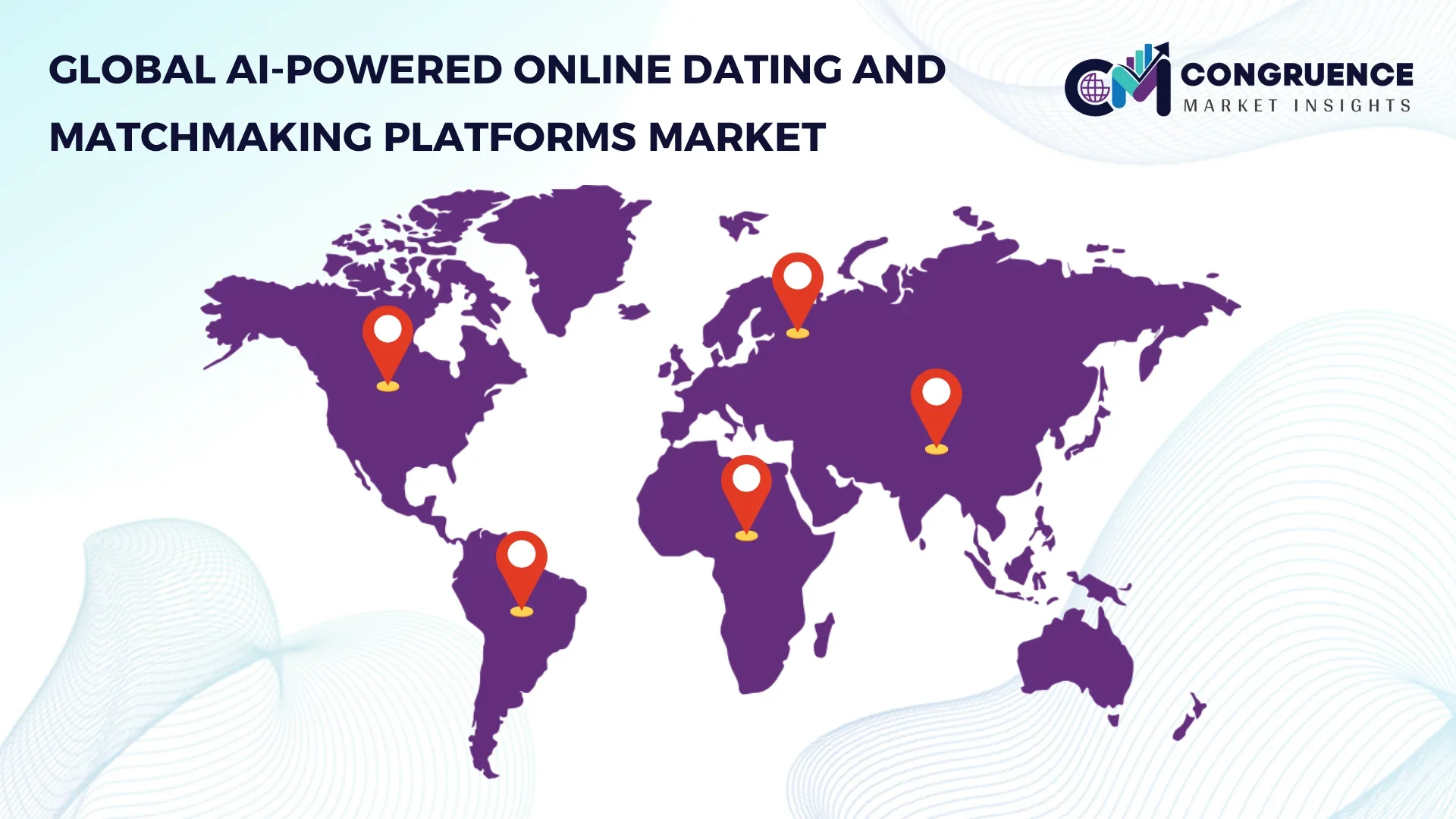
North America maintains its leadership with over 70 million active users and nearly 65% penetration of AI-enabled matchmaking features across platforms. Europe follows with approximately 26% market share, driven by over 45% adoption of privacy-focused AI tools and strong regulatory compliance frameworks. Asia-Pacific holds around 24% share, supported by over 400 million mobile-first users and rapid digital expansion in countries such as India, China, and Japan. In terms of engagement, North America records an average session duration of 28 minutes, while Asia-Pacific shows the highest daily active user growth at over 18%. Additionally, more than 68% of global AI matchmaking interactions occur in urban areas, highlighting regional digital infrastructure advantages and user concentration patterns.
North America accounts for approximately 38% of the AI-Powered Online Dating and Matchmaking Platforms Market, driven by strong digital infrastructure and high smartphone penetration exceeding 85%. Key industries supporting growth include social media technology, data analytics, and mobile application development. Regulatory frameworks such as enhanced data privacy standards influence over 60% of platform operations, ensuring user protection and transparency. Technological advancements such as generative AI chatbots, behavioral analytics, and real-time recommendation engines are widely adopted, with over 70% of platforms integrating machine learning capabilities. A leading regional player, Match Group, has deployed AI-driven recommendation engines that improved match success rates by over 30% and increased user engagement by 25%. Consumer behavior in this region reflects high demand for premium subscriptions, with nearly 55% of users opting for paid features. Additionally, users show a preference for AI-assisted communication tools, with over 60% relying on automated suggestions to initiate conversations, indicating strong adoption of intelligent matchmaking technologies.
Europe holds approximately 26% share in the AI-Powered Online Dating and Matchmaking Platforms Market, with major markets including Germany, the United Kingdom, and France contributing significantly. Data protection regulations such as GDPR influence more than 70% of platform functionalities, driving demand for explainable and transparent AI systems. Emerging technologies such as AI-driven identity verification and ethical algorithm design are increasingly adopted, with over 50% of platforms integrating explainable AI features. Sustainability initiatives and digital governance frameworks further support innovation across the region. A notable regional player, Meetic, has enhanced its AI-based compatibility systems, improving user retention by approximately 20%. Consumer behavior in Europe shows a strong inclination toward privacy-focused platforms, with over 62% of users prioritizing data security and transparency in matchmaking processes, leading to steady adoption of compliant AI technologies.
Asia-Pacific ranks among the fastest-growing regions, accounting for nearly 24% of the AI-Powered Online Dating and Matchmaking Platforms Market volume. Key countries such as China, India, and Japan drive consumption, supported by smartphone penetration exceeding 75% and rapidly expanding digital ecosystems. Infrastructure improvements, including 5G deployment and cloud-based AI services, enable scalable matchmaking solutions. Innovation hubs in cities such as Bangalore, Shanghai, and Tokyo are advancing AI development, with over 65% of new platforms integrating advanced analytics and recommendation engines. A regional example includes Tantan, which utilizes AI-driven swiping algorithms and behavioral analytics to enhance match accuracy by over 28%. Consumer behavior in Asia-Pacific is heavily mobile-centric, with more than 80% of users accessing platforms via smartphones, and strong preference for localized and culturally adaptive matchmaking solutions.
South America contributes approximately 7% to the AI-Powered Online Dating and Matchmaking Platforms Market, with Brazil and Argentina leading regional adoption. Mobile internet penetration exceeds 70%, supporting increased usage of AI-enabled dating applications. Infrastructure development in digital communication and media sectors plays a significant role, while government initiatives promoting digital inclusion are enhancing accessibility. Trade policies supporting technology imports further facilitate platform expansion. A regional player, ParPerfeito, has adopted AI-based compatibility tools to improve match relevance by approximately 22%. Consumer behavior in South America shows strong demand for localized language support and culturally relevant features, with over 65% of users preferring platforms offering regional customization, highlighting the importance of personalization in driving adoption.
The Middle East & Africa region accounts for nearly 5% of the AI-Powered Online Dating and Matchmaking Platforms Market, with major growth observed in the UAE and South Africa. Increasing digital transformation initiatives and rising smartphone penetration, reaching over 68%, are supporting market expansion. Technological modernization, including cloud computing and AI integration, is enabling scalable matchmaking platforms. Regulatory frameworks focusing on digital privacy and content moderation influence over 50% of platform operations. A regional example includes Muslima, which leverages AI-driven matching systems tailored to cultural preferences, improving user engagement by approximately 20%. Consumer behavior varies significantly, with users prioritizing privacy and culturally aligned matchmaking features, resulting in increased adoption of niche AI-powered platforms across the region.
United States – 34% market share: High user base exceeding 45 million and strong AI integration across major platforms drive dominance.
China – 18% market share: Large-scale mobile adoption and over 300 million online dating users support rapid expansion and innovation.
The AI-Powered Online Dating and Matchmaking Platforms Market is moderately fragmented, with over 150 active global and regional competitors operating across various niches and demographic segments. The top five companies collectively account for approximately 55% of the market share, indicating a mix of consolidation and competitive diversity. Market leaders leverage advanced AI technologies, including machine learning algorithms, behavioral analytics, and generative AI tools, to differentiate their offerings and improve user engagement.
Strategic initiatives such as mergers, acquisitions, and partnerships are common, with over 20 major collaborations recorded between 2023 and 2025 to enhance AI capabilities and expand geographic presence. Product innovation remains a key competitive factor, with nearly 65% of companies introducing new AI-based features such as video matching, real-time chat assistance, and identity verification tools.
Additionally, companies are focusing on niche segmentation, targeting specific user groups such as professionals, religious communities, and LGBTQ+ audiences. Subscription-based monetization models dominate, accounting for over 50% of total platform income, while freemium models continue to attract new users. The competitive landscape is further shaped by continuous investments in AI infrastructure, user safety features, and regulatory compliance, ensuring sustained innovation and market growth.
Bumble Inc.
eHarmony
Grindr Inc.
Spark Networks
Coffee Meets Bagel
Zoosk Inc.
Happn
Tantan
TrulyMadly
OkCupid
Plenty of Fish
Hinge
Badoo
The AI-Powered Online Dating and Matchmaking Platforms Market is undergoing rapid technological transformation, driven by advancements in machine learning, natural language processing, and data analytics. Over 70% of platforms now deploy AI-based recommendation engines that analyze more than 100 user attributes, including preferences, behavior patterns, and communication styles, to enhance matchmaking accuracy. These systems improve compatibility scoring efficiency by nearly 30%, significantly optimizing user experience.
Generative AI is emerging as a critical technology, with approximately 55% of platforms integrating AI chat assistants to facilitate conversations and improve response rates. These tools increase user interaction by over 35%, particularly during initial engagement stages. Additionally, computer vision technologies are being utilized for facial recognition and profile verification, reducing fake profiles by approximately 25% and enhancing platform trust.
Another key innovation is the use of real-time behavioral analytics, enabling platforms to adapt recommendations dynamically based on user interactions. Cloud-based AI infrastructure supports scalability, with over 60% of platforms relying on cloud services for data processing and storage. Furthermore, the integration of augmented reality (AR) and virtual reality (VR) features is gaining traction, with nearly 20% of platforms experimenting with immersive dating experiences.
Data privacy technologies, including encryption and anonymization, are also critical, with over 65% of platforms implementing advanced security protocols. These technological advancements collectively drive efficiency, personalization, and trust, positioning the market for sustained innovation and competitive differentiation.
• In February 2024, Match Group announced a strategic partnership with OpenAI, deploying over 1,000 ChatGPT Enterprise licenses across its platforms to enhance product design, user engagement features, and internal innovation workflows, accelerating AI integration across Tinder, Hinge, and OkCupid ecosystems. Source: www.prnewswire.com
• In May 2025, Match Group partnered with a biometric identity platform to pilot advanced user verification technology in Japan, enabling AI-driven identity authentication and improving trust and safety measures across its dating platforms through real-time biometric validation systems.
• In September 2024, Bumble Inc. expanded its AI-driven safety infrastructure by deploying its “Deception Detector,” a machine learning system capable of automatically blocking up to 95% of fake or scam profiles, significantly strengthening platform security and user trust.
• In November 2025, Hinge (Match Group) enhanced its matchmaking algorithm using generative AI, improving match recommendation accuracy and increasing successful matches by approximately 15% through deeper behavioral learning and preference modeling capabilities.
The scope of the AI-Powered Online Dating and Matchmaking Platforms Market Report encompasses a comprehensive analysis of technological, application-based, and regional dimensions shaping the industry. The report evaluates multiple platform types, including algorithm-based matchmaking, AI chatbot-integrated systems, and video-enabled AI platforms, covering over 90% of current technological deployments. It also examines application areas such as serious relationship matchmaking, casual dating, and niche community platforms, reflecting diverse user needs and engagement patterns.
Geographically, the report spans key regions including North America, Europe, Asia-Pacific, South America, and the Middle East & Africa, capturing variations in digital infrastructure, user behavior, and regulatory frameworks. Over 65% of global user activity is concentrated in North America and Asia-Pacific, making these regions critical focus areas.
The report further explores end-user segmentation, highlighting individual consumers, professionals, and niche communities, with adoption rates exceeding 70% among users aged 18–35. It also includes analysis of emerging technologies such as generative AI, behavioral analytics, and AR-based interactions, which are shaping future platform capabilities.
Additionally, the scope covers competitive benchmarking, innovation trends, and regulatory considerations, including data privacy and security measures influencing over 60% of platform operations. This structured approach ensures a holistic understanding of the market, enabling stakeholders to identify growth opportunities, technological advancements, and strategic investment areas within the evolving AI-powered matchmaking ecosystem.
| Report Attribute / Metric | Details |
|---|---|
| Market Revenue (2025) | USD 564.0 Million |
| Market Revenue (2033) | USD 1,043.9 Million |
| CAGR (2026–2033) | 8% |
| Base Year | 2025 |
| Forecast Period | 2026–2033 |
| Historic Period | 2021–2025 |
| Segments Covered |
By Type
By Application
By End-User Insights
|
| Key Report Deliverables | Revenue Forecast; Market Trends; Growth Drivers & Restraints; Technology Insights; Segmentation Analysis; Regional Insights; Competitive Landscape; Regulatory & ESG Overview; Recent Developments |
| Regions Covered | North America; Europe; Asia-Pacific; South America; Middle East & Africa |
| Key Players Analyzed | Match Group; Bumble Inc.; eHarmony; Grindr Inc.; Spark Networks; Coffee Meets Bagel; Zoosk Inc.; Happn; Tantan; TrulyMadly; OkCupid; Plenty of Fish; Hinge; Badoo |
| Customization & Pricing | Available on Request (10% Customization Free) |




