
Reports
The Global AI-Powered Marketing Content and Presentation Platforms Market was valued at USD 300.0 Million in 2025 and is anticipated to reach a value of USD 1,788.1 Million by 2033 expanding at a CAGR of 25.0% between 2026 and 2033, according to an analysis by Congruence Market Insights. This growth is primarily driven by increasing enterprise demand for automated, scalable, and personalized digital content generation across marketing channels.
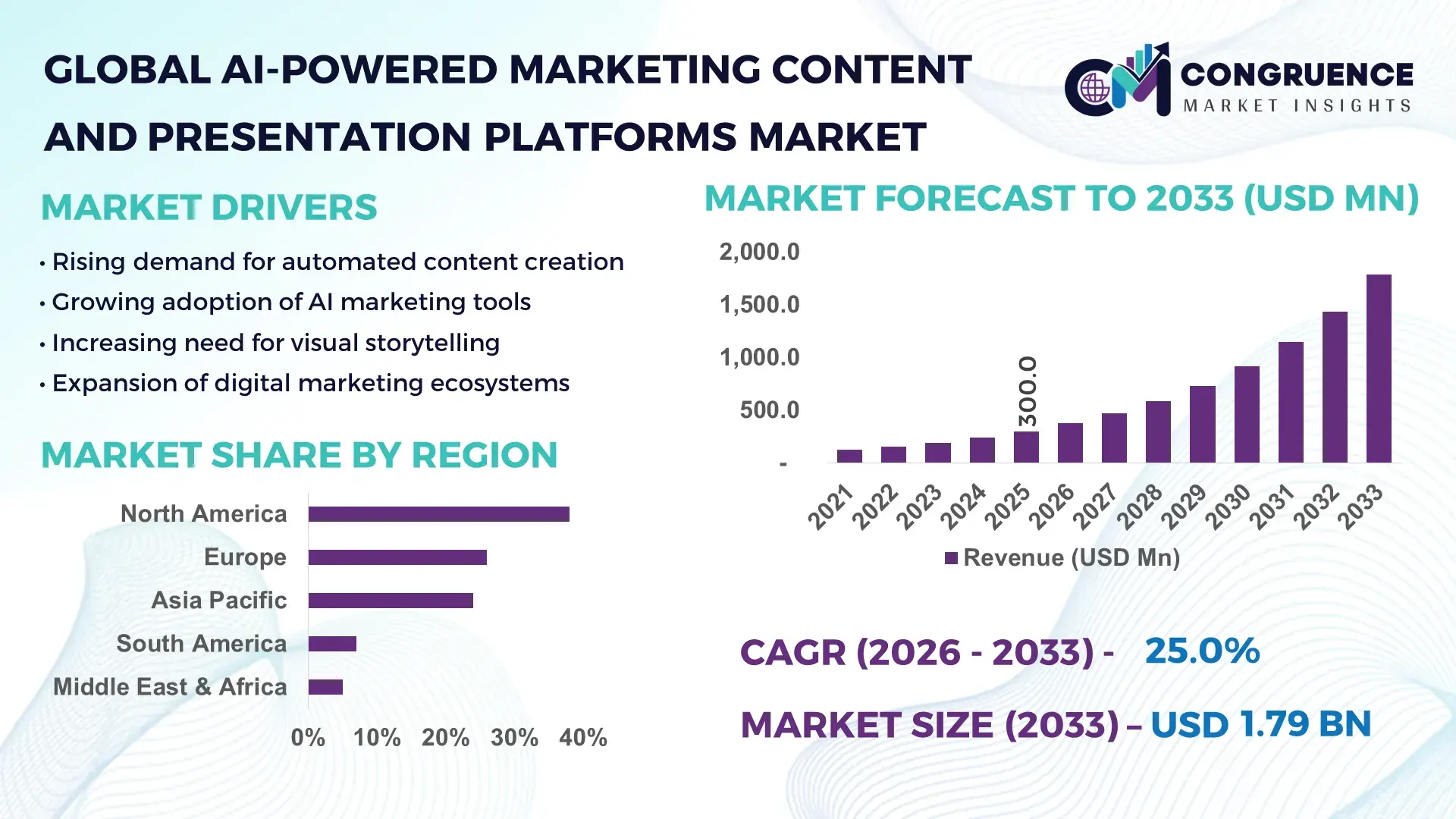
The United States continues to lead the AI-Powered Marketing Content and Presentation Platforms Market with strong technological infrastructure and high enterprise adoption rates. Over 68% of Fortune 500 companies have integrated AI-driven content tools into their marketing workflows, while more than 55% of mid-sized enterprises actively deploy AI-based presentation automation systems. The country accounts for over 45% of global AI software development capacity, supported by annual investments exceeding USD 25 billion in AI innovation ecosystems. Key applications include digital advertising, e-commerce content personalization, and enterprise sales presentations. Additionally, over 60% of marketing teams in the U.S. report productivity gains exceeding 30% through AI-assisted content tools, highlighting widespread adoption across industries such as retail, BFSI, and media.
Market Size & Growth: USD 300.0 Million in 2025 projected to reach USD 1,788.1 Million by 2033 at 25.0% CAGR, driven by rising demand for automated content creation and personalization.
Top Growth Drivers: 72% enterprise AI adoption, 45% increase in marketing automation efficiency, 38% reduction in content production time.
Short-Term Forecast: By 2028, AI platforms expected to improve campaign ROI by 35% and reduce content costs by 28%.
Emerging Technologies: Generative AI, multimodal AI systems, real-time content personalization engines.
Regional Leaders: North America (~USD 720 Million by 2033) leads in enterprise adoption; Europe (~USD 480 Million) focuses on compliance-driven AI; Asia-Pacific (~USD 410 Million) driven by mobile-first content ecosystems.
Consumer/End-User Trends: Over 64% of enterprises prioritize AI tools for content scalability, with SMEs increasing adoption by 41% annually.
Pilot or Case Example: In 2025, a global retail brand achieved 32% higher engagement using AI-generated marketing campaigns.
Competitive Landscape: Market leader holds ~18% share; key players include Adobe, Canva, Jasper, Synthesia, Beautiful.ai.
Regulatory & ESG Impact: Over 52% firms align with AI governance frameworks focusing on transparency and ethical AI usage.
Investment & Funding Patterns: Over USD 12 billion invested globally in generative AI platforms between 2024–2025.
Innovation & Future Outlook: Integration of AI with CRM and analytics tools expected to enhance personalization accuracy by over 40%.
AI-powered marketing content platforms are increasingly utilized across retail (32%), media (21%), and BFSI (18%), supported by advancements in generative AI and NLP technologies. Regulatory frameworks emphasizing ethical AI use and data transparency are influencing product design, while Asia-Pacific shows rapid adoption due to mobile-first economies. Continuous innovation in multimodal AI and real-time personalization is expected to drive future enterprise adoption and operational efficiency.
The AI-Powered Marketing Content and Presentation Platforms Market holds strong strategic relevance as enterprises increasingly prioritize automation, scalability, and personalization in digital marketing ecosystems. Organizations are leveraging AI to streamline content creation processes, reduce operational costs, and enhance campaign performance. Generative AI delivers up to 45% improvement compared to traditional manual content production methods, significantly accelerating time-to-market for marketing campaigns. The integration of AI with customer data platforms and CRM systems enables hyper-personalized content delivery, improving customer engagement metrics by over 35%.
From a regional perspective, North America dominates in volume due to high enterprise digitization, while Asia-Pacific leads in adoption with over 58% of digital-first companies actively deploying AI-powered content tools. In the short term, by 2028, real-time content personalization technologies are expected to improve campaign conversion rates by 30% and reduce content iteration cycles by 25%. Furthermore, compliance and ESG considerations are becoming critical, with firms committing to reduce digital waste and redundant content generation by 20% through AI optimization techniques by 2030.
A micro-scenario highlights that in 2025, a leading U.S.-based e-commerce company achieved a 33% reduction in content production costs through AI-driven automation tools, enabling scalable campaign deployment across multiple regions. Additionally, AI-driven A/B testing platforms are improving marketing accuracy by over 28%, reinforcing their strategic value. Moving forward, the AI-Powered Marketing Content and Presentation Platforms Market is expected to serve as a core pillar for business resilience, regulatory compliance, and sustainable growth, enabling organizations to remain competitive in rapidly evolving digital landscapes.
The AI-Powered Marketing Content and Presentation Platforms Market is shaped by rapid advancements in artificial intelligence, increasing digital transformation across industries, and growing reliance on automated marketing tools. Enterprises are focusing on optimizing content workflows, reducing manual effort, and improving personalization accuracy. Over 65% of global organizations have already integrated some form of AI into their marketing operations, while nearly 48% are expanding investments in AI-driven content platforms. The rise of omnichannel marketing strategies, combined with increasing demand for real-time engagement, is further accelerating adoption. Additionally, the expansion of cloud-based deployment models and API-driven integrations is enabling seamless scalability of these platforms. However, data privacy concerns, evolving regulatory frameworks, and the need for skilled AI professionals continue to influence adoption patterns. Overall, the market reflects a balance between innovation-driven growth and operational challenges, with continuous improvements in AI capabilities shaping future trajectories.
The rising demand for personalized digital marketing is a primary driver of the AI-Powered Marketing Content and Presentation Platforms Market. Over 71% of consumers expect brands to deliver personalized experiences, while 63% of marketers report higher engagement rates when using AI-driven personalization tools. AI platforms enable real-time data analysis and content customization, allowing businesses to tailor messaging across multiple channels. For instance, AI-driven recommendation engines have improved click-through rates by up to 42% in digital campaigns. Additionally, automated content generation reduces production timelines by nearly 40%, enabling marketers to respond quickly to market trends. The integration of AI with customer analytics tools further enhances segmentation accuracy, increasing campaign effectiveness by over 35%. As organizations prioritize customer-centric strategies, the demand for AI-powered content and presentation tools continues to rise significantly across industries.
Data privacy concerns remain a significant restraint in the adoption of AI-Powered Marketing Content and Presentation Platforms. Approximately 58% of enterprises cite regulatory compliance as a key challenge when implementing AI-driven marketing solutions. Strict regulations such as GDPR and evolving data protection laws require organizations to ensure transparency and secure handling of consumer data. Additionally, nearly 46% of companies report difficulties in managing large volumes of customer data without compromising privacy standards. AI models rely heavily on data inputs, and any limitations in data accessibility can reduce model accuracy by up to 25%. Concerns around algorithmic bias and misuse of personal data further hinder adoption, especially in highly regulated sectors such as BFSI and healthcare. As a result, organizations must invest in robust data governance frameworks, increasing implementation complexity and slowing market penetration.
The integration of generative AI presents significant opportunities for the AI-Powered Marketing Content and Presentation Platforms Market. Over 67% of enterprises are exploring generative AI to automate content creation, enabling faster production and improved scalability. Generative AI tools can create high-quality marketing content, including text, images, and presentations, reducing manual effort by up to 50%. Additionally, AI-powered design automation platforms are improving visual content creation efficiency by 38%. The adoption of multilingual AI capabilities is expanding global reach, allowing companies to localize content for diverse markets. Furthermore, the integration of AI with voice and video technologies is enabling immersive marketing experiences, enhancing customer engagement by over 30%. These advancements are opening new avenues for innovation, particularly in sectors such as e-commerce, media, and digital advertising.
The shortage of skilled AI professionals poses a major challenge to the AI-Powered Marketing Content and Presentation Platforms Market. Nearly 54% of organizations report a lack of qualified talent as a barrier to AI adoption. Developing and managing AI-driven platforms requires expertise in machine learning, data science, and software engineering, which remains limited globally. This skills gap leads to longer implementation timelines and increased operational costs. Additionally, over 49% of enterprises face difficulties in integrating AI tools with existing marketing systems due to technical complexities. The lack of training and upskilling initiatives further exacerbates the issue, reducing overall efficiency and slowing innovation. As demand for AI solutions continues to grow, addressing the talent shortage becomes critical for sustaining market expansion.
Generative AI adoption surpasses 70% across marketing teams: Over 72% of enterprises are actively using generative AI tools for content creation, with automated copywriting improving campaign turnaround time by 45% and increasing engagement rates by 34%. AI-generated visual assets now account for nearly 28% of total digital marketing content produced globally.
Multimodal AI integration improves campaign performance by 40%: Platforms combining text, image, and video generation capabilities are gaining traction, with 61% of enterprises deploying multimodal AI solutions. These tools enhance storytelling consistency and boost customer interaction rates by up to 40% across digital channels.
Real-time personalization engines drive 35% higher conversion rates: Around 66% of marketers use AI-powered personalization tools, enabling dynamic content adjustments based on user behavior. This has resulted in a 35% increase in conversion rates and a 29% improvement in customer retention metrics.
Cloud-based AI platforms achieve 50% faster deployment rates: Nearly 68% of AI marketing solutions are now cloud-based, allowing enterprises to scale operations efficiently. Cloud deployment reduces infrastructure costs by 32% and accelerates implementation timelines by over 50%, supporting rapid digital transformation initiatives.
The AI-Powered Marketing Content and Presentation Platforms Market is segmented based on type, application, and end-user, reflecting diverse adoption patterns across industries. Content generation tools dominate due to their ability to automate large-scale marketing workflows, while presentation automation platforms are gaining traction in enterprise communication. Applications are primarily driven by digital marketing and advertising, followed by corporate communications and e-learning. End-user adoption is led by large enterprises, supported by increasing SME penetration due to affordable cloud-based solutions. Approximately 62% of usage is concentrated in marketing-focused applications, while cross-functional use in sales and HR is expanding steadily. The integration of AI with analytics and CRM systems is enhancing segmentation capabilities, enabling more targeted and efficient content strategies across industries.
The AI-Powered Marketing Content and Presentation Platforms Market by type includes AI content generation platforms, AI presentation automation tools, multimodal content platforms, and others. AI content generation platforms dominate the segment, accounting for approximately 48% share due to their extensive use in automated copywriting, ad creation, and digital campaign management. These tools are widely adopted across industries for improving efficiency and reducing manual workload. In comparison, AI presentation automation tools hold around 27% share, primarily driven by enterprise demand for automated business presentations and sales pitches. However, multimodal content platforms are emerging as the fastest-growing segment, expanding at an estimated CAGR of 28%, driven by their ability to integrate text, video, and visual content generation within a single platform. Other niche platforms, including voice-based content tools and AI design assistants, collectively contribute around 25% of the market, serving specialized use cases such as branding and multimedia production.
• In 2025, a leading enterprise software firm deployed AI-driven presentation tools to automate over 1 million business slides annually, improving productivity by 35% across global teams.
The application segment of the AI-Powered Marketing Content and Presentation Platforms Market includes digital marketing, corporate communications, e-learning, and others. Digital marketing leads the segment with approximately 52% share, driven by increasing demand for automated ad creation, social media content, and personalized marketing campaigns. Corporate communications account for around 21%, as organizations adopt AI tools to streamline internal presentations and stakeholder communications. E-learning applications are growing rapidly and represent the fastest-growing segment, expanding at a CAGR of 27% due to rising demand for automated educational content and training materials. Other applications, including media production and customer support, contribute nearly 27% collectively. In 2025, more than 64% of enterprises globally reported using AI-powered platforms for marketing automation and customer engagement. Additionally, over 58% of digital-native companies rely on AI-generated content for daily operations.
• In 2025, an international education provider implemented AI-driven content platforms to generate personalized training modules for over 500,000 learners, improving learning engagement by 29%.
The AI-Powered Marketing Content and Presentation Platforms Market by end-user includes large enterprises, SMEs, and others. Large enterprises dominate with approximately 57% share, as they invest heavily in AI-driven marketing solutions to enhance scalability and operational efficiency. SMEs account for around 28% of the market and represent the fastest-growing segment, expanding at a CAGR of 29%, driven by the availability of cost-effective, cloud-based AI tools. Other end-users, including freelancers and creative agencies, contribute about 15% collectively, leveraging AI platforms for niche and project-based applications. In 2025, over 68% of large enterprises reported integrating AI into their marketing workflows, while nearly 46% of SMEs adopted AI tools to improve content creation efficiency. Additionally, 61% of digital agencies rely on AI-powered platforms for campaign optimization and client deliverables.
• In 2025, a global retail enterprise implemented AI marketing platforms across 120 markets, achieving a 31% increase in campaign efficiency and reducing manual content creation efforts by 40%.
North America accounted for the largest market share at 38% in 2025 however, Asia-Pacific is expected to register the fastest growth, expanding at a CAGR of 27% between 2026 and 2033.
North America’s leadership is driven by high enterprise adoption, with over 70% of large organizations integrating AI-powered marketing tools. Europe holds approximately 26% share, supported by strong regulatory frameworks and increasing adoption of ethical AI solutions. Asia-Pacific accounts for around 24% share, with rapid digitalization and mobile-first economies driving adoption across countries such as China, India, and Japan. South America and the Middle East & Africa collectively contribute nearly 12% of the market, supported by growing investments in digital marketing infrastructure. Additionally, over 65% of global AI marketing platform deployments are concentrated in developed regions, while emerging markets are witnessing adoption growth exceeding 30% annually due to expanding internet penetration and digital transformation initiatives.
North America holds approximately 38% of the AI-Powered Marketing Content and Presentation Platforms Market, driven by strong adoption across industries such as BFSI, retail, and healthcare. Over 72% of enterprises in the region use AI tools for marketing automation and personalized content delivery. Government support for AI innovation, combined with advanced cloud infrastructure, is accelerating adoption. Technological advancements such as generative AI and multimodal systems are widely integrated into enterprise workflows. A notable example includes a leading U.S.-based company deploying AI platforms to automate over 60% of its digital campaigns. Consumer behavior shows higher adoption among enterprises in finance and healthcare sectors, where AI-driven personalization enhances customer engagement and operational efficiency.
Europe accounts for approximately 26% of the AI-Powered Marketing Content and Presentation Platforms Market, with key markets including Germany, the UK, and France. The region emphasizes regulatory compliance, with over 60% of enterprises prioritizing explainable AI solutions. Initiatives focusing on data protection and sustainability are influencing platform development. Adoption of AI technologies such as NLP and automated design tools is increasing across industries. A regional technology firm has implemented AI-driven content platforms to improve digital marketing efficiency by 28%. Consumer behavior in Europe reflects a preference for transparent and ethical AI systems, driving demand for compliant and secure solutions.
Asia-Pacific accounts for around 24% of the AI-Powered Marketing Content and Presentation Platforms Market and ranks as the fastest-growing region. Countries such as China, India, and Japan are leading adoption due to rapid digitalization and expanding e-commerce ecosystems. Over 62% of businesses in the region utilize AI-powered tools for content creation and marketing automation. Infrastructure growth and increasing smartphone penetration are supporting adoption. A regional AI startup has developed multilingual content platforms used by over 2 million users. Consumer behavior highlights strong reliance on mobile AI applications, particularly in e-commerce and social media marketing.
South America holds approximately 7% of the AI-Powered Marketing Content and Presentation Platforms Market, with Brazil and Argentina as key contributors. The region is witnessing increasing adoption of AI tools for localized content generation, particularly in media and advertising sectors. Government initiatives supporting digital transformation are encouraging market growth. A regional company has deployed AI-driven marketing platforms to improve campaign engagement by 25%. Consumer behavior reflects strong demand for language-specific and culturally relevant content, driving the adoption of AI-powered localization tools.
The Middle East & Africa accounts for approximately 5% of the AI-Powered Marketing Content and Presentation Platforms Market, with key growth in the UAE and South Africa. Increasing investments in digital infrastructure and smart city initiatives are driving adoption. Over 48% of enterprises in the region are exploring AI-powered marketing solutions. A regional technology provider has implemented AI platforms to enhance digital campaigns, achieving a 22% increase in engagement. Consumer behavior indicates growing adoption of AI tools in retail and e-commerce sectors, supported by rising internet penetration and mobile usage.
United States – 34% Market share: driven by strong AI infrastructure, high enterprise adoption, and significant investment in AI innovation ecosystems.
China – 18% Market share: supported by rapid digitalization, large-scale e-commerce platforms, and government-backed AI initiatives.
The AI-Powered Marketing Content and Presentation Platforms Market is moderately fragmented, with over 120 active global and regional players competing across different segments. The top five companies collectively hold approximately 52% of the market share, indicating a mix of consolidation and competitive diversity. Leading players are focusing on product innovation, strategic partnerships, and mergers to strengthen their market position. Over 40% of companies have introduced new AI-driven features between 2024 and 2025, particularly in generative AI and multimodal capabilities. Strategic collaborations between AI firms and cloud service providers have increased by 35%, enabling scalable and integrated solutions. Additionally, nearly 60% of market participants are investing in R&D to enhance AI model accuracy and performance. Startups are playing a crucial role in driving innovation, contributing to over 30% of new product launches. The competitive landscape is characterized by rapid technological advancements, increasing investment in AI research, and growing demand for differentiated solutions tailored to specific industry needs.
Canva Pty Ltd
Jasper AI
Synthesia Ltd
Beautiful.ai
Writesonic Inc.
Copy.ai
Lumen5 Technologies Ltd
Tome App Inc.
Gamma App
Simplified AI
Design.ai
Visme
Prezi Inc.
The AI-Powered Marketing Content and Presentation Platforms Market is driven by rapid advancements in generative AI, natural language processing (NLP), and computer vision technologies. Generative AI models are capable of producing high-quality text, images, and videos, enabling automated content creation at scale. Over 70% of platforms now incorporate NLP capabilities to enhance language understanding and contextual relevance. Multimodal AI systems, which integrate text, image, and video generation, are gaining traction, with adoption rates exceeding 60% among enterprises.
Cloud computing plays a critical role in enabling scalable AI deployments, with approximately 68% of platforms utilizing cloud-based infrastructure for real-time processing and storage. Additionally, API-driven architectures allow seamless integration with CRM, analytics, and marketing automation tools, improving operational efficiency by over 40%. AI-powered analytics tools are also enhancing decision-making, enabling marketers to optimize campaigns based on real-time data insights.
Emerging technologies such as reinforcement learning and AI-driven personalization engines are further transforming the market. These technologies enable dynamic content adaptation based on user behavior, improving engagement rates by over 35%. Furthermore, advancements in voice and video AI are enabling interactive and immersive marketing experiences. As AI technology continues to evolve, the integration of advanced algorithms and data-driven insights will play a crucial role in shaping the future of marketing content and presentation platforms.
• In March 2025, Adobe expanded its generative AI platform by integrating commercially safe AI models through Adobe Firefly and GenStudio, enabling enterprises to streamline content supply chains and eliminate workflow bottlenecks across marketing operations. The update also introduced interoperability partnerships with major enterprise platforms to enhance customer experience delivery. Source: www.adobe.com
• In October 2025, Adobe introduced advanced AI capabilities across Creative Cloud, Firefly, and Express, including AI assistants and new Firefly Image Model 5. These innovations enable end-to-end content generation, including video and audio creation, significantly improving productivity and enabling conversational content creation workflows.
• In March 2025, Canva published its “State of Marketing & AI Report,” highlighting that global enterprises are shifting from experimentation to full-scale generative AI deployment, with over 2,400 marketing leaders confirming increased investments in AI-driven design and content tools to enhance productivity and creative output.
• In January 2025, Synthesia reached a valuation exceeding USD 2.1 billion and expanded its AI video platform capabilities, focusing on multilingual video generation and enterprise applications such as corporate training and marketing communications, with continued development of interactive AI avatar technologies.
The scope of the AI-Powered Marketing Content and Presentation Platforms Market Report encompasses a comprehensive analysis of key market segments, technologies, applications, and regional dynamics. The report covers various platform types, including AI content generation tools, presentation automation systems, and multimodal AI platforms, providing insights into their adoption across industries. Applications analyzed include digital marketing, corporate communications, e-learning, and media production, highlighting their contribution to overall market demand.
Geographically, the report examines key regions such as North America, Europe, Asia-Pacific, South America, and the Middle East & Africa, offering detailed insights into regional adoption patterns, technological advancements, and industry trends. The report also evaluates end-user segments, including large enterprises, SMEs, and creative agencies, focusing on their adoption behavior and operational requirements.
Additionally, the report provides in-depth analysis of technological developments such as generative AI, NLP, computer vision, and cloud-based deployment models. It also explores emerging trends, including real-time personalization, multimodal content generation, and AI-driven analytics. The scope further includes competitive landscape analysis, highlighting key market players, strategic initiatives, and innovation trends. Overall, the report offers a holistic view of the market, enabling stakeholders to make informed decisions and identify growth opportunities across various segments and regions.
| Report Attribute / Metric | Details |
|---|---|
| Market Revenue (2025) | USD 300.0 Million |
| Market Revenue (2033) | USD 1,788.1 Million |
| CAGR (2026–2033) | 25.0% |
| Base Year | 2025 |
| Forecast Period | 2026–2033 |
| Historic Period | 2021–2025 |
| Segments Covered |
By Type
By Application
By End-User Insights
|
| Key Report Deliverables | Revenue Forecast; Market Trends; Growth Drivers & Restraints; Technology Insights; Segmentation Analysis; Regional Insights; Competitive Landscape; Regulatory & ESG Overview; Recent Developments |
| Regions Covered | North America; Europe; Asia-Pacific; South America; Middle East & Africa |
| Key Players Analyzed | Adobe Inc.; Canva Pty Ltd; Jasper AI; Synthesia Ltd; Beautiful.ai; Writesonic Inc.; Copy.ai; Lumen5 Technologies Ltd; Tome App Inc.; Gamma App; Simplified AI; Design.ai; Visme; Prezi Inc. |
| Customization & Pricing | Available on Request (10% Customization Free) |




