
Reports
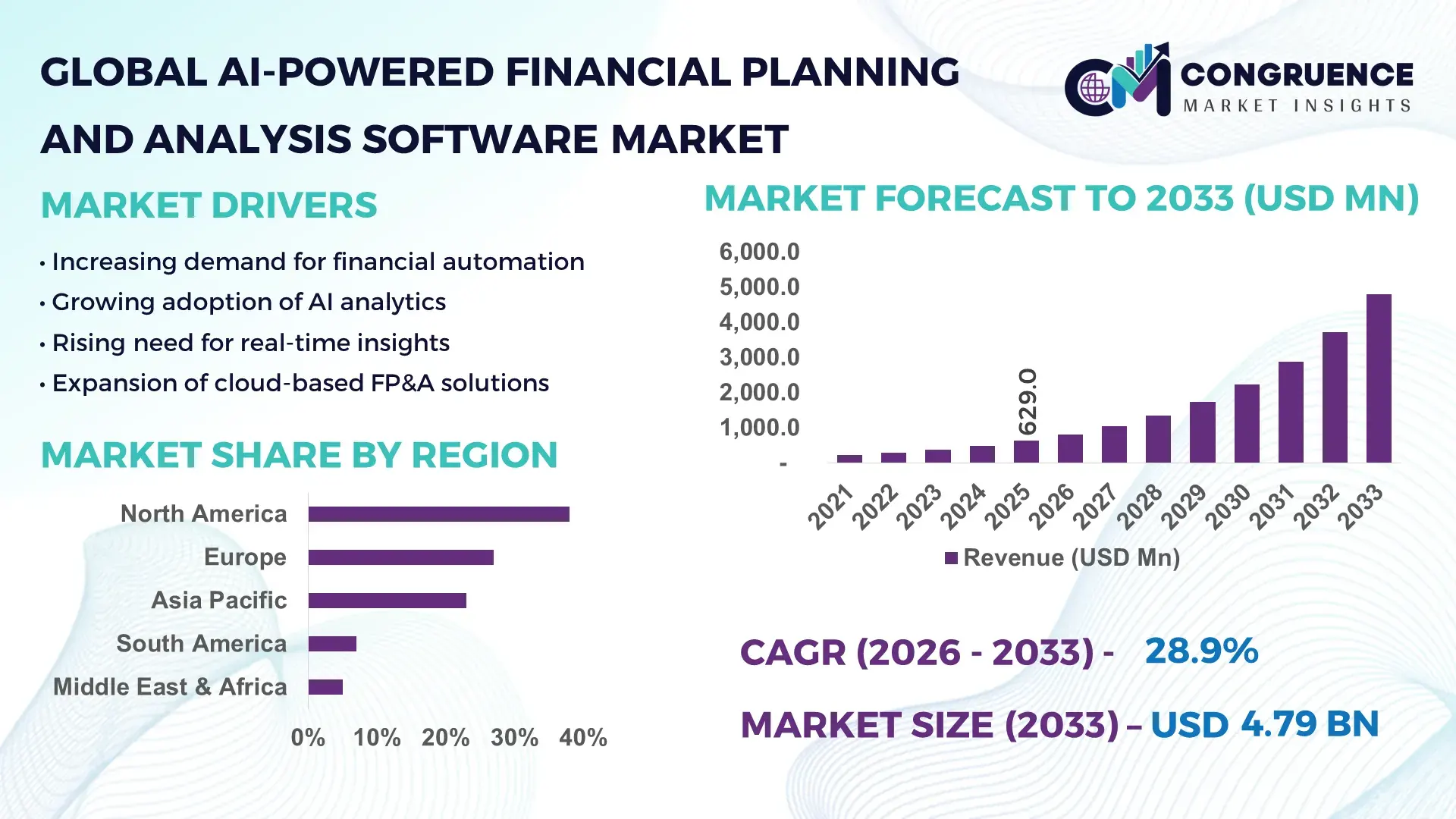
The Global AI-Powered Financial Planning and Analysis Software Market was valued at USD 629.0 Million in 2025 and is anticipated to reach a value of USD 4,793.7 Million by 2033 expanding at a CAGR of 28.9% between 2026 and 2033, according to an analysis by Congruence Market Insights. The growth is primarily driven by increasing enterprise demand for real-time financial insights, automation of budgeting processes, and predictive analytics capabilities.
The United States leads the global AI-Powered Financial Planning and Analysis Software Market with significant enterprise adoption and strong investment ecosystems. Over 68% of large enterprises in the U.S. have integrated AI-driven FP&A tools into their financial workflows, while more than 45% of mid-sized firms are actively piloting AI-based forecasting platforms. Annual enterprise spending on AI-enabled financial solutions exceeded USD 18 billion in 2025, supported by over 2,500 fintech startups focused on automation and analytics. Key industries such as BFSI, healthcare, and retail collectively account for nearly 60% of AI-FP&A deployments, while cloud-based FP&A solutions represent over 72% of installations. Additionally, AI-powered financial automation tools have improved forecasting accuracy by up to 35% across Fortune 500 companies, demonstrating strong technological advancement and scalability in the region.
Market Size & Growth: Valued at USD 629.0 Million in 2025, projected to reach USD 4,793.7 Million by 2033, expanding at 28.9% CAGR driven by enterprise-wide AI adoption and demand for predictive analytics.
Top Growth Drivers: AI adoption in finance (62%), automation efficiency gains (48%), real-time data processing demand (53%).
Short-Term Forecast: By 2028, AI-driven FP&A tools are expected to reduce financial reporting cycle time by 40% and improve forecasting accuracy by 30%.
Emerging Technologies: Generative AI for financial modeling, NLP-based reporting tools, and autonomous forecasting engines.
Regional Leaders: North America (~USD 1,950 Million by 2033) driven by enterprise AI adoption; Europe (~USD 1,320 Million) driven by compliance; Asia-Pacific (~USD 1,180 Million) driven by digital transformation.
Consumer/End-User Trends: Over 64% of enterprises prefer cloud-based FP&A platforms, while 52% rely on AI tools for scenario planning and forecasting.
Pilot or Case Example: In 2025, a multinational retail firm improved budgeting efficiency by 37% using AI-driven FP&A tools, reducing manual errors by 28%.
Competitive Landscape: Market leader holds ~18% share; key players include Oracle, SAP, IBM, Anaplan, and Workday.
Regulatory & ESG Impact: Around 42% of enterprises integrate ESG metrics into FP&A systems to comply with sustainability mandates.
Investment & Funding Patterns: Over USD 9.5 billion invested globally in AI-finance solutions between 2023–2025, with strong venture capital participation.
Innovation & Future Outlook: Integration of AI with ERP and real-time analytics platforms is expected to drive over 70% enterprise adoption by 2030.
AI-powered financial planning and analysis software is increasingly adopted across BFSI (34%), retail (21%), and healthcare (16%) sectors, supported by advancements in predictive analytics and automation tools. Regulatory requirements for financial transparency and ESG reporting are influencing adoption, while cloud-based deployments dominate with over 70% share. Asia-Pacific shows strong growth due to digitalization, while future trends include autonomous finance systems and real-time decision intelligence.
The AI-Powered Financial Planning and Analysis Software Market has become strategically critical for enterprises aiming to enhance financial agility, operational efficiency, and decision-making accuracy. Organizations are increasingly integrating AI-driven FP&A tools into enterprise resource planning systems, enabling real-time financial insights and predictive scenario modeling. These systems are improving planning accuracy by up to 35% compared to traditional spreadsheet-based approaches, while reducing manual workload by nearly 50%.
Advanced technologies such as generative AI and machine learning-based forecasting engines are redefining financial workflows. For instance, AI-driven forecasting delivers 30% improvement compared to traditional statistical models, allowing enterprises to react dynamically to market volatility. North America dominates in volume due to high enterprise adoption, while Asia-Pacific leads in adoption growth with over 58% of enterprises implementing AI-enabled finance tools in digital transformation initiatives.
In the short term, by 2028, autonomous financial planning systems are expected to reduce reporting cycle times by 45% and enhance operational efficiency by 38%. Organizations are also aligning AI-FP&A tools with ESG goals, with over 40% of firms committing to carbon footprint tracking and sustainability-linked financial reporting improvements by 2030.
A notable micro-scenario occurred in 2025, where a global manufacturing firm implemented AI-driven FP&A software and achieved a 33% reduction in forecasting errors and a 27% improvement in budget allocation efficiency. Such initiatives highlight the growing importance of AI-driven financial automation.
Overall, the AI-Powered Financial Planning and Analysis Software Market is evolving into a cornerstone of enterprise resilience, enabling compliance, sustainability, and long-term strategic growth through intelligent financial systems.
The AI-Powered Financial Planning and Analysis Software Market is characterized by rapid technological evolution, increasing enterprise digitization, and a shift toward data-driven financial decision-making. Organizations are transitioning from traditional financial planning tools to AI-enabled platforms that offer predictive analytics, automation, and real-time reporting capabilities. More than 65% of enterprises globally have initiated digital finance transformation programs, with AI-FP&A tools forming a core component.
The demand for integrated financial solutions is rising, particularly among large enterprises managing complex financial data across multiple geographies. Cloud-based deployment models account for over 70% of implementations, driven by scalability, cost efficiency, and ease of integration. Additionally, advancements in machine learning and natural language processing are enabling automated report generation, reducing manual effort by up to 40%.
The market is also influenced by regulatory requirements for financial transparency and ESG reporting, pushing organizations to adopt AI-driven tools that ensure compliance and accuracy. Increasing competition among software providers is driving innovation, with companies focusing on enhancing user experience, data visualization, and real-time analytics capabilities.
The growing need for real-time financial insights is a major driver of the AI-Powered Financial Planning and Analysis Software Market. Enterprises are dealing with increasing volumes of financial data, with over 2.5 quintillion bytes generated daily across industries. Traditional financial systems struggle to process such large datasets efficiently, leading to delays and inaccuracies. AI-powered FP&A tools address this challenge by enabling real-time data processing and predictive analytics. More than 60% of organizations report that real-time financial visibility improves decision-making speed by at least 25%. AI-driven dashboards and analytics platforms allow finance teams to monitor key performance indicators continuously, identify trends, and respond to changes promptly. Additionally, automated forecasting tools reduce human errors by approximately 30%, enhancing accuracy and reliability. Industries such as BFSI and retail are particularly benefiting from real-time insights, with over 55% of firms in these sectors adopting AI-based financial tools. As businesses prioritize agility and responsiveness, the demand for AI-powered FP&A solutions is expected to remain strong.
The complexity associated with implementing AI-powered FP&A systems is a significant restraint for the market. Integrating these solutions with existing enterprise systems such as ERP, CRM, and legacy financial software requires substantial technical expertise and resources. Approximately 48% of organizations report challenges in system integration, leading to delays in deployment and increased costs. Data quality and standardization issues further complicate implementation, as AI systems rely heavily on accurate and structured data. Around 35% of enterprises face difficulties in preparing their data for AI applications, resulting in suboptimal performance of FP&A tools. Additionally, the shortage of skilled professionals with expertise in AI and financial analytics poses a challenge, with nearly 40% of companies citing talent gaps as a barrier to adoption. These factors collectively limit the widespread adoption of AI-powered FP&A solutions, particularly among small and medium-sized enterprises with limited resources.
The rapid adoption of cloud computing presents significant opportunities for the AI-Powered Financial Planning and Analysis Software Market. Cloud-based FP&A solutions offer scalability, flexibility, and cost efficiency, making them attractive to organizations of all sizes. Over 72% of enterprises now prefer cloud-based financial systems due to lower infrastructure costs and faster deployment times. Cloud platforms also enable seamless integration with other enterprise applications, facilitating data sharing and collaboration across departments. This enhances the effectiveness of AI-driven analytics and decision-making processes. Furthermore, the availability of subscription-based pricing models reduces upfront investment requirements, encouraging adoption among SMEs. The growing focus on remote work and digital collaboration has further accelerated the demand for cloud-based FP&A tools. As organizations continue to embrace cloud technologies, the market is expected to witness increased innovation and expansion opportunities.
Data security and privacy concerns represent a major challenge for the AI-Powered Financial Planning and Analysis Software Market. Financial data is highly sensitive, and any breach can have severe consequences for organizations. Approximately 52% of enterprises consider data security a critical factor when adopting AI-based financial tools. The use of cloud-based platforms raises concerns about data storage, access control, and compliance with regulatory requirements. Organizations must ensure that their AI-FP&A systems comply with data protection regulations such as GDPR and other regional standards. Additionally, cyberattacks targeting financial systems have increased by over 30% in recent years, highlighting the need for robust security measures. Addressing these challenges requires significant investment in cybersecurity infrastructure and continuous monitoring, which can increase operational costs and complexity for organizations.
Rapid Adoption of Generative AI in Financial Modeling: Over 48% of enterprises integrated generative AI tools into financial planning workflows in 2025, enabling automated scenario modeling and reducing manual modeling time by 35%. These tools enhance forecasting precision and support dynamic budget adjustments across multi-region operations.
Expansion of Cloud-Based FP&A Platforms: Cloud deployments account for more than 72% of installations globally, with enterprises reporting 28% faster implementation timelines and 32% lower infrastructure costs. Hybrid cloud adoption is also increasing, with 41% of firms opting for multi-cloud FP&A environments.
Increasing Use of Real-Time Analytics Dashboards: Approximately 63% of finance teams rely on real-time dashboards for decision-making, leading to 25% faster reporting cycles and 20% improvement in financial transparency across departments.
Integration of ESG Metrics into Financial Planning: Around 42% of enterprises have integrated ESG reporting into FP&A systems, enabling 30% better tracking of sustainability metrics and improving compliance with global environmental standards.
The AI-Powered Financial Planning and Analysis Software Market is segmented based on type, application, and end-user, each playing a crucial role in shaping market dynamics. Organizations are increasingly adopting AI-driven tools tailored to their operational requirements, with cloud-based solutions dominating due to scalability and cost efficiency. Enterprise demand is driven by the need for automation, predictive analytics, and real-time financial insights.
Applications such as budgeting, forecasting, and financial reporting are witnessing strong adoption, while advanced use cases like scenario planning and risk management are gaining traction. End-users range from large enterprises to SMEs, with varying adoption levels based on resource availability and digital maturity. The segmentation highlights the diverse use cases and growth opportunities within the market.
The market is segmented into Cloud-Based FP&A Software, On-Premises FP&A Software, and Hybrid Solutions. Cloud-based FP&A software leads the segment, accounting for approximately 62% of total adoption due to its scalability, lower infrastructure costs, and ease of deployment. Enterprises prefer cloud solutions for their ability to integrate seamlessly with other business applications and provide real-time access to financial data. On-premises solutions hold around 24% share, primarily among large organizations with stringent data security requirements. These systems offer greater control over data but require significant investment in infrastructure and maintenance. Hybrid solutions account for the remaining 14%, providing a balance between flexibility and control, particularly for organizations transitioning to cloud environments. The fastest-growing segment is hybrid FP&A solutions, expected to expand at a CAGR of 31%, driven by the need for flexible deployment models and enhanced data security.
• In 2025, a global enterprise software provider deployed hybrid FP&A solutions across 120+ multinational firms, improving financial reporting efficiency by 28% and enabling real-time analytics integration across regions.
Key applications include Budgeting & Forecasting, Financial Reporting, Scenario Planning, Risk Management, and Performance Management. Budgeting & Forecasting dominates with a 38% share, as organizations prioritize accurate financial planning and predictive analytics. Financial Reporting accounts for 24%, driven by regulatory compliance requirements and demand for transparency. Scenario Planning is the fastest-growing application, expanding at a CAGR of 33%, supported by increasing market volatility and the need for dynamic decision-making tools. Risk Management and Performance Management collectively contribute 38% to the market, providing critical insights for strategic planning. In 2025, over 58% of enterprises reported using AI-powered FP&A tools for budgeting and forecasting, while 46% adopted these tools for scenario analysis. Additionally, 61% of finance professionals indicated improved decision-making accuracy with AI-driven analytics.
• In 2025, a leading financial institution implemented AI-based scenario planning tools across 80 branches, improving risk assessment accuracy by 29% and reducing financial uncertainties significantly.
The market serves Large Enterprises, Small & Medium Enterprises (SMEs), and Government Organizations. Large enterprises dominate with a 57% share due to their extensive financial operations and higher investment capacity in advanced technologies. SMEs account for 29%, increasingly adopting cloud-based FP&A solutions to enhance efficiency and reduce operational costs. Government organizations contribute 14%, focusing on transparency and budget optimization. The fastest-growing segment is SMEs, expanding at a CAGR of 34%, driven by affordable cloud-based solutions and increasing awareness of AI capabilities. Large enterprises continue to invest heavily in AI-driven financial tools, with over 65% implementing advanced analytics for strategic decision-making. In 2025, approximately 52% of SMEs reported adopting AI-powered financial tools, while 68% of large enterprises integrated AI into their financial workflows.
• In 2025, a government agency implemented AI-driven FP&A tools to manage public finances, achieving a 26% improvement in budget allocation efficiency and enhancing financial transparency across departments.
North America accounted for the largest market share at 38% in 2025 however, Asia-Pacific is expected to register the fastest growth, expanding at a CAGR of 31% between 2026 and 2033.

North America benefits from strong enterprise adoption, with over 70% of large organizations deploying AI-driven financial tools. Europe holds approximately 27% share, driven by regulatory compliance and ESG integration requirements. Asia-Pacific accounts for 23% of the market, supported by rapid digital transformation and increasing adoption of cloud technologies. South America and Middle East & Africa collectively contribute 12%, with growing investments in financial technology and digital infrastructure.
North America holds approximately 38% of the global market share, driven by strong adoption across BFSI, healthcare, and retail sectors. Over 72% of enterprises in the region use AI-powered FP&A tools for financial forecasting and reporting. Regulatory frameworks supporting financial transparency and data security further encourage adoption. Technological advancements such as integration with ERP systems and real-time analytics platforms are enhancing efficiency. A major U.S.-based software provider reported a 30% increase in AI-driven financial automation adoption among Fortune 500 companies. Consumer behavior indicates higher adoption among large enterprises, with over 68% actively using AI tools for decision-making.
Europe accounts for 27% of the global market, with key countries including Germany, the UK, and France driving adoption. Regulatory requirements such as GDPR and sustainability reporting standards influence demand for AI-powered FP&A tools. Approximately 54% of enterprises in Europe prioritize explainable AI solutions to ensure compliance. Technological adoption includes integration of ESG metrics into financial systems, with over 45% of firms implementing sustainability tracking tools. Regional consumer behavior shows strong preference for transparent and compliant financial systems.
Asia-Pacific ranks as the fastest-growing region, accounting for 23% of the market. Key countries such as China, India, and Japan are leading adoption due to expanding digital infrastructure and fintech ecosystems. Over 58% of enterprises in the region are adopting AI-powered financial tools as part of digital transformation initiatives. Local players are focusing on cloud-based solutions, with adoption rates exceeding 60% in urban enterprises. Consumer behavior indicates strong growth driven by mobile-first applications and e-commerce expansion.
South America holds around 7% of the global market, with Brazil and Argentina as key contributors. Adoption is driven by increasing demand for financial automation and digital transformation in enterprises. Government incentives supporting fintech innovation and trade policies encouraging digital adoption are key factors. Approximately 46% of enterprises in the region are investing in AI-based financial tools. Consumer behavior reflects growing interest in cost-efficient solutions and localized financial platforms.
Middle East & Africa account for nearly 5% of the global market, with UAE and South Africa leading adoption. The region is witnessing increased demand for AI-powered financial tools in oil & gas, construction, and banking sectors. Technological modernization initiatives and partnerships with global technology providers are driving adoption. Around 42% of enterprises are implementing AI-driven financial solutions to enhance efficiency. Consumer behavior indicates rising demand for digital financial tools and cloud-based platforms.
United States – 34% Market share: Strong enterprise adoption and advanced AI infrastructure
China – 19% Market share: Rapid digital transformation and expanding fintech ecosystem
The AI-Powered Financial Planning and Analysis Software Market is moderately fragmented, with over 120 active competitors operating globally. The top five companies collectively account for approximately 52% of the market share, indicating a balanced mix of dominant players and emerging innovators. Leading companies are focusing on strategic partnerships, mergers, and product innovations to strengthen their market position.
Cloud-based solutions and AI-driven analytics platforms are key areas of competition, with companies investing heavily in research and development. Over 65% of market players have introduced AI-enabled features in their FP&A solutions, enhancing automation and predictive capabilities. Strategic collaborations between software providers and financial institutions are also increasing, with more than 40% of firms engaging in partnerships to expand their customer base.
The competitive landscape is characterized by rapid innovation, with companies launching new products and features to meet evolving customer demands. The focus on user experience, data visualization, and real-time analytics is driving differentiation among market players.
SAP
IBM
Workday
Anaplan
Microsoft
Adobe
Salesforce
Jedox
Planful
Prophix
Vena Solutions
OneStream Software
Board International
Adaptive Insights
The AI-Powered Financial Planning and Analysis Software Market is driven by continuous advancements in artificial intelligence, machine learning, and data analytics technologies. Machine learning algorithms are widely used for predictive forecasting, enabling organizations to improve accuracy by up to 35% compared to traditional methods. Natural language processing (NLP) is another critical technology, allowing finance professionals to generate automated reports and insights, reducing manual effort by approximately 40%.
Generative AI is emerging as a transformative technology, enabling automated scenario modeling and financial simulations. Over 48% of enterprises have started integrating generative AI into their FP&A processes, enhancing decision-making capabilities. Cloud computing plays a crucial role, with more than 70% of FP&A solutions deployed on cloud platforms, offering scalability and real-time data access.
Integration with enterprise resource planning systems is also a key trend, enabling seamless data flow across departments. Advanced data visualization tools are improving user experience, with interactive dashboards used by over 60% of finance teams. Additionally, cybersecurity technologies are being integrated to address data privacy concerns, with organizations investing heavily in encryption and access control systems.
Overall, technological advancements are enhancing the efficiency, accuracy, and scalability of AI-powered FP&A solutions, making them essential for modern financial management.
• In October 2025, Oracle introduced an AI-powered Analytics AI Assistant within its Fusion Data Intelligence platform, enabling users to interact with enterprise financial data through natural language queries and generate contextual insights, significantly improving financial analysis efficiency and decision-making speed. Source: www.oracle.com
• In April 2025, Oracle launched new AI agents embedded in Oracle Cloud ERP, including predictive forecasting agents and anomaly detection tools that automate end-to-end finance processes, enhance financial accuracy, and generate AI-driven narrative reports for management decision-making.
• In May 2025, IBM expanded its enterprise AI portfolio with hybrid AI and agent-based capabilities through watsonx Orchestrate, enabling organizations to deploy AI agents across financial workflows and automate planning, forecasting, and operational decision processes at scale.
• In 2025, SAP introduced generative AI capabilities through SAP Joule within its S/4HANA Cloud platform, embedding AI-driven financial analytics, automation, and predictive insights directly into core finance operations to enhance planning accuracy and streamline enterprise financial processes.
The AI-Powered Financial Planning and Analysis Software Market Report provides a comprehensive analysis of market dynamics, segmentation, regional insights, and competitive landscape. The report covers key segments including type, application, and end-user, offering detailed insights into cloud-based, on-premises, and hybrid solutions. It examines applications such as budgeting, forecasting, financial reporting, scenario planning, and risk management, highlighting their adoption patterns and industry relevance.
Geographically, the report analyzes major regions including North America, Europe, Asia-Pacific, South America, and Middle East & Africa, providing insights into regional trends, adoption rates, and technological advancements. The report also explores key industries such as BFSI, healthcare, retail, and manufacturing, detailing their contribution to market growth and adoption of AI-powered FP&A solutions.
Technological analysis includes advancements in machine learning, natural language processing, generative AI, and cloud computing, emphasizing their impact on financial planning and analysis processes. The report further examines regulatory and ESG factors influencing market adoption, including compliance requirements and sustainability initiatives.
Additionally, the report provides insights into emerging trends, innovation strategies, and future growth opportunities, enabling stakeholders to make informed decisions. It serves as a valuable resource for business leaders, investors, and industry professionals seeking to understand the evolving landscape of AI-powered financial planning and analysis software.
| Report Attribute / Metric | Details |
|---|---|
| Market Revenue (2025) | USD 629.0 Million |
| Market Revenue (2033) | USD 4,793.7 Million |
| CAGR (2026–2033) | 28.9% |
| Base Year | 2025 |
| Forecast Period | 2026–2033 |
| Historic Period | 2021–2025 |
| Segments Covered |
By Type
By Application
By End-User Insights
|
| Key Report Deliverables | Revenue Forecast; Market Trends; Growth Drivers & Restraints; Technology Insights; Segmentation Analysis; Regional Insights; Competitive Landscape; Regulatory & ESG Overview; Recent Developments |
| Regions Covered | North America; Europe; Asia-Pacific; South America; Middle East & Africa |
| Key Players Analyzed | Oracle; SAP; IBM; Workday; Anaplan; Microsoft; Salesforce; Jedox; Planful; Prophix; Vena Solutions; OneStream Software; Board International; Adaptive Insights |
| Customization & Pricing | Available on Request (10% Customization Free) |




