
Reports
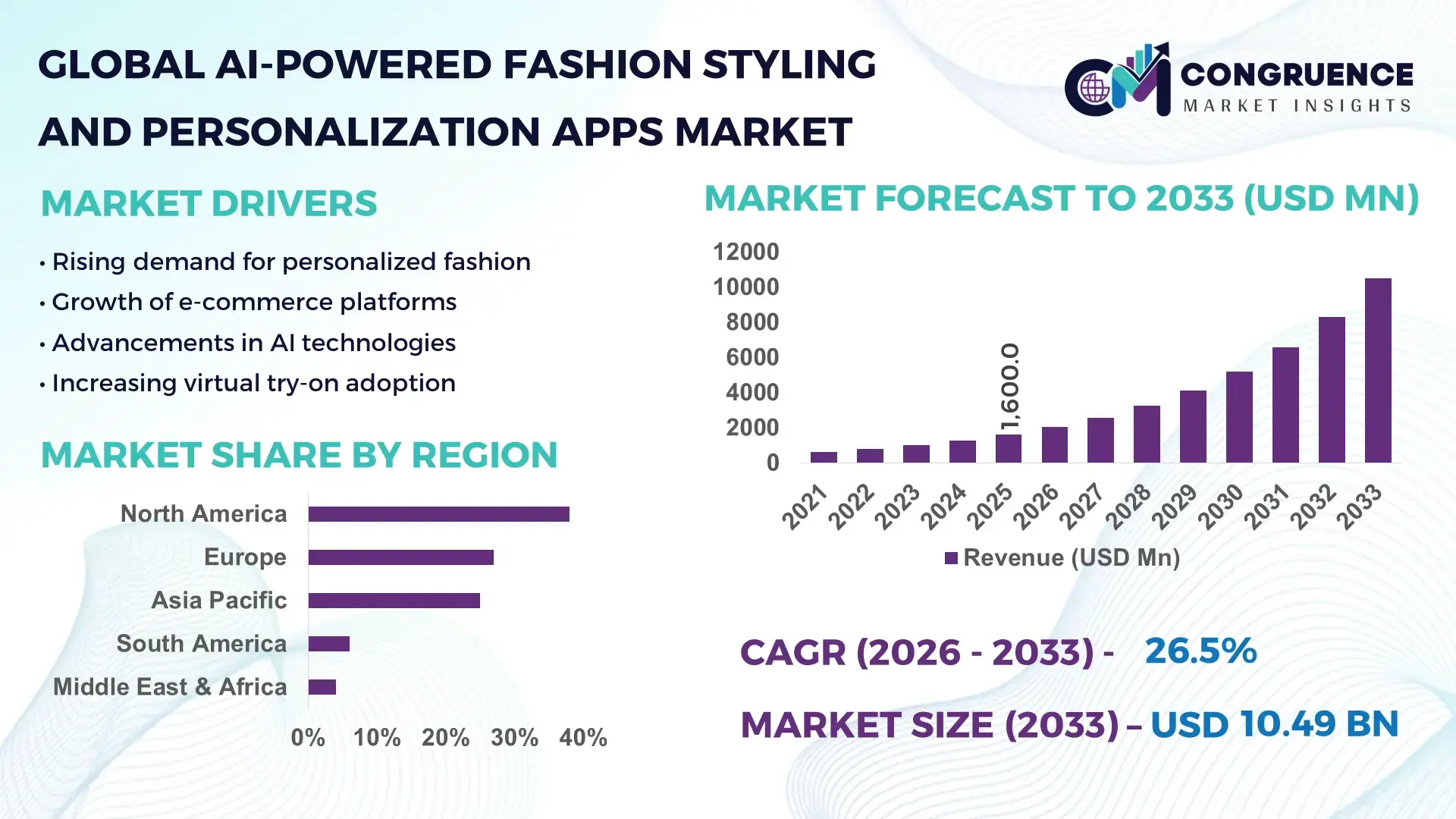
The Global AI-Powered Fashion Styling and Personalization Apps Market was valued at USD 1,600.0 Million in 2025 and is anticipated to reach a value of USD 10,491.7 Million by 2033 expanding at a CAGR of 26.5% between 2026 and 2033, according to an analysis by Congruence Market Insights. Growth is driven by rising demand for hyper-personalized shopping experiences enabled by AI algorithms and real-time consumer data analytics.
The United States remains a dominant hub for AI-powered fashion styling and personalization apps, supported by strong digital infrastructure and high consumer engagement in e-commerce ecosystems. Over 72% of online fashion retailers in the country have integrated AI-driven recommendation engines, while approximately 65% of consumers interact with personalized styling suggestions weekly. Investment in AI-based retail technologies exceeded USD 5 billion annually, with major applications spanning virtual try-ons, predictive styling, and wardrobe management. More than 40% of fashion brands deploy computer vision models for outfit matching, and over 30% utilize generative AI tools for personalized design suggestions. Mobile-based AI styling apps account for nearly 68% of user engagement, highlighting the role of smartphone penetration in driving adoption.
Market Size & Growth: USD 1,600.0 Million in 2025, projected to reach USD 10,491.7 Million by 2033 at 26.5% CAGR, driven by AI-led personalization in digital retail.
Top Growth Drivers: 70% rise in AI adoption in fashion retail, 55% improvement in customer engagement, 48% increase in conversion rates through personalization.
Short-Term Forecast: By 2028, AI-driven styling apps are expected to improve customer retention rates by 35% and reduce product returns by 25%.
Emerging Technologies: Generative AI, computer vision-based virtual try-ons, and multimodal recommendation engines are shaping innovation.
Regional Leaders: North America (USD 4,200 Million by 2033) leads in enterprise adoption; Europe (USD 3,100 Million) focuses on ethical AI; Asia-Pacific (USD 2,800 Million) driven by mobile-first usage.
Consumer/End-User Trends: Over 60% of Gen Z consumers prefer AI-based styling recommendations, with high engagement in mobile apps and social commerce.
Pilot or Case Example: In 2025, a major fashion retailer implemented AI styling tools, improving recommendation accuracy by 42% and reducing browsing time by 28%.
Competitive Landscape: Market leader holds ~18% share, followed by key players such as Stitch Fix, Zalando, Vue.ai, and Fashwell.
Regulatory & ESG Impact: Data privacy regulations impact over 50% of platforms, while sustainable fashion initiatives drive AI adoption for inventory optimization.
Investment & Funding Patterns: Over USD 2.5 billion invested globally in AI fashion startups, with strong venture capital inflows in personalization platforms.
Innovation & Future Outlook: Integration of AI with AR/VR and digital avatars is expected to redefine user experience and personalization depth.
AI-powered fashion styling and personalization apps are increasingly integrated across retail, e-commerce, and luxury fashion sectors, contributing over 65% of total application usage. Advances in generative AI and virtual try-on technologies are improving personalization accuracy by 40%. Regulatory focus on data protection and sustainability is shaping platform design, while Asia-Pacific accounts for over 45% of mobile-driven consumption, indicating strong future growth potential.
The AI-Powered Fashion Styling and Personalization Apps Market holds significant strategic relevance as retailers and fashion brands increasingly prioritize customer-centric digital transformation. AI-driven personalization engines enable up to 55% higher engagement rates compared to traditional recommendation systems, while computer vision-based styling tools deliver 35% improvement in product discovery efficiency compared to manual browsing methods. These technologies are becoming essential in enhancing user experience, optimizing inventory management, and reducing return rates by up to 25%.
Generative AI delivers 40% improvement compared to rule-based styling systems, allowing brands to offer dynamic outfit recommendations tailored to individual preferences. North America dominates in volume due to strong enterprise adoption, while Asia-Pacific leads in adoption with over 68% of users engaging with mobile-based AI styling platforms. This contrast highlights regional differences in infrastructure maturity and consumer behavior patterns.
By 2028, AI-powered virtual styling assistants are expected to reduce customer acquisition costs by 30% and improve conversion rates by 45%. Firms are committing to ESG goals, including 20% reduction in fashion waste through AI-driven demand forecasting and inventory optimization by 2030. These initiatives align with broader sustainability mandates and regulatory frameworks.
In 2025, a leading fashion platform in the United States achieved a 38% increase in customer retention through deployment of AI-based personalization engines, demonstrating tangible business impact. The AI-Powered Fashion Styling and Personalization Apps Market is expected to emerge as a critical pillar of resilience, compliance, and sustainable growth, enabling organizations to navigate evolving consumer expectations and regulatory landscapes effectively.
The AI-Powered Fashion Styling and Personalization Apps Market is evolving rapidly, driven by the convergence of artificial intelligence, big data analytics, and digital commerce. Increasing smartphone penetration, which exceeds 75% globally, has significantly boosted mobile-based styling applications. Retailers are leveraging AI algorithms to analyze over 1,000 data points per user, including browsing behavior, purchase history, and style preferences, to deliver hyper-personalized recommendations. Additionally, the integration of augmented reality features has improved user engagement rates by nearly 50%, enhancing virtual try-on experiences. The growing emphasis on omnichannel retail strategies has further accelerated the deployment of AI-powered personalization tools across both online and offline platforms. Meanwhile, advancements in machine learning and natural language processing are enabling more intuitive and conversational user interfaces, transforming the overall customer journey.
The increasing consumer preference for personalized shopping experiences is a major driver of the AI-Powered Fashion Styling and Personalization Apps Market. Studies indicate that nearly 80% of consumers are more likely to purchase from brands that offer personalized experiences, while 65% expect real-time recommendations based on their preferences. AI-powered styling apps analyze vast datasets, including user demographics, past purchases, and browsing patterns, to deliver tailored suggestions. This has resulted in up to 50% higher engagement rates and 30% increased conversion rates for retailers implementing such solutions. Additionally, personalized recommendations have been shown to reduce product return rates by 20%, improving operational efficiency. The integration of AI with social media platforms further enhances personalization by leveraging user-generated content and influencer trends, driving widespread adoption across fashion brands and retailers.
Data privacy concerns present a significant restraint in the AI-Powered Fashion Styling and Personalization Apps Market, as these platforms rely heavily on user data for personalization. Approximately 60% of consumers express concerns about how their personal data is collected and used, leading to reduced trust in AI-driven applications. Stringent regulations such as GDPR and similar frameworks require companies to implement robust data protection measures, increasing compliance costs by up to 25%. Additionally, data breaches in digital platforms have impacted over 40% of online users globally, raising concerns about security vulnerabilities. These challenges limit the extent to which companies can utilize data for personalization, potentially affecting recommendation accuracy and user experience. Furthermore, obtaining explicit user consent for data usage can reduce data availability by nearly 30%, impacting the effectiveness of AI algorithms.
The rapid expansion of e-commerce platforms presents significant opportunities for the AI-Powered Fashion Styling and Personalization Apps Market. Global online fashion sales account for over 35% of total apparel purchases, creating a strong demand for AI-driven personalization tools. AI-powered styling apps can increase average order value by up to 25% by recommending complementary products and personalized outfits. Additionally, the integration of virtual try-on technologies has improved purchase confidence among consumers, reducing return rates by nearly 20%. Emerging markets, particularly in Asia-Pacific, are witnessing over 50% growth in mobile commerce usage, providing a large user base for AI-powered apps. The rise of social commerce and influencer marketing further enhances opportunities, as AI algorithms can analyze social trends to deliver highly relevant styling recommendations.
High implementation costs remain a key challenge in the AI-Powered Fashion Styling and Personalization Apps Market, particularly for small and medium-sized enterprises. Developing and deploying AI algorithms requires significant investment in data infrastructure, cloud computing, and skilled personnel, with initial costs increasing by up to 40%. Additionally, maintaining and updating AI models to ensure accuracy and relevance adds ongoing operational expenses. The need for large datasets to train AI systems further complicates implementation, as data acquisition and processing can be resource-intensive. Integration with existing retail systems and platforms also requires additional investment, often increasing deployment timelines by 20–30%. These financial and technical barriers limit adoption among smaller players, potentially slowing overall market growth.
Rapid Adoption of Generative AI in Styling: Over 58% of fashion apps have integrated generative AI tools to create personalized outfit suggestions, improving styling accuracy by 40% and increasing user engagement by 35%. These tools analyze user preferences and generate real-time recommendations, enhancing overall customer experience.
Expansion of Virtual Try-On Technologies: Approximately 62% of leading fashion platforms now offer virtual try-on features powered by computer vision, resulting in a 30% reduction in product returns and a 45% increase in purchase confidence among users.
Growth in Mobile-First AI Applications: Mobile-based AI styling apps account for over 68% of total usage, with daily active users increasing by 50% in emerging markets. Smartphone penetration exceeding 75% is a key factor driving this trend.
Integration of Social Commerce and AI: Around 55% of consumers rely on social media platforms for fashion inspiration, while AI-powered apps analyze these trends to deliver personalized recommendations, improving conversion rates by 28%.
The AI-Powered Fashion Styling and Personalization Apps Market is segmented across type, application, and end-user categories, reflecting diverse technological adoption and use-case expansion. AI model types range from recommendation engines to computer vision-based styling tools, enabling precise outfit matching and user preference learning. Applications span across e-commerce platforms, personal wardrobe assistants, and virtual styling services, with e-commerce dominating due to high integration rates exceeding 65%. End-users include fashion retailers, individual consumers, and fashion designers, with retailers accounting for over 50% of total adoption due to demand for customer engagement optimization. Increasing reliance on AI-driven personalization tools across mobile and web platforms highlights strong segmentation-driven growth, with advanced analytics and automation enhancing decision-making capabilities for businesses.
The market by type includes recommendation engines, computer vision-based styling systems, generative AI styling tools, and virtual try-on technologies. Recommendation engines currently dominate, accounting for approximately 38% of total adoption due to their widespread integration in e-commerce platforms and ability to process large-scale consumer data efficiently. Computer vision-based systems hold around 27% share, driven by demand for visual outfit matching and real-time styling analysis. However, generative AI styling tools are the fastest-growing segment, expected to grow at a CAGR of 34%, fueled by increasing use of AI for automated outfit creation and personalized fashion design. Virtual try-on technologies contribute nearly 20%, while remaining niche solutions collectively account for 15% of the market, supporting specialized use cases such as wardrobe digitization and AI fashion assistants.
• In 2025, a leading global fashion platform deployed computer vision models to analyze over 50 million product images, improving outfit recommendation accuracy by 45% and enhancing user engagement significantly.
The application segment includes e-commerce personalization, virtual styling services, wardrobe management, and fashion design assistance. E-commerce personalization leads the segment with over 45% share, as retailers increasingly integrate AI tools to enhance user experience and drive conversions. Virtual styling services account for approximately 25%, offering real-time outfit recommendations and styling advice. Wardrobe management applications are gaining traction, contributing around 15%, while fashion design assistance tools represent nearly 15% of the segment. Virtual styling services are the fastest-growing application, expected to expand at a CAGR of 32%, supported by advancements in AI-driven chatbots and virtual assistants. In 2025, over 62% of online shoppers interacted with AI-based recommendation systems, while more than 58% of Gen Z consumers reported higher satisfaction with personalized styling suggestions.
• In 2025, an international fashion retailer implemented AI-powered styling tools across its platform, improving customer engagement by 40% and increasing average session duration by 30%.
The end-user segment includes fashion retailers, individual consumers, fashion designers, and enterprises. Fashion retailers dominate with approximately 52% share, driven by the need to enhance customer engagement and optimize inventory management. Individual consumers account for around 28%, leveraging AI apps for personal styling and wardrobe management. Fashion designers contribute nearly 12%, using AI tools for trend analysis and design automation, while enterprises represent 8%, focusing on analytics and personalization strategies. Individual consumers represent the fastest-growing segment, expected to grow at a CAGR of 35%, supported by increasing smartphone adoption and demand for personalized experiences. In 2025, more than 65% of fashion brands reported implementing AI-based personalization tools, while over 60% of consumers expressed preference for AI-driven styling recommendations.
• In 2025, a global retail study found that over 500 fashion companies adopted AI-powered analytics platforms, improving inventory efficiency by 25% and reducing stockouts significantly.
North America accounted for the largest market share at 38% in 2025 however, Asia-Pacific is expected to register the fastest growth, expanding at a CAGR of 29% between 2026 and 2033.
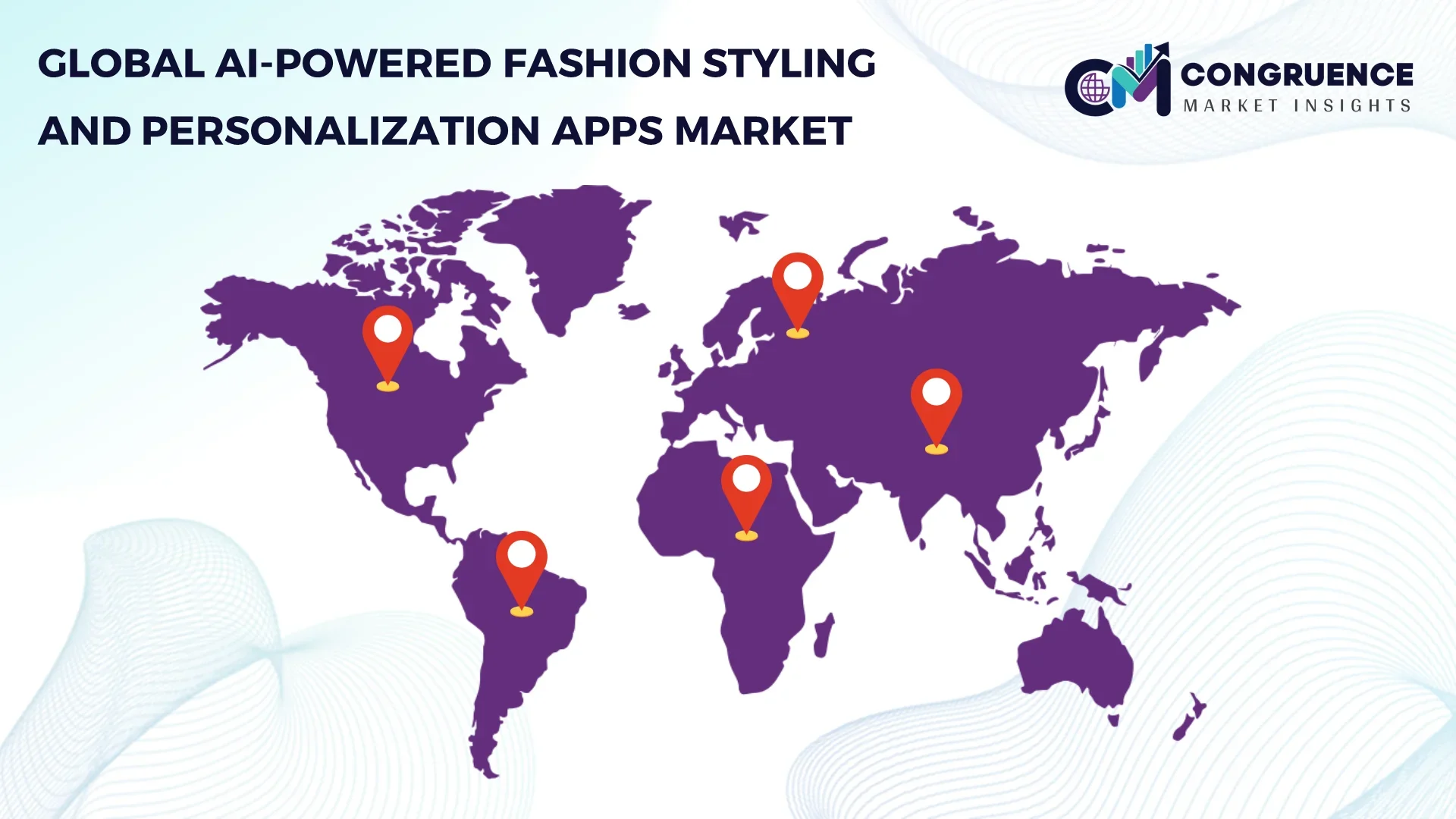
North America leads due to strong digital infrastructure and high adoption of AI in retail, with over 70% of fashion retailers integrating AI-driven personalization tools. Europe follows with a 27% share, driven by regulatory compliance and sustainability-focused AI applications, particularly in countries such as Germany, the UK, and France. Asia-Pacific holds around 25% share, supported by rapid mobile commerce growth and increasing smartphone penetration exceeding 75% in key markets like China and India. South America and the Middle East & Africa collectively account for approximately 10%, with emerging adoption driven by expanding e-commerce ecosystems and digital transformation initiatives.
North America holds approximately 38% of the market, driven by high adoption across e-commerce, retail, and luxury fashion industries. Government support for AI innovation and strong private sector investment contribute significantly to growth. Over 72% of retailers utilize AI-based recommendation engines, while more than 65% of consumers engage with personalized styling tools regularly. Companies such as Stitch Fix are leveraging AI to deliver personalized clothing subscriptions, improving customer retention rates by over 30%. Consumer behavior shows a preference for convenience and customization, with high engagement in mobile and web platforms.
Europe accounts for approximately 27% of the market, with strong presence in Germany, the UK, and France. Regulatory frameworks emphasize data privacy and sustainable practices, driving demand for explainable AI solutions. Over 60% of fashion companies in the region have implemented AI tools for inventory optimization and waste reduction. Companies such as Zalando are investing in AI-powered personalization to enhance customer experience. Consumers in Europe show higher preference for ethical and transparent AI applications.
Asia-Pacific represents around 25% of the market and ranks as the fastest-growing region. Countries such as China, India, and Japan lead adoption due to rapid digitalization and expanding e-commerce platforms. Smartphone penetration exceeds 75%, with mobile apps accounting for over 68% of AI styling interactions. Local players are leveraging AI for real-time personalization and social commerce integration. Consumer behavior is driven by mobile-first usage and strong engagement with digital platforms.
South America holds approximately 6% of the market, with Brazil and Argentina leading adoption. Growth is supported by increasing internet penetration and expansion of e-commerce platforms. Government initiatives promoting digital transformation and cross-border trade enhance market development. Local companies are integrating AI tools to improve customer engagement and optimize retail operations. Consumer demand is influenced by localized content and language-specific personalization features.
Middle East & Africa accounts for around 4% of the market, with key growth in the UAE and South Africa. Investments in digital infrastructure and smart city projects support AI adoption. Retail and luxury fashion sectors are key demand drivers, with increasing focus on personalized shopping experiences. Local players are adopting AI to enhance customer engagement and improve operational efficiency. Consumer behavior reflects growing interest in digital platforms and personalized services.
United States – 34% Market share: Driven by strong AI infrastructure and high retail adoption
China – 21% Market share: Supported by large consumer base and rapid e-commerce expansion
The AI-Powered Fashion Styling and Personalization Apps Market is moderately fragmented, with over 60 active global and regional players competing across different technology layers and application segments. The top five companies collectively account for approximately 42% of the market, indicating a balanced mix of competition and consolidation. Leading players focus on enhancing AI capabilities, expanding product portfolios, and forming strategic partnerships with fashion retailers and e-commerce platforms.
Key competitive strategies include mergers and acquisitions, with over 15 notable deals recorded between 2023 and 2025, and product innovation, particularly in generative AI and virtual try-on technologies. Companies are investing heavily in R&D, allocating up to 20% of their budgets toward AI development. Additionally, partnerships between AI firms and fashion brands have increased by 35%, enabling faster deployment of personalization tools. Competitive differentiation is driven by algorithm accuracy, user interface design, and integration capabilities with existing retail systems.
Zalando
Vue.ai
Fashwell
Stylumia
Syte.ai
Intelistyle
Wide Eyes Technologies
Lily AI
True Fit
Mode.ai
Heuritech
Metail
Reflektion
Technological advancements are at the core of the AI-Powered Fashion Styling and Personalization Apps Market, with machine learning, computer vision, and natural language processing playing critical roles. Machine learning algorithms process over 1,000 data points per user to generate personalized recommendations, improving accuracy by up to 45%. Computer vision technologies enable image recognition and outfit matching, analyzing millions of product images to deliver visually coherent styling suggestions.
Generative AI is emerging as a transformative technology, enabling automated outfit creation and personalized fashion design. These models can generate styling combinations in real time, improving user engagement by over 35%. Additionally, augmented reality (AR) technologies are enhancing virtual try-on experiences, reducing product return rates by approximately 30%.
Cloud computing and edge AI are further supporting scalability and real-time processing, enabling seamless user experiences across devices. Integration with big data analytics platforms allows companies to derive actionable insights from large datasets, improving decision-making and operational efficiency.
• In October 2024, Zalando rolled out its AI-powered fashion assistant across all 25 markets, enabling personalized styling recommendations in local languages using large language models and proprietary AI systems, significantly enhancing contextual outfit suggestions and user interaction across its platform. Source: www.corporate.zalando.com
• In February 2025, Zalando launched its first data-driven “Trend Forecast 2025,” leveraging its AI-based Trend Spotter to analyze customer behavior across 10 European cities, enabling predictive fashion insights and personalized discovery experiences based on real-time consumer data patterns.
• In May 2025, Zalando expanded its use of generative AI for marketing and styling visualization, reducing content production timelines from 6–8 weeks to just 3–4 days and lowering associated costs by approximately 90%, while increasing customer engagement through highly relevant AI-generated imagery.
• In July–October 2025, Zalando introduced and expanded its AI-driven personalized discovery feed to over 22 markets, enabling users to receive real-time curated fashion content aligned with their preferences, while integrating interactive features such as style boards and brand-following capabilities.
The AI-Powered Fashion Styling and Personalization Apps Market Report provides a comprehensive analysis of the industry, covering multiple dimensions including technology, application, and regional dynamics. The report evaluates key segments such as recommendation engines, computer vision-based systems, generative AI tools, and virtual try-on technologies, offering insights into their adoption patterns and functional capabilities.
From an application perspective, the report examines e-commerce personalization, virtual styling services, wardrobe management, and design assistance tools, highlighting their role in enhancing customer engagement and operational efficiency. End-user analysis includes fashion retailers, individual consumers, designers, and enterprises, with detailed insights into adoption trends and usage patterns.
Geographically, the report covers North America, Europe, Asia-Pacific, South America, and the Middle East & Africa, providing detailed analysis of regional performance, infrastructure development, and consumer behavior. The report also explores emerging trends such as social commerce integration, mobile-first AI applications, and sustainability-focused innovations.
Additionally, the scope includes competitive landscape analysis, profiling key market players and their strategic initiatives, along with technological advancements shaping the industry. The report serves as a valuable resource for stakeholders, offering actionable insights and data-driven analysis to support strategic decision-making and investment planning.
| Report Attribute / Metric | Details |
|---|---|
| Market Revenue (2025) | USD 1,600.0 Million |
| Market Revenue (2033) | USD 10,491.7 Million |
| CAGR (2026–2033) | 26.5% |
| Base Year | 2025 |
| Forecast Period | 2026–2033 |
| Historic Period | 2021–2025 |
| Segments Covered |
By Type
By Application
By End-User Insights
|
| Key Report Deliverables | Revenue Forecast; Market Trends; Growth Drivers & Restraints; Technology Insights; Segmentation Analysis; Regional Insights; Competitive Landscape; Regulatory & ESG Overview; Recent Developments |
| Regions Covered | North America; Europe; Asia-Pacific; South America; Middle East & Africa |
| Key Players Analyzed | Stitch Fix; Zalando; Vue.ai; Fashwell; Stylumia; Syte.ai; Intelistyle; Wide Eyes Technologies; Lily AI; True Fit; Mode.ai; Heuritech; Metail; Reflektion |
| Customization & Pricing | Available on Request (10% Customization Free) |




