
Reports
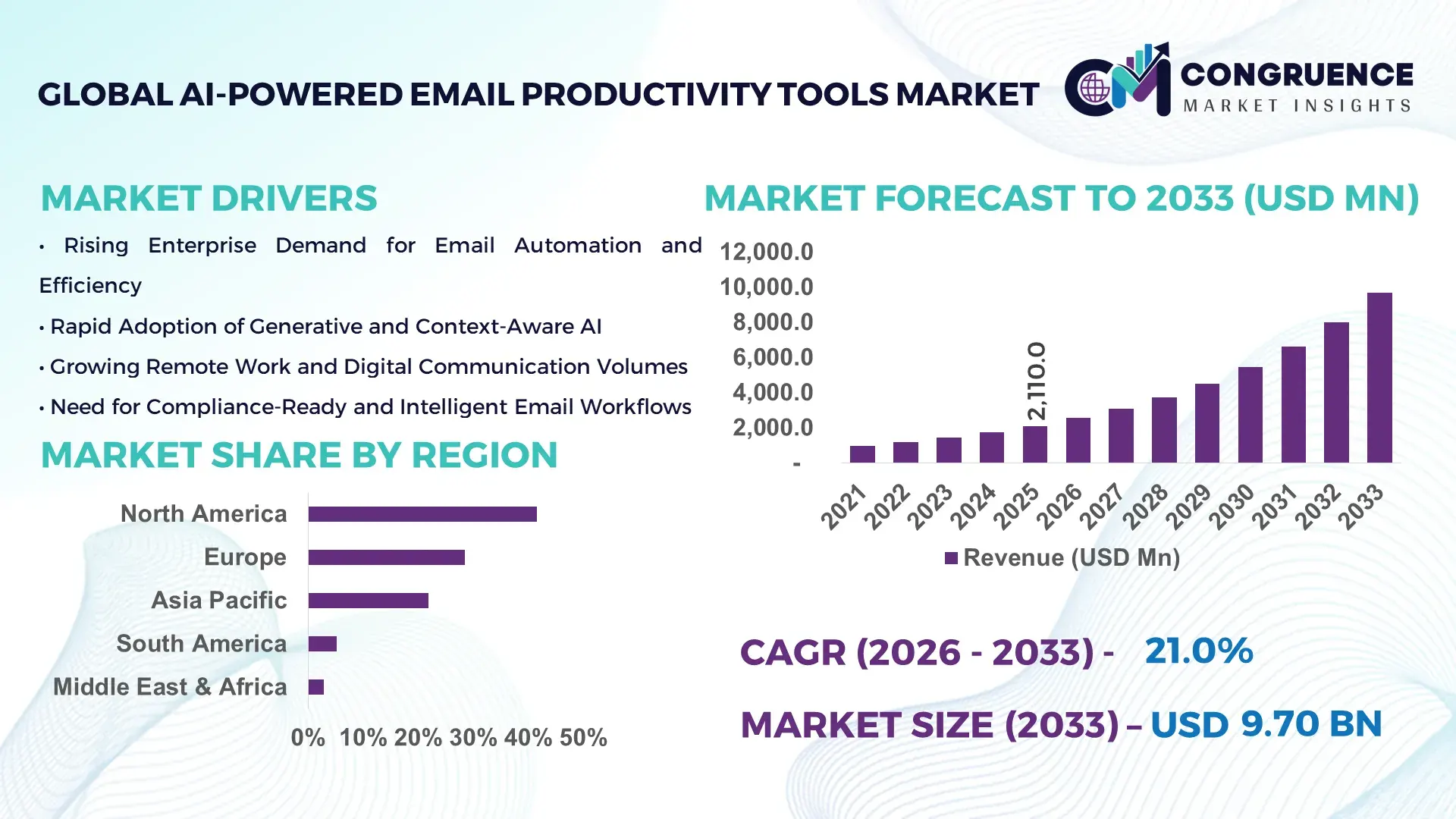
The Global AI-Powered Email Productivity Tools Market was valued at USD 2,110 Million in 2025 and is anticipated to reach a value of USD 9,695.4 Million by 2033 expanding at a CAGR of 21% between 2026 and 2033, according to an analysis by Congruence Market Insights. This growth is primarily supported by accelerating enterprise adoption of generative AI for communication automation, workflow optimization, and decision-support across knowledge-intensive industries.
The United States represents the dominant country in the AI-Powered Email Productivity Tools Market, supported by deep production capacity, high enterprise AI investment, and advanced digital workplace infrastructure. In 2024, over 72% of Fortune 1000 enterprises in the U.S. had integrated AI-enabled email assistants within productivity suites for sales, legal, HR, and customer support functions. Annual private and public investment in enterprise AI software exceeded USD 85 billion, with a significant portion directed toward natural language processing and workflow automation. The U.S. hosts more than 65% of global AI SaaS vendors, with hyperscalers embedding AI email copilots into platforms used by over 400 million active business users. Adoption is especially strong in BFSI, technology, and professional services, where AI-driven email classification, response generation, and sentiment analysis handle 35–45% of inbound enterprise email volumes, materially improving operational throughput.
Market Size & Growth: Valued at USD 2,110 Million in 2025, projected to reach USD 9,695.4 Million by 2033 at a CAGR of 21%, driven by enterprise-wide automation of communication workflows and generative AI integration.
Top Growth Drivers: Enterprise AI adoption rate at 68%, email handling time reduction of 42%, employee productivity uplift of 31%.
Short-Term Forecast: By 2028, AI-powered email tools are expected to reduce operational email management costs by 38% across large enterprises.
Emerging Technologies: Generative AI copilots, large language models with contextual memory, predictive intent detection, and multilingual NLP engines.
Regional Leaders: North America (USD 3,980 Million by 2033) with deep enterprise penetration; Europe (USD 2,640 Million) driven by compliance-focused deployments; Asia Pacific (USD 1,920 Million) led by SaaS-led SME adoption.
Consumer/End-User Trends: Knowledge workers account for over 60% of usage, with sales, customer service, and legal teams showing the highest automation intensity.
Pilot or Case Example: In 2024, a U.S.-based SaaS enterprise reported a 46% reduction in average response time after deploying AI email copilots across customer support.
Competitive Landscape: Microsoft (~32% share) leads, followed by Google, Salesforce, HubSpot, and Zoho.
Regulatory & ESG Impact: GDPR-aligned AI transparency mandates and enterprise ESG targets are accelerating demand for explainable and auditable AI email tools.
Investment & Funding Patterns: Over USD 14 billion invested globally in AI productivity software since 2022, dominated by venture-backed SaaS platforms.
Innovation & Future Outlook: Deep integration with CRM, ERP, and collaboration platforms is shaping next-generation autonomous email workflows.
Enterprise adoption is strongest in IT services, BFSI, healthcare administration, and professional services, collectively contributing over 70% of demand. Recent innovations include context-aware generative replies, automated compliance tagging, and emotion-detection models. Regulatory emphasis on data privacy, strong SaaS penetration in North America and Europe, and rising digital workforce density in Asia Pacific are shaping consumption patterns, while autonomous AI agents represent the next growth frontier.
The AI-Powered Email Productivity Tools Market has become strategically critical as enterprises confront rising communication complexity, distributed workforces, and productivity optimization mandates. AI-driven email copilots now function as decision-support systems, enabling automated prioritization, response generation, compliance screening, and workflow orchestration. Compared to rule-based email filters, generative AI copilots deliver up to 55% improvement in response accuracy and contextual relevance, significantly reducing manual intervention.
Regionally, North America dominates in deployment volume, while Europe leads in regulated adoption, with over 62% of large enterprises integrating AI email tools within GDPR-compliant digital workplace frameworks. By 2028, autonomous AI email agents leveraging multimodal context are expected to reduce employee email processing time by 40%, directly impacting operational efficiency KPIs. From an ESG perspective, enterprises are committing to digital efficiency targets, including 30% reductions in redundant internal communications by 2030, lowering digital energy consumption and cognitive load.
In 2024, a global consulting firm operating in the United States achieved a 48% reduction in internal email volume by deploying AI-based intent clustering and automated routing systems. Looking ahead, tighter integration with enterprise knowledge graphs, CRM systems, and compliance engines positions the AI-Powered Email Productivity Tools Market as a foundational pillar for organizational resilience, regulatory alignment, and sustainable digital productivity growth.
The AI-Powered Email Productivity Tools Market is shaped by accelerating digital workplace transformation, rapid generative AI advancements, and growing pressure on enterprises to improve knowledge-worker efficiency. Organizations are increasingly automating high-volume communication tasks, including sorting, prioritization, drafting, and compliance tagging. Integration with enterprise platforms such as CRM, ERP, and collaboration suites is deepening, enabling end-to-end workflow automation. Data privacy regulations and explainable AI requirements are influencing product design, while rising adoption among SMEs is expanding the addressable market. Competitive intensity remains high as platform vendors and niche AI startups innovate around accuracy, contextual intelligence, and enterprise-grade security.
Enterprises face mounting communication overload, with knowledge workers spending 28–32% of their workweek managing emails. AI-powered email tools directly address this inefficiency by automating triage, summarization, and response drafting. Large organizations report productivity gains of 30–45% in customer-facing and internal communication roles after deployment. The shift toward remote and hybrid work models has further amplified demand, as AI tools standardize communication quality and speed across distributed teams. High adoption in sales, legal, and customer service functions continues to reinforce this driver.
Despite strong demand, concerns around data sovereignty, email content sensitivity, and AI model transparency limit adoption in regulated industries. Over 40% of enterprises cite uncertainty around data residency and model training practices as a key barrier. Compliance requirements under GDPR, HIPAA, and sector-specific regulations increase deployment complexity and procurement timelines. Additionally, internal resistance to AI-generated communications in legal and executive functions slows full-scale rollout, particularly in highly regulated regions.
The convergence of AI email tools with autonomous workflow engines presents significant opportunity. Embedding AI agents capable of triggering CRM updates, scheduling actions, and compliance workflows transforms email from a communication tool into an execution layer. Enterprises piloting autonomous email-to-action systems report 35–50% faster task completion. Expansion into multilingual support, voice-to-email automation, and vertical-specific AI models further broadens addressable demand across emerging markets and regulated sectors.
Maintaining high contextual accuracy remains a challenge, particularly in complex or sensitive communications. Enterprises report that 12–18% of AI-generated drafts require manual correction due to tone, factual alignment, or compliance nuances. Hallucination risks and inconsistent outputs undermine user trust, especially in legal, healthcare, and financial communications. Continuous model training, explainability, and human-in-the-loop controls increase development and deployment costs, impacting scalability for smaller vendors.
Rapid Expansion of Generative AI Email Copilots: More than 70% of new enterprise deployments now include generative AI copilots capable of drafting full responses, summaries, and follow-ups. Organizations report average response-time reductions of 44%, with sales and support teams handling 1.6× higher email volumes without additional headcount.
Deep Integration with Enterprise Systems: AI email tools are increasingly embedded into CRM, ERP, and HR platforms. Over 58% of enterprises use AI-driven email triggers to automate downstream workflows, resulting in 33% faster deal closures and 29% improvement in internal request resolution times.
Rising Adoption of Compliance-Aware AI Models: Regulation-ready AI email systems with built-in audit trails and explainability features are gaining traction. Adoption of compliance-aware models increased by 41% year-on-year, particularly in BFSI and healthcare, reducing compliance review cycles by 26%.
Growth of Multilingual and Sentiment-Aware Email AI: Advanced NLP models supporting over 50 languages and real-time sentiment detection are improving global collaboration. Enterprises deploying sentiment-aware email AI report 22% improvement in customer satisfaction scores and 19% reduction in escalation rates across support operations.
The AI-Powered Email Productivity Tools Market is segmented by type, application, and end-user, reflecting how AI capabilities are embedded across enterprise communication workflows. By type, segmentation is shaped by the underlying AI model architecture used to analyze, generate, and automate email interactions. By application, demand varies based on functional use cases such as sales enablement, customer support, compliance, and internal collaboration, each requiring different levels of automation and contextual intelligence. End-user segmentation highlights adoption differences between large enterprises, SMEs, and sector-specific users such as BFSI, healthcare, and technology firms. Across all segments, adoption intensity is strongly correlated with email volume, regulatory exposure, and the need for response-time optimization, making segmentation a critical lens for understanding deployment priorities and value creation patterns.
AI-powered email productivity tools are primarily segmented into text-based generative AI models, context-aware predictive models, voice-to-email AI systems, and multimodal AI models.
Text-based generative AI models currently lead the market, accounting for approximately 48% of adoption, as they directly automate drafting, summarization, and response generation for high-volume enterprise emails. Their dominance is supported by strong natural language understanding capabilities and seamless integration with existing email clients.
Context-aware predictive models hold around 27% share, enabling prioritization, intent detection, and workflow routing based on historical patterns. However, multimodal AI models—which combine text with calendar data, CRM signals, and voice inputs—are the fastest-growing type, expanding at an estimated 26% CAGR, driven by demand for unified communication intelligence across platforms. Voice-to-email AI systems and niche rule-augmented models together contribute a combined 25% share, serving accessibility use cases, mobile-first workflows, and compliance-heavy environments.
• In 2025, a large enterprise software provider deployed context-aware generative email AI across internal operations, enabling automated summarization and action tagging for over 1 million daily emails, reducing manual handling time by more than 40%.
By application, sales and customer relationship management (CRM) represents the leading segment, accounting for about 36% of total adoption, as AI-powered email tools significantly improve lead response times, follow-up accuracy, and personalization at scale. Customer support applications follow closely at 29%, where AI-driven email triage and automated replies reduce ticket backlogs and improve service-level adherence.
The fastest-growing application area is compliance and risk-sensitive communication management, expanding at an estimated 24% CAGR, supported by increasing regulatory scrutiny in BFSI, healthcare, and legal services. AI tools in this segment focus on policy checks, audit trails, and sensitive data detection. Internal collaboration, HR communication, and executive assistance collectively account for a combined 35% share, supporting meeting coordination, policy dissemination, and cross-functional workflows.
In terms of adoption behavior, over 41% of global enterprises in 2025 reported piloting AI-powered email tools within customer experience platforms, while more than 58% of Gen Z professionals showed higher preference for organizations using AI-assisted communication tools that reduce response delays and information overload.
• In 2024, a multinational financial institution implemented AI-driven email compliance screening across regional offices, automatically reviewing millions of internal and external emails annually and significantly improving regulatory audit readiness.
From an end-user perspective, large enterprises dominate adoption with an estimated 52% share, driven by high email volumes, complex workflows, and strong IT budgets supporting AI integration. These organizations deploy AI-powered email tools across sales, legal, HR, and executive functions to standardize communication quality and improve operational efficiency.
Small and medium-sized enterprises (SMEs) represent the fastest-growing end-user segment, expanding at approximately 23% CAGR, fueled by SaaS-based deployment models, lower implementation complexity, and growing awareness of productivity gains. SMEs increasingly adopt AI email tools to compensate for lean teams, particularly in sales operations and customer support. Sector-wise, BFSI, technology, and professional services together account for a combined 48% of enterprise adoption, while healthcare, education, and public sector users contribute the remaining 52%, reflecting expanding use beyond traditional corporate environments.
Adoption trends indicate that nearly 39% of SMEs globally in 2025 tested AI-powered email assistants, while over 60% of knowledge workers reported improved task prioritization when AI tools were embedded into daily email workflows.
• In 2025, a global survey of mid-sized enterprises highlighted that AI-powered email automation enabled hundreds of firms to reduce internal response bottlenecks and improve client communication consistency within the first year of deployment.
North America accounted for the largest market share at 41.6% in 2025 however, Asia Pacific is expected to register the fastest growth, expanding at a CAGR of 24.2% between 2026 and 2033.
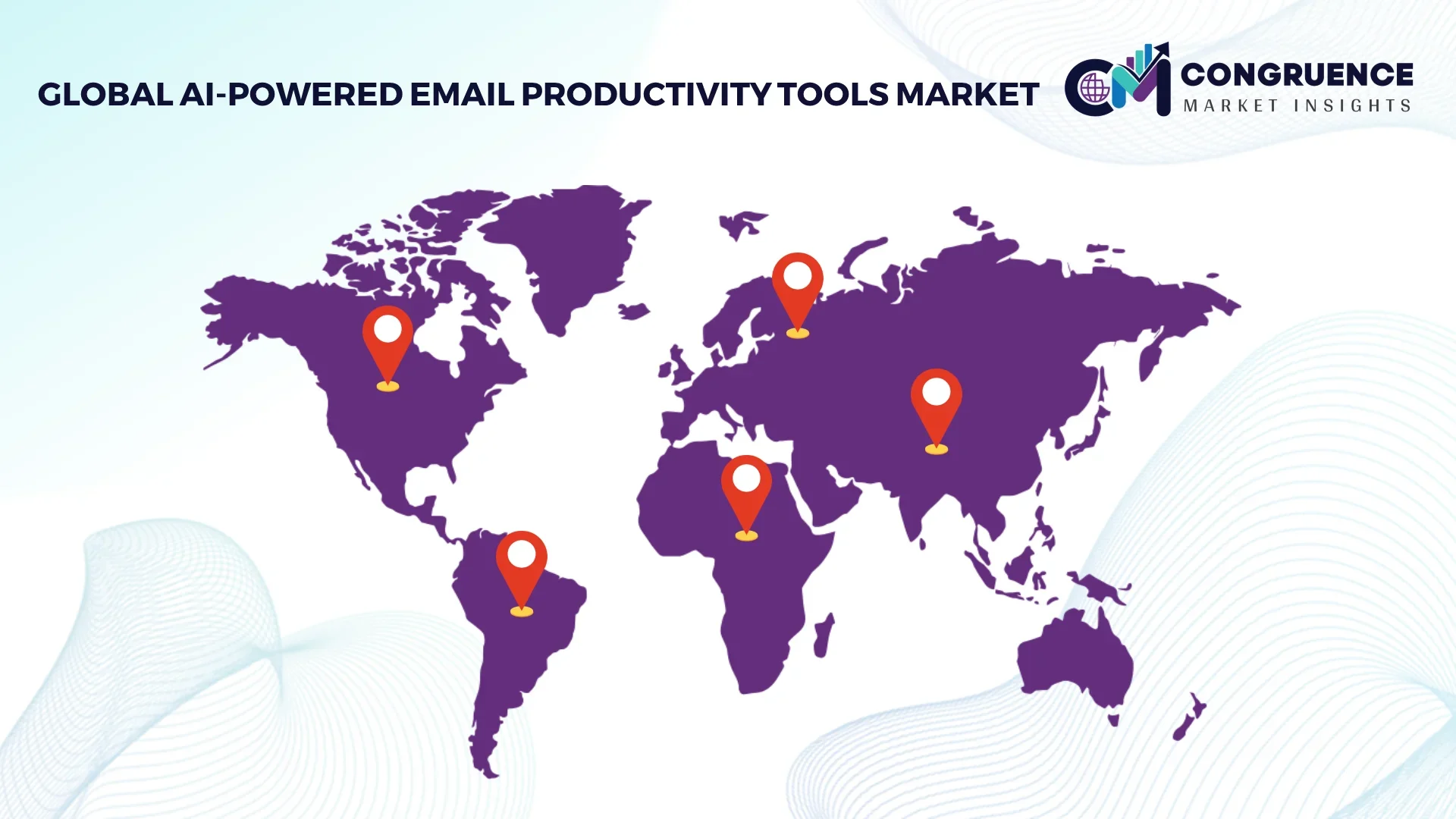
Region-wise performance in the AI-Powered Email Productivity Tools Market is shaped by digital workplace maturity, enterprise AI readiness, regulatory environments, and cloud infrastructure penetration. North America leads due to high enterprise AI integration, with over 70% of large organizations embedding AI into communication workflows. Europe follows with 28.4% share, driven by compliance-oriented deployments and explainable AI requirements. Asia Pacific, currently holding 21.9%, shows strong momentum supported by rapid SaaS adoption, mobile-first workforces, and SME digitalization across China, India, and Southeast Asia. South America and Middle East & Africa together account for 8.1%, where adoption is rising steadily due to multilingual automation needs, public-sector digitization, and expanding cloud access. Increasing regional differentiation in AI governance, data localization, and workforce structures continues to influence deployment strategies and investment priorities.
North America holds approximately 41.6% market share, reflecting early adoption of AI-driven productivity platforms across large enterprises. Key demand originates from BFSI, healthcare, IT services, and professional consulting, where email volumes exceed 120–150 emails per employee per day in client-facing roles. Regulatory clarity around enterprise AI use, combined with government-backed digital transformation initiatives, supports adoption, particularly in healthcare administration and financial compliance workflows. Technological advancements include deep integration of AI email copilots with CRM, ERP, and collaboration suites, enabling end-to-end workflow automation. Major local players are expanding contextual AI features such as intent recognition and compliance tagging across enterprise subscriptions. Consumer behavior shows higher adoption among regulated industries, with healthcare and finance enterprises exhibiting 20–25% higher deployment intensity than retail or media sectors.
Europe accounts for nearly 28.4% of the market, led by Germany, the UK, and France, which together contribute over 65% of regional demand. Strong regulatory oversight by data protection authorities has accelerated adoption of explainable and auditable AI email tools. Sustainability and digital sovereignty initiatives are encouraging enterprises to deploy AI systems that ensure transparency, traceability, and human-in-the-loop oversight. Adoption of emerging technologies such as multilingual NLP and compliance-aware AI models is particularly strong in financial services and public administration. Local software vendors are increasingly offering region-specific AI email solutions aligned with EU data residency norms. Consumer behavior reflects regulatory influence, with enterprises prioritizing explainable AI, resulting in over 58% of deployments incorporating compliance and audit features by default.
Asia-Pacific ranks third by market share at 21.9% but leads in growth momentum. China, India, and Japan collectively account for over 72% of regional consumption, driven by expanding digital enterprises and high SME density. Cloud infrastructure expansion and cost-efficient SaaS deployment models support rapid scaling. Innovation hubs in India, Singapore, and South Korea are driving advancements in multilingual AI, handling 20+ regional languages within enterprise email workflows. Local technology firms are embedding AI email assistants into super-app ecosystems and business communication platforms. Consumer behavior shows strong mobile usage, with over 60% of users accessing AI-powered email tools through mobile devices, especially in e-commerce, IT services, and outsourcing industries.
South America holds around 5.2% market share, with Brazil and Argentina accounting for nearly 68% of regional demand. Growth is supported by expanding digital infrastructure and increased adoption among media, marketing, and cross-border service industries. Governments are promoting digital inclusion and cloud adoption through tax incentives and technology modernization programs. AI-powered email tools are increasingly used for language localization, customer engagement, and regional sales coordination. Local software providers focus on Portuguese- and Spanish-optimized NLP models. Consumer behavior indicates demand tied closely to multilingual communication needs, with over 45% of adopters using AI tools primarily for translation, tone adaptation, and regional customer engagement.
Middle East & Africa represents approximately 2.9% of global demand, led by the UAE, Saudi Arabia, and South Africa. Adoption is driven by digital government programs, smart city initiatives, and enterprise modernization in oil & gas, construction, and financial services. Regional organizations are investing in AI-enabled productivity tools to manage multilingual and cross-border communications. Trade partnerships and cloud infrastructure investments are improving access to AI platforms. Local technology firms are integrating AI email tools with enterprise resource systems to support large project-based communications. Consumer behavior varies widely, with higher adoption in government and large enterprises, while SMEs show gradual uptake aligned with cloud migration progress.
United States – 31.8% Market Share: Dominates the AI-Powered Email Productivity Tools Market due to high enterprise AI penetration, advanced SaaS ecosystems, and large-scale deployment across regulated industries.
China – 14.6% Market Share: Holds a leading position driven by massive SME digitalization, strong domestic AI platforms, and widespread adoption of mobile-first productivity applications.
The competitive environment of the AI-Powered Email Productivity Tools Market is robust and increasingly dynamic, with 30+ active competitors ranging from global tech giants to agile startups. The market exhibits a moderately consolidated structure, where the top 5 companies collectively hold an estimated 58–63% combined share of enterprise deployments and platform integrations. Major incumbents such as Microsoft, Google, Salesforce, and Zoho maintain strong positioning through deep embedding of AI assistants within broader productivity ecosystems, while emerging innovators like Superhuman, Perplexity, and Missive carve niche specialization in autonomous email management and intelligent prioritization. Strategic initiatives such as partnerships with AI model providers, strategic acquisitions, platform integrations, and continuous feature enhancements drive competition. For example, Microsoft has expanded AI copilots across Outlook and Office workflows, and Google has overhauled Gmail with generative AI inbox features to streamline user tasks. The competitive landscape is also shaped by innovation trends including natural language thread summarization, contextual intent detection, predictive task orchestration, and AI-generated email drafting. Enterprise demand for integrated workflow intelligence and customizable AI agents fuels ongoing rivalry, while newcomers focus on specialized email automation, multilingual capabilities, and enhanced privacy controls to differentiate offerings. This environment pushes all players toward rapid product evolution and differentiated value propositions in both B2B and SMB segments.
Salesforce
Zoho
x.ai
Boomerang
Affinda
Amazon
Slack
Mailbutler
Clearbit
SaneBox
Missive
Spike
Salesforge
The AI-Powered Email Productivity Tools Market is powered by a suite of current and emerging technologies designed to automate, contextualize, and optimize enterprise email workflows. At the core, generative AI and large language models (LLMs) enable natural language understanding, intelligent drafting, summarization, sentiment analysis, and contextual prioritization. Platforms such as Microsoft Copilot embed AI directly into email clients like Outlook, enabling users to generate drafts, summarize attachments, and extract contextual tasks within the email interface. Similarly, Gmail’s AI Inbox and AI Overviews use advanced natural language processing to convert complex threads into actionable summaries, reducing manual scanning of high-volume inboxes. AI-driven intent detection, combined with contextual memory frameworks, allows systems to automatically classify, tag, and route communication based on urgency, topic, and workflow relevance.
Emerging technologies include AI-powered agent frameworks, where customizable no-code AI agents (like Workspace Studio) can be configured to perform multi-step tasks such as scheduling meetings, routing follow-ups, or generating task lists without explicit coding. Multimodal AI models integrate data from calendars, CRM systems, and document repositories to offer broader digital context beyond text. Predictive task orchestration uses historical patterns to predict likely next actions, integrating with enterprise workflows to accelerate decision-making. Continued innovation is seen in privacy-preserving AI, where local processing and data governance enhance enterprise compliance while maintaining responsiveness. Additionally, multilingual support engines expand the market’s reach across global enterprises by supporting diverse language datasets. These technologies collectively shape an ecosystem focused on productivity augmentation, secure automation, and seamless integration with enterprise tools, providing measurable efficiency gains for decision-makers and knowledge workers.
• In late 2025, Google introduced Workspace Studio within Google Workspace, enabling users to design and deploy custom AI-powered agents across Gmail, Drive, and Chat to automate routine tasks and complex workflows through intuitive interfaces. Source: www.timesofindia.indiatimes.com
• In early 2026, Google rolled out a new AI-powered “Inbox” view for Gmail that transforms email lists into personalized to-do lists and topic summaries, enhancing productivity with action suggestions and contextual prioritization. Source: www.theverge.com
• In October 2025, Grammarly rebranded as Superhuman, launching Superhuman Go, an integrated AI assistant operating across 100+ apps, automating email drafting, summarization, and workflow tasks to improve work efficiency. Source: www.techradar.com
• In late 2025, Perplexity launched its premium AI Email Assistant for Outlook and Gmail under its Max subscription, capable of automated inbox organization, prioritized replies, and calendar scheduling via AI agents. Source: www.windowscentral.com
The AI-Powered Email Productivity Tools Market Report offers a comprehensive examination of the ecosystem driving automated communication efficiency across enterprises, SMBs, and individual professionals. The report encompasses segmentation by product type, including text-based generative models, predictive intent detection engines, and agentic automation systems, as well as application areas such as customer engagement, compliance workflows, internal collaboration, and executive assistance. End-user insights are detailed across knowledge-intensive industries like finance, healthcare, technology, and professional services, delineating adoption trends, use-case prioritization, and deployment preferences.
Geographically, coverage spans North America, Europe, Asia-Pacific, South America, and Middle East & Africa, highlighting regional maturity, regulatory influences, and infrastructure readiness that shape technology uptake. The report quantifies technology adoption patterns, including integration depth with CRM, ERP, calendar, and AI agent frameworks, and explores advanced innovation vectors such as multilingual NLP, contextual task automation, and privacy-first AI operations. It also examines competitive positioning, strategic partnerships, and product rollouts, offering a multi-dimensional view of market dynamics for decision-makers.
In addition to established enterprise tools, the report identifies emerging segments such as on-device AI assistants, embedded workflow agents, and customizable no-code AI builder platforms. By synthesizing adoption statistics, organizational behavior insights, and innovation trends, the scope equips industry professionals with actionable intelligence to understand the breadth of AI email productivity solutions, anticipate future capabilities, and navigate investment and implementation strategies in a rapidly evolving digital workplace landscape.
| Report Attribute / Metric | Details |
|---|---|
| Market Revenue (2025) | USD 2,110.0 Million |
| Market Revenue (2033) | USD 9,695.4 Million |
| CAGR (2026–2033) | 21.0% |
| Base Year | 2025 |
| Forecast Period | 2026–2033 |
| Historic Period | 2021–2025 |
| Segments Covered |
By Type
By Application
By End-User Insights
|
| Key Report Deliverables | Revenue Forecast, Market Trends, Growth Drivers & Restraints, Technology Insights, Segmentation Analysis, Regional Insights, Competitive Landscape, Regulatory & ESG Overview, Recent Developments |
| Regions Covered | North America, Europe, Asia-Pacific, South America, Middle East & Africa |
| Key Players Analyzed | Microsoft, Superhuman, Perplexity, Google, Salesforce, Zoho, x.ai, Boomerang, Affinda, Amazon, Slack, Mailbutler, Clearbit, SaneBox, Missive, Spike, Salesforge |
| Customization & Pricing | Available on Request (10% Customization Free) |




