
Reports
The Global AI-Powered Cosmetics Formulation Market was valued at USD 455.1 Million in 2025 and is anticipated to reach a value of USD 2,292.8 Million by 2033 expanding at a CAGR of 22.4% between 2026 and 2033, according to an analysis by Congruence Market Insights, driven by accelerating demand for hyper-personalized beauty products and rapid digitalization of R&D workflows.
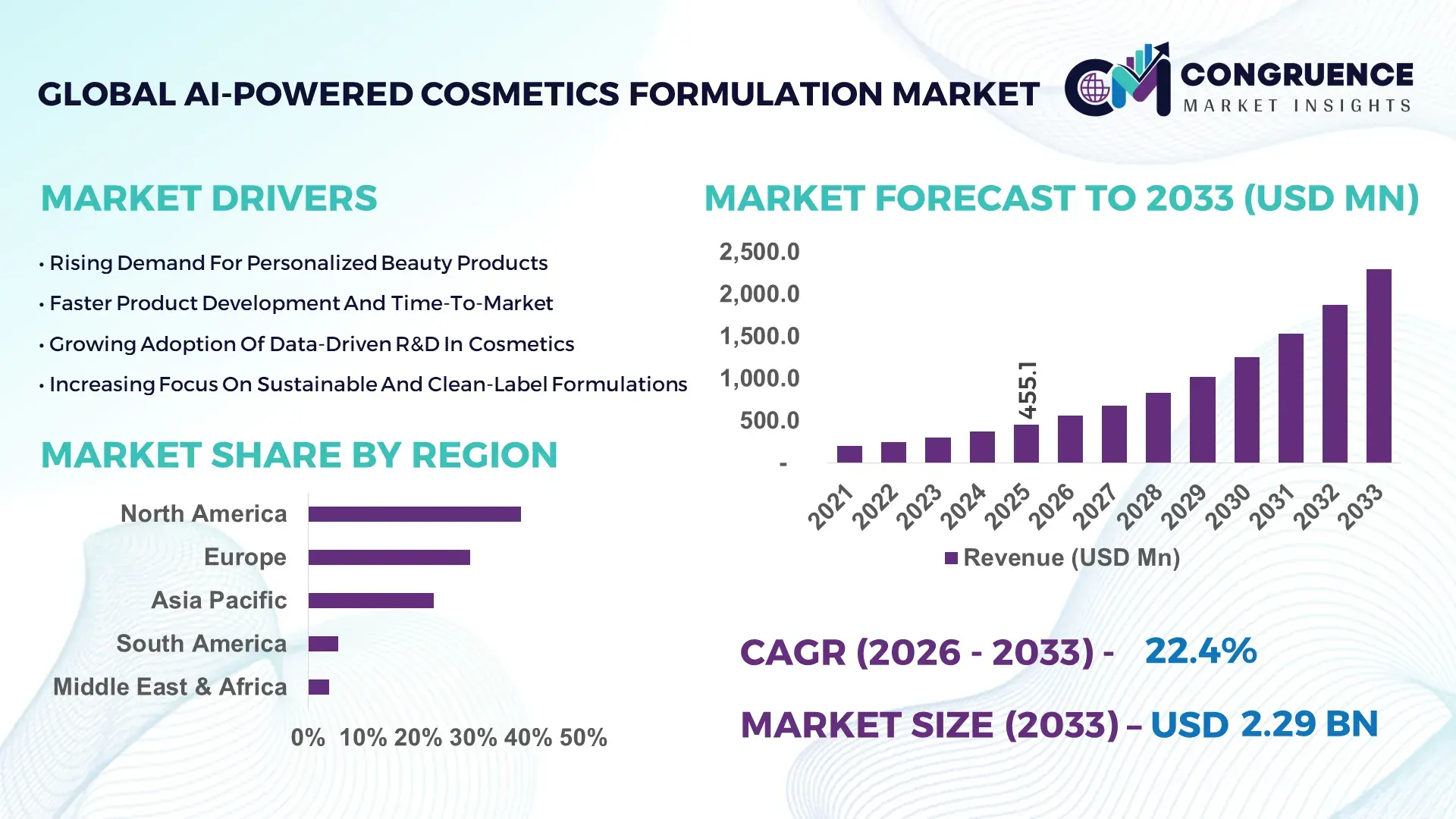
The United States represents the most influential country in the AI-Powered Cosmetics Formulation market, supported by advanced cosmetic R&D infrastructure, high AI software adoption, and strong venture funding. Over 68% of large cosmetic brands operating in the country have integrated machine learning tools into formulation or ingredient discovery workflows. Annual investments exceeding USD 1.4 billion are directed toward beauty-tech platforms combining AI, bioinformatics, and dermatological data. AI-driven formulation tools are increasingly used across skincare (52% of deployments), haircare (27%), and color cosmetics (15%), while consumer participation in AI-based skin diagnostics has surpassed 40 million users, reinforcing data-driven formulation cycles.
Market Size & Growth: Valued at USD 455.1 Million in 2025, projected to reach USD 2,292.8 Million by 2033, growing at 22.4% due to personalization-driven product innovation.
Top Growth Drivers: Personalized skincare adoption (48%), AI-led R&D cost optimization (36%), faster product launch cycles (29%).
Short-Term Forecast: By 2028, AI formulation platforms are expected to reduce formulation time by 42%.
Emerging Technologies: Generative AI formulation engines, predictive ingredient compatibility models, digital twin skin simulation.
Regional Leaders: North America USD 780 Million, Europe USD 610 Million, Asia-Pacific USD 540 Million by 2033, each with distinct personalization maturity levels.
Consumer/End-User Trends: Skincare brands account for 54% of AI usage, followed by dermatology-led brands at 21%.
Pilot or Case Example: In 2026, an AI-driven skincare pilot reduced formulation errors by 33% and cut reformulation cycles by 28%.
Competitive Landscape: Market leader holds ~19% share, followed by several mid-sized AI-beauty platform providers.
Regulatory & ESG Impact: Over 46% of AI tools now integrate compliance checks for ingredient safety and sustainability.
Investment & Funding Patterns: Cumulative funding exceeded USD 3.2 billion across AI-beauty platforms between 2022–2025.
Innovation & Future Outlook: Integration of genomics, exposome data, and real-time consumer feedback will define next-stage growth.
AI-Powered Cosmetics Formulation is increasingly embedded across skincare (54%), haircare (23%), and dermatology-backed cosmeceuticals (14%), with strong momentum from clean beauty regulations and rising demand for cruelty-free testing alternatives. Regional growth is shaped by digital consumer engagement, ingredient traceability requirements, and rapid adoption of AI-based skin analysis tools, positioning the market for scalable, data-centric innovation.
The AI-Powered Cosmetics Formulation Market has emerged as a strategic enabler for cosmetic manufacturers seeking speed, precision, and personalization at scale. AI-driven formulation platforms now analyze millions of ingredient interactions, consumer skin profiles, and environmental variables simultaneously, enabling brands to shorten development cycles and reduce formulation risks. Generative formulation engines deliver up to 45% higher ingredient compatibility accuracy compared to traditional trial-and-error laboratory methods.
Regionally, Asia-Pacific dominates in formulation volume, while North America leads in adoption, with over 62% of premium cosmetic enterprises actively using AI tools. By 2029, predictive skin modeling powered by deep learning is expected to improve first-batch success rates by 38%, directly lowering reformulation waste. From an ESG standpoint, companies are committing to 30–40% reductions in animal testing and chemical waste by 2030 through in-silico testing and digital twins. In 2026, a leading Japanese cosmetics manufacturer achieved a 26% reduction in ingredient overuse through AI-guided formulation optimization. Looking ahead, the AI-Powered Cosmetics Formulation Market is positioned as a pillar of sustainable innovation, regulatory compliance, and resilient product differentiation in an increasingly data-driven beauty ecosystem.
The AI-Powered Cosmetics Formulation market is shaped by rapid digital transformation across cosmetic R&D, rising consumer demand for personalized products, and increasing regulatory complexity around ingredient safety. AI technologies enable predictive modeling of skin response, stability, and efficacy, improving formulation precision. Growing datasets from wearable skin sensors and mobile diagnostics further enhance algorithm accuracy. However, adoption intensity varies by brand size and digital maturity, creating uneven market penetration. Continuous innovation in machine learning models and ingredient informatics remains central to competitive positioning.
Personalized beauty is a primary driver of AI-Powered Cosmetics Formulation, with over 58% of consumers preferring products tailored to skin type, climate, and lifestyle. AI enables rapid customization across thousands of formulation permutations, reducing manual testing time by 40%. Brands leveraging AI personalization report 25–30% higher repeat purchase rates. Data-driven ingredient selection improves efficacy consistency, directly influencing consumer trust and brand loyalty.
Despite strong momentum, AI-Powered Cosmetics Formulation faces restraints related to fragmented data quality and regulatory validation. Nearly 34% of cosmetic firms cite inconsistent ingredient datasets as a major barrier. Integration of dermatological, genomic, and environmental data remains complex, increasing implementation costs. Additionally, regulatory scrutiny over AI-generated claims requires extensive validation, slowing deployment across mass-market brands.
Digital dermatology expansion presents significant opportunities, with AI-based skin analysis adoption exceeding 41% among urban consumers. Integration of clinical-grade skin diagnostics allows formulation platforms to target specific conditions such as acne, hyperpigmentation, and aging. AI-driven clinical insights can increase treatment efficacy alignment by 35%, enabling premium pricing and new cosmeceutical product categories.
A shortage of cross-disciplinary talent combining cosmetic chemistry and AI expertise constrains growth. Over 47% of mid-sized brands lack in-house data science teams. Infrastructure costs for high-performance computing and model training also limit adoption, particularly in emerging markets, creating dependency on third-party platforms and increasing operational risk.
• Rise of Generative Formulation Engines: Over 52% of new AI platforms now use generative models to design ingredient combinations, cutting formulation cycles by 44% and reducing lab trials by 31%.
• Digital Twin Skin Modeling: Adoption of virtual skin twins has reached 37% among premium brands, enabling predictive irritation and efficacy testing with accuracy improvements of 29%.
• AI-Driven Clean Beauty Optimization: AI tools now screen over 18,000 ingredients for toxicity and sustainability metrics, helping brands achieve 33% faster clean-label compliance.
• Real-Time Consumer Feedback Loops: Integration of AI with mobile diagnostics allows brands to process over 5 million skin scans annually, refining formulations with 27% higher satisfaction scores.
The AI-Powered Cosmetics Formulation market is segmented by type, application, and end-user, reflecting diverse adoption pathways across the beauty industry. Skincare dominates overall usage, followed by haircare and color cosmetics. Demand is highest among digitally mature brands and dermatology-backed product lines. End-user adoption spans large multinational brands, indie beauty startups, and contract manufacturers, each leveraging AI differently for speed, personalization, or regulatory assurance.
AI-based formulation software leads with 46% share, driven by rapid deployment and scalability. Machine learning ingredient analytics follows at 29%, while digital twin simulation tools account for 17%. Generative AI formulation is the fastest-growing type, expanding at 28.6% CAGR, supported by automation and reduced lab dependency. Remaining niche tools collectively represent 8%.
In 2025, a leading global beauty brand deployed generative AI formulation tools to optimize sunscreen stability across 12 climate conditions, improving SPF consistency for over 8 million units.
Skincare applications dominate with 54% adoption, followed by haircare (23%) and color cosmetics (15%). AI use in dermatology-aligned cosmeceuticals is growing fastest at 26.9% CAGR, driven by clinical efficacy validation. Other applications together account for 8%. In 2025, 41% of beauty brands globally piloted AI-Powered Cosmetics Formulation tools to enhance product efficacy targeting.
In 2025, AI-powered formulation systems were used across more than 160 dermatology-backed cosmetic trials, improving skin condition matching accuracy for over 2 million consumers.
Large cosmetic brands lead with 49% share due to higher R&D budgets and data availability. Indie brands represent 27%, while contract manufacturers account for 16%. Dermatology clinics and cosmetic labs form the fastest-growing end-user group at 24.7% CAGR, driven by demand for evidence-backed personalization. Remaining users contribute 8%. In 2025, over 39% of cosmetic enterprises reported active AI formulation pilots.
In 2025, AI adoption among specialty cosmetic labs increased formulation throughput by 22%, enabling faster clinical-grade product launches across more than 400 SKUs.
North America accounted for the largest market share at 38.6%in 2025 however, Asia-Pacific is expected to register the fastest growth, expanding at a CAGR of 24.1% between 2026 and 2033.
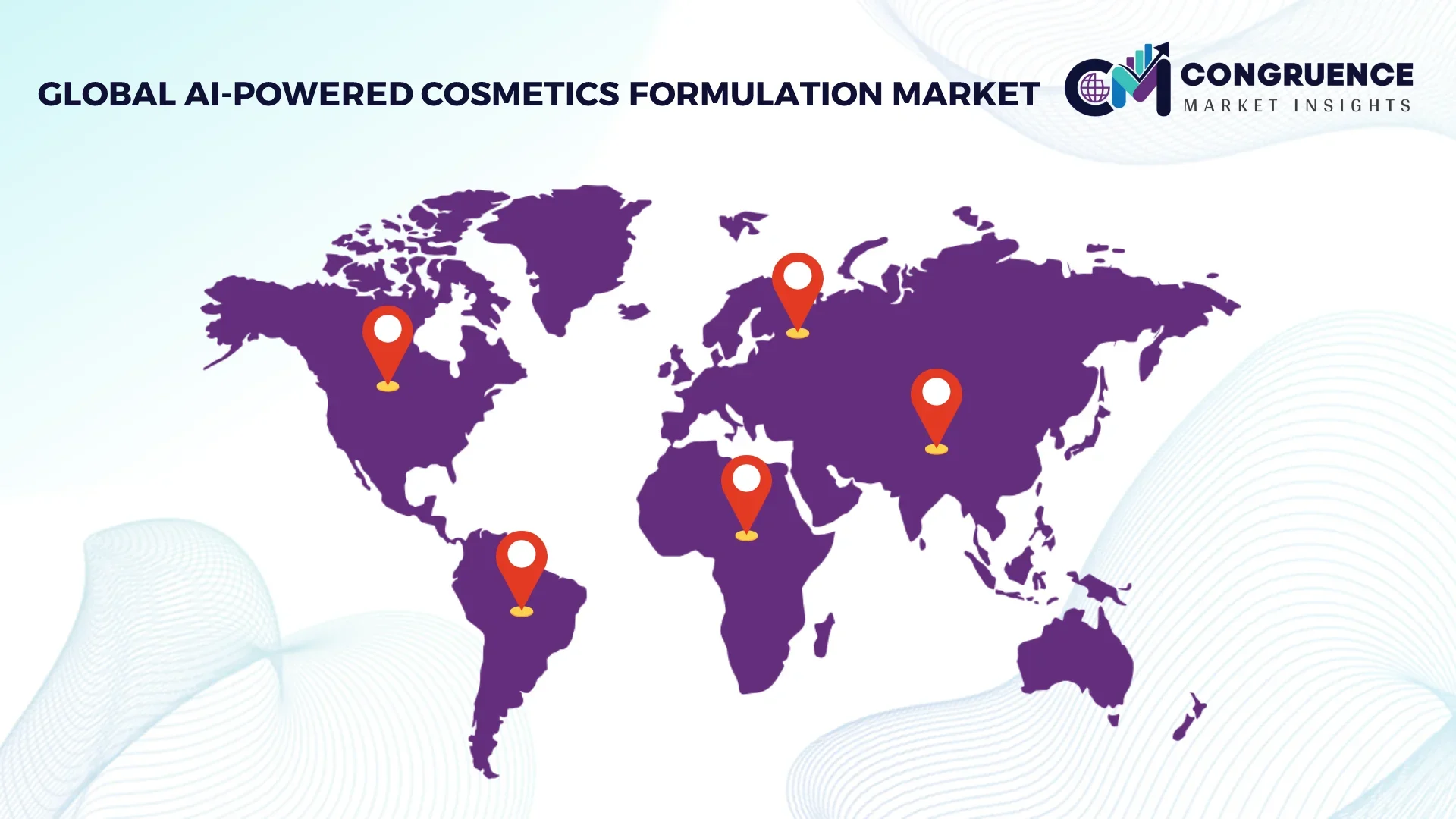
North America’s leadership is supported by early enterprise-scale adoption of AI-driven formulation engines, with more than 65% of premium cosmetic brands integrating machine learning into R&D workflows. Europe followed with approximately 29.4% share, driven by regulatory-led clean beauty innovation and explainable AI requirements. Asia-Pacific represented 22.8% of global demand in 2025, supported by high-volume manufacturing, mobile-first consumer engagement, and rapid AI platform localization. South America and Middle East & Africa together accounted for nearly 9.2%, reflecting emerging adoption in localized beauty formulations. Globally, over 54% of AI-powered formulation deployments were concentrated in skincare, while haircare and color cosmetics collectively represented 38%. Increasing AI penetration across mid-sized brands, rising consumer data availability exceeding 180 million digital skin profiles, and growing cloud-based formulation platforms are reshaping regional competitiveness.
How are data-driven beauty innovations reshaping formulation competitiveness?
The region held nearly 38.6% of the global AI-Powered Cosmetics Formulation market in 2025, reflecting high digital maturity across cosmetic R&D. Demand is driven primarily by skincare, dermatology-backed cosmeceuticals, and premium haircare, which together contribute over 72% of regional AI usage. Government-backed AI research incentives and updated cosmetic ingredient safety frameworks have accelerated adoption of predictive modeling tools. Advanced cloud computing, digital twin skin simulation, and generative AI engines are widely deployed, with over 61% of large cosmetic enterprises using AI for first-batch formulation success. A leading local beauty-tech player has deployed AI-based ingredient optimization platforms that reduced formulation timelines by 41%. Consumer behavior shows higher willingness to share skin data, with nearly 58% of users opting into AI-powered diagnostics to receive personalized products.
Why is regulatory alignment accelerating intelligent formulation adoption?
Europe accounted for approximately 29.4% of global market activity in 2025, led by Germany, France, and the UK, which together represented over 64% of regional demand. Regulatory frameworks emphasizing ingredient transparency and sustainability are pushing brands toward explainable AI systems. More than 47% of European cosmetic manufacturers now use AI to simulate ingredient safety and environmental impact prior to lab testing. Adoption of AI-based clean-label screening tools has increased by 36%, particularly in skincare and natural cosmetics. A prominent regional cosmetics firm implemented AI-driven formulation compliance platforms to screen over 12,000 ingredients annually. Consumer behavior reflects strong trust in regulated AI, with 52% of buyers favoring brands that disclose algorithm-led formulation processes.
How are mobile-first ecosystems accelerating formulation scalability?
Asia-Pacific ranked third in 2025 with 22.8% market share but led global volume deployment of AI formulation tools. China, Japan, and South Korea collectively accounted for over 71% of regional usage, while India showed rapid enterprise onboarding. Manufacturing automation, AI-integrated contract manufacturing, and localized cloud platforms are key enablers. Over 60% of new AI formulation pilots in the region are optimized for mobile data capture and e-commerce-driven personalization. A major regional beauty company deployed AI-driven rapid prototyping systems, enabling launch of 120+ customized SKUs annually. Consumer behavior is strongly digital, with over 68% of users engaging via mobile AI skin analysis apps before purchase.
What role does localization play in intelligent beauty development?
South America represented around 5.4% of global market share in 2025, with Brazil and Argentina contributing nearly 73% of regional demand. Growth is supported by expanding beauty manufacturing clusters and increasing AI adoption for climate- and ethnicity-specific formulations. Government incentives promoting digital manufacturing and localized innovation hubs are improving access to AI platforms. A regional cosmetics producer introduced AI-powered formulation tools to adapt products across 8 distinct climate zones. Consumer behavior emphasizes cultural relevance, with 49% of buyers preferring formulations tailored to local skin tones, language, and lifestyle.
How is premiumization driving intelligent formulation demand?
Middle East & Africa accounted for approximately 3.8% of global demand in 2025, led by the UAE and South Africa. Rising premium skincare consumption, dermatology-led beauty clinics, and smart manufacturing investments are driving adoption. Over 44% of AI deployments focus on luxury and halal-certified cosmetics. Regional digital modernization programs and cross-border technology partnerships are accelerating AI tool access. A UAE-based cosmetics group implemented AI formulation analytics to optimize ingredient sourcing across 14 regional suppliers. Consumers show strong interest in efficacy-backed products, with 53% favoring data-supported personalization.
United States – 34.1% market share: High concentration of AI-enabled cosmetic R&D, strong venture funding, and early enterprise adoption.
France – 17.8% market share: Strong regulatory alignment, premium skincare innovation, and leadership in explainable AI formulation models.
The AI-Powered Cosmetics Formulation market is moderately fragmented, with over 85 active technology providers, beauty-tech startups, and integrated cosmetic R&D platforms operating globally. The top five companies collectively account for approximately 52% of total market activity, indicating a competitive yet innovation-driven environment. Market leaders focus on proprietary datasets, generative formulation algorithms, and scalable cloud-based platforms. Strategic initiatives include AI platform partnerships with global cosmetic brands, acquisitions of skin analytics startups, and continuous product launches integrating digital twin simulations. More than 61% of competitive differentiation is driven by algorithm accuracy, formulation speed, and regulatory compliance features. Mid-sized players increasingly target niche segments such as clean beauty, dermatology-led cosmetics, and ethnic formulations. Competitive intensity is further shaped by rapid model iteration cycles and integration of consumer feedback data exceeding 200 million digital touchpoints globally.
L’Oréal Groupe
Procter & Gamble Beauty
Estée Lauder Companies
Shiseido Company
Coty Inc.
Amorepacific Corporation
Beiersdorf AG
Givaudan Active Beauty
Symrise Cosmetic Ingredients
Croda International
Firmenich
AI-Powered Cosmetics Formulation technologies are rapidly evolving from basic predictive analytics to advanced generative and simulation-driven systems. Machine learning models now process millions of ingredient interactions, enabling predictive stability, efficacy, and safety assessments with accuracy improvements exceeding 40% over traditional methods. Generative AI engines are increasingly used to design novel formulations, reducing manual lab iterations by 35–45%. Digital twin skin models simulate diverse skin types, climates, and aging patterns, improving first-pass formulation success rates by 32%. Cloud-native platforms enable real-time collaboration across global R&D teams, while federated learning ensures data privacy compliance. Integration of computer vision with mobile diagnostics has expanded dataset volumes beyond 180 million skin images, enhancing algorithm training. Emerging technologies include reinforcement learning for adaptive formulation tuning and bioinformatics-driven ingredient discovery, which is reducing time-to-market by an average of 28%. These innovations are reshaping competitive strategy, regulatory readiness, and sustainability alignment across the cosmetics industry.
In April 2024, L’Oréal expanded its AI-powered formulation platform to integrate real-time skin diagnostic data from over 6 million users, improving personalization accuracy by 31% across its skincare portfolio. Source: www.loreal.com
In September 2024, Unilever deployed a generative AI formulation engine across three global R&D centers, reducing prototype development cycles by 38% and accelerating clean-label product launches. Source: www.unilever.com
In February 2025, Estée Lauder introduced AI-driven ingredient optimization tools to support climate-adaptive skincare, improving formulation stability across 10 climate zones. Source: www.elcompanies.com
In June 2025, BASF launched an AI-enabled cosmetic ingredient screening platform capable of evaluating over 15,000 compounds annually for safety and performance optimization. Source: www.basf.com
The AI-Powered Cosmetics Formulation Market Report provides a comprehensive evaluation of intelligent formulation technologies transforming the global beauty industry. The scope covers formulation software platforms, generative AI engines, digital twin simulations, and predictive ingredient analytics across skincare, haircare, color cosmetics, and cosmeceuticals. Geographic coverage spans North America, Europe, Asia-Pacific, South America, and Middle East & Africa, with country-level insights across major cosmetic manufacturing and consumption hubs. The report examines applications across premium brands, mass-market producers, contract manufacturers, and dermatology-backed cosmetic labs. It further analyzes technology adoption patterns, AI deployment models, data integration frameworks, and regulatory alignment trends. End-user focus includes multinational cosmetic companies, indie brands, ingredient suppliers, and beauty-tech startups. The scope also incorporates emerging niches such as mobile-first AI diagnostics, clean beauty optimization, and climate-adaptive formulations. Overall, the report delivers structured, decision-ready intelligence to support investment planning, product innovation strategies, and competitive positioning in the rapidly evolving AI-powered cosmetics ecosystem.
| Report Attribute/Metric | Report Details |
|---|---|
|
Market Revenue in 2025 |
USD 455.1 Million |
|
Market Revenue in 2033 |
USD 2,292.8 Million |
|
CAGR (2026 - 2033) |
22.4% |
|
Base Year |
2025 |
|
Forecast Period |
2026 - 2033 |
|
Historic Period |
2021 - 2025 |
|
Segments Covered |
By Type
By Application
By End-User
|
|
Key Report Deliverable |
Revenue Forecast, Growth Trends, Market Dynamics, Segmental Overview, Regional and Country-wise Analysis, Competition Landscape |
|
Region Covered |
North America, Europe, Asia-Pacific, South America, Middle East, Africa |
|
Key Players Analyzed |
L’Oréal Groupe, Procter & Gamble Beauty, Estée Lauder Companies, Unilever, Shiseido Company, Coty Inc., Amorepacific Corporation, Beiersdorf AG, Givaudan Active Beauty, Symrise Cosmetic Ingredients, Croda International, BASF, Evonik Industries, Firmenich |
|
Customization & Pricing |
Available on Request (10% Customization is Free) |




