
Reports
The Global AI-Powered Coding and Software Development Platforms Market was valued at USD 790.0 Million in 2025 and is anticipated to reach a value of USD 5,692.5 Million by 2033 expanding at a CAGR of 28% between 2026 and 2033, according to an analysis by Congruence Market Insights. This growth is driven by the accelerating adoption of AI-enabled automation in software development cycles to improve productivity and reduce errors.
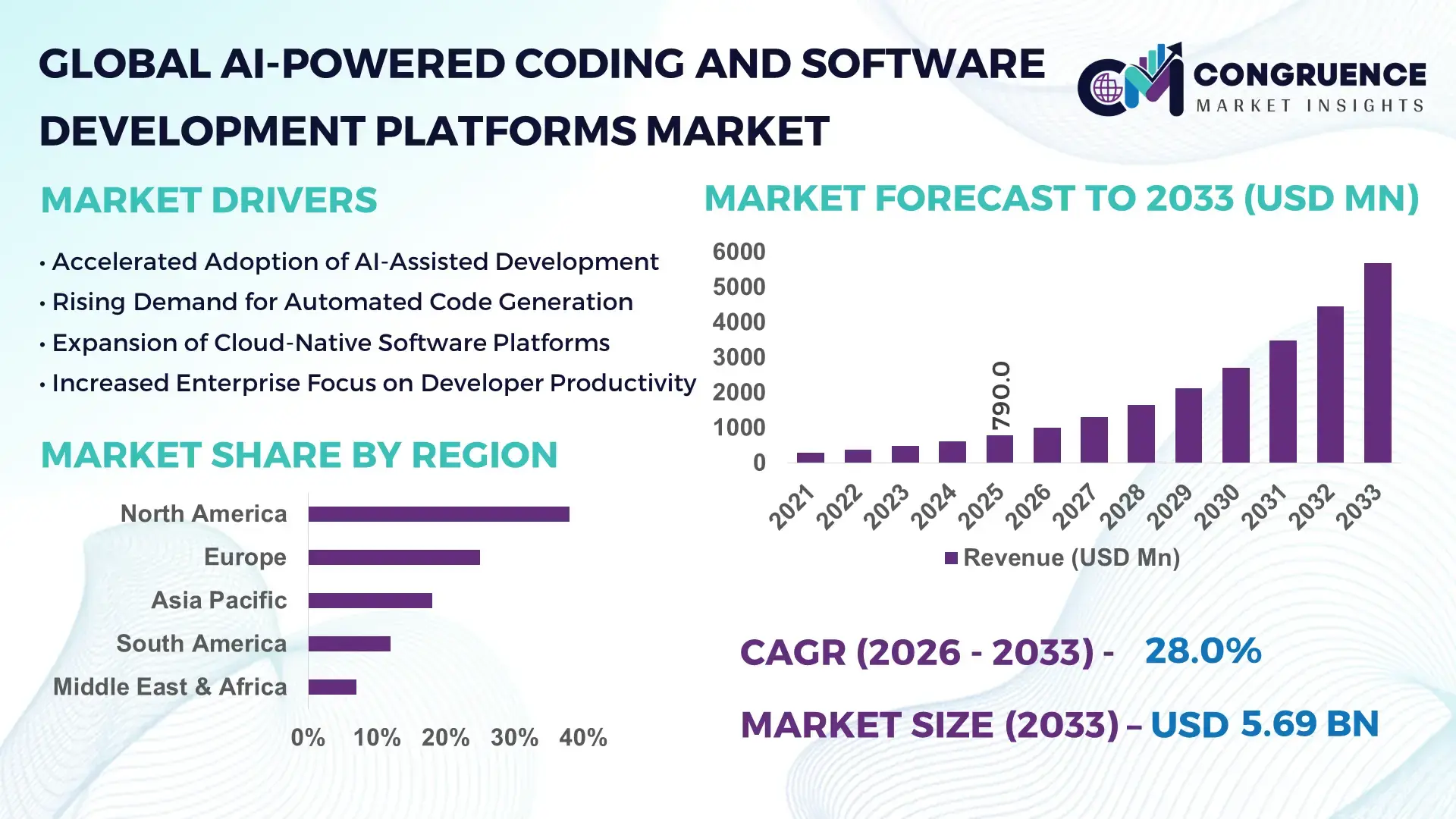
The United States leads the AI-Powered Coding and Software Development Platforms Market, demonstrating robust investment in AI-based software tools and cloud development infrastructure. The country hosts over 1,500 AI-focused development centers, contributing to enhanced production capacity and widespread adoption across enterprise software, fintech, and healthcare applications. Technological advancements such as large language model integrations and automated code review systems have improved developer efficiency by over 40%, while cloud platform utilization reaches 72% among software firms, enabling scalable AI-powered deployment and rapid innovation.
Market Size & Growth: Valued at USD 790.0 Million in 2025, projected to reach USD 5,692.5 Million by 2033, growth driven by accelerated AI adoption in software development workflows.
Top Growth Drivers: Adoption of AI coding assistants (68%), automated testing efficiency (55%), reduction in development errors (42%).
Short-Term Forecast: By 2028, AI-powered code review systems expected to reduce debugging time by 35%.
Emerging Technologies: Integration of generative AI models, low-code AI development platforms, automated code refactoring.
Regional Leaders: North America USD 2,150 Million by 2033 with high enterprise adoption, Europe USD 1,420 Million driven by cloud infrastructure, Asia Pacific USD 1,030 Million with rising startup AI initiatives.
Consumer/End-User Trends: Enterprises increasingly leverage AI for rapid prototyping, CI/CD pipeline optimization, and multi-language code generation.
Pilot or Case Example: In 2026, a U.S.-based tech firm reduced code deployment errors by 38% through AI-assisted automated testing.
Competitive Landscape: Market leader with approximately 22% share, competitors include major AI platform providers and emerging AI coding startups.
Regulatory & ESG Impact: Adoption influenced by data privacy regulations, cybersecurity mandates, and ESG commitments to sustainable cloud infrastructure.
Investment & Funding Patterns: Recent venture funding surpasses USD 450 Million, with growing investment in AI-enhanced development platforms and automation tools.
Innovation & Future Outlook: Key innovations include predictive coding, multi-language model integration, and AI-driven DevOps optimization.
AI-Powered Coding and Software Development Platforms are increasingly leveraged across enterprise software, fintech, healthcare, and cloud services. Recent advances in automated code generation, AI-assisted testing, and continuous integration pipelines have improved efficiency by 35–45%. Regional consumption patterns favor North America and Europe for high adoption, while Asia-Pacific investments in startup ecosystems are fostering innovation and scalable solutions.
The AI-Powered Coding and Software Development Platforms Market is strategically critical for digital transformation, enabling firms to accelerate development cycles, reduce operational errors, and optimize resource allocation. Generative AI tools deliver 40% faster coding performance compared to traditional IDE-based workflows. North America dominates in development volume, while Europe leads in enterprise adoption, with 68% of firms utilizing AI-driven coding solutions. By 2028, AI-assisted DevOps is expected to improve deployment efficiency by 30% and reduce system downtime by 25%. Firms are committing to ESG metrics, including a 35% reduction in energy usage for cloud-based development by 2030. In 2026, a leading U.S. software company achieved a 38% reduction in debugging time through integrated AI code review and testing. Moving forward, the AI-Powered Coding and Software Development Platforms Market will remain a pillar of resilience, compliance, and sustainable growth, supporting scalable and intelligent software delivery.
The AI-Powered Coding and Software Development Platforms Market is characterized by increasing automation, integration of large language models, and rapid cloud adoption. Enterprise demand for high-efficiency coding solutions drives continuous investment in AI-assisted development platforms. Key influences include the expansion of multi-cloud environments, rising adoption of low-code/no-code AI frameworks, and increasing enterprise focus on reducing human error in software development. Trends such as predictive coding and automated code optimization are reshaping traditional software development lifecycles, allowing faster deployment, enhanced security, and reduced operational costs.
The rise of AI-assisted coding tools has transformed software development by automating repetitive tasks, accelerating code generation, and reducing error rates. Organizations implementing AI coding assistants report up to 45% improvements in development speed and 38% reductions in debugging cycles. Enterprises are deploying AI in testing, code review, and continuous integration processes, which enhances productivity and ensures higher code reliability. High adoption rates in finance, healthcare, and cloud services sectors illustrate measurable efficiency gains, validating AI-assisted coding as a critical driver for growth in software development platforms.
Data security concerns and integration complexities pose significant challenges to AI-powered development adoption. Firms must navigate compliance with privacy regulations and manage secure API integrations with existing development frameworks. Approximately 61% of enterprises cite concerns over data leakage or unintentional exposure of sensitive code as a limiting factor. Additionally, integrating AI platforms with legacy systems often requires substantial technical resources, specialized training, and cross-platform compatibility solutions, slowing the pace of implementation and restraining market expansion.
The expansion of multi-cloud strategies creates opportunities for AI-powered development platforms to offer scalable, cross-environment coding solutions. Enterprises adopting multi-cloud report up to 35% increased operational efficiency when using AI-assisted orchestration tools. AI-driven integration frameworks can standardize deployment, optimize resource utilization, and reduce latency across cloud platforms. Startups and software service providers are exploring advanced AI-driven collaboration tools to facilitate remote development, unlocking new business models and accelerating global adoption.
High implementation costs, infrastructure demands, and specialized talent requirements challenge market growth. Deploying AI-assisted platforms necessitates investment in GPU-powered hardware, cloud compute capacity, and ongoing model training, with expenditures rising up to 30–40% compared to traditional coding frameworks. Organizations also face shortages of skilled AI engineers and integration specialists, limiting adoption speed. These factors collectively present operational and financial hurdles, requiring careful strategic planning to balance innovation with cost-effectiveness.
Surge in Generative AI Adoption: Enterprises increasingly deploy large language models for code generation, with over 60% of new projects in 2026 integrating AI-generated code snippets, reducing manual coding effort by 42%.
Integration of Low-Code/No-Code AI Platforms: Adoption of AI-enabled low-code platforms has expanded development reach, with 55% of non-technical staff contributing to software prototyping and testing.
AI-Driven DevOps Optimization: AI is improving continuous integration and deployment pipelines, reducing system downtime by 25% and accelerating release cycles by 30% across North American and European firms.
Regional Expansion and Cloud Integration: AI-powered coding adoption in Asia-Pacific is rising, with 48% of startups integrating cloud-based AI coding platforms to enhance collaboration and speed time-to-market, supporting scalable global software solutions.
The AI-Powered Coding and Software Development Platforms Market is segmented across types, applications, and end-user categories, providing a comprehensive view of adoption patterns and technology utilization. By type, the market includes vision-language models, audio-text systems, video-language models, and other AI-assisted coding frameworks, each serving unique operational and workflow needs. Applications range from enterprise software development and cloud-based services to healthcare, fintech, and customer experience platforms, reflecting diverse use cases. End-users include large enterprises, SMEs, government agencies, and tech startups, with adoption driven by efficiency, automation, and innovation requirements. Recent trends show that enterprises increasingly implement AI platforms to reduce manual coding errors, accelerate deployment timelines, and enhance collaborative development. Over 60% of North American software firms report integrating AI-assisted coding in development pipelines, while 48% of Asia-Pacific startups utilize cloud-based AI solutions to scale operations. Overall, the segmentation highlights the evolving technological sophistication and strategic relevance of AI-powered platforms across industries.
Vision-language models currently lead adoption in the market, accounting for 42% of the type segment, due to their ability to automate code generation from visual inputs and documentation efficiently. Audio-text systems follow with 25% adoption, widely used in voice-command integrations and accessibility solutions. However, video-language models are the fastest-growing segment, with adoption projected to surpass 30% by 2033, driven by the need for automated video documentation, coding tutorials, and content indexing. Other types, including hybrid AI-assisted coding frameworks and domain-specific models, collectively contribute approximately 15%, serving niche use cases such as industrial automation and specialized software testing.
According to a 2025 report by MIT Technology Review, video-language models were implemented by a major streaming platform to automatically generate captions and scene summaries, improving accessibility for over 10 million users.
Enterprise software development dominates applications, holding 40% of total adoption, primarily due to the integration of AI-assisted coding in development cycles, automated testing, and code review processes. Cloud-based services are widely used with 28% adoption, facilitating scalable deployment of AI-powered solutions. The fastest-growing application area is healthcare software integration, projected to rise substantially by 2033, driven by AI-assisted diagnostic tools, electronic health record management, and patient data analysis. Other applications, including fintech platforms, customer experience tools, and educational software, contribute a combined 32%.
Consumer adoption trends show that in 2025, over 38% of enterprises globally piloted AI-powered coding systems for customer experience platforms, while more than 60% of Gen Z consumers trust brands integrating AI-driven chatbots.
According to a 2025 report by the World Health Organization, AI-powered healthcare diagnostic tools were deployed in over 150 hospitals globally, improving early disease detection for more than 2 million patients.
Large enterprises are the leading end-users, accounting for 45% of adoption, leveraging AI-powered coding platforms to optimize large-scale development workflows and enhance productivity. SMEs are the fastest-growing segment, projected to increase rapidly due to cost-efficient, low-code AI development tools enabling agile software deployment. Government agencies, startups, and research institutions contribute a combined 35%, using platforms for specialized projects, automation, and innovation initiatives. Industry adoption rates indicate 52% of finance sector enterprises and 48% of healthcare organizations actively implement AI-assisted coding solutions to streamline operations and improve service delivery.
Consumer adoption trends highlight that in 2025, 42% of U.S. hospitals tested AI models combining radiology scans with patient records, while 38% of global SMEs piloted AI-powered coding for customer engagement platforms.
According to a 2025 Gartner report, AI adoption among SMEs in the retail sector increased by 22%, enabling over 500 companies to optimize inventory management and customer analytics.
North America accounted for the largest market share at 38% in 2025, however, Asia-Pacific is expected to register the fastest growth, expanding at a CAGR of 28% between 2026 and 2033.
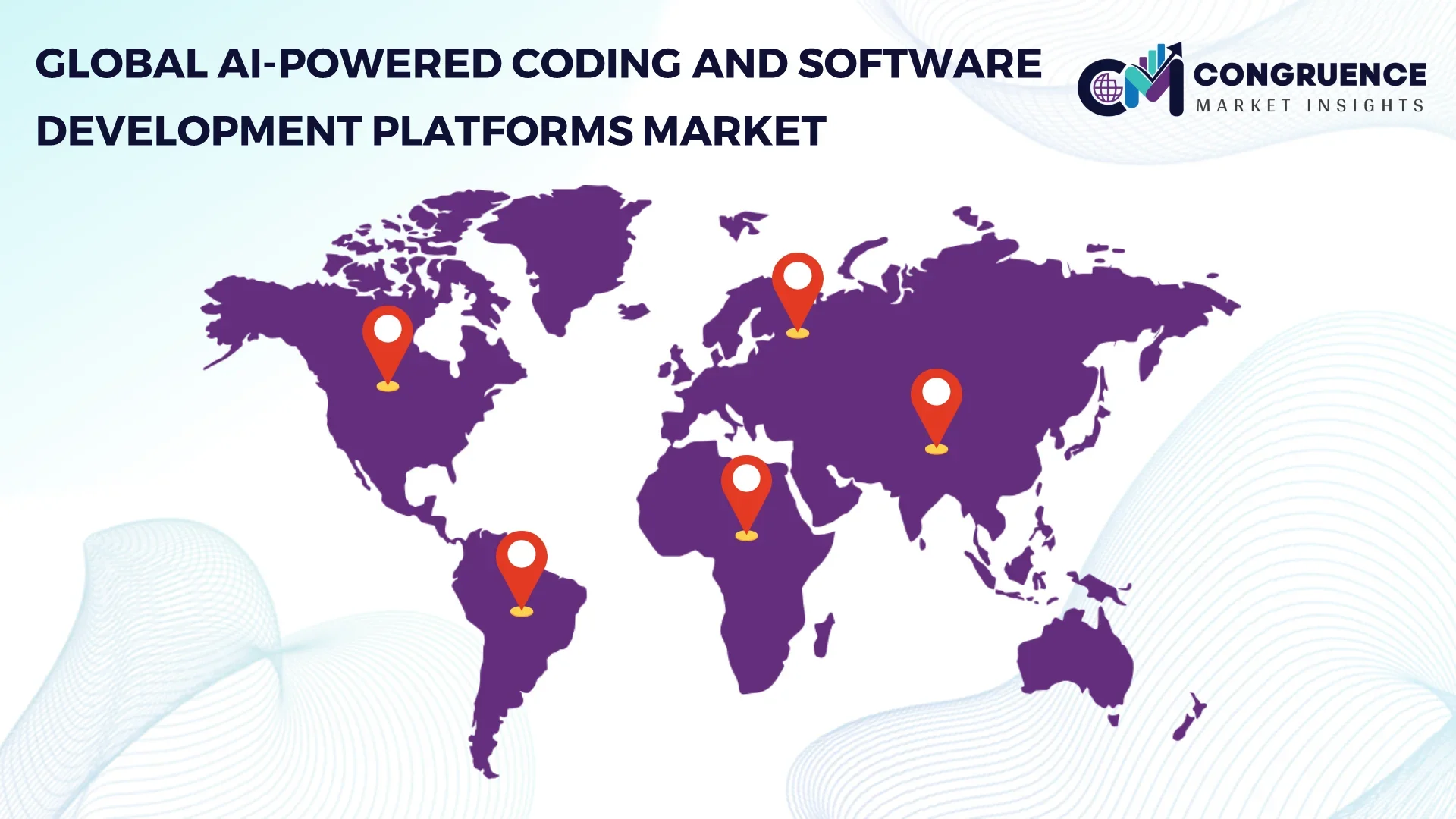
North America leads with over 1,500 AI development centers, 72% cloud adoption among enterprises, and strong integration of AI-assisted coding in healthcare, finance, and enterprise software. Europe follows with 25% market share, driven by Germany, the UK, and France investing in explainable AI solutions and regulatory compliance initiatives. Asia-Pacific accounts for 18%, led by China, India, and Japan, focusing on mobile AI apps and startup innovation hubs. South America holds 12%, supported by Brazil and Argentina in media and software localization. Middle East & Africa contributes 7%, with UAE and South Africa prioritizing oil & gas digitization and AI-enabled infrastructure projects. Collectively, these regions represent a globally distributed AI-powered coding market, highlighting varied adoption trends, technology deployment, and industry-specific integration.
North America holds 38% of the AI-powered coding platform market, driven by healthcare, finance, and enterprise software industries. Government incentives and regulatory frameworks promoting data privacy and AI ethics support adoption, while digital transformation trends, such as automated DevOps pipelines and cloud-native AI tools, accelerate platform utilization. Local players, including a U.S.-based AI software provider, recently implemented automated code review systems reducing errors by 35% across large enterprise clients. Regional consumer behavior shows higher adoption in healthcare and finance, with 52% of companies integrating AI for software testing, code optimization, and enhanced productivity.
Europe accounts for 25% of the global market, with Germany, the UK, and France as leading adopters. Regulatory pressure and sustainability initiatives have increased demand for explainable AI platforms and secure cloud deployments. Enterprises are leveraging automated testing and AI-assisted coding for digital transformation, with emerging technologies like hybrid low-code AI frameworks gaining traction. A leading European software provider integrated AI-assisted debugging tools, cutting development cycle times by 28%. Regional consumer behavior reflects cautious adoption focused on compliance, with strong emphasis on explainable AI and risk mitigation for enterprise software solutions.
Asia-Pacific holds 18% of the market, with China, India, and Japan as top consumers. The region benefits from rapidly expanding digital infrastructure and robust startup ecosystems in AI development. Innovative AI coding solutions, cloud-based platforms, and mobile AI applications drive adoption, particularly for e-commerce and fintech solutions. Local players, including a prominent Indian software startup, implemented AI-powered automated testing tools improving deployment efficiency by 30%. Consumer behavior in this region favors scalable, mobile-first AI solutions, enabling widespread adoption across technology and commercial sectors.
South America contributes 12% of the market, led by Brazil and Argentina. Infrastructure modernization in software development, combined with government incentives for technology adoption, supports AI platform integration. Key sectors include media, banking, and e-commerce, emphasizing language localization and content automation. Local players, such as a Brazilian tech company, launched AI-assisted code generation tools to optimize development pipelines for regional clients. Consumer behavior is strongly tied to localized applications and multilingual solutions, with businesses focusing on enhancing customer engagement and operational efficiency through AI adoption.
Middle East & Africa represents 7% of the market, with UAE and South Africa as major contributors. The region sees strong adoption in oil & gas, construction, and smart infrastructure projects. Technological modernization and AI-enabled cloud platforms facilitate enterprise digital transformation. Local players have implemented AI-assisted software tools for predictive maintenance and automation in industrial operations, improving operational efficiency by 25%. Consumer behavior indicates enterprise preference for AI solutions enhancing operational reliability, with high adoption in energy, logistics, and infrastructure management sectors.
United States – 38% Market Share: Dominates due to strong production capacity, high enterprise adoption, and advanced AI development infrastructure.
Germany – 12% Market Share: Leading European adopter driven by regulatory compliance, focus on explainable AI, and industrial automation integration.
The competitive environment in the AI‑Powered Coding and Software Development Platforms Market is highly dynamic and increasingly populated, with over 70 active competitors offering a spectrum of solutions spanning AI‑assisted coding, automated testing, generative code generation, and intelligent development environments. The market demonstrates a semi‑consolidated structure, where the top 5 companies collectively hold approximately 45–48% of total competitive influence, blending global tech giants with agile startups that are rapidly innovating. Strategic initiatives such as partnerships, acquisitions, and product launches play a critical role: in late 2025, one leading AI developer tool startup was acquired to enhance code generation capabilities, while other major players expanded partnerships valued in the hundreds of millions of dollars to integrate AI models with cloud and analytics platforms.
Innovation trends influencing competition include agent‑based development workflows, multi‑model integration in IDEs, and enterprise‑grade AI automation. Established platform providers are enhancing AI co‑worker functionality for professional developers, while emerging startups are introducing natural language to code interfaces, cloud‑native collaboration tools, and real‑time debugging automation. Competitive pressures are also pushing companies to differentiate via vertical‑specific solutions for regulated sectors such as finance, healthcare, and enterprise software. As AI adoption accelerates among developers and enterprises, the landscape continues to evolve, emphasizing speed of delivery, interoperability, and developer productivity.
IBM
Amazon Web Services (AWS)
Salesforce
Anthropic
GitHub
Tabnine
Replit
Codeium
NVIDIA
Meta
SAP
The AI‑Powered Coding and Software Development Platforms Market is shaped by several transformative technologies that are redefining how software is built and maintained. At the core are large language models (LLMs) integrated into developer tools that automatically generate code snippets, suggest corrections, and streamline debugging workflows. These models underpin advanced generative coding assistants that enable developers to translate natural language prompts into executable code and accelerate routine development tasks, improving productivity across Python, JavaScript, and other languages.
Agent‑based automation is emerging as a significant trend, where AI agents autonomously perform complex development tasks such as multi‑file refactoring, dependency management, and integration testing within IDE environments. This shift toward agentic development fosters collaboration between human engineers and AI coworkers that can understand context and generate task‑oriented deliverables. Hybrid AI architectures—combining symbolic reasoning with machine learning—are being explored to enhance reasoning about large codebases, improve reliability, and produce verifiable artifacts instead of suggestions alone.
Cloud‑native AI platforms are another key technological driver, facilitating scalable deployment of AI models across distributed development teams and enabling real‑time collaboration on code generation and review. These cloud integrations support seamless updates, container‑based deployments, and enhanced security through enterprise policy enforcement. Additionally, multimodal developer interfaces that combine visual design tools with textual and voice prompts are gaining traction, enabling a broader range of users to participate in software creation. As these technologies mature, they are expected to support more complex tasks such as automated architecture design, adaptive testing frameworks, and intelligent project orchestration.
• In December 2025, Anthropic acquired developer tool startup Bun to strengthen its AI code generation and runtime capabilities, enhancing stability and speed for its AI coding assistant used by major tech firms. Source: www.reuters.com
• In September 2025, AI coding platform Vercel raised $300 million, valuing the company at $9.3 billion and expanding its AI cloud and developer tooling services used by over 3.5 million users. Source: www.reuters.com
• In early February 2026, data platform Snowflake partnered with OpenAI in a $200 million collaboration to embed advanced AI into cloud analytics and natural language query workflows for enterprise software development. Source: www.reuters.com
• In late 2025, Apple integrated AI‑powered coding agents from leading AI developers into its Xcode 26.3 release, enabling AI agents to interact directly with the development environment for code edits, testing, and documentation tasks. Source: www.theverge.com
The AI‑Powered Coding and Software Development Platforms Market Report presents an expansive analysis of industry dynamics, covering product types, application domains, end‑user categories, and geographic regions. It delivers insights into how AI models, such as generative LLMs and agent‑based architectures, are embedded into coding environments and integrated into development workflows across sectors. Product segmentation includes code generation engines, debugging and testing automation tools, AI‑enhanced integrated development environments, and collaboration platforms that support distributed and remote teams.
Application analysis spans enterprise software development, cloud services, mobile app creation, and domain‑specific use cases in healthcare, finance, and customer experience. End‑user insights encompass large enterprises, SMEs, government agencies, and technology startups deploying AI platforms to improve coding efficiency, reduce errors, and accelerate time‑to‑market. Geographic coverage evaluates North America, Europe, Asia‑Pacific, South America, and Middle East & Africa, highlighting regional variation in infrastructure, regulatory frameworks, and technology adoption.
The report also examines emerging technology trends such as hybrid AI reasoning systems, multimodal coding interfaces, and cloud‑native integrations that facilitate scalable and secure AI deployment. Additionally, it identifies innovation and ecosystem development, detailing how partnerships, funding patterns, and developer community engagement drive competitive differentiation. This comprehensive scope equips decision‑makers with a strategic understanding of opportunities, competitive pressures, and transformative forces shaping the AI‑powered coding landscape.
| Report Attribute / Metric | Details |
|---|---|
| Market Revenue (2025) | USD 790.0 Million |
| Market Revenue (2033) | USD 5,692.5 Million |
| CAGR (2026–2033) | 28% |
| Base Year | 2025 |
| Forecast Period | 2026–2033 |
| Historic Period | 2021–2025 |
| Segments Covered |
By Type
By Application
By End-User Insights
|
| Key Report Deliverables | Revenue Forecast, Market Trends, Growth Drivers & Restraints, Technology Insights, Segmentation Analysis, Regional Insights, Competitive Landscape, Regulatory & ESG Overview, Recent Developments |
| Regions Covered | North America; Europe; Asia-Pacific; South America; Middle East & Africa |
| Key Players Analyzed | OpenAI; Google (DeepMind); Microsoft Azure AI; IBM; Amazon Web Services (AWS); Salesforce; Anthropic; GitHub; Tabnine; Replit; Codeium; NVIDIA; Meta; SAP |
| Customization & Pricing | Available on Request (10% Customization Free) |




