
Reports
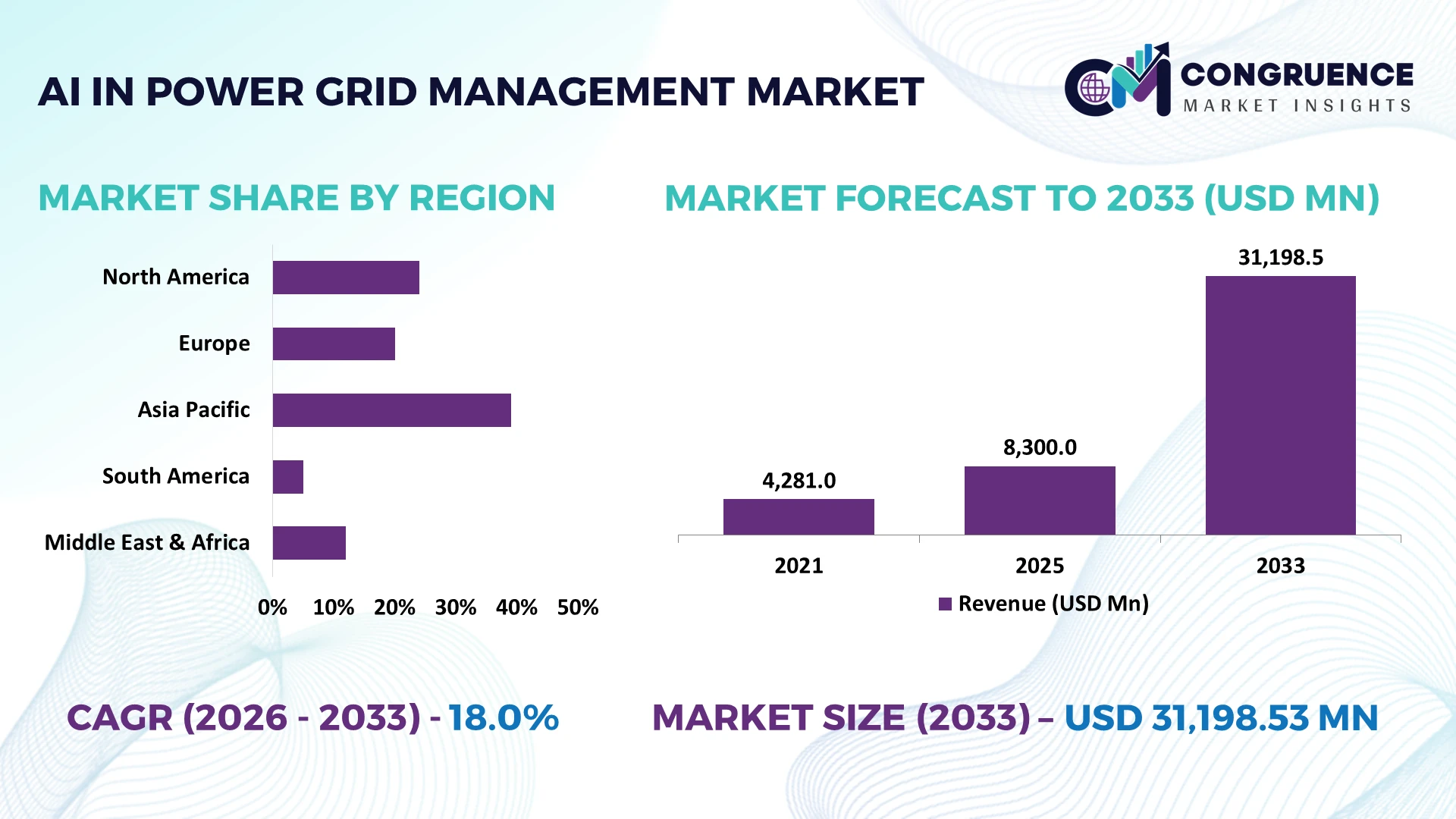
The Global AI in Power Grid Management Market was valued at USD 8300 Million in 2025 and is anticipated to reach a value of USD 31198.53 Million by 2033 expanding at a CAGR of 18% between 2026 and 2033. Grid digitalization, large-scale renewable energy integration, and AI-enabled predictive grid balancing are accelerating utility investments in intelligent power infrastructure across developed and emerging economies.
The United States leads the global AI in Power Grid Management Market with approximately 31% market share, supported by more than USD 20 billion in ongoing grid modernization programs, extensive smart meter deployment exceeding 140 million units, and strong adoption across utilities serving industrial and commercial sectors. Compared with Germany, the U.S. deploys AI-based grid analytics at nearly 1.8× higher utility penetration, while 2026 energy security priorities following global geopolitical supply-chain disruptions continue to strengthen investments in resilient transmission networks and real-time grid intelligence.
Strategic investment in scalable AI platforms and interoperable grid infrastructure will determine long-term competitiveness for utilities, technology providers, and infrastructure investors.
Market Size & Growth: USD 8300 Million in 2025, projected to reach USD 31198.53 Million by 2033 at 18% CAGR, driven by AI-powered grid optimization and renewable integration.
Top Growth Drivers: Renewable integration increases 38%, predictive maintenance adoption reaches 42%, and smart grid digitalization expands 35% across utilities.
Short-Term Forecast: By 2028, AI-enabled grid operations reduce outage response time by 28% and improve network efficiency by 19%.
Emerging Technologies: Edge AI, digital twins, and machine learning-based forecasting improve asset utilization by over 25% across advanced power networks.
Regional Leaders: North America exceeds USD 10.8 Billion, Europe reaches USD 8.1 Billion, and Asia Pacific surpasses USD 9.6 Billion, supported by rapid smart-grid deployment and regional expansion.
Consumer/End-User Trends: Nearly 57% of large utilities prioritize AI-driven demand forecasting and automated grid control systems.
Pilot/Case Example: In 2026, an AI-enabled transmission project improved fault detection accuracy by 34% while reducing maintenance costs by 22%.
Competitive Landscape: Leading providers collectively account for approximately 46% market share, with Siemens, Schneider Electric, ABB, GE Vernova, and Hitachi Energy strengthening portfolios.
Regulatory & ESG Impact: Grid decarbonization initiatives improve renewable integration by 30% while supporting measurable emission reduction targets.
Investment & Funding: More than USD 14 Billion supports utility partnerships, digital infrastructure expansion, and advanced AI software deployment amid resilient supply-chain transformation.
Innovation & Future Outlook: Autonomous grid orchestration, generative AI analytics, and self-healing networks accelerate strategic modernization and operational resilience.
AI in Power Grid Management Market demand is expanding across transmission operators, renewable energy developers, and distribution utilities implementing autonomous grid intelligence. Advanced digital twins, edge AI, and real-time predictive analytics improve asset utilization by nearly 27%, while stricter grid reliability requirements and evolving energy security regulations accelerate deployment. Regional grid modernization programs continue strengthening resilient, data-driven utility operations, shaping the next phase of strategic market development.
Artificial intelligence is becoming a strategic differentiator for utilities as grid operators balance renewable integration, electrification, and rising power demand from data centers and advanced manufacturing. Infrastructure modernization and stricter grid resilience policies are accelerating digital grid investments, while supply-chain restructuring encourages utilities to prioritize software-defined control systems that improve asset visibility and operational flexibility across transmission and distribution networks.
Compared with conventional rule-based energy management, AI-enabled grid platforms improve fault detection accuracy by nearly 35% and reduce maintenance planning costs by approximately 22% through predictive analytics and automated asset monitoring. The United States deploys AI across large transmission networks at a broader scale, while Japan emphasizes high-precision forecasting and distributed energy optimization for densely connected urban grids. Over the next two to three years, AI-assisted grid scheduling is expected to exceed 60% deployment among large utility operators, supported by expanding edge computing and digital twin integration.
Utilities are increasingly deploying AI for real-time outage prediction, transformer health monitoring, and renewable dispatch optimization, with several operators integrating AI into centralized control centers through technology partnerships. Companies are expanding software ecosystems, strengthening cybersecurity capabilities, and investing in interoperable platforms to secure long-term competitive positioning, improve grid reliability, and support sustainable infrastructure modernization.
Rapid grid modernization and the expansion of renewable generation remain the primary catalysts for AI deployment across power networks. More than 48% of utilities are increasing investment in predictive grid analytics, while AI-based load forecasting improves demand prediction accuracy by around 30% and reduces unplanned outages by nearly 25%. The United States continues upgrading aging transmission infrastructure through digital substations and intelligent monitoring, encouraging technology suppliers to expand software capabilities. Utilities are responding through strategic partnerships with AI platform developers, cloud providers, and equipment manufacturers to accelerate deployment. A notable operational advantage is the transition from calendar-based maintenance to condition-based asset management, enabling better capital allocation and higher network reliability.
Fragmented grid infrastructure and limited interoperability between legacy operational technology and modern AI platforms continue restricting deployment efficiency. Approximately 45% of utility assets remain connected to aging control systems, while system integration projects can increase implementation costs by nearly 20%. Supply-chain constraints affecting advanced sensors, communication modules, and semiconductor components further extend deployment timelines in countries including Germany and Japan. Utilities are reducing these risks through phased modernization, localized procurement strategies, and standardized communication protocols. Companies are also investing in modular AI architectures that integrate with existing supervisory systems, minimizing operational disruption while improving scalability across complex transmission and distribution environments.
Growing adoption of distributed energy resources creates substantial opportunities for AI-driven orchestration platforms capable of balancing decentralized electricity flows. AI-based optimization improves renewable utilization by approximately 27% while lowering grid balancing costs by nearly 18%. India is expanding smart grid deployments alongside advanced metering infrastructure, creating demand for scalable AI software and cloud-based energy management solutions. Companies are increasing R&D spending on digital twins, autonomous grid control, and federated learning models while forming ecosystem partnerships with utilities and technology firms. A strategic opportunity lies in monetizing predictive grid services through subscription-based software platforms, creating recurring value beyond conventional hardware deployments.
Expanding AI deployment across critical energy infrastructure increases cybersecurity complexity and operational integration requirements. More than 52% of utility executives identify cyber resilience as a top digital transformation priority, while interconnected AI platforms can generate over 40% more operational data requiring secure processing and governance. The United Kingdom and the United States are strengthening grid cybersecurity requirements, increasing compliance obligations for utilities and technology providers. Companies must invest in zero-trust security architectures, AI model validation, workforce training, and resilient cloud-edge infrastructure to maintain deployment consistency. Organizations that successfully integrate secure AI governance with scalable grid operations will establish stronger long-term competitiveness and operational resilience.
AI-Driven Grid Autonomy Expands Utilities are accelerating deployment of autonomous grid control platforms, with AI-assisted decision-making improving dispatch efficiency by nearly 26% and reducing manual intervention by 34%. United States utilities are integrating digital substations with AI orchestration following grid resilience initiatives, while technology providers expand software partnerships and automation capabilities to shorten response cycles and improve operational continuity.
Edge Intelligence Gains Momentum Edge AI adoption has increased by approximately 38% as utilities process operational data closer to substations, reducing latency by nearly 45% and improving fault response speed by 28%. Japan is prioritizing decentralized computing for high-density power networks, prompting vendors to restructure product portfolios around intelligent edge devices, secure communication infrastructure, and real-time analytics platforms.
Cybersecure AI Platforms Evolve Grid operators are embedding cybersecurity directly into AI architectures, with zero-trust deployment increasing by 31% and automated threat detection improving incident identification by around 40%. Regulatory tightening across critical infrastructure is driving utilities to consolidate software ecosystems, while technology companies expand strategic alliances with cybersecurity specialists to strengthen resilient grid operations and compliance readiness.
Digital Twin Integration Accelerates Digital twin implementation has expanded by approximately 36%, enabling simulation-driven maintenance that lowers equipment downtime by 24% while improving asset planning accuracy by nearly 29%. Germany is advancing digital infrastructure modernization through intelligent network modeling, encouraging AI providers to scale interoperable platforms, optimize engineering workflows, and support data-driven investment planning across transmission assets.
Software remains the leading segment, accounting for approximately 52% of market deployment due to its scalability, cloud integration, and ability to deliver predictive analytics across complex utility environments. AI-powered software platforms improve operational efficiency by nearly 28% while reducing outage analysis time by around 30%, making them essential for real-time grid management. Utilities increasingly favor interoperable software capable of integrating legacy supervisory systems with advanced machine learning models. Vendors continue strengthening software portfolios through cloud-native architectures, cybersecurity enhancements, and enterprise partnerships.
Hardware represents a mature foundation supporting intelligent sensors, edge computing devices, and advanced communication modules, maintaining strategic importance for reliable AI deployment. Services are emerging as the fastest-growing segment, supported by increasing demand for AI integration, consulting, managed operations, and lifecycle optimization, with enterprise adoption expanding by approximately 34%. Companies are investing in implementation expertise and long-term service agreements to accelerate deployment while reducing integration complexity. Investment priorities are gradually shifting from standalone hardware procurement toward software-centric ecosystems supported by specialized service capabilities.
Grid Monitoring holds the largest share at approximately 34% as utilities prioritize continuous visibility across transmission and distribution assets. AI-powered monitoring improves anomaly detection by nearly 32% while reducing operational response time by around 25%, strengthening network resilience and asset utilization. Utilities are expanding integrated monitoring platforms capable of processing data from substations, smart meters, and distributed energy resources through centralized operational dashboards.
Fault Detection is the fastest-growing application, supported by AI models capable of identifying equipment failures before service disruption. Predictive Maintenance continues expanding through condition-based asset management, while Load Forecasting gains importance as renewable generation introduces greater demand variability. Energy Management remains strategically relevant as utilities optimize power flow and storage utilization, improving balancing efficiency by approximately 21%. Technology providers are integrating multiple applications into unified AI platforms, enabling utilities to automate workflows and enhance decision-making while reducing operational complexity across interconnected power networks.
Utilities account for approximately 49% of total demand because of their extensive infrastructure ownership, continuous asset management requirements, and responsibility for maintaining grid reliability. AI deployment improves operational efficiency by nearly 27% while reducing maintenance planning costs by around 20%, encouraging utilities to modernize control centers and strengthen digital grid capabilities. Technology vendors increasingly customize platforms for large utility environments through long-term implementation partnerships and interoperable software ecosystems.
Renewable Energy Providers represent the fastest-growing end-user segment as expanding solar and wind integration requires AI-driven forecasting and balancing capabilities. Transmission Operators continue investing in intelligent congestion management and grid stability tools, while Distribution Operators adopt AI to improve localized outage management and customer service automation. Enterprise adoption among renewable operators has increased by approximately 35%, prompting suppliers to expand cloud-based platforms, flexible pricing models, and ecosystem partnerships. Competitive positioning is increasingly defined by the ability to deliver scalable AI solutions tailored to diverse operational requirements across electricity value chains.
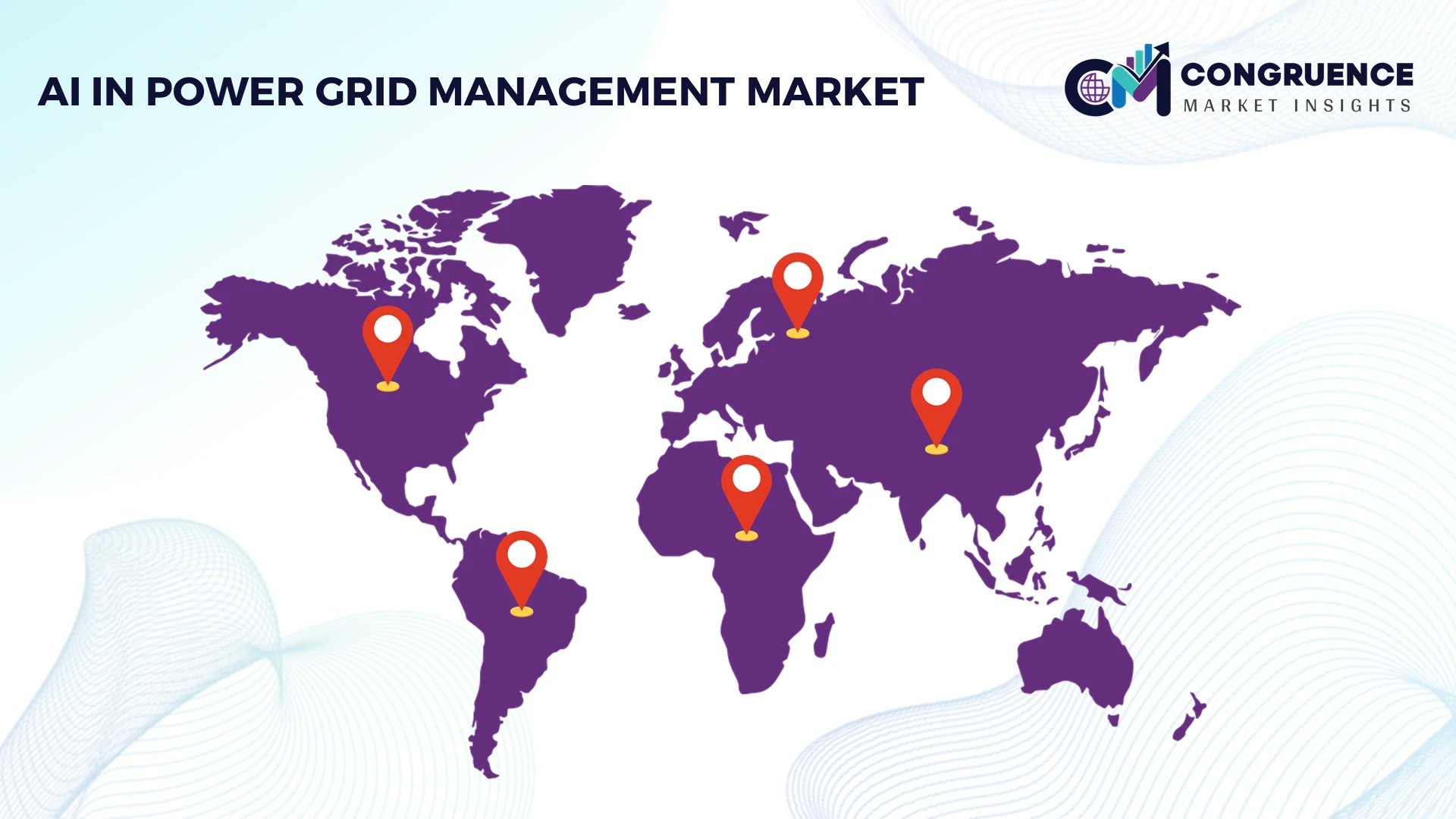
North America accounted for the largest market share at 36% in 2025 however, Asia-Pacific is expected to register the fastest growth, expanding at a 20.3% between 2026 and 2033.
AI-Enabled Grid Modernization Accelerates Utility Transformation
North America maintains its leadership through extensive smart grid deployment, advanced transmission infrastructure, and high enterprise adoption of AI-driven utility platforms. The region represents approximately 36% of global market demand, supported by large-scale investments in grid resilience, renewable integration, and digital substations. Utilities are increasingly deploying predictive analytics, digital twins, and automated fault management systems to improve operational reliability. More than 60% of large electricity providers have incorporated AI into at least one critical grid operation. Strategic partnerships between utilities, cloud providers, and industrial automation companies continue expanding AI deployment while strengthening cybersecurity and operational resilience. Infrastructure modernization programs and increasing electricity demand from data centers further reinforce AI adoption across transmission and distribution networks.
United States Market Outlook: The United States leads regional deployment through extensive utility digitalization, advanced transmission infrastructure, and large-scale renewable integration. More than 140 million smart meters support AI-enabled grid analytics, while major utilities continue expanding predictive maintenance and automated control centers. Strong investment in intelligent substations, cloud-based energy management, and cybersecurity platforms enables rapid commercialization of advanced AI solutions across the national electricity network.
Digital Energy Transition Drives Intelligent Grid Operations
Europe continues strengthening AI deployment through grid modernization, decarbonization initiatives, and advanced energy management systems. The region accounts for approximately 27% of global deployment, supported by increasing integration of renewable electricity and stricter operational efficiency standards. Utilities are implementing AI for demand forecasting, voltage optimization, and asset performance management to improve grid flexibility. Intelligent transmission management has reduced operational interruptions by nearly 23% across several modernization programs. Technology providers are expanding collaborations with utilities to develop interoperable AI platforms capable of supporting decentralized electricity networks while improving system resilience and sustainability.
Germany Market Outlook: Germany remains the regional technology leader through advanced industrial automation, renewable integration, and digital transmission infrastructure. AI deployment continues expanding across distribution operators and grid control centers, supported by smart substation modernization and intelligent forecasting systems. Utilities increasingly integrate AI with distributed renewable assets to optimize network stability while improving operational efficiency across one of Europe's most sophisticated electricity systems.
Large-Scale Smart Grid Deployment Expands Rapidly
Asia-Pacific is becoming the fastest-expanding market due to accelerated infrastructure development, urban electrification, and extensive smart grid investments. The region contributes approximately 30% of global deployment activity, with utilities rapidly adopting AI-powered monitoring, demand forecasting, and outage management systems. Governments are supporting digital electricity infrastructure through modernization initiatives and advanced metering programs. Smart grid deployment has increased by nearly 35% across major economies, while utilities continue integrating AI with distributed renewable generation. Technology providers are strengthening manufacturing capacity, software localization, and strategic partnerships to address rising enterprise demand for scalable grid intelligence.
China Market Outlook: China dominates regional deployment through extensive transmission expansion, smart grid infrastructure, and large-scale renewable integration. AI is increasingly deployed across ultra-high-voltage transmission networks, intelligent substations, and utility control centers. Nationwide digital grid initiatives and domestic technology innovation enable rapid deployment of AI-powered operational platforms, strengthening electricity reliability while supporting industrial electrification and energy transition objectives.
Utility Digitalization Supports Grid Reliability
South America is steadily expanding AI adoption as utilities modernize aging electricity infrastructure and improve network efficiency. The region contributes approximately 5% of global deployment, with increasing investment focused on intelligent monitoring, outage prediction, and renewable energy integration. Grid modernization programs are improving operational visibility while reducing maintenance complexity. AI-assisted monitoring has enhanced fault identification efficiency by nearly 20% across selected utility projects. Infrastructure funding limitations remain a challenge, encouraging utilities to prioritize phased implementation strategies and technology partnerships that maximize operational returns while minimizing capital intensity.
Brazil Market Outlook: Brazil leads regional adoption through large electricity networks, expanding renewable generation, and increasing digital utility investments. National utilities are integrating AI into transmission monitoring, hydroelectric asset management, and predictive maintenance platforms. Growing deployment of intelligent monitoring systems strengthens operational efficiency while supporting stable electricity delivery across geographically diverse transmission corridors.
Infrastructure Investment Strengthens Intelligent Energy Networks
The Middle East & Africa market is advancing through national grid modernization programs, expanding renewable capacity, and strategic investment in digital infrastructure. The region contributes approximately 2% of global deployment while demonstrating increasing demand for AI-enabled energy management and predictive maintenance. Utilities are adopting intelligent monitoring systems to improve network reliability and optimize power distribution. Digital grid projects have improved operational visibility by approximately 22% across newly modernized facilities. Technology companies continue forming long-term partnerships with public utilities to accelerate deployment of scalable AI platforms supporting energy diversification strategies.
Saudi Arabia Market Outlook: Saudi Arabia leads regional investment through extensive power infrastructure modernization and digital transformation initiatives. Utilities are deploying AI across transmission management, renewable integration, and intelligent substations to improve operational performance. National infrastructure programs continue accelerating smart grid implementation, encouraging technology providers to establish local partnerships and expand advanced grid management capabilities.
Global technology leaders including Siemens, Schneider Electric, ABB, GE Vernova, Hitachi Energy, and IBM compete directly with specialized AI software providers for utility modernization projects. The top five participants collectively control approximately 47% of the market through integrated software, automation platforms, and digital grid ecosystems. Competition is centered on AI accuracy, deployment speed, cybersecurity, interoperability, and lifecycle services rather than price alone. Advanced AI platforms improve operational efficiency by nearly 25%, while predictive maintenance capabilities reduce asset downtime by around 22%, creating clear differentiation. Companies are strengthening their positions through strategic acquisitions, cloud partnerships, joint innovation programs, and vertically integrated digital energy portfolios. The competitive landscape is shifting toward software-defined grid management as utilities increasingly prioritize interoperable and scalable AI platforms. High integration complexity, cybersecurity compliance, and long utility procurement cycles remain major entry barriers. Sustainable competitive advantage depends on delivering secure, interoperable, and operationally proven AI solutions with measurable utility performance improvements.
Siemens
Schneider Electric
ABB
GE Vernova
Hitachi Energy
IBM
Microsoft
Oracle
Cisco Systems
Eaton
Honeywell
Emerson Electric
Itron
Landis+Gyr
Artificial intelligence platforms integrated with advanced distribution management systems, predictive analytics, and edge computing currently define the technology landscape. AI-based load forecasting improves forecasting accuracy by nearly 30%, while predictive maintenance lowers unplanned equipment failures by around 25%. More than 58% of large utilities now deploy AI within at least one core grid operation, enabling faster decision-making, automated dispatch, and higher transmission reliability. Integration with IoT sensors and advanced metering infrastructure further strengthens real-time grid visibility and operational resilience.
Emerging technologies between 2026 and 2028 include digital twins, agentic AI, federated learning, and grid-edge intelligence. Digital twins improve asset planning efficiency by approximately 22%, while edge AI reduces fault response latency by nearly 35% compared with centralized processing. AI-driven autonomous grid orchestration delivers roughly 40% faster network optimization than legacy rule-based energy management systems, allowing utilities to integrate distributed renewable resources without compromising grid stability. Utilities adopting interoperable AI ecosystems gain stronger operational flexibility and lower maintenance costs than operators relying on isolated automation platforms.
Disruptive innovation is shifting competition toward software-defined grid intelligence, cybersecurity-enabled AI, and cloud-edge convergence. Technology leaders with scalable AI platforms benefit through faster deployment, broader ecosystem partnerships, and recurring software services, while traditional hardware-focused vendors increasingly expand digital capabilities. Organizations investing early in autonomous grid technologies and interoperable architectures will secure stronger competitive positioning as intelligent, self-healing electricity networks become mainstream by 2028.
January 2026 Siemens and NVIDIA expanded their strategic partnership to build an Industrial AI Operating System, integrating AI, simulation, and automation across industrial infrastructure. The collaboration accelerates AI-enabled grid and energy workflows while improving engineering productivity through end-to-end digital integration.
March 2026 Siemens announced a strategic investment in Emerald AI and expanded its data center ecosystem, integrating energy storage and AI-powered infrastructure modeling to accelerate grid connections and reduce deployment bottlenecks for AI facilities.
May 2026 Siemens introduced the latest Gridscale X platform with AI-powered transmission planning, enabling utilities to integrate third-party applications while supporting faster, scalable grid operations. The platform was successfully deployed by Dutch utility Alliander for operational flexibility. Source: (Siemens Press)
June 2026 GE Vernova launched GridOS for Transmission and released AI-focused grid planning frameworks, providing near real-time coordinated transmission operations to improve grid visibility and operational efficiency for modern utilities. Source: (GE Vernova)
This report provides comprehensive analysis of the AI in Power Grid Management Market across Software, Hardware, and Services, with detailed assessment of applications including Grid Monitoring, Predictive Maintenance, Load Forecasting, Energy Management, and Fault Detection. It evaluates demand across Utilities, Renewable Energy Providers, Transmission Operators, and Distribution Operators while covering North America, Europe, Asia-Pacific, South America, and the Middle East & Africa. The study examines deployment patterns, technology adoption, competitive positioning, and enterprise implementation trends influencing intelligent grid transformation.
The report analyzes AI platforms, digital twins, edge computing, predictive analytics, cybersecurity integration, and cloud-enabled grid management technologies alongside operational benchmarks and adoption indicators. It reviews market participation across leading technology providers, investment priorities, infrastructure modernization strategies, and emerging deployment models. Strategic insights support expansion planning, product development, partnership evaluation, competitive benchmarking, and long-term decision-making for stakeholders navigating evolving utility digitalization and intelligent power infrastructure between 2026 and 2033.
| Report Attribute/Metric | Report Details |
|---|---|
Market Revenue in 2025 | USD 8300 Million |
Market Revenue in 2033 | USD 31198.53 Million |
CAGR (2026 - 2033) | 18% |
Base Year | 2025 |
Forecast Period | 2026 - 2033 |
Historic Period | 2021 - 2025 |
Segments Covered | By Type
By Application
By End-User
|
Key Report Deliverable | Revenue Forecast, Growth Trends, Market Dynamics, Segmental Overview, Regional and Country-wise Analysis, Competition Landscape |
Region Covered | North America, Europe, Asia-Pacific, South America, Middle East, Africa |
Key Players Analyzed | Siemens, Schneider Electric, ABB, GE Vernova, Hitachi Energy, IBM, Microsoft, Oracle, Cisco Systems, Eaton, Honeywell, Emerson Electric, Itron, Landis+Gyr |
Customization & Pricing | Available on Request (10% Customization is Free) |




