
Reports
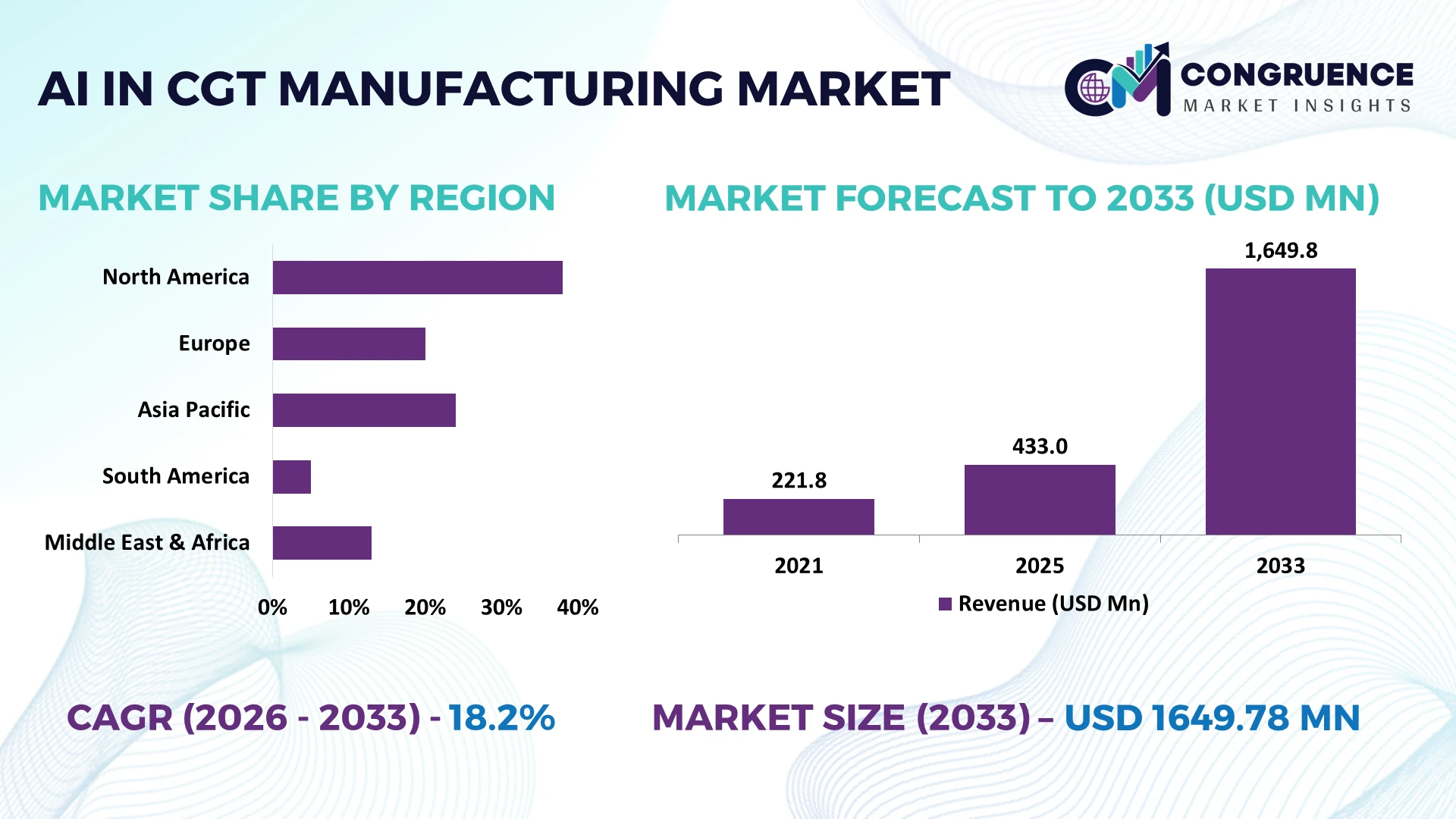
The Global AI in CGT Manufacturing Market was valued at USD 433 Million in 2025 and is anticipated to reach a value of USD 1649.78 Million by 2033 expanding at a CAGR of 18.2% between 2026 and 2033. AI-powered process optimization, predictive quality analytics, automated cell processing, and digital manufacturing platforms are accelerating commercial-scale CGT production while improving batch consistency and reducing manufacturing deviations.
The United States dominates the global AI in CGT Manufacturing Market with nearly 44% of advanced commercial CGT manufacturing capacity, supported by more than USD 6 billion in biomanufacturing investments, over 80 operational CGT manufacturing facilities, and widespread AI deployment across GMP production. In comparison, Germany accounts for approximately 12% of Europe's commercial manufacturing capacity through expanding automated biopharmaceutical facilities. Following continued supply-chain localization under the 2026 Biosecure Act environment, manufacturers are strengthening domestic AI-enabled production networks to improve manufacturing resilience and technology leadership.
Organizations investing early in AI-integrated CGT manufacturing infrastructure and regional production capabilities will secure stronger operational scalability, regulatory readiness, and long-term competitive positioning.
Market Size & Growth: The Global AI in CGT Manufacturing Market was valued at USD 433 Million in 2025 and is projected to reach USD 1649.78 Million by 2033, expanding at a CAGR of 18.2% between 2026 and 2033, driven by AI-enabled bioprocess automation and digital manufacturing.
Top Growth Drivers: Predictive analytics improves production efficiency by 35%, AI-powered quality inspection lowers batch failures by 30%, and automated manufacturing workflows reduce processing time by 25%.
Short-Term Forecast: By 2028, AI-integrated CGT manufacturing facilities are expected to reduce production costs by 20% while increasing manufacturing throughput by 28%.
Emerging Technologies: Generative AI, digital twins, machine learning, and autonomous robotics are improving process optimization, reducing manufacturing deviations by more than 30%, and enabling real-time quality monitoring.
Regional Leaders: North America is projected to exceed USD 700 Million, Europe USD 430 Million, and Asia-Pacific USD 360 Million, supported by expanding AI-enabled biomanufacturing facilities and regional production localization.
Consumer/End-User Trends: More than 60% of commercial CGT manufacturers are deploying AI-driven manufacturing execution systems to improve operational efficiency, product consistency, and manufacturing visibility.
Pilot/Case Example: In 2026, AI-assisted CGT manufacturing validation projects achieved a 27% reduction in production deviations and a 22% improvement in batch qualification timelines.
Competitive Landscape: Leading technology providers account for approximately 38% of advanced AI manufacturing deployments, while major biotechnology, automation, and software companies continue expanding strategic collaborations.
Regulatory & ESG Impact: AI-enabled digital documentation reduces compliance workloads by approximately 35%, improves manufacturing traceability, and supports increasingly stringent global regulatory requirements.
Investment & Funding: More than USD 2.5 Billion has been invested globally in AI-enabled CGT manufacturing through strategic partnerships, manufacturing expansion, and digital platform integration amid ongoing regional supply-chain diversification.
Innovation & Future Outlook: Autonomous manufacturing, real-time release analytics, adaptive AI process control, and intelligent robotics are advancing next-generation CGT manufacturing with greater scalability, resilience, and operational precision.
AI in CGT Manufacturing Market demand is accelerating across autologous therapies, allogeneic cell production, viral vector manufacturing, and commercial bioprocessing as manufacturers prioritize intelligent automation and predictive quality management. AI-enabled manufacturing platforms have improved process efficiency by approximately 30%, while 2026 regulatory emphasis on digital traceability and resilient regional supply chains is driving broader adoption of advanced manufacturing technologies, setting the stage for the strategic market analysis that follows.
Artificial intelligence is becoming a strategic differentiator in CGT manufacturing as developers transition from clinical-scale production to commercial manufacturing with tighter quality expectations and shorter production timelines. Digital manufacturing platforms, AI-enabled batch analytics, and predictive process control are helping manufacturers standardize highly variable cell and gene therapy workflows. The market is also benefiting from supply-chain restructuring, with the United States and several European countries expanding domestic biomanufacturing infrastructure to strengthen production resilience and reduce dependence on external processing capacity.
Compared with conventional rule-based manufacturing systems, AI-driven process optimization improves batch consistency by approximately 30% while reducing deviation investigations by nearly 25% through continuous process monitoring and adaptive control. The United States remains ahead in commercial AI deployment because of its mature CGT manufacturing ecosystem, whereas Japan is accelerating adoption through automated production facilities and digital quality initiatives. Over the next two to three years, AI-enabled manufacturing execution systems are expected to support more than 60% of newly commissioned commercial CGT production facilities, reflecting a clear shift toward intelligent manufacturing.
Manufacturers are deploying AI to optimize viral vector production, automate quality review, and improve scheduling across multi-product facilities. Companies are increasing investments in cloud-based manufacturing platforms, strategic technology partnerships, and modular production infrastructure to accelerate commercialization while maintaining regulatory compliance. Organizations that integrate AI across manufacturing, quality assurance, and operational planning will establish stronger competitive positioning through greater manufacturing flexibility, faster technology transfer, and improved production reliability.
AI adoption is accelerating as CGT manufacturers seek greater production consistency across increasingly complex therapies. Predictive analytics has reduced manufacturing deviations by approximately 28%, while AI-assisted process control improves production efficiency by nearly 35% and shortens batch review cycles by around 22%. The United States continues expanding digital biomanufacturing capabilities through advanced manufacturing facilities and AI-integrated GMP operations, encouraging broader technology deployment across commercial production. In response, biotechnology companies are increasing investment in intelligent manufacturing software, automation platforms, and strategic partnerships with AI technology providers. This shift enables scalable commercial manufacturing, strengthens quality performance, and creates a sustainable competitive advantage through data-driven operational excellence.
Legacy manufacturing infrastructure remains a significant constraint for AI implementation across CGT production. Approximately 40% of existing manufacturing facilities still rely on fragmented data environments, while system integration projects can increase implementation timelines by nearly 30%. Interoperability limitations between laboratory systems, manufacturing execution platforms, and quality management software continue to restrict real-time process optimization. Germany and several established manufacturing hubs are addressing these issues through phased digital modernization programs. Companies are reducing operational risk by standardizing data architectures, localizing technology partners, and adopting modular software platforms that improve compatibility while supporting regulatory compliance and long-term manufacturing scalability.
The strongest opportunity lies in autonomous manufacturing supported by AI, digital twins, and advanced predictive modeling. AI-driven production scheduling can improve equipment utilization by approximately 25%, while intelligent quality prediction reduces process variability by nearly 30%. South Korea is strengthening national biomanufacturing capabilities through investments in smart manufacturing infrastructure and digital bioprocess innovation. Companies are expanding R&D collaborations with automation specialists, cloud platform providers, and biotechnology developers to build integrated manufacturing ecosystems. Beyond efficiency improvements, these platforms enable faster technology transfer between manufacturing sites, creating a strategic advantage for organizations expanding commercial CGT production across multiple facilities.
Scaling AI consistently across commercial CGT manufacturing remains a complex execution challenge requiring advanced infrastructure, skilled personnel, and secure digital ecosystems. More than 45% of manufacturers report shortages of specialists with expertise spanning AI, bioprocess engineering, and GMP manufacturing, while cybersecurity investments have increased by over 20% to protect sensitive production data. The United Kingdom and other advanced manufacturing markets are strengthening digital workforce development to support intelligent biomanufacturing. Companies must invest in workforce training, validated AI models, interoperable digital infrastructure, and secure cloud environments to achieve reliable enterprise-wide deployment while maintaining manufacturing consistency and long-term operational competitiveness.
AI-Driven Batch Intelligence: Manufacturers are embedding AI into batch monitoring systems, reducing process deviations by nearly 28% and accelerating batch review cycles by approximately 24%. Growing regulatory emphasis on digital data integrity and electronic manufacturing records is accelerating deployment across U.S. facilities. Companies are expanding automation partnerships to standardize commercial CGT production while shortening product release timelines and improving operational consistency.
Digital Twin Process Expansion: Digital twin adoption has increased by nearly 35% across advanced CGT manufacturing operations, enabling simulation-based process validation that lowers engineering change requests by about 20%. Japan is integrating virtual manufacturing environments to improve technology transfer between production sites. Companies are scaling digital engineering capabilities to optimize equipment utilization, minimize commissioning delays, and support multi-product manufacturing flexibility.
Intelligent Supply Chain Coordination: AI-enabled supply chain platforms have improved inventory forecasting accuracy by approximately 30% while reducing critical material shortages by nearly 18%. Ongoing supply-chain localization and cold-chain reliability requirements are driving manufacturers to integrate predictive logistics with production planning. Companies are restructuring supplier networks and deploying cloud-based planning systems to strengthen manufacturing continuity and reduce scheduling disruptions.
Collaborative Manufacturing Automation: Human-machine collaborative workflows have increased manufacturing productivity by around 26% while reducing repetitive manual interventions by over 32% in commercial CGT facilities. The United Kingdom is expanding smart biomanufacturing initiatives to address skilled labor shortages through intelligent automation. Companies are investing in robotics integration, AI-assisted quality review, and workforce upskilling to enhance operational resilience while maintaining GMP compliance.
Machine Learning remains the leading technology segment, accounting for approximately 34% of the AI in CGT Manufacturing Market due to its ability to optimize manufacturing parameters, predict process deviations, and improve production consistency using continuously generated manufacturing data. Predictive Analytics follows closely as a mature technology supporting quality forecasting and equipment performance monitoring, while Computer Vision continues expanding for automated inspection and defect identification. Companies are integrating multiple AI technologies into unified manufacturing platforms, reducing process variability by nearly 30% while improving production efficiency by approximately 25%.
Digital Twins represent the fastest-growing segment as manufacturers increasingly simulate production environments before commercial deployment, reducing validation timelines by nearly 22%. Robotics Automation is also expanding rapidly as manufacturers automate material handling and aseptic processing to improve consistency and reduce manual intervention. Investment priorities are shifting toward integrated AI ecosystems combining Machine Learning, Digital Twins, and Robotics Automation through technology partnerships, product innovation, and advanced software development to support scalable commercial manufacturing.
Process Optimization represents the largest application segment with an estimated 36% market share, as manufacturers prioritize AI to improve production consistency, optimize critical process parameters, and reduce manufacturing deviations. AI-assisted process optimization has improved manufacturing efficiency by approximately 30% while lowering batch investigation requirements by nearly 25%. Quality Control remains a mature application with expanding deployment of Computer Vision and predictive analytics for automated inspection. Companies continue integrating AI across manufacturing execution systems to improve production visibility and regulatory readiness.
Gene Therapy Manufacturing is the fastest-growing application as increasing commercial production requires intelligent scheduling, adaptive process control, and real-time monitoring. Cell Processing is gaining momentum through automated workflow optimization, while Supply Chain Management is becoming increasingly important as manufacturers improve inventory planning and cold-chain coordination. Companies are expanding AI deployment across interconnected production operations to strengthen manufacturing flexibility and reduce operational bottlenecks.
Process Optimization remains the dominant end-user segment, representing approximately 33% of overall AI deployment because commercial CGT manufacturers prioritize production efficiency, process standardization, and manufacturing scalability. Facilities deploying AI-enabled optimization report nearly 28% lower process variability and approximately 24% faster manufacturing decision cycles. Quality Control continues as an established buyer segment investing in automated inspection technologies, while Cell Processing operations increasingly adopt intelligent workflow management to improve production consistency and reduce operator dependency.
Gene Therapy Manufacturing is emerging as the fastest-growing end-user segment as commercial manufacturing capacity expands and production complexity increases. Supply Chain Management is also strengthening through AI-driven logistics planning and inventory optimization to support time-sensitive biologics distribution. Technology providers are responding through customized AI platforms, strategic implementation partnerships, modular software solutions, and integrated manufacturing ecosystems designed to address diverse operational requirements across advanced CGT production facilities.
North America accounted for the largest market share at 42% in 2025 however, Asia-Pacific is expected to register the fastest growth, expanding at a 20.8% CAGR between 2026 and 2033.
AI-Led Commercial Manufacturing Leadership
North America maintains the leading position in the AI in CGT Manufacturing Market through its mature commercial manufacturing ecosystem, advanced GMP facilities, and strong integration of AI into cell and gene therapy production. The region contributes approximately 42% of global deployment activity, supported by expanding automation, cloud-based manufacturing execution systems, and predictive quality platforms. More than 70% of newly commissioned commercial CGT facilities incorporate AI-enabled manufacturing analytics during production planning and quality monitoring. Strategic collaborations between biotechnology developers, software providers, and automation companies continue improving manufacturing efficiency while reducing technology transfer timelines. Continuous investment in digital infrastructure and commercial-scale production capacity enables manufacturers to accelerate therapy commercialization while strengthening regulatory readiness and operational resilience.
United States Market Outlook: The United States remains the regional technology leader due to its concentration of commercial CGT manufacturing facilities, advanced digital infrastructure, and extensive AI software deployment across regulated production environments. More than 80 commercial CGT manufacturing facilities actively integrate intelligent manufacturing technologies, while leading biotechnology companies continue expanding AI partnerships to improve process optimization, production scheduling, and quality assurance. Strong domestic manufacturing initiatives further reinforce long-term industrial competitiveness.
Digital Manufacturing Modernization Accelerates
Europe is strengthening its competitive position through advanced manufacturing modernization, regulatory digitalization, and expanding biopharmaceutical production capabilities. The region accounts for nearly 29% of global AI-enabled CGT manufacturing activity, supported by increasing deployment of automated production systems and digital quality management platforms. Manufacturers are accelerating facility modernization, with AI-assisted manufacturing reducing process deviations by approximately 25% across advanced production sites. Growing emphasis on electronic documentation and standardized manufacturing workflows supports efficient regulatory compliance while improving operational transparency. Strategic partnerships between biotechnology companies, engineering firms, and AI developers continue expanding intelligent manufacturing capabilities throughout established pharmaceutical clusters.
Germany Market Outlook: Germany leads the European market through its strong industrial automation expertise, pharmaceutical manufacturing infrastructure, and advanced engineering ecosystem. More than 40% of newly modernized CGT production facilities incorporate AI-assisted manufacturing technologies to improve process reliability and equipment utilization. Continued investment in smart manufacturing platforms and industrial software integration strengthens Germany's position as a key innovation hub for commercial CGT production.
Manufacturing Scale Drives Adoption
Asia-Pacific is rapidly expanding AI deployment by combining large-scale manufacturing investments with accelerating biotechnology innovation and digital production capabilities. The region represents approximately 22% of global AI in CGT manufacturing activity while recording the fastest operational expansion supported by new manufacturing facilities and intelligent automation. Commercial manufacturers are increasing AI-assisted production deployment by nearly 35% to improve process consistency and manufacturing flexibility. National initiatives supporting advanced biomanufacturing infrastructure, automation, and digital transformation continue attracting technology providers and production investments. Companies are establishing regional manufacturing partnerships to strengthen localized supply chains and accelerate commercial production capacity.
China Market Outlook: China is emerging as the region's largest manufacturing hub through extensive investment in biotechnology infrastructure, AI innovation, and commercial CGT production. More than 50 advanced biomanufacturing projects are expanding intelligent production capabilities, while domestic companies continue integrating AI into quality monitoring, production scheduling, and process optimization. Government-backed industrial modernization programs further support technology adoption and commercial manufacturing competitiveness.
Healthcare Innovation Expands Demand
South America is gradually increasing AI adoption in CGT manufacturing through expanding biotechnology capabilities, research collaboration, and healthcare modernization initiatives. The region contributes a modest share of global deployment but continues strengthening manufacturing readiness through targeted infrastructure investment and digital laboratory transformation. AI-assisted manufacturing platforms improve production planning efficiency by approximately 18%, while collaborative partnerships between research organizations and biotechnology firms support technology transfer. Limited commercial manufacturing capacity remains a constraint; however, companies are prioritizing modular production systems and localized digital infrastructure to improve operational scalability and reduce dependence on imported manufacturing services.
Brazil Market Outlook: Brazil leads regional development through its established biotechnology research ecosystem, growing pharmaceutical manufacturing sector, and expanding investment in advanced therapy infrastructure. Commercial organizations are increasing adoption of AI-enabled laboratory management and manufacturing software to improve operational efficiency. Public-private collaborations continue supporting domestic production capabilities while strengthening technical expertise in advanced biologics manufacturing.
Strategic Infrastructure Investment Momentum
The Middle East & Africa market is advancing through healthcare modernization, biotechnology investment, and digital infrastructure development supporting advanced therapy manufacturing. Although representing a relatively small portion of global deployment, the region is increasing adoption of intelligent manufacturing technologies within newly established biotechnology facilities. Investment in automated laboratory infrastructure has expanded by approximately 20%, while national healthcare diversification strategies encourage digital manufacturing capabilities. Companies are focusing on strategic partnerships with international technology providers to accelerate knowledge transfer, establish advanced production capabilities, and strengthen long-term manufacturing competitiveness across emerging biotechnology ecosystems.
Saudi Arabia Market Outlook: Saudi Arabia is leading regional investment through national biotechnology strategies, healthcare transformation programs, and expansion of advanced pharmaceutical manufacturing infrastructure. AI-enabled laboratory automation and digital manufacturing technologies are increasingly integrated into newly developed life science facilities, supported by government-backed industrial initiatives. Continued investment in biotechnology partnerships and advanced manufacturing capabilities positions the country as the primary regional growth center for intelligent CGT manufacturing.
Competition in the AI in CGT Manufacturing Market is led by technology innovators such as Siemens, NVIDIA, GE HealthCare, Microsoft, and Dassault Systèmes competing against specialized life science software providers and industrial automation companies for commercial biomanufacturing contracts. The top five participants collectively control approximately 47% of advanced AI-enabled CGT manufacturing deployments. Competition is driven by platform capability, workflow integration, deployment speed, and regulatory compliance rather than pricing alone. AI-enabled process optimization improves manufacturing efficiency by nearly 30%, while integrated digital manufacturing platforms reduce implementation time by approximately 25% and lower process deviations by about 22%. Companies are strengthening competitive positions through strategic partnerships with biotechnology manufacturers, cloud platform expansion, digital twin development, and vertical integration across manufacturing software and automation. The competitive landscape is shifting toward unified intelligent manufacturing ecosystems as fragmented standalone applications lose strategic relevance. High validation requirements and complex GMP integration remain major entry barriers. Success depends on delivering scalable, validated AI platforms that combine automation, interoperability, regulatory readiness, and measurable manufacturing performance.
Siemens AG
NVIDIA Corporation
Microsoft Corporation
GE HealthCare
Dassault Systèmes
ABB Ltd.
Emerson Electric Co.
Rockwell Automation, Inc.
Schneider Electric SE
Honeywell International Inc.
SAP SE
Oracle Corporation
Cognizant Technology Solutions
Palantir Technologies Inc.
Artificial intelligence is transforming CGT manufacturing through machine learning, predictive analytics, and computer vision integrated into manufacturing execution systems. Machine learning models improve process consistency by approximately 30%, while predictive quality analytics reduce batch deviations by nearly 25%. More than 60% of newly commissioned commercial CGT facilities now deploy at least one AI-enabled manufacturing application, reflecting a decisive shift from isolated automation toward connected digital production. Companies adopting integrated AI platforms achieve faster process optimization, stronger data integrity, and improved regulatory readiness, creating meaningful operational advantages over manufacturers relying on conventional monitoring systems.
Emerging technologies including digital twins, autonomous robotics, and real-time process simulation are reshaping production planning and facility operations. Compared with traditional rule-based process management, AI-driven digital twins shorten process validation by approximately 35% while improving equipment utilization by nearly 20%. Global biotechnology manufacturers and advanced automation providers benefit most because integrated digital environments accelerate technology transfer, reduce engineering changes, and support flexible multi-product manufacturing with higher operational reliability.
Between 2026 and 2028, intelligent autonomous manufacturing, generative AI-assisted process development, and cloud-native manufacturing analytics will become core competitive technologies. Deployment across commercial CGT facilities is expected to exceed 70% as manufacturers prioritize end-to-end digital integration instead of isolated software tools. Organizations investing now in interoperable AI platforms, cybersecurity, and scalable data infrastructure will strengthen manufacturing resilience, accelerate commercial production, and secure long-term competitive differentiation in advanced therapy manufacturing.
The formatting should be exactly like this:
March 2024: NVIDIA launched over 24 healthcare generative AI microservices supporting drug discovery, genomics, imaging, and digital health applications. The platform strengthens AI-enabled workflows applicable to CGT manufacturing and accelerates intelligent bioprocess development.
June 2024: Siemens Healthineers partnered with Microsoft to integrate generative AI into healthcare workflows through Microsoft Azure AI, expanding intelligent digital capabilities for advanced life sciences. The collaboration improves productivity and accelerates AI deployment across regulated manufacturing environments.
May 2025: The International Society for Cell & Gene Therapy (ISCT) published guidance on artificial intelligence, machine learning, and digitalization for cell and gene therapy manufacturing, establishing standardized terminology and implementation practices that strengthen commercial manufacturing readiness. (https://www.isctglobal.org)
June 2025: BioPhorum launched its AI in Quality Investigations for Advanced Therapy Medicinal Products initiative, enabling collaborative development of AI-based quality investigation frameworks to improve manufacturing consistency and digital compliance across CGT production. Source: (https://www.biophorum.com)
The AI in CGT Manufacturing Market report provides comprehensive coverage of technology adoption, manufacturing transformation, competitive dynamics, and operational developments shaping commercial cell and gene therapy production. The study evaluates five technology segments, five application areas, and five end-user categories while assessing deployment trends across North America, Europe, Asia-Pacific, South America, and the Middle East & Africa. It examines AI integration across predictive analytics, machine learning, digital twins, robotics automation, and computer vision, reflecting growing digital manufacturing adoption in more than 60% of commercial CGT facilities.
The report further analyzes regional manufacturing capabilities, enterprise deployment strategies, infrastructure expansion, automation investments, and technology partnerships influencing industry evolution between 2026 and 2033. It delivers strategic intelligence on competitive positioning, production optimization, supply-chain modernization, digital quality management, investment priorities, and emerging intelligent manufacturing models, enabling stakeholders to evaluate expansion opportunities, benchmark competitors, identify operational risks, and support informed long-term business decisions.
| Report Attribute/Metric | Report Details |
|---|---|
Market Revenue in 2025 | USD 433 Million |
Market Revenue in 2033 | USD 1649.78 Million |
CAGR (2026 - 2033) | 18.2% |
Base Year | 2025 |
Forecast Period | 2026 - 2033 |
Historic Period | 2021 - 2025 |
Segments Covered | By Type
By Application
By End-User
|
Key Report Deliverable | Revenue Forecast, Growth Trends, Market Dynamics, Segmental Overview, Regional and Country-wise Analysis, Competition Landscape |
Region Covered | North America, Europe, Asia-Pacific, South America, Middle East, Africa |
Key Players Analyzed | Siemens AG, NVIDIA Corporation, Microsoft Corporation, GE HealthCare, Dassault Systèmes, ABB Ltd., Emerson Electric Co., Rockwell Automation, Inc., Schneider Electric SE, Honeywell International Inc., SAP SE, Oracle Corporation, Cognizant Technology Solutions, Palantir Technologies Inc. |
Customization & Pricing | Available on Request (10% Customization is Free) |




