
Reports
The Global AI Hallucination Detection Market was valued at USD 1643000 Million in 2025 and is anticipated to reach a value of USD 17387841 Million by 2033 expanding at a CAGR of 34.3% between 2026 and 2033. Growth is being accelerated by enterprise deployment of generative AI, stricter model governance requirements, and rising adoption of real-time validation frameworks that reduce inaccurate AI outputs across regulated industries.
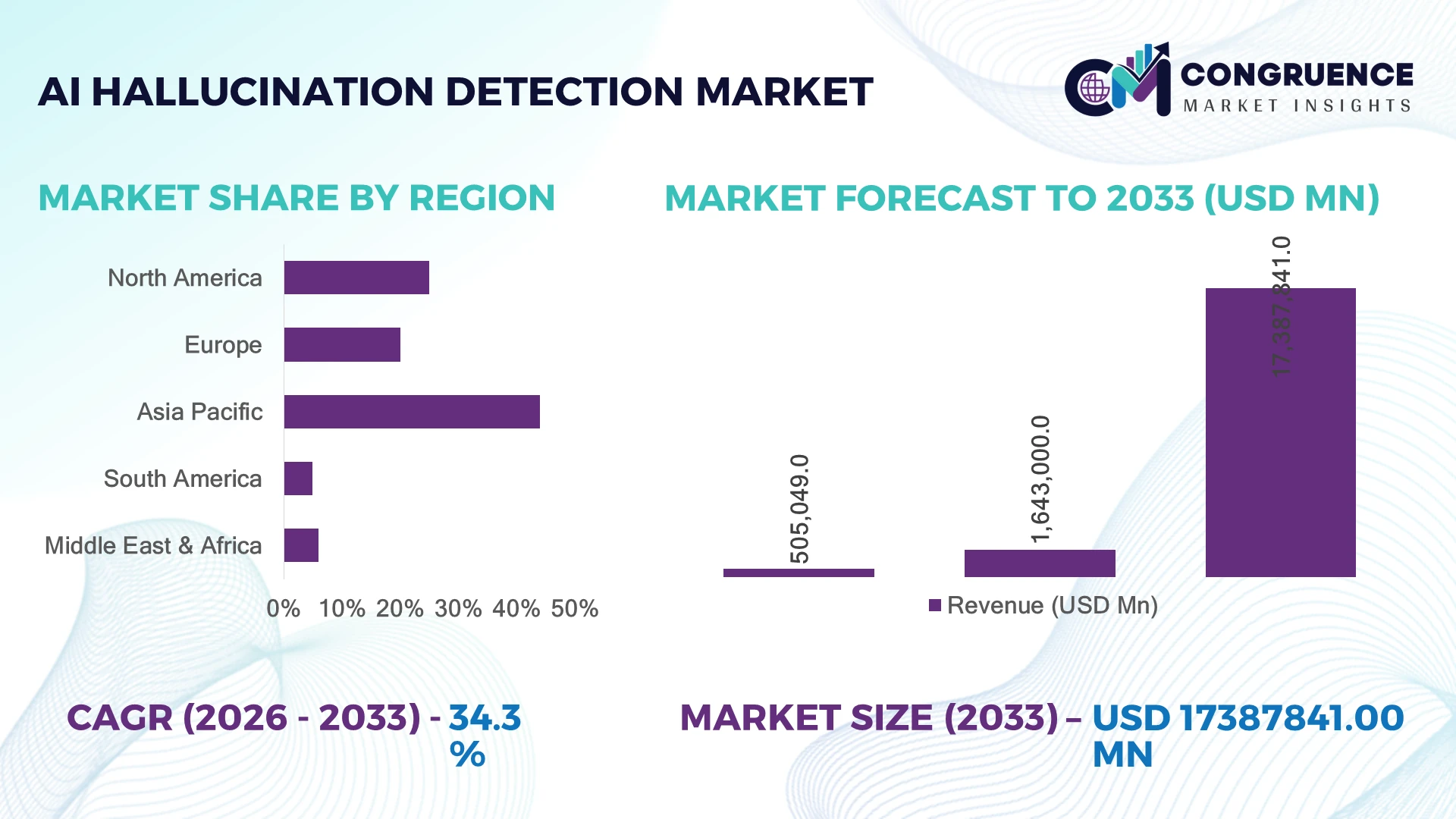
The United States dominates the market with approximately 41% share, supported by over USD 12 billion in enterprise generative AI investments and widespread deployment across financial services, healthcare, defense, and cloud platforms. Compared with Germany, where enterprise AI governance adoption exceeds 46%, the U.S. benefits from larger-scale foundation model development and verification infrastructure. Following heightened regulatory scrutiny around AI transparency in 2026, more than 68% of large enterprises integrated hallucination monitoring into production AI workflows, reinforcing leadership in advanced AI assurance technologies.
Organizations that prioritize scalable hallucination detection platforms, audit-ready AI governance, and continuous model validation are positioned to strengthen trust, reduce operational risk, and gain competitive advantage in enterprise AI deployment.
Market Size & Growth: USD 1,643,000 million in 2025 rising to USD 17,387,841 million by 2033 at 34.3% growth, driven by enterprise generative AI governance and model reliability requirements.
Top Growth Drivers: AI deployment expansion (+61%), regulatory compliance adoption (+48%), and automated model monitoring implementation (+44%).
Short-Term Forecast: By 2028, hallucination-related remediation costs decline by 32% while AI output verification efficiency improves by 38%.
Emerging Technologies: Retrieval-augmented generation, agentic AI validation, and real-time fact-checking engines improve response accuracy by 25–40%.
Regional Leaders: North America exceeds USD 6.8 billion, Europe USD 4.2 billion, and Asia-Pacific USD 3.7 billion, supported by enterprise AI expansion.
Consumer/End-User Trends: Over 72% of large enterprises deploy AI assurance tools before production release of advanced generative models.
Pilot/Case Example: In 2026, enterprise validation deployments reduced inaccurate AI outputs by 41% across customer-support environments.
Competitive Landscape: Leading vendors control roughly 35% share, with competition centered on governance, monitoring, explainability, and verification capabilities.
Regulatory & ESG Impact: AI governance frameworks improve audit readiness by 45% and strengthen transparency requirements across regulated sectors.
Investment & Funding: More than USD 8 billion supports AI trust, safety, and monitoring platforms through partnerships, acquisitions, and expansion programs.
Innovation & Future Outlook: Autonomous AI oversight, multimodal verification, and synthetic testing environments are reshaping next-generation enterprise AI assurance strategies.
AI Hallucination Detection Market demand is expanding across financial services, healthcare, cybersecurity, government, and enterprise software environments where output accuracy directly affects operational performance. Recent innovations include real-time fact verification engines, retrieval-augmented validation systems, and automated governance dashboards. Nearly 68% of large organizations now evaluate AI reliability before deployment, while evolving regulatory oversight and enterprise risk-management requirements are accelerating adoption of continuous monitoring frameworks, setting the stage for broader strategic market developments.
AI hallucination detection has become a strategic layer within enterprise AI infrastructure as organizations shift from experimentation to production-scale deployment of generative models. Competitive advantage increasingly depends on the ability to verify outputs, reduce misinformation risk, and maintain regulatory compliance. The market is benefiting from stricter AI governance frameworks, particularly across the United States and Europe, where more than 65% of large enterprises now require automated validation before deploying customer-facing AI applications. This transition is reshaping procurement priorities and accelerating investment in trust and safety architectures.
Modern hallucination detection platforms deliver measurable operational gains compared with legacy manual review processes. Automated validation systems reduce content verification time by nearly 70% while lowering monitoring costs by approximately 35%. The United States leads large-scale deployment through cloud-based AI governance ecosystems, whereas Germany and Japan are emphasizing compliance-centric implementations for regulated industries. A practical example includes financial institutions integrating real-time verification layers into AI assistants, reducing inaccurate responses by over 40% and improving audit readiness across critical workflows.
Over the next two to three years, enterprise adoption is expected to move beyond risk management toward continuous AI performance optimization. Technology vendors are expanding partnerships with cloud providers, cybersecurity firms, and foundation model developers to strengthen verification capabilities. Organizations that embed hallucination detection directly into AI development pipelines will secure stronger operational resilience, faster deployment cycles, and more sustainable competitive positioning.
The rapid transition from pilot AI programs to business-critical deployments is the primary catalyst for AI hallucination detection adoption. More than 72% of large enterprises now operate generative AI systems within customer service, software development, or knowledge management environments, while approximately 68% have introduced dedicated AI governance frameworks. Regulatory developments in the European Union and the United States are increasing accountability for AI-generated outputs, creating direct demand for validation and monitoring tools. This shift is reducing tolerance for unverified model responses and forcing organizations to implement continuous oversight. Technology providers are responding through platform expansion, strategic acquisitions, and integration partnerships. A notable operational insight is that organizations treating hallucination detection as core infrastructure rather than a compliance tool achieve faster production deployment and stronger user trust.
Deployment complexity remains a significant structural limitation, particularly for enterprises operating multiple AI models across fragmented technology environments. Nearly 45% of organizations report interoperability challenges between validation platforms and existing AI infrastructure, while implementation timelines can extend by 25–30% when integrating across diverse data ecosystems. In the United States, enterprises frequently manage outputs from several foundation models simultaneously, increasing validation complexity and operational costs. Inconsistent benchmarking methodologies further complicate performance measurement and procurement decisions. Companies are mitigating these constraints through standardized APIs, localized deployment architectures, and long-term software partnerships. A key strategic issue is that inadequate integration planning often creates hidden operational costs that outweigh initial software investment savings.
A major opportunity lies in the development of real-time verification ecosystems that combine retrieval technologies, knowledge graphs, and autonomous monitoring agents. More than 60% of enterprises are evaluating retrieval-augmented architectures, while advanced validation frameworks have demonstrated up to 40% improvements in response reliability. Japan and Singapore are emerging as important adoption centers due to government-backed AI governance initiatives and digital transformation programs. Companies are increasing investment in multimodal verification systems capable of monitoring text, image, and voice outputs within a single workflow. A non-obvious opportunity exists in sector-specific validation models for healthcare, legal services, and industrial operations, where domain accuracy generates substantial efficiency advantages and creates differentiated commercial value.
Long-term market expansion depends on solving scalability and trust-management challenges across increasingly complex AI ecosystems. Enterprise AI environments are expected to process over 50% more multimodal content streams within the next few years, while cybersecurity incidents involving AI-generated content continue to rise. Around 43% of organizations identify skilled AI governance personnel shortages as a barrier to large-scale deployment. In Germany and the United States, organizations face growing pressure to maintain transparency, auditability, and consistent validation performance across distributed AI workloads. Companies must invest in workforce development, automated governance infrastructure, and advanced monitoring architectures. The strongest strategic challenge is ensuring validation quality remains consistent as AI models become more autonomous, interconnected, and operationally critical.
Real-Time Validation Becomes Standard: More than 67% of enterprise AI deployments now incorporate real-time hallucination detection compared with 42% two years ago. Organizations are embedding verification layers directly into inference workflows, reducing response correction cycles by nearly 38% and improving operational consistency. As AI regulations tighten in the United States and Europe, vendors are scaling partnerships with cloud providers and model developers to accelerate deployment and compliance readiness.
Retrieval-Augmented Architectures Expand Rapidly: Adoption of retrieval-based validation frameworks has increased by approximately 45%, while factual accuracy improvements frequently exceed 30% in enterprise environments. Companies are restructuring AI pipelines to connect models with curated knowledge repositories instead of relying solely on pretrained parameters. This transition lowers manual review requirements and supports faster deployment across healthcare, legal research, and financial services applications.
Multimodal Governance Gains Priority: Nearly 54% of large enterprises are extending hallucination detection beyond text into image, audio, and document-processing workflows. The growth of multimodal AI systems has increased validation workloads by over 35%, creating demand for unified monitoring platforms. Vendors are responding through product consolidation, automation, and ecosystem partnerships that simplify governance across complex AI environments while lowering administrative overhead.
Domain-Specific Models Drive Adoption: Industry-focused validation systems are emerging as a competitive differentiator, with deployment rates rising by roughly 40% across healthcare and banking organizations. Rather than using generic monitoring tools, enterprises are training sector-specific detection models that align with operational terminology and compliance requirements. This non-obvious shift improves verification precision by more than 25% and is influencing procurement strategies, partnership structures, and long-term platform selection.
Hybrid Detection holds the largest share of the AI Hallucination Detection Market because it combines rule-based controls, retrieval validation, model-based analysis, and human oversight into a unified framework. Large enterprises increasingly prefer hybrid architectures as they improve detection accuracy by 30–40% compared with single-method approaches while reducing operational review workloads by nearly 25%. Their ability to integrate across multiple AI environments and foundation models makes them the preferred choice for banking, healthcare, and government deployments. Vendors are prioritizing hybrid platforms through acquisitions, ecosystem partnerships, and expanded governance capabilities.
Retrieval-Based Validation is the fastest-growing segment as organizations connect AI systems to verified enterprise knowledge repositories. Adoption has increased by approximately 45% due to demand for traceable and explainable outputs. Model-Based Detection remains strategically important for scalable automation, while Rule-Based Detection continues serving compliance-driven environments requiring deterministic controls. Human-in-the-Loop Validation maintains relevance in high-risk applications where accountability and auditability remain critical. Investment priorities are increasingly shifting toward integrated validation ecosystems capable of balancing automation, scalability, and governance requirements.
Customer Support represents the leading application segment because organizations deploy AI assistants at scale across service operations where response accuracy directly influences customer experience and operating efficiency. More than 60% of enterprise AI deployments are linked to customer-facing functions, and effective hallucination detection can reduce misinformation incidents by over 35%. Companies are integrating validation systems into contact-center workflows to improve response quality, reduce escalation rates, and support round-the-clock service delivery.
Healthcare AI is emerging as the fastest-growing application due to the critical need for factual accuracy in clinical documentation, diagnostics support, and medical knowledge retrieval. Deployment activity has increased by approximately 42% as healthcare providers strengthen governance around AI-assisted decision-making. Financial Services and Legal Research continue expanding due to compliance requirements and documentation accuracy needs, while Software Development increasingly utilizes hallucination detection to validate code generation outputs. Content Generation remains a substantial use case, particularly for enterprise publishing environments requiring brand consistency and factual reliability. Vendors are expanding sector-specific capabilities to address growing application diversity.
IT & Telecommunications accounts for the largest share of market demand due to extensive deployment of generative AI across cloud services, software platforms, network operations, and digital support functions. Nearly 65% of large technology enterprises operate AI systems requiring continuous output monitoring, making hallucination detection a foundational component of production environments. Vendors are targeting this segment through platform integrations, usage-based pricing models, and strategic cloud partnerships that simplify enterprise-scale adoption.
Healthcare Organizations represent the fastest-growing end-user segment as AI-generated clinical content, patient engagement tools, and administrative automation require stronger verification frameworks. Adoption rates have increased by roughly 44%, driven by governance requirements and risk management priorities. Banking & Financial Services remains a significant buyer due to compliance-driven validation needs, while Government Agencies increasingly deploy detection tools to support secure and trustworthy digital services. Retail & E-commerce organizations are adopting these platforms to improve automated customer interactions, and Media & Entertainment companies are utilizing them to strengthen content integrity. Competitive positioning increasingly depends on industry-specific customization and ecosystem development strategies.
North America accounted for the largest market share at 41% in 2025 however, Asia-Pacific is expected to register the fastest growth, expanding at a CAGR of 37.1% between 2026 and 2033.

Enterprise AI Governance Becomes Core Infrastructure
North America maintains leadership through large-scale deployment of generative AI across cloud platforms, financial services, healthcare systems, and enterprise software environments. The region represents approximately 41% of global adoption activity, supported by mature AI infrastructure and extensive enterprise spending on trust and safety technologies. More than 70% of large organizations deploying generative AI have integrated validation and monitoring capabilities into production workflows. Strategic partnerships between AI developers, cybersecurity firms, and cloud providers are accelerating deployment of real-time hallucination detection frameworks. The market is increasingly shifting from standalone monitoring tools toward integrated governance platforms capable of supporting multimodal AI environments and regulatory compliance requirements.
United States Market Outlook: The United States serves as the primary innovation and deployment hub for AI hallucination detection technologies. Large enterprises across banking, healthcare, defense, and software sectors are embedding validation systems directly into AI development pipelines. More than 68% of Fortune 500 organizations utilizing generative AI have implemented automated output verification processes. Strong cloud infrastructure, advanced AI research ecosystems, and growing regulatory focus on AI accountability continue to strengthen the country's competitive position in enterprise-scale deployment.
Regulatory-Led AI Assurance Transformation
Europe is characterized by strong governance frameworks and compliance-driven AI adoption strategies. The region accounts for nearly 27% of global market activity, with enterprises prioritizing transparency, explainability, and risk management. Regulatory developments are encouraging broader deployment of validation systems across financial institutions, healthcare providers, and public-sector organizations. More than 55% of enterprise AI implementations now include structured monitoring protocols to support governance requirements. Technology vendors are expanding regional partnerships and localized compliance capabilities to address evolving operational expectations. AI hallucination detection is increasingly viewed as a strategic requirement for enterprise deployment rather than a supplementary technology layer.
Germany Market Outlook: Germany leads the European market through its advanced industrial technology base, strong enterprise software ecosystem, and emphasis on responsible AI implementation. Manufacturing, automotive, and financial services organizations are integrating validation tools into operational AI workflows to improve decision reliability. Approximately 50% of large German enterprises deploying generative AI have established formal governance programs. The country's focus on industrial digitalization and enterprise-grade AI assurance continues to support sustained demand for sophisticated monitoring platforms.
Rapid Scaling of Enterprise AI Deployments
Asia-Pacific is emerging as the fastest-expanding market due to aggressive digital transformation programs, expanding AI infrastructure investments, and widespread enterprise adoption. The region contributes roughly 22% of global deployment activity and continues to gain share through large-scale implementation initiatives. More than 60% of new enterprise AI projects launched in key technology markets now include validation and monitoring requirements during deployment planning. Organizations are investing heavily in cloud-native governance frameworks and automated verification systems to support growing AI workloads. The region benefits from a combination of expanding data-center infrastructure, government-backed AI programs, and increasing enterprise automation requirements.
China Market Outlook: China holds the strongest position within Asia-Pacific due to extensive AI investment, large-scale enterprise deployment, and rapid infrastructure expansion. Technology companies are integrating hallucination detection capabilities into conversational AI, industrial automation, and enterprise productivity platforms. Over 65% of major domestic AI deployments include some form of output validation or monitoring process. Government support for trustworthy AI development and expanding enterprise digitization initiatives continue to strengthen demand for scalable verification technologies across multiple industries.
Digital Service Expansion Drives Demand
South America is experiencing growing adoption as enterprises modernize customer engagement, banking services, and digital operations. The region represents approximately 5% of global market activity, with adoption concentrated among large enterprises and technology-driven organizations. Financial institutions and telecommunications providers are leading implementation efforts as they expand AI-powered customer interactions. Enterprise demand for verification technologies has increased by more than 30% alongside broader generative AI deployment. While infrastructure maturity varies across countries, ongoing cloud investments and strategic technology partnerships are improving deployment readiness. Organizations are prioritizing operational reliability and risk reduction as AI systems become more integrated into business processes.
Brazil Market Outlook: Brazil serves as the region's leading market due to its large digital economy, advanced banking sector, and expanding enterprise technology investments. Financial institutions, e-commerce companies, and telecommunications providers are deploying AI governance solutions to support customer-facing applications. Nearly half of large organizations evaluating generative AI have introduced validation frameworks during pilot or production phases. Strong demand for digital transformation and increasing focus on operational resilience position Brazil as a key growth center for AI assurance technologies.
AI Infrastructure Modernization Accelerates Adoption
The Middle East & Africa market is developing through government-backed digital transformation programs, smart-city initiatives, and enterprise modernization projects. The region contributes approximately 5% of global adoption activity but is gaining strategic importance as AI infrastructure investment increases. More than 40% of newly launched public-sector AI programs now include governance and validation requirements. Organizations are implementing hallucination detection technologies to support trusted AI deployment across finance, government, and telecommunications sectors. Infrastructure modernization, cloud expansion, and national AI strategies are creating favorable conditions for long-term adoption while improving deployment consistency across emerging technology ecosystems.
United Arab Emirates Market Outlook: The United Arab Emirates leads regional adoption through substantial investment in AI infrastructure, digital government initiatives, and advanced technology ecosystems. Enterprises are integrating validation systems into smart-service platforms, financial applications, and public-sector AI deployments. More than 50% of large AI transformation projects incorporate governance and monitoring components during implementation. Strong policy support, international technology partnerships, and a focus on trusted AI innovation continue to position the country as a regional center for enterprise AI assurance solutions.
The AI Hallucination Detection Market is led by technology innovators including OpenAI, Anthropic, IBM, Microsoft, NVIDIA, and Google, competing against specialized AI governance and model-monitoring providers. The top five participants collectively account for approximately 48% of market activity, creating a moderately concentrated structure. Competition centers on detection accuracy, deployment speed, scalability, explainability, and integration depth rather than price alone. Advanced validation platforms demonstrating 25–40% higher accuracy and 30% faster deployment cycles gain stronger enterprise traction. Global AI platform providers compete through ecosystem expansion and infrastructure advantages, while specialist vendors differentiate through industry-specific verification models and governance capabilities. Strategic partnerships between cloud providers, cybersecurity firms, and foundation model developers have increased by over 35%, accelerating product maturity and enterprise adoption. Market consolidation is emerging as larger AI companies acquire governance and monitoring capabilities. The primary barrier to entry is access to high-quality validation datasets and enterprise-grade deployment infrastructure. Success depends on delivering reliable, scalable, and seamlessly integrated AI assurance solutions.
OpenAI
Anthropic
IBM
Microsoft
NVIDIA
Salesforce
Datadog
Fiddler AI
Arthur AI
Credo AI
TruEra
WhyLabs
Humanloop
Current market deployment is centered on retrieval-augmented validation (RAG), confidence scoring engines, and model-based verification frameworks. More than 62% of enterprise AI deployments now use retrieval-based validation to cross-check generated outputs against trusted knowledge sources. These technologies improve factual accuracy by 25–35% and reduce manual review workloads by approximately 30%. Compared with legacy human-only verification processes, automated validation systems deliver nearly 70% faster response assessment and stronger operational scalability. Large enterprises benefit most by reducing compliance risks while accelerating deployment of customer-facing AI applications.
Emerging technologies include multimodal hallucination detection, AI agent monitoring, and knowledge graph integration. Multimodal verification platforms improve detection performance by 20–28% across text, image, and voice environments, while knowledge graph validation enhances contextual accuracy by nearly 22%. Adoption has surpassed 45% among organizations deploying advanced generative AI workflows. Companies are integrating these capabilities directly into AI governance platforms to create unified monitoring environments, improving audit readiness and reducing remediation costs. Technology providers with strong ecosystem partnerships gain an advantage through broader interoperability and faster enterprise deployment.
Disruptive innovation is shifting toward autonomous AI oversight systems, reasoning-based validation engines, and real-time model auditing. These technologies improve detection precision by 30–40% over first-generation semantic similarity tools and support continuous monitoring across large-scale AI ecosystems. Between 2026 and 2028, deployment rates are expected to exceed 75% among enterprise-grade AI environments. Organizations investing now in embedded validation architectures will achieve stronger trust, lower operational risk, and a more sustainable competitive position as AI systems become increasingly autonomous.
February 2025 – OpenAI launched GPT-4.5 with significantly reduced hallucination behavior through advances in training and post-training techniques. Independent reporting highlighted a 37.1% reduction in hallucination rates versus earlier model generations, improving enterprise reliability and accelerating adoption of AI validation workflows. Source: reuters.com
February 2025 – Anthropic introduced Constitutional Classifiers, a safeguard architecture designed to defend against universal jailbreak attacks. The updated system achieved comparable robustness with only a 0.38% increase in refusal rates, strengthening AI safety controls while maintaining usability for enterprise deployments. Source: anthropic.com
September 2025 – OpenAI and NVIDIA announced a strategic partnership to deploy at least 10 gigawatts of AI infrastructure using NVIDIA systems. The initiative supports next-generation model development and large-scale reliability improvements, strengthening the technical foundation for advanced hallucination mitigation and AI assurance capabilities. Source: openai.com
June 2026 – NVIDIA unveiled Halos for Robotics, a full-stack AI safety architecture integrating compute, sensors, and inspection capabilities into a unified framework. The deployment established a common safety system for physical AI environments, improving operational trust and supporting responsible automation across industrial applications. Source: nvidianews.nvidia.com
This report provides a comprehensive assessment of the AI Hallucination Detection Market across technology categories, deployment models, applications, end-users, and major geographic markets. Coverage includes Rule-Based Detection, Model-Based Detection, Retrieval-Based Validation, Human-in-the-Loop Validation, and Hybrid Detection solutions. The analysis evaluates adoption patterns across Content Generation, Customer Support, Healthcare AI, Financial Services, Legal Research, and Software Development environments, supported by operational benchmarks, deployment trends, and enterprise implementation insights. More than 60% of large-scale AI deployments now incorporate structured validation mechanisms, making technology assessment a critical component of strategic planning.
The study examines demand across IT & Telecommunications, Healthcare Organizations, Banking & Financial Services, Government Agencies, Retail & E-commerce, and Media & Entertainment sectors. Regional coverage spans North America, Europe, Asia-Pacific, South America, and the Middle East & Africa, including country-level strategic analysis. The report also evaluates emerging areas such as multimodal verification, autonomous AI oversight, and real-time governance platforms. It supports investment prioritization, market-entry planning, competitive benchmarking, partnership strategy, and long-term positioning decisions between 2026 and 2033.
| Report Attribute/Metric | Report Details |
|---|---|
Market Revenue in 2025 | USD 1643000 Million |
Market Revenue in 2033 | USD 17387841 Million |
CAGR (2026 - 2033) | 34.3% |
Base Year | 2025 |
Forecast Period | 2026 - 2033 |
Historic Period | 2021 - 2025 |
Segments Covered | By Type
By Application
By End-User
|
Key Report Deliverable | Revenue Forecast, Growth Trends, Market Dynamics, Segmental Overview, Regional and Country-wise Analysis, Competition Landscape |
Region Covered | North America, Europe, Asia-Pacific, South America, Middle East, Africa |
Key Players Analyzed | OpenAI, Anthropic, IBM, Microsoft, Google, NVIDIA, Salesforce, Datadog, Fiddler AI, Arthur AI, Credo AI, TruEra, WhyLabs, Humanloop |
Customization & Pricing | Available on Request (10% Customization is Free) |




