
Reports
The Global AI Governance Market was valued at USD 35.99 Million in 2025 and is anticipated to reach a value of USD 215.92 Million by 2033 expanding at a CAGR of 25.1% between 2026 and 2033. Enterprise-scale deployment of generative AI, mandatory governance frameworks for high-risk AI systems, and integrated model risk management across regulated industries are accelerating adoption of AI governance platforms.
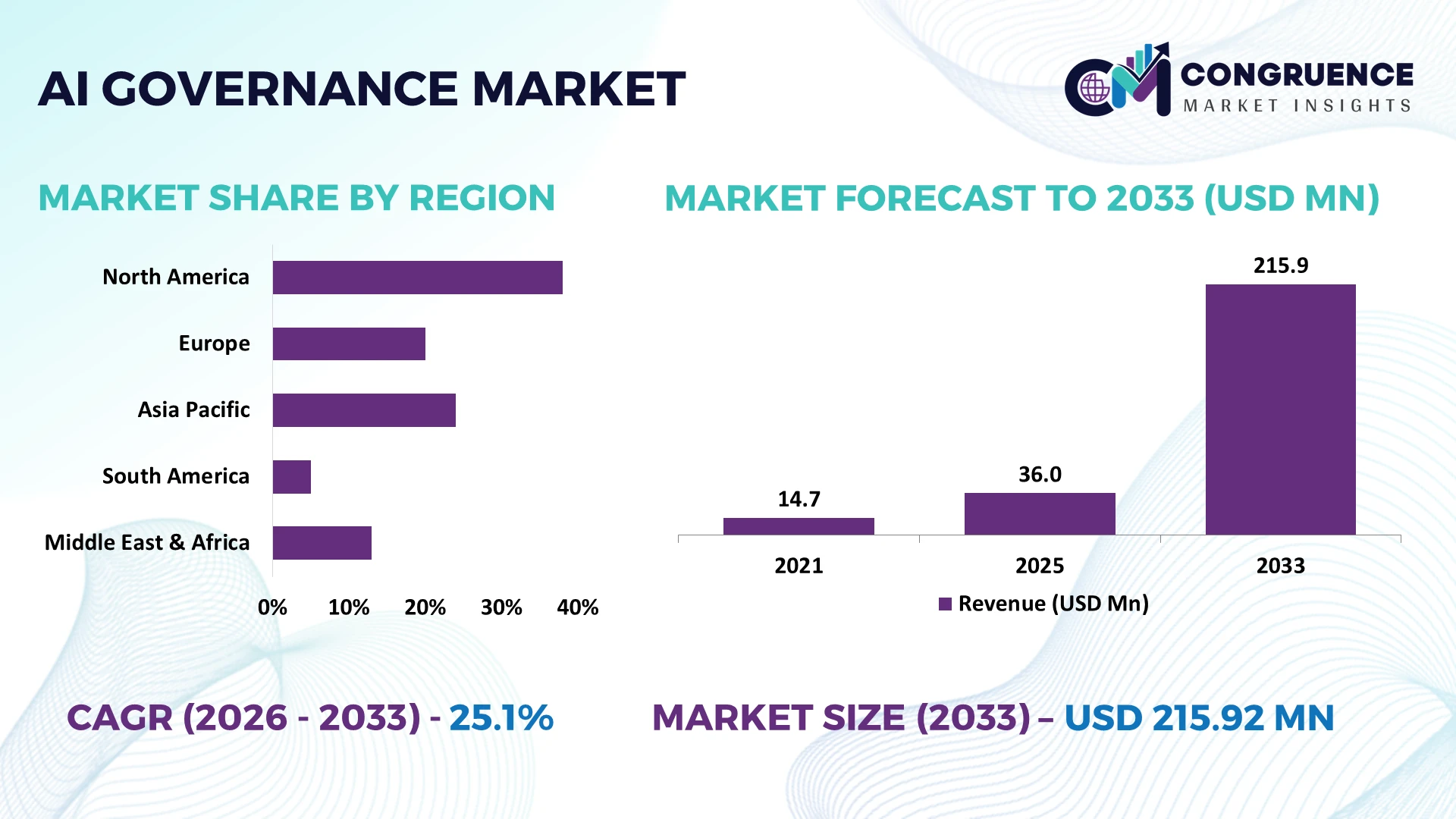
The United States commands nearly 39% of global AI governance implementation, supported by more than USD 85 billion in annual AI investment and over 74% enterprise adoption of formal AI risk controls across financial services, healthcare, and defense. Compared with Japan, where enterprise AI governance adoption remains below 45%, the U.S. benefits from broader cloud AI deployment. The continued enforcement of the EU AI Act in 2026 is also reshaping governance standards for multinational organizations.
Organizations embedding AI governance into enterprise AI lifecycles will strengthen regulatory readiness, operational resilience, and long-term competitive positioning.
Market Size & Growth: USD 35.99 Million in 2025, projected to reach USD 215.92 Million by 2033 at a CAGR of 25.1%, driven by enterprise AI governance integration.
Top Growth Drivers: Generative AI adoption exceeds 68%, AI compliance budgets rise 41%, and automated model governance improves by 36%.
Short-Term Forecast: By 2028, governance automation reduces compliance effort by 31% while audit efficiency increases by 46%.
Emerging Technologies: Explainable AI, automated policy engines, and continuous model monitoring improve governance accuracy by over 40%.
Regional Leaders: North America leads with about USD 83 Million, Europe USD 64 Million, and Asia-Pacific USD 50 Million through rapid enterprise AI expansion.
End-User Adoption: More than 72% of large enterprises integrate AI governance into cybersecurity, risk management, and data governance operations.
Operational Example: In 2026, enterprise AI governance programs shortened model approval cycles by 35% while reducing policy violations by 29%.
Competitive Landscape: Top five providers hold approximately 47% market share, competing through governance automation, transparency, cloud integration, and compliance intelligence.
Regulatory Impact: The EU AI Act and evolving global AI regulations increase governance platform deployment by nearly 34% across multinational enterprises.
Investment Activity: Global AI governance investment exceeds USD 6.5 billion through strategic partnerships, enterprise software expansion, and responsible AI initiatives.
Innovation Outlook: AI agents, real-time governance analytics, and lifecycle risk monitoring strengthen enterprise oversight while supporting scalable AI deployment.
AI Governance Market adoption is expanding across banking, healthcare, manufacturing, and public administration as organizations prioritize transparent, accountable AI operations. Advanced policy automation, explainable AI, and continuous model monitoring improve governance efficiency by nearly 40%, while evolving regulatory obligations and increasingly complex cross-border AI operations are driving long-term investment, setting the foundation for the strategic market analysis that follows.
AI governance has become a strategic enterprise capability as organizations move artificial intelligence from pilot projects to business-critical operations. Competitive differentiation increasingly depends on transparent model oversight, regulatory compliance, and responsible AI deployment rather than model performance alone. The enforcement of AI-specific regulations and modernization of digital governance infrastructure are prompting enterprises to redesign AI operating frameworks, making governance software a core investment priority across financial services, healthcare, manufacturing, and public administration.
Modern AI governance platforms automate policy validation, model monitoring, and compliance reporting, reducing audit preparation time by nearly 40% compared with legacy manual governance processes while lowering policy management costs by around 28%. The United States leads enterprise-scale deployment through mature cloud ecosystems and financial-sector adoption, whereas Singapore is rapidly expanding AI governance across public-sector digital services using centralized governance frameworks. During the next two to three years, more than 65% of large organizations are expected to integrate governance directly into AI development pipelines rather than deploying standalone compliance tools.
A leading banking institution, for example, embedded automated governance across its generative AI applications, reducing model approval cycles by approximately 35% while strengthening regulatory traceability. Technology vendors are expanding partnerships with cloud providers, cybersecurity firms, and consulting organizations to deliver integrated governance ecosystems. Companies establishing governance capabilities alongside AI innovation will strengthen operational resilience, accelerate enterprise deployment, and secure long-term competitive advantage.
Rapid enterprise adoption of generative AI is accelerating demand for structured AI governance as organizations seek consistent oversight across complex model portfolios. More than 72% of large enterprises now implement formal AI governance policies, while automated model monitoring reduces compliance effort by approximately 33% and governance workflow automation improves operational efficiency by nearly 30%. The implementation of the EU AI Act and expanding AI regulations in the United States have shifted governance from a compliance function to a board-level business priority. Technology providers are responding through platform expansion, strategic cloud partnerships, and integrated risk management capabilities, enabling organizations to deploy AI at scale while maintaining transparency, auditability, and operational control.
Diverging regulatory frameworks and inconsistent governance standards continue to complicate enterprise AI deployment across multiple jurisdictions. Nearly 47% of multinational organizations report increased compliance complexity when managing AI models across different regulatory environments, while integration costs rise by almost 25% when legacy data governance systems require modernization. Cross-border AI operations face additional challenges from fragmented data residency requirements and varying documentation obligations. To reduce operational exposure, companies are investing in localized compliance frameworks, standardized governance architectures, and interoperable policy management platforms. Organizations adopting flexible governance models gain greater scalability while minimizing implementation delays across international business operations.
Embedding governance directly into AI development and deployment environments is creating new enterprise value beyond regulatory compliance. Automated governance platforms improve model lifecycle efficiency by approximately 38%, while continuous policy enforcement reduces operational intervention by nearly 30%. Japan and the United Arab Emirates are accelerating national AI initiatives that emphasize responsible AI deployment alongside digital transformation. Technology vendors are expanding research investments, API-based governance platforms, and strategic ecosystem partnerships to support foundation models, AI agents, and multimodal applications. Organizations integrating governance into enterprise AI architecture are establishing scalable operational frameworks that strengthen innovation speed while reducing long-term compliance overhead.
The rapid emergence of autonomous AI agents and increasingly complex foundation models is challenging the scalability of existing governance frameworks. Around 44% of enterprises identify continuous model monitoring as their most difficult operational requirement, while AI security incidents associated with unmanaged models have increased by nearly 27% across large digital organizations. The shortage of specialized AI governance professionals further limits deployment consistency, particularly within highly regulated sectors in the United States and the United Kingdom. Companies are addressing these execution barriers through AI-assisted governance automation, workforce upskilling, cloud-native governance infrastructure, and cybersecurity partnerships. Successfully scaling governance capabilities will determine long-term competitiveness as enterprise AI environments continue to expand in complexity.
Governance Embedded Into AI Pipelines Enterprise AI teams are integrating governance directly into model development rather than adding compliance after deployment. More than 68% of large organizations now automate policy validation, while continuous monitoring reduces approval cycles by around 34% and manual reviews by 29%. Growing regulatory oversight in the United States is driving platform integration, prompting software vendors to expand partnerships with cloud providers and DevSecOps specialists for streamlined AI lifecycle management.
Automated Compliance Becomes Standard Organizations are replacing document-based compliance with automated evidence collection and real-time policy enforcement. Automated reporting lowers compliance workloads by nearly 37%, improves audit readiness by 43%, and reduces governance exceptions by 26%. The implementation of AI-specific regulations is accelerating deployment, while enterprises are restructuring governance teams around centralized operating models that combine legal, cybersecurity, and AI engineering expertise.
Foundation Model Oversight Expands Rapid adoption of foundation models is increasing demand for specialized governance capabilities covering model traceability, bias detection, and explainability. More than 61% of enterprises now evaluate governance before production deployment, while automated risk scoring improves assessment efficiency by approximately 32%. Technology suppliers are scaling dedicated governance platforms and collaborating with model developers to support secure enterprise deployment across regulated industries.
AI Security And Governance Converge AI governance is increasingly merging with enterprise cybersecurity operations as organizations address model integrity and data protection together. Integrated governance frameworks reduce policy conflicts by about 31% and improve incident response coordination by 27%. Rising AI-enabled cyber threats and expanding third-party AI adoption are encouraging companies to automate governance controls, strengthen ecosystem partnerships, and standardize enterprise-wide operational oversight.
Software remains the leading segment, accounting for approximately 46% of the AI Governance Market as enterprises prioritize scalable policy management, model lifecycle oversight, and centralized compliance capabilities. Organizations favor software platforms because they integrate efficiently with existing AI development environments while reducing governance complexity by nearly 35%. Platform providers continue expanding functionality through automated documentation, explainability tools, and real-time monitoring, allowing customers to standardize governance across multiple business units with lower operational effort.
Platforms represent the fastest-growing segment as enterprises shift toward unified governance architectures capable of managing foundation models and AI agents. Adoption of integrated platforms has increased by almost 38% among large enterprises seeking end-to-end visibility, while services remain strategically important for implementation, customization, regulatory consulting, and managed governance operations. Vendors are strengthening portfolios through acquisitions, cloud partnerships, and modular product development, reflecting growing customer preference for flexible governance ecosystems rather than standalone compliance solutions.
Risk Management leads the application landscape with an estimated 34% share as enterprises prioritize AI risk identification, model accountability, and operational resilience. Financial institutions, healthcare providers, and critical infrastructure operators increasingly integrate governance into enterprise risk frameworks, improving policy enforcement efficiency by approximately 36%. Compliance Management remains a core operational requirement as evolving regulations require continuous documentation, automated reporting, and standardized governance controls across distributed AI environments.
Model Monitoring is emerging as the fastest-growing application because enterprises require continuous visibility into model drift, bias, and operational performance after deployment. Adoption of automated monitoring has increased by nearly 41%, while AI Auditing and Policy Management continue expanding through workflow automation and centralized governance platforms. Technology vendors are integrating these applications into unified governance suites, helping organizations reduce manual oversight while supporting enterprise-scale AI deployment with greater operational consistency.
BFSI remains the dominant end-user segment with approximately 31% market share due to strict regulatory oversight, high-value AI decision-making, and extensive digital banking operations. Large financial institutions increasingly automate governance across fraud detection, credit assessment, and customer service models, improving compliance efficiency by around 33%. Government organizations continue strengthening adoption through national AI governance initiatives, while IT & Telecom providers integrate governance into cloud-native AI services supporting enterprise customers.
Healthcare represents the fastest-growing end-user segment as hospitals and life sciences organizations expand AI-assisted diagnostics, clinical decision support, and patient data analytics. AI governance deployment within healthcare has increased by nearly 39%, driven by stricter privacy requirements and demand for transparent clinical AI systems. Retail organizations are adopting governance to improve recommendation engines and customer analytics, while technology providers are developing sector-specific governance solutions through strategic partnerships, industry frameworks, and customized deployment models.
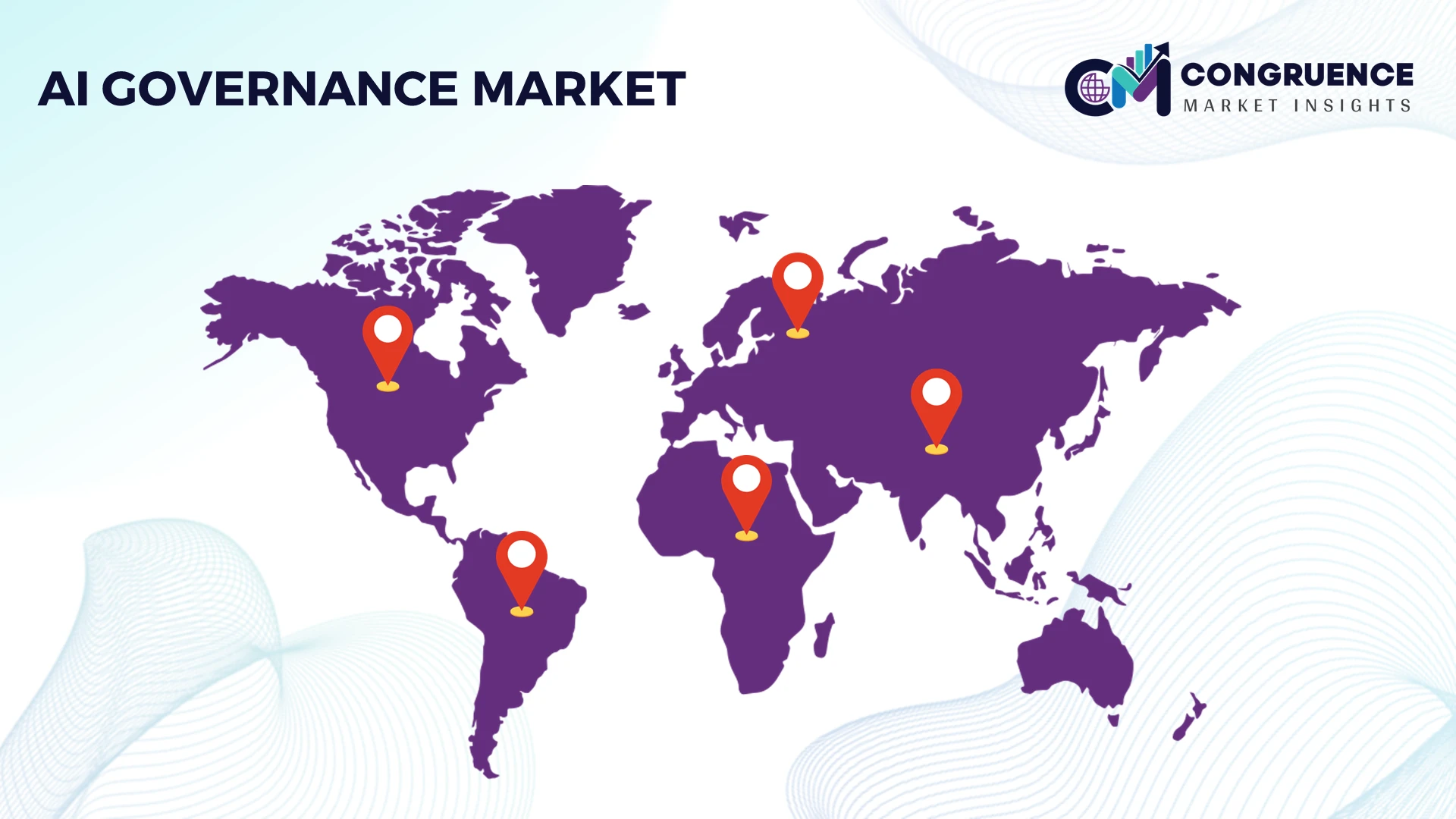
North America accounted for the largest market share at 39.2% in 2025 however, Asia-Pacific is expected to register the fastest growth, expanding at a 27.8% CAGR between 2026 and 2033.
Enterprise AI Governance Becomes Operational Standard
North America maintains market leadership through large-scale enterprise AI deployment, mature cloud infrastructure, and rapidly evolving regulatory expectations. Financial services, healthcare, defense, and technology companies are integrating AI governance into enterprise risk and cybersecurity frameworks to improve transparency and operational resilience. More than 72% of large organizations have formal AI governance programs, while automated governance workflows reduce compliance preparation time by approximately 35%. Strategic partnerships between cloud providers, cybersecurity vendors, and governance software developers are accelerating integrated platform adoption. Enterprise investment increasingly prioritizes continuous model monitoring, explainability, and policy automation, enabling organizations to standardize AI operations while supporting expanding generative AI deployment across mission-critical business functions.
United States Market Outlook: The United States remains the operational center of the regional market due to its concentration of hyperscale cloud providers, AI software developers, and regulated enterprise sectors. More than 75% of Fortune 500 organizations have expanded responsible AI initiatives, while financial institutions continue integrating governance into enterprise-wide AI platforms. Strong investment in AI infrastructure and regulatory preparedness positions the country as the benchmark for enterprise AI governance deployment.
Regulation Accelerates Enterprise Transformation
Europe is strengthening its position through regulatory leadership, trusted AI implementation, and enterprise compliance modernization. The rollout of AI-specific regulatory frameworks is driving governance adoption across banking, manufacturing, healthcare, and public administration. The region contributes nearly 29% of global enterprise AI governance deployment, with automated compliance platforms improving documentation efficiency by approximately 32%. Organizations are embedding governance controls into digital transformation programs rather than treating compliance as a standalone process. Technology providers continue expanding partnerships with consulting firms and cloud infrastructure companies to deliver integrated governance solutions aligned with evolving enterprise regulatory requirements.
Germany Market Outlook: Germany leads regional deployment through its advanced manufacturing ecosystem and industrial AI adoption. Automotive, engineering, and industrial automation companies increasingly integrate AI governance into production analytics and intelligent manufacturing systems. More than 58% of large industrial enterprises have formal AI oversight policies, reinforcing Germany's position as a strategic hub for trustworthy industrial AI deployment and enterprise governance innovation.
Digital Scale Fuels Governance Expansion
Asia-Pacific is emerging as the fastest-expanding regional market as governments and enterprises accelerate digital transformation, AI infrastructure investment, and enterprise automation. Large-scale cloud adoption, expanding AI development ecosystems, and national AI strategies are increasing demand for governance platforms across finance, manufacturing, telecommunications, and government services. Enterprise AI deployment has grown by over 40% in major economies, while governance automation improves policy consistency by approximately 30%. Technology vendors are localizing platforms, strengthening ecosystem partnerships, and expanding cloud-based governance capabilities to support diverse regulatory environments and rapidly increasing enterprise AI adoption.
China Market Outlook: China remains the region's largest operational market through extensive AI infrastructure investment, strong enterprise digitalization, and widespread industrial AI deployment. Major technology companies continue integrating governance capabilities into cloud AI platforms supporting manufacturing, financial services, and smart city applications. Enterprise AI utilization exceeds 70% among leading digital businesses, creating sustained demand for scalable governance and lifecycle management solutions.
Enterprise Digitalization Strengthens Demand
South America is experiencing steady expansion as financial institutions, public agencies, and telecommunications providers strengthen AI governance alongside broader digital transformation initiatives. The region represents approximately 7% of global deployment, with enterprise AI governance implementation increasing by nearly 28% across regulated industries. Financial modernization and cloud migration continue supporting adoption despite uneven digital infrastructure across several markets. Software vendors are expanding regional partnerships, localized implementation services, and managed governance offerings to improve accessibility while addressing operational complexity and compliance requirements for growing enterprise AI environments.
Brazil Market Outlook: Brazil leads regional adoption through its mature financial sector, expanding cloud ecosystem, and accelerating enterprise AI implementation. Large banks, insurance companies, and technology firms continue investing in governance frameworks supporting responsible AI deployment and regulatory compliance. More than 60% of major financial institutions have integrated AI governance into enterprise risk management, reinforcing Brazil's strategic leadership within the regional market.
National AI Programs Drive Modernization
The Middle East & Africa market is advancing through government-led AI strategies, cloud infrastructure investment, and digital public service modernization. Organizations are adopting governance frameworks alongside national AI initiatives to strengthen transparency, cybersecurity, and operational accountability. Enterprise AI deployment has increased by approximately 33% across priority sectors including finance, energy, healthcare, and government administration. Strategic collaborations between technology providers and regional digital transformation agencies continue accelerating implementation, while expanding cloud infrastructure improves scalability for enterprise governance platforms across high-value AI applications.
United Arab Emirates Market Outlook: The United Arab Emirates serves as the region's leading AI governance hub through ambitious national AI strategies, advanced digital infrastructure, and proactive regulatory development. Government agencies and financial institutions continue integrating governance into enterprise AI programs supporting smart government and digital economy initiatives. More than 65% of government AI projects incorporate structured governance frameworks, strengthening the country's position as a regional center for responsible AI deployment.
Competition is led by enterprise software providers including Microsoft, IBM, SAS Institute, DataRobot, and Salesforce, competing directly with specialized AI governance platform developers focused on explainability, model monitoring, and policy automation. The top five players collectively control approximately 46% of the market through integrated cloud ecosystems and enterprise relationships. Competition increasingly depends on governance automation, deployment speed, and interoperability, with automated workflows improving compliance efficiency by nearly 35% and integrated platforms reducing implementation effort by approximately 28%. Vendors are strengthening market positions through cloud partnerships, cybersecurity integration, AI lifecycle innovation, and industry-specific governance capabilities rather than price competition alone. Specialized providers differentiate through customization and regulatory expertise, while global technology companies leverage existing enterprise infrastructure and platform scale. High integration complexity and enterprise trust remain significant entry barriers. Sustainable competitive advantage depends on delivering scalable, transparent, and continuously automated governance across increasingly complex enterprise AI environments.
Microsoft
IBM
SAS Institute
DataRobot
Salesforce
Amazon Web Services (AWS)
Oracle
SAP
ServiceNow
FICO
H2O.ai
Credo AI
Holistic AI
AI governance technology is shifting from policy documentation toward automated lifecycle control integrated directly into enterprise AI workflows. Current platforms combine model monitoring, explainability, risk scoring, and compliance automation to improve governance efficiency by 30–40% while reducing manual audit effort by nearly 35%. More than 70% of large enterprises now connect governance tools with MLOps, cybersecurity, and data governance systems to create unified oversight environments. Compared with legacy spreadsheet-based governance processes, automated governance platforms shorten model approval cycles by approximately 45% and improve traceability across distributed AI environments. Financial services, healthcare, and public-sector organizations gain the greatest operational advantage due to strict regulatory obligations and increasing AI deployment complexity.
Emerging technologies between 2026 and 2028 include governance for AI agents, real-time policy engines, synthetic testing environments, and automated control frameworks for foundation models. Agentic AI oversight tools improve policy enforcement by around 28%, while continuous monitoring systems reduce governance exceptions by nearly 25%. Adoption of explainable AI capabilities has surpassed 60% among regulated enterprises as organizations seek transparent decision-making and stronger audit readiness.
Disruptive innovation is centered on AI-assisted governance, where governance systems themselves use machine learning to detect risk, automate controls, and predict compliance gaps. Companies integrating governance into cloud platforms, cybersecurity architecture, and AI development pipelines will gain faster deployment cycles, lower compliance costs, and stronger competitive positioning as enterprise AI environments become increasingly autonomous.
February 2025 IBM published its AI Safety and Governance Framework aligned with the AI Seoul Summit commitments, strengthening enterprise governance across model development, monitoring, and accountability. The framework covers end-to-end lifecycle controls for high-risk AI systems, improving operational trust and compliance readiness.
June 2025 IBM introduced industry-first software integrating watsonx.governance with Guardium AI Security, unifying governance and security for AI agents. The platform enables automated auditing, shadow-agent detection, and centralized risk visibility, supporting enterprise-scale deployment of generative AI applications. Source: IBM Newsroom
December 2025 IBM launched the watsonx.governance Enterprise Governance Accelerator featuring automated AI asset onboarding and governed inventories across models, agents, and applications. Automation reduces manual governance processes while improving enterprise policy consistency and accelerating AI deployment. Source: IBM
April 2026 Microsoft released the Agent Governance Toolkit supporting runtime policy enforcement for AI agents across Python, Rust, Go, .NET, and TypeScript environments. The toolkit addresses all 10 OWASP Agentic AI risks, strengthening security and governance for autonomous enterprise systems. Source: Microsoft Community Reference
This report provides a comprehensive assessment of the AI Governance Market, covering software, services, and platform segments alongside core applications including risk management, compliance management, model monitoring, AI auditing, and policy management. Analysis spans key end-users such as BFSI, healthcare, government, IT & telecom, and retail, reflecting more than 70% of enterprise AI governance demand. Regional evaluation includes North America, Europe, Asia-Pacific, South America, and the Middle East & Africa, with country-level insights into deployment patterns, regulatory frameworks, and technology adoption.
The report examines emerging technologies including explainable AI, automated governance, foundation model oversight, and governance for AI agents, alongside competitive positioning across major market participants. Strategic insights support investment decisions, product development, expansion planning, partnership evaluation, and long-term market prioritization between 2026 and 2033. Coverage also includes evolving enterprise operating models, regulatory shifts, and sector-specific governance requirements shaping future demand.
| Report Attribute/Metric | Report Details |
|---|---|
Market Revenue in 2025 | USD 35.99 Million |
Market Revenue in 2033 | USD 215.92 Million |
CAGR (2026 - 2033) | 25.1% |
Base Year | 2025 |
Forecast Period | 2026 - 2033 |
Historic Period | 2021 - 2025 |
Segments Covered | By Type
By Application
By End-User
|
Key Report Deliverable | Revenue Forecast, Growth Trends, Market Dynamics, Segmental Overview, Regional and Country-wise Analysis, Competition Landscape |
Region Covered | North America, Europe, Asia-Pacific, South America, Middle East, Africa |
Key Players Analyzed | Microsoft, IBM, SAS Institute, DataRobot, Salesforce, Google, Amazon Web Services (AWS), Oracle, SAP, ServiceNow, FICO, H2O.ai, Credo AI, Holistic AI |
Customization & Pricing | Available on Request (10% Customization is Free) |




