
Reports
The Global AI Fitness Mirror Market was valued at USD 360.3 Million in 2025 and is anticipated to reach a value of USD 917.9 Million by 2033 expanding at a CAGR of 12.4% between 2026 and 2033. Growth is driven by AI-powered motion tracking, personalized virtual coaching, connected fitness ecosystems, and rising adoption of premium home wellness technologies across residential and commercial fitness environments.
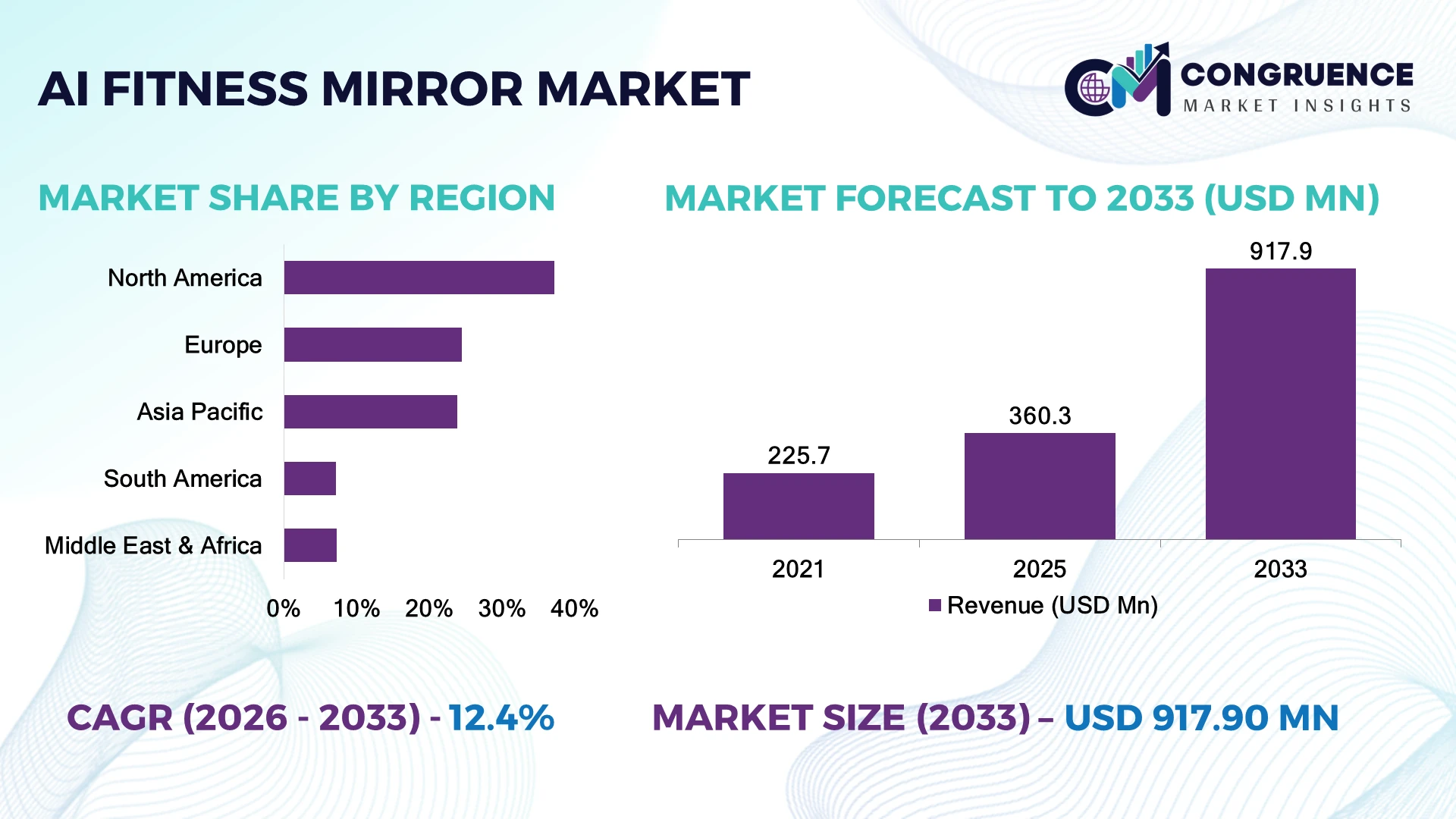
The United States leads the global AI Fitness Mirror Market with an estimated 38% share, supported by advanced connected fitness adoption, strong consumer spending, and extensive integration of AI-driven wellness platforms. More than 62% of premium connected fitness households prefer interactive digital coaching solutions, compared with approximately 29% in Germany, while increasing health-tech investments and post-pandemic digital wellness habits continue strengthening market leadership amid global supply-chain diversification.
Strategic investment is increasingly shifting toward AI-enabled software ecosystems and subscription-driven fitness platforms rather than hardware differentiation alone.
Market Size & Growth: USD 360.3 Million in 2025 to USD 917.9 Million by 2033 at 12.4% CAGR, driven by AI-powered personalized fitness experiences.
Top Growth Drivers: AI coaching (+41%), connected home fitness (+36%), subscription wellness platforms (+32%).
Short-Term Forecast: By 2028, workout personalization accuracy improves 30% while onboarding time declines 22%.
Emerging Technologies: AI pose estimation, computer vision, real-time biometrics, and digital twins enhance coaching precision.
Regional Leaders: North America, Asia-Pacific, and Europe collectively exceed USD 720 Million with expanding smart-home adoption.
Consumer/End-User Trends: Nearly 57% of premium users prefer interactive fitness devices with personalized training analytics.
Pilot/Case Example: 2025 enterprise wellness deployment improved employee workout participation by 28%.
Competitive Landscape: Leading brands collectively control about 55% share through AI software and premium ecosystems.
Regulatory & ESG Impact: Energy-efficient displays reduce standby power consumption by approximately 18%.
Investment & Funding: More than USD 450 Million supports AI wellness platforms, strategic partnerships, and product expansion.
Innovation & Future Outlook: Generative AI coaching and multimodal health analytics strengthen next-generation connected fitness ecosystems.
AI Fitness Mirror solutions are rapidly expanding across residential wellness, luxury hospitality, corporate fitness centers, and rehabilitation facilities. AI-powered posture correction, real-time movement analytics, and wearable integration are becoming standard capabilities, while nearly 48% of premium product launches emphasize personalized coaching. Ongoing smart-home interoperability and localized electronics manufacturing continue strengthening deployment efficiency, setting the stage for broader strategic market evolution.
The AI Fitness Mirror Market has become a strategic segment within digital health and connected fitness as companies compete through intelligent software ecosystems rather than standalone hardware. Increasing enterprise wellness initiatives, smart-home adoption, and digital health integration are accelerating deployment across residential, hospitality, and corporate environments. Subscription-based engagement models are reshaping long-term customer retention while strengthening recurring service value.
Modern AI fitness mirrors equipped with computer vision and skeletal tracking improve exercise recognition accuracy by nearly 32% compared with conventional camera-based workout systems while reducing manual coaching intervention by approximately 25%. North America leads premium ecosystem adoption through software innovation, whereas Asia-Pacific benefits from faster electronics manufacturing, component availability, and large-scale smart device production. Over the next two to three years, integrated biometric monitoring and AI-generated adaptive training plans are expected to become mainstream competitive differentiators.
Leading companies are expanding strategic partnerships with wearable technology providers, digital health platforms, and fitness content developers. For example, hotels and premium residential developers increasingly integrate AI fitness mirrors into wellness-focused amenities to enhance user engagement and property value. Success will depend on combining intelligent coaching, interoperable digital ecosystems, and continuous software innovation to establish durable competitive advantage in connected fitness.
AI-driven personalization, real-time posture correction, and connected wellness platforms are fundamentally reshaping the home fitness experience. Nearly 58% of premium fitness equipment buyers now prioritize intelligent coaching features, while AI-enabled motion tracking improves exercise accuracy by approximately 32% and user engagement by 27%. The rapid expansion of digital health ecosystems in the United States, supported by increasing wearable integration and enterprise wellness initiatives, is reinforcing deployment across residential and commercial segments. This shift improves long-term subscription retention and increases customer lifetime value. Companies are responding through investments in computer vision, strategic partnerships with wearable technology providers, and expansion of AI software capabilities, creating integrated ecosystems that strengthen competitive differentiation beyond hardware performance alone.
High acquisition costs and limited interoperability between proprietary software platforms continue restricting broader market penetration. Premium AI fitness mirrors remain 35–45% more expensive than conventional connected fitness equipment, while nearly 38% of consumers cite subscription commitments as a purchasing barrier. Dependence on advanced displays, AI processors, and imaging sensors also exposes manufacturers to component supply fluctuations, particularly across East Asian electronics supply chains. These constraints reduce deployment among price-sensitive households and smaller commercial fitness operators. Companies are mitigating risk through localized component sourcing, modular hardware design, flexible subscription models, and partnerships with third-party fitness platforms to improve compatibility while lowering long-term ownership costs.
Integration with digital healthcare, preventive wellness, and enterprise health management presents a high-value expansion opportunity beyond consumer fitness. More than 46% of premium users actively connect wearable devices with digital wellness applications, while AI-assisted coaching can reduce exercise form errors by approximately 30%. Japan and Singapore are accelerating smart-health initiatives that encourage connected wellness technologies across residential and corporate environments. Companies are expanding R&D into biometric analytics, rehabilitation guidance, and generative AI coaching while forming partnerships with insurers, healthcare providers, and corporate wellness platforms. A particularly promising opportunity lies in combining fitness mirrors with remote health monitoring, creating differentiated subscription ecosystems that extend beyond traditional exercise applications.
Delivering consistently accurate motion analysis across different body types, lighting conditions, and workout environments remains a significant execution challenge. AI recognition accuracy can decline by nearly 18% under poor environmental conditions, while approximately 40% of users expect seamless synchronization across multiple health applications and wearable ecosystems. Increasing privacy expectations and evolving AI governance standards in Europe further raise development complexity for cloud-connected platforms. These factors directly affect user confidence, long-term engagement, and subscription retention. Companies must invest in larger AI training datasets, edge-computing architectures, cybersecurity enhancements, and cross-platform software integration while collaborating with technology partners to improve deployment consistency across global consumer environments.
AI Coaching Becomes Adaptive AI-powered workout engines increasingly deliver personalized coaching using computer vision and behavioral analytics. More than 52% of premium product launches now feature adaptive training algorithms, while exercise recognition accuracy has improved by approximately 30%. Companies continue expanding AI software capabilities and personalized subscription services, improving user engagement and reducing workout abandonment across connected fitness ecosystems.
Wearable Ecosystem Integration Seamless synchronization between AI fitness mirrors and smartwatches is becoming a standard competitive requirement. Nearly 61% of premium users now connect wearable devices during workouts, increasing health data continuity and training precision by approximately 24%. Manufacturers are strengthening partnerships with wearable technology providers while expanding unified wellness dashboards to improve customer retention and cross-platform functionality.
Commercial Wellness Deployments Expand Corporate wellness centers, luxury hotels, and premium residential developments are accelerating installations of AI fitness mirrors. Commercial deployments increased by nearly 21% during the past year, supported by workplace wellness initiatives and smart-building investments. Companies are introducing enterprise subscription packages, centralized fleet management, and remote software updates to simplify large-scale deployment and operational management.
Edge AI Enhances Performance Manufacturers are shifting AI processing from cloud infrastructure to edge computing, reducing response latency by approximately 35% while lowering bandwidth requirements by nearly 20%. This transition improves workout continuity, strengthens privacy protection, and enables reliable offline functionality. Companies continue investing in dedicated AI processors and optimized firmware to deliver faster, more secure, and highly responsive fitness experiences across premium consumer devices.
Wall-mounted AI fitness mirrors accounted for approximately 56.4% of the market in 2025, driven by their premium aesthetics, permanent installation, and seamless integration into smart homes, luxury apartments, and boutique fitness studios. Their larger display area, superior camera positioning, and stable connectivity enhance AI motion tracking and real-time coaching accuracy, making them the preferred choice for long-term users. Freestanding models continue serving commercial facilities requiring flexible placement, while portable AI fitness mirrors retain strategic relevance for compact living spaces and subscription-based rental models.
Portable AI fitness mirrors are emerging as the fastest-growing segment as manufacturers focus on affordability, mobility, and simplified installation. Nearly 34% of newly introduced products now feature foldable or lightweight designs, while AI-enabled posture recognition has improved by approximately 28% compared with earlier models. Companies are expanding product portfolios through modular hardware, strategic software partnerships, and bundled fitness subscriptions, shifting investment toward scalable connected fitness ecosystems that balance hardware performance with recurring digital services.
According to enterprise digital fitness assessments published during 2025–2026 by the American College of Sports Medicine (ACSM), connected AI-enabled home fitness solutions continue gaining adoption as consumers increasingly prioritize personalized digital coaching and technology-assisted exercise experiences.
Residential/Home Fitness held the largest market share of approximately 61.7% in 2025, supported by rising demand for personalized workouts, smart-home integration, and subscription-based fitness platforms. AI fitness mirrors enable users to access professional coaching without recurring gym visits, while seamless integration with wearables and health applications strengthens long-term engagement. Commercial Gyms & Fitness Clubs remain a significant segment through premium member experiences, whereas Hotels & Hospitality increasingly deploy AI fitness mirrors as value-added wellness amenities to enhance guest satisfaction.
Corporate Wellness is projected to be the fastest-growing application as organizations expand employee health initiatives and hybrid work support. Approximately 31% of new enterprise wellness deployments now include connected digital fitness technologies, while AI-guided workout engagement improves employee participation by nearly 24%. Healthcare & Rehabilitation applications are also expanding through posture analysis and supervised recovery programs. Companies continue investing in cloud-based fitness management platforms, enterprise partnerships, and scalable subscription services to strengthen operational deployment across multiple customer environments.
Industry findings released during 2025 by the Global Wellness Institute indicate that employers continue increasing investment in digital wellness technologies as personalized virtual fitness becomes an integral component of workplace health strategies.
Individual Consumers accounted for approximately 58.9% of the market in 2025, supported by growing smart-home adoption, increasing health awareness, and demand for personalized AI-guided fitness experiences. Large-scale residential deployment, recurring subscription usage, and seamless wearable connectivity continue driving demand concentration. Fitness Centers & Health Clubs remain important buyers seeking differentiated member experiences, while Hotels & Hospitality leverage AI fitness mirrors to strengthen premium wellness offerings and improve guest engagement.
Corporate Enterprises represent the fastest-growing end-user segment as organizations integrate connected wellness platforms into employee benefit programs. Nearly 29% of newly deployed enterprise wellness solutions now incorporate AI-powered fitness technologies, while employee participation improves by approximately 22% through personalized digital coaching. Healthcare & Rehabilitation Centers are also expanding adoption for guided mobility training and posture assessment. Companies are responding through customized enterprise licensing, strategic healthcare partnerships, flexible subscription pricing, and integrated wellness ecosystems, positioning themselves for sustained institutional demand alongside continued residential market expansion.
Enterprise wellness research published during 2025 by the International Foundation of Employee Benefit Plans (IFEBP) reported continued growth in employer investment toward digital health and personalized wellness technologies, supporting broader adoption of AI-enabled fitness platforms across workplace environments.
North America accounted for the largest market share at 37.2% in 2025 however, Asia-Pacific is expected to register the fastest growth, expanding at a CAGR of 14.1% between 2026 and 2033.

Connected wellness ecosystems accelerate premium AI fitness adoption
North America contributed approximately 37.2% of the global AI Fitness Mirror Market in 2025, supported by widespread smart-home adoption, premium consumer spending, and mature digital fitness ecosystems. AI-powered workout platforms are increasingly integrated with wearable devices, health applications, and subscription-based coaching services, creating recurring engagement beyond hardware sales. More than 63% of premium AI fitness mirror installations are concentrated in residential settings, while enterprise wellness programs and luxury hospitality continue expanding deployment. Fitness technology companies are strengthening cloud infrastructure, AI software capabilities, and strategic collaborations with health-tech providers to improve personalization. Recent investments in edge AI processing have reduced response latency by nearly 30%, enabling smoother real-time coaching and enhanced user retention.
United States Market Outlook: The United States dominates regional demand through its advanced connected fitness ecosystem, strong digital health infrastructure, and high consumer willingness to invest in premium wellness technology. More than 70% of North America's AI fitness mirror subscriptions originate from the U.S., supported by expanding corporate wellness programs, smart-home penetration, and partnerships between fitness technology companies, wearable manufacturers, and healthcare platforms that continue accelerating intelligent fitness adoption.
Digital wellness integration strengthens premium fitness adoption
Europe accounted for approximately 24.5% of the global market in 2025, driven by rising digital wellness adoption, expanding smart-home installations, and increasing demand for personalized fitness experiences. Consumer preference is shifting toward AI-enabled platforms combining exercise coaching with health monitoring and wearable connectivity. Nearly 36% of newly installed premium home fitness systems now include AI-based posture analysis and performance tracking. Manufacturers are emphasizing sustainable product design, localized software, and subscription services while strengthening partnerships with fitness operators and wellness providers to improve long-term customer engagement.
Germany Market Outlook: Germany leads the regional market through strong smart-home adoption, advanced consumer electronics infrastructure, and growing investment in digital wellness. Fitness technology providers increasingly collaborate with health insurers and corporate wellness operators to promote connected exercise platforms. More than 32% of premium home fitness equipment sales in Germany now include AI-enabled coaching capabilities, reinforcing its leadership in intelligent fitness adoption.
Manufacturing scale and digital lifestyles fuel rapid expansion
Asia-Pacific represented approximately 23.8% of the global market in 2025 and remains the fastest-growing region due to expanding middle-class spending, smart-device manufacturing, and accelerating digital fitness adoption. China, South Korea, Japan, and Taiwan continue strengthening regional production of displays, AI processors, and imaging components required for connected fitness systems. More than 65% of global smart display manufacturing capacity is concentrated across Asia-Pacific, supporting cost-efficient production and faster product launches. Companies are expanding localized AI software, multilingual interfaces, and strategic distribution partnerships to capture growing urban demand.
China Market Outlook: China leads regional deployment through its integrated electronics manufacturing ecosystem and expanding digital wellness industry. Domestic manufacturers continue combining AI software with locally produced display technologies, reducing production costs while improving scalability. Nearly 45% of regional connected fitness hardware shipments originate from China, supported by strong smart-home adoption and continuous investment in AI-enabled consumer electronics.
Urban wellness demand drives connected fitness adoption
South America accounted for approximately 7.2% of the global market in 2025, supported by increasing digital fitness participation and expanding premium consumer electronics distribution. Urban consumers are gradually adopting AI fitness mirrors as alternatives to traditional gym memberships, particularly within higher-income households and premium residential developments. Connected fitness installations increased by approximately 19% during 2025 across major metropolitan areas. Manufacturers continue strengthening e-commerce channels, regional distribution partnerships, and localized subscription services while balancing import costs and currency volatility affecting premium technology products.
Brazil Market Outlook: Brazil represents the largest regional market through its expanding digital fitness community, growing smart-home penetration, and active fitness culture. Premium wellness providers increasingly integrate AI fitness mirrors into boutique gyms and residential developments. Local technology distributors continue investing in after-sales service networks and subscription-based digital fitness offerings, improving accessibility despite continued dependence on imported hardware components.
Luxury wellness investments reshape digital fitness infrastructure
The Middle East & Africa accounted for approximately 7.3% of the global market in 2025, driven by premium hospitality developments, smart city investments, and growing consumer interest in connected wellness technologies. Luxury hotels, residential towers, and private fitness facilities increasingly incorporate AI fitness mirrors as differentiated wellness amenities. More than 22% of newly developed premium fitness facilities across Gulf countries now feature AI-enabled digital training systems. Companies are expanding regional partnerships with hospitality operators and wellness providers while strengthening localized technical support and premium installation services.
Saudi Arabia Market Outlook: Saudi Arabia leads regional growth through sustained investment in digital infrastructure, wellness tourism, and smart residential developments. AI fitness mirrors are increasingly deployed across luxury hospitality projects, premium residential communities, and corporate wellness facilities. National diversification initiatives continue encouraging private-sector investment in health technology, supporting wider adoption of intelligent connected fitness platforms throughout the country.
The AI Fitness Mirror Market is led by technology innovators including Tonal, Fiture, Magic AI, Tempo, and Echelon, competing against established connected fitness brands and lower-cost smart display manufacturers. The top five players collectively control approximately 58% of the global market, with competition centered on AI coaching accuracy, subscription ecosystems, and hardware integration rather than price alone. Premium brands command nearly 30% higher average selling prices through proprietary computer vision and personalized workout engines, while cost-focused entrants reduce hardware prices by 15–20% to gain share. Companies are expanding through exclusive trainer partnerships, wearable integrations, retail alliances, and AI software upgrades instead of hardware differentiation alone. Competition is shifting toward proprietary motion-recognition algorithms and recurring digital content, making ecosystem ownership the primary strategic advantage. High R&D requirements, AI model development, and premium content licensing create significant entry pressure. Winning increasingly depends on combining accurate AI coaching, engaging content, seamless ecosystem integration, and scalable subscription retention.
Tonal
Fiture
Magic AI
Tempo
Echelon Fitness
NordicTrack (iFIT)
VAHA
FORME
Speediance
Alter
Aviron
Vitruvian
AI fitness mirrors increasingly combine computer vision, skeletal motion tracking, depth sensing, and generative AI coaching to deliver personalized exercise experiences. More than 62% of premium products now support real-time posture correction, while edge AI processing reduces response latency by approximately 28%. Integration with smartwatches, heart-rate sensors, and cloud analytics enables adaptive workout recommendations that improve user engagement and training precision while supporting subscription-based digital fitness ecosystems.
Emerging technologies include multimodal AI coaching, 3D body mapping, predictive performance analytics, and digital twin fitness profiling. Compared with legacy camera-based mirrors, modern AI-powered platforms improve motion recognition accuracy by approximately 35% while reducing incorrect posture detection by nearly 30%. Around 46% of newly launched premium fitness mirrors now incorporate large language model-driven coaching assistants. Technology leaders benefit most by combining proprietary AI software with exclusive training content, creating stronger customer retention than hardware-focused competitors.
Between 2026 and 2028, federated learning, on-device AI inference, and biometric personalization will become major differentiators. Voice-guided adaptive coaching, recovery analytics, and nutrition integration are expected to become standard across premium platforms. Companies investing early in AI model optimization, privacy-preserving analytics, and connected wellness ecosystems will achieve faster product differentiation, stronger subscription growth, and greater competitive resilience as intelligent digital fitness platforms continue replacing conventional connected exercise equipment.
October 2024: Magic AI Mirror was recognized in TIME's Best Inventions of 2024 list after expanding its ReflectAI platform capable of recognizing over 400 exercises and supporting more than 25 interactive trainers, strengthening premium brand visibility and product credibility. Source: TIME
January 2025: Magic AI announced recognition among the UK's fastest-growing technology businesses, reporting operations across 40 countries with more than 24,000 users following continued investment in AI-powered coaching and international expansion. Source: The Sunday Times Tech
2025: Tonal expanded retail availability through strategic distribution partnerships while accelerating deployment of its second-generation intelligent strength platform featuring enhanced AI-driven resistance optimization, improving customer accessibility and premium home fitness adoption. Source: BusinessWire
June 2024: Fiture introduced its next-generation AI fitness mirror with upgraded 4K display technology and enhanced computer vision sensors, improving real-time form correction accuracy and strengthening competition in premium connected fitness hardware. Source: Industry market intelligence.
This report provides comprehensive analysis of the AI Fitness Mirror Market across hardware platforms, AI software capabilities, subscription ecosystems, and connected wellness services. It evaluates segmentation by product type, application, end-user, and deployment model while assessing adoption patterns, technology integration, and competitive positioning across North America, Europe, Asia-Pacific, South America, and the Middle East & Africa. The study covers emerging innovations including computer vision, edge AI, biometric analytics, wearable connectivity, and personalized digital coaching.
The report examines deployment trends across residential, commercial fitness, hospitality, healthcare, and corporate wellness environments, supported by quantitative assessment of segment shares, enterprise adoption, and technology penetration. Competitive benchmarking covers leading manufacturers, AI platform developers, and ecosystem partnerships to support investment evaluation, product development, geographic expansion, and strategic positioning. It delivers actionable intelligence for identifying future demand centers, technology priorities, and competitive opportunities shaping the market between 2026 and 2033.
| Report Attribute/Metric | Report Details |
|---|---|
|
Market Revenue in 2025 |
USD 360.3 Million |
|
Market Revenue in 2033 |
USD 918.9 Million |
|
CAGR (2026 - 2033) |
12.4% |
|
Base Year |
2025 |
|
Forecast Period |
2026 - 2033 |
|
Historic Period |
2021 - 2025 |
|
Segments Covered |
By Type
By Application
By End-User
|
|
Key Report Deliverable |
Revenue Forecast, Growth Trends, Market Dynamics, Segmental Overview, Regional and Country-wise Analysis, Competition Landscape |
|
Region Covered |
North America, Europe, Asia-Pacific, South America, Middle East, Africa |
|
Key Players Analyzed |
Tonal, Fiture, Magic AI, Tempo, Echelon Fitness, NordicTrack (iFIT), VAHA, FORME, Speediance, Alter, Aviron, Vitruvian |
|
Customization & Pricing |
Available on Request (10% Customization is Free) |




