
Reports
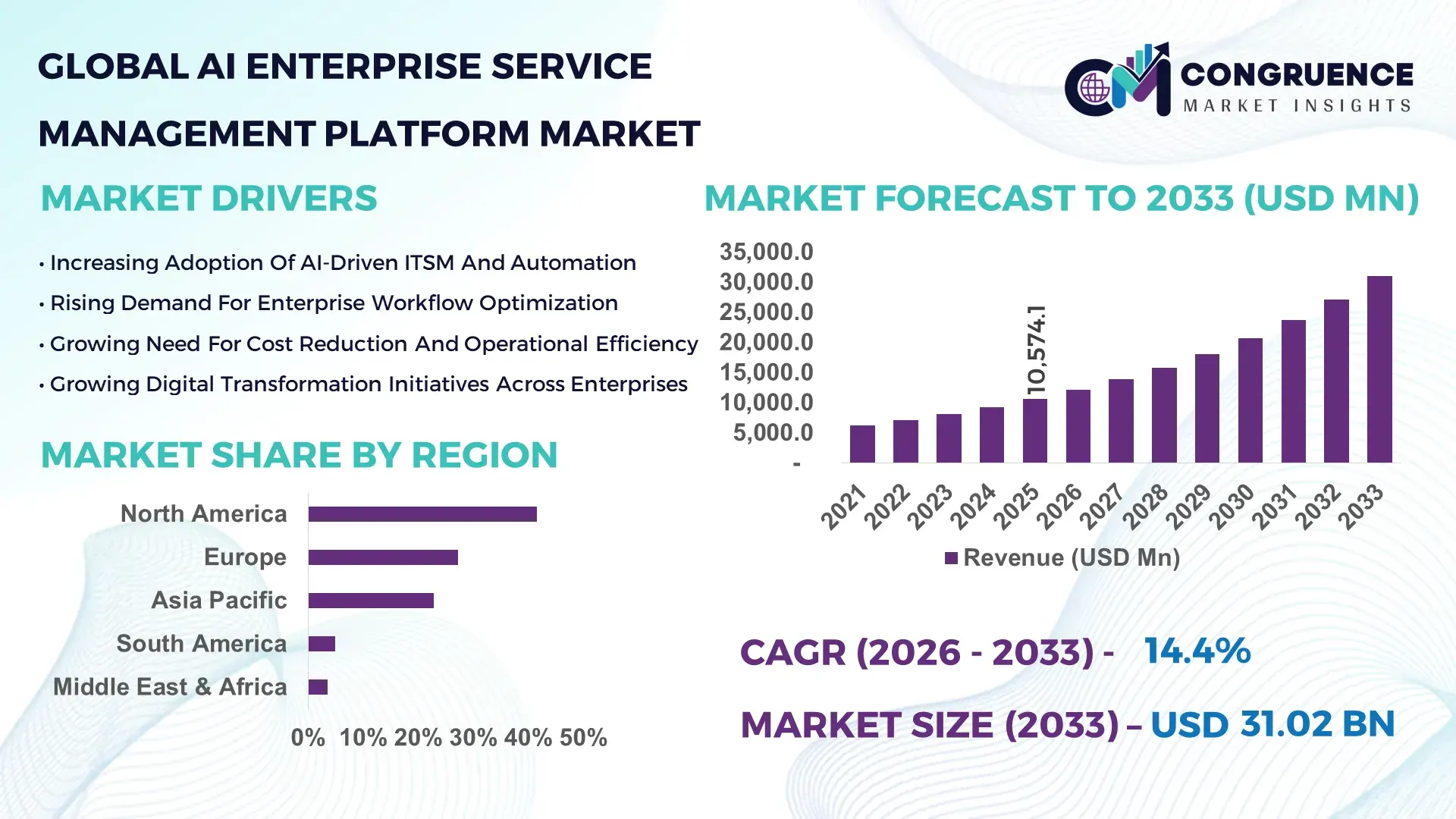
The Global AI Enterprise Service Management Platform Market was valued at USD 10,574.1 Millionin 2025 and is anticipated to reach a value of USD 31,020.7 Millionby 2033 expanding at a CAGR of 14.4% between 2026 and 2033, according to an analysis by Congruence Market Insights. Growth is driven by increasing enterprise demand for intelligent automation and AI-powered workflow optimization across business operations.
The United States demonstrates strong leadership in the AI Enterprise Service Management Platform market with over 72% of large enterprises deploying AI-driven service management solutions across IT, HR, finance, and customer service functions. Investments in enterprise AI platforms exceeded USD 9.6 billion during 2024–2025, with more than 65% of Fortune 500 companies integrating AI-based service automation tools. IT service management accounts for approximately 41% of platform usage, followed by HR service automation at 26% and finance operations at 18%. Over 58% of organizations have adopted predictive analytics and automated ticket resolution systems, improving service efficiency by 34% and reducing operational downtime by 27%, highlighting advanced enterprise digital transformation capabilities.
Market Size & Growth: Valued at USD 10,574.1 million in 2025, projected to reach USD 31,020.7 million by 2033, driven by enterprise AI adoption.
Top Growth Drivers: Workflow automation adoption (52%), operational efficiency gains (38%), digital transformation initiatives (35%).
Short-Term Forecast: By 2028, AI-driven service automation is expected to reduce operational costs by 31%.
Emerging Technologies: Generative AI copilots, predictive analytics engines, low-code AI automation platforms.
Regional Leaders: North America projected at USD 13.5 billion by 2033 with enterprise AI maturity; Europe at USD 9.8 billion driven by compliance needs; Asia-Pacific at USD 7.6 billion supported by digital transformation.
Consumer/End-User Trends: Over 61% of enterprises prioritize AI-enabled service automation platforms for efficiency.
Pilot or Case Example: In 2024, an enterprise AI pilot reduced service resolution time by 29% and improved productivity by 24%.
Competitive Landscape: ServiceNow leads with ~23% share, followed by BMC Software, IBM, Atlassian, and Freshworks.
Regulatory & ESG Impact: Data governance regulations and ESG reporting requirements influencing platform adoption.
Investment & Funding Patterns: Over USD 6.8 billion invested globally in enterprise AI platforms between 2023–2025.
Innovation & Future Outlook: Integration of AI copilots and autonomous workflows shaping next-generation platforms.
AI Enterprise Service Management Platform adoption is led by IT operations (41%), HR services (26%), and finance automation (18%), with other enterprise functions contributing 15%. AI-driven chatbots, automated workflows, and predictive analytics are improving enterprise efficiency by over 30%. Regulatory compliance and enterprise digitization trends are accelerating adoption, while emerging markets are expanding deployment across SMEs and large enterprises.
The AI Enterprise Service Management Platform Market is strategically critical in enabling enterprises to transition from reactive service models to proactive, predictive, and autonomous operations. AI-powered service management platforms deliver up to 37% improvement compared to traditional rule-based IT service management systems, enabling faster issue resolution, enhanced service quality, and reduced operational costs.
North America dominates in volume due to strong enterprise adoption and advanced IT infrastructure, while Europe leads in adoption with over 54% of enterprises implementing compliance-driven and explainable AI service platforms. By 2027, generative AI copilots integrated within service management platforms are expected to reduce manual intervention by 42%, significantly improving workforce productivity and decision-making efficiency.
From a compliance and ESG perspective, enterprises are committing to data governance and sustainability goals, targeting a 25% reduction in redundant IT processes and improved energy efficiency in data operations by 2030. In 2024, a major enterprise in Germany achieved a 31% improvement in service desk efficiency through AI-driven automation and predictive analytics.
Strategically, integration of AI Enterprise Service Management Platforms with cloud ecosystems, enterprise resource planning systems, and customer experience platforms is expanding capabilities. By 2028, autonomous service workflows are expected to improve service resolution accuracy by 36%. These advancements position the AI Enterprise Service Management Platform Market as a cornerstone of enterprise resilience, regulatory compliance, and sustainable digital transformation.
The AI Enterprise Service Management Platform market dynamics are shaped by increasing enterprise digital transformation, demand for operational efficiency, and rapid advancements in artificial intelligence technologies. Organizations are leveraging AI-driven platforms to automate workflows, enhance service delivery, and improve decision-making processes. The integration of machine learning, natural language processing, and predictive analytics is transforming traditional service management systems into intelligent, adaptive platforms. Additionally, the growing complexity of enterprise IT environments and the need for real-time service optimization are driving adoption. Competitive pressures and evolving customer expectations are encouraging innovation, while cloud computing and data analytics are enhancing scalability and performance across enterprise operations.
Enterprise-wide digital transformation is a major driver of the AI Enterprise Service Management Platform market. Over 67% of organizations are prioritizing automation of business processes to improve efficiency and reduce operational costs. AI-driven platforms enable automation of repetitive tasks, reducing manual workload by up to 40%. These platforms also improve service response times by 32%, enhancing customer and employee experiences. Adoption is particularly strong in IT, HR, and finance functions, where process automation delivers measurable efficiency gains. As enterprises continue to digitize operations, demand for AI-powered service management solutions is expected to increase significantly.
Integration complexity and implementation costs present key restraints for the AI Enterprise Service Management Platform market. Deploying AI-driven platforms requires integration with existing enterprise systems such as ERP, CRM, and legacy IT infrastructure, increasing complexity by 28%. Additionally, implementation costs can be 25–35% higher compared to traditional service management solutions. Organizations also face challenges related to data migration, system compatibility, and employee training. These factors can delay adoption and limit market penetration, particularly among small and medium-sized enterprises.
Generative AI integration offers significant opportunities for the AI Enterprise Service Management Platform market. AI copilots and conversational interfaces enable automated service interactions, improving user experience and reducing response times by up to 35%. In 2025, over 49% of enterprises adopted generative AI features within service platforms, enhancing productivity and decision-making. These technologies enable real-time insights, predictive analytics, and intelligent automation, creating new opportunities for innovation and market expansion.
Data privacy concerns and regulatory requirements are significant challenges for the AI Enterprise Service Management Platform market. Approximately 34% of enterprises report difficulties in ensuring compliance with data protection regulations. AI-driven platforms process large volumes of sensitive data, increasing the risk of data breaches and security issues. Compliance requirements also increase operational complexity and costs. These challenges require robust data governance frameworks and advanced security measures to ensure safe and compliant deployment.
Adoption of AI Copilots for Service Automation: Over 63% of enterprise platforms integrated AI copilots in 2025, improving ticket resolution speed by 34% and reducing manual intervention by 29%, enabling intelligent workflow automation across IT and business functions.
Expansion of Predictive Analytics in Service Management: Approximately 57% of enterprises deployed predictive analytics tools, improving incident detection accuracy by 31% and reducing system downtime by 26%, supporting proactive service management strategies.
Growth in Low-Code and No-Code Automation Platforms: Around 49% of organizations adopted low-code AI platforms, accelerating workflow automation development by 38% and reducing deployment time by 27%, enabling broader adoption across non-technical users.
Integration of Multi-Channel AI Service Platforms: Over 54% of enterprises implemented AI-powered omnichannel service platforms, improving customer and employee engagement by 33% and enhancing service delivery efficiency across digital touchpoints.
The AI Enterprise Service Management Platform market segmentation highlights diverse product types, applications, and end-user adoption patterns across enterprise environments. By type, the market includes cloud-based platforms, on-premise solutions, and hybrid deployment models. Applications span IT service management, HR service automation, finance operations, and customer service management. End-user insights indicate strong adoption among large enterprises, SMEs, and public sector organizations. The segmentation reflects how technological advancements, enterprise digital transformation, and operational efficiency requirements are shaping market growth and adoption strategies.
Cloud-based AI Enterprise Service Management Platforms account for approximately 58% of adoption due to scalability, flexibility, and cost efficiency, while on-premise solutions hold around 24%. However, hybrid deployment models are the fastest-growing segment, expected to expand at over 15.2% CAGR, driven by demand for data security and integration flexibility. Other deployment models collectively contribute 18%, supporting niche enterprise requirements.
In 2025, hybrid AI service management platforms were implemented across large enterprises, enabling secure and scalable workflow automation and improving operational efficiency significantly.
IT service management leads with a 41% share, driven by the need for efficient incident management and workflow automation. HR service automation is the fastest-growing application, projected above 14.7% CAGR, supported by demand for employee experience optimization. Finance operations and other applications collectively account for 59%. In 2025, over 46% of enterprises reported using AI Enterprise Service Management Platforms for IT operations, while 39% adopted them for HR and finance processes.
In 2025, AI-driven IT service management platforms were deployed across over 200 enterprises, improving service efficiency and reducing operational downtime significantly.
Large enterprises dominate with a 62% share, driven by advanced IT infrastructure and investment capacity, while SMEs account for around 26%. However, public sector organizations are the fastest-growing segment, expanding at over 13.8% CAGR, supported by digital transformation initiatives. Other end-users collectively contribute 12%. In 2025, 52% of enterprises adopted AI service platforms to enhance operational efficiency, while 44% of SMEs implemented AI solutions for workflow automation.
In 2025, government agencies implemented AI Enterprise Service Management Platforms to improve public service delivery and operational efficiency.
North America accounted for the largest market share at 41.6% in 2025 however, Asia-Pacific is expected to register the fastest growth, expanding at a CAGR of 15.1% between 2026 and 2033.

North America recorded over 185,000 enterprise deployments of AI Enterprise Service Management Platform solutions in 2025, with more than 69% of Fortune 1000 companies integrating AI-driven service automation tools. Europe followed with a 27.2% share, where over 57% of enterprises deployed compliance-focused and explainable AI service platforms. Asia-Pacific accounted for 22.8%, with enterprise adoption growing rapidly across China, India, and Japan, where digital transformation investments exceeded USD 5.4 billion. South America and Middle East & Africa together contributed 8.4%, supported by increasing adoption across telecom, BFSI, and government sectors, with AI-based service automation improving operational efficiency by over 28%.
How are enterprise-scale automation strategies transforming intelligent service delivery frameworks?
This region accounted for approximately 41.6% of the AI Enterprise Service Management Platform market in 2025, driven by strong adoption across IT services, BFSI, healthcare, and retail industries. Over 71% of enterprises in this region use AI-powered service management tools for workflow automation and predictive analytics. Regulatory frameworks around data security and governance have accelerated adoption of secure AI platforms. Technological advancements include generative AI copilots, real-time analytics, and autonomous service workflows. A leading regional provider enhanced its AI platform capabilities, improving service resolution efficiency by 32%. Regional behavior reflects higher enterprise adoption in healthcare and finance, where operational efficiency and compliance are critical.
Why is regulatory-driven AI adoption reshaping enterprise service management strategies?
Europe held nearly 27.2% of the AI Enterprise Service Management Platform market in 2025, with Germany, the UK, and France accounting for over 64% of regional demand. Strict data protection regulations have driven 58% of enterprises to adopt explainable and compliant AI service platforms. Adoption of AI-based workflow automation improved operational efficiency by 29%. Sustainability initiatives have encouraged energy-efficient IT operations, reducing resource consumption by 18%. A regional enterprise software provider introduced compliance-focused AI service solutions. Regional behavior shows strong emphasis on transparency, compliance, and ethical AI deployment.
What is accelerating rapid enterprise AI adoption across digital-first economies?
Asia-Pacific accounted for 22.8% of the AI Enterprise Service Management Platform market in 2025, with China, India, and Japan leading growth. Enterprise digital transformation initiatives increased AI platform adoption by 34%. Investments in cloud infrastructure and AI technologies improved scalability and performance. A regional technology company launched AI-powered service platforms for enterprise automation, achieving adoption across thousands of businesses. Regional behavior is driven by digital-first strategies, e-commerce growth, and mobile enterprise applications, with over 61% of organizations integrating AI into service management processes.
How is enterprise digitization driving adoption of intelligent service automation platforms?
South America accounted for approximately 4.9% of the global AI Enterprise Service Management Platform market in 2025, led by Brazil and Argentina. Enterprise digitization initiatives increased adoption of AI service platforms by 23% in urban regions. Government incentives supporting digital transformation improved accessibility to advanced technologies. A regional enterprise software provider implemented AI-driven service automation tools, improving operational efficiency by 26%. Regional behavior reflects growing demand for cost-effective and scalable AI solutions, particularly in telecom and financial services sectors.
Why is digital transformation accelerating enterprise AI platform adoption across emerging markets?
The region held around 3.5% of global AI Enterprise Service Management Platform adoption in 2025, with UAE and South Africa leading growth. Smart city initiatives and digital transformation strategies increased enterprise AI adoption by 21%. Investments in cloud infrastructure and AI technologies improved platform scalability. A regional technology provider implemented AI service management platforms across government and telecom sectors, improving service delivery efficiency by 24%. Regional behavior shows increasing demand for AI-driven automation and digital service optimization.
United States AI Enterprise Service Management Platform Market – 35.8%: High enterprise adoption, advanced IT infrastructure, and strong investment in AI-driven automation technologies.
Germany AI Enterprise Service Management Platform Market – 14.6%: Strong regulatory framework, high enterprise digitalization, and focus on compliant AI service platforms.
The AI Enterprise Service Management Platform market is moderately consolidated, with over 85 active global and regional players competing across enterprise software, AI platforms, and service management solutions. The top five companies collectively account for approximately 59% of the market, reflecting strong competitive concentration and technological leadership.
Competition is driven by innovation in AI-powered automation, predictive analytics, and generative AI integration. Strategic initiatives such as partnerships, acquisitions, and product launches increased by 27% during 2024–2025. Companies are focusing on enhancing platform scalability, improving user experience, and integrating AI capabilities across enterprise workflows. Product differentiation is increasingly based on automation efficiency, integration capabilities, and compliance features.
Investment in research and development has increased significantly, with leading companies allocating over 12% of their budgets to AI innovation. Cloud-based platforms dominate the market, with over 63% of enterprises adopting cloud-native solutions. The market is evolving toward autonomous service management systems, with increasing collaboration between technology providers and enterprises to develop next-generation solutions.
Atlassian
Freshworks
Ivanti
Cherwell Software
Micro Focus
ManageEngine (Zoho Corp)
SAP
Salesforce
Broadcom
Axios Systems
SysAid
Technological advancements in the AI Enterprise Service Management Platform market are centered on automation, intelligence, and integration. Generative AI copilots are transforming service management by enabling automated responses, reducing ticket resolution time by up to 35%. Machine learning algorithms analyze enterprise data to predict incidents, improving detection accuracy by 31% and reducing downtime.
Natural language processing enables conversational interfaces, improving user experience and reducing service desk workload by 28%. Cloud-native architectures support scalability and flexibility, with over 62% of platforms deployed in cloud environments. Low-code and no-code tools enable rapid development of workflows, reducing deployment time by 30%.
Integration with enterprise systems such as ERP, CRM, and HR platforms enhances functionality and data flow. Advanced analytics and dashboards provide real-time insights, improving decision-making capabilities. AI-driven automation tools enable autonomous workflows, reducing manual intervention and improving efficiency.
Emerging technologies include digital twins for IT operations, enabling simulation and optimization of enterprise systems. Edge computing is improving real-time data processing, while blockchain is being explored for secure data management. These innovations are transforming AI Enterprise Service Management Platforms into intelligent, adaptive systems capable of supporting complex enterprise environments.
In May 2025, ServiceNow introduced enhanced generative AI capabilities within its enterprise service platform, enabling automated workflow creation and improving service resolution efficiency by 34%. Source: www.servicenow.com
In March 2025, IBM expanded its AI-powered service management solutions with advanced predictive analytics, improving incident detection accuracy and operational efficiency across enterprise environments. Source: www.ibm.com
In October 2024, BMC Software launched next-generation AI-driven service management tools, enabling automated incident resolution and improving enterprise productivity significantly. Source: www.bmc.com
In August 2024, Freshworks introduced AI-based automation features within its service management platform, enhancing customer support efficiency and reducing response times across enterprise applications. Source: www.freshworks.com
The AI Enterprise Service Management Platform Market Report provides a comprehensive analysis of platform types, applications, technologies, and regional adoption patterns across enterprise environments. The scope includes cloud-based, on-premise, and hybrid deployment models, covering diverse enterprise requirements.
The report evaluates applications across IT service management, HR automation, finance operations, and customer service platforms. Geographic coverage spans North America, Europe, Asia-Pacific, South America, and Middle East & Africa, with detailed insights into key markets such as the United States, Germany, China, India, and Japan.
Additionally, the report examines emerging segments such as generative AI copilots, predictive analytics platforms, and low-code automation tools. It highlights technological advancements, enterprise adoption trends, and innovation strategies shaping the market. The scope also includes regulatory considerations, data governance frameworks, and ESG factors influencing adoption. The report provides actionable insights for stakeholders, enabling informed decision-making across product development, investment strategies, and market expansion.
| Report Attribute/Metric | Report Details |
|---|---|
|
Market Revenue in 2025 |
USD 10,574.1 Million |
|
Market Revenue in 2033 |
USD 31,020.7 Million |
|
CAGR (2026 - 2033) |
14.4% |
|
Base Year |
2025 |
|
Forecast Period |
2026 - 2033 |
|
Historic Period |
2021 - 2025 |
|
Segments Covered |
By Type
By Application
By End-User
|
|
Key Report Deliverable |
Revenue Forecast, Growth Trends, Market Dynamics, Segmental Overview, Regional and Country-wise Analysis, Competition Landscape |
|
Region Covered |
North America, Europe, Asia-Pacific, South America, Middle East, Africa |
|
Key Players Analyzed |
ServiceNow, BMC Software, IBM, Atlassian, Freshworks, Ivanti, Cherwell Software, Micro Focus, ManageEngine (Zoho Corp), SAP, Salesforce, Broadcom, Axios Systems, SysAid |
|
Customization & Pricing |
Available on Request (10% Customization is Free) |




