
Reports
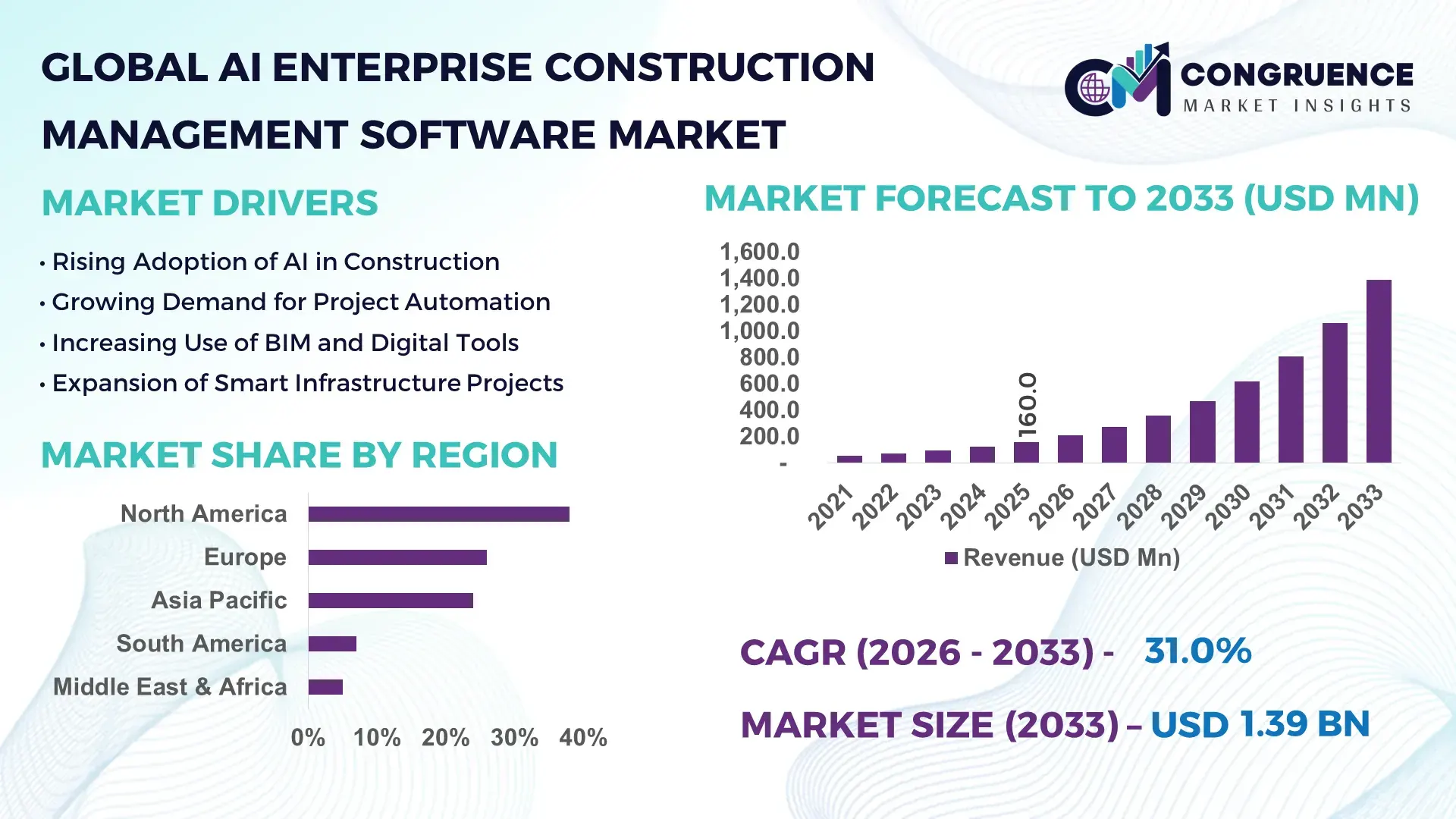
The Global AI Enterprise Construction Management Software Market was valued at USD 160.0 Million in 2025 and is anticipated to reach a value of USD 1,387.7 Million by 2033 expanding at a CAGR of 31% between 2026 and 2033, according to an analysis by Congruence Market Insights. Growth is primarily driven by the rapid adoption of predictive analytics, AI-driven scheduling, and automated site monitoring systems that enhance project efficiency and reduce operational risks in large-scale construction projects.
The United States represents the most technologically advanced environment for AI enterprise construction management platforms. The country hosts more than 3.9 million construction businesses, with over 780,000 construction establishments adopting digital project management systems for planning and resource allocation. Enterprise construction firms are investing heavily in AI-enabled Building Information Modeling (BIM), digital twin simulation, and predictive safety analytics. Large infrastructure programs such as the USD 1.2 trillion Infrastructure Investment and Jobs Act have accelerated software deployment across transportation, utilities, and smart-city developments. Surveys indicate that over 42% of large US construction contractors use AI-enabled project planning tools, while 30% of engineering firms have integrated machine learning-based risk forecasting systems for cost and schedule optimization. Additionally, more than 65% of major contractors utilize cloud-based construction management platforms integrated with AI-driven progress monitoring and workforce productivity analytics.
Market Size & Growth: Valued at USD 160.0 Million in 2025, projected to reach USD 1,387.7 Million by 2033, expanding at 31% CAGR, driven by increasing digitalization and AI-driven automation in construction project management.
Top Growth Drivers: AI-enabled predictive scheduling adoption increased by 41%, automated cost estimation improving budgeting accuracy by 35%, and real-time site monitoring improving productivity by 28%.
Short-Term Forecast: By 2028, AI-based construction planning systems are projected to reduce project delays by 22% and improve resource utilization efficiency by 30%.
Emerging Technologies: Digital twins for infrastructure simulation, AI-integrated BIM platforms, and computer vision-based safety monitoring systems are rapidly transforming enterprise construction workflows.
Regional Leaders: North America projected to reach USD 520 Million by 2033 driven by infrastructure modernization; Europe expected to reach USD 380 Million with strong smart-building initiatives; Asia-Pacific forecast to reach USD 410 Million fueled by rapid urbanization and mega infrastructure projects.
Consumer/End-User Trends: Large construction enterprises and engineering firms increasingly deploy AI software for risk prediction, automated documentation, and workforce productivity monitoring across complex multi-site infrastructure projects.
Pilot or Case Example: In 2024, a digital construction pilot integrating AI scheduling and drone-based monitoring achieved 26% faster project completion and reduced rework costs by 18% in a major infrastructure project.
Competitive Landscape: The market leader holds approximately 18% share, followed by major competitors including global enterprise construction software providers and AI-enabled infrastructure technology firms.
Regulatory & ESG Impact: Governments are promoting AI-driven project transparency and sustainability monitoring; digital construction compliance frameworks now encourage up to 25% improvement in energy efficiency tracking across large projects.
Investment & Funding Patterns: More than USD 1.8 Billion has been invested globally in construction technology startups focusing on AI-powered project analytics, predictive planning, and digital site monitoring platforms.
Innovation & Future Outlook: Integration of generative AI planning assistants, autonomous progress monitoring systems, and predictive maintenance algorithms will redefine enterprise construction management platforms across global infrastructure projects.
Enterprise adoption is expanding across commercial construction (around 38% usage), infrastructure development (about 32%), and industrial construction (nearly 18%), while residential megaprojects account for the remaining share. Recent innovations include AI-driven progress analytics, drone-integrated site monitoring, and predictive cost-estimation tools. Regulatory initiatives promoting digital project documentation and sustainability reporting are accelerating adoption, particularly in North America and Asia-Pacific, while cloud-based AI platforms are enabling scalable deployment across multi-site global construction projects.
The AI Enterprise Construction Management Software Market is becoming strategically critical for infrastructure developers, engineering firms, and large construction enterprises seeking greater project transparency, operational efficiency, and cost predictability. Construction projects are historically prone to cost overruns and schedule delays; global studies suggest that large infrastructure projects exceed budgets by nearly 20% on average and experience schedule overruns exceeding 30%. AI-driven enterprise construction management platforms are helping address these challenges through predictive analytics, automated scheduling, and intelligent risk detection systems that enable project managers to make faster, data-driven decisions.
The integration of digital twin technology within enterprise construction software is rapidly transforming planning and simulation capabilities. Digital twin systems can simulate infrastructure development scenarios, detect conflicts in project design, and optimize resource allocation. For example, digital twin-based project simulation delivers nearly 35% improvement in planning accuracy compared to traditional manual scheduling systems. Similarly, AI-driven BIM analytics can identify design clashes and material shortages early in the planning stage, reducing construction rework and material waste.
Regional deployment patterns also demonstrate contrasting strategic pathways. Asia-Pacific dominates in project volume due to extensive infrastructure expansion and urbanization, while North America leads in enterprise adoption with nearly 48% of large contractors deploying AI-enabled construction management platforms. European markets are focusing heavily on sustainability monitoring and digital compliance frameworks that integrate AI-based environmental performance analytics.
In the short term, the market is expected to accelerate through enhanced automation capabilities. By 2028, AI-powered predictive project analytics are expected to reduce schedule delays by approximately 25% and improve construction workforce productivity by nearly 30%. Companies are also aligning these technologies with environmental commitments. Firms are committing to reducing construction waste by nearly 20% by 2030 through AI-enabled material optimization and recycling analytics integrated within enterprise construction management systems.
A notable micro-scenario illustrates the impact of AI-driven project analytics. In 2024, a major infrastructure developer in Singapore implemented AI-powered predictive construction planning tools and achieved a 24% reduction in project delays while improving labor productivity by nearly 18%. Similar deployments across large engineering firms highlight the tangible operational benefits of enterprise AI platforms.
Looking forward, the AI Enterprise Construction Management Software Market will increasingly serve as a pillar of digital transformation within the global construction sector. The convergence of AI, cloud computing, BIM integration, and IoT-enabled site monitoring will position these platforms as foundational tools supporting resilient infrastructure development, regulatory compliance, and sustainable construction practices across large-scale projects.
The AI Enterprise Construction Management Software Market is evolving rapidly as construction firms embrace digital transformation to improve project efficiency, safety compliance, and cost control. Large infrastructure programs, urbanization, and smart city initiatives are generating significant demand for AI-powered project management platforms capable of processing complex datasets and providing real-time insights. Construction enterprises are increasingly deploying AI-based predictive analytics to forecast project risks, optimize resource allocation, and automate scheduling processes.
Advanced technologies such as computer vision, digital twins, and IoT-enabled site monitoring systems are being integrated into enterprise construction software to improve operational visibility across multi-site projects. These platforms help detect safety hazards, track equipment utilization, and automate reporting functions for regulatory compliance. At the same time, cloud deployment models are enabling seamless collaboration between project stakeholders including architects, engineers, contractors, and regulators. However, high implementation costs, workforce skill gaps, and cybersecurity concerns continue to influence adoption patterns. As organizations prioritize operational efficiency and sustainability, AI enterprise construction management software is becoming a key tool supporting data-driven infrastructure development strategies.
Construction projects involve complex coordination among multiple stakeholders, materials, and schedules, making predictive planning essential for minimizing disruptions. AI-driven enterprise construction management platforms analyze historical project data, weather patterns, labor availability, and equipment utilization to forecast risks before they occur. Studies indicate that nearly 70% of construction delays are linked to poor scheduling and planning inefficiencies, highlighting the need for advanced analytics platforms. AI-powered scheduling systems can process thousands of project variables simultaneously, enabling managers to identify potential bottlenecks and allocate resources more effectively. Additionally, predictive cost analytics tools improve budgeting accuracy by identifying potential cost overruns early in project execution. In large infrastructure projects, AI-enabled construction management software has demonstrated the ability to reduce rework incidents by more than 20% and improve schedule adherence across multi-phase construction programs. As infrastructure investments continue expanding globally, enterprises are prioritizing advanced planning platforms to ensure project reliability and operational efficiency.
Despite its advantages, the adoption of AI enterprise construction management software is constrained by significant implementation costs and technological integration challenges. Deploying advanced AI platforms requires substantial investment in cloud infrastructure, data integration systems, and workforce training programs. Large construction organizations often manage data across multiple legacy systems such as traditional project management tools, accounting software, and building information modeling platforms, making integration complex and time-consuming. Industry surveys suggest that more than 40% of mid-sized construction firms lack centralized data infrastructure, which limits the effectiveness of AI-driven analytics tools. Additionally, skilled professionals capable of managing AI-based project analytics remain limited within the construction sector. Training engineering teams to interpret AI-generated insights and adapt operational workflows requires significant organizational change. Security concerns related to cloud-based project data storage also create hesitation among infrastructure developers managing sensitive project information. These factors collectively slow adoption among smaller construction enterprises and regional contractors.
The expansion of smart infrastructure and urban development initiatives is creating significant opportunities for AI enterprise construction management platforms. Governments worldwide are investing heavily in smart transportation networks, renewable energy facilities, and digital infrastructure projects that require advanced planning and coordination tools. AI-powered construction management systems enable real-time monitoring of equipment, workforce productivity, and material supply chains, making them essential for complex multi-phase infrastructure programs. Additionally, the integration of IoT sensors and drone-based monitoring systems is enabling AI software to collect real-time data from construction sites, improving decision-making accuracy. Smart city projects increasingly rely on digital twins and AI-based analytics to simulate infrastructure development scenarios before construction begins. These capabilities allow developers to optimize energy usage, minimize material waste, and improve long-term asset performance. As urban populations grow and infrastructure projects become more complex, AI-driven construction management software will play a critical role in ensuring efficient project delivery.
One of the most significant challenges facing the AI Enterprise Construction Management Software Market is the shortage of skilled professionals capable of managing AI-driven construction analytics systems. The construction sector has traditionally relied on manual project planning and on-site supervision rather than advanced data analytics. As a result, many organizations lack professionals trained in machine learning, predictive analytics, and digital construction platforms. Surveys indicate that nearly 55% of construction firms report difficulty recruiting technology specialists capable of managing digital construction systems. This skills gap limits the ability of enterprises to fully leverage AI capabilities such as predictive risk analysis and automated scheduling optimization. Additionally, existing construction managers must undergo extensive training to interpret AI-generated insights and integrate them into project decision-making processes. Without sufficient digital literacy among project teams, the effectiveness of AI enterprise construction management platforms can be significantly reduced, slowing adoption across traditional construction organizations.
Expansion of AI-Integrated Building Information Modeling (BIM) Platforms: AI-powered BIM solutions are becoming central to enterprise construction management systems. Nearly 62% of large infrastructure projects now deploy BIM platforms integrated with AI-based analytics to detect design conflicts and optimize project planning. These systems analyze thousands of design variables to identify structural inconsistencies before construction begins, reducing engineering rework by approximately 28% and improving cross-team collaboration across architects, engineers, and contractors.
Growing Adoption of Computer Vision for Site Monitoring: Computer vision systems are transforming construction site monitoring by enabling automated safety inspections and progress tracking. More than 45% of large construction companies now deploy AI-enabled camera analytics to identify safety hazards and track worker movements in real time. These solutions have demonstrated up to 35% reduction in workplace safety incidents, while automated progress tracking tools improve reporting accuracy by nearly 30% compared to manual site inspections.
Rise in Modular and Prefabricated Construction: The adoption of modular construction is reshaping demand dynamics in the AI Enterprise Construction Management Software Market. Research suggests that 55% of new projects experience measurable cost benefits when modular and prefabricated methods are integrated into planning workflows. AI-driven project planning software helps coordinate off-site manufacturing schedules and on-site assembly timelines, enabling project managers to shorten construction cycles by up to 25%.
Integration of Digital Twin Technology for Infrastructure Planning: Digital twin platforms are increasingly integrated into enterprise construction management systems to simulate large-scale infrastructure development scenarios. Around 48% of major engineering firms are experimenting with digital twin simulations for infrastructure planning and maintenance forecasting. These systems enable predictive asset monitoring and lifecycle optimization, helping infrastructure developers improve long-term project performance by nearly 32%.
The AI Enterprise Construction Management Software Market is segmented across type, application, and end-user categories, reflecting the diverse operational requirements of construction enterprises and infrastructure developers. AI-driven software platforms are increasingly deployed to support predictive project planning, automated documentation, and real-time construction site monitoring. Large engineering firms rely on integrated project management systems that combine scheduling analytics, cost estimation tools, and digital collaboration platforms.
Segmentation also reflects how different construction sectors adopt these technologies. Infrastructure and commercial construction projects typically require advanced enterprise platforms capable of managing multi-site operations, while residential development projects often use lighter software solutions focused on budgeting and scheduling automation. The growing integration of AI with BIM systems, drone monitoring platforms, and IoT-enabled construction equipment is further shaping segmentation trends across project planning, safety monitoring, and cost management applications.
AI enterprise construction management software is primarily categorized into project planning and scheduling platforms, cost estimation and financial management systems, safety and risk monitoring solutions, collaboration and document management platforms, and integrated AI-BIM management systems. Among these, project planning and scheduling platforms currently represent the leading segment with approximately 36% adoption, as construction firms prioritize predictive analytics for managing complex infrastructure timelines. These systems analyze thousands of scheduling variables including workforce availability, supply chain disruptions, and weather conditions to improve planning accuracy and minimize delays. AI-enabled safety and risk monitoring platforms represent the fastest-growing type with an estimated growth rate of around 34%, driven by the increasing need for automated hazard detection and compliance monitoring. Computer vision systems integrated within these platforms analyze live construction site footage to detect unsafe behavior and potential structural risks in real time. Cost estimation and financial management software accounts for nearly 22% of enterprise deployments, helping construction companies forecast project budgets and track procurement expenditures. Collaboration and document management platforms contribute about 18%, enabling seamless communication between contractors, architects, and engineering teams across geographically distributed projects.
• A 2025 engineering technology assessment highlighted that AI-driven scheduling algorithms reduced project planning time by nearly 40% in large infrastructure development programs.
Key applications of AI enterprise construction management software include project planning and scheduling, construction site monitoring, cost management and budgeting, workforce productivity analytics, and compliance and safety management. Project planning and scheduling currently represent the leading application segment with approximately 39% adoption, as construction firms increasingly rely on predictive analytics to manage complex multi-phase infrastructure projects. AI-powered planning systems help reduce scheduling conflicts and improve resource allocation efficiency across large construction sites. Construction site monitoring is emerging as the fastest-growing application with an estimated growth rate of about 33%, driven by the rapid adoption of drone surveillance, IoT sensors, and computer vision-based safety monitoring technologies. These solutions allow project managers to track site progress in real time and identify potential safety hazards before incidents occur. Cost management and budgeting applications account for nearly 26% of enterprise usage, enabling project managers to forecast procurement costs and manage supplier contracts more effectively. Workforce productivity analytics and compliance monitoring together contribute around 35% of remaining deployments, supporting operational efficiency and regulatory reporting across infrastructure development projects. In 2025, approximately 44% of large construction enterprises reported piloting AI-powered monitoring systems to track project progress and workforce productivity across multiple sites. Additionally, over 36% of engineering firms globally have implemented AI-enabled cost forecasting tools to improve budgeting accuracy.
• A 2025 construction technology review reported that AI-driven drone monitoring platforms were deployed across more than 1,200 infrastructure projects to track construction progress and safety compliance.
The end-user landscape of the AI Enterprise Construction Management Software Market includes large construction enterprises, engineering and architectural firms, infrastructure developers, and government agencies managing public infrastructure projects. Large construction enterprises currently represent the leading end-user segment with approximately 41% adoption, as multinational contractors require integrated enterprise platforms to coordinate multi-billion-dollar infrastructure developments across multiple locations. These organizations rely heavily on AI-driven analytics for resource planning, safety compliance, and project risk forecasting. Infrastructure developers represent the fastest-growing end-user segment with an estimated growth rate of around 32%, fueled by the rapid expansion of smart city initiatives, transportation networks, and renewable energy infrastructure projects. These projects often require advanced digital twin simulations and AI-powered planning tools to manage large-scale construction operations efficiently. Engineering and architectural firms account for nearly 29% of total enterprise deployments, utilizing AI platforms to optimize design workflows and detect structural conflicts through BIM analytics. Government agencies and public infrastructure authorities contribute the remaining 30%, deploying AI-based construction management tools to improve transparency and monitoring across public infrastructure programs. In 2025, nearly 40% of global construction enterprises reported adopting AI-driven project analytics platforms, while 34% of engineering consultancies indicated increased investment in digital construction management systems to support large infrastructure projects.
• A 2025 global construction technology survey indicated that over 500 infrastructure developers implemented AI-based construction planning platforms to optimize multi-site project coordination and risk management.
North America accounted for the largest market share at 38% in 2025; however, Asia-Pacific is expected to register the fastest growth, expanding at a CAGR of 34% between 2026 and 2033.

The global AI Enterprise Construction Management Software Market shows strong regional variation driven by digital infrastructure investments, smart-city development programs, and construction technology adoption levels. North America leads due to early adoption of cloud-based construction platforms and enterprise-level BIM integration, with more than 48% of large construction firms in the region using AI-driven project management tools. Europe holds approximately 26% of the global market, driven by sustainability compliance frameworks and digital building regulations across Germany, the UK, and France. Meanwhile, Asia-Pacific accounts for nearly 24% of global demand, fueled by mega infrastructure programs exceeding USD 2 trillion annually across China, India, and Southeast Asia. South America contributes around 7% of market deployment, particularly in infrastructure modernization projects in Brazil and Chile. The Middle East & Africa collectively represent about 5%, supported by smart-city megaprojects, including urban development initiatives involving more than 200 large-scale infrastructure projects across the UAE and Saudi Arabia. Regional adoption patterns increasingly depend on digital transformation readiness, government infrastructure investment, and enterprise cloud-software penetration within the construction sector.
North America represents the most mature regional market for AI enterprise construction management software, accounting for approximately 38% of global deployment. The United States and Canada host more than 800,000 construction establishments using digital project management platforms, creating a strong environment for advanced analytics solutions. Key industries driving demand include transportation infrastructure, commercial real estate development, energy facilities, and data-center construction. Government programs such as the USD 1.2 trillion infrastructure modernization program in the United States are accelerating the adoption of digital construction technologies, including AI-enabled project analytics and predictive scheduling systems. Construction enterprises increasingly deploy AI-powered BIM platforms capable of analyzing thousands of design variables to reduce scheduling conflicts and material waste. Digital transformation trends also include drone-based site monitoring, IoT equipment tracking, and AI-driven cost forecasting systems. A notable regional player, Procore Technologies, has expanded AI-powered project analytics capabilities across its platform to automate documentation workflows and improve construction decision-making. Regional enterprise behavior shows high adoption of integrated project management platforms, particularly among large contractors managing multi-site infrastructure projects, where over 45% of contractors rely on cloud-based AI construction software to manage collaboration across architects, engineers, and subcontractors.
Europe accounts for approximately 26% of the global AI Enterprise Construction Management Software Market, supported by strong regulatory frameworks promoting digital construction practices and sustainable infrastructure development. Key markets such as Germany, the United Kingdom, and France are implementing digital building compliance standards that encourage the use of advanced BIM platforms and AI-driven construction planning tools. The European construction sector includes more than 3.7 million companies, many of which are transitioning toward cloud-based project management solutions to improve operational transparency and environmental monitoring. Sustainability regulations such as the EU Green Deal and energy-efficient building directives are pushing developers to integrate AI software capable of tracking carbon emissions, material usage, and lifecycle performance across infrastructure projects. Technological adoption is also increasing in areas such as digital twin simulations and automated safety monitoring. European construction technology firms are developing specialized AI analytics solutions designed for regulatory reporting and environmental performance optimization. Regional enterprise behavior reflects strong demand for explainable AI systems, as regulatory oversight encourages transparency in digital decision-making processes across construction planning and project monitoring.
Asia-Pacific represents one of the fastest-expanding markets for AI enterprise construction management software, accounting for approximately 24% of global adoption and ranking among the highest regions in infrastructure project volume. Major consuming countries include China, India, Japan, and South Korea, where large-scale urban development programs and transportation infrastructure projects are driving demand for digital construction platforms. China alone manages more than 100 major smart-city initiatives, while India is implementing infrastructure investments exceeding USD 1.4 trillion across transportation, energy, and urban development projects. Construction firms across the region increasingly deploy AI-enabled project planning systems to manage complex multi-contractor operations and large workforce deployments. Technology innovation hubs in cities such as Shenzhen, Tokyo, and Bengaluru are producing AI solutions focused on predictive scheduling, drone-based monitoring, and automated safety analytics. Regional technology providers are integrating machine learning algorithms with BIM systems to enhance project coordination and cost forecasting. Consumer behavior across Asia-Pacific demonstrates strong mobile adoption patterns, with more than 50% of construction site managers using mobile-based project monitoring applications to track real-time site activity and project performance metrics.
South America accounts for approximately 7% of the global AI Enterprise Construction Management Software Market, with adoption primarily concentrated in Brazil, Argentina, and Chile. Regional demand is closely tied to large infrastructure and energy development projects, including transportation networks, renewable energy installations, and urban redevelopment programs. Brazil alone manages more than 4,000 major infrastructure projects, many of which are adopting digital project management platforms to improve coordination among contractors and engineering teams. Government policies promoting infrastructure modernization and public-private partnerships are encouraging construction firms to deploy AI-enabled planning tools for cost forecasting and scheduling optimization. The energy sector, particularly hydroelectric and renewable energy construction projects, represents a significant application area for digital construction management software. Regional technology adoption trends also include drone-based site inspections and AI-driven document management platforms that streamline regulatory reporting. Consumer behavior across the region reflects a growing preference for cloud-based construction platforms capable of supporting multilingual collaboration across international engineering teams and contractors.
The Middle East & Africa region accounts for approximately 5% of the global AI Enterprise Construction Management Software Market, supported by major urban development programs and infrastructure modernization initiatives. Countries such as the United Arab Emirates, Saudi Arabia, and South Africa are investing heavily in smart-city infrastructure and digital construction technologies. The Middle East alone hosts more than USD 1 trillion worth of active construction projects, including smart-city developments, transportation infrastructure, and tourism facilities. Construction enterprises increasingly deploy AI-driven project management systems to coordinate large-scale engineering operations involving hundreds of contractors and suppliers. Technological modernization trends include digital twin simulations, predictive maintenance analytics, and automated site monitoring systems using AI-enabled cameras and drones. Local technology providers and engineering firms are collaborating with international construction software vendors to implement integrated digital construction ecosystems. Regional enterprise behavior also reflects strong demand for centralized cloud platforms capable of managing cross-border infrastructure projects and multinational contractor networks.
United States – 32% Market Share: It leads due to strong enterprise digital transformation, large-scale infrastructure investments, and widespread adoption of AI-enabled BIM and project analytics systems.
China – 18% Market Share: It remains highly influential due to massive infrastructure development programs, smart-city initiatives, and widespread deployment of digital construction platforms across large public infrastructure projects.
The AI Enterprise Construction Management Software Market is characterized by a moderately fragmented yet highly competitive environment, with more than 60 active global technology providers offering specialized digital construction platforms. Enterprise software vendors, construction technology startups, and cloud infrastructure providers compete to deliver integrated AI-driven project management ecosystems that support complex infrastructure development projects. The top five companies collectively account for approximately 42% of the global market, reflecting a competitive landscape where innovation and platform integration play a decisive role in market positioning.
Leading technology providers are focusing on expanding AI capabilities within construction management platforms through predictive analytics, natural language processing, and computer vision technologies. Strategic partnerships between software vendors and engineering firms are also increasing. For example, construction software providers are collaborating with cloud infrastructure platforms to integrate advanced machine learning models capable of analyzing millions of project data points.
Product innovation remains a primary competitive strategy. Vendors are launching AI assistants, automated document processing tools, and digital twin simulation platforms to enhance decision-making in construction project planning. Additionally, mergers and acquisitions are reshaping the competitive landscape as established enterprise software companies acquire emerging construction technology startups specializing in AI analytics, drone monitoring, and digital site management. The competitive environment is further intensified by the growing demand for integrated project management ecosystems that combine financial management, workforce coordination, and predictive risk analytics within a single digital platform.
Procore Technologies
Trimble
Bentley Systems
Oracle Construction and Engineering
Nemetschek Group
Hexagon AB
Sage Group
CMiC
Viewpoint (Trimble Construction One)
Buildertrend
Fieldwire
PlanGrid
e-Builder
Jonas Construction Software
The technological evolution of the AI Enterprise Construction Management Software Market is driven by the convergence of artificial intelligence, building information modeling (BIM), cloud computing, and Internet of Things (IoT) technologies. Modern enterprise construction platforms are designed to process vast volumes of project data generated across multiple construction sites, enabling predictive analytics that supports planning, cost management, and risk mitigation.
One of the most influential technologies is AI-integrated Building Information Modeling, which allows construction firms to analyze digital building models and identify potential design conflicts before construction begins. Advanced BIM analytics platforms can evaluate thousands of structural parameters simultaneously, helping engineering teams detect design inconsistencies that could otherwise lead to costly project delays. Industry estimates indicate that AI-enabled BIM systems can reduce construction rework by more than 20% and improve project coordination across multiple engineering teams.
Another emerging technology shaping the market is digital twin simulation, which enables developers to create virtual replicas of infrastructure projects. These digital twins continuously receive data from sensors embedded within construction equipment and structural components, allowing project managers to simulate project scenarios and optimize operational decisions. Digital twin technology is increasingly used in large infrastructure developments such as transportation networks, airports, and smart-city projects.
Computer vision technologies are also transforming construction site monitoring. AI-powered cameras and drone imaging systems analyze site conditions in real time, detecting safety hazards, monitoring worker productivity, and tracking construction progress. These systems can process thousands of images daily and automatically generate site progress reports, improving reporting accuracy by nearly 30% compared with manual inspections.
Cloud computing infrastructure further enhances the scalability of AI enterprise construction management platforms. Cloud-based software environments allow contractors, architects, and engineers to collaborate across geographically distributed project sites, ensuring that project data, design documentation, and performance analytics remain accessible to all stakeholders in real time. As these technologies continue to evolve, AI-driven construction management platforms are expected to become core components of digital infrastructure development worldwide.
• In October 2025, Procore introduced new artificial intelligence capabilities within its Procore Helix intelligence layer, including multilingual AI assistants and photo-analysis tools capable of generating safety insights from jobsite images and automating workflow processes such as RFIs and project documentation. Source: www.procore.com
• In November 2024, Trimble expanded access to its ProjectSight construction management platform by launching a free version that integrates AI automation features. The platform uses AI algorithms to automatically read and extract information from construction drawings, improving document processing accuracy and reducing manual data entry workloads.
• In November 2024, Procore announced the launch of Procore AI, introducing AI agents designed to automate construction workflows such as submittals, RFIs, and scheduling. The system integrates predictive analytics and document summarization capabilities to help project managers analyze risks and improve project decision-making.
• In June 2024, Procore unveiled new AI-driven features including AI Locations and Copilot integration with Microsoft Teams, enabling construction teams to query project data conversationally and automatically organize project locations from construction drawings, improving collaboration and information retrieval across large engineering teams.
The AI Enterprise Construction Management Software Market Report provides a comprehensive evaluation of the global digital construction technology ecosystem, focusing on enterprise platforms that integrate artificial intelligence to support project planning, cost management, safety monitoring, and operational analytics across construction projects. The report examines the deployment of AI-driven software platforms across a broad spectrum of construction activities, including infrastructure development, commercial building projects, industrial facilities, and large-scale urban development programs.
The scope of the report includes detailed analysis of multiple software categories such as AI-enabled project scheduling platforms, cost estimation and procurement management tools, digital collaboration platforms, automated compliance monitoring systems, and integrated Building Information Modeling solutions. The report also evaluates emerging technologies shaping the industry, including computer vision-based safety monitoring systems, digital twin infrastructure simulations, predictive analytics algorithms, and IoT-enabled construction equipment tracking systems.
From a geographic perspective, the report covers major global regions including North America, Europe, Asia-Pacific, South America, and the Middle East & Africa, analyzing variations in digital construction adoption, infrastructure investment patterns, and enterprise technology deployment. The study evaluates how regional infrastructure programs, smart-city development initiatives, and government digitalization policies influence software adoption across construction enterprises.
The report further analyzes adoption patterns among key industry participants such as large construction contractors, engineering and architectural firms, infrastructure developers, and government infrastructure authorities. It also examines enterprise digital transformation strategies, workforce productivity optimization initiatives, and sustainability monitoring requirements driving the adoption of AI-enabled construction management platforms.
In addition, the report explores the broader ecosystem of construction technology innovation, including integration with drone monitoring systems, robotics-assisted construction workflows, and automated supply chain management platforms. By examining these technological, operational, and regional dynamics, the report provides decision-makers with a structured understanding of the market landscape and the strategic opportunities emerging within AI-enabled construction project management systems.
| Report Attribute / Metric | Details |
|---|---|
| Market Revenue (2025) | USD 160.0 Million |
| Market Revenue (2033) | USD 1,387.7 Million |
| CAGR (2026–2033) | 31.0% |
| Base Year | 2025 |
| Forecast Period | 2026–2033 |
| Historic Period | 2021–2025 |
| Segments Covered |
By Type
By Application
By End-User Insights
|
| Key Report Deliverables | Revenue Forecast; Market Trends; Growth Drivers & Restraints; Technology Insights; Segmentation Analysis; Regional Insights; Competitive Landscape; Regulatory & ESG Overview; Recent Developments |
| Regions Covered | North America; Europe; Asia-Pacific; South America; Middle East & Africa |
| Key Players Analyzed | Autodesk; Procore Technologies; Trimble; Bentley Systems; Oracle Construction and Engineering; Nemetschek Group; Hexagon AB; Sage Group; CMiC; Viewpoint (Trimble Construction One); Buildertrend; Fieldwire; PlanGrid; e-Builder; Jonas Construction Software |
| Customization & Pricing | Available on Request (10% Customization Free) |




