
Reports
The Global AI Dubbing Tools Market was valued at USD 1094.03 Million in 2025 and is anticipated to reach a value of USD 3164.9 Million by 2033 expanding at a CAGR of 14.2% between 2026 and 2033. Growth is driven by automated multilingual video localization, neural voice cloning, lip-synchronization, creator-platform integration, and streaming services converting large content libraries into additional language tracks.
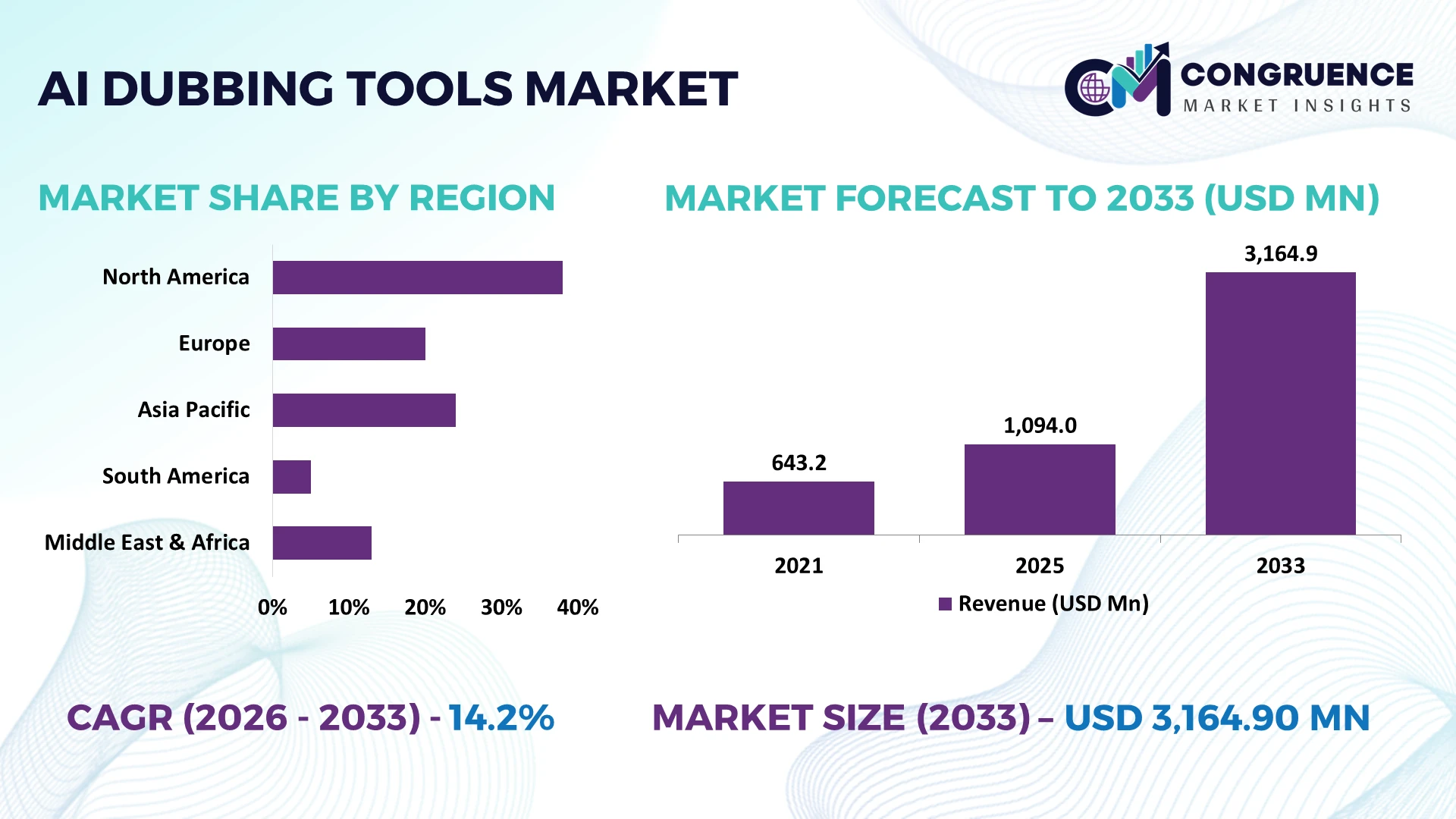
The United States anchors North America’s approximately 42.6% AI dubbing-for-OTT share, supported by streaming, creator media, advertising, enterprise learning, and voice-AI investment. ElevenLabs secured USD 500 million in 2026, while YouTube expanded auto dubbing to 27 languages and recorded more than 6 million daily viewers consuming at least 10 minutes of auto-dubbed content. India, by comparison, is scaling localized AI dubbing across 11 major languages.
Strategically, buyers should prioritize multilingual accuracy, consent-based voice cloning, lip-sync quality, and scalable human-in-the-loop workflows as the EU AI Act and emerging performer-protection rules tighten governance around synthetic media.
Market Size & Growth: USD 1,094.03 million in 2025 advances toward USD 3,164.9 million by 2033 at 14.2% CAGR, driven by automated multilingual video localization.
Top Growth Drivers: Multi-language viewing exceeds 25% of watch time, dubbed-language viewing exceeds 40% on applicable videos, and cloud AI dubbing deployment holds 63.34%.
Short-Term Forecast: By 2028, automated speech translation, synchronization, and QA workflows are positioned to reduce localization turnaround by approximately 30% while expanding simultaneously supported language combinations.
Emerging Technologies: Neural voice cloning, expressive speech, and automated lip sync are converging; YouTube now supports 27 auto-dubbing languages, including 8 with Expressive Speech.
Regional Leaders: Modeled 2033 positioning places North America near USD 1.20 billion, Asia-Pacific around USD 0.95 billion, and Europe near USD 0.70 billion as cloud localization expands.
Consumer/End-User Trends: Multi-language audio creators receive more than 25% of watch time from non-primary languages, while selected channels have achieved 3× viewing increases after localization.
Pilot/Case Example: In 2025, Prime Video tested AI-aided dubbing across 12 licensed movies and series, combining automation with human localization oversight.
Competitive Landscape: North America holds approximately 42.6% of AI dubbing-for-OTT activity, with ElevenLabs, Google, Microsoft, Deepdub, and Synthesia competing through voice quality and workflow automation.
Regulatory & ESG Impact: From August 2026, EU AI Act transparency requirements apply to AI-generated or manipulated content, increasing demand for traceable synthetic-media workflows.
Investment & Funding: ElevenLabs raised USD 500 million in February 2026, taking disclosed cumulative funding to USD 781 million and intensifying investment in advanced voice models and dubbing.
Innovation & Future Outlook: YouTube records over 6 million daily viewers consuming at least 10 minutes of auto-dubbed content, validating automated localization as mainstream distribution infrastructure.
AI Dubbing Tools Market demand is concentrating across OTT streaming, creator video, online education, advertising, gaming, and enterprise media localization. Cloud workflows already represent 63.34% of AI dubbing-for-OTT deployments, while expressive speech, voice preservation, automated lip synchronization, and multilingual QA are improving production economics. Regulatory scrutiny of synthetic voices is simultaneously shifting procurement toward consent-based, auditable localization systems, establishing the strategic context for deeper market analysis.
AI dubbing is becoming strategic distribution infrastructure as streaming platforms, creators, educators, advertisers, and enterprises compete for audiences beyond their original languages. Multi-language audio can generate over 25% of creator watch time from non-primary languages, converting localization from post-production spending into an audience-acquisition mechanism. Simultaneously, synthetic-media disclosure and performer-consent requirements are shifting procurement toward traceable, rights-managed voice workflows.
Neural speech translation, voice cloning, and automated synchronization can compress localization cycles by roughly 30% versus conventional recording-led workflows while enabling simultaneous language production. The United States leads model development and platform integration, while India offers exceptional localization depth across Hindi and regional-language audiences. Europe emphasizes consent, disclosure, and provenance, making governance functionality more commercially important alongside voice quality.
Through 2028, expressive speech, automated lip synchronization, voice preservation, and human-in-the-loop QA will move deeper into production workflows. YouTube already supports auto dubbing across 27 languages, demonstrating deployment at platform scale. Streaming services can localize back-catalog titles without rebuilding complete studio workflows, while vendors invest in multilingual models, partnerships, and rights-management infrastructure. Competitive leadership will depend on delivering emotionally accurate localization at scale without sacrificing performer rights, brand control, or production speed.
Cross-language audience acquisition is the strongest structural driver for AI dubbing tools. Creators using multi-language audio generate more than 25% of watch time from viewers consuming content outside its primary language, while cloud deployment represents approximately 63% of AI dubbing-for-OTT usage and North America accounts for about 43% of activity. YouTube's expansion of automatic dubbing across 27 languages demonstrates the transition from specialist localization to platform-level infrastructure. The non-obvious impact is content monetization: existing video libraries become reusable multilingual assets without equivalent increases in studio capacity. Streaming platforms, creators, education providers, and advertisers consequently shorten localization queues and expand addressable audiences. ElevenLabs, Google, Microsoft, and specialist dubbing vendors are responding through multilingual model development, expressive speech, automated synchronization, API integration, and partnerships with content-production ecosystems.
Synthetic voice ownership and consent requirements constrain unrestricted deployment, particularly for entertainment and professionally voiced content. Data-security and privacy concerns surrounding generative AI affect more than 50% of enterprise AI decision-makers, while European transparency requirements for certain AI-generated content become applicable in 2026. Meanwhile, AI dubbing systems operating across 20-plus languages must manage different contractual, cultural, and data-protection environments. The operational constraint is therefore not inference capacity but rights clearance: technically scalable voice models cannot be deployed commercially when performer authorization, training-data provenance, or permitted reuse remains unclear. Hollywood labor negotiations have intensified attention on digital replicas and performer control. Vendors are responding with licensed voice libraries, consent verification, watermarking, usage tracking, contractual safeguards, and enterprise governance layers that separate authorized professional cloning from unrestricted synthetic-voice generation.
India presents a distinctive opportunity because digital video audiences span Hindi, Tamil, Telugu, Bengali, Marathi, Kannada, Malayalam, and other high-volume languages that historically required separate localization pipelines. Automated dubbing can reduce selected production cycles by approximately 30%, while multi-language distribution can contribute more than 25% of watch time outside a creator's primary language. Cloud-based workflows already account for roughly 63% of AI dubbing-for-OTT deployment, making localization accessible without dedicated recording infrastructure. The less obvious opportunity lies in long-tail libraries: older educational courses, product demonstrations, corporate training, and creator archives can become commercially relevant again through low-cost localization. Vendors are investing in Indian-language models, accent preservation, contextual translation, API-based workflow automation, and partnerships with media platforms. By 2028, localization breadth will increasingly function as a distribution capability rather than a production constraint.
Scaling AI dubbing without degrading emotional fidelity remains the industry's hardest execution problem. Platforms now support more than 20 dubbing languages, yet pronunciation, timing, humor, dialect, speaker identity, and emotional intensity vary substantially across languages. Even a 5–10% manual correction requirement becomes operationally significant when thousands of content hours are processed monthly. Lip synchronization adds another constraint because translated speech frequently differs in duration from the original dialogue, creating visible timing errors. Japan and South Korea present particularly demanding environments where established professional dubbing standards raise audience expectations for performance quality. The non-obvious competitive risk is reputational rather than technical: poor localization can weaken engagement even when translation is semantically correct. Providers must invest in expressive models, contextual translation, automated QA, pronunciation dictionaries, human reviewer networks, and creator-feedback systems to make quality consistent at industrial scale.
Expressive Speech Replaces Flat Voices: AI dubbing is shifting from literal synthetic narration toward emotion-preserving speech. YouTube now supports auto dubbing across 27 languages, with Expressive Speech available in 8 languages and more than 6 million daily viewers consuming at least 10 minutes of auto-dubbed content. Platforms are scaling prosody modeling, contextual translation, and speaker-style preservation to improve engagement and reduce manual voice-direction requirements.
Real-Time Dubbing Enters Broadcasting: Live localization is moving from experimental use toward broadcast workflows. Deepdub introduced real-time multilingual dubbing with first-token audio latency of approximately 125 milliseconds, while cloud-based AI dubbing represents 63.34% of OTT deployment. Broadcasters are integrating low-latency speech translation and emotion-preserving synthesis into live pipelines, reducing dependence on separately produced language feeds.
Lip-Sync Automation Gains Production Weight: Lip synchronization is becoming a core quality layer rather than optional post-production. Lip-sync dubbing held roughly 64.48% of OTT dubbing activity in 2025, while YouTube began testing automated visual synchronization across multilingual workflows. Vendors are combining phoneme timing, facial alignment, and neural speech generation, reducing re-editing requirements and improving perceived authenticity.
Human Review Becomes Governance Layer: AI workflows increasingly retain professional oversight for dialogue accuracy, cultural adaptation, and voice authorization. Cloud deployment exceeds 63%, yet premium scripted content still requires hybrid review as performer-consent and disclosure rules tighten. Companies are restructuring localization operations around AI-first generation followed by targeted linguistic QA, making human expertise a higher-value validation function rather than the primary production engine.
Multilingual Dubbing leads with an estimated 31% share as streaming platforms, creators, education providers, and enterprises increasingly generate multiple localized audio tracks from a single production workflow. Centralized translation, reusable voice assets, and parallel language processing strengthen its scalability advantage. Voice Dubbing follows at approximately 24%, remaining established across narration, educational, corporate, and media content where visual synchronization is less critical. Video Dubbing represents about 20%, combining translated dialogue with timing and visual alignment for premium productions.
AI Voice Cloning holds an estimated 15% and is expanding rapidly as platforms preserve speaker identity, accent, and vocal characteristics across languages. Real-Time Dubbing represents approximately 10% but is emerging fastest as live sports, broadcasting, conferences, and streaming require near-instant localization. Companies are directing R&D toward low-latency inference, expressive speech, voice preservation, and synchronization. Investment priorities are consequently shifting from isolated speech generation toward integrated multilingual engines capable of supporting both recorded and live workflows.
YouTube & Streaming leads with an estimated 34% share because creator platforms and OTT services manage continuously expanding libraries requiring scalable localization. Automated language generation, cloud processing, and viewer-controlled audio selection make streaming particularly suited to AI dubbing. Film & Television represents approximately 27%, where premium content requires stronger human supervision, dialogue adaptation, performance matching, and lip synchronization. Advertising accounts for roughly 14%, benefiting from rapid campaign localization across national and linguistic markets.
E-Learning represents approximately 15% and is expanding rapidly as education providers convert instructor-led courses into multilingual content without repeating complete recording workflows. Gaming contributes around 10%, with adoption concentrated in dialogue-heavy titles and international releases. Providers are responding with terminology controls, batch localization, API integration, speaker consistency, and human-in-the-loop quality assurance. The commercial shift favors platforms that can process large content inventories while maintaining contextual accuracy, turning dubbing from individual production work into repeatable localization infrastructure.
Media & Entertainment leads with an estimated 38% share because streaming services, studios, broadcasters, and production companies process the highest recurring volumes of localized audiovisual content. Their requirements extend beyond translation into lip synchronization, speaker consistency, rights management, and multi-territory distribution. Content Creators represent approximately 23%, benefiting from self-service AI workflows that reduce dependence on conventional localization infrastructure. Education Providers account for about 16%, particularly across multilingual digital courses and training libraries.
Content Creators are the fastest-expanding end-user group as platform-integrated dubbing transforms localization into an automated publishing capability. Advertising Agencies represent approximately 13%, while Game Developers hold about 10% through character dialogue and international content releases. Vendors are targeting these buyer groups through creator subscriptions, enterprise APIs, licensed voice libraries, workflow integrations, and usage-based pricing. Competitive differentiation increasingly depends on serving both individual creators and high-volume professional media operations without sacrificing voice authorization, emotional fidelity, or localization control.
North America accounted for the largest market share at 42.6% in 2025 however, Asia-Pacific is expected to register the fastest growth, expanding at a CAGR of 16.8% between 2026 and 2033.
Platform Integration Industrializes AI Localization
North America accounts for approximately 42.6% of AI dubbing activity, anchored by U.S. streaming platforms, generative-AI developers, production studios, creator ecosystems, and cloud infrastructure. AI dubbing is moving from standalone post-production into native content-distribution workflows as YouTube, Amazon, and technology providers automate translation, voice generation, and synchronization. YouTube supports auto dubbing across 27 languages, while Prime Video tested AI-aided dubbing on 12 licensed movies and series, demonstrating deployment across both creator and premium streaming environments. ElevenLabs' expansion in enterprise voice AI is intensifying competition around expressive speech, consent management, and multilingual accuracy. Canadian demand centers on bilingual English-French localization, gaming, education, broadcasting, and corporate training, creating a commercially relevant secondary market for governed multilingual production.
United States Market Outlook: The United States combines Hollywood production capacity, global streaming headquarters, hyperscale computing, and leading generative-voice developers. YouTube records more than 6 million daily viewers consuming at least 10 minutes of auto-dubbed content. This scale gives U.S. developers unusually large feedback datasets for improving pronunciation, prosody, synchronization, and automated quality control across production workflows.
Synthetic Voice Governance Reshapes Procurement
Europe represents an estimated 24% of AI dubbing demand, supported by unusually fragmented language markets and substantial streaming, broadcasting, advertising, education, and gaming industries. Localization requirements across German, French, Spanish, Italian, Polish, and other languages create natural demand for scalable multilingual production, but regulatory controls increasingly shape vendor selection. EU AI Act transparency obligations applicable from 2026 strengthen requirements around disclosure of synthetic content, while GDPR reinforces controls over biometric and voice-related personal data. This shifts competition toward consent-based cloning, provenance, watermarking, and auditable voice libraries rather than unrestricted synthesis. European broadcasters and studios are increasingly combining AI generation with professional linguistic review to preserve cultural context. Technology providers are consequently developing enterprise governance, controlled voice inventories, and human-in-the-loop workflows alongside faster speech-generation models.
United Kingdom Market Outlook: The United Kingdom offers a strong combination of film production, broadcasting, advertising, gaming, and AI development. London's international media ecosystem generates localization workflows serving both domestic and export markets. ElevenLabs' UK origins and broader voice-AI ecosystem reinforce technical capability, while established production companies provide professional linguistic and performance expertise needed for premium hybrid dubbing rather than fully automated output.
Language Diversity Accelerates Localization Automation
Asia-Pacific represents approximately 22% of AI dubbing activity but offers the deepest structural need for scalable multilingual localization. India alone combines Hindi with large Tamil, Telugu, Bengali, Marathi, Kannada, Malayalam, and other digital audiences, while Japan and South Korea maintain sophisticated dubbing, animation, gaming, and streaming industries. China adds enormous domestic video volumes but operates within a distinct regulatory and platform environment. Mobile-first consumption and expanding creator economies favor cloud-based dubbing that avoids conventional studio capacity constraints. Technology suppliers are improving accent handling, code-switching, pronunciation dictionaries, and culturally adaptive translation rather than simply adding languages. India's expanding streaming and educational-video ecosystems make localized voice production particularly operationally valuable, while Japanese and Korean buyers emphasize emotional fidelity and character consistency for premium entertainment.
India Market Outlook: India provides one of the strongest use cases for multilingual AI dubbing because a single national distribution strategy can require more than 10 major languages. YouTube, streaming services, education platforms, and digital advertisers increasingly use localized audio to reach audiences outside English and Hindi. Domestic AI developers are therefore prioritizing Indic-language speech models, code-switching accuracy, regional accents, and cost-efficient cloud inference.
Streaming Localization Broadens Language Access
South America accounts for an estimated 6% of AI dubbing activity, with Brazil providing the largest individual market and Spanish-speaking economies creating substantial cross-border localization opportunities. Streaming, creator media, online education, gaming, and advertising are driving adoption as companies seek Portuguese and Latin American Spanish versions without maintaining parallel studio workflows. AI-assisted localization is particularly attractive for long-tail content where conventional dubbing economics previously restricted language availability. Infrastructure quality remains uneven outside major technology hubs, making cloud delivery essential for smaller production teams. Providers are responding with Brazilian Portuguese voice models, Latin American Spanish adaptation, subscription pricing, and browser-based production tools. The strategic opportunity lies in adapting linguistic style and regional pronunciation rather than treating Spanish-speaking audiences as a single standardized localization market.
Brazil Market Outlook: Brazil combines more than 200 million consumers with a large creator economy, streaming audience, advertising sector, and established Portuguese dubbing culture. Professional expectations for localized entertainment remain high, favoring hybrid AI-human production. São Paulo's technology and media ecosystem provides the strongest commercial base for deploying Portuguese voice cloning, automated synchronization, advertising localization, and multilingual creator tools.
Arabic Localization Drives AI Deployment
Middle East & Africa represents an estimated 5.4% of AI dubbing activity, with deployment concentrated in the UAE, Saudi Arabia, Israel, South Africa, and digital-media hubs serving Arabic-speaking audiences. Arabic creates a distinctive technology requirement because Modern Standard Arabic coexists with Egyptian, Gulf, Levantine, and other dialects, making contextual voice localization strategically important. Government digitization, streaming expansion, tourism marketing, education technology, and enterprise training are increasing localized video production. Saudi Arabia's entertainment transformation and the UAE's media and AI investments provide particularly strong deployment environments. African markets present greater linguistic fragmentation and infrastructure variability, favoring lightweight cloud-based platforms. Vendors are responding through Arabic model development, dialect adaptation, regional partnerships, cloud infrastructure, and customized enterprise localization services.
United Arab Emirates Market Outlook: The UAE combines advanced cloud infrastructure, international media operations, multilingual business activity, and government-backed AI adoption. Dubai and Abu Dhabi provide strategic bases for localization covering Arabic, English, Hindi, and other widely used languages. The country's population comprises more than 200 nationalities, making multilingual voice technology particularly relevant across tourism, government communication, corporate training, advertising, and digital media.
ElevenLabs, Google, Microsoft, Deepdub, and Synthesia compete across AI voice generation, multilingual dubbing, and enterprise localization, while specialized platforms challenge hyperscalers through workflow customization and expressive speech. The top five players hold an estimated 45%–50% combined share, leaving meaningful space for language-focused specialists. Competition centers on voice fidelity, latency, language coverage, consent controls, and production economics. Advanced automation reduces selected localization turnaround by approximately 30%, while leading platforms support 20-plus languages and real-time systems approach sub-200-millisecond initial audio latency. ElevenLabs emphasizes expressive voice technology; Google leverages YouTube-scale distribution; Microsoft integrates speech AI with enterprise cloud workflows; Deepdub targets professional media localization; Synthesia combines synthetic video and multilingual voice. Partnerships with studios, creators, broadcasters, and cloud platforms are replacing isolated tool sales. Voice rights, training-data access, and linguistic accuracy remain major entry barriers. Winning requires scalable multilingual quality, authorized voices, workflow integration, predictable costs, and production-grade governance.
ElevenLabs
Microsoft
Deepdub
Synthesia
Papercup
Respeecher
Rask AI
Murf AI
Speechify
HeyGen
CAMB.AI
Dubverse
Maestra
Current AI dubbing stacks combine neural machine translation, speech recognition, voice cloning, and automated lip synchronization within cloud production pipelines. Expressive-speech models preserve tone and pacing across more than 20 languages, while automated alignment can reduce localization turnaround by about 30%. Adoption is moving from pilots into creator, streaming, training, and advertising workflows, giving high-volume publishers faster release cycles and lower studio dependency at scale.
Emerging systems add emotion transfer, speaker diarization, terminology control, and real-time speech-to-speech translation. Low-latency engines now approach 125-millisecond first-token audio response, while integrated dubbing platforms support 90-plus languages. Compared with traditional recording-led localization, AI-first production can improve workflow efficiency by roughly 40% through automated transcription, translation, synthesis, and synchronization. Media groups benefit most because existing catalogs can be localized without rebuilding complete recording workflows.
From 2026 through 2028, disruptive development will center on live dubbing, multimodal lip reconstruction, consent-based voice identities, and agentic quality assurance. Platform-level deployment across 27 languages already signals industrial adoption. Vendors integrating rights management, human review, APIs, and distribution platforms will outperform standalone voice generators. Acting now matters because localization technology is becoming embedded distribution infrastructure, shifting competitive advantage toward companies that combine multilingual scale, emotional fidelity, governance, and rapid deployment.
September 2024 Deepdub launched an Enterprise Plan, API integration, and enhanced eTTS 2.1 model after reporting fivefold year-over-year growth. The expansion embedded AI dubbing into studio workflows, strengthening enterprise localization scalability, workflow automation, distribution reach, and integration flexibility.
March 2025 Amazon Prime Video began testing AI-aided dubbing on 12 licensed movies and series in English and Latin American Spanish. Human localization professionals remained involved, extending dubbing availability to titles previously lacking localized audio and expanding accessibility. Source: reuters.com
February 2026 YouTube expanded auto dubbing to 27 languages and reported over 6 million daily viewers watching at least 10 minutes of auto-dubbed content. The rollout validated platform-scale multilingual consumption and strengthened creator access to international audiences worldwide. Source: youtube.com
May 2026 ElevenLabs launched Dubbing v2, preserving original performance across more than 90 languages and accents through source-conditioned speech generation. The model carries tone, pacing, delivery, and emotional intent across languages, raising quality standards for automated localization globally. Source: elevenlabs.io
The report covers AI Dubbing Tools across Voice Dubbing, Video Dubbing, Real-Time Dubbing, Multilingual Dubbing, and AI Voice Cloning, alongside Film & Television, E-Learning, YouTube & Streaming, Advertising, and Gaming applications. End-user coverage spans Media & Entertainment, Education Providers, Content Creators, Advertising Agencies, and Game Developers, with regional analysis across North America, Europe, Asia-Pacific, South America, and Middle East & Africa.
Technology assessment includes expressive speech, neural translation, automated lip synchronization, voice preservation, real-time speech-to-speech systems, and consent-based voice governance. Multilingual platforms now support 90-plus languages, while major distribution platforms operate auto dubbing across 27 languages, highlighting rapid deployment maturity. The report evaluates competitive positioning, localization workflows, regulatory exposure, partnership models, and emerging live-dubbing niches, supporting investment planning, geographic expansion, product prioritization, and long-term strategic decisions from 2026 through 2033.
| Report Attribute/Metric | Report Details |
|---|---|
Market Revenue in 2025 | USD 1094.03 Million |
Market Revenue in 2033 | USD 3164.9 Million |
CAGR (2026 - 2033) | 14.2% |
Base Year | 2025 |
Forecast Period | 2026 - 2033 |
Historic Period | 2021 - 2025 |
Segments Covered | By Type
By Application
By End-User
|
Key Report Deliverable | Revenue Forecast, Growth Trends, Market Dynamics, Segmental Overview, Regional and Country-wise Analysis, Competition Landscape |
Region Covered | North America, Europe, Asia-Pacific, South America, Middle East, Africa |
Key Players Analyzed | ElevenLabs, Google, Microsoft, Deepdub, Synthesia, Papercup, Respeecher, Rask AI, Murf AI, Speechify, HeyGen, CAMB.AI, Dubverse, Maestra |
Customization & Pricing | Available on Request (10% Customization is Free) |




