
Reports
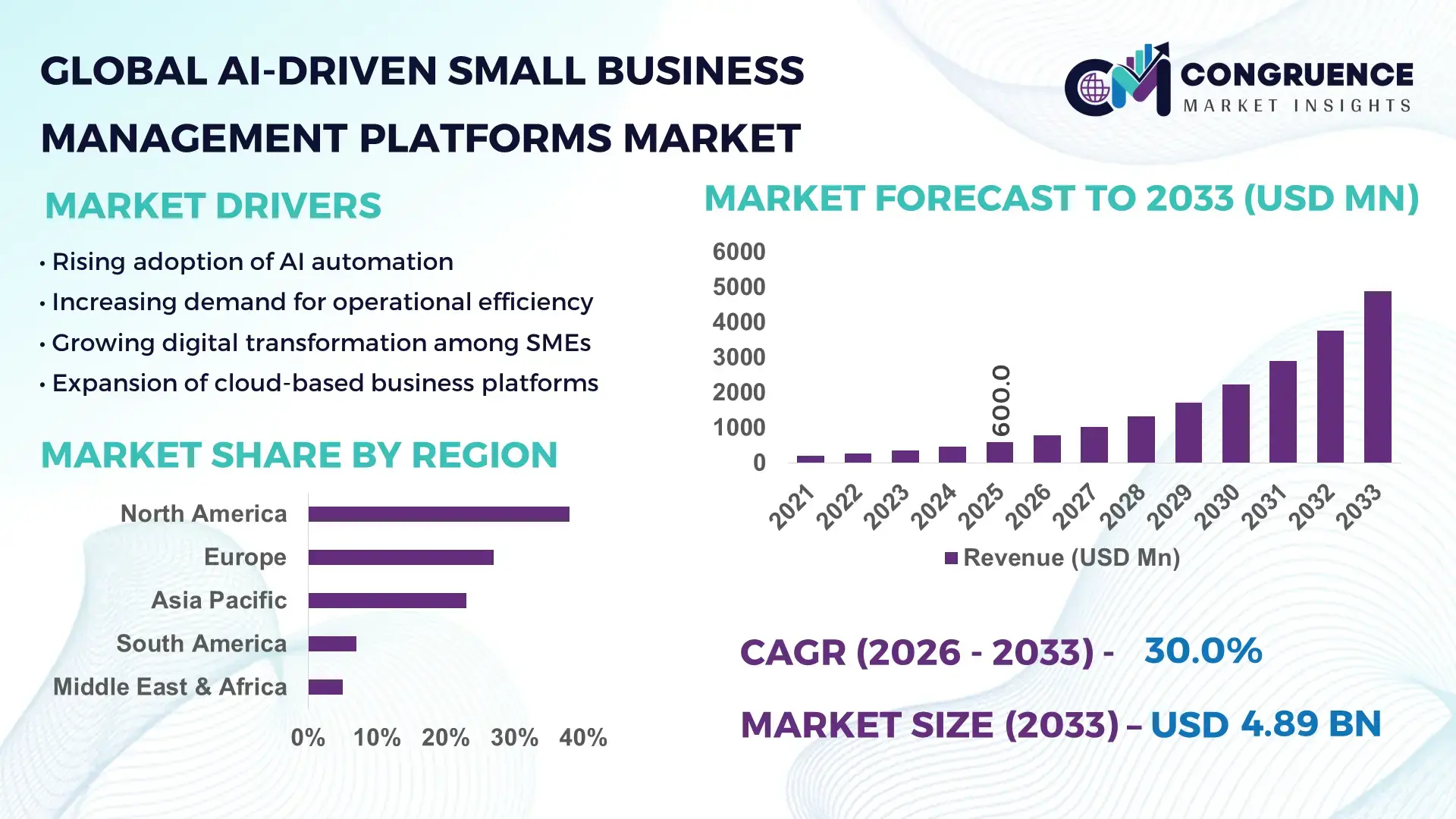
The Global AI-Driven Small Business Management Platforms Market was valued at USD 600.0 Million in 2025 and is anticipated to reach a value of USD 4,894.4 Million by 2033 expanding at a CAGR of 30% between 2026 and 2033, according to an analysis by Congruence Market Insights. The market is expanding rapidly due to increasing adoption of automation tools that enhance operational efficiency and decision-making for small businesses.
The United States remains a central hub for AI-Driven Small Business Management Platforms Market development, with over 33 million small businesses contributing to widespread adoption of AI-enabled platforms. Approximately 62% of SMEs in the country have integrated at least one AI-driven tool into operations such as accounting, CRM, or HR management. Investments in AI software startups exceeded USD 50 billion in 2025, with a significant portion directed toward SaaS-based business management solutions. Cloud-based AI platforms account for nearly 70% of deployments among U.S. SMEs, highlighting strong infrastructure readiness. Additionally, sectors such as retail, professional services, and logistics collectively contribute over 55% of platform utilization, reflecting diverse application integration across industries.
Market Size & Growth: Valued at USD 600.0 Million in 2025 and projected to reach USD 4,894.4 Million by 2033 at a CAGR of 30%, driven by rising SME digitalization and AI adoption.
Top Growth Drivers: SME AI adoption at 62%, workflow automation improving efficiency by 45%, and cloud platform usage exceeding 70%.
Short-Term Forecast: By 2028, operational costs are expected to reduce by 28% through AI-driven automation and predictive analytics.
Emerging Technologies: Integration of generative AI, no-code/low-code platforms, and AI-powered analytics engines is accelerating innovation.
Regional Leaders: North America projected at USD 1.9 Billion by 2033 with strong SaaS adoption; Europe at USD 1.3 Billion driven by compliance-focused tools; Asia-Pacific at USD 1.1 Billion fueled by SME digitization.
Consumer/End-User Trends: Over 58% of SMEs prefer subscription-based AI tools, with increased demand for integrated platforms combining CRM, HR, and finance.
Pilot or Case Example: In 2025, a U.S.-based SME pilot reduced manual accounting workload by 40% using AI automation tools.
Competitive Landscape: Market leader holds approximately 18% share, followed by competitors including Intuit, Zoho, SAP, Oracle, and Freshworks.
Regulatory & ESG Impact: Data privacy laws such as GDPR and AI governance frameworks are influencing platform design and compliance adoption.
Investment & Funding Patterns: Over USD 20 billion invested globally in SME-focused AI SaaS platforms, with strong venture capital participation.
Innovation & Future Outlook: Increasing integration of AI copilots and predictive analytics is shaping next-generation business management platforms.
AI-Driven Small Business Management Platforms Market is influenced by strong demand from retail (28%), professional services (22%), and e-commerce (18%) sectors. Advances in generative AI and automation tools are enhancing productivity across SMEs. Regulatory frameworks supporting digital transformation and cloud adoption are accelerating deployment. North America and Asia-Pacific dominate consumption patterns, while Europe emphasizes compliance-driven solutions. Future growth is driven by AI integration, scalable SaaS models, and rising SME digital maturity.
The AI-Driven Small Business Management Platforms Market is strategically positioned at the intersection of digital transformation and operational efficiency, enabling SMEs to streamline processes across finance, HR, customer engagement, and supply chain operations. Businesses leveraging AI-powered platforms report up to 45% efficiency gains compared to traditional manual management systems, highlighting measurable productivity improvements.
AI-powered automation platforms deliver 40% improvement compared to legacy ERP systems in terms of processing speed and decision-making accuracy. North America dominates in volume, while Asia-Pacific leads in adoption with over 65% of SMEs implementing cloud-based AI tools for business management. This shift reflects the growing reliance on scalable, cloud-native infrastructure that supports real-time analytics and predictive insights.
By 2028, generative AI integration is expected to improve workflow efficiency by 35%, enabling SMEs to automate repetitive tasks such as invoicing, payroll, and customer support. Firms are committing to ESG targets, including 25% reduction in paper-based processes by 2027 through digitized workflows and AI-enabled documentation systems.
In 2025, a leading SME technology provider in the United States achieved a 38% reduction in operational errors through AI-driven automation and predictive analytics integration. These improvements demonstrate the growing impact of intelligent systems in minimizing human intervention and enhancing accuracy.
Looking ahead, the AI-Driven Small Business Management Platforms Market is expected to evolve as a critical pillar supporting resilience, regulatory compliance, and sustainable growth, with AI integration driving continuous innovation across SME ecosystems.
The AI-Driven Small Business Management Platforms Market is shaped by rapid digital transformation among SMEs, increasing demand for automation, and growing reliance on data-driven decision-making. Over 60% of small businesses globally are transitioning toward cloud-based platforms, integrating AI capabilities such as predictive analytics, natural language processing, and workflow automation. The market is influenced by rising adoption across sectors including retail, healthcare, and professional services, where operational efficiency and cost optimization are critical. Additionally, integration of AI with SaaS models has improved accessibility, enabling smaller enterprises to deploy advanced tools without heavy upfront investments. Regulatory frameworks focusing on data protection and AI governance are also influencing platform development, ensuring compliance and security. Competitive innovation, strategic partnerships, and continuous product enhancements further drive the market, positioning it as a key enabler of SME digital ecosystems worldwide.
The rapid digital transformation among SMEs is a primary driver of the AI-Driven Small Business Management Platforms Market. More than 64% of SMEs globally have adopted digital tools to enhance operational efficiency, with AI-driven platforms playing a crucial role in automating business functions such as accounting, inventory management, and customer relationship management. Automation tools reduce manual workload by up to 40%, enabling businesses to reallocate resources toward strategic growth initiatives. Cloud-based solutions account for over 70% of deployments, providing scalability and cost efficiency. Additionally, increasing internet penetration and mobile device usage have expanded accessibility to AI-powered platforms. SMEs in sectors such as retail and e-commerce are leveraging AI to improve customer engagement and optimize supply chains, resulting in improved performance metrics and competitive advantage.
Data privacy concerns and integration challenges present significant restraints to the AI-Driven Small Business Management Platforms Market. Approximately 48% of SMEs express concerns about data security when adopting AI-driven platforms, particularly regarding sensitive financial and customer information. Compliance with regulations such as GDPR and other regional data protection laws requires additional investment in security infrastructure, which can be a barrier for smaller businesses. Integration with existing legacy systems is another challenge, with nearly 35% of SMEs reporting difficulties in aligning new AI tools with current workflows. Lack of technical expertise further complicates adoption, as businesses struggle to manage implementation and maintenance effectively. These factors collectively slow down the pace of adoption despite the clear benefits offered by AI-driven solutions.
The rise of AI-powered SaaS ecosystems presents substantial opportunities for the AI-Driven Small Business Management Platforms Market. Over 72% of SMEs prefer subscription-based software models due to lower upfront costs and flexible scalability. AI integration within SaaS platforms enables real-time analytics, predictive insights, and automated workflows, significantly enhancing business performance. Emerging markets in Asia-Pacific and Latin America are witnessing increased adoption, with SME digitization rates exceeding 55%. Additionally, advancements in generative AI and low-code platforms are enabling non-technical users to deploy customized solutions, expanding the addressable market. Partnerships between AI technology providers and cloud service companies are further accelerating innovation, creating new revenue streams and enhancing platform capabilities.
Rising implementation costs and skill gaps pose key challenges to the AI-Driven Small Business Management Platforms Market. While cloud-based solutions reduce upfront expenses, customization and integration costs remain significant, with SMEs allocating up to 20% of IT budgets toward implementation. Additionally, nearly 42% of small businesses report a lack of skilled personnel capable of managing AI-driven systems, limiting effective utilization. Training requirements and change management processes further add to operational complexity. The rapid pace of technological advancement also creates challenges in keeping systems updated and compatible. These factors hinder widespread adoption, particularly among micro and small enterprises with limited financial and technical resources.
Increasing Adoption of Generative AI in Business Operations: Over 48% of SMEs have integrated generative AI tools into daily workflows, enabling automated content creation, financial forecasting, and customer support. AI-generated insights have improved decision-making speed by 35%, particularly in retail and service industries where real-time responsiveness is critical.
Expansion of No-Code and Low-Code AI Platforms: Approximately 52% of SMEs are adopting no-code or low-code platforms to build customized applications without requiring technical expertise. This trend has reduced development time by nearly 40%, enabling faster deployment of business management tools across industries.
Rising Integration of AI with Cloud-Based SaaS Solutions: Cloud-based AI platforms account for over 70% of deployments, offering scalability and cost efficiency. SMEs leveraging cloud AI solutions report up to 30% improvement in operational efficiency and a 25% reduction in IT infrastructure costs.
Growth in AI-Powered Predictive Analytics Tools: Predictive analytics adoption has increased by 45% among SMEs, enabling businesses to forecast demand, optimize inventory, and enhance customer retention. Companies using predictive tools have reported a 20% increase in revenue-generating opportunities through improved strategic planning.
The AI-Driven Small Business Management Platforms Market is segmented based on type, application, and end-user insights, reflecting diverse adoption patterns across industries. Platform types range from integrated AI suites to standalone modules such as CRM, accounting, and HR automation tools. Applications are widely distributed across financial management, customer engagement, supply chain optimization, and workforce management, with increasing adoption in e-commerce and professional services. End-user segmentation highlights strong uptake among SMEs in retail, IT services, and healthcare sectors, where automation and real-time analytics significantly improve operational efficiency. Approximately 60% of adoption is driven by service-oriented SMEs, while manufacturing and logistics contribute to around 25%, indicating balanced growth across sectors.
The AI-Driven Small Business Management Platforms Market includes integrated platforms, CRM-focused AI solutions, accounting and finance automation tools, HR and payroll management systems, and supply chain optimization platforms. Integrated AI platforms dominate with approximately 38% share due to their ability to provide unified solutions combining multiple business functions into a single interface, improving efficiency and reducing complexity. CRM-focused AI solutions account for around 22%, driven by demand for enhanced customer engagement and personalized marketing strategies. Accounting and finance automation tools represent nearly 18%, while HR and payroll systems contribute about 12%. The fastest-growing segment is supply chain optimization platforms, expanding at an estimated CAGR of 34% due to increasing demand for real-time inventory tracking and predictive logistics management. The remaining segments collectively account for around 10%, reflecting niche adoption across specialized business functions.
• In 2025, an industry study highlighted that over 12 million SMEs globally adopted integrated AI platforms to streamline multi-functional operations, improving productivity by over 30%.
Applications in the AI-Driven Small Business Management Platforms Market include financial management, customer relationship management, workforce management, marketing automation, and supply chain optimization. Financial management leads with approximately 30% share due to its critical role in budgeting, invoicing, and compliance. CRM applications account for 25%, while workforce management holds around 18%. Marketing automation and supply chain optimization together contribute nearly 27%. The fastest-growing application is marketing automation, expanding at an estimated CAGR of 32% as businesses increasingly leverage AI for targeted campaigns and customer insights. In 2025, more than 40% of SMEs globally reported using AI-powered CRM systems to enhance customer engagement. Additionally, over 58% of businesses indicated improved customer retention through AI-driven personalization tools.
• In 2025, a global enterprise survey reported that AI-powered marketing tools improved campaign efficiency for over 8 million SMEs, increasing conversion rates by nearly 25%.
End-users in the AI-Driven Small Business Management Platforms Market include retail SMEs, IT and professional services, manufacturing, healthcare, and logistics sectors. Retail SMEs dominate with approximately 32% share due to high demand for customer analytics and inventory management tools. IT and professional services account for around 26%, while manufacturing and logistics collectively contribute nearly 28%. Healthcare SMEs represent about 14% of the market. The fastest-growing end-user segment is healthcare, expanding at an estimated CAGR of 31% due to increasing adoption of AI-driven administrative and patient management tools. In 2025, more than 45% of retail SMEs adopted AI platforms for inventory and sales optimization. Additionally, over 50% of IT service firms reported using AI tools for project management and customer support automation.
• In 2025, a global SME technology report indicated that AI adoption in retail businesses improved inventory accuracy by 35% across over 500,000 companies.
North America accounted for the largest market share at 38% in 2025 however, Asia-Pacific is expected to register the fastest growth, expanding at a CAGR of 32% between 2026 and 2033.

North America leads due to advanced digital infrastructure and high SME adoption rates, with over 65% of businesses integrating AI tools. Europe holds approximately 27% share, driven by strong regulatory frameworks and enterprise digitalization initiatives. Asia-Pacific accounts for around 23%, supported by rapid SME digitization in countries like China and India. South America contributes nearly 7%, while the Middle East & Africa represent about 5%. Increasing investments in cloud computing, AI innovation hubs, and government-led digital transformation programs are accelerating adoption across all regions.
North America holds approximately 38% share of the AI-Driven Small Business Management Platforms Market, supported by strong digital infrastructure and high SME adoption rates. Key industries driving demand include retail, financial services, and healthcare, where AI tools enhance operational efficiency and customer engagement. Government initiatives promoting digital transformation and data security regulations are encouraging platform adoption. Over 65% of SMEs in the region use cloud-based AI tools, reflecting high technological maturity. Companies such as Intuit are actively enhancing AI capabilities within their platforms to improve automation and analytics. Consumer behavior indicates strong preference for integrated, subscription-based solutions, with businesses prioritizing efficiency and scalability.
Europe accounts for around 27% of the market, with key countries including Germany, the UK, and France leading adoption. Regulatory frameworks such as GDPR have significantly influenced platform design, emphasizing data privacy and transparency. Approximately 58% of SMEs in Europe prioritize compliance-driven AI solutions. Emerging technologies such as explainable AI and secure cloud platforms are gaining traction. Companies like SAP are investing in AI-driven enterprise solutions tailored for SMEs. Consumer behavior shows a preference for transparent and compliant systems, with businesses focusing on data security and regulatory adherence.
Asia-Pacific represents about 23% of the market and ranks as the fastest-growing region. Major consuming countries include China, India, and Japan, where SME digitization rates exceed 55%. Infrastructure improvements and expanding internet penetration are supporting adoption. Technology hubs in cities such as Bangalore and Shenzhen are driving innovation. Companies like Zoho are expanding AI capabilities to cater to growing SME demand. Consumer behavior is driven by mobile-first solutions and cost-effective platforms, with businesses prioritizing scalability and ease of use.
South America holds approximately 7% share, with Brazil and Argentina as key markets. Adoption is influenced by increasing digitalization and demand for localized AI solutions. Government initiatives supporting SME growth and digital transformation are driving market expansion. Infrastructure improvements in cloud computing are enhancing accessibility. Local players are focusing on language-specific and regionally tailored platforms. Consumer behavior reflects growing demand for affordable and customizable solutions, particularly in retail and service sectors.
The Middle East & Africa account for about 5% of the market, with countries such as the UAE and South Africa leading adoption. Demand is driven by sectors including retail, construction, and logistics. Government initiatives promoting digital transformation and smart city projects are supporting growth. Technological modernization and increasing cloud adoption are key trends. Local companies are focusing on AI-driven solutions tailored to regional needs. Consumer behavior indicates rising interest in scalable and cost-effective platforms, particularly among SMEs seeking operational efficiency improvements.
United States – 34% Market share: Driven by strong SME ecosystem and high AI adoption rates.
China – 21% Market share: Supported by rapid digital transformation and large SME base.
The AI-Driven Small Business Management Platforms Market is moderately fragmented, with over 120 active global and regional players competing across integrated platform solutions and specialized AI modules. The top five companies collectively hold approximately 45% of the market, indicating a competitive yet evolving landscape. Key players are focusing on strategic initiatives such as mergers, acquisitions, and partnerships to enhance their technological capabilities and expand market reach.
Product innovation remains a critical competitive factor, with companies investing heavily in generative AI, predictive analytics, and no-code platform development. Approximately 60% of leading vendors have introduced AI copilots or automation features within their platforms to improve user experience and efficiency. Partnerships with cloud service providers are also increasing, enabling scalable deployment and global accessibility.
Regional players are gaining traction by offering cost-effective and localized solutions tailored to SME needs, particularly in emerging markets. Competitive differentiation is driven by platform integration, ease of use, and customization capabilities. Continuous innovation and strategic collaborations are expected to shape the competitive dynamics of the market in the coming years.
Zoho Corporation
Freshworks
SAP SE
Oracle Corporation
Microsoft Corporation
Salesforce Inc.
Sage Group plc
Xero Limited
HubSpot Inc.
Odoo S.A.
Epicor Software Corporation
Infor Inc.
Workday Inc.
The AI-Driven Small Business Management Platforms Market is witnessing rapid technological advancements, with artificial intelligence, machine learning, and cloud computing forming the backbone of innovation. Generative AI is increasingly being integrated into platforms, enabling automated content generation, financial forecasting, and customer interaction management. Approximately 48% of SMEs have adopted AI-powered automation tools, improving operational efficiency and reducing manual workloads by up to 40%.
Cloud-native architectures dominate the market, accounting for over 70% of deployments, providing scalability, flexibility, and cost efficiency. Integration of predictive analytics allows businesses to forecast demand and optimize resource allocation, with adoption rates exceeding 45% among SMEs. Natural language processing (NLP) is enhancing user interfaces, enabling conversational AI systems that improve customer engagement and support services.
Low-code and no-code platforms are transforming accessibility, allowing non-technical users to develop customized applications. Over 50% of SMEs are leveraging these tools to build tailored solutions, reducing development time significantly. Additionally, AI copilots are emerging as key innovations, assisting users in decision-making and workflow automation. These technologies collectively drive continuous innovation, enabling SMEs to enhance productivity, scalability, and competitiveness in a rapidly evolving digital landscape.
• In July 2025, Intuit announced new intelligent automation features within QuickBooks, enabling faster payments and improved financial compliance for small businesses through enhanced AI-driven accounting workflows and automation capabilities across international markets. Source: www.investors.intuit.com
• In November 2025, Intuit introduced a virtual team of AI agents within its all-in-one platform, allowing small businesses to automate finance, customer management, and tax operations, delivering improved efficiency and actionable insights through integrated AI-driven workflows.
• In February 2025, Zoho launched Zia AI agents within its CRM platform along with a dedicated marketplace, enabling SMEs to automate sales, support, and marketing workflows through customizable AI-driven agents integrated directly into business operations.
• In December 2025, Freshworks announced its expansion strategy focused on AI-driven platforms, including acquisition initiatives targeting AI and employee experience software, strengthening its capabilities in automation, customer engagement, and enterprise service management solutions.
The AI-Driven Small Business Management Platforms Market Report provides a comprehensive analysis of industry trends, technological advancements, and market segmentation across global regions. The scope includes detailed insights into platform types such as integrated AI suites, CRM systems, accounting automation tools, and HR management solutions, highlighting their adoption across diverse business functions.
The report covers application areas including financial management, customer relationship management, workforce optimization, marketing automation, and supply chain management, offering a holistic view of how AI is transforming SME operations. Geographic analysis spans North America, Europe, Asia-Pacific, South America, and the Middle East & Africa, providing region-specific insights into adoption patterns, infrastructure development, and regulatory frameworks.
Additionally, the report examines end-user industries such as retail, healthcare, manufacturing, logistics, and professional services, emphasizing their unique requirements and adoption trends. Emerging technologies such as generative AI, predictive analytics, and no-code platforms are analyzed for their impact on market evolution. The scope also includes competitive landscape assessment, profiling key players and their strategic initiatives.
Overall, the report delivers a detailed, data-driven perspective on the AI-Driven Small Business Management Platforms Market, enabling stakeholders to identify growth opportunities, evaluate risks, and make informed business decisions in a rapidly evolving digital ecosystem.
| Report Attribute / Metric | Details |
|---|---|
| Market Revenue (2025) | USD 600.0 Million |
| Market Revenue (2033) | USD 4,894.4 Million |
| CAGR (2026–2033) | 30% |
| Base Year | 2025 |
| Forecast Period | 2026–2033 |
| Historic Period | 2021–2025 |
| Segments Covered |
By Type
By Application
By End-User Insights
|
| Key Report Deliverables | Revenue Forecast; Market Trends; Growth Drivers & Restraints; Technology Insights; Segmentation Analysis; Regional Insights; Competitive Landscape; Regulatory & ESG Overview; Recent Developments |
| Regions Covered | North America; Europe; Asia-Pacific; South America; Middle East & Africa |
| Key Players Analyzed | Intuit; Zoho Corporation; Freshworks; SAP SE; Oracle Corporation; Microsoft Corporation; Salesforce Inc.; Sage Group plc; Xero Limited; HubSpot Inc.; Odoo S.A.; Epicor Software Corporation; Infor Inc.; Workday Inc. |
| Customization & Pricing | Available on Request (10% Customization Free) |




