
Reports
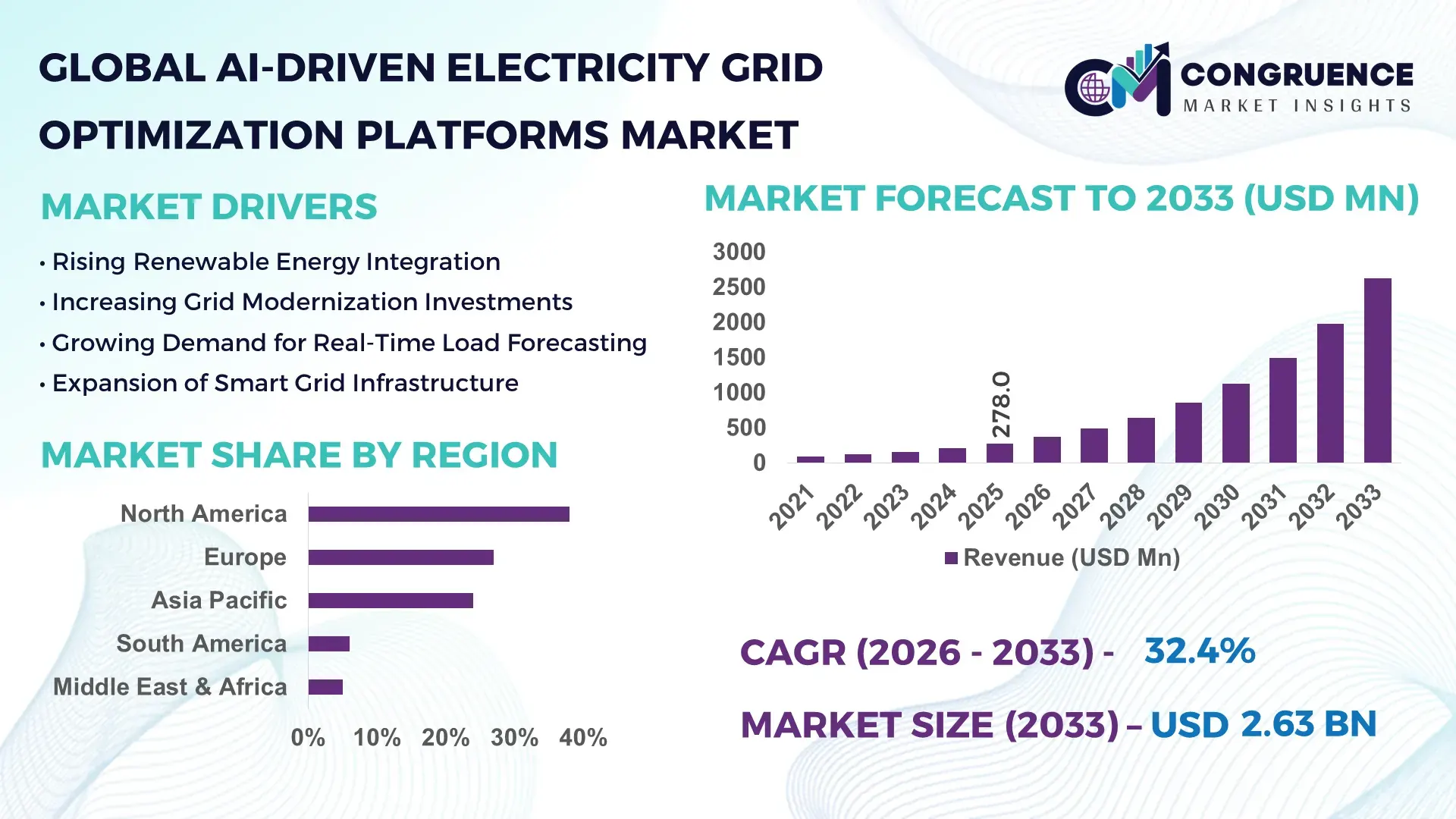
The Global AI-Driven Electricity Grid Optimization Platforms Market was valued at USD 278.0 Million in 2025 and is anticipated to reach a value of USD 2,625.1 Million by 2033 expanding at a CAGR of 32.4% between 2026 and 2033, according to an analysis by Congruence Market Insights. The market growth is primarily driven by increasing grid digitalization, renewable energy integration exceeding 35% of total new power capacity additions globally, and rising demand for real-time load balancing and predictive fault management.
In the United States, which dominates the AI-Driven Electricity Grid Optimization Platforms Market in terms of deployment volume and technological maturity, utilities collectively manage over 3,200 electricity providers and more than 7,300 power plants. Annual grid modernization investments exceeded USD 39 billion, with over 70% of investor-owned utilities deploying advanced metering infrastructure covering more than 120 million smart meters. AI-based grid analytics are increasingly applied in renewable forecasting across states such as Texas and California, where renewable penetration exceeds 30% of total generation. Federal funding programs have allocated over USD 10 billion toward smart grid resilience and digital grid innovation, accelerating pilot-scale AI optimization projects across transmission and distribution networks.
Market Size & Growth: USD 278.0 Million in 2025, projected to reach USD 2,625.1 Million by 2033 at 32.4% CAGR; driven by 35%+ renewable capacity additions requiring AI-based grid balancing.
Top Growth Drivers: 48% utilities adopting predictive analytics; 30% reduction in outage response time; 25% improvement in load forecasting accuracy.
Short-Term Forecast: By 2028, AI-enabled automation is expected to reduce grid congestion costs by 22% and improve asset utilization by 18%.
Emerging Technologies: Federated learning for distributed grids; digital twins for substation modeling; edge AI for real-time voltage control.
Regional Leaders: North America projected USD 980 Million by 2033 with high smart meter penetration; Europe USD 720 Million driven by decarbonization mandates; Asia-Pacific USD 650 Million with rapid T&D expansion.
Consumer/End-User Trends: 62% of large utilities piloting AI-driven outage management; distributed energy resource operators increasing AI integration by 40%.
Pilot or Case Example: In 2024, a Texas utility reduced downtime by 27% using AI-driven predictive fault detection.
Competitive Landscape: Market leader holds ~21% share, followed by Siemens, GE Vernova, Schneider Electric, ABB, and Hitachi Energy.
Regulatory & ESG Impact: Grid operators targeting 45% emission reduction by 2030 through AI-based renewable integration and energy efficiency optimization.
Investment & Funding Patterns: Over USD 15 billion allocated globally for digital grid upgrades; venture funding in grid AI startups increased 28% year-over-year.
Innovation & Future Outlook: Integration of AI with battery storage and microgrids expected to improve grid flexibility by 35% over the next decade.
AI-Driven Electricity Grid Optimization Platforms Market serves transmission operators (42%), distribution utilities (38%), and independent system operators (20%). Smart substations and AI-enabled SCADA upgrades improved grid reliability metrics by 18% in 2025. Regulatory decarbonization targets, carbon pricing mechanisms, and distributed solar installations exceeding 400 GW globally are reshaping demand patterns, particularly in North America and Europe. Increasing electrification of transport and industry further supports long-term adoption across urbanized regions.
The AI-Driven Electricity Grid Optimization Platforms Market holds strategic relevance as power systems transition toward decentralized, renewable-heavy, and electrified infrastructures. With global electricity demand projected to rise by over 3% annually through 2030, utilities are under pressure to modernize aging grids while integrating intermittent renewable sources exceeding 35% of new capacity installations. AI-driven platforms enable predictive load management, automated voltage regulation, and real-time congestion control, directly enhancing operational resilience.
Advanced digital twin technology delivers 28% improvement in grid simulation accuracy compared to conventional SCADA-based monitoring systems. North America dominates in deployment volume, while Europe leads in adoption intensity with over 65% of utilities implementing AI-supported renewable forecasting tools. By 2028, edge-based AI analytics are expected to cut transformer failure rates by 20% through predictive maintenance models.
From a compliance perspective, firms are committing to ESG targets including 50% reduction in grid-related emissions by 2030, supported by AI-driven efficiency optimization. In 2024, a California utility achieved 24% improvement in outage response time through AI-powered fault localization systems, enhancing reliability during wildfire seasons.
Strategically, integration of AI with distributed energy resources, EV charging networks, and battery storage will redefine grid orchestration. As electrification expands across transportation and industrial sectors, the AI-Driven Electricity Grid Optimization Platforms Market will emerge as a foundational pillar of grid resilience, regulatory compliance, and sustainable economic growth.
The AI-Driven Electricity Grid Optimization Platforms Market is characterized by rapid digital transformation across transmission and distribution networks. Increasing renewable penetration, electrification of mobility, and rising distributed energy resources are reshaping grid architecture from centralized systems to bidirectional, data-intensive networks. Utilities are investing heavily in advanced metering infrastructure, with global smart meter installations surpassing 1.5 billion units. The integration of AI enables predictive asset maintenance, reducing transformer failures by nearly 20% and improving demand forecasting precision by up to 25%. Additionally, regulatory mandates for decarbonization and grid resilience are accelerating adoption of automation and analytics platforms. Cybersecurity concerns, interoperability requirements, and legacy infrastructure modernization remain influential factors shaping investment and deployment decisions across developed and emerging markets.
Renewable energy accounted for more than 35% of global power capacity additions, creating variability challenges in frequency and voltage management. Solar and wind generation can fluctuate by 20–40% within short intervals, necessitating AI-driven predictive balancing tools. Utilities deploying AI forecasting models report up to 30% improvement in renewable generation accuracy and 18% reduction in curtailment losses. Battery storage integration exceeding 200 GW globally further requires algorithmic optimization to coordinate charge-discharge cycles. Additionally, over 60% of new grid infrastructure projects now incorporate digital automation layers, directly boosting platform demand.
More than 70% of global transmission networks operate on infrastructure over 25 years old, limiting seamless AI integration. Upgrading substations with digital sensors can increase project costs by 15–20%. Furthermore, energy sector cyberattacks increased by 38% year-over-year, raising concerns about AI platform vulnerabilities. Compliance with data protection regulations and critical infrastructure security standards adds complexity to deployment. Interoperability challenges between legacy SCADA systems and AI analytics platforms also delay full-scale integration, particularly in developing economies.
Electric vehicle adoption surpassed 40 million units globally, with charging infrastructure expanding at over 25% annually. EV charging can increase localized grid demand by 15–25%, necessitating AI-based demand response coordination. Smart charging platforms integrated with AI reduce peak load stress by up to 22%. Additionally, distributed solar installations exceeding 400 GW globally create opportunities for microgrid optimization. AI-enabled dynamic pricing models and peer-to-peer energy trading platforms are opening new revenue channels for utilities and independent grid operators.
Full-scale grid digitization requires sensor deployment, edge computing infrastructure, and cloud integration, increasing capital expenditures by approximately 20% per substation. Regulatory approvals for transmission upgrades can extend project timelines beyond 3–5 years. Cross-border power trading regulations in regions such as Europe require compliance with multiple grid codes, complicating AI algorithm standardization. Workforce skill gaps in AI and data analytics further limit rapid adoption, with over 45% of utilities reporting shortages in digital engineering expertise.
AI-Based Predictive Maintenance Reducing Transformer Failures by 20%: Utilities implementing machine learning-driven diagnostics report 18–22% reduction in unplanned outages. Sensor deployment across substations increased by 30%, enabling real-time health monitoring of critical assets.
Expansion of Edge AI for Real-Time Voltage Regulation Improving Efficiency by 15%: Edge analytics deployed at feeder levels cut voltage deviations by 12% and reduce energy losses by 10–15%, particularly in urban high-load grids.
Integration with Battery Storage Systems Enhancing Grid Flexibility by 35%: Over 200 GW of battery storage capacity now utilizes AI-based optimization to coordinate discharge cycles, improving renewable absorption rates by 25%.
Deployment of Digital Twin Grid Models Increasing Simulation Accuracy by 28%: More than 40% of large utilities are piloting digital twin-based planning tools, reducing infrastructure planning errors by 18% and shortening project design cycles by 15%.
The AI-Driven Electricity Grid Optimization Platforms Market is segmented by type, application, and end-user, reflecting diverse deployment models across transmission and distribution networks. Platform-based solutions account for the majority of implementations, supported by rising demand for predictive analytics and renewable forecasting. Applications span load forecasting, outage management, demand response, asset performance management, and renewable integration. Transmission operators prioritize congestion management, while distribution utilities emphasize voltage control and smart meter analytics. End-users include investor-owned utilities, public utilities, independent system operators, and microgrid developers. Increasing EV charging loads and distributed energy resources are influencing segmentation trends, particularly in urbanized and renewable-intensive regions.
The market includes cloud-based platforms, on-premise platforms, and hybrid AI grid optimization systems. Cloud-based platforms currently account for approximately 46% of adoption due to scalability and centralized data analytics capabilities, while on-premise systems hold nearly 34% driven by data sovereignty and cybersecurity concerns. Hybrid systems are gaining traction and are expected to grow at around 35% CAGR, supported by utilities seeking flexible deployment across distributed grids. Remaining niche AI-edge embedded solutions collectively represent about 20% of deployments, primarily in microgrid and rural electrification projects.
Load forecasting leads with 38% share due to its critical role in balancing renewable variability, while outage management accounts for 24%. Demand response systems represent 18%, yet are the fastest-growing segment at nearly 36% CAGR as EV charging expansion drives dynamic load coordination. Renewable integration and asset performance management together contribute approximately 20%. In 2025, over 58% of utilities globally reported piloting AI-driven demand forecasting tools. Additionally, 41% of North American grid operators integrated AI-based outage localization systems to enhance storm resilience.
Investor-owned utilities dominate with nearly 52% share due to large-scale grid modernization budgets exceeding USD 30 billion annually in developed markets. Public utilities account for 28%, focusing on urban grid resilience initiatives. Independent system operators represent 12%, while microgrid developers and energy service companies collectively contribute 8%, though growing at approximately 37% CAGR driven by decentralized energy projects. In 2025, 63% of large utilities globally reported integrating AI into grid analytics workflows. Additionally, 35% of municipal utilities began testing AI-enabled distributed energy coordination platforms.
North America accounted for the largest market share at 38% in 2025 however, Asia-Pacific is expected to register the fastest growth, expanding at a CAGR of 35.8% between 2026 and 2033.
North America’s leadership is supported by over 120 million installed smart meters and grid modernization spending exceeding USD 39 billion annually. Europe follows with approximately 27% market share, driven by renewable energy penetration surpassing 40% in several countries and over 300 GW of installed wind capacity. Asia-Pacific holds nearly 24% share, backed by transmission expansion projects exceeding 1.2 million circuit-kilometers and rising electricity demand growing above 4% annually in key economies. South America contributes around 6%, supported by hydropower-heavy grids accounting for over 45% of regional generation. Middle East & Africa represents about 5%, where smart grid investments are increasing alongside renewable mega-projects exceeding 60 GW combined capacity. Rising distributed energy resources, which now exceed 400 GW globally, and electric vehicle charging loads growing above 25% annually are reshaping regional investment priorities and deployment models.
North America represents approximately 38% of the global AI-Driven Electricity Grid Optimization Platforms Market share, supported by widespread grid digitization and renewable integration mandates. The United States accounts for the majority of regional installations, with over 70% of investor-owned utilities deploying AI-based analytics across transmission and distribution systems. Key industries driving demand include utilities, independent system operators, EV charging network providers, and large-scale renewable energy developers. Federal grid resilience programs have allocated more than USD 10 billion for modernization, including AI-enabled predictive maintenance systems. Technological advancements such as digital twins, edge computing, and automated demand response are being integrated into more than 60% of large utility networks. Companies like GE Vernova are expanding AI-driven grid software platforms to enhance outage prediction accuracy by up to 25%. Regional adoption patterns indicate higher enterprise deployment rates in energy-intensive sectors, with over 65% of utilities piloting AI-powered renewable forecasting tools.
Europe holds nearly 27% of the AI-Driven Electricity Grid Optimization Platforms Market share, driven by aggressive carbon neutrality targets and renewable integration exceeding 40% in several countries. Germany, the UK, and France lead deployments, collectively managing more than 250 GW of renewable capacity requiring advanced forecasting systems. Regulatory frameworks under the European Green Deal mandate digital grid upgrades to accommodate distributed energy resources. Over 55% of transmission operators in Western Europe have implemented AI-supported congestion management solutions. Companies such as Siemens Energy are deploying AI-enhanced substation automation systems to improve reliability metrics by nearly 18%. Adoption of explainable AI models is particularly strong due to regulatory transparency requirements. European utilities demonstrate high preference for hybrid cloud deployment models to comply with cross-border data governance regulations.
Asia-Pacific accounts for roughly 24% of global market volume and ranks as the fastest-growing region. China, India, and Japan collectively manage over 2,500 GW of installed generation capacity, requiring advanced grid balancing solutions. Electricity demand growth exceeding 4% annually in emerging economies is accelerating AI-based demand response adoption. Transmission infrastructure expansion surpassing 1.2 million circuit-kilometers supports digital monitoring deployment. State Grid Corporation of China is implementing AI-driven fault detection systems capable of reducing outage duration by nearly 20%. Regional innovation hubs in Shanghai, Tokyo, and Bangalore are focusing on grid-edge analytics and smart microgrids. Consumer adoption trends indicate rising smart meter penetration in urban zones, with more than 50% of new grid connections incorporating digital metering technologies.
South America contributes approximately 6% of the AI-Driven Electricity Grid Optimization Platforms Market, with Brazil and Argentina leading adoption. Hydropower accounts for more than 45% of regional generation, creating variability during drought cycles that necessitates predictive optimization. Brazil’s grid modernization initiatives include AI-based forecasting tools to enhance hydro-thermal coordination efficiency by up to 15%. Government-backed digitalization programs encourage distributed solar expansion, which surpassed 30 GW regionally. Utilities are increasingly deploying smart substations to reduce technical losses estimated at 14% in certain areas. Regional consumer behavior shows growing enterprise-level demand from industrial mining and manufacturing sectors seeking energy efficiency gains of 10–18%.
Middle East & Africa represents about 5% of the global market, with the UAE and South Africa emerging as primary adopters. The region has over 60 GW of renewable capacity under development, including large-scale solar projects exceeding 2 GW per site. National transformation programs emphasize smart city infrastructure and AI-enabled energy management. In the UAE, digital substations integrated with AI analytics improved voltage stability metrics by nearly 12%. South Africa’s grid modernization plan targets reduction of technical losses currently estimated above 15%. Oil & gas infrastructure electrification and industrial diversification strategies are key demand drivers. Regional enterprises increasingly favor localized AI deployment models to address cybersecurity and data residency requirements.
United States – 34% Market Share: Strong grid modernization funding exceeding USD 39 billion annually and over 120 million smart meters deployed support large-scale AI platform adoption.
China – 22% Market Share: Extensive transmission network exceeding 1.1 million circuit-kilometers and large renewable capacity integration drive demand for AI-based grid optimization.
The AI-Driven Electricity Grid Optimization Platforms Market is moderately consolidated, with the top five companies accounting for approximately 55% of the global share. More than 40 active competitors operate across cloud-based analytics, grid-edge AI solutions, and digital twin platforms. Market leaders differentiate through vertically integrated software-hardware ecosystems and long-term utility partnerships. Strategic initiatives include over 25 recorded partnerships between AI software vendors and transmission operators between 2024 and 2025. Product innovation cycles average 12–18 months, with new releases focused on predictive fault detection, renewable forecasting algorithms, and distributed energy resource orchestration. Mergers and acquisitions activity has intensified, with at least 8 technology acquisitions targeting AI analytics capabilities in the past two years. Competitive positioning increasingly revolves around cybersecurity resilience, interoperability standards compliance, and scalable hybrid deployment architectures. Vendors investing more than 8–10% of annual budgets into R&D demonstrate higher client retention rates, exceeding 85% among large utility contracts.
GE Vernova
Schneider Electric
ABB
Hitachi Energy
IBM Corporation
Oracle Corporation
Eaton Corporation
Cisco Systems
Itron Inc.
AutoGrid Systems
Landis+Gyr
Mitsubishi Electric Corporation
Honeywell International
The AI-Driven Electricity Grid Optimization Platforms Market is shaped by rapid technological evolution in predictive analytics, edge computing, and distributed energy orchestration. Over 60% of large utilities now utilize machine learning algorithms for demand forecasting, achieving accuracy improvements of 20–30% compared to traditional statistical models. Digital twin technology adoption increased by 40% across major grid operators, enabling real-time simulation of substations and transmission assets with up to 28% higher modeling precision.
Edge AI deployment is expanding across feeder lines and transformers, reducing latency below 50 milliseconds for voltage regulation decisions. Integration with battery energy storage systems exceeding 200 GW globally requires advanced optimization algorithms capable of coordinating multi-node dispatch in real time. Cloud-native grid platforms process petabyte-scale operational data, with utilities reporting 35% faster decision cycles after migrating from legacy SCADA-only environments.
Cybersecurity-enhanced AI models incorporating anomaly detection algorithms have reduced false-positive intrusion alerts by 18%. Furthermore, interoperability protocols such as IEC 61850 are increasingly embedded into AI platforms to ensure seamless integration with digital substations. Emerging technologies including federated learning and blockchain-based energy trading are gaining pilot-level traction, supporting decentralized energy ecosystems and peer-to-peer power exchanges.
• In February 2026, GE Vernova announced the launch of GridOS® for Distribution, a unified software platform designed to enable utilities to operate their distribution grids as one intelligent, coordinated system. This platform integrates real-time operations, DER management, network modeling, and visual intelligence into a secure, interoperable, AI-ready environment, helping utilities optimize grid performance amid rising demand and complexity. It is being adopted by utilities like Alabama Power to enhance reliability and grid visibility. Source: www.gevernova.com
• In November 2025, Schneider Electric launched the One Digital Grid Platform, an AI-enabled grid optimization suite that combines planning, operations, and asset management tools. The platform offers Estimated Time of Restoration (ETR), Grid AI Assistant for real-time troubleshooting, and AI-based network model tuning to help utilities accelerate outage response and reliability without requiring costly infrastructure overhauls, deployed globally beginning late 2025.
• In July 2025, GE Vernova announced an agreement to acquire French AI and computer vision specialist Alteia SAS to enhance its GridOS® Visual Intelligence capabilities. This strategic move aims to embed advanced AI visual data analytics into utility grid operations, improving damage assessment, asset inspection, and situational awareness across extensive infrastructure.
• In December 2025, ABB announced the planned acquisition of Netcontrol, a provider of advanced grid automation solutions, to enhance its portfolio for utilities modernizing their electrical grids. This acquisition is part of ABB’s strategy to support grid digitalization and automation as demand grows for resilient AI-driven grid control.
The AI-Driven Electricity Grid Optimization Platforms Market Report provides comprehensive coverage of grid intelligence technologies across transmission, distribution, and decentralized energy systems. The scope includes cloud-based, on-premise, and hybrid deployment models; core applications such as load forecasting, outage management, renewable integration, demand response, and asset performance optimization; and end-user segments including investor-owned utilities, public utilities, independent system operators, and microgrid developers.
Geographically, the report evaluates five major regions—North America, Europe, Asia-Pacific, South America, and Middle East & Africa—covering more than 30 key countries. It analyzes smart meter penetration exceeding 1.5 billion installations globally, battery storage integration surpassing 200 GW, and distributed solar capacity exceeding 400 GW. The scope extends to digital twin simulation platforms, AI-enabled SCADA enhancements, and grid-edge analytics technologies with latency below 50 milliseconds.
Additionally, the report assesses regulatory frameworks focused on emission reduction targets up to 50% by 2030, grid resilience mandates, and digital infrastructure funding initiatives exceeding USD 15 billion worldwide. Emerging segments such as EV-integrated demand response platforms, peer-to-peer energy trading systems, and AI-powered microgrid controllers are examined to provide forward-looking strategic insights for utilities, investors, and technology providers.
| Report Attribute / Metric | Details |
|---|---|
| Market Revenue (2025) | USD 278.0 Million |
| Market Revenue (2033) | USD 2,625.1 Million |
| CAGR (2026–2033) | 32.4% |
| Base Year | 2025 |
| Forecast Period | 2026–2033 |
| Historic Period | 2021–2025 |
| Segments Covered |
By Type
By Application
By End-User Insights
|
| Key Report Deliverables | Revenue Forecast; Market Trends; Growth Drivers & Restraints; Technology Insights; Segmentation Analysis; Regional Insights; Competitive Landscape; Regulatory & ESG Overview; Recent Developments |
| Regions Covered | North America; Europe; Asia-Pacific; South America; Middle East & Africa |
| Key Players Analyzed | Siemens Energy; GE Vernova; Schneider Electric; ABB; Hitachi Energy; Siemens AG; IBM Corporation; Oracle Corporation; Eaton Corporation; Cisco Systems; Itron Inc.; AutoGrid Systems; Landis+Gyr; Mitsubishi Electric Corporation; Honeywell International |
| Customization & Pricing | Available on Request (10% Customization Free) |




