
Reports
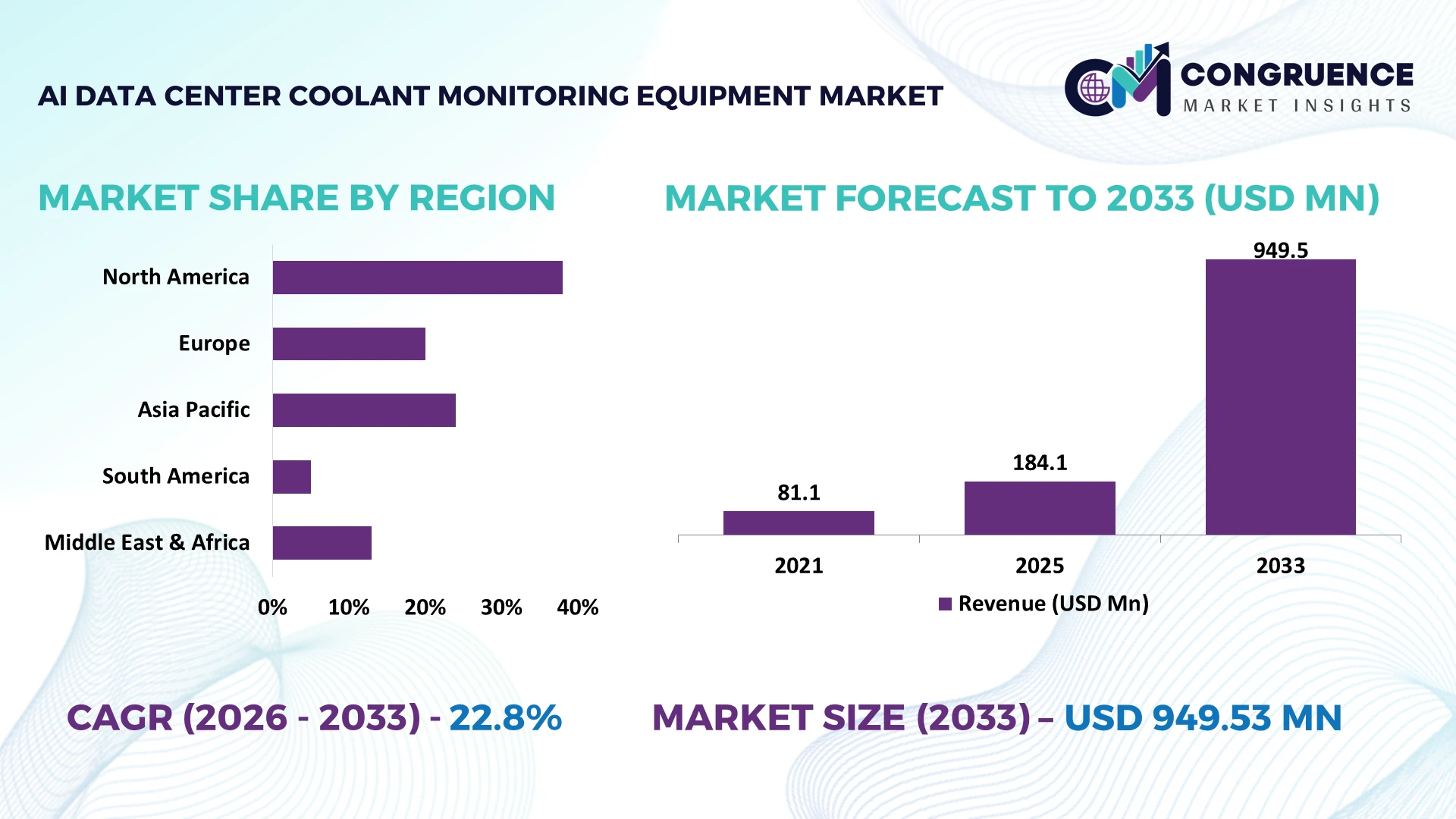
The Global AI Data Center Coolant Monitoring Equipment Market was valued at USD 184.1 Million in 2025 and is anticipated to reach a value of USD 949.53 Million by 2033 expanding at a CAGR of 22.76% between 2026 and 2033. Growth is driven by the transition toward liquid cooled AI server racks exceeding 100 kW, increasing deployment of coolant distribution units, and continuous monitoring requirements for flow, pressure, temperature, conductivity, and leak detection.
The United States dominates the global AI data center coolant monitoring equipment landscape, supported by hyperscale infrastructure expansion and advanced liquid cooling adoption. The country accounted for approximately 44% of global data center electricity consumption in 2024, compared with China's approximately 25%, according to IEA estimates. Microsoft's USD 80 billion fiscal 2025 AI data center investment plan reinforces infrastructure expansion. NVIDIA's Blackwell architecture supports rack configurations exceeding 100 kW, strengthening demand for precision coolant monitoring across cloud computing, semiconductor, and enterprise AI facilities.
Strategically, equipment manufacturers should prioritize United States hyperscale deployments and monitoring systems supporting 100 kW and higher rack densities, with integrated leak detection and predictive maintenance capabilities.
Market Size & Growth: USD 184.1 million in 2025, reaching USD 949.53 million by 2033 at 22.76% CAGR, driven by liquid cooled AI infrastructure expansion.
Top Growth Drivers: Analytical demand drivers include liquid cooling penetration growth of 35%, monitoring automation expansion of 28%, and predictive maintenance adoption growth of 24%.
Short Term Forecast: By 2028, integrated coolant monitoring is projected to reduce manual inspection requirements by approximately 20% in advanced AI facilities.
Emerging Technologies: Three critical innovations include AI predictive diagnostics, automated coolant chemistry sensors, and fiber optic temperature monitoring for high density computing.
Regional Leaders: Indicative 2033 allocations place North America at USD 427.29 million, Asia Pacific at USD 303.85 million, and Europe at USD 170.92 million, supported respectively by hyperscale expansion, AI infrastructure localization, and efficiency compliance.
Consumer/End User Trends: AI racks exceeding 100 kW are accelerating demand for continuous flow measurement, real time thermal analytics, and automated leak detection.
Pilot/Case Example: In 2024, NVIDIA introduced GB200 NVL72 liquid cooled rack architecture integrating 72 Blackwell GPUs, demonstrating the increasing complexity of coolant monitoring requirements.
Competitive Landscape: Schneider Electric, Vertiv, Siemens, Danfoss, and Sensirion compete across cooling infrastructure, industrial sensing, and monitoring integration; no verified individual market share is established.
Regulatory & ESG Impact: The EU Energy Efficiency Directive introduces reporting obligations for qualifying data centers with installed IT power demand of at least 500 kW.
Investment & Funding: Microsoft's USD 80 billion fiscal 2025 AI infrastructure investment plan demonstrates the scale of hyperscale expansion supporting advanced cooling equipment procurement.
Innovation & Future Outlook: Next generation systems combine 24/7 coolant diagnostics, digital twins, and automated controls, shifting procurement toward integrated thermal reliability platforms.
The AI Data Center Coolant Monitoring Equipment Market is evolving from standalone instrumentation toward integrated thermal intelligence platforms serving hyperscale cloud operators, colocation providers, and AI infrastructure developers. Advanced monitoring architectures combine ultrasonic flow sensors, conductivity probes, pressure transducers, and automated leak detection with centralized analytics. Direct liquid cooling becomes increasingly critical as NVIDIA GB200 NVL72 systems integrate 72 GPUs within a single rack architecture. European energy reporting requirements are strengthening operational measurement priorities, while coolant distribution unit manufacturers increasingly integrate diagnostics directly into equipment controls. These developments establish the foundation for evaluating competitive positioning and strategic investment priorities.
AI data center coolant monitoring equipment is becoming strategically essential as hyperscale operators prioritize thermal reliability, infrastructure efficiency, and uninterrupted AI computing performance. NVIDIA's GB200 NVL72 architecture integrates 72 GPUs within a liquid cooled rack, accelerating the transition from conventional air cooling toward precision liquid cooling infrastructure. This transformation increases demand for continuous coolant flow measurement, pressure monitoring, conductivity analysis, and automated leak detection. Equipment manufacturers are consequently integrating intelligent sensing capabilities into coolant distribution units and centralized facility management platforms.
Compared with periodic manual inspections, continuous sensor monitoring provides 24 hour operational visibility and enables earlier identification of thermal abnormalities. Advanced liquid cooling architectures can reduce cooling energy requirements by approximately 30% compared with conventional air cooling configurations, depending on facility design. The United States leads hyperscale deployment, while China emphasizes domestic AI infrastructure development and Germany prioritizes energy efficiency compliance. During 2026 to 2028, deployment priorities will increasingly favor automated diagnostics, predictive maintenance, and integrated thermal management across high density computing facilities.
A practical deployment involves monitoring supply and return temperatures, differential pressure, and coolant conductivity across 100 kW AI racks. Schneider Electric and Vertiv are expanding integrated cooling portfolios, while sensor manufacturers pursue partnerships with infrastructure providers. Competitive advantage will depend on measurement accuracy, interoperability, and the ability to prevent costly computing interruptions.
Rapid adoption of liquid cooling in AI computing facilities is strengthening demand for precision coolant monitoring equipment. NVIDIA's GB200 NVL72 architecture integrates 72 GPUs, requiring advanced thermal management across high density rack configurations. Direct liquid cooling can capture more than 70% of server heat in appropriately designed systems, while liquid cooling architectures can reduce cooling energy consumption by approximately 30% compared with conventional air cooling. In the United States, hyperscale operators are modernizing infrastructure to accommodate accelerated computing workloads. Schneider Electric, Vertiv, and Danfoss are expanding liquid cooling capabilities through product development and strategic partnerships. Continuous flow, pressure, and temperature monitoring is becoming essential for protecting expensive GPU infrastructure and maintaining computing availability.
High initial integration expenses and inconsistent equipment interfaces constrain coolant monitoring deployment across existing data centers. Liquid cooling retrofits require additional piping, coolant distribution units, sensors, and control infrastructure, increasing engineering complexity. The Uptime Institute's 2024 survey reported that approximately 48% of operators experienced significant outages during the preceding three years, emphasizing infrastructure reliability concerns. Coolant monitoring installations must also accommodate temperature measurement tolerances approaching ±0.5°C and flow measurement accuracy commonly specified within ±1% to ±2% for precision applications. In India, existing air cooled facilities face additional retrofit challenges involving water quality and mechanical infrastructure. Equipment suppliers are responding through modular monitoring platforms, standardized communication protocols, and integrated cooling packages that reduce installation complexity.
Integration of artificial intelligence, digital twins, and automated coolant analytics creates opportunities beyond conventional sensing hardware. Predictive monitoring platforms can continuously evaluate temperature, pressure, flow, and conductivity to identify developing thermal abnormalities before equipment failure. Advanced liquid cooling configurations can reduce cooling electricity requirements by approximately 30%, while monitoring systems operating at ±1% flow measurement accuracy support precise thermal balancing. Singapore's Green Data Centre Roadmap targets at least 300 MW of additional capacity in the near term, creating opportunities for intelligent cooling infrastructure. Schneider Electric, Siemens, and specialized sensor manufacturers are strengthening digital monitoring capabilities through software integration and ecosystem partnerships. Subscription based analytics and remote diagnostics create recurring service opportunities alongside equipment installations.
Scaling coolant monitoring across increasingly dense AI computing environments creates substantial operational and cybersecurity challenges. NVIDIA's GB200 NVL72 architecture combines 72 GPUs within a single rack, requiring coordinated thermal management across interconnected liquid cooling circuits. Monitoring platforms must maintain measurement accuracy within approximately ±1% to ±2% for critical flow applications while supporting continuous operational availability. Cooling systems designed to capture more than 70% of server heat require dependable sensor calibration, fault detection, and automated response mechanisms. In the United States, hyperscale facilities are integrating coolant monitoring with building management and industrial control networks, increasing cybersecurity exposure. Equipment manufacturers must strengthen secure communications, sensor redundancy, automated calibration, and workforce training to maintain consistent performance across expanding AI infrastructure deployments.
Standardized Coolant Chemistry Monitoring Protocols: AI infrastructure operators are introducing tighter coolant specifications to protect cold plates, manifolds, and distribution equipment. Conductivity monitoring increasingly targets measurement accuracy within ±2%, while temperature compensated readings use a 25°C reference. United States equipment manufacturers are standardizing sampling procedures and fluid compatibility testing across supplier networks. This transition reduces inconsistent maintenance practices and supports faster qualification of replacement components.
Rack Level Instrumentation Gains Importance: Cooling equipment suppliers are shifting measurement points closer to individual server racks rather than relying exclusively on facility level readings. NVIDIA's GB200 NVL72 integrates 72 GPUs, while emerging rack configurations exceed 100 kW. Vertiv and Schneider Electric are adapting instrumentation architectures to support localized pressure differential measurements and temperature verification, improving fault isolation and reducing unnecessary cooling adjustments.
European Reporting Requirements Reshape Instrumentation: The European Union's energy efficiency reporting framework covers qualifying data centers with installed IT power demand of at least 500 kW. Operators increasingly consolidate cooling performance measurements into standardized reporting workflows, including power usage effectiveness and water usage effectiveness. German infrastructure providers are strengthening sensor traceability, calibration records, and centralized data collection to reduce compliance administration and improve operational transparency.
Modular Sensor Replacement Gains Momentum: Operators are prioritizing replaceable measurement assemblies to minimize maintenance interruptions across liquid cooling circuits. Industrial temperature probes commonly support ±0.5°C accuracy, while precision flow instruments offer approximately ±1% measurement accuracy under specified conditions. Sensor suppliers are developing standardized connectors, isolation valves, and serviceable assemblies. This approach supports component replacement without draining entire cooling loops, reducing maintenance complexity and spare parts inventory requirements.
Integrated Monitoring Systems represent the leading equipment category, with an indicative 31% market share, reflecting increasing preference for centralized instrumentation across complex liquid cooling networks. These systems combine readings from Coolant Quality Sensors, Flow Sensors, Pressure Sensors, and Temperature Sensors into coordinated control architectures. Flow Sensors remain essential for verifying coolant circulation and identifying distribution imbalances, while Pressure Sensors detect hydraulic restrictions and abnormal pressure differentials. Temperature Sensors support continuous thermal performance assessment, particularly in high density AI rack configurations. Integrated platforms reduce dependence on isolated instruments and enable standardized monitoring across multiple coolant distribution units.
Leak Detection Sensors represent the fastest expanding type, supported by rising requirements for localized fluid detection around GPU assemblies, manifolds, and rack connections. An indicative 24% segment allocation reflects their growing importance in equipment protection. Coolant Contamination Monitors address particulate accumulation and fluid degradation, while Coolant Quality Sensors measure conductivity and chemical stability. Manufacturers are prioritizing modular instrumentation, standardized communications, and replaceable sensing components. Investment is shifting toward equipment that combines measurement precision with simplified maintenance and operational reliability.
Flow and Pressure Monitoring represents the leading application, with an indicative 29% market share, supported by its direct role in maintaining coolant circulation and hydraulic stability. Liquid cooling networks require continuous verification of flow distribution across coolant distribution units, manifolds, and server cold plates. Temperature Monitoring remains a fundamental application for tracking supply and return conditions and identifying localized thermal deviations. Coolant Quality Monitoring supports fluid compatibility, conductivity control, and equipment protection, particularly where multiple cooling components operate within shared circulation networks. Equipment manufacturers are integrating these measurements into unified control interfaces to simplify facility operations.
Cooling System Optimization is gaining importance as operators coordinate pump performance, heat exchanger operation, and coolant distribution across variable computing workloads. Predictive Maintenance represents the fastest expanding application, supported by increasing use of equipment condition histories and automated fault classification. Leak Detection remains essential for identifying fluid escape near sensitive electronics. Continuous instrumentation enables 24 hour monitoring, while precision flow measurements commonly target ±1% accuracy under specified operating conditions. Suppliers are expanding configurable monitoring packages and automated alarm workflows to support higher equipment availability and faster maintenance intervention.
Hyperscale Data Centers represent the dominant end user category, with an indicative 38% market share, supported by extensive cooling infrastructure, centralized procurement, and continuous computing operations. Large facilities require coordinated coolant monitoring across multiple equipment rooms, distribution networks, and high density server installations. Cloud Service Providers maintain substantial purchasing influence through standardized infrastructure specifications and equipment qualification requirements. Colocation Data Centers increasingly deploy flexible monitoring configurations to accommodate different customer cooling architectures. Enterprise Data Centers prioritize equipment compatibility, maintenance accessibility, and phased infrastructure modernization. Schneider Electric and Vertiv are targeting these buyers through integrated cooling portfolios and standardized instrumentation packages.
AI Computing Facilities represent the fastest expanding end user category as specialized GPU deployments increase thermal management complexity. NVIDIA's GB200 NVL72 architecture integrates 72 GPUs, illustrating the concentrated computing density driving specialized monitoring requirements. Data Center Operators increasingly prioritize centralized alarm management, sensor calibration, and operational reporting. Suppliers are responding with configurable instrumentation, service partnerships, and monitoring platforms that accommodate different facility sizes and operating models.
North America accounted for the largest estimated market share at 45% in 2025 however, Asia Pacific is expected to register the fastest growth, expanding at a CAGR of approximately 25.8% between 2026 and 2033.
Hyperscale AI Infrastructure Accelerates Precision Cooling Instrumentation
North America commands an estimated 45% of the global AI data center coolant monitoring equipment market, supported by concentrated hyperscale computing infrastructure and extensive liquid cooling investments. The United States dominates regional procurement through Microsoft, Google, Amazon, and Meta infrastructure expansion. Increasing deployment of NVIDIA Blackwell computing platforms is accelerating demand for coolant flow verification, differential pressure sensing, and automated temperature monitoring. Canadian data center operators are strengthening thermal management capabilities to support cloud computing and artificial intelligence workloads. Schneider Electric and Vertiv are expanding integrated liquid cooling portfolios, creating procurement opportunities for specialized instrumentation manufacturers. The region benefits from established industrial automation suppliers, advanced engineering capabilities, and extensive service networks. Equipment purchasing increasingly emphasizes monitoring interoperability, rapid component replacement, and reliability across high density computing environments.
United States Market Outlook: The United States maintains a decisive advantage through advanced semiconductor infrastructure, hyperscale computing clusters, and established cooling equipment supply networks. Microsoft's announced USD 80 billion fiscal 2025 AI infrastructure investment program demonstrates the scale of computing expansion. Virginia, Texas, and Arizona are important deployment locations, where increasing rack power densities strengthen requirements for precision sensors, coolant distribution monitoring, and automated thermal fault detection.
Energy Efficiency Regulation Strengthens Cooling Measurement Standards
Europe represents an estimated 18% of the global market, supported by established colocation infrastructure, industrial instrumentation expertise, and increasingly stringent data center efficiency requirements. Germany, the United Kingdom, France, and the Netherlands concentrate demand for advanced coolant monitoring technologies. The European Union's Energy Efficiency Directive requires qualifying data centers with installed IT power demand of at least 500 kW to report specified operational performance indicators. This framework strengthens the importance of reliable cooling measurements and consistent equipment data collection. Siemens, Danfoss, and Schneider Electric support regional adoption through industrial automation, fluid control technologies, and integrated infrastructure management. Operators are modernizing cooling networks with temperature sensors, flow measurement instruments, and automated leak detection. Procurement priorities increasingly favor standardized communication interfaces, equipment traceability, and monitoring solutions compatible with existing facility management systems.
Germany Market Outlook: Germany benefits from advanced industrial sensor manufacturing, precision engineering, and a strong data center presence around Frankfurt. Its Energy Efficiency Act establishes additional operational requirements for data centers, including progressively stricter energy efficiency provisions. German operators are integrating calibrated temperature instrumentation, coolant quality monitoring, and automated controls to strengthen compliance capabilities while maintaining reliable AI computing infrastructure.
AI Computing Expansion Strengthens Localized Cooling Supply Chains
Asia Pacific accounts for an estimated 32% of global market demand, supported by accelerating AI infrastructure deployment and extensive electronics manufacturing capabilities. China leads regional computing infrastructure development, while Japan, South Korea, India, and Singapore contribute through semiconductor manufacturing, cloud expansion, and advanced industrial automation. Regional equipment procurement increasingly emphasizes precision flow sensors, coolant quality monitoring, and compact instrumentation compatible with high density server configurations. Singapore's Green Data Centre Roadmap targets at least 300 MW of additional capacity in the near term, reinforcing demand for efficient cooling infrastructure. China benefits from established electronics production networks and domestic industrial sensor manufacturing capabilities. Japanese manufacturers contribute advanced measurement technologies and fluid control components. Suppliers are strengthening local engineering support, component qualification, and manufacturing partnerships to reduce procurement lead times and improve cooling system compatibility.
China Market Outlook: China maintains substantial competitive advantages through domestic electronics manufacturing, industrial automation capabilities, and large scale AI computing infrastructure. The country's Eastern Data and Western Computing initiative supports geographic redistribution of computing workloads. Domestic manufacturers are expanding precision instrumentation capabilities, while cloud infrastructure developers prioritize liquid cooling compatibility, localized equipment procurement, and dependable thermal monitoring across increasingly powerful computing clusters.
Colocation Expansion Creates Specialized Cooling Infrastructure Demand
South America holds an estimated 3% of the global market, with Brazil representing the principal center of hyperscale and colocation infrastructure development. Chile and Colombia provide additional demand through cloud services, enterprise modernization, and expanding digital infrastructure. Regional procurement focuses on temperature measurement, coolant circulation monitoring, and leak detection for facilities transitioning toward higher computing densities. Brazil's established data center clusters around São Paulo support equipment integration and specialized maintenance services. Operators face constraints involving electricity infrastructure, imported instrumentation costs, and limited availability of specialized liquid cooling technicians. These conditions favor modular monitoring systems that simplify installation and maintenance. International cooling equipment suppliers are strengthening distributor partnerships and technical support arrangements, while facility developers prioritize instrumentation that accommodates phased infrastructure upgrades without requiring complete cooling system replacement.
Brazil Market Outlook: Brazil leads South American deployment through concentrated enterprise computing infrastructure, cloud availability zones, and expanding colocation investment. São Paulo remains the principal operational hub, supported by established telecommunications connectivity and industrial service providers. The country's 2025 Redata policy initiative highlights government attention toward data center investment. Equipment suppliers are targeting localized installation services, imported precision sensors, and integrated cooling controls to support increasingly demanding computing workloads.
Sovereign AI Investment Accelerates Thermal Infrastructure Modernization
The Middle East and Africa represent an estimated 2% of global demand, with investment concentrated in the United Arab Emirates, Saudi Arabia, and South Africa. Sovereign AI programs, cloud infrastructure expansion, and enterprise digital transformation are increasing requirements for dependable liquid cooling instrumentation. High ambient temperatures create additional operational pressure on cooling equipment, strengthening demand for continuous temperature monitoring, flow verification, and coolant condition assessment. The UAE's announced Stargate UAE project includes an initial 200 MW AI computing phase within a planned 1 GW cluster, illustrating the scale of emerging infrastructure requirements. Equipment manufacturers are developing partnerships with engineering contractors and cooling system integrators to support deployment. Procurement emphasizes thermal resilience, remote diagnostics, and monitoring architectures capable of maintaining reliable operation under demanding environmental conditions.
United Arab Emirates Market Outlook: The UAE is establishing a strategic position through sovereign AI infrastructure investment, advanced telecommunications networks, and international technology partnerships. Abu Dhabi's expanding AI infrastructure ecosystem supports demand for precision coolant monitoring, automated leak detection, and centralized thermal controls. High ambient temperatures make equipment reliability particularly important, encouraging developers to specify robust sensors, redundant monitoring channels, and integrated cooling management during initial facility design.
The AI data center coolant monitoring equipment market features competition between integrated infrastructure leaders Schneider Electric, Vertiv, and Siemens and specialized instrumentation suppliers Sensirion, Danfoss, and Endress+Hauser. The five largest suppliers collectively represent an estimated 48% of market activity, reflecting fragmented procurement across cooling infrastructure and sensing technologies. Integrated providers compete through bundled monitoring platforms, while sensor specialists differentiate through measurement accuracy, component reliability, and customization. Precision flow instruments offering approximately ±1% accuracy compete with standard devices operating around ±2%, strengthening differentiation in critical cooling applications. Schneider Electric and Vertiv are expanding liquid cooling partnerships, while instrumentation manufacturers prioritize modular integration and digital connectivity. Competition increasingly centers on equipment interoperability, localized technical support, and control system integration rather than standalone sensor pricing. Qualification requirements, calibration reliability, and established customer relationships create entry barriers. Winning suppliers must combine precision measurement, dependable service, flexible integration, and scalable manufacturing capabilities across hyperscale deployments.
Schneider Electric SE
Vertiv Holdings Co.
Siemens AG
Danfoss A/S
Sensirion AG
Endress+Hauser Group
Emerson Electric Co.
Honeywell International Inc.
ABB Ltd.
SICK AG
ifm electronic GmbH
WIKA Alexander Wiegand SE & Co. KG
Badger Meter, Inc.
TE Connectivity plc
Current coolant monitoring technologies combine ultrasonic flow meters, pressure transducers, conductivity probes, and precision temperature sensors within centralized cooling management systems. Industrial flow instruments commonly achieve ±1% measurement accuracy, compared with approximately ±2% for conventional alternatives, representing a 50% reduction in measurement uncertainty. Continuous monitoring across 24 hour operating cycles improves fault visibility and enables targeted maintenance. Integrated coolant distribution units increasingly support automated alarms, sensor calibration, and communication with facility management platforms, strengthening operational reliability.
Emerging technologies include fiber optic temperature sensing, wireless instrumentation, and intelligent coolant chemistry monitoring. Distributed fiber optic systems enable temperature measurement across multiple locations using a single sensing architecture, while automated conductivity compensation improves consistency across changing fluid temperatures. Advanced liquid cooling designs can reduce cooling electricity requirements by approximately 30% compared with conventional air cooling. Equipment manufacturers integrating these capabilities gain advantages through simplified installation, reduced manual inspections, and improved thermal performance verification.
Between 2026 and 2028, digital twins, automated fault isolation, and integrated sensor diagnostics will reshape equipment procurement. NVIDIA's 72 GPU rack architecture demonstrates increasing monitoring complexity. Suppliers prioritizing interoperable instrumentation, secure connectivity, and modular maintenance will strengthen competitiveness as hyperscale operators standardize advanced cooling infrastructure globally.
January 2026: Schneider Electric introduced its Motivair MCDU70 coolant distribution unit, delivering 2.5 MW cooling capacity with centralized controls. The launch strengthens hyperscale thermal infrastructure scalability while supporting precise coolant flow management, pressure stability, and coordinated cooling operations. Source: se.com
June 2026: Nidec Corporation announced a 300 kW coolant distribution unit incorporating internal and external leak sensors alongside continuous temperature, pressure, flow, and liquid level monitoring. The innovation strengthens equipment protection and supports reliable high density AI server deployment. Source: nidec.com
October 2026: Vertiv completed a liquid cooling deployment supporting 30 MW of AI workloads at CapitaLand India Trust's Mumbai data center. The project incorporated coolant loop balancing and commissioning validation, strengthening India's engineering capabilities for hyperscale cooling infrastructure. Source: expresscomputer.in
October 2026: DCX Liquid Cooling Systems integrated continuous coolant chemistry monitoring and automated chemical dosing into its facility distribution units supporting up to 8 MW. This advancement enables automatic coolant condition correction, reducing manual treatment requirements and protecting cooling reliability. Source: datacentremagazine.com
The AI Data Center Coolant Monitoring Equipment Market Report evaluates seven equipment types, including coolant quality sensors, flow sensors, pressure sensors, temperature sensors, leak detection sensors, coolant contamination monitors, and integrated monitoring systems. Application coverage includes coolant quality monitoring, flow and pressure monitoring, temperature monitoring, leak detection, cooling system optimization, and predictive maintenance. End user analysis examines hyperscale data centers, colocation facilities, enterprise data centers, cloud service providers, AI computing facilities, and data center operators.
Geographic coverage spans North America, Europe, Asia Pacific, South America, and the Middle East and Africa, with country specific infrastructure and procurement assessments. The report examines sensor accuracy, automated diagnostics, coolant distribution integration, and emerging thermal management technologies. Competitive analysis evaluates 14 influential companies, supporting investment planning, supplier selection, expansion strategies, and technology positioning through 2033.
| Report Attribute/Metric | Report Details |
|---|---|
Market Revenue in 2025 | USD 184.1 Million |
Market Revenue in 2033 | USD 949.53 Million |
CAGR (2026 - 2033) | 22.76% |
Base Year | 2025 |
Forecast Period | 2026 - 2033 |
Historic Period | 2021 - 2025 |
Segments Covered | By Type
By Application
By End-User
|
Key Report Deliverable | Revenue Forecast, Growth Trends, Market Dynamics, Segmental Overview, Regional and Country-wise Analysis, Competition Landscape |
Region Covered | North America, Europe, Asia-Pacific, South America, Middle East, Africa |
Key Players Analyzed | Schneider Electric SE, Vertiv Holdings Co., Siemens AG, Danfoss A/S, Sensirion AG, Endress+Hauser Group, Emerson Electric Co., Honeywell International Inc., ABB Ltd., SICK AG, ifm electronic GmbH, WIKA Alexander Wiegand SE & Co. KG, Badger Meter, Inc., TE Connectivity plc |
Customization & Pricing | Available on Request (10% Customization is Free) |




