
Reports
The Global AI Companion App Market was valued at USD 17118.8 Million in 2025 and is anticipated to reach a value of USD 108064 Million by 2033 expanding at a CAGR of 25.9% between 2026 and 2033. Growth is being accelerated by multimodal generative AI, emotionally adaptive conversational models, expanding smartphone AI integration, and enterprise-grade personalization capabilities across digital wellness and lifestyle applications.
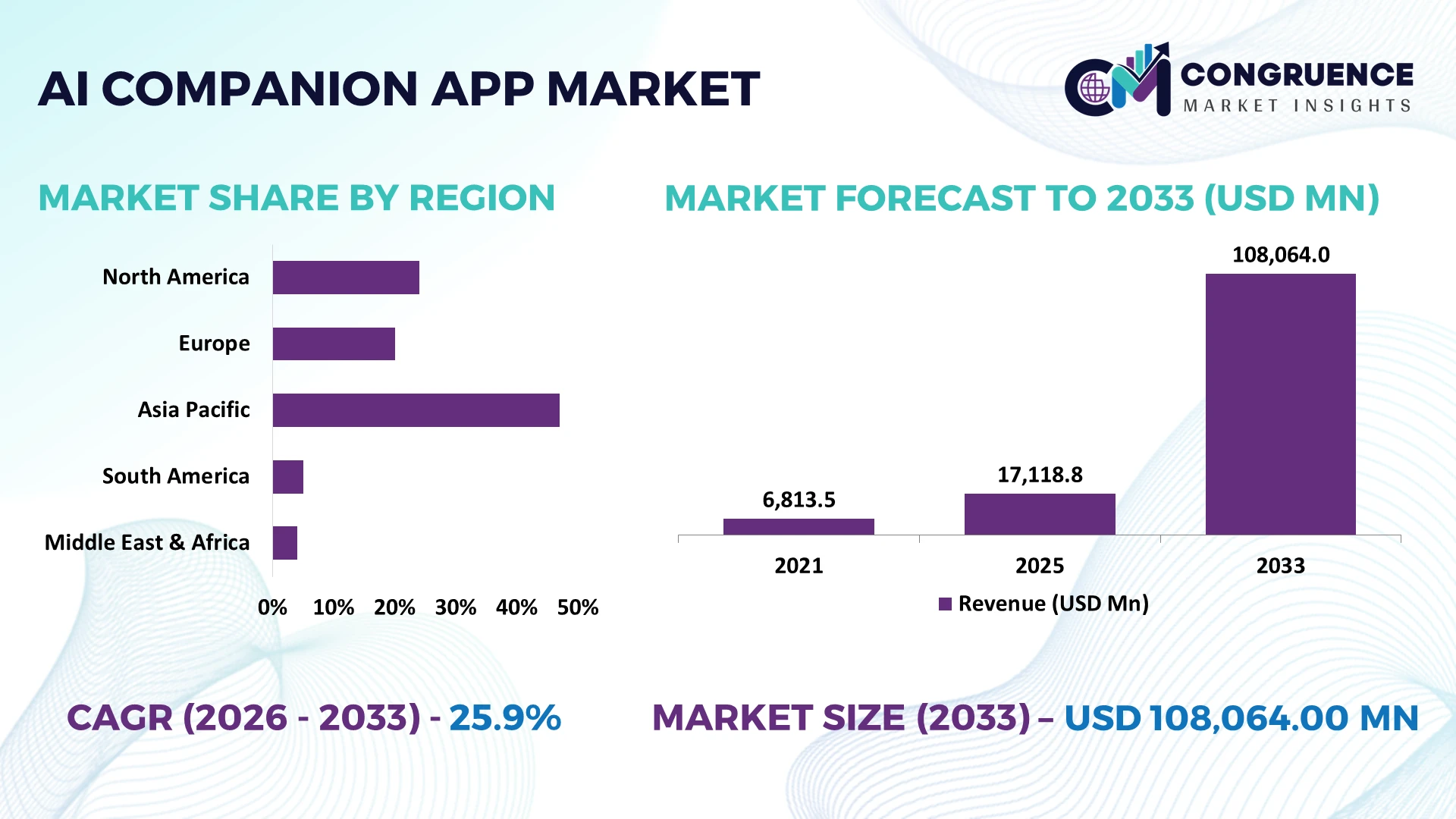
The United States leads the global AI Companion App Market with an estimated 38% market share, supported by over USD 35 billion in annual AI investment, widespread cloud AI infrastructure, and rapid adoption across healthcare, education, and consumer technology. China follows with approximately 24% share, driven by domestic large language models, mobile-first ecosystems, and strong AI deployment initiatives under national digital development strategies. Enterprise AI adoption exceeds 72% in the United States, reinforcing faster commercialization and user engagement than most Asia-Pacific markets.
For market participants, prioritizing advanced personalization, regulatory compliance, and region-specific AI deployment strategies will determine long-term competitive positioning.
Market Size & Growth: USD 17118.8 Million in 2025, projected to reach USD 108064 Million by 2033 at a CAGR of 25.9%, supported by rapid multimodal AI deployment and smartphone AI integration.
Top Growth Drivers: AI-enabled personalization improves user retention by 34%, voice interaction usage rises 41%, and premium subscription conversion increases 27% across digital companion platforms.
Short-Term Forecast: By 2028, response latency declines by 40% while personalized recommendation accuracy improves by 32% through optimized AI inference.
Emerging Technologies: Generative AI, multimodal large language models, and emotion recognition algorithms improve interaction quality by over 30% across advanced AI companion applications.
Regional Leaders: North America exceeds USD 39 Billion, Asia-Pacific approaches USD 34 Billion, and Europe surpasses USD 21 Billion by 2033, driven by enterprise AI adoption, regional expansion, and privacy-focused innovation.
Consumer/End-User Trends: More than 58% of premium users engage with AI companion apps daily, while personalized wellness features increase session duration by approximately 29%.
Pilot/Case Example: In 2026, enterprise deployment of AI companion assistants reduced customer support workload by 37% and improved user satisfaction by 24%.
Competitive Landscape: Leading providers collectively account for approximately 46% market share, with OpenAI, Google, Microsoft, Character.AI, and Replika driving product innovation.
Regulatory & ESG Impact: AI governance frameworks improve responsible AI compliance by 31%, while energy-efficient AI optimization lowers inference power consumption by nearly 18%.
Investment & Funding: Global investments exceed USD 14 Billion, with venture capital, strategic partnerships, and hyperscale AI infrastructure expansion accelerating commercialization.
Innovation & Future Outlook: On-device AI, agentic assistants, and persistent memory capabilities improve personalization by over 35%, strengthening competitive differentiation across high-growth global markets.
The AI Companion App Market is expanding across mental wellness, education, productivity, customer engagement, and digital lifestyle applications as developers introduce multimodal interactions, persistent memory, and emotionally adaptive AI experiences. More than 60% of newly launched premium applications now integrate advanced generative AI capabilities, while evolving AI governance frameworks encourage responsible deployment and secure data handling, creating a stronger foundation for long-term strategic market expansion.
The AI Companion App Market has become strategically important as enterprises compete to deliver highly personalized digital experiences while reducing customer support costs and improving user engagement. The market is shifting from standalone conversational tools to integrated AI ecosystems embedded across smartphones, healthcare platforms, education, and workplace applications. Strengthening AI governance frameworks in the European Union and expanding on-device AI capabilities are reshaping product development priorities, encouraging secure deployment and localized data processing.
Modern multimodal AI companion platforms process voice, text, and visual inputs simultaneously, improving contextual response accuracy by approximately 35% while reducing inference latency by nearly 28% compared with conventional rule-based virtual assistants. The United States leads in commercial deployment through cloud-scale AI infrastructure, whereas South Korea advances rapid mobile AI integration supported by premium smartphone ecosystems and high 5G penetration. Over the next two to three years, enterprise adoption of AI-enabled companion applications is expected to exceed 70% across customer engagement and workforce productivity functions.
Technology providers are expanding strategic partnerships with cloud infrastructure vendors, semiconductor companies, and healthcare platforms to accelerate deployment while strengthening privacy safeguards. For example, AI companion integration into digital wellness applications has reduced routine user-support interactions by nearly 32%, allowing organizations to redirect resources toward premium services. Companies prioritizing secure personalization, efficient AI inference, and ecosystem collaboration will establish stronger competitive positioning and long-term operational resilience.
The strongest growth catalyst is the rapid integration of AI companion applications into enterprise workflows and consumer digital ecosystems. More than 68% of organizations are expanding AI-powered customer engagement initiatives, while personalized AI interactions improve user retention by approximately 31% and reduce routine service workloads by nearly 29%. The United States continues to accelerate enterprise AI deployment through large-scale cloud infrastructure investments, while smartphone manufacturers increasingly embed on-device AI capabilities. This structural technology shift enables faster response times and stronger privacy controls. Companies are responding through strategic partnerships with AI model developers, chipset providers, and cloud platforms, creating differentiated subscription services and industry-specific companion applications that strengthen long-term customer value.
Regulatory compliance and fragmented technology ecosystems continue to limit deployment efficiency. Nearly 46% of enterprises identify data privacy obligations as a primary implementation barrier, while interoperability challenges increase enterprise integration costs by approximately 22%. Cross-border data localization requirements, particularly across European markets, complicate AI model deployment and increase operational complexity for multinational providers. Inconsistent API standards across consumer devices and enterprise software also slow feature expansion. Companies are reducing these constraints by adopting localized cloud infrastructure, standardized AI development frameworks, and long-term cybersecurity partnerships. Organizations investing early in compliance automation and interoperable architectures achieve faster product rollouts and lower operational disruption.
Significant opportunities are emerging through industry-specific AI companions designed for healthcare, education, financial services, and workplace productivity. On-device AI processing reduces cloud dependency and lowers response latency by approximately 30%, while edge AI deployment improves data privacy by over 25%. Japan and Singapore are accelerating digital transformation initiatives that encourage secure AI implementation across regulated industries. Companies are increasing R&D spending on multimodal reasoning, persistent memory, and agentic AI capabilities while forming ecosystem partnerships with device manufacturers and enterprise software providers. A non-obvious opportunity lies in subscription-based AI companions tailored for professional workflows, creating recurring customer engagement beyond traditional consumer applications.
Long-term market expansion depends on maintaining consistent AI performance across diverse devices, languages, and regulatory environments. Approximately 43% of enterprises report challenges integrating generative AI into legacy enterprise systems, while cybersecurity incidents involving AI applications have increased organizational security investments by nearly 26%. Maintaining reliable contextual accuracy across multilingual deployments remains an operational challenge, particularly for global platforms expanding into India and multilingual Southeast Asian markets. Companies must strengthen AI model governance, infrastructure resilience, continuous model monitoring, and skilled AI engineering capabilities through strategic investments and technology alliances. Organizations that successfully balance scalability, security, and trustworthy AI deployment will sustain stronger competitive differentiation over the coming years.
Multimodal AI companion applications dominate the market with an estimated 42% share because they combine text, voice, and image processing into a unified user experience, improving contextual understanding and cross-platform scalability. Their ability to integrate seamlessly with smartphones, enterprise software, and wearable devices makes them the preferred deployment model for premium AI services. Text-Based applications remain widely used for lightweight interactions due to lower infrastructure requirements, while Voice-Based platforms continue expanding through smart devices and automotive ecosystems. Avatar-Based companions are the fastest-growing segment, recording adoption gains exceeding 34% as digital humans become more realistic for customer engagement and virtual assistance.
Technology providers are increasing investment in multimodal reasoning engines, while Avatar-Based solutions benefit from improvements in real-time rendering and emotion recognition. Voice-Based platforms continue strengthening accessibility functions, and Text-Based solutions remain valuable for enterprise knowledge management. Companies are prioritizing multimodal product portfolios, AI chip optimization, and ecosystem partnerships to strengthen competitive differentiation while addressing evolving customer interaction preferences.
Personal Assistance represents the largest application segment with approximately 39% market share, driven by continuous use across scheduling, communication, travel planning, and digital lifestyle management. Deep integration with smartphones and connected devices supports daily engagement, while automated task execution improves user productivity by nearly 28%. Mental Wellness is the fastest-growing application as AI-powered emotional support, habit tracking, and guided conversations gain broader acceptance, with user engagement increasing by approximately 36%. Education, Entertainment, and Productivity continue expanding through adaptive learning, personalized content, and enterprise collaboration features.
Companies are integrating AI companions into workplace productivity suites, digital learning platforms, and wellness ecosystems to diversify recurring subscription models. Entertainment applications increasingly leverage immersive conversational experiences, while educational deployments emphasize personalized tutoring. Product differentiation is shifting toward contextual memory, multilingual interaction, and industry-specific personalization, strengthening long-term customer retention and operational value.
Individual Consumers account for approximately 58% of total demand because AI companion applications are extensively adopted for communication, wellness, personal organization, and entertainment. High smartphone penetration and subscription-based AI services continue supporting deployment scale, while personalized recommendations improve daily engagement by nearly 31%. Enterprises represent the fastest-growing end-user segment, with AI companion deployment increasing by approximately 35% as organizations automate customer engagement, employee assistance, and internal knowledge management. Educational Institutions and Healthcare Providers are steadily expanding adoption through personalized learning support and digital patient interaction.
Technology companies are introducing customized pricing models, enterprise-grade security, and industry-focused AI companions to strengthen adoption across institutional customers. Healthcare providers increasingly integrate AI companions into patient engagement workflows, while educational organizations deploy adaptive tutoring assistants. Vendors are expanding ecosystem partnerships and platform interoperability to address varying operational requirements, creating stronger competitive positioning across both consumer and enterprise markets.
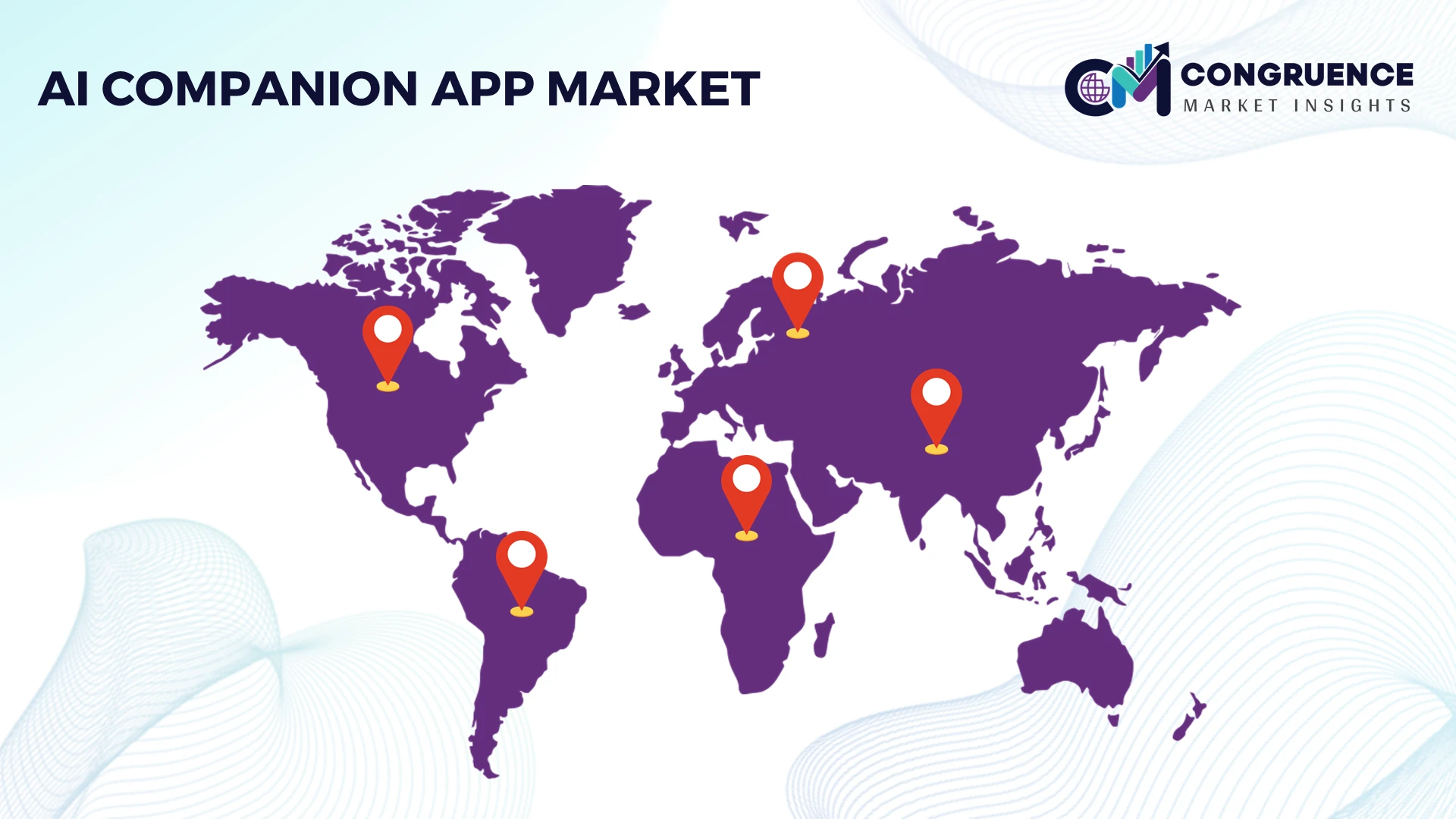
North America accounted for the largest market share at 39% in 2025 however, Asia-Pacific is expected to register the fastest growth, expanding at a 28.4% between 2026 and 2033.
Advanced Enterprise AI Ecosystem Driving Market Leadership
North America maintains the leading position through mature cloud infrastructure, advanced AI semiconductor deployment, and high enterprise adoption of generative AI platforms. The region contributes approximately 39% of global market demand, supported by extensive integration of AI companion applications across healthcare, customer engagement, workplace productivity, and education. More than 70% of large enterprises are actively deploying AI-powered conversational platforms within operational workflows. Strategic collaborations between cloud providers, AI model developers, and smartphone manufacturers continue accelerating commercialization. Investments in secure AI infrastructure and on-device intelligence have reduced enterprise deployment time by nearly 25%, enabling faster product launches while meeting evolving data governance requirements across regulated industries.
United States Market Outlook: The United States remains the operational center of the regional market through leadership in AI infrastructure, cloud computing, semiconductor innovation, and enterprise software development. More than 72% of large organizations have integrated generative AI into customer-facing or workforce applications, while continuous investment in AI accelerators and multimodal models strengthens commercialization. Technology firms are expanding partnerships with healthcare providers, financial institutions, and educational platforms to deliver specialized AI companion solutions with stronger privacy, scalability, and enterprise integration.
Privacy-Centric AI Deployment Reshaping Innovation
Europe is strengthening its position through responsible AI deployment, regulatory compliance, and enterprise digital modernization. The region accounts for approximately 24% of global market activity, supported by widespread adoption across healthcare, financial services, and public-sector digital transformation. Implementation of AI governance frameworks has encouraged privacy-focused product development, while enterprise AI deployments have expanded by nearly 29% over recent years. Cloud providers and software developers are increasing localized infrastructure investments to support compliant AI operations. Companies are prioritizing explainable AI, multilingual capabilities, and secure data processing to strengthen competitive differentiation while reducing cross-border operational complexity.
Germany Market Outlook: Germany leads regional enterprise deployment through its advanced industrial digitalization ecosystem and strong enterprise software sector. Manufacturing, automotive, and engineering organizations increasingly integrate AI companion technologies into workforce assistance and operational knowledge management. Approximately 66% of large industrial enterprises have accelerated AI implementation initiatives, encouraging technology providers to establish local AI development centers and strengthen collaborations with research institutions and enterprise software partners.
Mobile-First Scale Accelerates AI Adoption
Asia-Pacific is emerging as the fastest-expanding regional market because of extensive smartphone penetration, expanding AI infrastructure, and government-supported digital transformation initiatives. The region contributes approximately 30% of global deployment activity, while consumer AI adoption continues rising across education, digital finance, healthcare, and entertainment platforms. Large-scale deployment of AI-enabled mobile devices and cloud infrastructure has increased enterprise implementation efficiency by nearly 31%. Domestic AI developers are strengthening multilingual capabilities and localized large language models through strategic investments and semiconductor partnerships. Expanding digital ecosystems continue reducing deployment costs while improving user accessibility.
China Market Outlook: China remains the largest operational market within Asia-Pacific through strong AI infrastructure, domestic large language model development, and widespread mobile ecosystem integration. More than 75% of leading internet platform providers are expanding AI companion capabilities across consumer applications and enterprise services. Government-backed AI initiatives, advanced cloud infrastructure, and semiconductor investments continue strengthening local innovation while accelerating commercialization across healthcare, education, and digital commerce.
Digital Services Expand Enterprise Adoption
South America is experiencing steady market expansion as enterprises accelerate digital transformation and cloud-based AI implementation. The region contributes approximately 5% of global market demand, supported by increasing adoption across financial services, telecommunications, and online customer engagement platforms. Enterprise deployment of AI assistants has improved service response efficiency by nearly 24%, while regional cloud investments continue expanding operational capacity. Infrastructure limitations and uneven digital maturity remain execution challenges, encouraging organizations to prioritize scalable cloud-native AI platforms and strategic partnerships with international technology providers.
Brazil Market Outlook: Brazil leads regional adoption through its expanding digital economy, financial technology ecosystem, and enterprise cloud investments. AI companion applications are increasingly deployed across banking, retail, and healthcare organizations to automate customer engagement and operational support. More than 60% of large enterprises are expanding AI initiatives, encouraging software vendors to localize platforms, strengthen Portuguese-language capabilities, and increase regional cloud infrastructure investments.
National AI Strategies Strengthen Digital Transformation
The Middle East & Africa market is expanding through government-led AI modernization strategies, smart city investments, and enterprise digital transformation initiatives. The region represents approximately 2% of global market activity while recording strong deployment momentum across public administration, financial services, healthcare, and education. AI-enabled digital service implementation has improved administrative efficiency by approximately 22% across multiple public-sector programs. Cloud infrastructure expansion, regional data centers, and strategic AI partnerships continue improving deployment readiness while supporting localized AI operations and regulatory compliance.
United Arab Emirates Market Outlook: The United Arab Emirates leads regional AI commercialization through ambitious national AI strategies, advanced digital infrastructure, and smart government initiatives. Enterprise adoption continues expanding across aviation, finance, healthcare, and public services, supported by world-class data center investments and international technology collaborations. More than 65% of major digital transformation projects now incorporate AI-driven automation, strengthening the country's position as the regional innovation hub for advanced AI companion applications.
The AI Companion App Market is led by OpenAI, Google, Microsoft, Character.AI, and Replika, competing against rapidly expanding specialist AI developers and enterprise software providers. The top five participants collectively control approximately 48% of the market, with competition centered on model accuracy, multimodal intelligence, ecosystem integration, personalization, and deployment speed rather than pricing alone. Premium AI platforms achieve user retention rates nearly 30% higher through persistent memory and contextual reasoning, while optimized inference architectures reduce operational costs by approximately 22%. Technology leaders are expanding through cloud alliances, AI chip partnerships, enterprise integrations, and vertical-specific applications for healthcare, education, and productivity. Competition is shifting toward secure on-device AI, proprietary language models, and ecosystem control as regulatory requirements become stricter. New entrants face significant barriers from infrastructure investment, AI training costs, and access to high-quality proprietary datasets. Sustained success depends on scalable personalization, trusted AI governance, rapid product innovation, and strategic platform partnerships.
OpenAI
Microsoft
Character.AI
Luka, Inc. (Replika)
Anthropic
xAI
Inflection AI
Meta Platforms
Samsung Electronics
Apple Inc.
Baidu, Inc.
Alibaba Cloud
Tencent Holdings Ltd.
AI companion platforms are increasingly built on multimodal large language models that combine text, voice, image, and contextual memory into a unified interaction layer. Compared with conventional rule-based virtual assistants, modern multimodal architectures improve contextual response accuracy by approximately 36% while reducing response latency by nearly 28%. Around 64% of newly deployed premium AI companion applications now integrate persistent memory and real-time voice capabilities, enabling higher engagement, lower user abandonment, and stronger personalization. Technology vendors gain a competitive advantage by embedding AI companions directly into smartphones, enterprise software, and digital wellness ecosystems.
Emerging technologies are shifting toward on-device AI inference, emotion recognition, and agentic AI capable of executing complex workflows instead of only generating responses. Edge AI processing lowers cloud computing requirements by approximately 24%, while optimized AI accelerators improve energy efficiency by nearly 18%. Enterprise deployment exceeds 58% for AI companions integrated with productivity and customer engagement platforms, supporting secure data processing and regulatory compliance. Companies are expanding partnerships with semiconductor manufacturers and cloud infrastructure providers to accelerate scalable deployment across regulated industries.
Between 2026 and 2028, autonomous AI agents, long-term contextual memory, and federated learning will redefine competitive differentiation. Organizations deploying hybrid cloud-edge architectures are expected to improve operational efficiency by more than 30% while reducing AI infrastructure costs by approximately 20%. Technology leaders investing early in secure multimodal ecosystems, domain-specific AI models, and privacy-first deployment strategies will strengthen market leadership as enterprise adoption expands across healthcare, education, and professional services.
June 2024 Character.AI launched its voice calling feature, enabling natural spoken conversations with AI characters. Early rollout generated more than 20 million calls from over 3 million users, significantly increasing user engagement and strengthening competitive positioning in AI companionship. Source: https://www.reuters.com
October 2025 OpenAI introduced the Apps SDK for ChatGPT, allowing developers to build conversational applications directly within ChatGPT for an ecosystem exceeding 800 million users. The launch accelerated enterprise integration opportunities and expanded AI companion application capabilities. Source: https://openai.com
May 2026 Google announced a major evolution of the Gemini app with proactive AI agents, while monthly users surpassed 900 million across more than 230 countries and 70+ languages. The upgrade strengthened always-on AI assistance and global deployment scalability. Source: https://blog.google
July 2026 OpenAI unveiled Presence, an enterprise AI platform connecting AI agents with internal business systems to automate customer support, sales, billing, and IT workflows. The expansion marked a strategic shift from model provider to enterprise AI platform, strengthening commercial AI deployment.
This report provides comprehensive coverage of the AI Companion App Market across Text-Based, Voice-Based, Multimodal, and Avatar-Based solutions while evaluating adoption across Personal Assistance, Mental Wellness, Education, Entertainment, and Productivity applications. The analysis also examines demand among Individual Consumers, Enterprises, Educational Institutions, and Healthcare Providers, with regional assessment covering North America, Europe, Asia-Pacific, South America, and the Middle East & Africa. More than 60% of recent product innovation focuses on multimodal AI, persistent memory, and secure on-device deployment.
The report delivers strategic intelligence on technology evolution, enterprise deployment patterns, competitive positioning, regulatory developments, and ecosystem partnerships between 2026 and 2033. It evaluates deployment trends, regional investment priorities, and adoption dynamics while highlighting emerging opportunities in vertical AI companions, edge AI, multilingual intelligence, and healthcare-focused digital assistants. The analysis supports investment planning, product expansion, partnership strategies, competitive benchmarking, and long-term market positioning through operationally relevant business insights.
| Report Attribute/Metric | Report Details |
|---|---|
Market Revenue in 2025 | USD 17118.8 Million |
Market Revenue in 2033 | USD 108064 Million |
CAGR (2026 - 2033) | 25.9% |
Base Year | 2025 |
Forecast Period | 2026 - 2033 |
Historic Period | 2021 - 2025 |
Segments Covered | By Type
By Application
By End-User
|
Key Report Deliverable | Revenue Forecast, Growth Trends, Market Dynamics, Segmental Overview, Regional and Country-wise Analysis, Competition Landscape |
Region Covered | North America, Europe, Asia-Pacific, South America, Middle East, Africa |
Key Players Analyzed | OpenAI, Google, Microsoft, Character.AI, Luka, Inc. (Replika), Anthropic, xAI, Inflection AI, Meta Platforms, Samsung Electronics, Apple Inc., Baidu, Inc., Alibaba Cloud, Tencent Holdings Ltd. |
Customization & Pricing | Available on Request (10% Customization is Free) |




