
Reports
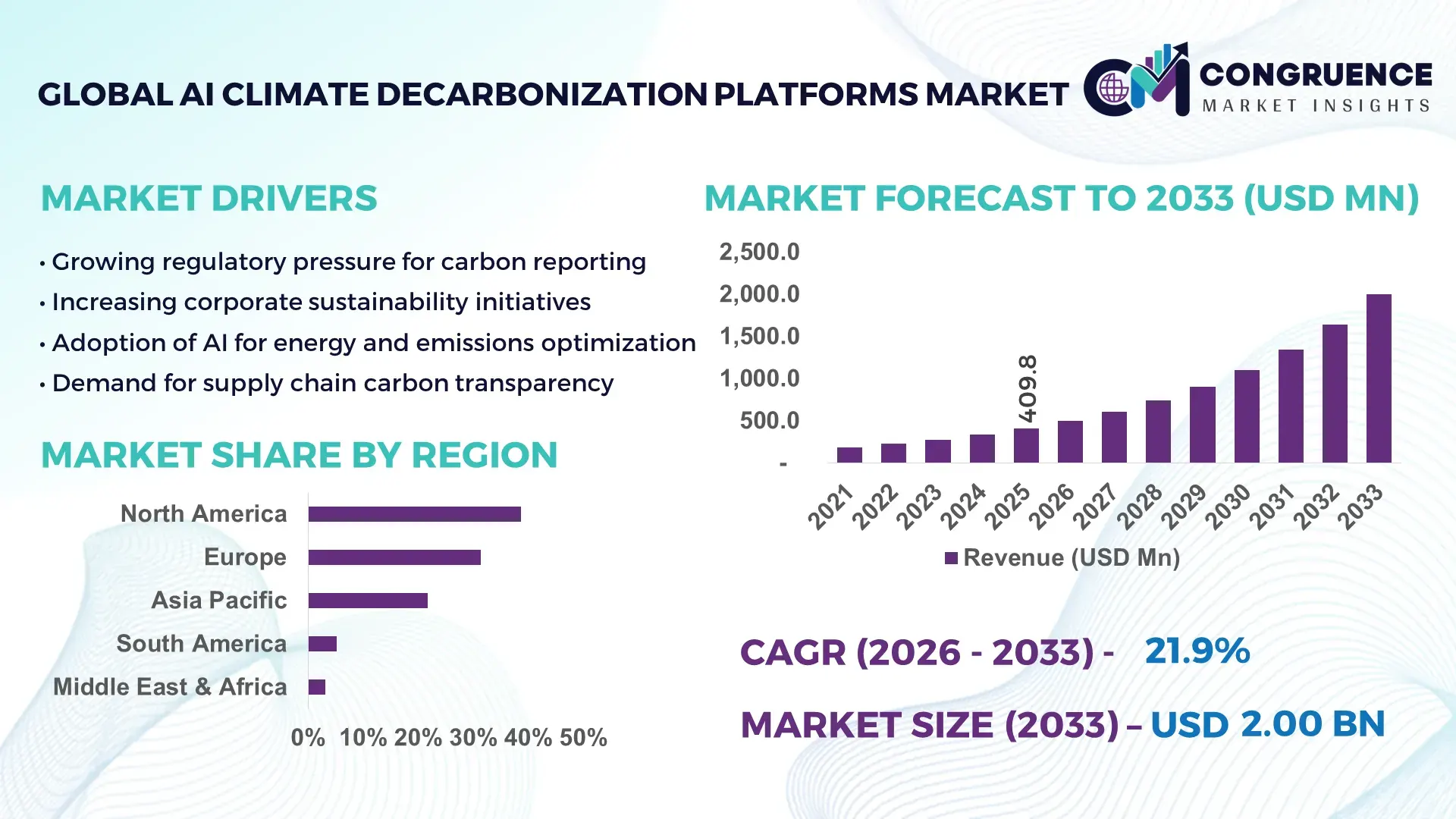
The Global AI Climate Decarbonization Platforms Market was valued at USD 409.8 Million in 2025 and is anticipated to reach a value of USD 1,998.0 Million by 2033 expanding at a CAGR of 21.9% between 2026 and 2033, according to an analysis by Congruence Market Insights. The market is expanding rapidly due to increasing corporate net-zero commitments and the adoption of AI-driven platforms that optimize energy efficiency, emissions monitoring, and carbon reduction strategies across industrial operations.
The United States represents the dominant country in the AI Climate Decarbonization Platforms Market with strong deployment across energy, manufacturing, and technology sectors. The U.S. hosts more than 45% of the global AI-based climate analytics startups and accounts for over 38% of enterprise carbon-tracking platform deployments. Over 3,200 large U.S. corporations currently use AI-powered carbon accounting systems to track Scope 1, 2, and 3 emissions. Federal initiatives and private investments have supported more than USD 6 billion in climate-AI related technology funding since 2022. In addition, over 41% of large U.S. manufacturing facilities have integrated AI-driven energy optimization systems that reduce operational emissions by an average of 18–25%.
Market Size & Growth: The market was valued at USD 409.8 Million in 2025 and is projected to reach USD 1,998.0 Million by 2033, expanding at a CAGR of 21.9% driven by rapid adoption of AI-based carbon monitoring platforms across industrial and corporate sustainability programs.
Top Growth Drivers: Over 68% of global enterprises are implementing digital carbon accounting systems, AI-based energy optimization improves operational efficiency by up to 32%, and approximately 54% of multinational companies have established AI-supported decarbonization roadmaps.
Short-Term Forecast: By 2028, AI-driven climate optimization tools are expected to reduce enterprise energy consumption by nearly 20% while improving emissions reporting accuracy by more than 35%.
Emerging Technologies: Key innovations include AI-powered carbon accounting engines, digital twin-based energy optimization platforms, and predictive climate analytics models that forecast emission patterns with up to 90% data accuracy.
Regional Leaders: North America is projected to exceed USD 760 Million by 2033 with strong enterprise adoption; Europe is expected to reach nearly USD 620 Million due to strict climate regulations; Asia-Pacific may surpass USD 410 Million as industrial decarbonization programs accelerate.
Consumer/End-User Trends: Large enterprises represent nearly 63% of platform deployments as organizations increasingly integrate AI decarbonization tools with ESG reporting, supply chain analytics, and sustainability dashboards.
Pilot or Case Example: In 2024, an AI-driven energy optimization pilot at a European manufacturing cluster reduced facility energy consumption by 22% and lowered annual carbon emissions by nearly 14%.
Competitive Landscape: The market leader holds approximately 16% share followed by major technology participants including several global cloud and sustainability analytics providers competing through AI-based carbon intelligence platforms.
Regulatory & ESG Impact: More than 72 countries have implemented mandatory carbon reporting frameworks while over 40% of Fortune 500 firms now align decarbonization strategies with ESG-linked digital monitoring platforms.
Investment & Funding Patterns: Global climate-AI funding exceeded USD 8.5 billion between 2022 and 2025 as venture capital and corporate investors accelerate investments in carbon analytics, climate intelligence, and sustainability automation platforms.
Innovation & Future Outlook: Advanced machine learning models integrated with satellite data, IoT sensors, and energy management systems are shaping next-generation climate intelligence platforms capable of real-time emissions forecasting and automated decarbonization planning.
AI Climate Decarbonization Platforms are increasingly deployed across energy (31%), manufacturing (27%), transportation (18%), and technology sectors (14%) to optimize emissions management and sustainability planning. Recent innovations include AI-driven carbon lifecycle modeling and automated ESG reporting dashboards. Governments across Europe and North America are enforcing stricter emissions disclosure policies, while Asia-Pacific industries are rapidly adopting predictive climate analytics to support large-scale industrial decarbonization strategies.
The AI Climate Decarbonization Platforms Market has emerged as a strategic technology segment supporting corporate sustainability commitments, industrial efficiency improvements, and regulatory compliance. Organizations worldwide are deploying AI-powered climate intelligence tools to monitor emissions, optimize energy usage, and implement data-driven decarbonization strategies across supply chains and operational assets. These platforms combine machine learning models, environmental data analytics, and IoT integrations to deliver precise carbon accounting and predictive climate optimization capabilities.
Advanced AI-driven carbon analytics platforms are demonstrating significant performance advantages compared to traditional sustainability reporting tools. For example, AI-powered digital twin energy optimization systems deliver nearly 30% improvement in energy efficiency compared to conventional manual monitoring systems. These platforms continuously analyze operational energy consumption patterns, identify inefficiencies, and recommend real-time optimization strategies across industrial processes.
From a regional perspective, North America dominates in deployment volume, supported by strong enterprise digitalization programs and climate technology investments, while Europe leads in regulatory-driven adoption with nearly 64% of large enterprises integrating AI-based emissions monitoring tools to comply with sustainability disclosure standards. Asia-Pacific is also witnessing rapid expansion due to industrial decarbonization initiatives across manufacturing and energy sectors.
In the short term, technological advancements are expected to further accelerate adoption. By 2028, AI-based predictive emissions analytics platforms are projected to improve carbon reduction planning accuracy by nearly 35%, enabling organizations to identify emission hotspots and prioritize sustainability investments more effectively.
Corporate sustainability commitments are also intensifying. Many firms are committing to measurable ESG targets such as 40% reductions in operational carbon emissions by 2030, supported by AI-enabled environmental monitoring platforms. In 2024, a national industrial energy optimization program in Japan reported a 21% reduction in manufacturing energy intensity after deploying AI-driven predictive climate analytics systems across multiple facilities.
Looking ahead, the AI Climate Decarbonization Platforms Market is expected to become a core digital infrastructure layer supporting sustainable industrial transformation. By integrating AI, IoT, and advanced environmental analytics, these platforms will play a crucial role in enabling organizations to achieve regulatory compliance, climate resilience, and long-term sustainable growth.
The AI Climate Decarbonization Platforms Market is evolving rapidly as organizations increasingly adopt digital technologies to support global decarbonization initiatives and corporate sustainability commitments. Governments and regulatory agencies across North America, Europe, and Asia-Pacific are introducing stricter carbon reporting frameworks, driving demand for advanced AI-based monitoring and optimization tools. These platforms leverage machine learning, environmental data modeling, and real-time analytics to monitor energy usage, identify emission hotspots, and optimize operational efficiency across complex industrial systems.
Rapid expansion of IoT-connected infrastructure has significantly strengthened the data ecosystem supporting AI decarbonization platforms. Industrial facilities, power plants, transportation networks, and smart buildings generate large volumes of environmental data that can be analyzed through AI-driven climate analytics tools. As a result, enterprises are increasingly integrating these platforms with enterprise resource planning systems, energy management tools, and ESG reporting frameworks to create unified sustainability intelligence ecosystems. Additionally, technological advancements such as digital twins, predictive energy optimization, and automated carbon accounting are enabling organizations to implement proactive climate strategies. The growing emphasis on carbon neutrality commitments by multinational corporations has further accelerated demand for AI-enabled climate management platforms capable of supporting large-scale decarbonization initiatives.
Corporate sustainability commitments are one of the strongest drivers behind the AI Climate Decarbonization Platforms Market. More than 4,500 global corporations have publicly committed to achieving net-zero emissions targets by 2050 or earlier, creating strong demand for advanced carbon monitoring and optimization technologies. AI decarbonization platforms enable companies to analyze emissions data across complex supply chains, track Scope 1, 2, and 3 emissions, and implement targeted energy reduction strategies. Large enterprises are increasingly investing in AI-powered sustainability management platforms to improve environmental reporting accuracy and operational transparency. Studies indicate that AI-based energy analytics can reduce industrial energy consumption by approximately 18–25% by identifying inefficiencies in production processes and facility operations. Additionally, over 60% of multinational corporations have begun integrating automated carbon accounting tools into ESG reporting frameworks. Manufacturing, logistics, and energy sectors are particularly active adopters of these technologies as they seek to meet regulatory requirements and corporate sustainability goals. As decarbonization strategies become more complex and data-intensive, AI platforms are emerging as essential tools for managing emissions reduction initiatives and long-term climate transition planning.
Despite strong growth potential, the AI Climate Decarbonization Platforms Market faces several adoption barriers related to implementation complexity and data infrastructure limitations. Many industrial organizations operate legacy operational systems that generate fragmented or incompatible data formats, making it difficult to integrate AI-based climate analytics platforms effectively. Successful deployment of AI-driven decarbonization solutions requires large volumes of accurate environmental data collected from sensors, IoT devices, energy meters, and supply chain systems. However, many organizations still lack comprehensive emissions monitoring infrastructure. Surveys indicate that nearly 37% of enterprises struggle to collect consistent Scope 3 emissions data due to limited supplier transparency and incomplete environmental reporting frameworks. Another challenge involves the technical expertise required to implement and maintain advanced AI platforms. Sustainability analytics systems often require specialized data science capabilities, environmental modeling expertise, and cloud-based infrastructure integration. Smaller enterprises in particular may face operational difficulties when attempting to deploy complex AI-based climate monitoring platforms. These barriers can slow adoption across certain industries despite the strong long-term value of these solutions.
The emergence of digital carbon accounting and climate intelligence ecosystems presents substantial opportunities for the AI Climate Decarbonization Platforms Market. As organizations expand ESG reporting initiatives, demand is increasing for integrated platforms capable of automating emissions measurement, sustainability analytics, and regulatory compliance reporting. AI-powered carbon intelligence systems are capable of analyzing large environmental datasets to generate predictive insights regarding future emission trends and operational energy patterns. These insights allow organizations to simulate decarbonization strategies, evaluate potential energy efficiency investments, and identify high-impact emission reduction initiatives. Additionally, increasing investments in smart energy infrastructure and industrial digitalization programs are creating new integration opportunities for AI climate platforms. Renewable energy operators, smart grid networks, and electric mobility systems are generating vast volumes of environmental and operational data that can be analyzed through AI-driven sustainability analytics tools. The growth of carbon markets and carbon credit trading systems also presents new use cases for AI-based emissions verification platforms. These solutions enable companies to track verified carbon reduction projects, optimize sustainability investments, and improve transparency across voluntary carbon markets.
Regulatory fragmentation and inconsistent carbon reporting standards remain significant challenges for the AI Climate Decarbonization Platforms Market. Different regions and regulatory bodies have implemented varying frameworks for emissions disclosure, sustainability reporting, and climate risk assessment. This lack of global standardization creates operational complexity for multinational organizations attempting to implement unified decarbonization strategies. For example, carbon reporting frameworks across the European Union, North America, and Asia-Pacific often require different data structures, calculation methodologies, and compliance documentation. AI decarbonization platforms must therefore accommodate multiple regulatory environments and continuously update their analytical models to align with evolving reporting requirements. Another challenge involves ensuring data accuracy and verification across complex supply chains. Many industries rely on third-party suppliers and global logistics networks, making it difficult to collect consistent environmental performance data. Estimates suggest that up to 70% of corporate emissions originate within supply chains, yet many organizations lack standardized reporting mechanisms to capture these emissions effectively. Addressing these regulatory and data challenges will require stronger international climate reporting frameworks, improved environmental data infrastructure, and continued innovation in AI-powered carbon monitoring technologies.
Rapid Expansion of AI-Driven Carbon Accounting Systems: Enterprises are increasingly deploying AI-powered carbon accounting tools to monitor emissions across operations and supply chains. Nearly 62% of global corporations now use digital carbon accounting platforms compared to 38% in 2021. These systems process millions of operational data points daily and can improve emissions tracking accuracy by approximately 35%. Adoption is particularly strong among multinational manufacturing firms, where automated emission monitoring has reduced compliance reporting time by nearly 28%.
Integration of Digital Twin Technology for Energy Optimization: Digital twin technology is becoming a core component of AI climate platforms, enabling organizations to simulate energy systems and predict emission outcomes before implementing operational changes. Industrial facilities using digital twin energy simulations report energy efficiency improvements of 20–27%. More than 45% of smart manufacturing plants in Europe have begun deploying digital twin-enabled sustainability platforms to analyze real-time operational energy consumption patterns.
AI-Enabled Supply Chain Emissions Intelligence: Supply chain emissions monitoring has become a critical focus area as organizations attempt to measure Scope 3 emissions. AI-based supply chain analytics platforms can process supplier data from thousands of sources and identify emission hotspots across procurement networks. Over 58% of large enterprises are currently deploying AI-driven supply chain sustainability dashboards, enabling them to reduce logistics-related emissions by approximately 15–19%.
Integration of Satellite and Climate Data Analytics: Advanced climate intelligence platforms are increasingly integrating satellite observation data with AI analytics engines to monitor environmental impact in real time. Satellite-enabled climate monitoring tools can analyze land use changes, industrial emissions, and energy consumption patterns across large geographic regions. More than 30 global climate technology firms now deploy satellite-assisted AI models capable of analyzing over 50 terabytes of environmental data annually to support industrial decarbonization strategies.
The AI Climate Decarbonization Platforms Market is segmented based on platform type, application areas, and end-user industries that deploy AI-enabled climate intelligence technologies. These platforms are increasingly used to automate emissions monitoring, optimize energy consumption, and support regulatory compliance in sustainability programs. Adoption varies significantly across different product architectures and deployment models, depending on the complexity of climate data analysis required by organizations. In terms of product types, organizations typically deploy AI-based carbon accounting platforms, predictive climate analytics platforms, and energy optimization systems. Application areas include emissions monitoring, sustainability reporting, supply chain carbon management, and renewable energy optimization. End-user adoption is strongest among large enterprises in energy, manufacturing, and transportation sectors where operational emissions monitoring is critical. The segmentation landscape highlights a growing shift toward integrated climate intelligence ecosystems combining AI analytics, IoT sensor networks, and enterprise ESG reporting platforms. This integration allows organizations to create centralized environmental data platforms capable of supporting enterprise-wide decarbonization strategies and long-term sustainability planning.
AI Climate Decarbonization Platforms are primarily categorized into Carbon Accounting Platforms, Predictive Climate Analytics Platforms, Energy Optimization Platforms, and Climate Intelligence Dashboards. Carbon accounting platforms currently represent the leading segment with approximately 39% adoption share. These systems enable enterprises to measure, track, and report Scope 1, Scope 2, and Scope 3 emissions across complex operations. Their dominance is driven by the growing number of mandatory ESG disclosure requirements and corporate sustainability reporting frameworks. Organizations increasingly rely on AI algorithms to automate emissions calculation processes and improve reporting transparency. Predictive climate analytics platforms represent the fastest-growing segment with an estimated CAGR of around 24%. These platforms utilize machine learning models to forecast emission trends, simulate decarbonization strategies, and optimize long-term sustainability planning. Growing demand for predictive decision-making tools in climate strategy development is accelerating their adoption. Energy optimization platforms contribute approximately 22% of the market, enabling real-time analysis of industrial energy consumption patterns and automated efficiency improvements. Climate intelligence dashboards and analytics visualization tools collectively represent the remaining 18% share, serving as enterprise reporting interfaces and decision-support platforms.
• In 2024, a national smart manufacturing program in Germany implemented AI-based energy optimization platforms across over 200 factories, resulting in average electricity consumption reductions of nearly 17% per facility.
The AI Climate Decarbonization Platforms Market serves several major applications including Emissions Monitoring, Energy Optimization, Sustainability Reporting, and Supply Chain Carbon Management. Emissions monitoring is the leading application area with approximately 36% adoption share, as organizations require real-time environmental data monitoring systems to comply with global climate disclosure regulations. AI algorithms process operational data streams to identify emission sources and provide actionable recommendations for reduction strategies. Energy optimization represents the fastest-growing application segment with an estimated CAGR of 23%. Organizations are deploying AI-driven analytics platforms to analyze equipment efficiency, operational energy consumption, and facility performance in order to reduce environmental impact while maintaining productivity. Sustainability reporting and ESG analytics collectively account for around 27% of application usage, supporting automated reporting and compliance documentation processes. Supply chain carbon management tools represent the remaining 18%, helping companies track emissions across supplier networks and logistics systems. In terms of enterprise adoption patterns, over 44% of global corporations reported piloting AI-based emissions monitoring platforms in 2025, while approximately 52% of sustainability teams rely on AI analytics to support ESG reporting frameworks.
• In 2025, an international environmental monitoring initiative deployed AI-based emissions tracking tools across more than 120 industrial facilities, improving carbon data transparency for over 1.8 million tons of annual emissions.
Major end-users of AI Climate Decarbonization Platforms include Energy & Utilities, Manufacturing, Transportation & Logistics, Technology Companies, and Government & Public Sector Organizations. The Energy and Utilities sector leads adoption with approximately 34% market share due to its large operational carbon footprint and strong regulatory oversight. Utility operators deploy AI-enabled climate analytics tools to monitor power generation emissions, optimize renewable energy integration, and manage grid efficiency. Manufacturing represents the fastest-growing end-user segment with an estimated CAGR of 25% as industrial companies deploy AI platforms to optimize production energy usage and reduce operational emissions. Smart factories are increasingly integrating these systems with industrial IoT networks to achieve real-time energy optimization. Transportation and logistics contribute around 19% of adoption, driven by fleet emission monitoring and route optimization analytics. Technology firms and government agencies collectively account for the remaining 21% share, primarily focusing on digital sustainability reporting and climate intelligence programs. Enterprise adoption trends show strong growth in corporate sustainability initiatives. Approximately 46% of large enterprises worldwide have integrated AI-based sustainability analytics into operational decision-making processes, while more than 38% of global companies now track emissions across at least three levels of their supply chains.
• In 2025, a national clean energy program in Canada deployed AI-driven emissions monitoring platforms across multiple public infrastructure projects, enabling real-time environmental performance tracking for over 150 government facilities.
North America accounted for the largest market share at 38.6% in 2025, however, Asia-Pacific is expected to register the fastest growth, expanding at a CAGR of 24.8% between 2026 and 2033.
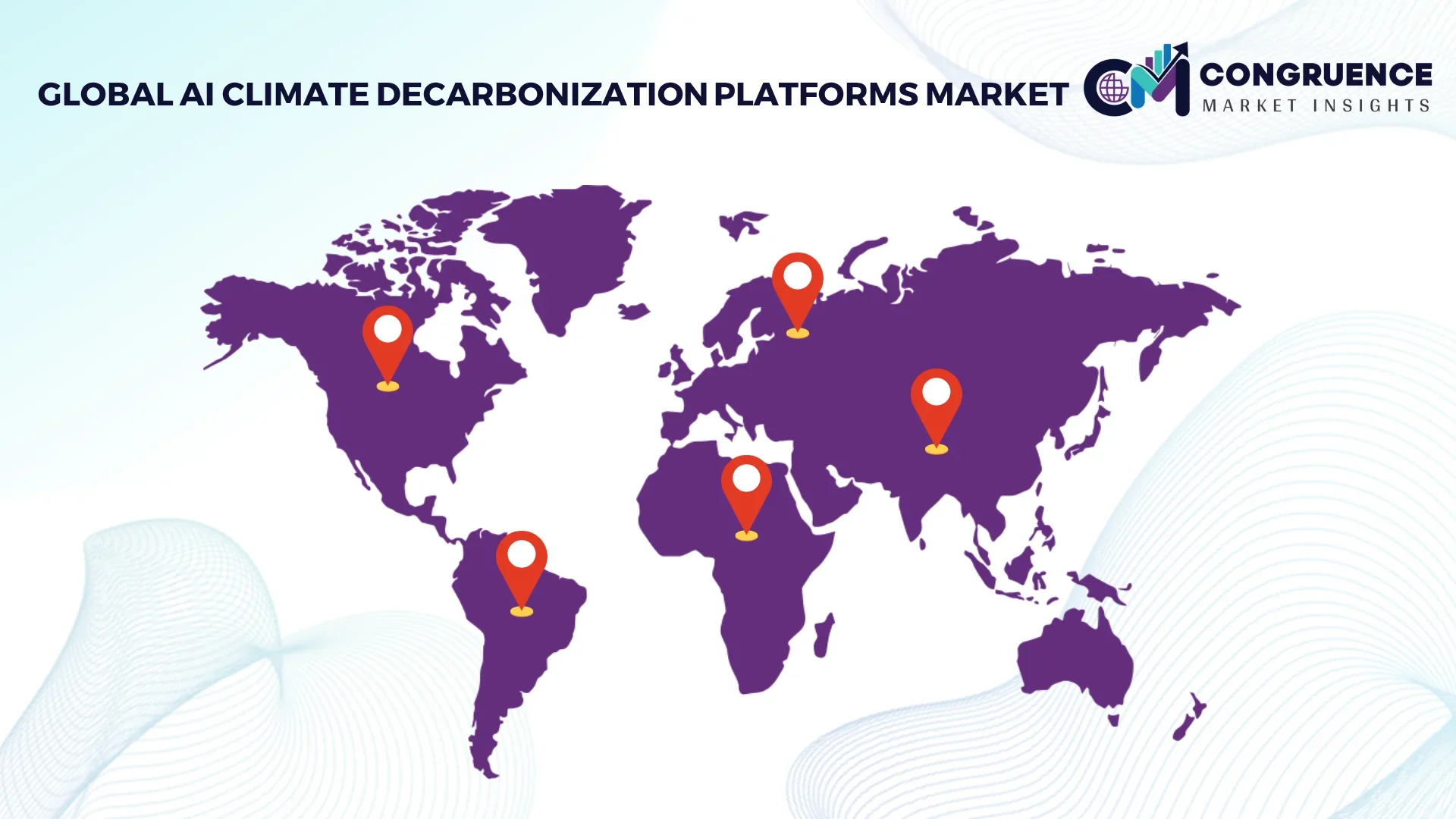
The global expansion of AI Climate Decarbonization Platforms is strongly influenced by regional policy frameworks, digital infrastructure readiness, and industrial decarbonization priorities. In 2025, North America hosted more than 420 operational climate analytics startups and over 3,800 enterprise deployments of AI-based emissions monitoring platforms. Europe followed with approximately 31.4% share, supported by more than 2,900 corporate ESG monitoring implementations and strong regulatory enforcement of sustainability disclosure standards across the European Union. Asia-Pacific represented nearly 21.7% of the market, driven by increasing industrial emissions monitoring across China, Japan, India, and South Korea, where over 1,700 manufacturing facilities integrated AI-based energy optimization tools. South America accounted for around 5.2% share, primarily supported by renewable energy expansion and carbon monitoring initiatives across Brazil and Chile. Meanwhile, the Middle East & Africa region represented approximately 3.1% of global deployments, where more than 240 industrial sustainability monitoring projects were launched between 2023 and 2025 to support energy transition initiatives. The regional outlook indicates that regulatory compliance, digital transformation investments, and industrial sustainability commitments will continue to shape adoption patterns across global markets.
North America represents the most mature regional market for AI Climate Decarbonization Platforms, accounting for approximately 38.6% of the global market share in 2025. The region hosts more than 3,800 enterprise deployments of AI-based emissions monitoring and sustainability analytics systems across industries including energy, manufacturing, finance, and technology. The United States alone contributes nearly 74% of regional adoption, supported by strong investments in climate technology and digital transformation programs. Government support and regulatory frameworks play a significant role in driving demand. More than 3,200 large corporations in the region now disclose carbon emissions under enhanced sustainability reporting frameworks, while federal climate initiatives have supported over USD 6 billion in clean technology investments since 2022. Industries such as energy utilities, cloud computing, and automotive manufacturing are increasingly integrating AI-driven platforms to monitor Scope 1, 2, and 3 emissions across operations. Technological innovation remains a key differentiator in the region. Over 65% of large enterprises deploy AI-powered sustainability dashboards integrated with IoT-enabled energy monitoring systems. A notable example includes Watershed, a climate analytics company headquartered in California, which has expanded its enterprise carbon accounting platform across more than 300 multinational organizations. Regional consumer behavior also differs significantly. North America shows higher enterprise adoption in finance, healthcare, and technology sectors, where digital ESG reporting tools are integrated directly into enterprise data platforms to improve regulatory transparency and sustainability reporting efficiency.
Europe accounts for approximately 31.4% of the global AI Climate Decarbonization Platforms Market, making it the second-largest regional market. Countries including Germany, the United Kingdom, France, and the Netherlands represent the primary adoption hubs, collectively accounting for nearly 68% of the regional deployments of AI-based sustainability analytics systems. The region’s strong regulatory framework significantly influences market growth. European sustainability initiatives such as the European Green Deal and Corporate Sustainability Reporting Directive (CSRD) require companies to monitor and report emissions across their entire value chains. As a result, more than 2,900 large enterprises in Europe have deployed AI-based emissions analytics tools to automate ESG reporting processes. Technological adoption is also accelerating across European industries. Approximately 44% of smart manufacturing facilities across Germany and Northern Europe now use AI-powered energy optimization platforms to monitor operational emissions and improve efficiency. These platforms integrate digital twins, IoT sensors, and predictive analytics to optimize industrial energy consumption. A key regional player is Plan A, a Berlin-based climate technology company that provides automated carbon accounting software used by more than 1,500 European organizations. Regional consumer behavior is heavily influenced by policy frameworks. Europe demonstrates strong demand for explainable and regulation-compliant AI sustainability tools, as organizations must ensure transparency in carbon accounting and environmental data reporting to meet regulatory obligations.
Asia-Pacific represents one of the fastest-growing regions in the AI Climate Decarbonization Platforms Market, accounting for approximately 21.7% of global adoption volume in 2025. The region includes major industrial economies such as China, Japan, India, and South Korea, which together represent more than 82% of regional platform deployments. China remains the largest consumer of AI-driven emissions monitoring platforms in the region, supported by large-scale industrial decarbonization initiatives across manufacturing and power generation sectors. More than 620 manufacturing facilities in China have integrated AI-powered energy optimization systems since 2023. Japan follows with strong adoption in automotive and electronics industries, where more than 410 companies use predictive sustainability analytics platforms. Rapid industrialization and infrastructure development across Asia-Pacific are key drivers. Over 1,700 smart manufacturing facilities in the region have deployed AI-based energy monitoring platforms, enabling companies to reduce operational emissions by an average of 16–22%. A notable regional player is Avarni, an Asia-Pacific climate analytics firm developing AI-driven carbon accounting platforms for supply chain emissions monitoring. The company has expanded services to more than 200 multinational enterprises operating in manufacturing and logistics sectors. Regional consumer behavior reflects the region’s technology-driven growth model. Asia-Pacific adoption is strongly driven by industrial manufacturing, logistics optimization, and digital sustainability solutions integrated into smart factories and supply chain platforms.
South America accounts for approximately 5.2% of the global AI Climate Decarbonization Platforms Market, with adoption concentrated primarily in Brazil, Argentina, and Chile. Brazil represents the largest national market in the region, contributing nearly 52% of regional platform deployments, driven by expanding renewable energy infrastructure and sustainability reporting initiatives across the industrial sector. The energy sector is a major driver of AI climate analytics adoption in South America. Over 280 renewable energy projects across Brazil and Chile now deploy AI-powered environmental monitoring tools to track emissions and optimize energy efficiency. Hydropower facilities, wind farms, and large-scale solar projects increasingly rely on AI platforms to improve operational sustainability metrics. Government incentives are also encouraging adoption. Several South American countries have introduced carbon monitoring requirements for large industrial operations, resulting in more than 140 corporate sustainability analytics implementations between 2023 and 2025. A regional technology player, WayCarbon, headquartered in Brazil, provides carbon intelligence software solutions used by over 400 organizations to measure and manage greenhouse gas emissions. Regional consumer behavior patterns also influence the market. South America shows strong demand for sustainability platforms linked to renewable energy operations and environmental impact monitoring, particularly in energy-intensive industries such as mining, agriculture, and utilities.
The Middle East & Africa region represents approximately 3.1% of the global AI Climate Decarbonization Platforms Market, but adoption is increasing rapidly due to major sustainability initiatives across energy and infrastructure sectors. Countries including the United Arab Emirates, Saudi Arabia, and South Africa are leading regional adoption of AI-powered emissions monitoring technologies. Oil and gas companies across the Middle East are increasingly deploying AI-driven sustainability analytics platforms to reduce operational emissions and optimize energy efficiency. More than 120 industrial energy monitoring projects were launched across the region between 2023 and 2025, many of which integrate AI-powered carbon analytics systems. Technological modernization programs are also accelerating adoption. Several Gulf countries are implementing smart city initiatives that integrate environmental monitoring and energy optimization technologies across infrastructure networks. For example, sustainability monitoring platforms are being deployed across over 60 smart infrastructure projects in the United Arab Emirates. A regional climate technology player, Zeroe, headquartered in the UAE, provides AI-based carbon management platforms designed for corporate sustainability monitoring and regulatory compliance. Regional consumer behavior is shaped by economic diversification efforts. Middle East enterprises prioritize AI platforms for energy efficiency, emissions monitoring, and smart infrastructure sustainability analytics, particularly in sectors such as oil & gas, construction, and urban development.
United States – 34.2% Market Share: It dominates due to strong enterprise adoption, extensive climate technology investments, and large-scale deployment of digital carbon accounting platforms across energy, manufacturing, and technology sectors.
Germany – 11.6% Market Share: It holds a leading position due to strict sustainability regulations, high industrial digitalization levels, and widespread adoption of AI-powered energy optimization systems across manufacturing facilities.
The AI Climate Decarbonization Platforms Market is characterized by a moderately fragmented competitive structure, with more than 85 active global technology vendors providing carbon accounting platforms, sustainability analytics tools, and AI-based emissions monitoring systems. The top five companies collectively account for approximately 32–36% of the total market share, indicating a competitive environment with a strong presence of emerging climate technology startups alongside established enterprise software providers.
Competition in the market is primarily driven by technological innovation, advanced data analytics capabilities, and integration with enterprise ESG reporting systems. Leading vendors are investing heavily in machine learning-based emissions forecasting, digital twin energy optimization tools, and automated carbon accounting platforms. More than 140 new AI sustainability software modules were introduced globally between 2023 and 2025, reflecting the rapid pace of innovation within the sector.
Strategic partnerships and acquisitions are also shaping the competitive landscape. Several technology companies are collaborating with energy utilities, manufacturing firms, and financial institutions to integrate climate analytics platforms with existing operational systems. Approximately 46% of climate technology companies entered at least one strategic partnership between 2022 and 2025 to expand product capabilities or geographic reach.
Product differentiation increasingly focuses on real-time environmental data analytics, automated ESG compliance reporting, and predictive climate modeling capabilities. Many vendors are integrating satellite environmental monitoring data, IoT-based energy sensors, and cloud-based analytics platforms to enhance platform performance.
The market also shows strong venture capital activity. More than USD 8 billion has been invested globally in climate analytics startups since 2022, leading to the emergence of specialized providers focused on supply chain emissions monitoring, carbon accounting automation, and sustainability intelligence dashboards. These trends are expected to intensify competition and accelerate technological advancements across the AI Climate Decarbonization Platforms Market.
IBM
Salesforce
SAP
Schneider Electric
Siemens
Honeywell
Amazon Web Services
Watershed
Persefoni
Plan A
Avarni
SINAI Technologies
Technological innovation is a fundamental driver shaping the AI Climate Decarbonization Platforms Market, as organizations increasingly rely on advanced digital tools to manage environmental impact, optimize energy efficiency, and achieve sustainability targets. Modern climate intelligence platforms combine artificial intelligence, machine learning, IoT sensor networks, satellite monitoring, and cloud-based analytics infrastructure to deliver comprehensive carbon monitoring and predictive sustainability insights.
One of the most influential technologies in the market is AI-based carbon accounting automation. These systems process operational energy data, logistics information, and supplier emissions data to automatically calculate Scope 1, Scope 2, and Scope 3 emissions across complex enterprise ecosystems. Advanced machine learning algorithms analyze more than 10 million operational data points per year for large industrial organizations, enabling companies to track emissions with higher accuracy and transparency.
Another rapidly expanding technology area is digital twin-based energy optimization. Digital twins create virtual models of industrial facilities, energy grids, or supply chains that simulate real-time operational performance. These systems enable companies to identify inefficiencies and predict emission impacts before implementing operational changes. Industrial facilities using digital twin energy models have reported energy efficiency improvements ranging from 18% to 27%.
The integration of IoT-enabled environmental monitoring systems is also transforming sustainability analytics. Modern industrial facilities deploy thousands of connected sensors to measure energy consumption, temperature variations, fuel usage, and emissions levels across operations. AI platforms analyze this data in real time to detect abnormal emission patterns and recommend optimization strategies.
Satellite data integration is another emerging trend influencing climate intelligence platforms. Environmental monitoring satellites generate large volumes of climate-related data, including land-use changes, atmospheric carbon concentrations, and industrial emission signals. AI models are capable of analyzing over 50 terabytes of environmental satellite data annually to provide accurate emissions tracking and climate forecasting insights.
Cloud computing infrastructure further supports scalability of AI climate platforms. More than 70% of enterprise sustainability analytics platforms are deployed through cloud-based architectures, enabling organizations to integrate environmental data across global operations.
Future technological development is expected to focus on autonomous sustainability optimization systems, where AI models continuously analyze operational performance and automatically adjust energy usage to minimize carbon emissions while maintaining operational productivity.
• In May 2025, SAP announced a major expansion of its sustainability software portfolio by integrating SAP Sustainability Control Tower with SAP Business Data Cloud. The initiative introduces unified ESG data management and embedded AI tools that connect sustainability metrics with financial and operational data across enterprise systems, enabling organizations to analyze environmental impact and compliance metrics in a single platform. Source: www.news.sap.com
• In January 2025, Microsoft highlighted new AI-driven sustainability initiatives within its cloud ecosystem aimed at optimizing resource efficiency and accelerating climate innovation. The company expanded AI capabilities that help organizations analyze energy consumption, optimize systems for carbon reduction, and support conservation and low-carbon infrastructure strategies across cloud-based operations.
• In July 2024, IBM announced a collaboration with JLL to deliver a sustainability solution for commercial real estate using IBM Envizi technology. The platform enables property operators to monitor ESG performance, manage environmental data, and improve emissions reporting across real estate portfolios, supporting enterprise decarbonization strategies in the building sector.
• In 2025, Schneider Electric introduced a multi-year initiative to build an AI-native ecosystem for sustainability and energy management. The new platform integrates artificial intelligence with energy analytics to help organizations monitor emissions, optimize energy consumption, and improve sustainability performance across industrial and infrastructure operations worldwide.
The AI Climate Decarbonization Platforms Market Report provides a comprehensive analysis of the technological, industrial, and geographic factors influencing the adoption of AI-powered sustainability analytics solutions worldwide. The scope of the report covers key market segments including platform types, application areas, deployment environments, and end-user industries, offering detailed insights into how organizations integrate AI technologies to manage carbon emissions and achieve environmental sustainability goals.
The report evaluates multiple platform categories such as carbon accounting platforms, predictive climate analytics systems, energy optimization tools, and sustainability intelligence dashboards. These solutions are used by enterprises to monitor greenhouse gas emissions, automate ESG reporting processes, and optimize energy consumption across large operational infrastructures. In addition, the report analyzes application areas including emissions monitoring, sustainability reporting, supply chain carbon management, and renewable energy optimization.
Industry coverage includes major end-user sectors such as energy and utilities, manufacturing, transportation and logistics, technology companies, government agencies, and financial institutions. These sectors collectively account for thousands of global deployments of AI-driven climate analytics platforms designed to support operational efficiency and regulatory compliance.
Geographically, the report examines adoption trends across North America, Europe, Asia-Pacific, South America, and the Middle East & Africa, highlighting differences in regulatory frameworks, technology infrastructure, and sustainability initiatives. The report also evaluates emerging niche segments including AI-enabled carbon credit verification systems, satellite-based emissions monitoring platforms, and digital twin climate simulation technologies.
Additionally, the study analyzes industry structure, competitive positioning of technology providers, and innovation trends shaping the market. With increasing global emphasis on net-zero emissions targets, the report highlights how AI-driven sustainability platforms are becoming essential tools for enterprises seeking to improve environmental performance, operational transparency, and long-term climate resilience strategies.
| Report Attribute / Metric | Details |
|---|---|
| Market Revenue (2025) | USD 409.8 Million |
| Market Revenue (2033) | USD 1,998.0 Million |
| CAGR (2026–2033) | 21.9% |
| Base Year | 2025 |
| Forecast Period | 2026–2033 |
| Historic Period | 2021–2025 |
| Segments Covered |
By Type
By Application
By End-User Insights
|
| Key Report Deliverables | Revenue Forecast; Market Trends; Growth Drivers & Restraints; Technology Insights; Segmentation Analysis; Regional Insights; Competitive Landscape; Regulatory & ESG Overview; Recent Developments |
| Regions Covered | North America; Europe; Asia-Pacific; South America; Middle East & Africa |
| Key Players Analyzed | Microsoft; IBM; Salesforce; SAP; Schneider Electric; Siemens; Honeywell; Google; Amazon Web Services; Watershed; Persefoni; Plan A; Avarni; SINAI Technologies |
| Customization & Pricing | Available on Request (10% Customization Free) |




