
Reports
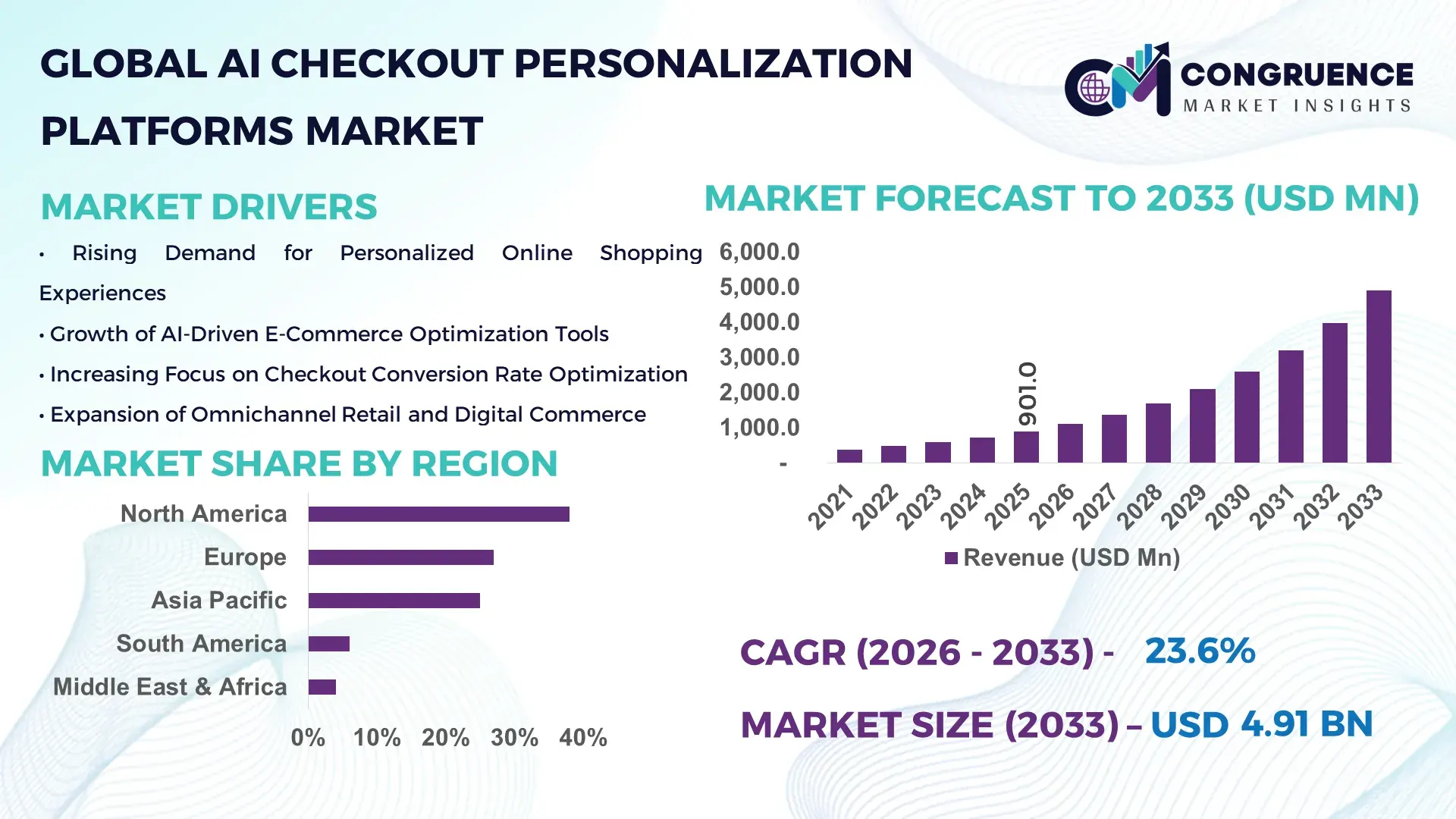
The Global AI Checkout Personalization Platforms Market was valued at USD 901.0 Million in 2025 and is anticipated to reach a value of USD 4,907.6 Million by 2033 expanding at a CAGR of 23.6% between 2026 and 2033, according to an analysis by Congruence Market Insights. The expansion is primarily driven by the growing adoption of AI-powered real-time recommendation engines and behavioral analytics that help online retailers reduce cart abandonment and improve checkout conversion efficiency.
The United States represents the most technologically advanced ecosystem for AI checkout personalization platforms, supported by a highly digitized retail sector and significant investments in artificial intelligence infrastructure. Over 72% of large U.S. e-commerce enterprises deploy AI-based personalization toolswithin checkout or cart stages to improve transaction success rates. In addition, the country hosts more than 4,000 AI startups focused on retail analytics, personalization, and recommendation technologies, many of which integrate checkout-level machine learning models. Retail applications dominate adoption, accounting for over 65% of enterprise implementations, followed by digital marketplaces and subscription commerce platforms. Furthermore, the U.S. retail industry processes over 16 billion online transactions annually, creating massive behavioral datasets that power predictive checkout algorithms and enable advanced technologies such as reinforcement learning-driven dynamic pricing, fraud detection models, and hyper-personalized upselling capabilities integrated into payment gateways.
Market Size & Growth:The market reached USD 901.0 Million in 2025and is projected to reach USD 4,907.6 Million by 2033, expanding at 23.6% CAGR, driven by increasing adoption of AI-driven checkout optimization tools that improve conversion rates and reduce cart abandonment.
Top Growth Drivers:Approximately 68% adoption of AI personalization in e-commerce platforms, 35% improvement in checkout conversion rates using predictive analytics, and 40% faster transaction processing through AI-optimized payment flows.
Short-Term Forecast:By 2028, AI-powered checkout optimization is expected to improve customer transaction completion rates by nearly 32%while reducing abandoned carts by up to 28%.
Emerging Technologies:Generative AI-powered recommendation engines, reinforcement learning-based pricing optimization, and multimodal consumer analytics integrating clickstream and payment data.
Regional Leaders:North Americais projected to exceed USD 1.9 Billion by 2033with strong SaaS adoption; Europeis expected to approach USD 1.4 Billiondriven by privacy-compliant AI personalization; Asia-Pacificis anticipated to surpass USD 1.2 Billiondue to rapid digital commerce expansion.
Consumer/End-User Trends:More than 60% of online retailersare integrating AI personalization tools at checkout to deliver tailored promotions, dynamic bundles, and real-time payment recommendations.
Pilot or Case Example:In 2024, a global online retailer deployed AI-based checkout personalization, achieving a 26% increase in average order value and 18% reduction in payment abandonment rates.
Competitive Landscape:Leading provider controls roughly 18% of the global market, followed by major players including several enterprise commerce software vendors and AI analytics platform providers competing through advanced recommendation technologies.
Regulatory & ESG Impact:Privacy regulations such as GDPR-aligned AI governance frameworks are pushing vendors to develop privacy-preserving machine learning modelsand secure checkout personalization systems.
Investment & Funding Patterns:More than USD 2.3 Billion in venture and strategic investmentshas been directed toward AI commerce platforms over the past few years, particularly in recommendation algorithms and predictive consumer analytics.
Innovation & Future Outlook:Advanced real-time behavioral AI engines, federated learning architectures, and integrated payment intelligence platformsare expected to redefine checkout personalization across global digital commerce ecosystems.
AI Checkout Personalization Platforms Market growth is shaped by expanding deployment in retail (over 55% of demand), digital marketplaces, and subscription commerce services. Continuous innovations such as predictive cart recommendations, AI fraud detection, and dynamic checkout interfacesare transforming transaction experiences. Regulatory frameworks supporting data privacy and responsible AI deployment are influencing platform design, while rapid digital commerce adoption across Asia-Pacific and North America is accelerating demand for advanced checkout analytics and personalization technologies.
The AI Checkout Personalization Platforms Market has emerged as a critical component of modern digital commerce infrastructure, enabling retailers and digital marketplaces to transform static checkout experiences into intelligent, adaptive transaction environments. By combining real-time behavioral analytics, predictive recommendation engines, and automated payment optimization, AI-driven checkout platforms enable organizations to significantly improve customer engagement and purchase completion rates. For example, machine-learning-based checkout recommendation systems deliver nearly 35% improvement in conversion efficiency compared to rule-based personalization systems, demonstrating the strategic advantage of AI-driven commerce technologies.
From a regional perspective, North America dominates in transaction volume due to the region’s large e-commerce infrastructure, while Asia-Pacific leads in adoption with nearly 58% of digital retailers integrating AI-enabled checkout analytics within their platforms. The growth of mobile-first commerce ecosystems in countries such as China, India, and South Korea is accelerating adoption of AI-powered payment recommendations, automated fraud detection, and dynamic promotional offers embedded within checkout interfaces.
In the short term, the integration of generative AI-driven consumer intent prediction systemsis expected to reshape the checkout experience. By 2028, predictive AI checkout technologies are projected to improve order value optimization by approximately 30% while reducing checkout abandonment by nearly 25%through personalized offers and automated payment method suggestions. Enterprises are also increasingly adopting AI-driven omnichannel checkout frameworks that synchronize consumer behavior data across web, mobile, and in-store digital systems.
Environmental, social, and governance considerations are also influencing the sector. Firms are committing to responsible AI governance frameworks and targeting a 20% reduction in data-processing energy consumption by 2030through optimized cloud infrastructure and efficient AI models.
Practical implementations already highlight the measurable impact of these technologies. In 2024, a major U.S. online marketplace implemented reinforcement learning-based checkout personalization algorithms that improved completed transactions by nearly 24% while increasing average order value by 19%.Such initiatives demonstrate how AI-enabled checkout intelligence can deliver operational efficiency and superior customer experiences.
Looking ahead, the AI Checkout Personalization Platforms Marketis expected to evolve into a foundational pillar of digital commerce strategy, enabling organizations to combine real-time analytics, adaptive customer journeys, and privacy-compliant personalization systems to achieve resilient, scalable, and sustainable business growth.
The AI Checkout Personalization Platforms Market is influenced by rapid digital commerce expansion, increasing consumer expectations for personalized shopping experiences, and the growing integration of artificial intelligence technologies across retail technology ecosystems. Businesses are increasingly deploying AI-based recommendation engines and behavioral analytics platforms at the checkout stage to optimize transaction outcomes and reduce abandoned carts. The proliferation of omnichannel retail strategies has also intensified demand for checkout personalization platforms capable of analyzing cross-device consumer interactions and dynamically adjusting payment options, discounts, and product suggestions. Moreover, the increasing availability of large-scale consumer data sets enables advanced machine learning algorithms to generate highly accurate purchase predictions. However, concerns related to data privacy regulations, algorithm transparency, and infrastructure complexity continue to shape market adoption patterns. As digital payment ecosystems evolve, AI checkout platforms are also integrating fraud detection, biometric authentication, and predictive consumer analytics to strengthen transaction security while maintaining seamless purchasing experiences.
The rapid shift toward digital commerce has intensified demand for personalized shopping experiences, particularly during the checkout phase where conversion outcomes are determined. Studies indicate that nearly 70% of online shoppers expect personalized product recommendations during the purchasing process, while approximately 60% of consumers are more likely to complete purchases when tailored discounts or product bundles are presented at checkout. AI checkout personalization platforms leverage machine learning models that analyze real-time behavioral signals such as browsing patterns, purchase history, device type, and geographic location to dynamically tailor checkout interfaces. This capability enables retailers to present optimized offers, preferred payment methods, and relevant product add-ons. Furthermore, predictive analytics systems can detect purchase intent signals and automatically adjust checkout recommendations to increase transaction success rates. Retailers deploying such systems have reported conversion rate improvements exceeding 30% and reductions in cart abandonment of nearly 25%, demonstrating how AI-driven checkout personalization significantly enhances digital commerce performance.
Despite significant technological benefits, data privacy and regulatory compliance remain major restraints affecting the adoption of AI checkout personalization platforms. These systems rely heavily on consumer behavioral data, transaction histories, and browsing patterns to generate personalized checkout experiences. However, stringent regulations governing consumer data protection, including privacy legislation and data governance frameworks, impose strict compliance requirements on businesses deploying such technologies. More than 60% of global enterprises report challenges in managing consent-based data collection practices, particularly when operating across multiple jurisdictions with varying regulatory standards. Additionally, organizations must invest in secure data processing infrastructures, encryption technologies, and privacy-preserving machine learning techniques to ensure compliance. The complexity of integrating AI algorithms with secure payment gateways and customer data platforms also creates operational challenges for many retailers. As a result, smaller enterprises often face barriers related to high implementation costs, compliance management, and technical expertise requirements.
The expansion of omnichannel commerce represents one of the most significant opportunities for the AI Checkout Personalization Platforms Market. Modern consumers interact with brands through multiple digital touchpoints, including mobile apps, websites, social commerce platforms, and physical retail stores. As a result, businesses are increasingly seeking unified AI platforms capable of synchronizing consumer behavior data across all channels to deliver consistent and personalized checkout experiences. Industry studies suggest that over 65% of retailers are investing in omnichannel commerce platforms, while more than 50% of global consumers now complete purchases across multiple digital devices during a single buying journey. AI checkout personalization platforms can aggregate and analyze cross-channel behavioral data to deliver intelligent checkout recommendations, automated loyalty rewards, and adaptive payment options. Furthermore, the integration of voice commerce, conversational AI assistants, and augmented shopping environments presents additional opportunities for checkout personalization technologies to enhance customer engagement and transaction success rates.
Implementing advanced AI checkout personalization systems requires complex technological infrastructure that integrates machine learning engines, cloud computing platforms, payment processing systems, and large-scale consumer data repositories. Many organizations struggle to unify these technologies within their existing digital commerce environments. Surveys indicate that nearly 48% of retailers report integration challenges when deploying AI-based personalization tools, particularly when connecting recommendation engines with legacy enterprise resource planning and payment gateway systems. Additionally, maintaining real-time analytics capabilities capable of processing millions of behavioral data points per second demands significant computational resources and cloud infrastructure investments. AI model training and optimization also require specialized expertise in data science and machine learning engineering, which many companies lack internally. These challenges can lead to extended deployment timelines and operational complexities that slow widespread adoption across smaller retail organizations and emerging digital marketplaces.
Rapid adoption of real-time AI recommendation engines in checkout interfaces:Retailers increasingly deploy AI models that analyze consumer behavior instantly to recommend relevant products or discounts during checkout. Approximately 64% of large e-commerce platforms now use real-time recommendation engines, improving checkout conversion rates by up to 31%and increasing average order value by 18%. These technologies utilize deep learning algorithms capable of analyzing more than 1 million behavioral signals per second, enabling hyper-personalized checkout experiences.
Expansion of AI-driven payment method optimization systems:Checkout personalization platforms are integrating AI engines that automatically recommend preferred payment options based on consumer history and regional preferences. Studies indicate that over 52% of online shoppers abandon transactions when preferred payment methods are unavailable, while AI-based payment recommendations have reduced payment friction by nearly 27%. Adoption is particularly strong in Asia-Pacific, where mobile wallet usage exceeds 60% of digital transactions.
Integration of predictive fraud detection within checkout personalization platforms:AI checkout systems increasingly combine personalization with advanced fraud analytics to secure transactions without increasing friction. Machine learning fraud detection tools analyze over 200 behavioral parametersduring each transaction, enabling businesses to identify suspicious activity while maintaining smooth checkout experiences. Retailers deploying AI fraud detection alongside personalization technologies report nearly 40% reduction in fraudulent transaction attempts.
Emergence of generative AI-driven conversational checkout assistants:Generative AI technologies are transforming checkout interactions by enabling conversational purchase support and personalized product guidance. Nearly 45% of global digital retailers are experimenting with AI chat-based checkout assistants, which can guide customers through payment options, recommend complementary items, and answer product queries in real time. Early implementations demonstrate 22% improvement in customer engagement ratesduring the checkout process.
The AI Checkout Personalization Platforms Market is segmented by type, application, and end-user industries, reflecting the diverse technological approaches and deployment scenarios across global digital commerce ecosystems. AI-driven checkout personalization solutions utilize machine learning algorithms, predictive analytics, and consumer behavioral modeling to optimize transaction experiences and maximize purchase completion rates. Type-based segmentation focuses on technological approaches such as recommendation engines, predictive analytics platforms, dynamic pricing systems, and AI-driven checkout assistants. Application-level segmentation highlights usage across e-commerce platforms, digital marketplaces, subscription commerce models, and omnichannel retail systems. End-user segmentation demonstrates the adoption of checkout personalization platforms across sectors including retail, travel and hospitality, media and entertainment, and digital service providers. Each segment reflects unique operational needs, consumer interaction patterns, and technological integration requirements, shaping the overall demand landscape of the AI Checkout Personalization Platforms Market.
AI Checkout Personalization Platforms can be categorized into AI recommendation engines, predictive analytics platforms, dynamic pricing engines, conversational checkout assistants, and fraud-aware personalization systems. Among these, AI recommendation engines dominate adoption with approximately 38% of market utilization, as they enable retailers to provide personalized product suggestions and tailored offers directly within checkout pages. These systems analyze browsing patterns, purchase history, and contextual behavioral signals to dynamically recommend complementary products and optimize order value. Predictive analytics platforms represent the fastest-growing type, expanding at an estimated CAGR of about 27%, as enterprises increasingly rely on predictive purchase intent modeling to anticipate customer actions and optimize checkout experiences. Such platforms analyze thousands of behavioral signals in real time, allowing businesses to adjust pricing, promotions, and payment suggestions dynamically. Dynamic pricing engines and conversational checkout assistants also play significant roles, collectively accounting for roughly 34% of adoption, particularly among advanced digital retailers seeking highly interactive checkout experiences. Fraud-aware personalization systems are emerging rapidly as security-focused technologies capable of balancing transaction safety with seamless purchasing journeys.
• A 2025 global retail technology survey found that several major online retailers deployed AI recommendation engines within checkout pages, increasing cross-sell success rates for over 8 million customers using automated product suggestion algorithms.
Applications of AI Checkout Personalization Platforms span e-commerce websites, digital marketplaces, subscription commerce services, and omnichannel retail ecosystems. Among these, e-commerce platforms represent the leading application segment with nearly 46% of adoption, primarily due to the large volume of digital transactions processed through online retail websites. Retailers utilize AI checkout personalization tools to optimize payment workflows, recommend complementary products, and provide personalized discounts during the checkout process. Digital marketplaces are the fastest-growing application segment with approximately 26% projected expansion rate, driven by increasing adoption among large multi-vendor platforms seeking to improve transaction efficiency and customer retention. These platforms use AI algorithms to analyze user behavior across thousands of vendors and product categories simultaneously. Subscription commerce platforms and omnichannel retail systems collectively contribute around 29% of adoption, particularly in industries such as digital media, SaaS platforms, and consumer services where recurring purchases are common. In terms of consumer behavior, over 58% of online shoppers interact with personalized product recommendations during checkout, and approximately 44% report higher purchase confidence when personalized offers appear at the payment stage.
• In 2025, a large global e-commerce platform deployed AI-based checkout personalization across its marketplace ecosystem, enabling automated product bundling for more than 12 million daily transactions.
End-user adoption of AI Checkout Personalization Platforms spans several industries including retail & e-commerce, travel and hospitality, digital services providers, media and entertainment platforms, and financial technology companies. Among these, retail and e-commerce organizations dominate the market with nearly 55% adoption, as online retailers rely heavily on checkout optimization to increase conversion rates and improve customer purchasing experiences. Digital services providers represent the fastest-growing end-user segment with an estimated 25% expansion rate, driven by the rise of subscription-based platforms and digital marketplaces that depend on seamless payment workflows and personalized checkout experiences. These organizations integrate AI checkout personalization tools to recommend subscription upgrades, service bundles, and targeted promotions during transaction processes. Travel and hospitality companies, along with media and entertainment platforms, contribute a combined adoption share of approximately 28%, using checkout personalization systems to recommend travel upgrades, entertainment bundles, and loyalty program incentives during booking and payment processes. Consumer adoption patterns also highlight growing demand for personalized digital transactions. Nearly 63% of Gen Z consumers report higher engagement with brands that provide AI-driven personalized checkout offers, while over 48% of global enterprises have piloted AI personalization tools for customer experience optimization.
• A global enterprise technology assessment in 2025 found that AI checkout personalization platforms were deployed by hundreds of retail SMEs, enabling automated payment optimization and real-time product recommendation capabilities across online storefronts.
North America accounted for the largest market share at 38% in 2025 however, Asia-Pacific is expected to register the fastest growth, expanding at a CAGR of 26.8% between 2026 and 2033.
North America’s leadership is driven by high enterprise adoption of AI-based commerce technologies and the presence of over 70% of global enterprise SaaS providers specializing in digital commerce and personalization software. The United States alone hosts more than 4,000 AI-focused retail technology startups, while over 72% of large retailersintegrate AI-powered checkout analytics into their digital storefronts. Europe represents the second-largest regional market with approximately 27% share, supported by strong adoption across the UK, Germany, and France where over 55% of mid-to-large online retailersuse AI-driven personalization tools. Meanwhile, Asia-Pacific is witnessing rapid expansion as mobile commerce transactions exceed 65% of total digital purchasesin several economies. China processes more than 10 billion mobile-based online payments monthly, providing vast consumer data streams for AI-driven checkout systems. South America accounts for roughly 6% of global demand, led by Brazil’s rapidly expanding e-commerce ecosystem with over 100 million online shoppers. The Middle East & Africa holds approximately 4% market share, driven by digital transformation programs in the UAE and Saudi Arabia that aim to increase digital retail transactions by over 40% by the end of the decade.
North America represents the largest regional ecosystem for AI Checkout Personalization Platforms, accounting for approximately 38% of global demand. The region’s dominance is supported by a mature digital commerce infrastructure, high enterprise AI adoption, and strong technology investment across the retail and fintech sectors. The United States leads adoption with over 72% of major online retailers deploying AI-driven checkout optimization systems, enabling real-time product recommendations, dynamic pricing adjustments, and personalized payment options. Key industries driving demand include e-commerce retail, subscription services, digital media platforms, and financial technology companies. Government initiatives supporting artificial intelligence innovation, combined with strong data infrastructure investments, continue to accelerate enterprise adoption. Technological advancements such as real-time consumer behavior modeling, reinforcement learning-based recommendation engines, and AI-driven fraud detection systems are widely implemented across major online marketplaces. Local technology firms are also shaping the market. For example, Dynamic Yield, a technology company headquartered in the United States, develops AI-powered personalization engines used by global retailers to deliver tailored checkout experiences and automated product recommendations. Consumer behavior trends show strong engagement with personalized digital experiences. Surveys indicate that over 64% of online shoppers in the region interact with AI-generated product recommendations during checkout, while nearly 45% of enterprises report improved transaction completion rates after implementing AI checkout optimization platforms.
Europe holds approximately 27% of the global AI Checkout Personalization Platforms Market, with strong adoption across leading digital economies such as Germany, the United Kingdom, and France. These countries collectively represent nearly 60% of the region’s AI-powered commerce technology deployments, driven by a rapidly expanding e-commerce ecosystem and increasing enterprise digital transformation investments. Regulatory frameworks emphasizing responsible data governance and consumer privacy significantly influence technology deployment strategies in the region. European regulatory bodies emphasize strict consumer data protection and algorithm transparency, which has encouraged the development of privacy-preserving machine learning technologies and explainable AI models. As a result, many checkout personalization vendors are integrating anonymized data processing systems and federated learning architectures to comply with regional requirements. Several technology innovators are actively contributing to the regional market. For instance, Nosto, a Finland-based commerce experience platform provider, delivers AI-powered personalization engines used by thousands of European online retailers to tailor checkout experiences and product recommendations. European consumers also demonstrate strong privacy awareness, with nearly 58% preferring platforms that clearly explain how AI is used to personalize digital transactions, creating demand for transparent AI-driven checkout systems.
Asia-Pacific represents one of the most dynamic markets for AI Checkout Personalization Platforms, ranking second globally in market volume and demonstrating the fastest expansion across emerging digital economies. Major consuming countries include China, India, Japan, and South Korea, which collectively process over 60% of the world’s mobile commerce transactions. The region’s rapid growth is driven by a mobile-first digital ecosystem, high smartphone penetration exceeding 75% in several economies, and expanding digital payment infrastructure. China remains a technological powerhouse in AI-powered commerce innovation. Large-scale digital marketplaces process billions of daily transactions, generating vast behavioral datasets that enable advanced AI algorithms to optimize checkout personalization. Similarly, India’s digital commerce ecosystem now includes over 850 million internet users, many of whom rely on mobile payment applications integrated with AI-driven recommendation systems. Innovation hubs in cities such as Shenzhen, Bangalore, Tokyo, and Singaporeare actively developing advanced AI retail technologies including predictive analytics platforms, conversational checkout assistants, and automated cross-selling systems. Local players such as Insider, an AI-driven customer experience platform provider operating across Asia-Pacific, help retailers implement real-time personalization technologies that increase checkout conversion rates and optimize digital consumer journeys. Consumer behavior trends highlight strong engagement with AI-driven commerce. In Asia-Pacific markets, mobile-based purchases account for nearly 68% of online transactions, and AI-powered promotional offers during checkout influence more than 40% of purchasing decisions.
South America accounts for roughly 6% of the global AI Checkout Personalization Platforms Market, with Brazil and Argentinarepresenting the most significant digital commerce hubs in the region. Brazil alone hosts over 100 million online shoppers, while digital retail transactions in the country continue to grow rapidly due to improved internet access and expanding mobile payment adoption. Local infrastructure improvements and government initiatives supporting digital transformation have encouraged retailers to adopt advanced customer analytics and checkout personalization technologies. Brazil’s e-commerce industry processes millions of transactions daily, generating valuable consumer behavior datasets used to train AI-based recommendation engines and predictive checkout analytics systems. Additionally, digital payment innovations such as instant transfer systems have accelerated online purchasing activity, enabling businesses to deploy AI-driven checkout experiences tailored to regional consumer preferences. Local technology companies are also playing an important role in the regional market. For instance, VTEX, a Brazil-based commerce platform provider, offers integrated AI personalization tools that help retailers optimize checkout processes and provide tailored product recommendations. Consumer behavior in South America reflects strong demand for localized digital experiences. Studies indicate that over 48% of online shoppers in the region prefer checkout interfaces available in local languages with region-specific payment options, demonstrating the importance of AI-driven localization in digital commerce platforms.
The Middle East & Africa region accounts for approximately 4% of the global AI Checkout Personalization Platforms Market, with rising demand driven by expanding digital retail ecosystems and government-led digital transformation programs. Countries such as the United Arab Emirates, Saudi Arabia, and South Africaare leading adoption as businesses increasingly implement advanced commerce technologies to enhance customer engagement and streamline online purchasing experiences. Major economic diversification programs across the Gulf region emphasize investment in digital infrastructure, artificial intelligence, and smart commerce platforms. For example, regional digital economy strategies aim to increase the contribution of technology sectors to national GDP by more than 20% over the next decade, creating strong demand for AI-driven retail solutions. Technological modernization is also transforming online retail environments. Large e-commerce platforms are deploying AI recommendation engines and intelligent checkout assistants to improve consumer engagement and reduce abandoned carts. Local technology providers are emerging within this ecosystem; for example, Unifonic, a communications platform headquartered in Saudi Arabia, integrates AI-driven customer engagement tools that support personalized digital commerce interactions. Regional consumer behavior trends highlight strong adoption of mobile commerce platforms. In several Middle Eastern markets, mobile-based transactions account for more than 60% of digital purchases, encouraging retailers to integrate AI-powered personalization systems optimized for smartphone-based checkout experiences.
United States – 34% market share: It leads globally due to high enterprise AI adoption, strong SaaS platform development, and a massive digital commerce ecosystem processing billions of transactions annually.
China – 22% market share: It benefits from large-scale mobile commerce adoption, advanced AI innovation hubs, and digital marketplaces handling billions of online transactions each month.
The AI Checkout Personalization Platforms Market features a highly competitive and moderately fragmented structure with more than 120 active technology providers globallyoffering AI-driven retail personalization, recommendation engines, and checkout optimization solutions. The market includes a mix of large enterprise software companies, specialized AI analytics firms, and emerging SaaS startups focusing on digital commerce personalization technologies.
The top five companies collectively control approximately 42% of the global market, driven by strong enterprise client bases, extensive product ecosystems, and advanced machine learning technologies integrated within their platforms. Competition in this sector is largely shaped by innovation in real-time recommendation engines, predictive analytics, automated fraud detection, and generative AI-powered conversational checkout assistants.
Strategic partnerships between AI platform providers and e-commerce software companies are common, enabling seamless integration of personalization technologies into digital storefronts and payment gateways. Over 60% of major commerce platforms now offer built-in AI personalization capabilities, intensifying competitive differentiation through algorithm accuracy, scalability, and integration flexibility.
Product innovation remains a key competitive strategy. Vendors are investing heavily in reinforcement learning algorithms, privacy-preserving AI models, and federated data architectures to comply with emerging data governance regulations while maintaining advanced personalization capabilities. Additionally, mergers and acquisitions within the retail technology sector continue to reshape the competitive landscape as companies expand their AI capabilities and global distribution networks.
Adobe
Dynamic Yield
Nosto
Algolia
Insider
Bloomreach
Qubit (Coveo)
Monetate
Kibo Commerce
Optimizely
Clerk.io
Emarsys
Certona
RichRelevance
Technological innovation is at the core of the AI Checkout Personalization Platforms Market, as companies increasingly integrate advanced artificial intelligence capabilities to transform traditional checkout processes into intelligent, data-driven decision environments. One of the most influential technologies shaping the market is real-time machine learning recommendation engines, which analyze consumer browsing patterns, purchase history, location signals, and device behavior to deliver personalized product suggestions and promotional offers during checkout. These engines process thousands of behavioral signals per second, enabling dynamic optimization of checkout interfaces.
Another critical technology is predictive analytics platformsthat use deep learning models to forecast customer purchase intent. These systems can evaluate more than 200 behavioral variables, including browsing speed, product comparisons, and cart modifications, to predict the likelihood of purchase completion. By leveraging predictive insights, retailers can deploy targeted discounts or alternative payment options to encourage successful transactions.
The integration of reinforcement learning algorithmsis also transforming checkout optimization. These systems continuously learn from consumer interactions and adjust recommendation strategies in real time, enabling retailers to test and refine personalization models across millions of transactions simultaneously. Additionally, natural language processing (NLP)technologies are powering conversational checkout assistants capable of guiding customers through payment processes, answering product queries, and suggesting complementary items during checkout.
Another emerging innovation is privacy-preserving artificial intelligence, including federated learning architectures and differential privacy frameworks. These technologies enable organizations to train machine learning models without directly exposing sensitive consumer data, addressing growing regulatory concerns related to data governance and algorithm transparency.
Cloud-native AI infrastructure is also accelerating technology deployment across the sector. Modern personalization platforms rely on distributed cloud environments capable of processing billions of consumer interaction events daily, enabling real-time analytics and scalable checkout optimization across global digital commerce ecosystems.
• In May 2024, Salesforceintroduced Einstein Copilot and Einstein Personalizationcapabilities for marketing and commerce platforms. The solution uses trusted enterprise data and generative AI to deliver automated customer segmentation, real-time product recommendations, and personalized shopping journeys across digital storefronts and checkout environments. Source: www.salesforce.com
• In September 2024, Salesforcelaunched the next generation of Commerce Cloud, integrating AI agents and unified commerce capabilities that connect payments, order management, and customer data to deliver more personalized shopping and checkout experiences across B2C and B2B channels.
• In August 2024, Bloomreachhighlighted the expansion of its AI-powered personalization platform, which uses machine learning models to analyze customer purchase behavior and dynamically adjust product recommendations across the entire shopping journey, including checkout stages to improve conversion efficiency and customer engagement.
• In November 2024, Bloomreachpublished new AI-driven commerce strategies demonstrating how predictive analytics and behavioral AI models can optimize checkout conversion rates by identifying purchase intent signals and delivering targeted recommendations during the final stage of digital transactions.
The AI Checkout Personalization Platforms Market Report provides a comprehensive analysis of technologies, applications, and business strategies shaping the evolution of AI-driven commerce optimization systems across global digital retail ecosystems. The report evaluates key technology segments including AI recommendation engines, predictive analytics platforms, conversational checkout assistants, dynamic pricing algorithms, and fraud-aware personalization systems that are transforming digital transaction experiences.
The study examines adoption trends across major industry applications such as e-commerce platforms, digital marketplaces, subscription commerce services, and omnichannel retail environments. Retail and e-commerce remain the primary application areas, representing more than 50% of industry deployments, followed by digital service providers, media platforms, and travel booking ecosystems. The report also highlights the increasing role of mobile commerce technologies, which account for over 60% of global online transactionsand significantly influence the adoption of AI-powered checkout optimization platforms.
Geographically, the report provides in-depth coverage across North America, Europe, Asia-Pacific, South America, and the Middle East & Africa, analyzing regional digital commerce infrastructure, enterprise AI adoption rates, consumer purchasing behaviors, and technological innovation hubs influencing market demand. Key countries examined include the United States, China, Germany, the United Kingdom, India, Japan, Brazil, and the United Arab Emirates.
In addition to technology adoption patterns, the report explores strategic industry themes such as data privacy compliance, responsible AI deployment, cloud-based personalization infrastructure, and integration with digital payment ecosystems. Emerging segments such as AI-powered conversational checkout assistants, generative AI recommendation systems, and real-time payment intelligence platforms are also examined as future growth areas within the global AI Checkout Personalization Platforms Market.
| Report Attribute / Metric | Details |
|---|---|
| Market Revenue (2025) | USD 901.0 Million |
| Market Revenue (2033) | USD 4,907.6 Million |
| CAGR (2026–2033) | 23.6% |
| Base Year | 2025 |
| Forecast Period | 2026–2033 |
| Historic Period | 2021–2025 |
| Segments Covered |
By Type
By Application
By End-User Insights
|
| Key Report Deliverables | Revenue Forecast; Market Trends; Growth Drivers & Restraints; Technology Insights; Segmentation Analysis; Regional Insights; Competitive Landscape; Regulatory & ESG Overview; Recent Developments |
| Regions Covered | North America; Europe; Asia-Pacific; South America; Middle East & Africa |
| Key Players Analyzed | Salesforce; Adobe; Dynamic Yield; Bloomreach; Nosto; Algolia; Insider; Optimizely; Monetate; Kibo Commerce; Clerk.io; Emarsys; Certona; RichRelevance |
| Customization & Pricing | Available on Request (10% Customization Free) |




