
Reports
The Global AI Avatars Market was valued at USD 6008.31 Million in 2025 and is anticipated to reach a value of USD 51792.81 Million by 2033 expanding at a CAGR of 30.9% between 2026 and 2033. Growth is primarily driven by multimodal generative AI, enterprise virtual assistants, digital workforce automation, and expanding deployment of AI-powered customer engagement platforms across healthcare, retail, education, media, and financial services.
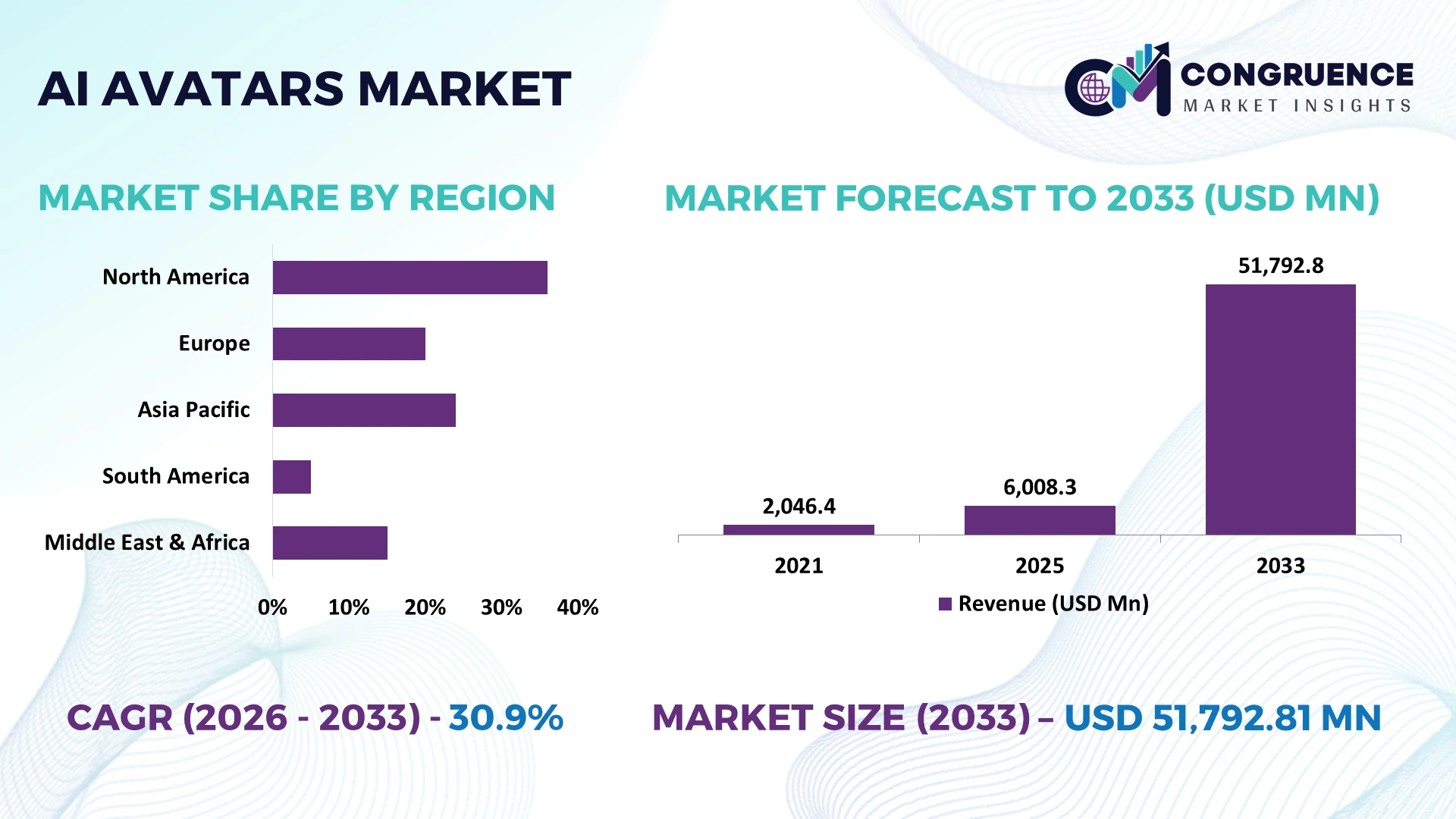
The United States remains the dominant market, accounting for approximately 38% of global AI avatar deployments, supported by enterprise AI investments, cloud infrastructure, and technology-led media, healthcare, and financial sectors. Compared with Japan, where enterprise deployment exceeds 21% across customer-facing digital services, the U.S. benefits from stronger hyperscale AI ecosystems and continued investment following global semiconductor supply-chain diversification initiatives introduced after the CHIPS Act, strengthening large-scale commercial implementation.
Organizations investing in scalable AI avatar ecosystems should prioritize enterprise-grade multilingual capabilities, governance frameworks, and vertical-specific deployment strategies to strengthen long-term competitive positioning.
Market Size & Growth: USD 6008.31 Million in 2025, reaching USD 51792.81 Million by 2033 at 30.9% CAGR, fueled by enterprise generative AI integration and digital workforce expansion.
Top Growth Drivers: Multimodal AI adoption (+34%), enterprise automation (+29%), and digital customer engagement (+27%) accelerate high-growth market expansion.
Short-Term Forecast: By 2028, avatar deployment reduces customer service costs by nearly 32% while improving response efficiency by approximately 41%.
Emerging Technologies: Generative AI, real-time speech synthesis, and digital human rendering improve interaction quality by over 35% across enterprise applications.
Regional Leaders: North America exceeds USD 19 Billion, Asia-Pacific surpasses USD 15 Billion, and Europe approaches USD 11 Billion, supported by enterprise AI adoption and regional digital transformation.
Consumer/End-User Trends: More than 58% of enterprises prioritize AI avatars for customer support, employee training, and virtual sales interactions.
Pilot/Case Example: In 2026, enterprise digital assistant deployments improved customer resolution rates by approximately 36% while reducing onboarding time by 28%.
Competitive Landscape: Leading vendors collectively control around 46% of the global market, with major competition among Microsoft, NVIDIA, Synthesia, HeyGen, and D-ID.
Regulatory & ESG Impact: Responsible AI governance frameworks reduce compliance risks by nearly 24%, supporting broader enterprise deployment across regulated industries.
Investment & Funding: Global investments exceed USD 8 Billion, driven by strategic partnerships, cloud infrastructure expansion, and regional AI innovation initiatives.
Innovation & Future Outlook: Next-generation autonomous avatars, multimodal reasoning, and industry-specific AI agents strengthen enterprise productivity while supporting resilient global deployment strategies amid evolving semiconductor supply chains.
The AI Avatars Market is expanding across customer service, digital healthcare, corporate learning, retail commerce, and media production through increasingly realistic multimodal avatars and low-latency conversational AI. Nearly 61% of new enterprise deployments emphasize multilingual capabilities and workflow integration, while evolving AI governance standards and improving semiconductor availability support faster commercial implementation, setting the stage for deeper strategic market analysis.
AI avatars have become a strategic technology layer for enterprises seeking scalable customer engagement, workforce productivity, and digital service delivery. Competition is increasingly centered on proprietary foundation models, secure deployment environments, and multilingual capabilities rather than standalone avatar creation. The market is also benefiting from accelerated cloud infrastructure modernization and stricter AI governance frameworks introduced across major economies, encouraging organizations to adopt enterprise-grade platforms with stronger transparency, identity verification, and content traceability.
Compared with conventional scripted virtual assistants, advanced AI avatars reduce customer interaction handling time by nearly 40% while improving first-contact resolution by approximately 30% through contextual reasoning and real-time speech synthesis. The United States leads large-scale enterprise deployment across finance and healthcare, whereas South Korea demonstrates faster commercialization in education and digital media through nationwide AI infrastructure initiatives. Over the next two to three years, enterprise deployment rates are expected to exceed 60% among large organizations implementing AI-powered customer communication and employee training solutions.
A leading telecommunications provider deploying AI avatars for multilingual customer support reduced onboarding time by roughly 28% while improving service consistency across digital channels. In response, technology vendors are expanding strategic cloud partnerships, investing in vertical-specific AI models, and strengthening compliance capabilities. Organizations that combine secure AI governance with scalable avatar ecosystems will establish stronger competitive differentiation, higher operational efficiency, and durable enterprise value.
Enterprise demand for AI-powered digital employees is reshaping customer engagement, internal training, and business automation. Around 64% of large enterprises are expanding conversational AI initiatives, while automated customer interactions improve operational efficiency by nearly 35% and reduce service costs by approximately 30%. The United States continues investing in sovereign AI infrastructure and advanced computing capacity, accelerating enterprise deployment across regulated industries. In response, software providers are introducing industry-specific avatar platforms through strategic partnerships with cloud and cybersecurity firms. This transition enables faster implementation, stronger compliance, and continuous multilingual service delivery, creating sustainable operational advantages beyond traditional chatbot deployments.
Interoperability challenges remain a significant structural limitation as enterprises integrate AI avatars with legacy CRM, ERP, and communication platforms. Nearly 42% of organizations report extended deployment timelines due to fragmented enterprise architectures, while compliance-related implementation costs increase by around 18% for regulated industries. Data residency requirements across Europe and localized AI governance policies create additional operational complexity for multinational deployments. Companies are mitigating these constraints by diversifying cloud environments, adopting open integration standards, and establishing regional data-processing infrastructure. Organizations that simplify platform interoperability gain faster deployment cycles and lower long-term operational costs while maintaining regulatory alignment.
Specialized AI avatars designed for healthcare, financial services, manufacturing, and education represent one of the strongest emerging opportunities. Industry-focused implementations improve task completion accuracy by approximately 33% while reducing employee training requirements by nearly 26%. Japan is accelerating enterprise adoption through digital transformation initiatives supporting AI-assisted public and commercial services, creating demand for localized language models. Companies are increasing R&D investment, forming ecosystem partnerships, and developing domain-trained AI models that integrate with enterprise workflows. The strongest competitive advantage will come from delivering highly specialized avatars capable of industry-specific reasoning rather than generic conversational functionality.
Maintaining trusted, enterprise-scale AI avatar ecosystems remains a long-term execution challenge as deployments expand across sensitive business functions. Approximately 48% of organizations identify synthetic identity misuse and deepfake risks as primary adoption concerns, while cybersecurity incidents involving AI-enabled content have increased by nearly 20% in enterprise environments. Singapore and the United States are strengthening AI governance expectations, requiring greater transparency and auditability for commercial deployments. Technology providers must invest in authentication frameworks, watermarking technologies, secure inference infrastructure, and continuous monitoring partnerships. Organizations that establish verifiable AI trust frameworks will achieve stronger deployment consistency, customer confidence, and long-term competitive resilience.
Multimodal Enterprise Platform Expansion Enterprise deployments increasingly combine text, voice, facial animation, and contextual reasoning within a unified workflow. More than 62% of newly deployed AI avatars now support multimodal interaction, while response accuracy has improved by approximately 31% and content production time has fallen by nearly 35%. Organizations in the United States are consolidating fragmented AI tools into centralized platforms, allowing technology vendors to scale cloud partnerships and standardized deployment frameworks that reduce integration complexity across customer-facing operations.
Digital Human Compliance Integration AI governance requirements are reshaping avatar development through embedded identity verification, content provenance, and audit capabilities. Around 54% of enterprise buyers now prioritize compliance-ready platforms, while automated governance functions reduce moderation workloads by nearly 27%. European regulatory developments have accelerated investment in explainable AI systems, prompting software providers to redesign product architectures and expand compliance-focused partnerships that improve procurement success in regulated industries.
Localized Language Model Adoption Companies are deploying country-specific AI avatars trained on regional languages, industry terminology, and cultural communication patterns. Localization initiatives improve customer engagement by approximately 29% while reducing translation-related operational costs by nearly 24%. Japan and India continue expanding enterprise AI deployment across financial services and education, encouraging platform providers to establish regional model development centers and strategic language technology alliances to strengthen market differentiation.
Synthetic Content Production Scaling Marketing, media, and training organizations are replacing conventional video production with AI-generated presenters and interactive digital humans. Automated avatar creation shortens content production cycles by about 45% while reducing creative production expenses by approximately 38%. Continuing semiconductor supply stabilization has improved access to AI computing infrastructure, enabling technology companies to expand enterprise subscription models, automate large-scale content workflows, and support continuous multilingual campaign delivery with greater operational flexibility.
3D Avatars remain the leading segment, representing approximately 41% of deployments due to superior realism, immersive interaction, and compatibility with virtual training, digital commerce, and enterprise collaboration platforms. Their ability to integrate with real-time rendering engines and spatial computing environments supports premium customer experiences and advanced workforce simulations. Meanwhile, Text-Based avatars continue serving high-volume customer support because of lower implementation costs and rapid scalability across enterprise communication channels.
Voice-Based avatars are the fastest-growing segment as natural speech synthesis and multilingual conversational AI become standard enterprise requirements, with adoption expanding by nearly 34% across customer service and healthcare applications. 2D Avatars retain strategic importance for education, marketing, and mobile-first deployments where lower computing requirements improve accessibility. Technology vendors are increasing investment in hybrid avatar ecosystems combining text, voice, and 3D visualization, while partnerships with cloud providers and AI model developers strengthen deployment flexibility and accelerate enterprise adoption across multiple operational environments.
Customer Support represents the largest application, accounting for roughly 36% of deployments as enterprises automate multilingual interactions, reduce service queues, and improve customer experience consistency. AI avatars deliver continuous availability while lowering routine support workloads by approximately 32% and improving first-response speed by nearly 38%. Virtual Assistants remain a mature adjacent segment, supporting internal productivity, employee onboarding, and knowledge management across large organizations through integrated enterprise workflows.
Education is the fastest-growing application as institutions deploy AI avatars for personalized tutoring, language instruction, and digital learning environments. Gaming continues expanding through intelligent non-player characters and immersive storytelling, while Marketing increasingly adopts AI avatars for personalized advertising, product demonstrations, and localized content production. Platform providers are strengthening vertical-specific solutions, expanding API integrations, and automating deployment processes to improve scalability and reduce implementation complexity across diverse commercial applications.
BFSI remains the leading end-user segment with an estimated 29% market share, driven by extensive deployment across digital banking, customer onboarding, fraud awareness, and financial advisory services. High regulatory standards and continuous customer interaction requirements encourage investment in secure AI avatar platforms, improving service efficiency by approximately 30% while reducing manual inquiry handling by nearly 27%. Retail follows with expanding omnichannel commerce initiatives that integrate AI avatars into personalized shopping and product recommendation workflows.
Healthcare is the fastest-growing end-user segment as hospitals and digital care providers deploy AI avatars for patient engagement, appointment assistance, and medical education. Education continues expanding through interactive learning environments, while Media & Entertainment increases adoption for digital presenters, virtual influencers, and automated content production. Technology vendors are responding with industry-specific customization, strategic healthcare partnerships, flexible pricing models, and ecosystem expansion to strengthen long-term enterprise adoption and competitive differentiation across specialized sectors.
North America accounted for the largest market share at 39.2% in 2025 however, Asia-Pacific is expected to register the fastest growth, expanding at a 33.8% between 2026 and 2033.
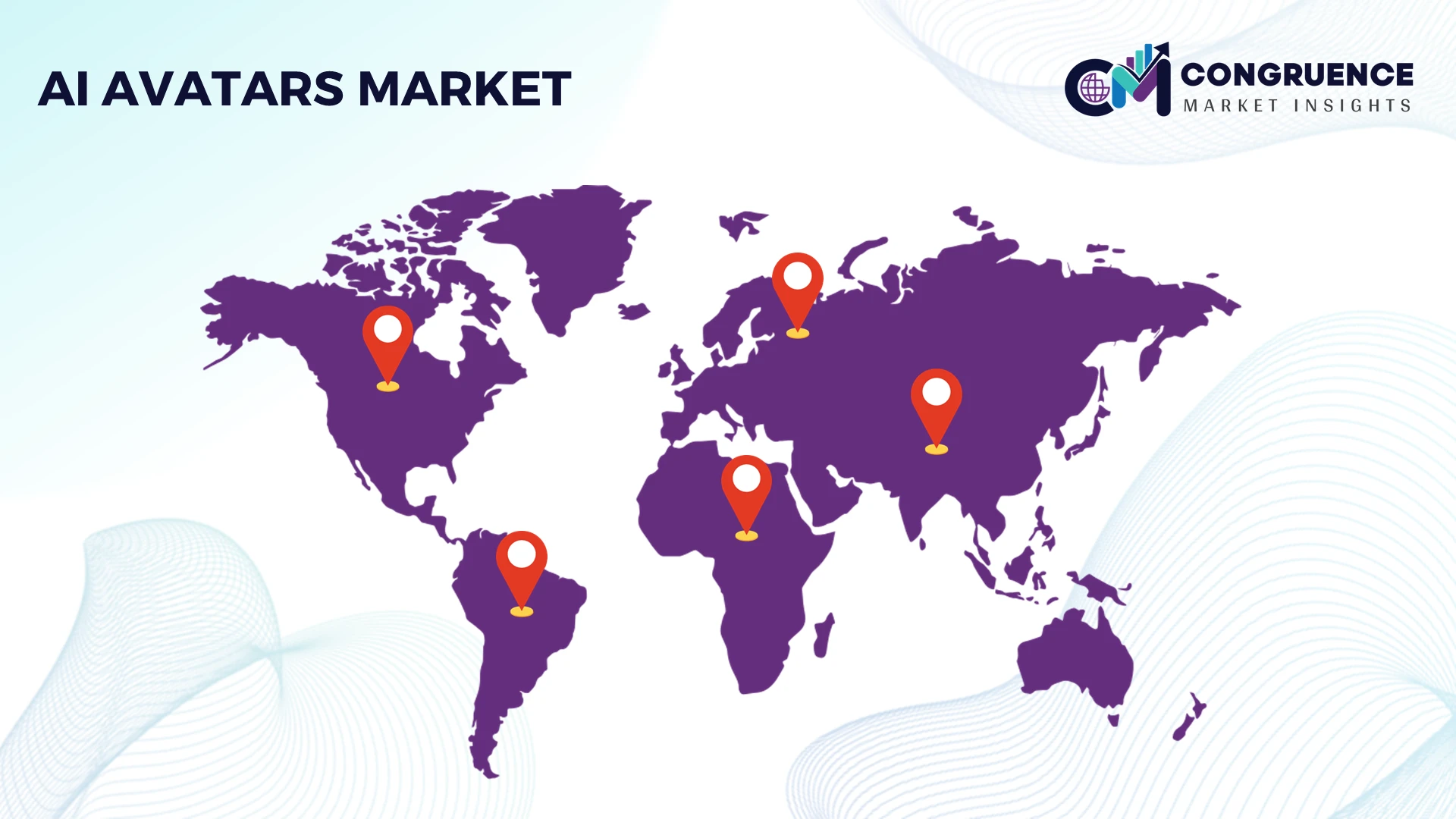
Enterprise AI Infrastructure Driving Commercial Scale
North America maintains market leadership through advanced AI infrastructure, hyperscale cloud ecosystems, and extensive enterprise deployment across BFSI, healthcare, retail, and media. The region accounts for nearly 39.2% of global AI avatar implementation, supported by mature digital transformation programs and strong investment in foundation models. More than 67% of Fortune 500 enterprises have expanded AI-enabled customer engagement initiatives, while enterprise deployment cycles have shortened by approximately 26% through cloud-native integration frameworks. Strategic alliances among AI software providers, cloud vendors, and cybersecurity specialists continue strengthening deployment reliability, multilingual capabilities, and governance standards. Organizations increasingly prioritize enterprise-grade avatar platforms with secure identity management and scalable orchestration to improve workforce productivity and customer interaction consistency.
United States Market Outlook: The United States remains the operational center of the regional market because of its concentration of AI platform developers, cloud infrastructure providers, and enterprise technology adopters. Nearly 72% of large enterprises are integrating generative AI into customer engagement and digital workplace strategies. Continued investment in AI computing infrastructure, semiconductor manufacturing, and enterprise software ecosystems enables faster commercialization, while strong collaboration between technology companies and regulated industries accelerates secure AI avatar deployment across finance, healthcare, and public services.
Regulation-Led Enterprise AI Transformation
Europe is strengthening its position through responsible AI implementation, enterprise modernization, and harmonized digital governance frameworks. The region contributes approximately 24% of global deployment activity, supported by financial services, manufacturing, education, and public-sector digitalization. Nearly 58% of enterprise buyers now prioritize explainable AI capabilities and transparent model governance, encouraging vendors to redesign platform architectures. Cross-border cloud infrastructure expansion and secure data-processing facilities continue improving operational resilience. Companies increasingly integrate AI avatars into multilingual customer engagement and workforce training while aligning deployments with evolving regulatory expectations, creating higher barriers for non-compliant providers and reinforcing enterprise confidence in commercial AI adoption.
Germany Market Outlook: Germany leads European enterprise deployment through its advanced industrial base, strong software ecosystem, and expanding AI innovation programs. Around 61% of large manufacturers are evaluating AI-powered digital assistants for employee support and customer communication. Collaboration between industrial technology providers, research institutions, and enterprise software companies continues accelerating AI avatar adoption across manufacturing, automotive, healthcare, and business services without compromising operational compliance.
Large-Scale Digital Adoption Accelerates Deployment
Asia-Pacific is emerging as the fastest-expanding market because of rapid enterprise digitization, expanding cloud infrastructure, and increasing multilingual AI adoption. The region accounts for approximately 29% of current deployments while demonstrating exceptional implementation momentum across education, financial services, retail, and telecommunications. Enterprise AI adoption has increased by nearly 36% in major digital economies, supported by national AI strategies and expanding data-center capacity. Technology companies continue localizing language models and strengthening partnerships with regional cloud providers to improve deployment efficiency and customer engagement. Growing demand for localized conversational AI solutions is reshaping platform development priorities across diverse commercial sectors.
China Market Outlook: China represents the region's largest operational market through extensive AI infrastructure, advanced digital ecosystems, and large-scale enterprise implementation. More than 65% of major technology enterprises are expanding AI-powered customer engagement capabilities using domestic AI models and cloud infrastructure. Continued investment in computing capacity, intelligent manufacturing, and digital public services strengthens enterprise deployment while encouraging platform providers to develop industry-specific AI avatar solutions tailored to local business requirements.
Digital Service Expansion Reshaping Adoption
South America is steadily expanding AI avatar adoption through financial inclusion initiatives, digital commerce growth, and enterprise automation strategies. The region contributes approximately 5% of global implementation, with banking, telecommunications, and retail leading commercial deployment. AI-enabled customer engagement projects have improved digital service efficiency by nearly 24% across major enterprises, while cloud migration continues supporting scalable implementation. Infrastructure disparities and varying enterprise digital maturity remain operational constraints; however, regional technology partnerships and managed AI service models are improving accessibility. Companies increasingly focus on cloud-based deployment to minimize implementation costs and accelerate commercial adoption.
Brazil Market Outlook: Brazil dominates regional demand through its expanding fintech ecosystem, digital banking leadership, and strong enterprise cloud adoption. Approximately 57% of large financial institutions are evaluating AI-powered virtual customer interaction platforms to improve service quality and operational responsiveness. Technology partnerships between software vendors, financial institutions, and cloud providers continue strengthening localized AI deployment while supporting broader enterprise modernization initiatives.
Government-Led AI Modernization Initiatives
The Middle East & Africa market is advancing through national AI strategies, smart city investments, and public-sector digital transformation programs. The region represents approximately 2.8% of global deployment but demonstrates increasing enterprise adoption across government services, banking, healthcare, and tourism. AI-enabled digital service initiatives have reduced administrative processing time by nearly 22% in several public-sector implementations. Continued investment in cloud infrastructure, digital identity systems, and AI innovation hubs is strengthening commercial deployment capacity. Technology vendors are expanding regional partnerships to deliver localized language capabilities and secure enterprise AI platforms aligned with government modernization priorities.
United Arab Emirates Market Outlook: The United Arab Emirates leads regional commercialization through ambitious AI policies, advanced digital infrastructure, and high enterprise technology investment. More than 60% of government digital transformation initiatives incorporate AI-enabled automation and intelligent customer engagement. Strong collaboration between public institutions, global technology providers, and innovation hubs continues accelerating AI avatar implementation across finance, healthcare, aviation, and smart government services.
Global technology innovators including Microsoft, NVIDIA, Synthesia, HeyGen and D-ID compete directly on enterprise AI platforms, while regional AI developers challenge them through localized language models and industry customization. The top five participants collectively control approximately 46% of market activity, reflecting moderate concentration with strong innovation intensity. Competition increasingly depends on inference quality, deployment speed, security architecture and multilingual performance rather than pricing alone. Advanced AI models improve interaction accuracy by nearly 32%, while optimized deployment frameworks reduce enterprise implementation time by approximately 24%. Vendors strengthen positions through cloud partnerships, proprietary foundation models, vertical-specific product development and strategic acquisitions that expand enterprise capabilities. Technology disruption continues shifting competition toward integrated AI ecosystems combining avatar generation, workflow automation and governance features. High computing infrastructure requirements, trusted AI compliance and proprietary data resources remain significant entry barriers. Sustainable competitive advantage depends on delivering scalable, secure, enterprise-ready AI avatar platforms with differentiated domain expertise and seamless system integration.
Microsoft
NVIDIA
Synthesia
HeyGen
D-ID
Hour One
Soul Machines
DeepBrain AI
Inworld AI
Colossyan
UneeQ
Tavus
Rephrase.ai
Elai.io
Current AI avatar technologies are shifting from basic scripted interfaces toward multimodal digital agents combining natural language processing, speech synthesis, computer vision, and real-time rendering. Generative AI models improve conversational accuracy by nearly 35%, while neural voice systems reduce response latency by approximately 28%. Around 60% of enterprise AI deployments now prioritize interactive assistants, enabling companies to improve customer support efficiency, automate training workflows, and deliver personalized digital experiences at scale.
Emerging technologies such as retrieval-augmented generation, emotion-aware AI, and advanced 3D rendering are improving avatar intelligence and realism. Compared with traditional rule-based virtual assistants, modern AI avatars deliver approximately 40% higher contextual response performance and reduce manual content creation costs by nearly 30%. Integration with cloud platforms, enterprise software, and digital identity systems is accelerating adoption across healthcare, education, financial services, and retail. Technology leaders benefit by combining proprietary AI models with secure enterprise infrastructure.
Between 2026 and 2028, disruptive technologies including autonomous AI agents, spatial computing, and real-time synthetic video generation will reshape avatar-based business operations. Companies investing early in scalable AI avatar ecosystems can gain competitive advantages through faster customer engagement, reduced operational workload, and improved global communication capabilities. The strongest market position will favor providers delivering secure, industry-specific, and highly adaptive avatar solutions.
February 2024 D-ID launched D-ID Agents, introducing real-time conversational AI avatars with multilingual interaction and retrieval-augmented generation capabilities. The platform enabled businesses to integrate digital humans into customer workflows, improving personalized engagement through automated conversations.
October 2024 D-ID expanded its Marketing Suite with hyper-realistic AI avatars, interactive agents, and personalized video tools. The solution supported brands with automated content creation workflows, enabling faster campaign production and broader customer communication scalability across digital channels. Source: D-ID
January 2025 Synthesia secured USD 180 million in Series D funding to accelerate enterprise AI video innovation and international expansion. The investment supported product development, talent growth, and platform scaling, strengthening adoption among more than 60,000 enterprise customers.
September 2025 Synthesia introduced Express-2, a full-body AI avatar engine combining voice cloning, diffusion transformer technology, and realistic gestures. The system generated 1080p, 30fps avatar videos, improving enterprise communication quality and scalable digital content production. Source: Synthesia
The AI Avatars Market Report covers comprehensive segmentation across types including Text-Based, Voice-Based, 2D Avatars, and 3D Avatars, along with applications such as Customer Support, Virtual Assistants, Education, Gaming, and Marketing. The study evaluates adoption patterns among BFSI, Retail, Healthcare, Education, and Media & Entertainment sectors across North America, Europe, Asia-Pacific, South America, and Middle East & Africa.
The report analyzes emerging technologies including generative AI, natural language processing, real-time rendering, voice synthesis, and digital identity solutions. It highlights deployment trends, competitive positioning, investment priorities, and strategic opportunities between 2026 and 2033. With analysis of enterprise adoption levels, technology transitions, and market participation from leading companies, the report supports decision-making for expansion planning, product innovation, partnership development, and long-term competitive positioning.
| Report Attribute/Metric | Report Details |
|---|---|
Market Revenue in 2025 | USD 6008.31 Million |
Market Revenue in 2033 | USD 51792.81 Million |
CAGR (2026 - 2033) | 30.9% |
Base Year | 2025 |
Forecast Period | 2026 - 2033 |
Historic Period | 2021 - 2025 |
Segments Covered | By Type
By Application
By End-User
|
Key Report Deliverable | Revenue Forecast, Growth Trends, Market Dynamics, Segmental Overview, Regional and Country-wise Analysis, Competition Landscape |
Region Covered | North America, Europe, Asia-Pacific, South America, Middle East, Africa |
Key Players Analyzed | Microsoft, NVIDIA, Synthesia, HeyGen, D-ID, Hour One, Soul Machines, DeepBrain AI, Inworld AI, Colossyan, UneeQ, Tavus, Rephrase.ai, Elai.io |
Customization & Pricing | Available on Request (10% Customization is Free) |




