
Reports
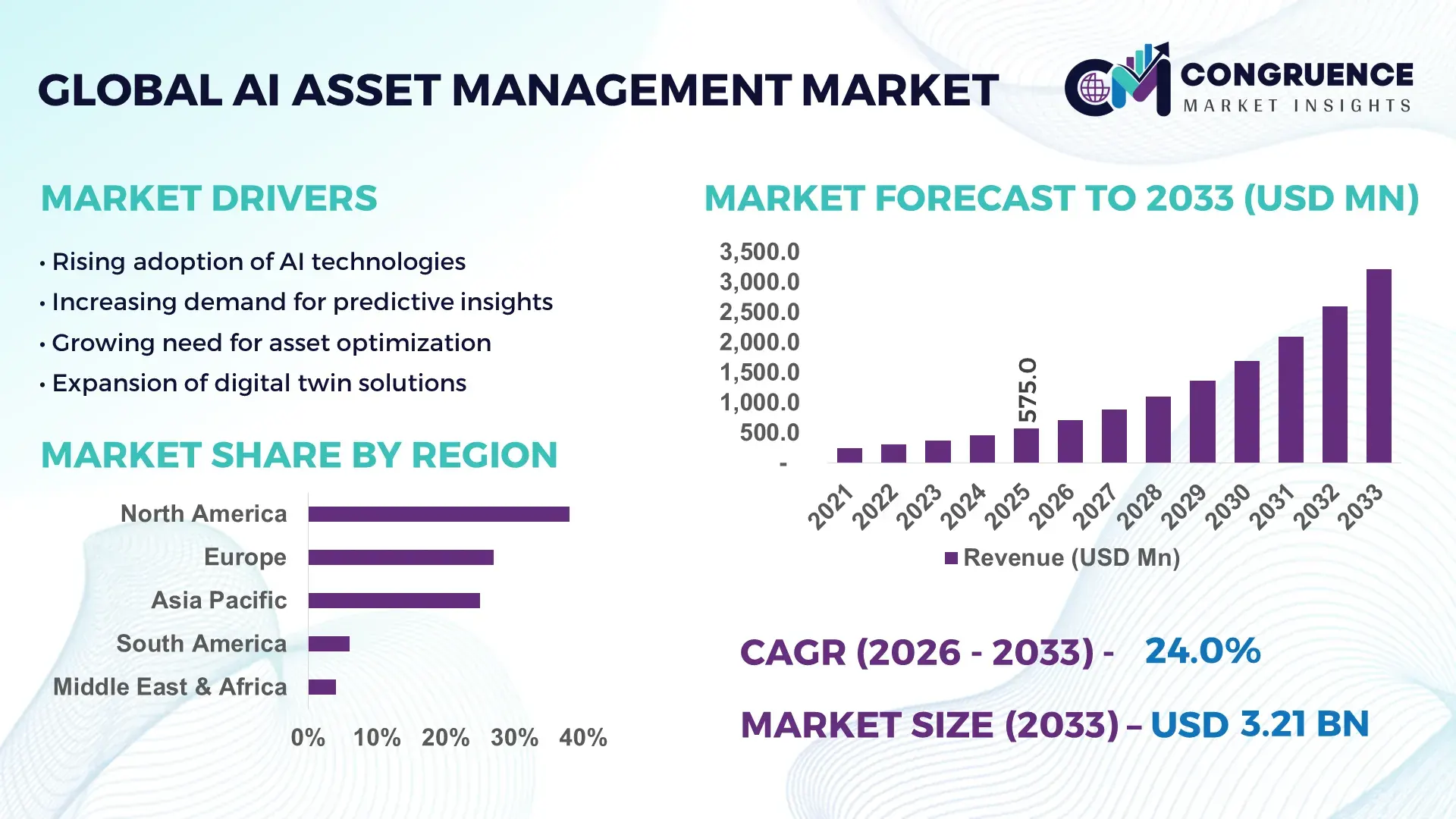
The Global AI Asset Management Market was valued at USD 575.0 Million in 2025 and is anticipated to reach a value of USD 3,214.0 Million by 2033 expanding at a CAGR of 24.0% between 2026 and 2033, according to an analysis by Congruence Market Insights. Growth is primarily driven by increasing adoption of predictive analytics and automation across financial and industrial asset management systems.
The United States leads the AI Asset Management Market with strong institutional adoption and large-scale investments. Over 68% of asset management firms in the U.S. have integrated AI-driven portfolio optimization tools, while more than 55% of industrial enterprises deploy AI for predictive maintenance and lifecycle management. The country accounts for over 40% of global AI investment in asset-centric applications, supported by advanced cloud infrastructure and high data availability. In financial services, AI-enabled trading platforms process over 75% of institutional trades, while energy and utilities sectors report a 30–35% improvement in asset uptime through AI-driven monitoring systems. Additionally, over 60% of Fortune 500 companies in the U.S. utilize AI-powered asset tracking and risk assessment tools, reflecting deep integration across sectors including manufacturing, logistics, and infrastructure management.
Market Size & Growth: USD 575.0 Million in 2025, projected to reach USD 3,214.0 Million by 2033, expanding at 24.0% CAGR driven by automation in asset lifecycle optimization.
Top Growth Drivers: AI adoption in asset tracking (65%), predictive maintenance efficiency gains (30%), data-driven investment optimization (28%).
Short-Term Forecast: By 2028, AI-driven asset systems are expected to reduce operational costs by 22% and improve asset utilization efficiency by 27%.
Emerging Technologies: Digital twins, machine learning-based predictive analytics, and edge AI integration for real-time monitoring.
Regional Leaders: North America (USD 1,250 Million by 2033) driven by enterprise AI adoption; Europe (USD 780 Million) driven by regulatory compliance; Asia-Pacific (USD 900 Million) driven by industrial automation.
Consumer/End-User Trends: Over 62% of enterprises prioritize AI-based asset optimization tools, with strong adoption in finance, manufacturing, and utilities sectors.
Pilot or Case Example: In 2025, a European utility firm reduced equipment downtime by 35% using AI-based predictive maintenance platforms.
Competitive Landscape: Market leader holds ~18% share, followed by IBM, Microsoft, SAP, Oracle, and BlackRock solutions.
Regulatory & ESG Impact: Over 45% of firms adopt AI tools aligned with ESG goals, improving asset efficiency and reducing emissions by up to 20%.
Investment & Funding Patterns: Over USD 2.5 Billion invested in AI asset platforms between 2023–2025, with increasing venture funding in predictive analytics startups.
Innovation & Future Outlook: Integration of AI with IoT and blockchain is enabling real-time asset tracking, enhanced transparency, and automated decision-making.
AI Asset Management Market is increasingly shaped by financial services (38%), manufacturing (26%), and energy sectors (18%), with rapid advancements in AI-driven analytics platforms and digital twins. Regulatory frameworks promoting data transparency and ESG compliance are accelerating adoption, while Asia-Pacific shows strong growth due to industrial expansion. Emerging trends include autonomous asset monitoring and AI-integrated risk modeling systems enhancing decision-making efficiency.
AI Asset Management Market is becoming strategically essential for organizations aiming to optimize asset performance, reduce operational inefficiencies, and enhance decision-making accuracy. AI-driven predictive analytics delivers up to 35% improvement compared to traditional rule-based asset monitoring systems, enabling enterprises to forecast failures and optimize maintenance schedules more effectively. North America dominates in volume, while Asia-Pacific leads in adoption with over 58% of enterprises integrating AI into industrial asset workflows, particularly in manufacturing and logistics sectors.
The market is witnessing strong alignment with digital transformation strategies, where AI integration supports real-time monitoring, automated risk analysis, and portfolio optimization. By 2028, AI-powered asset management platforms are expected to improve operational efficiency by 30% and reduce downtime by nearly 25% across industrial applications. Organizations are increasingly investing in digital twin technologies and edge AI systems to enhance asset visibility and lifecycle management.
From a compliance and ESG perspective, firms are committing to sustainability improvements such as 20–25% reduction in carbon emissions by 2030 through AI-enabled asset efficiency optimization. AI tools are also helping companies meet regulatory standards by improving reporting accuracy and transparency in asset utilization.
In 2025, Germany achieved a 28% reduction in industrial equipment downtime through AI-driven predictive maintenance initiatives in manufacturing clusters. This demonstrates how AI adoption is delivering measurable operational benefits. Looking forward, the AI Asset Management Market is expected to evolve as a critical pillar supporting resilience, regulatory compliance, and sustainable growth, driven by continuous innovation in machine learning, IoT integration, and autonomous asset management systems.
The AI Asset Management Market is characterized by rapid technological advancements, increasing data generation, and growing demand for intelligent asset optimization solutions across industries. Enterprises are leveraging AI to improve asset utilization, reduce operational costs, and enhance predictive capabilities. Over 60% of large enterprises have implemented AI-based asset monitoring systems, while nearly 45% are investing in advanced analytics platforms for real-time decision-making. The integration of IoT devices with AI platforms is further enabling continuous data collection and analysis, significantly improving asset lifecycle management. Additionally, financial institutions are increasingly adopting AI-driven portfolio management systems to optimize investment decisions and risk assessment. Regulatory pressures and ESG commitments are also influencing adoption, as organizations seek to improve transparency and sustainability metrics. The market is further driven by increasing cloud adoption, with over 70% of AI asset management solutions now deployed on cloud-based platforms, enhancing scalability and accessibility for enterprises across various sectors.
The growing adoption of predictive analytics is a key driver accelerating the AI Asset Management Market. More than 65% of enterprises now utilize predictive maintenance tools to monitor asset health and forecast potential failures. This has resulted in a 30–40% reduction in unexpected equipment downtime across manufacturing and energy sectors. AI-powered analytics platforms process large volumes of real-time data, enabling organizations to optimize maintenance schedules and extend asset lifecycles by up to 20%. In financial services, predictive analytics is used by over 70% of asset managers to enhance portfolio performance and risk management. Additionally, predictive models improve operational efficiency by enabling proactive decision-making, reducing maintenance costs by nearly 25%. The widespread adoption of IoT devices further enhances predictive capabilities by providing continuous data streams, allowing AI systems to deliver highly accurate insights and improve asset performance across industries.
Data privacy concerns and integration complexities significantly restrain the AI Asset Management Market. Approximately 48% of organizations report difficulties in integrating AI systems with legacy infrastructure, limiting the effectiveness of AI deployment. Additionally, over 52% of enterprises express concerns regarding data security and compliance with stringent regulations, particularly in regions with strict data protection laws. AI systems require access to large datasets, increasing the risk of data breaches and unauthorized access. Moreover, inconsistencies in data formats and lack of standardization across systems create challenges in achieving seamless integration. Organizations also face high initial implementation costs, with nearly 40% of small and medium enterprises delaying AI adoption due to budget constraints. These factors collectively hinder the widespread adoption of AI asset management solutions, especially in industries with complex legacy systems and strict regulatory requirements.
Digital twin technology presents significant growth opportunities in the AI Asset Management Market by enabling real-time simulation and monitoring of physical assets. Over 50% of industrial enterprises are exploring digital twin solutions to improve asset performance and operational efficiency. These technologies allow organizations to create virtual replicas of assets, enabling predictive maintenance and performance optimization. AI-powered digital twins can reduce maintenance costs by up to 25% and improve asset utilization by 30%. In sectors such as energy and manufacturing, digital twins are being used to simulate operational scenarios and optimize resource allocation. The increasing adoption of Industry 4.0 practices further enhances the demand for digital twin solutions. Additionally, advancements in cloud computing and IoT integration are making digital twin technology more accessible, creating new opportunities for AI-driven asset management across industries.
High implementation costs and a shortage of skilled professionals remain key challenges for the AI Asset Management Market. Nearly 45% of organizations report a lack of skilled AI professionals capable of managing advanced analytics systems. The cost of deploying AI solutions, including infrastructure, software, and training, can exceed 30% of initial IT budgets, making it difficult for smaller enterprises to adopt these technologies. Additionally, maintaining AI systems requires continuous updates and monitoring, increasing operational costs. The complexity of AI algorithms and the need for high-quality data further complicate implementation. Organizations also face challenges in change management, as integrating AI into existing workflows requires significant process restructuring. These factors create barriers to adoption, particularly in regions with limited access to skilled talent and technological infrastructure.
• Rapid Expansion of Predictive Maintenance Adoption: Over 68% of industrial enterprises have adopted AI-based predictive maintenance systems, leading to a 32% reduction in unexpected equipment failures. These systems analyze real-time sensor data to optimize maintenance schedules and extend asset lifespans by nearly 20%, significantly improving operational efficiency across manufacturing and utilities sectors.
• Integration of Digital Twin Technologies: Around 54% of large-scale enterprises are implementing digital twin solutions to simulate asset performance. These technologies enable a 28% improvement in operational planning accuracy and reduce maintenance costs by 22%, particularly in energy and infrastructure sectors where real-time monitoring is critical.
• Growth in Cloud-Based AI Platforms: More than 72% of AI asset management solutions are now deployed on cloud platforms, enabling scalability and remote access. Cloud integration has improved data processing speeds by 35% and reduced infrastructure costs by approximately 25%, making AI solutions more accessible to mid-sized enterprises.
• Increasing Use of AI in Financial Asset Optimization: Approximately 70% of asset management firms are utilizing AI-driven portfolio optimization tools, resulting in a 26% improvement in investment decision accuracy. AI models analyze large datasets to identify market trends and optimize asset allocation strategies, enhancing financial performance.
The AI Asset Management Market is segmented based on type, application, and end-user, reflecting its diverse adoption across industries. By type, predictive analytics and asset performance management solutions dominate due to their ability to enhance operational efficiency and reduce downtime. Machine learning-based optimization tools are gaining traction as organizations prioritize real-time insights and automation. By application, financial asset management and industrial asset monitoring are the most prominent segments, driven by increasing demand for risk management and operational optimization. In terms of end-users, large enterprises lead adoption due to their higher investment capacity and complex asset portfolios, while small and medium enterprises are gradually increasing adoption through cloud-based solutions. Across regions, developed economies show higher adoption rates due to advanced infrastructure, while emerging markets are witnessing rapid growth driven by industrialization and digital transformation initiatives.
Predictive analytics solutions account for approximately 38% of adoption, making them the leading segment due to their ability to forecast asset failures and optimize maintenance schedules. Asset performance management systems follow with around 27%, while AI-driven portfolio optimization tools contribute nearly 21%. However, digital twin-based asset management solutions are the fastest-growing segment, expected to grow at a CAGR of approximately 28%, driven by increasing adoption in manufacturing and energy sectors. Other types, including anomaly detection systems and automated asset tracking tools, collectively account for nearly 14% of the market, serving niche applications in logistics and infrastructure management. These solutions are gaining traction as organizations seek real-time visibility and improved asset utilization.
• In 2025, a global manufacturing firm deployed digital twin technology to monitor over 10,000 assets, achieving a 30% reduction in maintenance costs and improving operational efficiency across multiple facilities.
Financial asset management accounts for approximately 42% of adoption, driven by widespread use of AI in portfolio optimization and risk analysis. Industrial asset monitoring holds around 31%, while infrastructure and utilities applications contribute nearly 17%. However, healthcare asset management is the fastest-growing segment, with an expected CAGR of 26%, supported by increasing use of AI for equipment tracking and predictive maintenance. Other applications, including transportation and logistics, collectively account for about 10%, focusing on fleet management and asset tracking. In 2025, more than 40% of global enterprises reported using AI asset management systems for operational efficiency improvements. Additionally, over 65% of financial institutions rely on AI tools for investment decision-making and risk assessment.
• In 2025, AI-powered asset tracking systems were deployed across over 200 hospitals globally, improving equipment utilization rates by 25% and reducing operational inefficiencies significantly.
Large enterprises dominate the market with approximately 61% share due to their extensive asset portfolios and higher investment capacity. Small and medium enterprises account for around 39%, with adoption increasing through cloud-based AI solutions. However, SMEs represent the fastest-growing segment, with an expected CAGR of 27%, driven by cost-effective and scalable AI platforms. Industries such as finance, manufacturing, and energy show the highest adoption rates, with over 70% of large enterprises implementing AI-driven asset management systems. In 2025, more than 45% of SMEs reported piloting AI asset management solutions, while over 60% of enterprises highlighted improved operational efficiency through AI integration.
• In 2025, over 500 mid-sized companies implemented AI-based asset management platforms, achieving a 22% improvement in asset utilization and operational efficiency.
North America accounted for the largest market share at 38% in 2025 however, Asia-Pacific is expected to register the fastest growth, expanding at a CAGR of 26% between 2026 and 2033.

North America leads due to high enterprise adoption, with over 65% of companies deploying AI-based asset management systems. Europe holds approximately 27% share, driven by regulatory compliance and sustainability initiatives, while Asia-Pacific accounts for nearly 25%, supported by rapid industrialization and digital transformation. South America and Middle East & Africa collectively contribute around 10%, with increasing adoption in energy and infrastructure sectors. The global market shows strong regional diversification, with developed economies focusing on advanced AI integration, while emerging regions emphasize scalability and cost efficiency. Over 70% of AI solutions in North America are cloud-based, compared to 55% in Asia-Pacific, highlighting differences in technological maturity and infrastructure development.
North America holds approximately 38% of the global market share, driven by strong adoption across financial services, healthcare, and manufacturing sectors. Over 68% of enterprises utilize AI-driven asset management platforms for predictive analytics and operational optimization. Government initiatives supporting digital transformation and data-driven decision-making further enhance adoption. The region has witnessed a 30% increase in AI investments across asset-intensive industries. A key player example includes IBM, which is actively developing AI-powered asset monitoring solutions, enabling enterprises to reduce downtime by up to 35%. Consumer behavior in this region reflects high enterprise adoption, particularly in finance and healthcare, where organizations prioritize efficiency and risk management through AI technologies.
Europe accounts for approximately 27% of the global market, with key countries including Germany, the UK, and France driving adoption. Strict regulatory frameworks and sustainability initiatives encourage organizations to adopt AI-based asset management systems. Over 58% of enterprises in Europe focus on implementing AI solutions aligned with ESG goals. The region has seen a 25% increase in adoption of explainable AI technologies to ensure compliance and transparency. SAP, a leading player, is enhancing AI-driven asset management platforms to improve operational efficiency. Consumer behavior reflects a strong preference for transparent and compliant AI systems, driven by regulatory requirements and environmental considerations.
Asia-Pacific ranks among the fastest-growing regions, accounting for approximately 25% of the global market. Major countries such as China, India, and Japan are leading adoption due to rapid industrialization and digital transformation. Over 60% of enterprises in the region are investing in AI-based asset management systems. The rise of smart manufacturing and IoT integration has increased demand for real-time asset monitoring solutions. A notable example includes Tata Consultancy Services, which is expanding AI-driven asset management solutions across industrial sectors. Consumer behavior in this region is driven by mobile-first technologies and increasing adoption of AI-powered applications in logistics and manufacturing.
South America accounts for nearly 6% of the global market, with Brazil and Argentina being key contributors. The region is witnessing increased investment in infrastructure and energy sectors, driving demand for AI-based asset management solutions. Over 45% of enterprises in the region are exploring AI technologies for operational efficiency. Government incentives and trade policies supporting digital transformation are further boosting adoption. Regional players are focusing on AI integration to enhance asset performance. Consumer behavior reflects growing demand for localized AI solutions, particularly in media and language-based applications.
Middle East & Africa hold approximately 4% of the global market, with UAE and South Africa leading adoption. The region’s demand is primarily driven by oil & gas and construction sectors, where AI is used to optimize asset performance. Over 50% of large enterprises in the region are investing in AI-based asset monitoring systems. Technological modernization initiatives and international trade partnerships are accelerating adoption. A key regional trend includes the use of AI for predictive maintenance in energy infrastructure. Consumer behavior highlights increasing demand for efficient resource management and cost optimization.
United States – 34% Market share: Strong enterprise adoption and high investment in AI-driven asset optimization technologies.
China – 21% Market share: Rapid industrialization and increasing deployment of AI in manufacturing and infrastructure sectors.
The AI Asset Management Market is moderately fragmented, with over 120 active global and regional players competing across various segments. The top five companies collectively account for approximately 52% of the market share, indicating a mix of consolidation and competitive diversity. Leading players focus on strategic partnerships, product innovation, and acquisitions to strengthen their market position. Over 40% of companies have invested in AI-driven predictive analytics platforms, while nearly 35% are integrating IoT capabilities to enhance asset monitoring solutions.
The market is characterized by rapid technological advancements, with companies launching AI-powered digital twin solutions and cloud-based asset management platforms. Additionally, more than 25% of firms have engaged in mergers and acquisitions to expand their technological capabilities and geographic reach. Innovation remains a key competitive factor, with companies investing heavily in machine learning algorithms and real-time analytics to differentiate their offerings and capture market share.
Microsoft
SAP
Oracle
BlackRock
Siemens
Schneider Electric
General Electric
ABB
Honeywell
Cisco Systems
Infosys
Tata Consultancy Services
Accenture
The AI Asset Management Market is being significantly transformed by advancements in machine learning, IoT integration, cloud computing, and edge analytics. Machine learning algorithms are now capable of analyzing vast datasets with over 90% accuracy in predictive maintenance scenarios, enabling organizations to identify potential failures before they occur. IoT integration has expanded rapidly, with more than 75% of industrial assets now equipped with sensors that generate real-time data for AI systems. This has improved asset monitoring efficiency by approximately 35% and reduced maintenance costs by up to 25%.
Cloud-based platforms dominate the technological landscape, with over 70% of AI asset management solutions deployed on cloud infrastructure, enabling scalability and remote accessibility. Edge computing is also gaining traction, allowing real-time data processing at the source and reducing latency by nearly 40%. Digital twin technology is emerging as a key innovation, with over 50% of large enterprises implementing virtual asset replicas to simulate performance and optimize operations. Additionally, blockchain integration is enhancing transparency and security in asset tracking systems, with adoption increasing by 20% annually.
Natural language processing (NLP) is being used to improve user interaction with AI systems, enabling more intuitive data analysis and reporting. Furthermore, advancements in computer vision are enabling automated inspection and monitoring of physical assets, improving accuracy and reducing manual intervention. These technologies collectively contribute to enhanced operational efficiency, cost optimization, and improved decision-making capabilities across industries.
• In June 2025, IBM announced the release of Maximo Application Suite 9.1, introducing a generative AI assistant built with watsonx.ai to enhance asset lifecycle management. The update enables real-time conversational insights, faster decision-making, and improved workforce productivity through integrated AI-driven asset analytics.
• In December 2025, IBM introduced Maximo Condition Insight, an agentic AI capability that provides instant, explainable asset condition analysis and prescriptive maintenance recommendations. The system evaluates real-time operational data and automates decision-making workflows, helping organizations transition from reactive to predictive maintenance strategies. Source: www.ibm.com
• In June 2025, Meralco PowerGen Corporation (MGEN) adopted IBM Maximo Application Suite to optimize asset management across energy operations. The deployment focuses on improving operational efficiency, enhancing maintenance processes, and supporting large-scale power generation asset performance monitoring.
• In June 2024, IBM launched Maximo Application Suite 9.0 with AI-powered work order intelligence and emissions management capabilities. The platform leverages generative AI to improve maintenance workflows, enhance data quality, and support sustainability tracking, enabling organizations to reduce operational inefficiencies and environmental impact.
The AI Asset Management Market Report provides a comprehensive analysis of the global landscape, covering key segments such as type, application, end-user industries, and regional distribution. The report evaluates a wide range of AI-driven solutions including predictive analytics, asset performance management, digital twin technologies, and automated asset tracking systems. It highlights adoption trends across major industries such as financial services, manufacturing, energy, healthcare, and logistics, which collectively account for over 80% of market demand.
Geographically, the report covers North America, Europe, Asia-Pacific, South America, and Middle East & Africa, offering detailed insights into regional adoption patterns, technological advancements, and industry-specific trends. The report also examines the impact of emerging technologies such as IoT, cloud computing, edge analytics, and blockchain on asset management processes. Over 70% of organizations are transitioning toward cloud-based AI solutions, while more than 50% are exploring digital twin applications for enhanced asset visibility.
Additionally, the report includes analysis of regulatory frameworks, ESG considerations, and investment trends influencing market growth. It evaluates the competitive landscape, profiling key market players and their strategic initiatives such as partnerships, product innovations, and mergers. The scope further extends to identifying emerging opportunities in niche segments such as autonomous asset monitoring and AI-driven risk management systems. Overall, the report provides a holistic view of the market, enabling decision-makers to understand current dynamics, technological advancements, and future growth prospects.
| Report Attribute / Metric | Details |
|---|---|
| Market Revenue (2025) | USD 575.0 Million |
| Market Revenue (2033) | USD 3,214.0 Million |
| CAGR (2026–2033) | 24.0% |
| Base Year | 2025 |
| Forecast Period | 2026–2033 |
| Historic Period | 2021–2025 |
| Segments Covered |
By Type
By Application
By End-User Insights
|
| Key Report Deliverables | Revenue Forecast; Market Trends; Growth Drivers & Restraints; Technology Insights; Segmentation Analysis; Regional Insights; Competitive Landscape; Regulatory & ESG Overview; Recent Developments |
| Regions Covered | North America; Europe; Asia-Pacific; South America; Middle East & Africa |
| Key Players Analyzed | IBM; Microsoft; SAP; Oracle; BlackRock; Siemens; Schneider Electric; General Electric; ABB; Honeywell; Cisco Systems; Infosys; Tata Consultancy Services; Accenture |
| Customization & Pricing | Available on Request (10% Customization Free) |




