
Reports
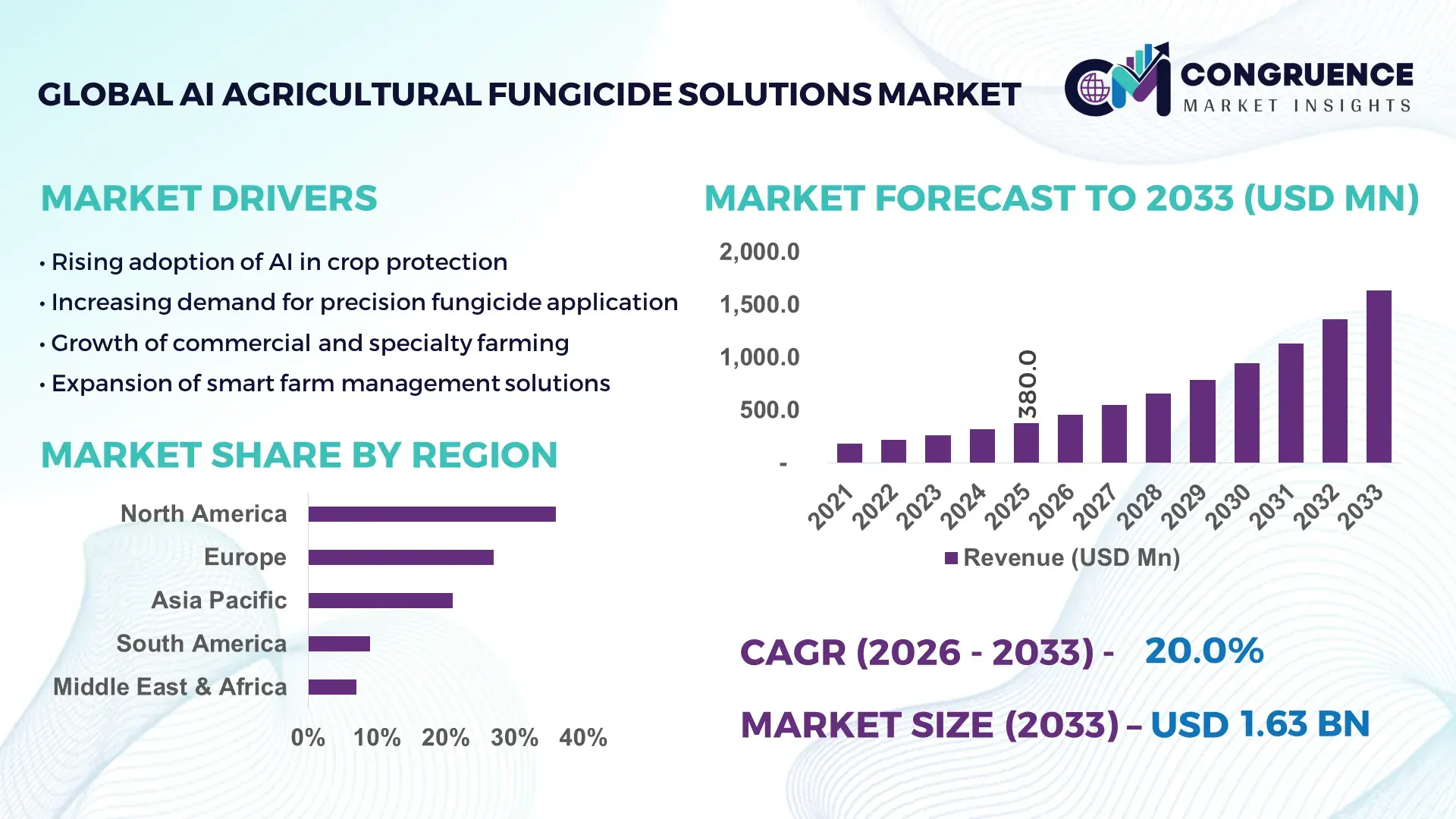
The Global AI Agricultural Fungicide Solutions Market was valued at USD 380.0 Million in 2025 and is anticipated to reach a value of USD 1,633.9 Million by 2033 expanding at a CAGR of 20% between 2026 and 2033, according to an analysis by Congruence Market Insights. The growth is primarily driven by increasing deployment of AI-powered crop disease detection, predictive analytics, and precision spraying technologies that enable farmers to optimize fungicide usage and improve crop protection efficiency.
In the United States, which represents the dominant country in the AI Agricultural Fungicide Solutions Market, adoption is supported by large-scale digital farming infrastructure and high agricultural technology investment. Over 38% of U.S. commercial farms use some form of AI-enabled precision agriculture tools, including disease monitoring platforms and drone-based crop surveillance systems. The country operates more than 900 million acres of farmland, and nearly 52% of large crop producers utilize satellite or sensor-based crop health analytics to detect fungal infections early. In addition, public and private agricultural technology investment exceeded USD 4.5 billion annually in digital farming innovations, supporting deployment of AI-driven crop protection software, automated spraying drones, and smart field sensors across corn, soybean, and wheat production regions.
Market Size & Growth: The market was valued at USD 380.0 Million in 2025 and is projected to reach USD 1,633.9 Million by 2033, expanding at a 20% CAGR due to growing adoption of AI-driven crop disease detection and precision spraying technologies.
Top Growth Drivers: Precision farming adoption expanding by 42%, AI-based crop disease detection improving detection accuracy by 35%, and drone-enabled fungicide spraying improving application efficiency by 30%.
Short-Term Forecast: By 2028, AI-powered crop analytics platforms are expected to reduce fungicide overuse by 22% and improve disease detection speed by 28% across commercial farms.
Emerging Technologies: Hyperspectral crop imaging, autonomous agricultural drones, and AI-powered predictive disease modeling platforms are transforming fungicide application strategies.
Regional Leaders: North America projected to reach USD 620 Million by 2033 with strong adoption of precision agriculture; Europe approaching USD 420 Million by 2033 driven by sustainable farming initiatives; Asia-Pacific expected to exceed USD 360 Million by 2033 supported by large-scale digital agriculture programs.
Consumer/End-User Trends: Large commercial farms and agribusinesses account for nearly 48% of AI fungicide solution adoption, while agritech cooperatives and precision farming service providers contribute approximately 32% of deployments.
Pilot or Case Example: In 2024, an AI-driven crop disease monitoring pilot in Brazil demonstrated 27% reduction in fungicide application volumes while improving early disease detection accuracy by 31%.
Competitive Landscape: Bayer Crop Science holds approximately 18% industry presence, followed by Syngenta, Corteva Agriscience, BASF Digital Farming, and Trimble Agriculture.
Regulatory & ESG Impact: Sustainable agriculture regulations and integrated pest management guidelines are encouraging up to 20% reduction in chemical pesticide use across several farming regions.
Investment & Funding Patterns: Global agritech investments related to AI crop protection technologies exceeded USD 3.2 billion between 2022 and 2025, with strong venture funding in precision agriculture startups.
Innovation & Future Outlook: Integration of satellite imaging, AI predictive disease models, and autonomous field robotics is expected to enable real-time crop health monitoring across more than 40% of large agricultural operations by 2030.
AI Agricultural Fungicide Solutions are increasingly applied across row crop farming (≈44%), specialty crops (≈31%), and greenhouse agriculture (≈18%), supported by innovations such as AI-based disease recognition algorithms and drone-assisted fungicide spraying systems. Stricter environmental regulations promoting reduced chemical use, combined with rising adoption of precision farming in North America and Europe, are accelerating technology deployment. Emerging integration with IoT crop sensors and satellite monitoring platforms is expected to enhance predictive disease analytics and optimize fungicide application strategies.
The AI Agricultural Fungicide Solutions Market is becoming strategically important as global agriculture increasingly relies on digital technologies to improve crop protection, productivity, and sustainability. AI-driven crop disease detection platforms are enabling real-time analysis of plant health through satellite imaging, field sensors, and drone-based monitoring systems. These systems can analyze thousands of crop images daily and detect fungal infections significantly earlier than traditional scouting methods. For example, AI-powered crop disease detection delivers nearly 35% faster diagnosis compared to manual field inspection, allowing farmers to apply fungicides precisely when required and minimize chemical waste.
From a strategic perspective, precision agriculture integration is reshaping crop protection practices. North America dominates in volume of AI-enabled agricultural technology deployments, supported by large mechanized farms and advanced digital infrastructure, while Europe leads in adoption with nearly 46% of commercial farming enterprises deploying precision agriculture technologies focused on sustainable crop protection. Governments and agricultural cooperatives are increasingly promoting data-driven fungicide management systems to comply with environmental regulations and improve yield stability.
Short-term technological evolution is expected to further strengthen market relevance. By 2028, AI-enabled predictive crop disease modeling platforms are expected to reduce fungicide application volumes by nearly 25% while improving early disease detection accuracy by 30%. These solutions integrate climate analytics, soil data, and plant health imaging to forecast fungal outbreaks before visible symptoms appear. At the same time, environmental sustainability initiatives are influencing technology deployment. Agricultural producers and agritech companies are committing to reducing chemical pesticide usage by up to 20% by 2030, aligning with global ESG goals for sustainable agriculture.
Real-world implementations highlight measurable benefits. In 2024, a precision agriculture program in the United States achieved nearly 29% reduction in fungicide overuse through AI-driven crop disease monitoring and drone-assisted spraying technologies. Similar digital farming initiatives across Asia-Pacific and Europe are improving crop yield consistency while lowering environmental impact. As global agriculture faces climate variability and increasing disease pressures, the AI Agricultural Fungicide Solutions Market is positioned as a critical pillar supporting resilient, compliant, and sustainable agricultural production systems.
The AI Agricultural Fungicide Solutions Market is evolving rapidly due to the growing convergence of artificial intelligence, precision agriculture technologies, and sustainable crop protection practices. Farmers and agribusinesses are increasingly adopting AI-enabled crop disease detection systems that analyze satellite imagery, drone data, and sensor-based crop monitoring inputs to identify fungal infections at early stages. These solutions help optimize fungicide usage, improve crop yields, and reduce chemical overapplication. The expansion of digital farming ecosystems is also accelerating adoption, with agricultural IoT sensors, automated field equipment, and cloud-based analytics platforms becoming integral components of modern crop management strategies.
Climate variability and increasing crop disease outbreaks are further influencing market dynamics. Global agriculture faces rising threats from fungal pathogens affecting staple crops such as wheat, rice, soybeans, and maize. As a result, producers are seeking advanced technologies that provide predictive insights into disease development and enable targeted fungicide interventions. Government support programs for sustainable agriculture and digital farming transformation are also encouraging adoption of AI-driven crop protection solutions. In addition, partnerships between agritech companies, research institutions, and agricultural cooperatives are driving innovation in AI-based disease modeling, precision spraying technologies, and automated crop monitoring platforms.
The rapid expansion of precision agriculture is one of the most significant drivers for the AI Agricultural Fungicide Solutions Market. Precision farming systems rely heavily on data analytics, remote sensing, and machine learning algorithms to monitor crop health and detect disease patterns across large agricultural fields. Globally, more than 35% of large commercial farms have adopted some form of precision agriculture technology, including satellite-based crop monitoring, autonomous tractors, and sensor-enabled irrigation systems. AI-based disease detection platforms integrate these datasets to identify fungal infections before they spread widely. The ability to perform targeted fungicide application significantly improves crop protection efficiency. Traditional blanket spraying methods often result in excessive chemical use, whereas AI-driven predictive analytics enable farmers to treat only affected areas. Studies show that precision fungicide management systems can reduce chemical application volumes by 20–30% while maintaining crop health. In addition, drone-based crop surveillance systems equipped with high-resolution cameras can scan up to 200 hectares of farmland in a single day, providing real-time data for disease detection algorithms. These technological capabilities are encouraging farmers and agribusinesses to invest in AI agricultural platforms that enhance productivity while reducing operational costs and environmental impact.
Despite its potential benefits, the AI Agricultural Fungicide Solutions Market faces challenges related to high initial investment and technology integration costs. Deploying AI-driven crop protection systems often requires multiple hardware and software components, including agricultural drones, satellite imagery subscriptions, IoT sensors, and cloud-based analytics platforms. For small and medium-scale farmers, these investments can be difficult to justify, especially in regions where agricultural profit margins are relatively low. In addition, integrating AI platforms with existing agricultural machinery and farm management systems can be technically complex. Many farms operate legacy equipment that lacks compatibility with modern digital farming platforms, requiring additional upgrades or specialized data integration services. Rural connectivity limitations also restrict the adoption of cloud-based agricultural analytics solutions. Approximately 45% of agricultural regions in developing economies still lack reliable broadband infrastructure, making real-time data transmission and analysis challenging. Furthermore, farmers require training to effectively interpret AI-generated crop health insights and implement precision fungicide strategies. These technical, financial, and infrastructure barriers continue to limit adoption in several agricultural regions.
The expansion of digital agriculture ecosystems presents significant opportunities for the AI Agricultural Fungicide Solutions Market. Governments, agricultural technology companies, and research institutions are investing heavily in smart farming platforms that integrate data from satellites, drones, soil sensors, and climate monitoring systems. These interconnected systems create comprehensive agricultural data environments that enable advanced AI models to analyze crop health patterns and predict disease outbreaks with higher accuracy. For instance, modern agricultural satellites can capture high-resolution crop imagery covering more than 95% of global farmland areas, providing continuous monitoring of vegetation health and environmental conditions. When combined with machine learning algorithms, these datasets allow farmers to detect fungal infections days or even weeks before symptoms become visible to the human eye. Additionally, agricultural robotics and autonomous spraying equipment are creating new opportunities for automated fungicide application systems. These machines can treat affected crop zones with precise dosage levels, improving efficiency and reducing chemical waste. As digital agriculture platforms expand globally, AI-driven crop protection solutions are expected to become central components of integrated farm management strategies.
One of the major challenges facing the AI Agricultural Fungicide Solutions Market is the complexity of accurately predicting fungal disease outbreaks across diverse agricultural environments. Crop diseases are influenced by numerous variables, including temperature fluctuations, humidity levels, soil conditions, and crop genetics. AI algorithms require large volumes of high-quality agricultural data to generate reliable predictions, but such datasets are often incomplete or inconsistent across different farming regions. Climate variability further complicates disease prediction models. Unpredictable weather patterns, including sudden rainfall or prolonged drought periods, can rapidly alter disease development conditions and reduce the accuracy of predictive analytics. For example, fungal pathogens can spread quickly in humid environments, but environmental changes can disrupt established forecasting models. Another challenge is the standardization of agricultural data collected from different sensors, drones, and monitoring platforms. Without consistent data formats and interoperability standards, integrating multiple data sources into a unified AI system can be difficult. These technical complexities require continuous algorithm training, improved data infrastructure, and stronger collaboration between agritech companies and agricultural research organizations.
• Rapid Adoption of AI-Based Crop Disease Detection Platforms: Advanced AI algorithms are increasingly used to analyze crop imagery and detect fungal infections at early stages. Modern machine learning models trained on millions of plant images can identify disease symptoms with over 90% classification accuracy. Agricultural drones equipped with multispectral cameras can scan up to 250 hectares per day, enabling large farms to monitor crop health continuously. Approximately 41% of precision agriculture technology users have integrated AI disease detection tools, allowing farmers to reduce manual crop scouting efforts and accelerate fungicide treatment decisions.
• Expansion of Drone-Enabled Precision Fungicide Spraying: Drone-based crop spraying systems are transforming fungicide application strategies by enabling highly targeted treatments. Agricultural spraying drones can apply fungicides across 10–15 hectares per hour, significantly faster than manual spraying methods. Studies show that drone-assisted spraying can reduce chemical use by 25% and improve application uniformity by 30%. In Asia-Pacific alone, more than 200,000 agricultural drones are currently deployed, supporting disease management across rice, wheat, and vegetable crops.
• Integration of Satellite Imaging and Climate Analytics: Satellite-based crop monitoring is becoming a key component of AI agricultural fungicide solutions. Modern agricultural satellites capture vegetation health data for nearly 90% of global farmland, enabling continuous monitoring of crop stress indicators. AI systems process satellite imagery along with weather and soil data to predict fungal disease risks with improved accuracy. These predictive analytics platforms can provide disease outbreak warnings 7–10 days in advance, allowing farmers to implement preventive fungicide strategies before infections spread.
• Growth of AI-Enabled Farm Management Platforms: Digital farm management platforms integrating AI analytics, IoT sensors, and automated equipment are becoming central to modern crop protection systems. Over 36% of large agricultural enterprises now operate cloud-based farm management software that tracks crop health, weather patterns, and pesticide applications. These platforms generate data-driven recommendations for fungicide application schedules and crop treatment strategies. Integration with field sensors measuring soil moisture, humidity, and temperature improves disease prediction models and supports more precise fungicide application decisions across large farming operations.
The AI Agricultural Fungicide Solutions Market is segmented across technology type, application area, and end-user category, reflecting the diverse ways in which artificial intelligence is integrated into modern crop protection systems. Each segment plays a distinct role in improving fungal disease detection, optimizing fungicide application strategies, and supporting sustainable agricultural production. AI-enabled disease prediction platforms, drone-based spraying systems, and crop monitoring tools collectively form a digital ecosystem designed to enhance productivity and minimize chemical usage.
From a segmentation perspective, technology categories such as AI disease detection platforms, precision spraying systems, and predictive analytics tools dominate adoption due to their ability to provide actionable insights for large-scale farms. Application segments are strongly linked to crop monitoring, disease prediction, and automated fungicide application, which allow farmers to deploy targeted interventions instead of conventional blanket spraying methods. On the end-user side, large commercial farms and agribusinesses represent the most prominent adopters due to their large cultivated areas and greater investment capacity in digital agriculture infrastructure. Meanwhile, agricultural cooperatives and greenhouse producers are rapidly integrating AI crop protection systems to maintain consistent crop quality. The segmentation landscape highlights the market’s transition from conventional chemical-based crop protection toward data-driven disease management strategies.
The AI Agricultural Fungicide Solutions Market includes several key technology types such as AI-based crop disease detection platforms, predictive disease analytics software, drone-enabled fungicide spraying systems, and IoT-based crop monitoring solutions. Among these, AI-based crop disease detection platforms currently represent the leading type with approximately 39% adoption, as they provide real-time analysis of crop images collected through drones, satellites, or field sensors. These systems allow farmers to identify fungal infections at early stages, reducing unnecessary fungicide use and enabling targeted treatment strategies across large agricultural fields. Predictive disease analytics platforms represent the fastest-growing segment with an estimated CAGR of around 23%, driven by increasing integration of climate modeling, satellite imagery, and soil data into advanced machine learning algorithms. These systems forecast fungal disease outbreaks before symptoms appear, helping farmers plan preventive fungicide treatments. Drone-based fungicide spraying systems and IoT-enabled crop monitoring solutions collectively account for approximately 36% of market adoption, supporting automated fungicide application and real-time crop health monitoring. Drones can treat infected zones with high precision, while IoT sensors measure environmental conditions such as humidity and temperature that influence fungal disease development.
• In 2024, a national agricultural research program in Japan deployed AI image-recognition systems across more than 12,000 rice farms, enabling automated detection of fungal infections and improving early disease identification accuracy by over 30%.
Applications within the AI Agricultural Fungicide Solutions Market primarily include crop disease detection and monitoring, predictive disease modeling, precision fungicide application, and farm management analytics integration. Among these, crop disease detection and monitoring represents the leading application with approximately 41% of total adoption, as continuous crop surveillance is essential for early identification of fungal infections affecting staple crops such as wheat, soybeans, and rice. AI algorithms analyze drone images and satellite data to detect abnormal plant patterns and disease symptoms at early stages. Predictive disease modeling applications are the fastest-growing segment with an estimated CAGR of about 24%, driven by increasing adoption of climate-based disease forecasting models. These platforms combine weather patterns, soil conditions, and crop growth data to predict disease outbreaks and guide fungicide treatment planning. Other applications such as precision fungicide spraying systems and integrated farm management analytics platforms together account for roughly 35% of adoption, enabling automated treatment scheduling and improved crop health management. Adoption trends are also expanding across commercial agriculture. In 2025, nearly 44% of large commercial farms globally reported testing AI-driven crop monitoring platforms, while over 37% of agritech service providers integrated predictive disease analytics into their precision agriculture offerings.
• In 2024, an agricultural digitalization initiative in Brazil deployed AI-driven crop disease monitoring platforms across more than 3 million hectares of soybean farmland, enabling earlier detection of fungal infections and reducing unnecessary fungicide spraying cycles by nearly 25%.
End-user segmentation in the AI Agricultural Fungicide Solutions Market includes large commercial farms, agribusiness corporations, agricultural cooperatives, greenhouse and specialty crop producers, and agricultural research institutions. Large commercial farms currently represent the leading end-user segment with approximately 46% of total adoption, as they manage extensive farmland areas and rely heavily on digital agriculture tools to monitor crop health and optimize chemical usage. These farms increasingly deploy AI-powered crop surveillance drones, satellite monitoring systems, and automated spraying technologies to improve crop productivity and operational efficiency. Agricultural cooperatives and precision farming service providers represent the fastest-growing end-user segment with an estimated CAGR of about 22%, as they provide AI-enabled crop protection solutions to smaller farmers who cannot independently invest in advanced technologies. These cooperatives aggregate farm data and deploy shared drone fleets and crop analytics platforms to support disease management across multiple farms. Other end-users such as greenhouse crop producers, specialty crop farms, and agricultural research institutes collectively account for approximately 31% of market adoption, particularly in high-value crops such as fruits, vegetables, and horticultural products where disease outbreaks can significantly impact yield quality. In terms of adoption trends, more than 40% of large-scale agricultural enterprises globally reported implementing AI-based crop health monitoring tools in 2025, while around 33% of greenhouse farming operations integrated sensor-based disease detection platforms to maintain controlled crop environments.
• In 2025, a nationwide digital agriculture initiative in the United States supported AI-based crop disease monitoring programs across more than 15,000 farms, enabling automated fungal disease detection and improving crop treatment decision-making across major corn and soybean production regions.
North America accounted for the largest market share at 36% in 2025 however, Asia-Pacific is expected to register the fastest growth, expanding at a CAGR of 23% between 2026 and 2033.

The regional landscape of the AI Agricultural Fungicide Solutions Market reflects differences in agricultural digitization, farm size, and investment in precision farming technologies. North America leads in early adoption of AI-powered crop monitoring systems, with more than 48% of large commercial farms integrating digital crop disease monitoring tools. Europe follows with approximately 27% market share, supported by strict agrochemical regulations and precision agriculture incentives.
Asia-Pacific represents the most dynamic region, driven by rapid digital agriculture investments in China, India, Japan, and Australia, where over 90 million hectares of farmland are now monitored using digital crop management tools. South America holds around 9% share, largely supported by soybean and corn cultivation across Brazil and Argentina, where AI disease monitoring is expanding across more than 30 million hectares of farmland. The Middle East & Africa region accounts for nearly 7%, with adoption rising through government-backed smart farming initiatives in UAE, Israel, and South Africa, where AI-powered greenhouse crop monitoring technologies are gaining traction across more than 6,000 large-scale greenhouse facilities.
North America accounts for approximately 36% of the global AI Agricultural Fungicide Solutions Market, supported by advanced digital agriculture infrastructure and large-scale commercial farming operations. The region’s agriculture sector includes more than 370 million acres of farmland in the United States alone, with large farms increasingly deploying AI-powered crop monitoring drones and satellite imaging technologies to detect fungal infections early.Key industries driving demand include row crop farming, greenhouse horticulture, and agribusiness crop protection services. Government-backed programs such as digital agriculture modernization initiatives and smart farming grants encourage farmers to adopt precision agriculture technologies. In the United States, more than 52% of large agricultural enterprises use precision agriculture tools, including AI crop health analytics systems.Technological advancements include the integration of satellite imagery, AI-powered disease prediction algorithms, and automated drone spraying systems. One notable player, Blue River Technology, is developing AI-based crop detection and targeted spraying platforms capable of identifying plant diseases in real time and treating infected plants individually.Consumer behavior also varies regionally: North American farms prioritize high automation levels and integration with farm management software, resulting in higher enterprise adoption rates for AI-based crop health monitoring technologies compared with smaller-scale farming regions.
Europe holds approximately 27% of the AI Agricultural Fungicide Solutions Market, supported by strong regulatory frameworks promoting sustainable agriculture and reduced chemical usage. Key European markets such as Germany, France, the United Kingdom, the Netherlands, and Spain are investing heavily in digital agriculture platforms to meet environmental compliance standards under the European Green Deal and Farm to Fork Strategy. These policies aim to reduce pesticide usage by 50% by 2030, which has accelerated demand for AI-based crop disease monitoring technologies that enable targeted fungicide application. Across Europe, more than 11 million hectares of farmland now utilize precision agriculture systems, including AI-powered crop health monitoring solutions.Technological adoption includes satellite-based crop disease prediction, automated greenhouse monitoring systems, and AI-enabled drone spraying technologies. European agritech companies are also integrating AI analytics with IoT sensors deployed in agricultural fields to track humidity and temperature levels influencing fungal disease outbreaks.For example, AgroScout, an AI agronomy platform developer, provides drone-based crop health monitoring systems capable of analyzing over 50 million plant observations annually. Consumer behavior in Europe is heavily influenced by regulatory pressure, with farmers prioritizing explainable and environmentally compliant AI technologies that help reduce chemical fungicide usage.
Asia-Pacific ranks among the largest and fastest-growing regional markets for AI Agricultural Fungicide Solutions due to its massive agricultural production capacity and growing agritech investment. The region accounts for more than 45% of global agricultural land area, with key consuming countries including China, India, Japan, South Korea, and Australia.China and India collectively cultivate more than 220 million hectares of farmland, and digital agriculture adoption is accelerating through government-backed smart farming initiatives. China has deployed over 50,000 agricultural drones, many equipped with AI-powered crop disease detection and precision spraying capabilities.Infrastructure investments are also expanding in agricultural data platforms, remote sensing satellites, and mobile farm management applications. Agritech innovation hubs in Beijing, Shenzhen, Tokyo, and Bangalore are developing AI-based crop health analytics tools capable of processing large-scale farm imagery data.One notable regional player, XAG, manufactures autonomous agricultural drones that can spray fungicides with centimeter-level precision across large farms. Consumer behavior in the region also differs significantly, as small and medium-scale farmers increasingly rely on mobile-based AI agriculture apps for crop disease detection and treatment recommendations.
South America accounts for approximately 9% of the AI Agricultural Fungicide Solutions Market, with adoption largely concentrated in Brazil and Argentina, two of the world’s largest soybean and corn producers. Brazil alone cultivates more than 75 million hectares of agricultural land, creating strong demand for advanced crop disease monitoring systems capable of protecting high-value crops from fungal infections.Agriculture infrastructure modernization across the region includes expanding agricultural drone fleets, satellite-based crop monitoring programs, and digital farm management platforms. AI-powered disease prediction systems are increasingly used to monitor fungal outbreaks in soybean fields, which can significantly impact crop yields.Government-backed initiatives encouraging digital agriculture adoption are also gaining momentum, with several regional agricultural innovation programs supporting precision farming technologies. For example, Brazilian agritech companies are developing drone-based crop monitoring solutions capable of scanning over 1,000 hectares of farmland per day for early disease detection.Consumer behavior patterns also influence the market: South American farmers prioritize productivity and crop yield optimization, resulting in strong demand for AI-based predictive crop disease analytics that help reduce fungicide overuse while protecting harvest output.
The Middle East & Africa region represents approximately 7% of the global AI Agricultural Fungicide Solutions Market, with adoption primarily driven by agricultural modernization and climate-resilient farming initiatives. Countries such as United Arab Emirates, Israel, Saudi Arabia, and South Africa are investing in advanced agricultural technologies to improve food security and crop productivity in challenging climates.Smart farming infrastructure across the region includes AI-enabled greenhouse monitoring systems, automated irrigation platforms, and precision crop disease detection technologies. Israel is a global leader in agricultural innovation, with more than 70% of its greenhouse farms using digital crop monitoring systems to manage plant diseases and environmental conditions.Local technology companies are also developing AI-based crop analytics platforms capable of monitoring plant health in arid environments where fungal disease outbreaks can rapidly damage crops. In the UAE, smart farming initiatives have supported the development of over 1,000 controlled-environment agriculture facilities, many equipped with sensor-based crop disease detection technologies.Regional consumer behavior differs from other markets, as farmers increasingly rely on greenhouse-based crop production systems and automated disease monitoring technologies to maintain stable crop yields under extreme climate conditions.
United States – 28% Market Share: Is driven by large-scale commercial farming operations and widespread adoption of AI-powered precision agriculture technologies.
China – 21% Market Share: Is supported by massive agricultural production capacity and rapid deployment of AI-enabled agricultural drones and digital farming platforms.
The AI Agricultural Fungicide Solutions Market is characterized by a moderately fragmented competitive landscape, with more than 70 active agritech and crop protection technology providers operating globally. Competition is driven by rapid innovation in AI-powered crop monitoring platforms, precision spraying technologies, and predictive disease analytics systems. The top five companies collectively account for approximately 34% of total market presence, indicating strong opportunities for emerging agritech startups and regional technology providers to enter the market.
Major companies are investing heavily in machine learning algorithms, satellite imagery analytics, and autonomous agricultural drones capable of identifying crop diseases at early stages. Strategic initiatives such as technology partnerships between agritech startups and global agrochemical companies are becoming common to accelerate digital agriculture adoption. Over the past three years, more than 45 partnerships and technology collaborations have been announced between agricultural technology firms and crop protection companies to develop AI-enabled disease management solutions.
Innovation also plays a central role in competition, with companies developing real-time crop monitoring platforms capable of analyzing millions of plant images per day. Additionally, companies are expanding their product ecosystems by integrating AI platforms with IoT sensors, satellite monitoring services, and farm management software. These developments are reshaping the competitive environment as firms compete to provide end-to-end digital crop protection platforms for commercial farming operations.
Syngenta Group
BASF SE
Corteva Agriscience
Trimble Inc.
Deere & Company
Climate LLC
XAG Co., Ltd.
Taranis
AgroScout
Blue River Technology
Prospera Technologies
SeeTree
Agribotix
Sentera
Technological innovation plays a central role in shaping the AI Agricultural Fungicide Solutions Market, as agricultural producers increasingly adopt data-driven crop protection tools to combat fungal diseases. One of the most influential technologies is computer vision-based crop disease detection, where AI algorithms analyze high-resolution drone or satellite images to identify early signs of fungal infection. Modern systems can analyze over 100,000 plant images per hour, enabling rapid detection of diseases across large farms exceeding 5,000 hectares.
Another important technological development is the integration of IoT-based environmental sensors with AI disease prediction models. These sensors measure humidity, temperature, soil moisture, and crop canopy conditions, all of which influence fungal disease development. AI algorithms analyze these environmental variables to predict disease outbreaks several days before symptoms appear, allowing farmers to apply preventive fungicide treatments instead of reactive spraying.
Autonomous agricultural drones are also transforming fungicide application practices. Modern drones can treat 10–15 hectares of farmland per hour, using AI-powered navigation systems to precisely spray infected zones while avoiding healthy crops. This targeted approach significantly reduces chemical usage and improves operational efficiency.
Additionally, satellite remote sensing technologies now provide real-time crop monitoring across large agricultural regions. Advanced satellite systems capture multispectral imagery capable of detecting plant stress signals linked to fungal infections. These platforms process terabytes of agricultural data daily, enabling large agribusinesses to track crop health across thousands of farms simultaneously.
Cloud-based farm management platforms integrated with AI analytics are also emerging as central digital hubs for agricultural decision-making. These platforms combine satellite imagery, drone data, and sensor readings to provide farmers with automated disease alerts and fungicide treatment recommendations. As digital agriculture ecosystems mature, these technologies are expected to play a critical role in improving crop resilience and optimizing fungicide usage worldwide.
• In January 2024, Syngenta Crop Protection and Enko announced the discovery of a new fungicide chemistry using artificial intelligence and DNA-encoded molecular libraries. The AI platform screened billions of chemical molecules to identify candidates targeting fungal diseases in cereal crops, accelerating the discovery timeline for crop protection products and improving selectivity and safety evaluation during R&D. Source: www.syngenta.com
• In October 2024, Syngenta partnered with ag-tech company Taranis to deploy AI-driven agronomy platforms across agricultural retail networks in the United States. The initiative integrates AI-based leaf-level crop scouting and generative AI agronomic insights to improve early detection of plant diseases and optimize crop protection strategies, including fungicide use.
• In March 2025, BASF collaborated with Agmatix to develop an AI-powered detection and prediction system for soybean cyst nematode infestations. The platform uses Agmatix’s Axiom AI engine to analyze large agronomic datasets and build machine-learning models, enabling early disease risk prediction and improved crop protection decision-making.
• In June 2025, FMC Corporation secured regulatory approval for Tremisia® fungicide containing fluindapyr technology in Ukraine. The approval enables deployment of the product across over 10 million hectares of farmland, including sunflower, wheat, and oilseed rape cultivation areas, expanding advanced fungicide technologies into the European, Middle East, and Africa agricultural markets.
The AI Agricultural Fungicide Solutions Market Report provides a comprehensive assessment of the technologies, applications, and industry ecosystems shaping the adoption of artificial intelligence in crop disease management. The report evaluates how AI-driven analytics platforms, precision spraying technologies, and digital crop monitoring systems are transforming fungicide usage strategies across global agriculture. It covers a broad range of market segments including AI disease detection platforms, predictive disease modeling systems, drone-based fungicide spraying technologies, and IoT-enabled crop monitoring solutions.
The report analyzes application areas such as crop disease monitoring, predictive disease forecasting, precision fungicide application, and integrated farm management systems. These technologies are widely used across major crop categories including cereal grains, oilseeds, fruits, vegetables, and greenhouse crops. The report also evaluates adoption patterns among different end-user groups including large commercial farms, agribusiness companies, agricultural cooperatives, greenhouse producers, and research institutions.
Geographically, the report assesses regional market dynamics across North America, Europe, Asia-Pacific, South America, and the Middle East & Africa, covering more than 25 major agricultural economies. It examines regional agricultural production trends, digital agriculture infrastructure development, and technology adoption patterns influencing the deployment of AI-powered crop disease monitoring platforms.
In addition to segmentation analysis, the report explores technology innovation trends, competitive landscape developments, regulatory frameworks, and sustainability initiatives influencing fungicide usage practices. The study also highlights emerging areas such as satellite-based crop disease detection, autonomous agricultural drones, and AI-powered environmental modeling systems that are expected to reshape the future of digital crop protection strategies.
| Report Attribute / Metric | Details |
|---|---|
| Market Revenue (2025) | USD 380.0 Million |
| Market Revenue (2033) | USD 1,633.9 Million |
| CAGR (2026–2033) | 20% |
| Base Year | 2025 |
| Forecast Period | 2026–2033 |
| Historic Period | 2021–2025 |
| Segments Covered |
By Type
By Application
By End-User Insights
|
| Key Report Deliverables | Revenue Forecast; Market Trends; Growth Drivers & Restraints; Technology Insights; Segmentation Analysis; Regional Insights; Competitive Landscape; Regulatory & ESG Overview; Recent Developments |
| Regions Covered | North America; Europe; Asia-Pacific; South America; Middle East & Africa |
| Key Players Analyzed | Bayer AG; Syngenta Group; BASF SE; Corteva Agriscience; Trimble Inc.; Deere & Company; Climate LLC; XAG Co., Ltd.; Taranis; AgroScout; Blue River Technology; Prospera Technologies; SeeTree; Agribotix; Sentera |
| Customization & Pricing | Available on Request (10% Customization Free) |




