
Reports
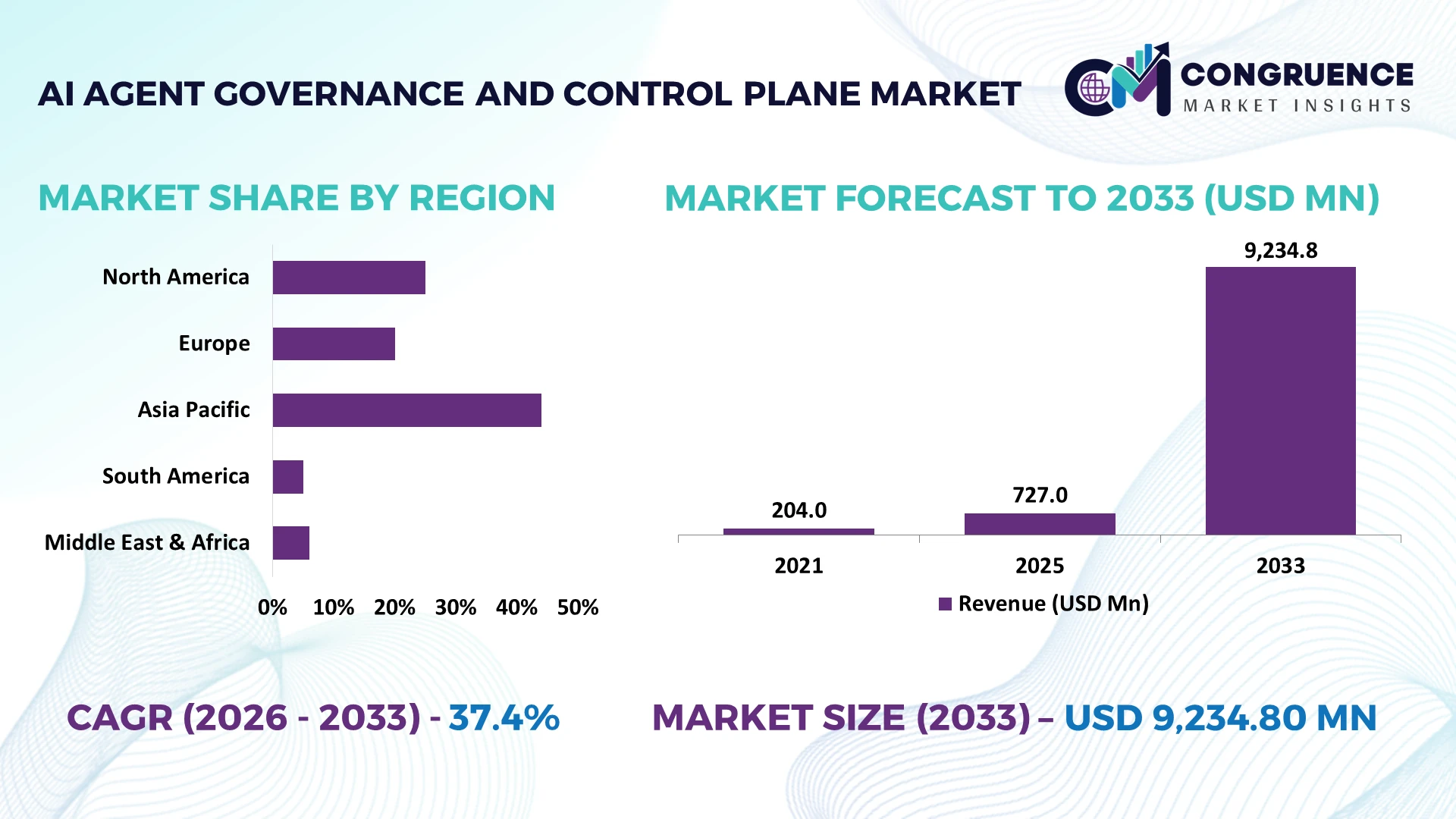
The Global AI Agent Governance and Control Plane Market was valued at USD 727 Million in 2025 and is anticipated to reach a value of USD 9234.8 Million by 2033 expanding at a CAGR of 37.4% between 2026 and 2033. Growth is driven by autonomous AI agent deployment, escalating machine identity security risks, regulatory accountability requirements, and enterprise demand for centralized runtime policy enforcement.
The United States dominates the global market with an estimated 43% share in 2025, supported by hyperscale cloud infrastructure, enterprise AI adoption, and cybersecurity investment. According to the 2025 Stanford AI Index, US private AI investment reached USD 109.1 billion in 2024, compared with China's USD 9.3 billion. Banking, healthcare, insurance, and enterprise software represent major governance demand centers. Microsoft, IBM, and Salesforce are expanding agent management capabilities, while US and China technology competition reinforces investment in secure AI infrastructure.
Strategic investment in centralized agent visibility, granular authorization, and continuous runtime governance will strengthen vendor positioning across regulated enterprise environments.
Market Size & Growth: USD 727 million in 2025, reaching USD 9234.8 million by 2033 at 37.4% CAGR, driven by autonomous agent adoption.
Top Growth Drivers: Estimated contributions include agent security (40%), regulatory compliance (35%), and operational oversight (25%).
Short Term Forecast: By 2028, automated governance targets 35% lower manual oversight workloads.
Emerging Technologies: Three priority innovations include runtime authorization, agent identity management, and automated policy orchestration.
Regional Leaders: Estimated 2033 values include North America (USD 4155.66 million, enterprise adoption), Europe (USD 2308.70 million, compliance), and Asia Pacific (USD 2031.66 million, cloud integration).
Consumer/End User Trends: In 2025, 23% of surveyed organizations reported scaling agentic AI within at least one business function.
Pilot/Case Example: Microsoft's 2025 Security Copilot study reported 26% faster task completion among participating security professionals.
Competitive Landscape: Microsoft holds an indicative 18% share estimate, alongside IBM, Salesforce, ServiceNow, and Palo Alto Networks.
Regulatory & ESG Impact: EU AI Act violations attract penalties reaching 7% of global annual turnover for prohibited practices.
Investment & Funding: Credo AI secured USD 21 million in 2024, supporting AI governance platform expansion.
Innovation & Future Outlook: By 2028, an estimated 40% of governance deployments will incorporate continuous agent behavior monitoring.
The global AI Agent Governance and Control Plane Market is witnessing concentrated demand across financial services, healthcare, cybersecurity, and enterprise automation environments requiring accountable autonomous operations. Recent innovations include agent identity registries, dynamic permission management, centralized policy engines, and automated intervention mechanisms. Cross platform agent governance is emerging as a procurement priority, targeting an estimated 30% reduction in fragmented monitoring workloads. EU AI Act compliance requirements and expanding enterprise deployment of autonomous agents are reshaping security architectures, positioning unified control planes and continuous behavioral oversight at the center of strategic investment decisions.
The AI Agent Governance and Control Plane Market is becoming strategically important as autonomous agents transition from isolated experimentation to enterprise workflows involving financial transactions, sensitive information, and automated decisions. This shift is restructuring cybersecurity architectures around continuous authorization rather than conventional application access controls. Centralized governance platforms target an estimated 35% reduction in oversight workloads compared with fragmented manual monitoring, improving operational scalability without proportionally increasing compliance staffing.
The United States leads commercial innovation through hyperscale cloud platforms, while Germany emphasizes regulatory accountability and industrial data protection. Microsoft's 2025 introduction of Agent 365 demonstrates the practical integration of agent inventories, security controls, and administrative oversight within enterprise environments. Between 2026 and 2028, an estimated 40% of large enterprises deploying multiple production agents will prioritize centralized governance architectures, strengthening demand for interoperable control planes.
Microsoft, Salesforce, IBM, and ServiceNow are expanding agent management portfolios, security integrations, and enterprise technology partnerships. Investment priorities increasingly encompass policy orchestration, behavioral observability, and independent authorization frameworks. Governance infrastructure is becoming a prerequisite for scaling autonomous operations rather than a supplementary compliance function. Vendors combining continuous oversight with flexible integration will strengthen customer retention and secure durable positions within enterprise automation ecosystems.
Rapid expansion of autonomous AI agents is creating demand for centralized governance infrastructure capable of managing permissions, operational boundaries, and accountability. In 2025, 23% of surveyed organizations reported scaling agentic AI within at least one business function, while 39% were experimenting with agents. The European Union AI Act introduces additional governance obligations for applicable high risk AI systems, increasing documentation and oversight requirements. Financial institutions and healthcare enterprises prioritize traceable agent actions because autonomous workflows introduce accountability beyond conventional software access. Microsoft and IBM are expanding centralized agent management capabilities and compliance integrations. Vendors offering unified oversight across independently developed agents gain commercial advantages by reducing fragmented governance expenditure.
Heterogeneous enterprise infrastructure, proprietary agent frameworks, and inconsistent identity standards restrict immediate control plane implementation. Custom integration can represent an estimated 25% to 35% of deployment expenditure, while connector maintenance accounts for approximately 15% under complex infrastructure scenarios. United States enterprises operating across multiple cloud environments face inconsistent authorization models and limited interoperability between agent development frameworks. These structural limitations increase implementation costs and weaken deployment economics for smaller organizations. Technology providers are addressing fragmentation through standardized connectors, modular licensing, and partnerships with identity management specialists. Platforms dependent on proprietary ecosystems face restricted addressable demand because customers increasingly require governance coverage across independently developed agents and existing enterprise applications.
Cross enterprise agent governance presents an emerging opportunity as autonomous workflows extend beyond internal applications into supplier networks, customer platforms, and outsourced business processes. Federated governance architectures and reusable policy templates target estimated onboarding cost reductions of 25% and administrative efficiency improvements of 30%. Singapore's 2026 Model AI Governance Framework for Agentic AI establishes practical guidance for responsible agent deployment, supporting demand for interoperable oversight mechanisms. ServiceNow, Salesforce, and specialized governance providers are expanding ecosystem partnerships and policy management capabilities. An attractive commercial opportunity involves providing shared governance services for organizations lacking dedicated AI security teams, converting complex infrastructure requirements into recurring managed service arrangements and expanding accessibility beyond large enterprises.
Maintaining reliable governance as autonomous agents modify workflows, interact with external tools, and operate across interconnected environments represents a substantial execution challenge. Continuous behavioral validation can account for an estimated 25% to 35% of ongoing governance expenditure, while automated incident correlation targets a 30% reduction in investigation workloads. The emergence of indirect prompt injection and unauthorized tool invocation creates security exposures that conventional application monitoring cannot consistently address. United States financial institutions face particular accountability requirements when automated decisions affect customer information or transactions. Companies must invest in behavioral evaluation, independent security testing, and incident attribution capabilities. Long term competitiveness depends on demonstrating sustained control effectiveness as agent behavior and operational dependencies evolve.
Agent Registries Become Enterprise Infrastructure: Organizations are introducing centralized inventories to replace disconnected agent registration processes. Unified registries target estimated reductions of 30% in asset reconciliation workloads and 25% in duplicate registration activities. Microsoft and Salesforce are integrating agent catalogs into administrative environments, improving ownership visibility and preventing unmanaged software proliferation.
Agent Spending Controls Enter Production: Enterprises are incorporating token budgets, consumption thresholds, and automated spending restrictions into governance workflows. Budget enforcement targets estimated reductions of 20% in unnecessary inference expenditure and 25% in manual cost reconciliation. Technology providers are integrating consumption analytics with administrative dashboards, strengthening financial accountability across autonomous workflows.
Human Approval Workflows Become Granular: Enterprises are replacing blanket approval requirements with transaction specific authorization thresholds. Selective approval mechanisms target estimated reductions of 35% in routine intervention workloads and 20% in approval delays. ServiceNow and IBM are integrating configurable escalation mechanisms, allowing organizations to balance operational automation with decision accountability.
Agent Lifecycle Management Gains Importance: Organizations are extending governance beyond initial deployment to include version management, retirement, and credential revocation. Automated decommissioning targets estimated reductions of 40% in orphaned credentials and 25% in administrative workloads. Identity security providers are expanding lifecycle integrations, addressing persistent access exposure from inactive agents.
Policy Management Platforms dominate the type segmentation with an estimated 26% market share in 2025, reflecting enterprise requirements for consistent operational rules across independently developed AI agents. Their dominance stems from centralized policy configuration, reusable governance templates, and integration with existing enterprise security infrastructure. Access Control Platforms account for an estimated 21% share, supporting permission management and resource authorization. Audit and Compliance Tools complement these established categories through automated evidence collection, regulatory reporting, and documentation of agent activities across sensitive business environments.
Agent Identity Platforms represent the projected fastest growing type as autonomous agents increasingly require distinct identities, credentials, and ownership records. Automated identity lifecycle management targets an estimated 30% reduction in credential administration workloads. Runtime Monitoring Tools support continuous visibility into agent behavior, while Risk Management Platforms prioritize exposure classification and remediation coordination. Microsoft, CyberArk, and IBM are expanding identity integrations and policy management capabilities, shifting investment toward unified governance architectures that reduce administrative fragmentation across enterprise applications.
Agent Access Control leads the application segment with an estimated 28% market share in 2025, reflecting enterprise requirements to restrict autonomous access to sensitive information, financial systems, and business applications. Demand concentrates on granular permissions, credential validation, and contextual authorization across distributed environments. Policy Enforcement represents an estimated 23% share, supporting consistent execution of organizational security requirements across agent workflows. Compliance Auditing complements these established applications through traceable activity records, automated evidence generation, and documentation of regulatory accountability across enterprise operations.
Risk Detection represents the projected fastest growing application as autonomous agents increasingly interact with external tools and sensitive operational systems. Automated risk classification targets an estimated 35% reduction in preliminary incident assessment workloads. Agent Monitoring supports continuous visibility into operational behavior, while Human Oversight enables intervention during sensitive decisions and exceptional transactions. Palo Alto Networks, Microsoft, and ServiceNow are expanding security integrations and automated intervention capabilities, positioning their offerings around preventive controls rather than retrospective activity reporting.
Banking and Finance dominates the end user segment with an estimated 29% market share in 2025, supported by sensitive transaction environments, extensive regulatory obligations, and increasing deployment of autonomous financial workflows. Financial institutions prioritize agent authorization, transaction accountability, and auditable decision processes. IT and Telecommunications accounts for an estimated 24% share, reflecting extensive agent development infrastructure and automated service management requirements. Government organizations emphasize administrative accountability and information protection, while Energy and Utilities prioritize controlled access to sensitive operational systems.
Healthcare represents the projected fastest growing end user segment as autonomous agents expand across clinical documentation, administrative coordination, and patient information management. Automated governance workflows target an estimated 25% reduction in routine compliance administration. Retail and E-commerce prioritize transaction authorization and customer information protection, while Manufacturing emphasizes controlled agent interactions with enterprise applications. IBM, Microsoft, and Salesforce are developing industry specific governance capabilities, configurable licensing arrangements, and specialized integration partnerships. Competitive differentiation increasingly depends on sector specific regulatory alignment and operational compatibility.
North America accounted for the largest market share at an estimated 46% in 2025; however, Asia-Pacific is expected to register the fastest growth, expanding at an estimated CAGR of 42.8% between 2026 and 2033.
Enterprise Agent Deployment Accelerates Centralized Governance Adoption
North America maintains market leadership through extensive cloud infrastructure, established cybersecurity ecosystems, and accelerating enterprise adoption of autonomous AI agents. Banking, healthcare, telecommunications, and enterprise software organizations prioritize centralized authorization, behavioral monitoring, and automated compliance management. The United States accounts for an estimated 93% of regional demand, while Canada strengthens its position through AI research and responsible technology development. Canada's CAD 2.4 billion AI investment package announced in 2024 includes substantial allocations for computing infrastructure and responsible AI adoption. Microsoft, Salesforce, and ServiceNow are integrating agent governance capabilities into established enterprise platforms, reducing dependence on fragmented administrative tools. Procurement increasingly favors solutions supporting heterogeneous agent frameworks and existing identity management infrastructure. Established enterprise distribution networks provide significant commercialization advantages for vendors offering integrated security, governance, and operational oversight capabilities.
United States Market Outlook: The United States benefits from extensive hyperscale computing infrastructure and concentrated enterprise technology investment. Microsoft introduced Agent 365 in November 2025, establishing five core capabilities spanning agent registration, access control, visualization, interoperability, and security. This development strengthens demand for centralized administrative environments, particularly among financial institutions and large enterprises managing independently developed autonomous agents.
Regulatory Accountability Reshapes Enterprise Governance Architecture
Europe accounted for an estimated 25% of global market demand in 2025, supported by stringent data protection requirements, industrial digitization, and increasing enterprise AI adoption. The European Union AI Act establishes risk based governance obligations, strengthening demand for documented oversight, operational transparency, and compliance monitoring. Eurostat reported that 20% of EU enterprises with at least ten employees used AI technologies in 2025, compared with 13.5% in 2024. Germany, France, and the United Kingdom represent prominent enterprise technology markets, with procurement concentrated across financial services, manufacturing, and public administration. Organizations increasingly prioritize governance platforms compatible with sovereign cloud environments and domestic information protection requirements. Technology providers are expanding localized hosting, configurable policy frameworks, and regulatory reporting capabilities. Vendors supporting auditable agent operations gain stronger positioning within regulated enterprise procurement environments.
Germany Market Outlook: Germany's manufacturing and financial services sectors create substantial demand for controlled AI deployment across sensitive operational environments. Microsoft announced EUR 3.2 billion in German AI and cloud infrastructure investment in 2024, including plans to double its local AI infrastructure capacity. Expanding computing availability strengthens opportunities for agent authorization, industrial workflow governance, and enterprise compliance management platforms.
Digital Enterprise Expansion Accelerates Agent Control Adoption
Asia Pacific represented an estimated 22% of global market demand in 2025, supported by expanding cloud infrastructure, digital financial services, enterprise automation, and domestic AI development. China, Japan, India, South Korea, and Singapore are strengthening AI ecosystems through infrastructure investment and specialized governance initiatives. Singapore introduced its Model AI Governance Framework for Agentic AI in January 2026, addressing four principal governance dimensions for responsible agent deployment. Japan's manufacturing ecosystem emphasizes controlled industrial automation, while India's technology services industry creates opportunities for scalable agent oversight across outsourced business processes. Chinese enterprises increasingly integrate domestic AI models into commercial applications, strengthening requirements for localized governance architectures. Technology providers are expanding regional partnerships, multilingual interfaces, and flexible deployment models. Commercial differentiation increasingly depends on supporting diverse regulatory environments and heterogeneous enterprise technology infrastructure.
China Market Outlook: China maintains a substantial domestic AI development ecosystem supported by Alibaba, Tencent, Baidu, and Huawei. Alibaba announced plans in February 2025 to invest at least CNY 380 billion in cloud computing and AI infrastructure over three years. This investment expands the technological foundation for autonomous enterprise applications, strengthening requirements for centralized agent permissions, operational accountability, and localized security management.
Financial Digitization Creates Focused Governance Opportunities
South America accounted for an estimated 3.8% of global market demand in 2025, with procurement concentrated across banking, digital commerce, telecommunications, and enterprise technology services. Brazil, Chile, and Colombia represent important adoption centers as organizations integrate AI into customer support, transaction management, and administrative workflows. Microsoft announced a BRL 14.7 billion investment in Brazilian cloud and AI infrastructure over three years in September 2024, expanding regional computing capabilities. Financial institutions increasingly prioritize controlled agent access to customer information and sensitive transaction environments. However, fragmented legacy infrastructure, limited specialist availability, and constrained technology budgets restrict comprehensive governance implementation among smaller enterprises. International vendors are addressing these limitations through managed governance services, localized cloud partnerships, and modular subscription arrangements. Affordable implementation models provide commercial advantages by enabling incremental adoption without extensive infrastructure replacement.
Brazil Market Outlook: Brazil leads regional opportunities through its extensive digital banking ecosystem, established technology services industry, and expanding enterprise cloud adoption. The Brazilian Artificial Intelligence Plan announced in 2024 proposed approximately BRL 23 billion in investment through 2028. Its emphasis on domestic AI capabilities and responsible development strengthens the institutional foundation for agent governance, risk management, and regulatory compliance platforms.
Sovereign AI Infrastructure Strengthens Governance Investment
The Middle East and Africa represented an estimated 3.2% of global market demand in 2025, with procurement concentrated across government services, financial institutions, telecommunications operators, and energy enterprises. Saudi Arabia and the United Arab Emirates are establishing advanced AI infrastructure ecosystems, while South Africa represents an important enterprise technology adoption center. In 2025, AWS and Saudi Arabia's HUMAIN announced plans to invest more than USD 5 billion in a dedicated AI Zone, expanding infrastructure availability for enterprise applications. Government modernization programs increasingly incorporate requirements for information sovereignty, controlled automation, and administrative accountability. Technology providers are prioritizing localized hosting, Arabic language support, and configurable access management capabilities. Uneven infrastructure readiness across African markets favors managed governance offerings that reduce dependence on specialized internal security teams and extensive enterprise technology resources.
United Arab Emirates Market Outlook: The United Arab Emirates benefits from coordinated government AI investment, advanced cloud infrastructure, and established technology partnerships. Microsoft's USD 1.5 billion investment in G42 announced in April 2024 strengthens domestic AI commercialization capabilities. Financial institutions, government agencies, and energy enterprises represent significant governance opportunities, particularly for platforms supporting sovereign information management, controlled agent authorization, and auditable operational workflows.
Microsoft, IBM, Salesforce, ServiceNow, and Palo Alto Networks compete across integrated agent governance, enterprise workflow management, and runtime security infrastructure. The top five players collectively account for an estimated 53% market share, indicating moderate concentration. Microsoft and Salesforce leverage established application ecosystems, while Palo Alto Networks differentiates through security intelligence and runtime protection. IBM and ServiceNow emphasize policy orchestration and enterprise integration. Centralized governance targets estimated administrative savings of 30%, while automated authorization offers potential permission management savings of 25%. Standardized connectors target 20% lower integration expenditure. Companies are expanding technology partnerships, acquiring specialized capabilities, and embedding governance within existing enterprise platforms. Competition is shifting from retrospective AI compliance toward continuous operational control. Entry barriers include heterogeneous agent frameworks, complex identity integrations, and enterprise security validation requirements. Winning requires interoperable architectures, granular authorization, demonstrable control effectiveness, and scalable deployment models that maintain consistent governance across independently developed enterprise agent ecosystems.
Microsoft Corporation
IBM Corporation
Salesforce, Inc.
ServiceNow, Inc.
Palo Alto Networks, Inc.
Cisco Systems, Inc.
Okta, Inc.
Credo AI
OneTrust, LLC
Fiddler AI
DataRobot, Inc.
Zenity
WitnessAI
Current technologies include centralized policy engines, identity management platforms, and runtime observability tools. Centralized policy engines target estimated administrative savings of 30% compared with conventional manual policy configuration. Identity management automation targets 25% lower credential maintenance workloads, while runtime observability tools target 35% faster incident identification. With 23% of surveyed enterprises scaling agentic AI during 2025, integrated governance capabilities are becoming essential for maintaining operational accountability.
Emerging technologies encompass contextual authorization, automated behavioral evaluation, and interoperable agent communication protocols. Contextual authorization targets estimated reductions of 25% in excessive permission exposure, while behavioral evaluation targets 30% lower manual assessment workloads. Standardized communication protocols offer potential integration savings of 20%. Enterprise security vendors supporting heterogeneous agent frameworks gain competitive advantages through broader deployment compatibility and reduced customer dependence on proprietary infrastructure.
Disruptive technologies include autonomous policy remediation, cryptographically verifiable agent identities, and adaptive risk scoring. Automated remediation targets estimated response time improvements of 40%, while verifiable identities target 25% lower authentication administration costs. Adaptive risk scoring targets 30% faster exposure classification. Between 2026 and 2028, production deployments will increasingly integrate these capabilities, strengthening continuous authorization, reducing governance overhead, and enabling enterprises to expand autonomous operations without proportionally increasing security staffing or administrative complexity.
July 2026: IBM introduced its Agentic Control Plane within watsonx Orchestrate across two cloud environments, AWS and IBM Cloud. The platform consolidates agent analytics, governance controls, incident investigation, and scheduling, supporting centralized administration across heterogeneous enterprise infrastructure. Source: ibm.com
November 2025: Microsoft introduced Agent 365, incorporating five core capabilities covering registration, access management, visualization, interoperability, and security. The product establishes centralized governance for independently developed agents, extending existing enterprise administrative infrastructure into autonomous AI operations. Source: microsoft.com
June 2025: IBM announced the integration of Credo AI Policy Packs into watsonx.governance Compliance Accelerators, covering three major frameworks, including European AI legislation, ISO standards, and NIST guidance. The integration supports streamlined regulatory mapping and compliance documentation. Source: ibm.com
October 2024: Zenity secured USD 38 million in Series B funding to expand agentic AI security capabilities. The investment supports recruitment across engineering and commercial functions alongside partner ecosystem development, strengthening distribution and enterprise security implementation capacity. Source: zenity.io
The report evaluates six platform types, including policy management, access control, agent identity, runtime monitoring, audit and compliance, and risk management platforms. Application coverage encompasses agent access control, policy enforcement, agent monitoring, risk detection, compliance auditing, and human oversight. End user analysis examines seven sectors, including banking and finance, IT and telecommunications, healthcare, retail and ecommerce, manufacturing, government, and energy and utilities.
Geographical coverage includes North America, Europe, Asia Pacific, South America, and the Middle East and Africa. The report profiles 13 prominent companies, examining technological differentiation, regulatory alignment, deployment strategies, and competitive positioning. Emerging technology assessment covers adaptive authorization, autonomous remediation, federated governance, and verifiable agent identities. Strategic insights support investment allocation, product development, partnership evaluation, enterprise expansion, and market positioning decisions between 2026 and 2033.
| Report Attribute/Metric | Report Details |
|---|---|
Market Revenue in 2025 | USD 727 Million |
Market Revenue in 2033 | USD 9234.8 Million |
CAGR (2026 - 2033) | 37.4% |
Base Year | 2025 |
Forecast Period | 2026 - 2033 |
Historic Period | 2021 - 2025 |
Segments Covered | By Type
By Application
By End-User
|
Key Report Deliverable | Revenue Forecast, Growth Trends, Market Dynamics, Segmental Overview, Regional and Country-wise Analysis, Competition Landscape |
Region Covered | North America, Europe, Asia-Pacific, South America, Middle East, Africa |
Key Players Analyzed | Microsoft Corporation, IBM Corporation, Salesforce, Inc., ServiceNow, Inc., Palo Alto Networks, Inc., Cisco Systems, Inc., Okta, Inc., Credo AI, OneTrust, LLC, Fiddler AI, DataRobot, Inc., Zenity, WitnessAI |
Customization & Pricing | Available on Request (10% Customization is Free) |




