Global AI Accelerator ASIC Market Report Overview
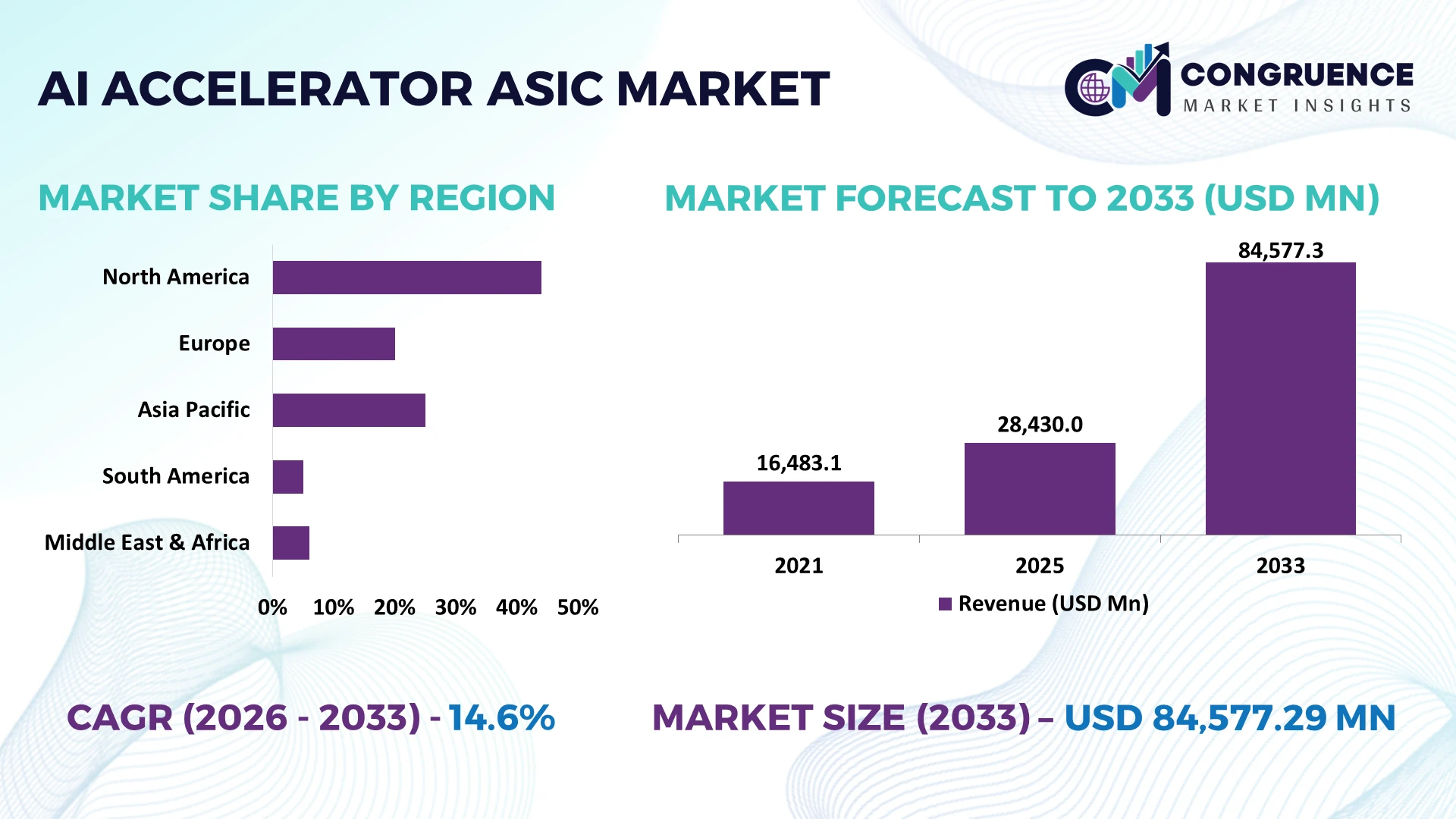
The Global AI Accelerator ASIC Market was valued at USD 28430 Million in 2025 and is anticipated to reach a value of USD 84577.29 Million by 2033 expanding at a CAGR of 14.6% between 2026 and 2033. Growth is driven by hyperscaler investment in custom AI inference processors, expanding high bandwidth memory integration, and the transition from general purpose GPUs toward workload optimized ASIC architectures.
The United States dominates the global AI accelerator ASIC ecosystem through semiconductor design leadership, hyperscale cloud infrastructure, and advanced processor development. NVIDIA, Google, Amazon, and Broadcom shape accelerator deployment across generative AI, cloud computing, and enterprise inference. Google introduced its seventh generation Ironwood TPU in 2025, supporting configurations of up to 9,216 chips. Meanwhile, Taiwan remains critical to advanced semiconductor manufacturing, with TSMC producing more than 90% of the world's most advanced logic chips, according to widely cited industry estimates. This concentration reinforces geopolitical exposure around Taiwan Strait semiconductor supply chains.
Strategically, manufacturers should prioritize 3 nm and 2 nm design capabilities, advanced packaging partnerships, and diversified fabrication capacity to strengthen performance competitiveness and supply resilience.
Key Highlights of the Global AI Accelerator ASIC Market
-
Market Size & Growth: USD 28,430 million in 2025, reaching USD 84,577.29 million by 2033 at 14.6% CAGR, supported by hyperscaler adoption of custom inference processors.
-
Top Growth Drivers: Illustrative planning assumptions identify 30% inference workload expansion, 25% demand growth for custom silicon, and 20% improvement in accelerator energy efficiency.
-
Short Term Forecast: By 2028, optimized ASIC architectures target approximately 20% lower inference energy consumption versus comparable baseline deployments.
-
Emerging Technologies: 2 nm semiconductor processes, HBM4 memory integration, and chiplet architectures support higher computational density and improved memory bandwidth.
-
Regional Leaders: Illustrative 2033 allocations place North America at USD 37,609 million, Asia Pacific at USD 30,448 million, and Europe at USD 10,149 million, supported respectively by hyperscaler deployment, semiconductor manufacturing, and sovereign AI infrastructure.
-
Consumer / End User Trends: Enterprise AI infrastructure increasingly prioritizes inference, with Google deploying seventh generation TPU technology to support large scale model execution.
-
Pilot / Case Example: In 2025, Google's Ironwood TPU demonstrated a reported 2 times performance per watt improvement over Trillium.
-
Competitive Landscape: NVIDIA leads the broader AI accelerator ecosystem, while Broadcom, Google, Amazon, AMD, and Marvell compete across custom silicon development and deployment.
-
Regulatory & ESG Impact: US semiconductor export controls and the European Chips Act, targeting 20% global semiconductor production share by 2030, influence regional investment decisions.
-
Investment & Funding: TSMC announced planned 2025 capital expenditure of USD 38 billion to USD 42 billion, supporting advanced fabrication and packaging expansion.
-
Innovation & Future Outlook: Next generation 2 nm ASICs, chiplet integration, and liquid cooled accelerator infrastructure strengthen the shift toward specialized AI computing.
The global AI Accelerator ASIC Market is undergoing a structural transition as hyperscale data centers, enterprise AI platforms, and sovereign computing initiatives prioritize specialized silicon architectures. Google's Ironwood TPU delivers a reported 2 times performance per watt improvement over its predecessor, highlighting the efficiency advantages of workload optimized processors. Advanced packaging, high bandwidth memory, and chiplet integration are becoming central to accelerator performance and manufacturing scalability. Meanwhile, US export restrictions on advanced semiconductors are reshaping procurement strategies and regional supply chains. These developments position architecture specialization, manufacturing access, and energy efficiency as decisive strategic priorities for industry participants.
What Is the Strategic Relevance and Future Pathways of the AI Accelerator ASIC Market?
The AI Accelerator ASIC Market is becoming strategically important as hyperscale cloud providers seek greater control over computing performance, energy consumption, and semiconductor supply chains. Custom accelerator architectures enable companies to optimize silicon for transformer inference, neural network training, and high throughput data processing. Google's seventh generation Ironwood TPU supports configurations containing 9,216 chips, demonstrating the scale of specialized AI infrastructure. Meanwhile, US semiconductor export restrictions are accelerating supply chain restructuring and encouraging domestic chip design capabilities.
Compared with general purpose processors, specialized ASIC architectures eliminate unnecessary instruction overhead and improve workload efficiency. Google's Ironwood TPU delivers approximately twice the performance per watt of its preceding Trillium generation, illustrating measurable improvements within custom accelerator platforms. The United States leads processor architecture development through Google, Amazon, and Broadcom, while Taiwan dominates advanced fabrication and packaging. China is strengthening domestic accelerator development as technology restrictions influence procurement decisions and computing infrastructure modernization.
During 2026 to 2028, competitive differentiation will increasingly depend on memory bandwidth, compiler optimization, and accelerator utilization. Amazon's Trainium infrastructure demonstrates how cloud providers integrate proprietary silicon with networking and software frameworks to optimize AI operations. Semiconductor companies are expanding advanced packaging partnerships, investing in chiplet architectures, and strengthening hardware software integration. The strategic advantage belongs to suppliers delivering predictable inference performance, lower energy intensity, and reliable deployment at hyperscale.
AI Accelerator ASIC Market Dynamics
DRIVER:
Hyperscale AI Infrastructure and Custom Silicon Adoption
Hyperscale operators are accelerating custom AI accelerator ASIC deployment to improve inference economics and reduce dependence on general purpose computing architectures. Google's Ironwood TPU delivers approximately 100% higher performance per watt than Trillium, while its maximum configuration connects 9,216 chips into a unified computing system. Advanced ASIC designs also target double digit improvements in workload specific energy efficiency through optimized data movement and memory access. In the United States, Google, Amazon, and Microsoft are expanding proprietary processor development alongside large language model infrastructure. This shift encourages semiconductor designers to establish deeper relationships with foundries, packaging specialists, and cloud operators. Securing long term silicon capacity increasingly determines deployment speed and competitive flexibility.
RESTRAINT:
Advanced Fabrication Concentration and Packaging Constraints
AI accelerator ASIC manufacturing remains constrained by concentrated advanced node fabrication, limited packaging capacity, and expensive design validation. TSMC accounts for more than 90% of global production of the most advanced logic chips, creating substantial geographic concentration around Taiwan. Advanced semiconductor manufacturing also requires yield optimization, with a 5% reduction in usable die output directly increasing effective production costs when other variables remain constant. High bandwidth memory integration introduces additional procurement dependencies involving suppliers in South Korea and the United States. Export controls further complicate accelerator distribution and customer qualification. Companies are responding through multiyear foundry agreements, alternative packaging partnerships, and more modular chiplet designs. Manufacturing flexibility increasingly outweighs nominal transistor density when evaluating production economics.
OPPORTUNITY:
Energy Optimized Inference and Next Generation Chiplet Platforms
The transition toward inference intensive AI infrastructure creates opportunities for application specific accelerator designs optimized for token generation, memory efficiency, and predictable latency. Google's Ironwood demonstrates approximately 100% higher performance per watt than Trillium, establishing a benchmark for specialized computing improvements. Emerging 2 nm manufacturing processes offer potential power reductions of approximately 25% to 30% compared with 3 nm technology at comparable performance, based on announced process targets. In India, expanding sovereign AI infrastructure creates opportunities for domestic system integration, accelerator software development, and specialized cloud services. Semiconductor companies are investing in chiplet interconnects, compiler optimization, and memory aware architectures. The strongest opportunity lies in optimizing complete inference systems rather than maximizing individual chip performance.
CHALLENGE:
Software Ecosystem Integration and Sustained Deployment Efficiency
Scaling AI accelerator ASIC platforms requires consistent performance across evolving model architectures, software frameworks, and distributed computing environments. Google's Ironwood supports 9,216 chip configurations, illustrating the coordination requirements of large accelerator clusters. A 5% decline in accelerator utilization directly reduces productive computing output, while a 10% increase in communication overhead can undermine theoretical processor performance advantages. In the United States, proprietary accelerator developers face persistent pressure to maintain compatibility with PyTorch, TensorFlow, and rapidly changing inference frameworks. Companies must invest in compiler engineering, runtime optimization, distributed scheduling, and developer support. The central execution challenge is sustaining high utilization across diverse workloads without creating costly software migration barriers or restricting customer flexibility.
AI Accelerator ASIC Market Latest Trends
-
Advanced Packaging Capacity Reallocation Accelerates: Taiwan's semiconductor ecosystem is shifting toward high density interconnect packaging and larger accelerator modules. TSMC's announced 2025 capital expenditure range of USD 38 billion to USD 42 billion illustrates the scale of manufacturing investment. CoWoS packaging integrates multiple compute dies with high bandwidth memory, increasing assembly complexity. Suppliers are expanding substrate procurement, packaging equipment capacity, and production scheduling coordination to reduce delivery bottlenecks and improve manufacturing predictability.
-
Memory Bandwidth Becomes Performance Differentiator: Accelerator developers are prioritizing memory subsystem performance as model sizes increase. HBM3E supports bandwidth exceeding 1 TB per second per stack, while HBM4 architectures target approximately 2 TB per second. These transitions change processor floorplanning, thermal engineering, and memory supplier qualification. Samsung, SK hynix, and Micron are advancing memory technologies, enabling ASIC designers to reduce data movement constraints and improve effective computing utilization.
-
Interconnect Standardization Reshapes System Design: The Ultra Accelerator Link consortium is advancing open accelerator connectivity to reduce proprietary communication dependencies. Its initial specification targets 200 Gbps per lane, while scale up architectures increasingly support hundreds of interconnected processing devices. Semiconductor manufacturers are integrating standardized interfaces, improving interoperability between compute modules and networking components. This transition strengthens supplier flexibility and reduces integration complexity for enterprise infrastructure operators.
-
Thermal Management Moves Into Procurement: High density accelerator installations are accelerating liquid cooling adoption as conventional airflow becomes insufficient. NVIDIA's GB200 NVL72 platform supports 72 GPUs within a liquid cooled rack architecture, demonstrating the infrastructure requirements of advanced AI systems. Direct liquid cooling can remove more than 70% of server heat in suitable configurations. Infrastructure providers are redesigning coolant distribution, monitoring systems, and service procedures to maintain reliability.
Segmentation Analysis
By Type
Training ASICs Lead While Inference Specialization Expands
Training ASICs represent the leading segment of the AI Accelerator ASIC Market, with an estimated 42% share in 2025, supported by large model training requirements, distributed computing infrastructure, and high bandwidth memory integration. These processors handle computationally intensive matrix operations and support synchronized processing across accelerator clusters. Google and other hyperscale operators prioritize training optimized silicon to improve utilization and reduce dependence on externally supplied processors. Inference ASICs account for an indicative 31% share, benefiting from expanding production deployment of generative AI applications and increasing requirements for predictable response latency.
Edge AI ASICs are positioned as the fastest growing type, driven by localized inference in industrial equipment, intelligent cameras, and embedded computing systems. Their advantages include reduced network dependence, improved data privacy, and lower communication latency. Custom AI ASICs address specialized workloads requiring differentiated memory hierarchies, instruction sets, and interconnect configurations. Semiconductor companies are reallocating design resources toward configurable accelerator platforms, energy efficient architectures, and application specific software support. Investment priorities increasingly reflect deployment economics rather than peak computational throughput alone.
- According to Google's 2025 Ironwood TPU announcement, its seventh generation accelerator supports configurations of 9,216 chips and delivers twice the performance per watt of Trillium, reinforcing the importance of specialized architectures for large scale AI workloads.
By Application
Generative AI Dominates Accelerator Deployment Demand
Generative AI represents the leading application segment, with an indicative 38% share of AI accelerator ASIC demand in 2025. Large language models, multimodal content generation, and enterprise AI assistants require substantial matrix computation, memory bandwidth, and distributed inference capacity. Natural Language Processing accounts for an estimated 24% share, supported by document intelligence, translation, conversational interfaces, and automated information retrieval. Cloud operators are optimizing accelerator configurations for transformer architectures, attention mechanisms, and continuous model serving, enabling greater throughput and more predictable operational performance.
Autonomous Systems represent the fastest growing application category as robotics, industrial navigation, and intelligent mobility platforms increasingly require deterministic processing and localized decision execution. Computer Vision maintains established deployment across manufacturing inspection, security analytics, and medical imaging, where optimized convolution and transformer processing improve computational efficiency. Recommendation Engines remain important for digital commerce, advertising, and content platforms, with ASIC specialization supporting high volume ranking and embedding operations. Semiconductor developers are responding through workload optimized compute engines, integrated memory architectures, and compiler enhancements. Competitive investment increasingly favors platforms capable of supporting multiple AI workloads without sacrificing application specific efficiency.
- McKinsey's 2025 State of AI research reported that 78% of surveyed organizations used AI in at least one business function, demonstrating the expanding operational foundation for specialized acceleration across generative AI, language processing, and intelligent automation.
By End-User
Cloud Service Providers Command Infrastructure Investment
Cloud Service Providers represent the largest end user segment, holding an indicative 39% share of the AI Accelerator ASIC Market in 2025. Their leadership reflects extensive computing infrastructure, recurring AI inference workloads, and direct control over processor procurement and deployment architecture. Amazon Web Services and Google Cloud integrate proprietary accelerator technologies into managed AI services, enabling tighter coordination between hardware, software, and customer workloads. Hyperscale Data Centers account for an estimated 33% share, emphasizing high density accelerator clusters, distributed networking, and sustained computational utilization. These operators prioritize memory bandwidth, power distribution, and predictable infrastructure performance.
Enterprise AI Developers represent the fastest growing end user segment as organizations move specialized AI applications from experimentation into production environments. Their purchasing behavior increasingly favors accessible development frameworks, workload compatibility, and transparent computing costs. Semiconductor Companies remain strategically important through ASIC design, intellectual property licensing, advanced packaging integration, and manufacturing partnerships. Suppliers are responding with customized accelerator configurations, managed development environments, and deeper software ecosystem integration. Competitive positioning increasingly depends on reducing deployment complexity while preserving performance advantages across different customer infrastructure requirements.
- The International Energy Agency's Energy and AI report in 2025 projected global data center electricity consumption of approximately 945 TWh by 2030, highlighting why cloud operators and hyperscale facilities increasingly prioritize accelerator efficiency and infrastructure optimization.
Region-Wise Market Insights
North America accounted for the largest market share at an estimated 44% in 2025 however, Asia Pacific is expected to register the fastest growth, expanding at a CAGR of approximately 17.2% between 2026 and 2033.

North America AI Accelerator ASIC Market
Hyperscale Infrastructure Leadership and Proprietary Silicon Expansion
North America holds an estimated 44% share of the global AI Accelerator ASIC Market, supported by concentrated hyperscale computing infrastructure, semiconductor architecture development, and enterprise AI deployment. The United States leads specialized accelerator innovation through Google, Amazon, Broadcom, and Microsoft, which are strengthening proprietary silicon capabilities. Google's seventh generation Ironwood TPU supports configurations containing 9,216 chips, demonstrating the scale of integrated AI computing infrastructure. Advanced networking, high bandwidth memory, and specialized compiler ecosystems reinforce regional deployment advantages. Canada's expanding AI research ecosystem supports demand for advanced computing infrastructure, particularly in machine learning and scientific applications. US semiconductor export regulations are also reshaping accelerator procurement and technology partnerships. Regional competitive positioning increasingly depends on securing advanced fabrication capacity, optimizing inference performance, and maintaining reliable access to specialized semiconductor manufacturing services.
United States Market Outlook: The United States remains the principal center for AI accelerator ASIC architecture development, cloud deployment, and semiconductor intellectual property commercialization. Amazon's Trainium processors and Google's TPU platforms demonstrate the strategic shift toward proprietary computing systems. The CHIPS and Science Act established approximately USD 52.7 billion in semiconductor incentives and research support, strengthening domestic manufacturing capabilities. Companies are prioritizing advanced packaging, processor design automation, and specialized AI infrastructure partnerships.
Europe AI Accelerator ASIC Market
Sovereign AI Infrastructure and Semiconductor Modernization
Europe represents an estimated 12% of global AI Accelerator ASIC Market activity, supported by sovereign computing initiatives, industrial automation, and semiconductor research capabilities. Germany, France, and the Netherlands are advancing AI infrastructure development through public investment, industrial partnerships, and specialized processor innovation. The European Chips Act targets a 20% share of global semiconductor production capacity by 2030, encouraging domestic manufacturing and advanced packaging investment. European accelerator developers increasingly emphasize energy efficient computing, secure data processing, and integration with industrial AI applications. France's AI computing ecosystem benefits from expanding cloud infrastructure and research partnerships, while the Netherlands contributes advanced semiconductor equipment technologies. European regulatory requirements encourage transparent AI deployment and stronger data governance. Competitive differentiation centers on reliable infrastructure, specialized industrial workloads, and reducing dependence on external semiconductor supply chains.
Germany Market Outlook: Germany holds a strategic position through its automotive manufacturing, industrial automation, and semiconductor engineering ecosystem. Infineon Technologies and research institutions such as Fraunhofer support advanced electronics and intelligent computing development. The European Union approved approximately EUR 5 billion in German state aid for the ESMC semiconductor fabrication project in Dresden in 2024. This investment strengthens local manufacturing capabilities and supports long term industrial semiconductor supply resilience.
Asia-Pacific AI Accelerator ASIC Market
Advanced Semiconductor Manufacturing and Accelerator Supply Leadership
Asia Pacific accounts for an estimated 36% of the global AI Accelerator ASIC Market, supported by advanced semiconductor fabrication, memory manufacturing, and expanding AI computing infrastructure. Taiwan provides critical foundry capacity through TSMC, while South Korea contributes high bandwidth memory technologies through SK hynix and Samsung Electronics. China is accelerating domestic accelerator development as US technology restrictions reshape access to advanced processors. Japan strengthens the semiconductor equipment and materials ecosystem, supporting manufacturing precision and process development. India's growing AI infrastructure initiatives are encouraging accelerator deployment and domestic system integration. TSMC's advanced manufacturing roadmap includes 2 nm process technology, enabling improved transistor density and energy efficiency. Regional competitive advantages increasingly depend on advanced packaging availability, memory integration, and coordinated manufacturing ecosystems connecting chip designers, foundries, and cloud infrastructure operators.
Taiwan Market Outlook: Taiwan remains central to global AI accelerator ASIC manufacturing through TSMC's advanced fabrication technologies and semiconductor packaging capabilities. The company's 2025 capital expenditure guidance of USD 38 billion to USD 42 billion reflected substantial investment in manufacturing expansion. Taiwan's CoWoS packaging ecosystem enables integration of accelerator dies with high bandwidth memory, supporting complex computing architectures. Manufacturing concentration also makes geographic diversification and operational continuity essential procurement considerations.
South America AI Accelerator ASIC Market
Cloud Infrastructure Localization and Enterprise AI Adoption
South America represents an estimated 3% of the global AI Accelerator ASIC Market, with demand concentrated in Brazil, Chile, and Argentina. Cloud infrastructure expansion, financial technology applications, and enterprise automation are supporting specialized computing requirements. Brazil provides the largest regional deployment base through established data center operations and expanding cloud services. Chile benefits from renewable electricity resources and growing interest in energy efficient computing facilities. Regional enterprises increasingly use cloud hosted AI acceleration rather than investing directly in custom semiconductor infrastructure. Limited advanced fabrication capacity and imported hardware dependence increase procurement complexity and infrastructure costs. Cloud providers are responding through localized computing facilities, managed AI platforms, and infrastructure partnerships. Regional competitiveness depends on electricity reliability, international connectivity, and the availability of specialized technical expertise for accelerator deployment.
Brazil Market Outlook: Brazil leads regional AI infrastructure adoption through its established cloud computing ecosystem, financial services industry, and enterprise technology sector. Microsoft's previously announced BRL 14.7 billion investment in Brazilian cloud and AI infrastructure over three years illustrates the scale of digital infrastructure development. São Paulo remains a major data center concentration, supporting AI applications in banking, retail analytics, and enterprise automation. Local deployment reduces dependence on distant computing infrastructure.
Middle East & Africa AI Accelerator ASIC Market
Sovereign Computing Investment and AI Infrastructure Transformation
The Middle East and Africa account for an estimated 5% of the global AI Accelerator ASIC Market, with infrastructure investment concentrated in the United Arab Emirates, Saudi Arabia, and selected African technology hubs. Sovereign AI initiatives are accelerating specialized computing deployment across government services, energy operations, and advanced digital infrastructure. The United Arab Emirates is strengthening international semiconductor partnerships and expanding high density computing capacity. Saudi Arabia's digital transformation initiatives support AI adoption in industrial operations and public services. South Africa provides an established enterprise technology ecosystem, although electricity availability and infrastructure costs constrain deployment economics. Regional development increasingly depends on reliable power infrastructure, advanced cooling systems, and secure international technology partnerships. Accelerator suppliers are targeting government backed computing programs and managed infrastructure deployments rather than fragmented enterprise procurement.
United Arab Emirates Market Outlook: The United Arab Emirates is strengthening its position through sovereign AI investment, cloud infrastructure partnerships, and advanced computing development. The UAE and United States announced a framework in 2025 for an AI campus in Abu Dhabi with planned capacity reaching 5 GW. G42 and international technology partners are advancing computing infrastructure development, positioning the country as an important destination for specialized accelerator deployment and AI infrastructure services.
Market Competition Landscape
The AI Accelerator ASIC Market features intense competition between hyperscale proprietary silicon developers and merchant semiconductor suppliers. Google, Amazon, and Microsoft prioritize vertically integrated accelerator platforms, while Broadcom and Marvell compete through custom ASIC design, networking integration, and manufacturing partnerships. NVIDIA influences purchasing decisions through its established GPU software ecosystem. The five leading ASIC participants collectively represent an indicative 65% of market activity, reflecting concentrated design capabilities and deployment relationships. Google's Ironwood delivers approximately 100% higher performance per watt than Trillium, establishing an important efficiency benchmark. Advanced 2 nm manufacturing targets approximately 25% to 30% lower power consumption than comparable 3 nm processes. Companies are expanding foundry agreements, packaging partnerships, and proprietary compiler development to strengthen customer retention. Manufacturing concentration, software compatibility, and qualification costs create substantial entry barriers. Competitive success requires differentiated workload performance, reliable semiconductor capacity, integrated software support, and demonstrably superior deployment economics at hyperscale production volumes.
Companies Profiled in the AI Accelerator ASIC Market Report
-
Google LLC
-
Amazon Web Services, Inc.
-
Microsoft Corporation
-
Broadcom Inc.
-
Marvell Technology, Inc.
-
NVIDIA Corporation
-
Advanced Micro Devices, Inc.
-
Intel Corporation
-
Qualcomm Incorporated
-
MediaTek Inc.
-
Huawei Technologies Co., Ltd.
-
Cambricon Technologies Corporation Limited
-
Tenstorrent Inc.
-
Groq, Inc.
Technology Insights for the AI Accelerator ASIC Market
Current AI accelerator ASIC technologies prioritize tensor processing, high bandwidth memory, and specialized interconnects to improve computational efficiency across hyperscale infrastructure. Google's Ironwood TPU delivers approximately 100% higher performance per watt than Trillium, demonstrating measurable advantages over preceding accelerator generations. Its 9,216 chip configurations support distributed model execution, while HBM3E memory provides bandwidth exceeding 1 TB per second per stack. These capabilities reduce memory bottlenecks, improve processor utilization, and strengthen cloud infrastructure competitiveness through optimized training and inference operations.
Emerging technologies include 2 nm semiconductor fabrication, HBM4 integration, and advanced chiplet packaging. TSMC's 2 nm technology targets approximately 25% to 30% lower power consumption than its 3 nm process at comparable performance. HBM4 architectures support approximately 2 TB per second memory bandwidth, improving data accessibility for large AI models. Semiconductor manufacturers are strengthening foundry partnerships, packaging capabilities, and compiler integration to reduce deployment complexity and improve system efficiency.
Between 2026 and 2028, disruptive innovations will emphasize optical interconnects, adaptive precision computing, and memory centric architectures. These technologies target improved communication efficiency and reduced data movement overhead. Hyperscale operators benefit from tighter hardware software integration, while specialized ASIC suppliers gain competitive advantages through workload customization and predictable inference performance.
Recent Developments in the Global AI Accelerator ASIC Market
-
December 2024: Amazon Web Services launched Trainium2 powered EC2 instances, delivering 30% to 40% better price performance than comparable GPU instances. The deployment strengthened custom silicon adoption and improved AI training economics for cloud customers. Source: aboutamazon.com
-
April 2025: Google introduced its seventh generation Ironwood TPU, delivering twice the performance per watt of Trillium. The inference optimized architecture strengthened hyperscale computing efficiency, enabling larger AI workloads and reducing energy requirements for advanced model execution. Source: blog.google
-
October 2025: Broadcom partnered with OpenAI to develop and deploy custom AI accelerators supporting 10 gigawatts of planned computing capacity. The agreement expanded Broadcom's custom silicon opportunities and strengthened OpenAI's infrastructure diversification strategy. Source: reuters.com
-
January 2025: Marvell Technology introduced a copackaged optics architecture for custom AI accelerators, enabling system scaling from tens to hundreds of processors across racks. The innovation addressed electrical interconnect limitations and strengthened next generation accelerator infrastructure scalability. Source: marvell.com
Scope of the AI Accelerator ASIC Market Report
The AI Accelerator ASIC Market Report evaluates industry developments between 2026 and 2033, covering Training ASICs, Inference ASICs, Edge AI ASICs, and Custom AI ASICs. Application analysis examines Natural Language Processing, Computer Vision, Generative AI, Autonomous Systems, and Recommendation Engines. End user coverage includes Cloud Service Providers, Hyperscale Data Centers, Semiconductor Companies, and Enterprise AI Developers. The assessment evaluates processor architectures, advanced packaging, memory integration, and workload optimization technologies influencing semiconductor procurement and deployment strategies.
Regional coverage includes North America, Europe, Asia Pacific, South America, and the Middle East and Africa, examining manufacturing concentration, infrastructure investment, and enterprise adoption. The report assesses 14 influential semiconductor and cloud technology participants, alongside emerging chiplet platforms, specialized inference architectures, and sovereign AI initiatives. Findings support investment allocation, manufacturing partnerships, geographic expansion, and competitive positioning decisions.
AI Accelerator ASIC Market Report Summary
| Report Attribute/Metric | Report Details |
|---|
Market Revenue in 2025 | USD 28430 Million |
Market Revenue in 2033 | USD 84577.29 Million |
CAGR (2026 - 2033) | 14.6% |
Base Year | 2025 |
Forecast Period | 2026 - 2033 |
Historic Period | 2021 - 2025 |
Segments Covered | By TypeBy ApplicationNatural Language Processing
By End-User |
Key Report Deliverable | Revenue Forecast, Growth Trends, Market Dynamics, Segmental Overview, Regional and Country-wise Analysis, Competition Landscape |
Region Covered | North America, Europe, Asia-Pacific, South America, Middle East, Africa |
Key Players Analyzed | Google LLC, Amazon Web Services, Inc., Microsoft Corporation, Broadcom Inc., Marvell Technology, Inc., NVIDIA Corporation, Advanced Micro Devices, Inc., Intel Corporation, Qualcomm Incorporated, MediaTek Inc., Huawei Technologies Co., Ltd., Cambricon Technologies Corporation Limited, Tenstorrent Inc., Groq, Inc. |
Customization & Pricing | Available on Request (10% Customization is Free) |





