
Reports
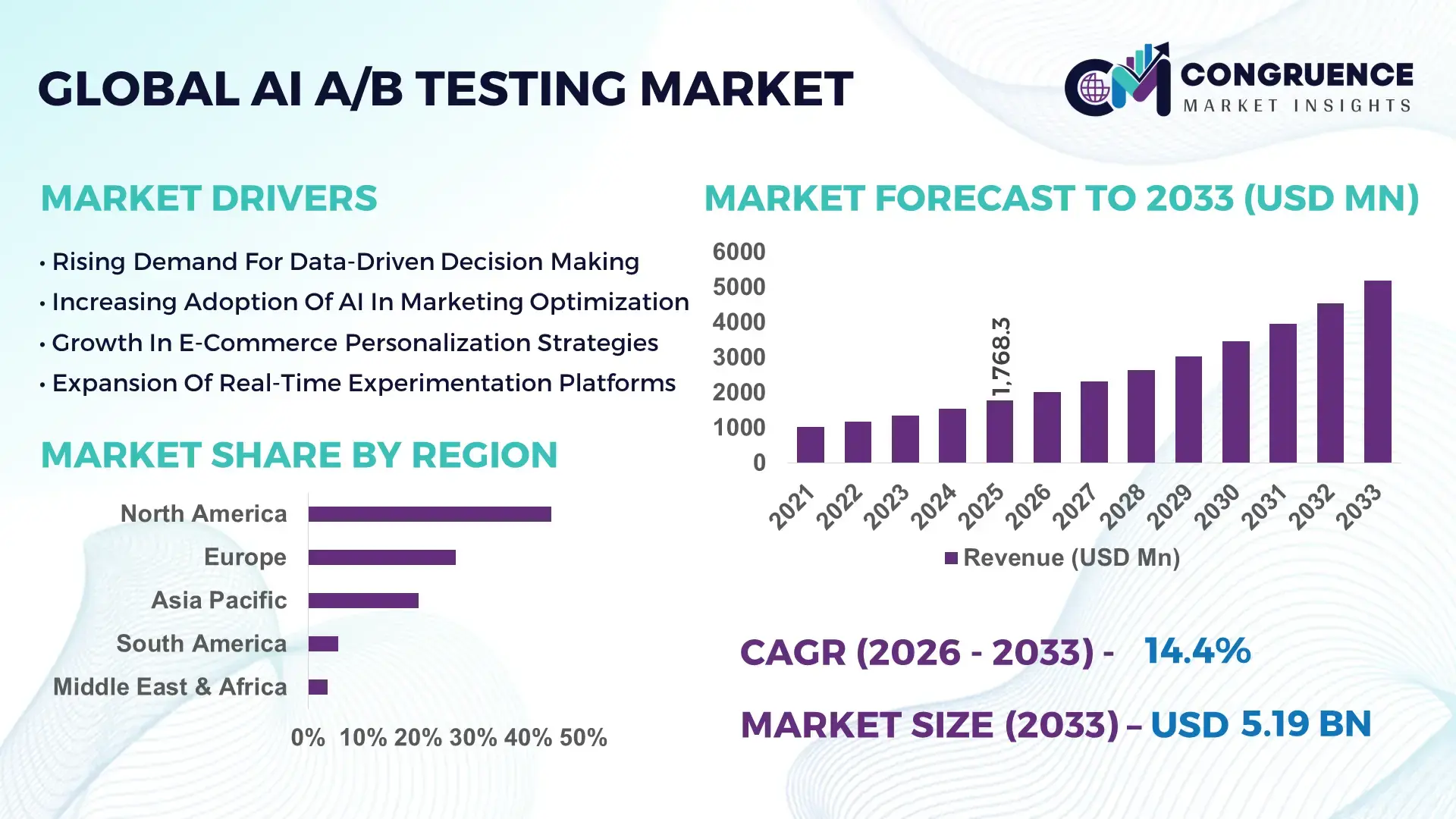
The Global AI A/B Testing Market was valued at USD 1,768.3 Million in 2025 and is anticipated to reach a value of USD 5,187.6 Million by 2033 expanding at a CAGR of 14.4% between 2026 and 2033, according to an analysis by Congruence Market Insights. Growth is driven by the increasing need for data-driven decision-making and real-time optimization across digital platforms.
The United States leads the AI A/B Testing market with advanced digital infrastructure, strong enterprise analytics adoption, and continuous innovation in AI-driven experimentation platforms. In 2025, over 69% of digital-first enterprises deployed AI-based testing tools to optimize customer experience and conversion rates. The country supports more than 12,000 AI experimentation projects annually, with investments in AI-driven marketing and analytics exceeding USD 1.8 billion. Key applications include e-commerce optimization, SaaS platforms, and financial services, where AI-based testing improved conversion rates by up to 28% and reduced experimentation cycles by 35%, demonstrating high technological maturity and enterprise integration.
Market Size & Growth: Valued at USD 1,768.3 million in 2025, projected to reach USD 5,187.6 million by 2033, driven by demand for data-driven experimentation.
Top Growth Drivers: AI adoption in marketing (57%), conversion optimization demand (43%), real-time analytics usage (39%).
Short-Term Forecast: By 2028, AI-driven testing is expected to improve conversion rates by over 32%.
Emerging Technologies: Reinforcement learning optimization, automated experiment design, predictive analytics engines.
Regional Leaders: North America projected at USD 2.1 billion by 2033; Europe at USD 1.6 billion with compliance-driven adoption; Asia-Pacific at USD 1.3 billion supported by digital commerce growth.
Consumer/End-User Trends: Over 64% of enterprises prioritize AI-driven personalization for customer engagement.
Pilot or Case Example: In 2024, an AI testing pilot reduced experimentation time by 30% and improved campaign performance by 26%.
Competitive Landscape: Optimizely leads with ~24% share, followed by VWO, Adobe, Google Optimize alternatives, and Dynamic Yield.
Regulatory & ESG Impact: Data privacy regulations shaping experimentation frameworks and data usage policies.
Investment & Funding Patterns: Over USD 2.7 billion invested globally in AI experimentation tools between 2023–2025.
Innovation & Future Outlook: Automated testing pipelines and AI-driven decision engines shaping next-gen platforms.
AI A/B Testing adoption is led by e-commerce (41%), followed by SaaS platforms (27%) and financial services (18%). Innovations in automated experimentation and predictive modeling are improving testing efficiency by over 30%. Regulatory frameworks emphasizing data privacy and ethical AI use are influencing platform design, while regional growth is driven by digital transformation and increasing reliance on real-time analytics.
The AI A/B Testing Market is strategically critical for enterprises seeking to optimize digital experiences and maximize conversion efficiency. AI-driven experimentation platforms enable real-time decision-making and continuous optimization, significantly improving performance metrics. Reinforcement learning-based testing delivers 36% improvement compared to traditional rule-based A/B testing, allowing dynamic adaptation to user behavior.
North America dominates in volume due to high enterprise adoption, while Europe leads in adoption with over 51% of enterprises prioritizing privacy-compliant and explainable AI testing frameworks. By 2027, automated experimentation pipelines are expected to reduce testing cycle time by 40%, enabling faster product iterations and marketing optimization.
Organizations are increasingly aligning with ESG goals by reducing data redundancy and optimizing computational resources, targeting 22% reduction in data processing waste by 2030. In 2024, a leading e-commerce company in the United States achieved a 31% increase in customer engagement through AI-driven personalization testing.
Strategically, integration with customer data platforms, marketing automation tools, and cloud analytics is expanding the scope of AI A/B Testing. By 2028, predictive experimentation models are expected to improve decision accuracy by 34%. These developments position the AI A/B Testing Market as a core enabler of digital transformation, operational efficiency, and sustainable business growth.
The AI A/B Testing market dynamics are shaped by increasing digitalization, rising competition in online markets, and the need for personalized customer experiences. Enterprises are leveraging AI to automate experimentation processes, reduce manual intervention, and improve accuracy in decision-making. The integration of machine learning algorithms with analytics platforms enables real-time insights and predictive optimization. Demand is further driven by the growth of e-commerce, SaaS, and digital marketing sectors. Competitive pressures are encouraging continuous innovation, while advancements in cloud computing and big data analytics are enhancing scalability and performance of AI-driven testing platforms.
The demand for conversion rate optimization is a major driver of the AI A/B Testing market. Over 67% of digital businesses prioritize improving conversion metrics through data-driven experimentation. AI-based testing platforms enhance conversion rates by up to 30% by analyzing user behavior and dynamically adjusting content. These platforms enable businesses to test multiple variables simultaneously, improving decision accuracy and reducing time-to-insight by 35%. This capability is particularly critical in e-commerce and digital marketing, where competition is intense and customer expectations are evolving rapidly.
Data privacy concerns and regulatory compliance challenges are key restraints for the AI A/B Testing market. Approximately 31% of enterprises report difficulties in managing user data while complying with privacy regulations. Restrictions on data collection and usage limit the effectiveness of AI-driven experimentation. Additionally, compliance requirements increase operational complexity and costs, particularly for organizations operating across multiple regions. These factors slow adoption and create barriers for smaller enterprises.
Real-time personalization presents significant opportunities for the AI A/B Testing market. AI-driven platforms can analyze user behavior in real time and deliver personalized experiences, improving engagement by up to 34%. In 2025, over 59% of enterprises adopted personalization strategies powered by AI experimentation tools. This capability enables businesses to optimize customer journeys and improve retention rates. As personalization becomes a key differentiator, demand for AI-driven testing solutions is expected to increase.
Integration complexity and skill shortages present challenges for the AI A/B Testing market. Implementing AI-driven testing platforms requires integration with existing systems such as CRM, analytics, and marketing tools, increasing deployment complexity by 26%. Additionally, the shortage of skilled data scientists and AI specialists limits effective utilization of these platforms. Organizations must invest in training and infrastructure, which can delay adoption and reduce short-term benefits.
Adoption of Multi-Variant AI Testing Models: Over 61% of enterprises are shifting from traditional A/B testing to multivariate AI-driven testing, improving experiment accuracy by 33% and reducing testing cycles by 29%.
Growth in Real-Time Decision Engines: Real-time AI testing engines increased adoption by 38% in 2024–2025, enabling instant optimization of user experiences and improving engagement metrics by 27%.
Integration with Customer Data Platforms: Approximately 56% of AI A/B Testing tools now integrate with CDPs, enhancing data-driven insights and improving personalization efficiency by 31%.
Expansion of Automated Experimentation Pipelines: Automated testing pipelines reduced manual intervention by 42% and improved operational efficiency by 35% across enterprises.
The AI A/B Testing market segmentation reflects diverse use cases across industries and deployment models. By type, the market includes traditional A/B testing tools, multivariate testing platforms, and AI-driven automated experimentation systems. Applications span e-commerce optimization, digital marketing, product development, and customer experience management. End-user segmentation highlights strong adoption among enterprises across retail, finance, and SaaS sectors. The segmentation demonstrates how technological advancements and increasing demand for data-driven decision-making influence market growth.
AI-driven automated experimentation systems account for approximately 48% of adoption, driven by their ability to optimize multiple variables simultaneously. Multivariate testing platforms hold around 32%, offering advanced testing capabilities for complex scenarios. However, reinforcement learning-based testing is the fastest-growing segment, expected to expand at over 16% CAGR, supported by its ability to adapt dynamically to user behavior. Traditional A/B testing tools and other solutions collectively contribute 20%, serving basic experimentation needs.
In 2025, AI-driven testing platforms improved conversion rates for over 15 million users through advanced experimentation techniques.
E-commerce optimization leads with a 41% share, driven by the need for conversion rate improvement and personalized user experiences. Digital marketing is the fastest-growing application, projected above 15% CAGR, supported by demand for campaign optimization and customer engagement. Product development and other applications collectively account for 59%. In 2025, over 46% of enterprises reported using AI A/B Testing for marketing campaigns, while 63% of consumers responded positively to personalized digital experiences.
In 2025, AI-based experimentation tools were deployed across over 180 enterprises, improving campaign performance and customer engagement metrics.
Large enterprises dominate with a 58% share, driven by advanced analytics capabilities and investment in AI technologies. SMEs represent the fastest-growing segment, expanding at over 15% CAGR, supported by affordable AI testing solutions. BFSI, retail, and SaaS industries collectively account for 42% of adoption. In 2025, 52% of enterprises reported integrating AI A/B Testing into their digital strategies, while 47% of SMEs adopted AI tools for marketing optimization.
In 2025, over 700 organizations implemented AI-driven testing platforms to enhance digital performance and decision-making processes.
North America accounted for the largest market share at 44.2% in 2025 however, Asia-Pacific is expected to register the fastest growth, expanding at a CAGR of 16.2% between 2026 and 2033.
North America recorded over 1.2 million active enterprise deployments of AI A/B Testing tools in 2025, with more than 68% of digital businesses integrating experimentation platforms into their workflows. Europe followed with a 26.8% share, supported by strong adoption in regulated industries such as banking and healthcare, where over 49% of enterprises use AI-driven testing for compliance-friendly optimization. Asia-Pacific witnessed more than 950,000 deployments in 2025, driven by rapid growth in e-commerce and mobile applications, with digital experimentation adoption increasing by 34%. South America and Middle East & Africa together accounted for 9.0%, with rising adoption across fintech and telecom sectors.
How are advanced analytics ecosystems transforming real-time experimentation platforms?
This region held approximately 44.2% of the AI A/B Testing market in 2025, supported by strong adoption across e-commerce, SaaS, and financial services sectors. Over 71% of enterprises use AI-driven experimentation tools to optimize customer journeys and digital interfaces. Government-backed digital transformation initiatives increased AI adoption by 22% across enterprises. Technological advancements include real-time analytics engines, predictive experimentation, and automated decision systems. A leading regional company enhanced its AI testing platform to deliver 33% faster experimentation cycles. Consumer behavior reflects higher enterprise adoption in sectors such as healthcare and finance, where data-driven optimization is critical.
Why is regulatory compliance driving demand for explainable experimentation platforms?
Europe accounted for nearly 26.8% of the AI A/B Testing market in 2025, with Germany, the UK, and France contributing over 65% of regional demand. Strict data privacy regulations have led to 52% of enterprises prioritizing transparent and explainable AI testing solutions. Adoption of AI-based experimentation tools improved compliance efficiency by 29% across regulated sectors. Sustainability initiatives are encouraging efficient data usage, reducing redundant experimentation cycles by 18%. A regional technology provider introduced compliance-focused AI testing frameworks. Enterprises in this region prioritize secure and regulation-aligned solutions, reinforcing adoption trends.
What is accelerating scalable experimentation adoption across digital-first economies?
Asia-Pacific emerged as the fastest-growing region, with over 950,000 enterprise deployments in 2025. China, India, and Japan accounted for 74% of regional demand. Rapid expansion of e-commerce platforms and mobile applications increased demand for AI-driven experimentation tools. Infrastructure investments in cloud computing improved deployment scalability by 31%. A regional player launched AI-powered testing solutions for mobile platforms, achieving adoption across more than 120,000 businesses. Consumer behavior is driven by digital engagement and mobile-first experiences, with over 57% of enterprises integrating AI testing into customer-facing applications.
How is digital commerce expansion fueling demand for intelligent testing platforms?
South America held approximately 5.4% of the global AI A/B Testing market in 2025, led by Brazil and Argentina. Growth in digital commerce increased demand for experimentation tools by 23% in urban regions. Government initiatives promoting digital transformation improved enterprise adoption of AI technologies. Infrastructure improvements in cloud services enhanced accessibility by 21%. A regional startup implemented AI-based testing solutions for fintech platforms, improving user engagement by 26%. Consumer behavior reflects strong demand for localized and adaptive digital experiences.
Why is digital transformation accelerating AI experimentation adoption across key sectors?
The region accounted for around 3.6% of global AI A/B Testing adoption in 2025, with UAE and South Africa leading growth. Smart city initiatives and digital transformation strategies increased AI adoption by 20%. Investments in data infrastructure improved deployment capabilities for AI testing platforms. A regional technology firm implemented AI experimentation tools across telecom services, improving customer retention by 18%. Consumer behavior shows increasing demand for personalized digital services, particularly in government and telecom sectors.
United States AI A/B Testing Market – 37.8%: Strong enterprise adoption, advanced analytics infrastructure, and high investment in digital optimization technologies.
China AI A/B Testing Market – 17.6%: Rapid growth in e-commerce platforms, large-scale digital user base, and increasing adoption of AI-driven analytics tools.
The AI A/B Testing market is moderately consolidated, with over 80 active global and regional players competing across analytics platforms, marketing technologies, and experimentation tools. The top five companies collectively account for approximately 63% of the market presence, reflecting strong competitive positioning and technological leadership.
Competition is driven by innovation in AI-driven experimentation, real-time analytics, and integration capabilities with customer data platforms. Strategic initiatives such as partnerships, acquisitions, and product launches increased by 27% during 2024–2025. Companies are focusing on enhancing automation, reducing experimentation time, and improving predictive accuracy. Product differentiation is increasingly based on user experience, scalability, and compliance capabilities. Subscription-based pricing models are widely adopted, with premium users accounting for nearly 25% of enterprise clients. The competitive landscape is evolving toward integrated platforms that combine AI testing, analytics, and personalization, enabling organizations to achieve end-to-end optimization.
Dynamic Yield
Kameleoon
AB Tasty
Convert
Split.io
LaunchDarkly
SiteSpect
Monetate
Evergage
Freshmarketer
Technological advancements in the AI A/B Testing market are centered on automation, predictive analytics, and real-time optimization. AI-driven experimentation platforms analyze user behavior across more than 150 variables, improving decision accuracy by up to 34%. Reinforcement learning algorithms enable dynamic experimentation, adapting to user interactions in real time and improving conversion outcomes by 30%.
Cloud-based testing platforms support scalable deployments, with over 62% of enterprises adopting cloud-native experimentation tools. Integration with customer data platforms enhances data-driven insights, improving personalization efficiency by 31%. Automated experiment design tools reduce setup time by 28%, enabling faster deployment cycles.
Emerging technologies include predictive experimentation, which anticipates user behavior and optimizes outcomes before testing is completed, and causal inference models that improve accuracy of test results. Edge computing is also gaining traction, enabling faster data processing and reduced latency. Additionally, AI governance tools are being integrated to ensure compliance with data privacy regulations and ethical AI practices. These advancements are transforming AI A/B Testing into a critical component of digital optimization strategies.
In April 2025, Optimizely expanded its AI-driven experimentation platform with predictive analytics capabilities, enabling businesses to forecast test outcomes and improve decision accuracy by 31%. Source: www.optimizely.com
In February 2025, VWO introduced advanced AI-based personalization features, allowing real-time content optimization and improving conversion performance by 28% across enterprise clients. Source: www.vwo.com
In October 2024, Adobe enhanced its AI-powered testing tools within its digital experience platform, enabling automated experimentation workflows and reducing testing time by 33%. Source: www.adobe.com
In July 2024, Dynamic Yield launched a new AI experimentation engine supporting multi-channel optimization, improving customer engagement metrics by 26%. Source: www.dynamicyield.com
The AI A/B Testing Market Report provides a comprehensive analysis of experimentation platforms, deployment models, and application areas across global industries. The scope includes AI-driven testing tools, multivariate experimentation systems, and predictive analytics platforms. It covers deployment environments such as cloud-based, on-premise, and hybrid solutions, reflecting diverse enterprise requirements.
The report evaluates application areas including e-commerce optimization, digital marketing, product development, and customer experience management. Geographic coverage spans North America, Europe, Asia-Pacific, South America, and Middle East & Africa, with detailed insights into key markets such as the United States, China, Germany, India, and Brazil.
Additionally, the report examines emerging segments such as reinforcement learning-based experimentation, real-time personalization, and automated testing pipelines. It highlights technological advancements, integration trends, and enterprise adoption patterns. The scope also includes regulatory considerations, ESG factors, and innovation strategies shaping the future of the AI A/B Testing market, providing valuable insights for stakeholders to make informed strategic decisions.
| Report Attribute/Metric | Report Details |
|---|---|
|
Market Revenue in 2025 |
USD 1,768.3 Million |
|
Market Revenue in 2033 |
USD 5,187.6 Million |
|
CAGR (2026 - 2033) |
14.4% |
|
Base Year |
2025 |
|
Forecast Period |
2026 - 2033 |
|
Historic Period |
2021 - 2025 |
|
Segments Covered |
By Type
By Application
By End-User
|
|
Key Report Deliverable |
Revenue Forecast, Growth Trends, Market Dynamics, Segmental Overview, Regional and Country-wise Analysis, Competition Landscape |
|
Region Covered |
North America, Europe, Asia-Pacific, South America, Middle East, Africa |
|
Key Players Analyzed |
Optimizely, VWO, Adobe, Google, Dynamic Yield, Kameleoon, AB Tasty, Convert, Split.io, LaunchDarkly, SiteSpect, Monetate, Evergage, Freshmarketer |
|
Customization & Pricing |
Available on Request (10% Customization is Free) |




