
Reports
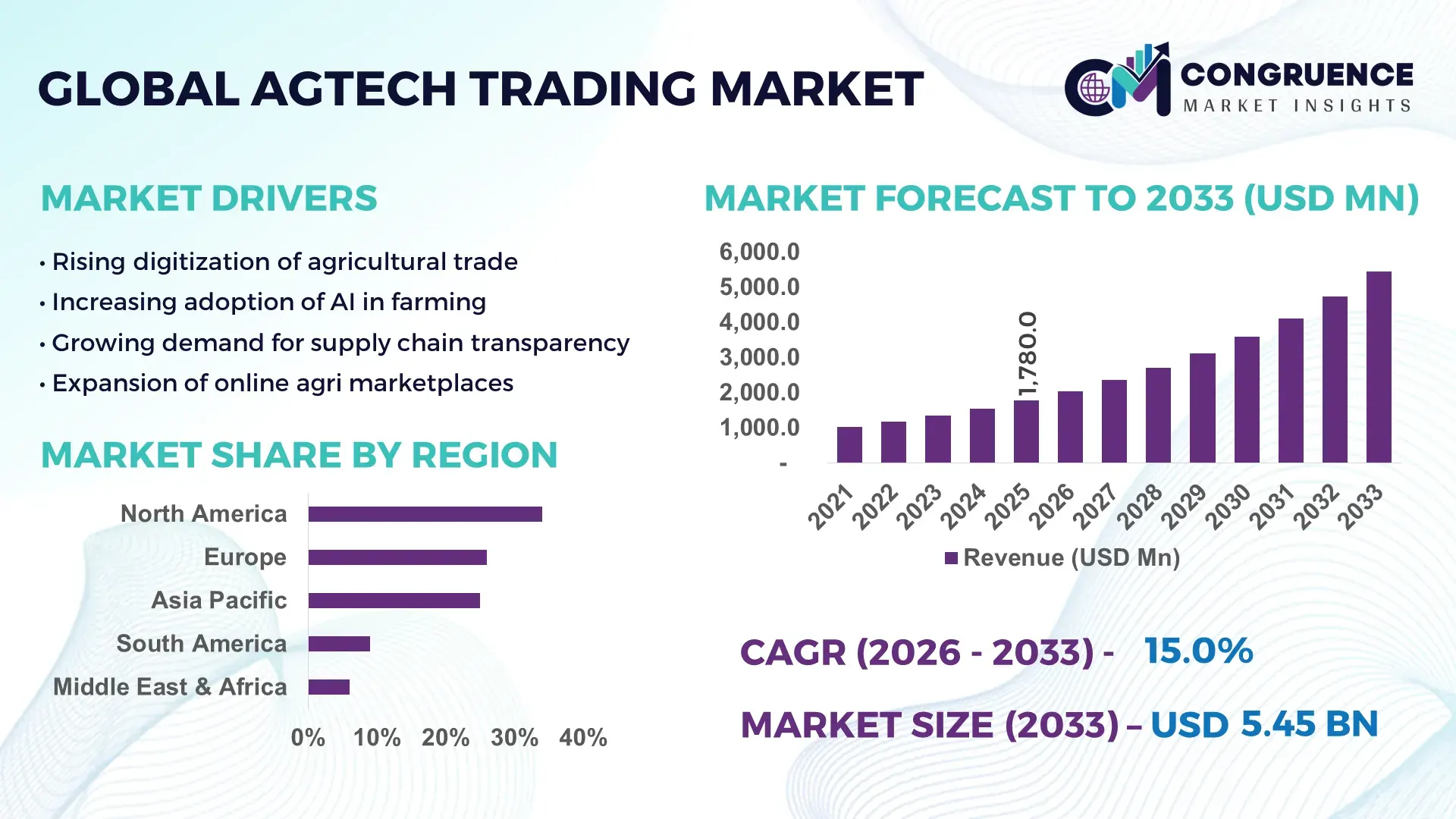
The Global AgTech Trading Market was valued at USD 1,780.0 Million in 2025 and is anticipated to reach a value of USD 5,445.1 Million by 2033 expanding at a CAGR of 15.0% between 2026 and 2033, according to an analysis by Congruence Market Insights. This growth is primarily driven by the rapid digitization of agricultural supply chains and increasing demand for transparent commodity trading platforms.
The United States leads the AgTech Trading Market with over 28% of global digital agriculture platform deployments, supported by more than 2,500 AgTech startups and annual investments exceeding USD 6 billion in precision agriculture and trading technologies. Approximately 62% of large-scale farms in the country utilize digital trading platforms for crop sales, input procurement, and logistics optimization. Grain trading platforms in the Midwest alone handle over 180 million metric tons annually through digital channels, reflecting high platform penetration. Additionally, AI-enabled commodity pricing tools have improved trading efficiency by 35%, while blockchain-based traceability solutions are adopted by nearly 40% of agribusiness enterprises. The country also records over 55% adoption of IoT-integrated trading systems among commercial farms, highlighting strong technological integration across the agricultural value chain.
Market Size & Growth: USD 1,780.0 Million in 2025, projected to reach USD 5,445.1 Million by 2033, growing at 15.0%, driven by digitized agri-supply chains.
Top Growth Drivers: 48% rise in digital platform adoption, 35% improvement in trading efficiency, 42% increase in real-time pricing usage.
Short-Term Forecast: By 2028, supply chain costs are expected to decline by 22% due to platform automation.
Emerging Technologies: Blockchain traceability, AI-based commodity pricing, IoT-enabled supply chain tracking.
Regional Leaders: North America (~USD 1.8 Billion by 2033) with advanced tech adoption; Asia-Pacific (~USD 2.1 Billion) driven by smallholder digitization; Europe (~USD 1.3 Billion) focusing on sustainability compliance.
Consumer/End-User Trends: Over 58% of agribusinesses prefer integrated trading platforms for procurement and sales.
Pilot or Case Example: In 2024, a digital grain trading pilot improved transaction speed by 40% and reduced intermediaries by 25%.
Competitive Landscape: Leader holds ~18% share, followed by 4–5 major global platform providers.
Regulatory & ESG Impact: Over 45% of platforms now integrate carbon tracking and sustainability reporting tools.
Investment & Funding Patterns: More than USD 9 billion invested globally in AgTech platforms between 2023–2025.
Innovation & Future Outlook: Integration of predictive analytics and satellite data is expected to transform trading accuracy and risk management.
AgTech Trading platforms are increasingly diversified across crop trading (45%), livestock trading (18%), and agri-input exchanges (22%), while emerging carbon-credit trading contributes nearly 10%. AI-based price forecasting tools have improved trade accuracy by 30%, while regulatory frameworks promoting transparency and traceability are accelerating adoption. Asia-Pacific shows strong consumption growth due to smallholder integration, while Europe emphasizes sustainability-linked trading.
The AgTech Trading Market plays a critical strategic role in transforming traditional agricultural supply chains into digitally connected ecosystems. By enabling real-time commodity pricing, automated transactions, and transparent traceability, these platforms reduce inefficiencies by up to 35% and enhance farmer profitability. The integration of AI-driven analytics has allowed agribusinesses to improve demand forecasting accuracy by nearly 28%, significantly reducing surplus and wastage across supply chains.
Blockchain-based trading platforms deliver 40% improvement in transaction transparency compared to conventional offline trading systems, while IoT-enabled logistics monitoring reduces post-harvest losses by approximately 22%. North America dominates in trading volume, while Asia-Pacific leads in adoption with over 52% of smallholder farmers increasingly engaging with digital platforms. By 2028, AI-powered predictive pricing tools are expected to improve trading margins by 25% through optimized decision-making.
From a compliance perspective, firms are committing to ESG targets such as reducing carbon emissions in agricultural logistics by 30% by 2030 through digital monitoring and reporting systems. In 2025, a major U.S.-based agribusiness platform achieved a 33% reduction in supply chain inefficiencies using AI-integrated trading solutions, demonstrating the measurable benefits of digital transformation.
Looking ahead, the AgTech Trading Market is positioned as a critical pillar for resilient food systems, regulatory compliance, and sustainable agricultural growth, driven by continuous innovation in AI, blockchain, and data analytics technologies.
The AgTech Trading Market is characterized by rapid digital transformation, increasing platform-based transactions, and rising integration of advanced technologies across agricultural value chains. Approximately 60% of global agribusinesses are transitioning toward digital trading systems to improve efficiency and reduce dependency on intermediaries. The adoption of cloud-based trading platforms has increased by over 45% in the past three years, enabling real-time access to market data and streamlined transactions. Additionally, cross-border agricultural trade through digital platforms has grown by nearly 30%, reflecting the increasing globalization of agri-commodities. Governments worldwide are also supporting digital agriculture initiatives, with over 50 countries implementing policies to promote agri-digitalization. The market is further influenced by growing demand for traceability, with nearly 48% of buyers prioritizing transparency in sourcing agricultural products.
The rapid digitalization of agriculture is a major driver for the AgTech Trading Market, with over 55% of farmers globally now using smartphones or digital tools for agricultural operations. Digital trading platforms enable direct market access, reducing intermediary involvement by nearly 30% and increasing farmer margins. Additionally, over 47% of agricultural cooperatives have adopted digital marketplaces for bulk trading, enhancing operational efficiency. AI-based pricing tools are used by approximately 38% of large agribusinesses, improving decision-making accuracy and reducing price volatility impacts. The integration of digital payment systems has also increased transaction security and speed, with transaction processing times reduced by up to 40%. These advancements are significantly boosting adoption rates and transforming traditional agricultural trading practices.
Despite rapid advancements, infrastructure limitations remain a critical restraint, particularly in developing regions where only 35% of rural areas have access to reliable internet connectivity. Approximately 42% of smallholder farmers face challenges in adopting digital trading platforms due to limited digital literacy and access to smart devices. Additionally, inconsistent logistics infrastructure leads to delays in over 28% of digital transactions, affecting platform reliability. Data security concerns also persist, with nearly 33% of users hesitant to adopt digital platforms due to fears of cyber threats and data misuse. These factors collectively hinder the widespread adoption of AgTech trading solutions, particularly in emerging economies.
The expansion of cross-border digital agriculture trade presents significant opportunities, with global agri-exports via digital platforms increasing by 30% over recent years. Nearly 46% of agribusinesses are exploring international trading platforms to access new markets and diversify revenue streams. The integration of blockchain technology enables secure and transparent transactions, reducing fraud risks by up to 25%. Additionally, digital platforms are facilitating access to financing, with over 35% of farmers using integrated fintech solutions for trade financing. Emerging markets in Asia and Africa are witnessing increased adoption, with platform usage growing by over 40%, creating substantial growth potential for global AgTech trading providers.
Regulatory complexities pose a significant challenge, as agricultural trade is subject to varying standards across countries. Approximately 38% of digital trading platforms face compliance challenges due to differing import-export regulations and quality standards. Data privacy laws also impact platform operations, with over 30% of companies investing heavily in compliance measures. Additionally, taxation policies on digital transactions vary significantly, increasing operational complexity for global platforms. Certification requirements for organic and sustainable products further complicate cross-border trade, affecting nearly 27% of transactions. These regulatory hurdles require continuous adaptation and increase operational costs for market participants.
Rapid Adoption of AI-Based Price Forecasting: Over 48% of AgTech trading platforms now integrate AI-driven pricing models, improving commodity price prediction accuracy by nearly 32%. These systems process over 1.5 million data points daily, enabling traders to optimize decisions and reduce price volatility exposure across global agricultural markets.
Expansion of Blockchain-Based Traceability Systems: Nearly 40% of agricultural trading platforms have adopted blockchain technology, enhancing supply chain transparency and reducing fraud incidents by approximately 25%. Over 65% of export-focused agribusinesses now require blockchain-based traceability to meet international compliance standards.
Growth in Mobile-Based Trading Platforms: Mobile usage accounts for over 58% of all digital agricultural transactions globally, driven by increased smartphone penetration among farmers. In emerging markets, mobile-based platforms have improved farmer participation in digital trading by more than 45%, enabling real-time access to buyers and pricing information.
Integration of IoT in Supply Chain Monitoring: Around 50% of large-scale agribusinesses use IoT-enabled systems to monitor crop conditions, storage, and transportation. These technologies have reduced post-harvest losses by up to 22% and improved logistics efficiency by 30%, significantly enhancing the reliability of digital trading ecosystems.
The AgTech Trading Market is segmented based on type, application, and end-user, each contributing distinctively to market expansion. Digital trading platforms dominate the market structure, supported by increasing adoption of real-time data analytics and automation technologies. Approximately 45% of the market is driven by crop-based trading, while livestock and agri-input trading collectively contribute over 40%, reflecting diversified use cases. Application-wise, commodity trading platforms lead due to their extensive use in large-scale agriculture and export markets. End-user segmentation shows strong participation from agribusiness enterprises, cooperatives, and individual farmers, with enterprises accounting for the largest share due to higher technological adoption. Emerging segments such as carbon credit trading and sustainability-linked agricultural exchanges are gaining traction, supported by regulatory initiatives and environmental awareness.
Digital trading platforms account for approximately 52% of the AgTech Trading Market, driven by their ability to facilitate real-time transactions and provide integrated analytics. These platforms are widely used for crop and commodity trading, offering scalability and efficiency advantages. Blockchain-based trading systems hold around 26% share, gaining traction due to their enhanced transparency and security features. However, AI-driven predictive trading systems are the fastest-growing segment, expected to expand at a CAGR of 18%, as they enable accurate demand forecasting and price optimization. Other types, including mobile-based trading applications and IoT-integrated systems, collectively account for nearly 22% of the market, supporting niche applications such as logistics tracking and smallholder participation. The increasing integration of AI and blockchain technologies is further driving innovation across all product types.
• In 2025, a leading agricultural exchange platform implemented AI-based predictive analytics to process over 2 million trade data points daily, improving pricing accuracy by 30% and reducing transaction delays by 25%.
Commodity trading dominates the application segment with a 48% share, driven by high demand for grains, oilseeds, and cash crops across global markets. Supply chain optimization applications account for approximately 27%, enabling efficient logistics and inventory management. However, carbon credit and sustainability trading is the fastest-growing application, expected to expand at a CAGR of 17%, supported by increasing environmental regulations and corporate sustainability goals. Other applications, including agri-input trading and livestock exchanges, collectively contribute around 25% of the market, reflecting diversified usage. In 2025, over 38% of agribusiness enterprises globally reported adopting digital trading platforms for supply chain management, while more than 55% of exporters rely on digital systems for cross-border transactions.
• In 2024, a global agricultural platform enabled over 500,000 farmers to participate in digital commodity trading, improving market access and reducing transaction costs by 20%.
Agribusiness enterprises lead the end-user segment with a 46% share, driven by large-scale operations and higher investment capacity in digital technologies. Cooperatives account for around 28%, leveraging collective trading to improve bargaining power and market access. Individual farmers represent approximately 18%, with adoption increasing due to mobile-based trading platforms. However, government and institutional users are the fastest-growing segment, expected to expand at a CAGR of 16%, driven by policy support and digital agriculture initiatives. Other end-users, including food processing companies and exporters, collectively contribute around 8%, supporting downstream supply chain integration. In 2025, over 42% of large agricultural enterprises reported integrating digital trading platforms into their operations, while nearly 35% of cooperatives adopted AI-based systems for pricing and demand forecasting.
• In 2025, a national agricultural board implemented a digital trading platform used by over 1 million farmers, increasing transaction efficiency by 35% and improving price transparency across regional markets.
North America accounted for the largest market share at 34% in 2025 however, Asia-Pacific is expected to register the fastest growth, expanding at a CAGR of 17.2% between 2026 and 2033.

North America processed over 220 million metric tons of agricultural commodities through digital platforms, while Europe accounted for 26% share with strong regulatory-driven adoption. Asia-Pacific recorded over 45% of global farmer participation in digital trading platforms, reflecting rapid adoption in countries like India and China. South America contributed around 9%, driven by large-scale soybean and grain exports, while the Middle East & Africa held approximately 6%, supported by increasing investments in agricultural modernization.
North America holds approximately 34% market share, driven by high adoption of AI, blockchain, and IoT technologies. The region processes over 220 million metric tons of agricultural commodities annually through digital platforms. Government support for digital agriculture, including funding programs covering over 40% of technology adoption costs, is accelerating growth. Companies like Indigo Ag are leveraging AI-driven platforms to optimize grain trading and improve pricing transparency. Consumer behavior shows high enterprise adoption, with over 60% of agribusiness firms relying on digital platforms for trading and supply chain management.
Europe accounts for approximately 26% market share, with countries like Germany, France, and the UK leading adoption. Over 50% of agribusinesses in the region comply with sustainability regulations requiring traceability and transparency. The European Union’s digital agriculture initiatives support over 35% of farmers in adopting trading platforms. Companies such as BASF Digital Farming are integrating blockchain for supply chain transparency. Consumer behavior reflects strong demand for sustainable sourcing, with over 45% of buyers prioritizing traceable agricultural products.
Asia-Pacific represents the fastest-growing region, with over 45% of global platform users. China, India, and Japan are key contributors, with India alone recording over 120 million farmers using digital tools. Government initiatives supporting digital agriculture cover nearly 50% of smallholder farmers. Platforms like Ninjacart are transforming supply chains by reducing intermediaries and improving farmer incomes. Consumer behavior is driven by mobile adoption, with over 65% of transactions conducted via smartphones.
South America holds around 9% market share, led by Brazil and Argentina. The region exports over 150 million metric tons of agricultural commodities annually, with increasing reliance on digital trading platforms. Government policies supporting digital agriculture adoption cover approximately 30% of large-scale farms. Companies like Agrofy are expanding digital marketplaces across the region. Consumer behavior is influenced by export demand, with over 55% of agribusinesses using digital platforms for international trade.
The Middle East & Africa account for approximately 6% market share, with countries like the UAE and South Africa leading adoption. Investments in agricultural modernization exceed USD 2 billion annually, supporting digital platform adoption. Over 35% of agribusinesses in the region are adopting trading technologies to improve supply chain efficiency. Local initiatives focus on improving food security through digital agriculture. Consumer behavior shows increasing adoption among large-scale farms, with over 40% using digital platforms for trading.
United States – 28% Market share: driven by high digital platform adoption and strong investment in AgTech infrastructure
China – 22% Market share: supported by large agricultural production capacity and rapid digital transformation
The AgTech Trading Market is moderately fragmented, with over 120 active global and regional players competing across platform-based trading, supply chain integration, and analytics solutions. The top five companies collectively account for approximately 38% of the total market share, indicating a competitive yet evolving landscape. Leading players are focusing on strategic partnerships, with over 45% of companies engaging in collaborations to enhance platform capabilities and expand geographic reach.
Product innovation remains a key competitive factor, with nearly 50% of companies investing in AI-driven pricing tools and blockchain-based traceability systems. Mergers and acquisitions have increased by 30% over the past two years, enabling companies to strengthen their technological portfolios and market presence. Additionally, around 42% of market participants are expanding into emerging markets to capture growth opportunities driven by increasing digital adoption. The competitive environment is further shaped by continuous advancements in data analytics, IoT integration, and cloud-based solutions, which are redefining efficiency and transparency in agricultural trading.
Agrofy
Farmers Business Network
DeHaat
Agribazaar
CropIn Technology
Granular Inc.
Bushel Inc.
FarmLead
TaniHub
AgroStar
WayCool Foods
ProducePay
The AgTech Trading Market is increasingly driven by advanced technologies that enhance efficiency, transparency, and scalability across agricultural value chains. Artificial intelligence is widely used for predictive analytics, with over 48% of trading platforms integrating AI-based tools to forecast commodity prices and demand patterns. These systems analyze millions of data points, improving pricing accuracy by nearly 30% and reducing market volatility risks.
Blockchain technology is another critical innovation, adopted by approximately 40% of platforms to ensure secure and transparent transactions. It enables end-to-end traceability, allowing stakeholders to track agricultural products from farm to market, reducing fraud by up to 25%. Internet of Things (IoT) technologies are also playing a significant role, with over 50% of large agribusinesses using IoT-enabled sensors for monitoring crop conditions, storage, and transportation. These systems have reduced post-harvest losses by approximately 22% and improved logistics efficiency by 30%.
Cloud computing is facilitating scalability and real-time data access, with nearly 55% of platforms operating on cloud-based infrastructure. Mobile technology is equally impactful, accounting for over 58% of platform access, particularly in emerging markets. Additionally, integration of satellite imagery and remote sensing technologies enables precision agriculture, supporting better decision-making and resource optimization. These technological advancements are collectively transforming the AgTech Trading Market into a highly data-driven and efficient ecosystem.
• In November 2025, Indigo Ag partnered with Kellanova and Walmart to expand regenerative agriculture programs in Arkansas, helping farmers reduce over 37,000 metric tons of CO₂e emissions and conserve 11 billion gallons of water, while improving profitability through data-driven trading and sustainability incentives. Source: www.indigoag.com
• In January 2026 (based on 2025 program scaling), Indigo Ag announced a long-term agreement with Microsoft to supply 2.85 million carbon removal credits, building on earlier deliveries of 60,000 credits in 2025, strengthening digital carbon trading ecosystems linked to agricultural marketplaces.
• In June 2024, Indigo Ag upgraded its Carbon by Indigo platform, improving data processing efficiency by 80% and increasing carbon credit generation potential by 40–60% per acre, enabling faster onboarding and enhanced monetization for farmers participating in digital agricultural trading ecosystems.
• In November 2024, Indigo Ag entered a multi-year strategic partnership with GROWMARK to deploy biological and sustainability solutions across cooperative networks, supported by over 2,000+ field trials, enhancing yield performance and expanding access to digital-enabled agricultural trading and input marketplaces.
The AgTech Trading Market Report provides a comprehensive analysis of the global ecosystem, covering key segments including digital trading platforms, blockchain-enabled systems, AI-driven analytics tools, and IoT-integrated supply chain solutions. The report evaluates multiple product types such as commodity trading platforms, agri-input marketplaces, and emerging carbon credit trading systems, reflecting the diversification of digital agriculture.
Geographically, the report encompasses major regions including North America, Europe, Asia-Pacific, South America, and the Middle East & Africa, analyzing regional adoption trends, infrastructure development, and technological integration. It highlights key applications such as commodity trading, supply chain optimization, and sustainability-linked trading, supported by detailed insights into end-user segments including agribusiness enterprises, cooperatives, individual farmers, and government institutions.
The report also examines technological advancements shaping the market, including AI, blockchain, IoT, and cloud computing, along with their impact on operational efficiency and transparency. Additionally, it covers emerging trends such as mobile-based trading, cross-border digital agriculture trade, and ESG-driven initiatives. With a focus on data-driven insights, the report enables stakeholders to understand market dynamics, identify growth opportunities, and make informed strategic decisions across the AgTech Trading Market.
| Report Attribute / Metric | Details |
|---|---|
| Market Revenue (2025) | USD 1,780.0 Million |
| Market Revenue (2033) | USD 5,445.1 Million |
| CAGR (2026–2033) | 15.0% |
| Base Year | 2025 |
| Forecast Period | 2026–2033 |
| Historic Period | 2021–2025 |
| Segments Covered |
By Type
By Application
By End-User Insights
|
| Key Report Deliverables | Revenue Forecast; Market Trends; Growth Drivers & Restraints; Technology Insights; Segmentation Analysis; Regional Insights; Competitive Landscape; Regulatory & ESG Overview; Recent Developments |
| Regions Covered | North America; Europe; Asia-Pacific; South America; Middle East & Africa |
| Key Players Analyzed | Indigo Ag; Ninjacart; Agrofy; Farmers Business Network; DeHaat; Agribazaar; CropIn Technology; Granular Inc.; Bushel Inc.; FarmLead; TaniHub; AgroStar; WayCool Foods; ProducePay |
| Customization & Pricing | Available on Request (10% Customization Free) |




