
Reports
The Global Agricultural Sensors Market was valued at USD 4572.22 Million in 2025 and is anticipated to reach a value of USD 8652.77 Million by 2033 expanding at a CAGR of 8.3% between 2026 and 2033. Precision irrigation, variable rate application, autonomous machinery, soil monitoring, and connected farm equipment are accelerating agricultural sensor deployment across commercial farming operations.
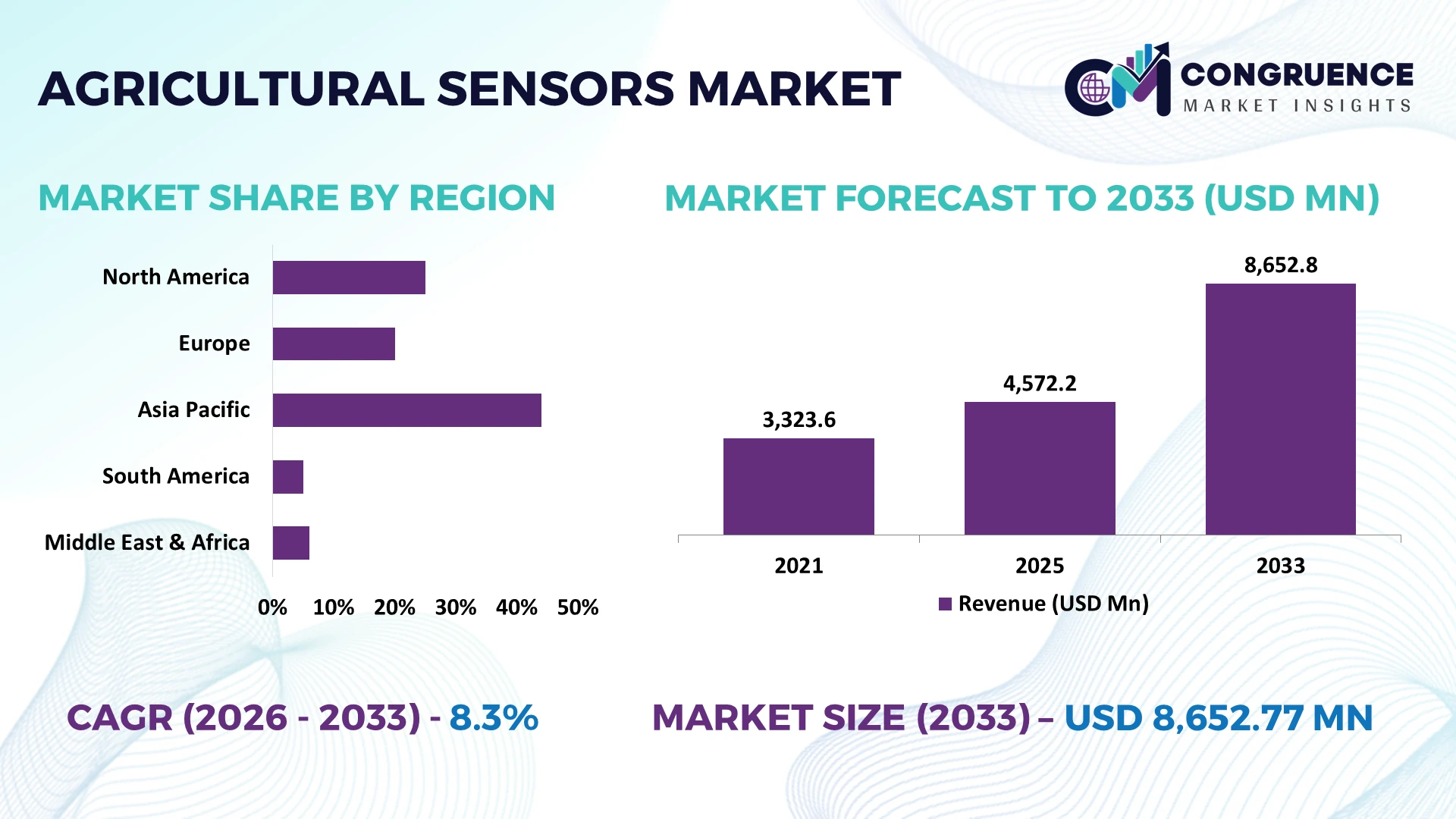
The United States dominates agricultural sensor adoption, supported by large commercial farms, mechanized crop production, and precision agriculture infrastructure. Around 25% of U.S. farms use precision agriculture practices, while adoption among large crop farms exceeds 60% for selected guidance, mapping, and monitoring technologies. Europe follows with approximately 18% of farms using precision farming technologies, strengthened by Common Agricultural Policy sustainability priorities. India is advancing digital agriculture through crop surveys and technology programs, expanding sensor opportunities across irrigation, soil monitoring, and field intelligence applications.
Strategically, suppliers should prioritize interoperable precision farming platforms in mature markets while scaling affordable wireless sensors across rapidly digitizing agricultural economies.
Market Size & Growth: USD 4,572.22 million in 2025 is projected to reach USD 8,652.77 million by 2033 at 8.3% CAGR, supported by precision agriculture adoption.
Top Growth Drivers: Precision irrigation, variable rate application, and autonomous equipment represent three core drivers, while approximately 25% of U.S. farms already use precision agriculture practices.
Short-Term Forecast: By 2028, integrated field sensing and automated input systems are positioned to reduce water and agrochemical consumption by approximately 10% to 20%.
Emerging Technologies: AI enabled sensing, IoT connectivity, edge analytics, multispectral monitoring, and sensor fusion are shifting farms toward continuous, automated field intelligence.
Regional Leaders: North America represents roughly 37% of global demand, followed by Europe near 27% and Asia Pacific near 24%, supported by distinct automation and irrigation priorities.
Consumer/End-User Trends: Large commercial crop operations lead adoption, with more than 60% of major U.S. farms deploying selected guidance, mapping, or precision monitoring technologies.
Pilot/Case Example: India expanded its Digital Crop Survey initiative across 436 districts in 2024, strengthening field level digital infrastructure supporting future sensor based agricultural monitoring.
Competitive Landscape: Deere holds an estimated high single digit share, while Trimble, Bosch, TE Connectivity, and Sensata compete through integrated sensing, connectivity, and precision farming technologies.
Regulatory & ESG Impact: Approximately 18% of EU farms use precision farming technologies, with Common Agricultural Policy sustainability requirements strengthening measurement driven fertilizer, pesticide, and water management.
Investment & Funding: Global agricultural technology funding exceeds USD 10 billion annually across multiple segments, with capital increasingly targeting AI, robotics, remote sensing, and connected farming platforms.
Innovation & Future Outlook: Next generation sensor fusion can combine 3 or more field data streams, shifting competitive advantage toward platforms integrating soil, crop, weather, and machinery intelligence.
Agricultural sensors are becoming central to high precision crop management, irrigation optimization, livestock monitoring, greenhouse automation, and machinery intelligence. Demand increasingly favors connected soil moisture, nutrient, climate, position, and optical sensors capable of feeding real time data into farm management platforms. Large commercial farms already record precision technology adoption above 60% for selected applications, demonstrating the operational value of automated decision support. Meanwhile, tighter water management requirements and unpredictable weather conditions are accelerating wireless sensing deployments, creating a stronger strategic case for integrated, interoperable agricultural monitoring ecosystems.
Agricultural sensors are becoming strategic infrastructure as farms shift from equipment led mechanization toward data directed production. Rising fertilizer costs, water constraints, and digital adoption are moving investment toward continuous soil, crop, climate, and machinery intelligence. In the United States, precision technologies are already used by roughly 25% of farms, while large crop operations record substantially higher penetration. This shift is redirecting supplier investment from standalone devices toward interoperable sensing ecosystems.
Connected soil moisture sensing paired with automated irrigation can reduce water application by approximately 15–25% compared with fixed schedule irrigation while improving intervention speed through real time field measurements. U.S. commercial farms benefit from extensive connected machinery infrastructure, whereas India offers larger greenfield potential through digital crop mapping and expanding micro irrigation. Practical deployments increasingly combine moisture probes, weather stations, GPS, and variable rate controllers to automate field level decisions.
Through 2028, wireless connectivity, edge analytics, and AI based sensor fusion will increase multi sensor deployments and reduce dependence on manual scouting. Manufacturers are strengthening partnerships with machinery OEMs, irrigation providers, and farm software platforms. Competitive advantage will increasingly belong to suppliers controlling interoperable data ecosystems rather than individual sensing components.
Precision agriculture adoption is the primary structural driver as growers replace uniform input application with sensor guided field management. Around 25% of U.S. farms use precision agriculture practices, while adoption among large crop farms exceeds 60% for selected guidance and mapping technologies. Sensor controlled irrigation can reduce water application by approximately 15–25% versus fixed scheduling by responding directly to soil moisture conditions. Increasing input costs reinforce this shift because measurement accuracy directly affects fertilizer, water, and fuel productivity. U.S. machinery manufacturers are consequently embedding positioning, environmental, equipment, and crop sensors into connected platforms. Sensor suppliers are expanding OEM partnerships and software integration, converting hardware sales into recurring analytics and decision support opportunities with stronger customer retention.
Farm connectivity and fragmented equipment architectures remain structural constraints on sensor deployment economics. Approximately 14% of U.S. farms reported having no internet access in recent agricultural surveys, while rural broadband performance remains uneven across production areas. Sensor networks can also lose 10–20% of expected operational value when incompatible protocols require separate gateways, manual data transfer, or duplicated software environments. India presents an additional constraint because smaller landholdings make per hectare hardware economics more demanding than on large mechanized farms. Semiconductor sourcing and specialized sensing component availability further expose manufacturers to procurement variability. Suppliers are responding with low power wide area networks, offline data storage, modular gateways, and multi protocol architectures while localizing assembly and diversifying component contracts to reduce deployment costs and supply exposure.
AI enabled sensor fusion creates an opportunity beyond conventional device sales by combining soil, weather, imagery, machinery, and crop measurements into automated agronomic decisions. Integrated sensing can reduce irrigation requirements by 15–25%, while targeted variable rate application can lower selected input use by approximately 10–20% under suitable field conditions. India provides substantial whitespace as digital crop surveys, irrigation modernization, and farm digitization expand addressable infrastructure. By 2028, edge processing will increasingly allow field devices to analyze multiple data streams without continuous cloud connectivity, improving responsiveness in connectivity constrained areas. Manufacturers are investing in multisensor platforms, API based interoperability, and predictive analytics partnerships. The strategic opportunity lies in monetizing decision intelligence and equipment optimization rather than competing primarily on sensor hardware pricing.
Scaling agricultural sensor networks introduces execution complexity as farms combine thousands of measurements from machinery, irrigation systems, weather stations, drones, and field devices. Large U.S. farms can operate equipment across several thousand acres, making calibration consistency, battery management, network coverage, and data synchronization critical. Wireless sensor accuracy can deteriorate by more than 10% when installation, calibration, or environmental compensation is poorly managed, while connected endpoints expand cybersecurity exposure across farm management systems. Australia illustrates the connectivity challenge because remote agricultural operations require reliable telemetry across extensive production areas. Suppliers must strengthen edge computing, encrypted communications, automated calibration, remote diagnostics, and standardized data interfaces. Long term competitiveness therefore depends on maintaining trustworthy field data at scale, not simply increasing the number of connected sensors.
Edge Intelligence Moves Into Fields: Agricultural sensing workflows are shifting processing closer to equipment, with edge enabled platforms cutting data latency by roughly 30–50% and reducing cloud data transmission by 20–40%. U.S. equipment providers are embedding local analytics into machinery and field nodes, enabling faster anomaly detection without continuous connectivity. Companies are redesigning architectures around edge gateways, low power processors, and selective cloud synchronization to improve response speed and network economics.
Wireless Networks Replace Wired Installations: LoRaWAN, cellular IoT, and low power mesh networks are changing sensor installation across dispersed farms. Wireless configurations can lower cabling requirements by more than 70% and reduce installation time by 30–50% compared with fixed wired architectures. Australian and U.S. operators increasingly favor battery powered remote nodes for extensive acreage. Vendors are extending battery life, ruggedizing enclosures, and partnering with connectivity providers to simplify multi field deployment.
Equipment Health Sensing Expands Rapidly: Machinery monitoring is moving beyond agronomic measurements as vibration, temperature, pressure, and position sensors enter tractors, harvesters, pumps, and implements. Predictive maintenance programs can reduce unplanned equipment downtime by 15–25% and maintenance costs by approximately 10–20%. Farm labor constraints reinforce automated diagnostics because fewer technicians must support larger equipment fleets. Sensor manufacturers are integrating condition monitoring with telematics platforms and dealer service networks.
Sensor Calibration Becomes Automated: Calibration is shifting from periodic manual checks toward software assisted correction using reference datasets and environmental compensation. Automated calibration can reduce field servicing time by 20–30% while improving measurement consistency by roughly 10–15% across heterogeneous conditions. This creates a less visible competitive advantage: dependable measurements reduce erroneous agronomic interventions. Technology suppliers are embedding self diagnostics, remote firmware updates, and calibration alerts into sensor management platforms, reducing service visits while strengthening device lifecycle economics.
Soil Sensors represent the leading type with an estimated 30% share, reflecting their broad applicability across moisture, temperature, salinity, and field condition measurement. Their scalability across open fields, orchards, and controlled agriculture supports larger deployment volumes than specialized sensing categories. Weather Sensors remain established components of localized forecasting networks, while Water Sensors support irrigation quality and availability monitoring. Nutrient Sensors are gaining strategic relevance as growers pursue more precise fertilizer decisions, with optimized sensing programs capable of reducing selected nutrient applications by approximately 10–15%.
Crop Sensors are the fastest-growing type as optical, spectral, and canopy sensing shifts monitoring from periodic scouting toward continuous plant level assessment. Advanced crop sensing can reduce scouting requirements by roughly 20–30% while detecting localized stress earlier. Livestock Sensors retain specialized demand across animal identification, activity, temperature, and feeding monitoring. Manufacturers are consequently prioritizing multisensor platforms and integrated crop intelligence, shifting investment from single parameter hardware toward systems capable of linking soil conditions directly with plant response.
Soil Monitoring leads applications with an estimated 27% share because moisture, temperature, salinity, and condition measurements influence multiple field operations throughout the production cycle. Irrigation Management follows closely as farms automate water scheduling, with sensor directed systems capable of lowering water application by approximately 15–25% under suitable conditions. Weather Monitoring provides localized environmental inputs, while Fertilizer Management converts soil and crop measurements into more targeted nutrient decisions. Greenhouse Management integrates environmental sensing with controlled ventilation, heating, and irrigation systems.
Crop Monitoring is the fastest-growing application as imaging, spectral sensing, and connected field devices enable continuous assessment of canopy condition, stress, disease indicators, and development stages. Automated monitoring can reduce manual scouting workloads by approximately 20–30%, making it particularly valuable across labor intensive operations. Livestock Monitoring remains strategically important for animal health and behavioral tracking. Sensor companies are expanding integrated dashboards and automated alerts, directing product investment toward applications where measurements trigger immediate operational actions rather than simply recording field conditions.
Large Farms constitute the dominant end-user group with an estimated 42% share, supported by extensive acreage, connected machinery fleets, stronger digital infrastructure, and greater capacity to distribute sensor investment across production volume. Their adoption of selected precision technologies exceeds 60% in major U.S. crop operations, making them important customers for high density field networks. Agribusinesses deploy sensing for production oversight and supply coordination, while Greenhouses require intensive environmental monitoring. Research Institutes and Government Agencies remain influential buyers for trials, validation programs, environmental monitoring, and digital agriculture infrastructure.
Small Farms represent the fastest-growing end-user group as lower cost wireless devices, smartphone connectivity, and modular subscriptions reduce traditional adoption barriers. Sensor packages requiring fewer gateways can lower initial infrastructure requirements by approximately 20–30%. Agricultural Cooperatives further improve economics by aggregating purchasing, technical support, and data services across member farms. Suppliers are responding with modular hardware, subscription analytics, cooperative partnerships, and simplified interfaces. Competitive positioning is therefore shifting toward scalable product architectures capable of serving both capital intensive commercial farms and distributed smaller holdings.
North America accounted for the largest market share at 37% in 2025 however, Asia-Pacific is expected to register the fastest growth, expanding at a CAGR of 10.2% between 2026 and 2033.

Connected Machinery Drives Sensor Density
North America accounts for approximately 37% of global agricultural sensor demand, supported by large farm sizes, sophisticated machinery fleets, satellite connectivity, and established precision agriculture infrastructure. U.S. commercial growers increasingly connect field sensors with variable rate controllers, telematics, automated steering, and farm management platforms rather than operating devices independently. More than 60% of large crop farms use selected precision technologies, creating concentrated demand for soil, crop, equipment, and environmental sensing. Canada adds deployment momentum through grain farming, greenhouse production, and water management across high value horticulture. The operational shift toward connected equipment is increasing sensor density per machine and hectare. Agricultural technology companies are consequently integrating sensing hardware with OEM platforms, dealer networks, cloud analytics, and remote diagnostics, improving deployment scalability while creating recurring software and equipment service opportunities.
United States Market Outlook: The United States combines approximately 880 million acres of farmland with a highly mechanized production base, making sensor integration economically attractive at scale. Guidance, yield mapping, equipment telemetry, and automated application technologies are established across major corn, soybean, wheat, and cotton operations. Federal rural broadband investment further strengthens the connectivity foundation required for remote field monitoring and machine to cloud data transmission.
Compliance Accelerates Measurement-Based Farming
Europe represents approximately 27% of global agricultural sensor demand, with deployment increasingly shaped by input efficiency, environmental measurement, traceability, and Common Agricultural Policy requirements. Germany, France, the Netherlands, Italy, and Spain provide major deployment clusters, but application priorities differ considerably. Dutch controlled environment agriculture emphasizes climate, nutrient, humidity, and substrate sensors, while Spanish farming increasingly requires irrigation monitoring under recurring water constraints. Precision technologies are used by roughly 18% of EU farms but cover a considerably larger proportion of agricultural land because adoption is concentrated among larger holdings. Policy pressure to improve fertilizer and pesticide efficiency is turning measurement capability into an operational requirement rather than an optional productivity tool. Suppliers are responding with interoperable sensor networks, automated documentation, decision support software, and partnerships linking sensing platforms with machinery and farm management systems.
Germany Market Outlook: Germany combines advanced agricultural machinery manufacturing with digitally sophisticated arable farming, creating strong conditions for equipment embedded sensors. Farms increasingly integrate telemetry, positioning, application control, and field mapping into mechanized workflows. Germany's agricultural structure, including holdings substantially larger than the EU average in its eastern states, supports higher sensor utilization per deployment and strengthens demand for interoperable machinery platforms.
Farm Digitization Expands Deployment Scale
Asia-Pacific holds approximately 24% of global agricultural sensor demand, with adoption moving from isolated precision farming projects toward larger digital agriculture ecosystems. China combines extensive agricultural production with domestic electronics manufacturing, supporting lower cost sensing hardware and connected machinery deployment. Japan and South Korea emphasize automation because aging agricultural workforces increase the value of remote monitoring and machine intelligence. India is expanding digital crop infrastructure across hundreds of districts while micro irrigation, protected cultivation, and smartphone based advisory systems create new sensor integration points. Unlike North America, where large farms support dense equipment installations, Asian suppliers must accommodate fragmented holdings through modular devices and shared service models. Manufacturers are therefore developing lower power sensors, affordable gateways, localized analytics, and telecommunications partnerships that reduce infrastructure requirements while improving deployment economics for distributed farming operations.
China Market Outlook: China provides the strongest combination of agricultural scale, electronics manufacturing capability, 5G infrastructure, and smart farming investment within the region. With more than 120 million hectares of cultivated land, even selective digitization creates substantial device requirements. Domestic suppliers increasingly combine BeiDou positioning, environmental sensing, drones, automated machinery, and cloud platforms, supporting integrated monitoring without dependence on imported technology stacks.
Large-Scale Cropping Rewards Precision Deployment
South America represents approximately 7% of agricultural sensor demand, concentrated primarily in Brazil and Argentina, where extensive soybean, corn, sugarcane, and cotton operations create favorable economics for field scale sensing. Brazil's commercial farms increasingly integrate weather stations, soil probes, machinery telemetry, and application monitoring across geographically dispersed properties. The country's agricultural area exceeds 230 million hectares, giving connected technologies significant operational leverage even at moderate penetration. Argentina's highly mechanized grain sector supports additional demand for equipment monitoring and precision application. However, inconsistent rural connectivity and long distances between production sites complicate continuous data transmission. Suppliers are responding with satellite connectivity, offline capable gateways, dealer based technical support, and ruggedized devices. The strongest commercial proposition centers on reducing field visits and improving visibility across remote, high acreage production systems.
Brazil Market Outlook: Brazil offers exceptional deployment scale because commercial agriculture operates across vast soybean, maize, sugarcane, coffee, and cotton areas. More than 40 million hectares of soybeans alone create a substantial addressable base for weather, soil, machinery, and crop sensing. Agricultural technology providers increasingly partner with machinery dealers, telecommunications operators, and farm software companies to reach remote production clusters efficiently.
Water Scarcity Redirects Technology Investment
Middle East & Africa accounts for approximately 5% of global agricultural sensor demand, but deployment is unusually concentrated in water management, controlled environment agriculture, and high value production. Gulf countries are investing in greenhouse, hydroponic, and precision irrigation infrastructure because conventional open field agriculture faces severe water and climatic constraints. Israel provides an established technology base for irrigation intelligence, while Saudi Arabia and the United Arab Emirates are expanding food security programs using automated environmental control. South Africa adds commercial demand from fruit, wine, grain, and horticultural operations. Sensor deployment increasingly links soil moisture, electrical conductivity, flow, climate, and fertigation measurements to automated control systems. Suppliers are targeting specialized projects through irrigation partnerships, greenhouse integrators, and remote monitoring platforms rather than pursuing hardware volume alone, increasing the strategic importance of application engineering capabilities.
Saudi Arabia Market Outlook: Saudi Arabia is prioritizing water efficient agriculture under Vision 2030 and national food security initiatives, creating demand for irrigation, greenhouse, climate, and nutrient sensing. Agriculture consumes the majority of the country's renewable water withdrawals, making measurement and automated control economically significant. Technology providers are aligning with greenhouse developers and irrigation specialists to deliver integrated systems rather than standalone field sensors.
Agricultural sensor competition increasingly pits Deere, Trimble, Bosch, TE Connectivity, and Sensata Technologies against specialized sensing and precision agriculture providers. The top five participants collectively hold approximately 32% of the market, leaving substantial space for application specialists and regional technology firms. Deere and Trimble compete through integrated machinery, positioning, telemetry, and farm software ecosystems, while Bosch, TE Connectivity, and Sensata emphasize sensor engineering, durability, connectivity, and OEM integration. Advanced platforms can improve field data processing efficiency by 20–30%, while integrated architectures reduce separate hardware interfaces by roughly 15–25%. Competition is shifting from standalone sensor accuracy toward interoperability, edge analytics, automated calibration, and recurring software services. Companies are strengthening OEM partnerships, expanding wireless portfolios, and integrating hardware with cloud decision platforms. Entry barriers increasingly center on agronomic validation, ruggedization, data compatibility, distribution access, and installed equipment relationships. Winning requires reliable sensing combined with scalable integration, service infrastructure, and actionable farm intelligence.
Deere & Company
Trimble Inc.
Robert Bosch GmbH
TE Connectivity
Sensata Technologies
Honeywell International Inc.
Texas Instruments Incorporated
STMicroelectronics
NXP Semiconductors
Analog Devices, Inc.
CropX Technologies
Sentera
Libelium
Monnit Corporation
Current agricultural sensing is shifting from standalone probes toward connected soil, weather, crop, and machinery networks linked with cloud analytics. Wireless telemetry can reduce manual field inspections by 20–30%, while sensor-directed irrigation can cut water application by 15–25%. Adoption is strongest on large mechanized farms, where precision technologies exceed 60% penetration for selected operations, giving integrated-platform suppliers stronger recurring software and service opportunities across digital production systems.
Emerging systems combine multispectral imaging, edge AI, GNSS, IoT gateways, and automated nutrient sensing. Compared with periodic manual sampling, continuous connected monitoring can improve intervention speed by roughly 30–50% by identifying field variability immediately. Edge processing also reduces unnecessary cloud transmission by 20–40%, improving performance where rural connectivity is inconsistent. Machinery OEMs, irrigation companies, and agronomy platforms benefit most because sensor data can trigger automated application decisions.
Disruptive development is moving toward sensor fusion, computer vision, and self-improving agronomic intelligence. Camera-guided spraying has already demonstrated nearly 50% lower non-residual herbicide use at commercial scale. Between 2026 and 2028, multi-depth sensing, portable spectroscopy, AI crop imaging, and machine-to-cloud integration will expand. Suppliers investing now gain differentiation through actionable data, interoperability, and automated decision workflows rather than hardware accuracy alone, making platform integration commercially decisive.
September 2024 CropX acquired EnGeniousAg, its sixth acquisition, adding patented near-instant nitrogen sensing across plants, soil, and water. Integration into CropX’s agronomy platform strengthens precision fertilizer management and converts field nutrient measurements into actionable recommendations for growers.
March 2025 Trimble and PTx Trimble launched IonoGuard for precision agriculture, strengthening RTK GNSS positioning during solar-storm interference. The technology protects centimeter-level field operations against ionospheric disruption, improving continuity for guidance, steering, and sensor-referenced applications during disruptions worldwide.
November 2025 John Deere reported See & Spray deployment across more than 5 million acres, reducing non-residual herbicide use nearly 50% and saving almost 31 million gallons of spray mix, validating machine-vision sensing at commercial scale.
April 2026 CropX introduced Apex, a multi-depth soil sensor offered in 12, 24, and 36-inch configurations, measuring moisture, temperature, and salinity every 4 inches. Higher-resolution root-zone data strengthens automated irrigation and leaching decisions across diverse crops and geographies.
The Agricultural Sensors Market Report evaluates six sensor types: Soil Sensors, Weather Sensors, Crop Sensors, Water Sensors, Nutrient Sensors, and Livestock Sensors. Application coverage spans seven operational areas, including soil and crop monitoring, irrigation, weather, fertilizer, livestock, and greenhouse management. Analysis also examines seven end-user groups, from Large Farms and Small Farms to Agribusinesses and Government Agencies, alongside North America, Europe, Asia-Pacific, South America, and Middle East & Africa.
Technology coverage assesses IoT telemetry, edge AI, multispectral sensing, GNSS, computer vision, nutrient sensing, sensor fusion, and automated control integration. With North America representing approximately 37% of current demand and large farms accounting for roughly 42% of end-user deployment, the report identifies where technology concentration and investment priorities differ. The 2026–2033 framework supports market entry, partnership selection, product positioning, geographic expansion, competitive benchmarking, and investment planning as agricultural sensing shifts toward integrated decision intelligence.
| Report Attribute/Metric | Report Details |
|---|---|
Market Revenue in 2025 | USD 4572.22 Million |
Market Revenue in 2033 | USD 8652.77 Million |
CAGR (2026 - 2033) | 8.3% |
Base Year | 2025 |
Forecast Period | 2026 - 2033 |
Historic Period | 2021 - 2025 |
Segments Covered | By Type
By Application
By End-User
|
Key Report Deliverable | Revenue Forecast, Growth Trends, Market Dynamics, Segmental Overview, Regional and Country-wise Analysis, Competition Landscape |
Region Covered | North America, Europe, Asia-Pacific, South America, Middle East, Africa |
Key Players Analyzed | Deere & Company, Trimble Inc., Robert Bosch GmbH, TE Connectivity, Sensata Technologies, Honeywell International Inc., Texas Instruments Incorporated, STMicroelectronics, NXP Semiconductors, Analog Devices, Inc., CropX Technologies, Sentera, Libelium, Monnit Corporation |
Customization & Pricing | Available on Request (10% Customization is Free) |




