
Reports
The Global Agricultural Multiwall Paper Bag Market was valued at USD 465.0 Million in 2025 and is anticipated to reach a value of USD 656.2 Million by 2033 expanding at a CAGR of 4.4% between 2026 and 2033. Growth is driven by rising adoption of recyclable fiber-based packaging, stricter plastic reduction policies, and increased demand for moisture-resistant multi-layer bags in fertilizer, seed, and agrochemical supply chains.
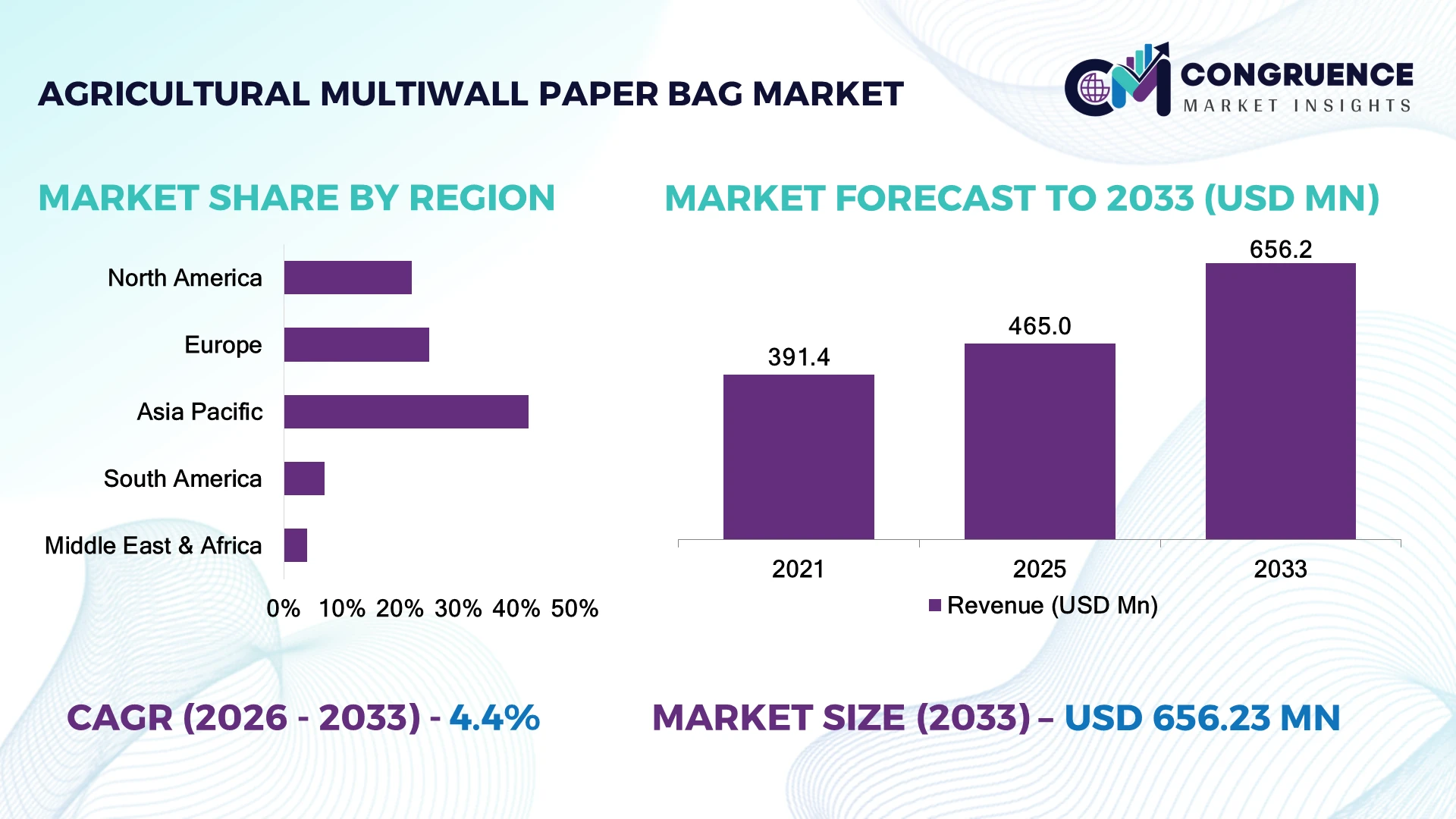
China dominates the market with approximately 28% share, supported by large fertilizer production capacity, agricultural exports, and investments in sustainable packaging infrastructure. India accounts for nearly 18% share, driven by government-backed fertilizer distribution networks and modernization of rural logistics. China’s annual fertilizer output exceeds 50 million tons, while India’s fertilizer consumption remains above 60 million tons, creating strong packaging demand. The EU’s plastic packaging regulations are accelerating paper bag adoption, with recyclable solutions gaining over 20% preference among industrial users.
Strategic expansion into sustainable materials and automated bag manufacturing will define competitive positioning.
Market Size & Growth: USD 465.0 Million in 2025 to USD 656.2 Million by 2033 at 4.4% CAGR, driven by recyclable packaging adoption and fertilizer supply-chain modernization.
Top Growth Drivers: Sustainable packaging adoption 35%, fertilizer demand expansion 28%, plastic replacement initiatives 22%.
Short-Term Forecast: By 2028, automated bag production reduces manufacturing waste by 15% and improves packaging efficiency by 20%.
Emerging Technologies: AI-based quality inspection, automated converting systems, and advanced moisture-barrier coatings are reshaping production.
Regional Leaders: Asia-Pacific reaches USD 310 Million with agricultural logistics expansion; Europe reaches USD 145 Million with ESG compliance adoption; North America reaches USD 120 Million with automated packaging integration.
Consumer/End-User Trends: More than 40% of agricultural suppliers are shifting toward recyclable packaging formats to meet sustainability requirements.
Pilot/Case Example: In 2024, automated paper bag production upgrades improved production efficiency by 18% for large packaging manufacturers.
Competitive Landscape: Leading manufacturers hold nearly 35% combined share, including Mondi, Smurfit Westrock, Sealed Air, LC Packaging, and International Paper.
Regulatory & ESG Impact: EU sustainability regulations are driving over 25% growth in demand for recyclable industrial packaging solutions.
Investment & Funding: More than USD 500 Million invested globally in packaging automation, fiber innovation, and sustainable material expansion.
Innovation & Future Outlook: Next-generation barrier coatings, lightweight paper structures, and digital tracking systems are strengthening long-term industry competitiveness.
Agricultural Multiwall Paper Bag solutions are becoming essential across fertilizer, seed, and agrochemical industries as manufacturers prioritize durable, recyclable, and high-performance packaging formats. Recent innovations in coated paper technology have improved moisture resistance by nearly 30%, supporting wider adoption in humid agricultural markets. Supply-chain restructuring after global commodity disruptions and stricter packaging regulations in Europe are accelerating investments in efficient paper-based packaging systems, creating new opportunities for manufacturers.
The Agricultural Multiwall Paper Bag Market is becoming strategically important as agricultural supply chains shift toward sustainable packaging models, operational efficiency, and regulatory compliance. Rising restrictions on single-use plastics in markets such as the European Union are encouraging fertilizer and agrochemical companies to redesign packaging strategies while improving recyclability.
Manufacturers are replacing traditional packaging systems with automated multiwall paper bag lines that improve output consistency by approximately 20% and reduce material waste by nearly 15% compared with older manual production processes. Germany and Japan are advancing high-automation packaging technologies, while India and Brazil are expanding deployment through agricultural distribution networks and export-oriented farming sectors.
Companies are increasingly investing in barrier coatings, lightweight paper structures, and regional manufacturing facilities to reduce transportation costs and supply-chain dependency. For example, fertilizer producers in India are adopting stronger multi-layer paper bags to improve storage reliability across rural distribution channels. Over the next 2–3 years, competitive advantage will depend on production automation, sustainable material innovation, and partnerships between packaging suppliers and agricultural enterprises.
Growing environmental regulations and agricultural sustainability initiatives are accelerating adoption of multiwall paper bags. Plastic replacement programs in Europe and Asia have increased demand for recyclable packaging solutions by nearly 25%, while fertilizer companies are targeting lower packaging waste through fiber-based alternatives. Germany’s packaging compliance framework and India’s agricultural modernization programs are influencing procurement decisions. Companies are responding through investments in automated converting equipment, stronger paper coatings, and regional production expansion. Advanced moisture-resistant layers have improved bag performance by approximately 30%, enabling wider use for fertilizers and seeds. The strategic shift toward recyclable packaging is allowing manufacturers to strengthen ESG positioning while reducing dependency on petroleum-based materials.
Paper price volatility and supply dependency remain key constraints for manufacturers. Global pulp price fluctuations of around 15–20% have affected production margins, while transportation disruptions continue to influence raw material availability. Countries dependent on imported kraft paper face higher operational exposure, particularly during commodity supply-chain disruptions. Manufacturers are reducing risks through supplier diversification, long-term procurement agreements, and localized paper sourcing strategies. Smaller producers face challenges competing with integrated packaging companies due to limited automation capacity and higher conversion costs. Maintaining consistent quality while controlling input expenses remains a critical operational challenge for sustainable market expansion.
Innovation in barrier coatings, lightweight paper structures, and smart packaging systems is creating new opportunities for market players. Next-generation coatings can improve moisture resistance by over 30% while reducing paper usage by approximately 10%, supporting cost-efficient production. Agricultural exporters in Brazil and India are increasing demand for durable packaging capable of handling longer logistics cycles. Companies are expanding R&D partnerships to develop recyclable coatings and digitally traceable packaging solutions. The integration of automation and intelligent inspection systems provides manufacturers with opportunities to reduce defects and improve production efficiency. Strategic investment in high-performance paper materials will unlock premium applications in fertilizers and specialty agricultural products.
Scaling advanced multiwall paper bag production requires significant investment in automation, skilled workforce development, and infrastructure upgrades. Approximately 30% of small and mid-sized manufacturers still operate with limited automation capabilities, affecting productivity and quality consistency. Developing markets face challenges related to equipment availability and technical expertise, while global producers must adapt to evolving sustainability standards. Companies are addressing these barriers through technology partnerships, manufacturing upgrades, and workforce training programs. Ensuring consistent barrier performance, production reliability, and compliance across different markets remains essential for maintaining competitiveness as agricultural packaging requirements become more sophisticated.
Automation-Driven Production Shift Agricultural packaging manufacturers are increasing automation adoption, with advanced converting lines improving production efficiency by around 20% and reducing material waste by nearly 15%. Companies in China and India are upgrading bag manufacturing workflows with automated cutting, stitching, and inspection systems to address labor shortages and improve consistency. These investments are strengthening operational speed and reducing quality variations across large-scale fertilizer packaging operations.
Barrier Coating Innovation Growth Paper bag producers are deploying advanced moisture-resistant coatings, improving product durability by approximately 30% and extending storage reliability in humid agricultural environments. Manufacturers are shifting toward recyclable barrier technologies as plastic reduction regulations expand across Europe. Companies are partnering with coating technology providers to develop lightweight multi-layer structures that lower material usage by nearly 10% while maintaining performance standards for fertilizers and seeds.
Digital Supply Chain Integration Agricultural packaging suppliers are adopting digital tracking and smart inventory systems, improving shipment visibility by more than 25% across complex distribution networks. Supply-chain disruptions after global commodity volatility have encouraged companies in Brazil and India to strengthen regional sourcing models. Producers are integrating barcode-enabled tracking and production analytics to improve order accuracy, reduce delays, and support large agricultural enterprises managing high-volume packaging requirements.
Sustainable Material Optimization Manufacturers are increasing the use of certified kraft paper and recyclable fiber inputs as ESG requirements reshape procurement decisions. More than 40% of large agricultural suppliers are prioritizing sustainable packaging specifications, particularly in European markets influenced by stricter packaging policies. Companies are restructuring material sourcing strategies, expanding recycled fiber partnerships, and investing in eco-efficient production processes to improve environmental performance without compromising industrial packaging strength.
Kraft paper bags represent the leading type segment, accounting for approximately 55% market share due to high strength, cost efficiency, and compatibility with fertilizer, seed, and agrochemical applications. Their superior tear resistance and recyclable properties make them preferred for large-volume agricultural packaging. Laminated paper bags hold around 30% share, supporting applications requiring enhanced moisture protection, while sewn open-mouth and pasted valve bags continue serving specialized distribution needs. Companies are focusing on lightweight kraft structures and improved fiber performance to reduce material consumption by nearly 10%. The fastest-growing segment is laminated multiwall paper bags, driven by increasing demand for moisture barriers and longer storage cycles in developing agricultural markets. Adoption is rising by approximately 15–20% among exporters handling fertilizer and specialty crop products. Manufacturers are expanding coating capabilities and forming partnerships with material innovators to improve durability while maintaining recyclability.
Fertilizer packaging is the leading application segment, contributing approximately 60% market share due to high-volume consumption across global agricultural supply chains. Large fertilizer producers require durable multiwall bags for storage, transportation, and distribution efficiency. Seed packaging accounts for nearly 20% share and is expanding as premium seed varieties require improved protection and handling performance. Agrochemical packaging and animal feed applications represent emerging demand areas with increasing focus on contamination control and product integrity. The fastest-growing application is specialty fertilizer and precision agriculture packaging, supported by increasing adoption of customized bag formats and improved labeling systems. Demand from these applications is rising by approximately 18% as agricultural companies modernize logistics and inventory management. Manufacturers are responding through customized packaging solutions, automated production expansion, and improved barrier technologies.
Fertilizer manufacturers represent the dominant end-user segment with approximately 65% market share due to extensive packaging requirements, bulk distribution networks, and continuous agricultural demand. Large producers in China, India, and Brazil rely on multiwall paper bags for efficient handling of fertilizers across domestic and export markets. Agrochemical companies account for around 20% share, while seed companies and agricultural cooperatives are expanding adoption through specialized packaging requirements. The fastest-growing end-user group is seed and specialty agricultural product companies, with adoption increasing by approximately 15% as premium crop inputs require stronger protection and traceability. Companies are targeting these segments through customized bag designs, smaller-volume packaging formats, and digital tracking integration. Established fertilizer producers continue prioritizing cost optimization, while emerging buyers focus on sustainability and product differentiation.
Asia-Pacific accounted for the largest market share at 42% in 2025 however, Europe is expected to register the fastest growth, expanding at a CAGR of 5.1% between 2026 and 2033.
North America holds approximately 22% of the global market, supported by advanced agricultural supply chains, high fertilizer consumption, and strong demand for recyclable industrial packaging. The United States represents the majority of regional demand due to large-scale fertilizer distribution and agricultural export operations. Packaging manufacturers are expanding automated production facilities, with modern converting systems improving operational efficiency by nearly 20%. Growing adoption of fiber-based packaging solutions is influenced by corporate sustainability targets and evolving packaging regulations. Companies are strengthening partnerships with agricultural suppliers to deliver customized multiwall paper bags with improved moisture resistance and durability for bulk transportation applications.
United States Market Outlook: The United States remains the key market due to its extensive fertilizer, grain, and agricultural chemical industries. More than 40 million tons of fertilizer products are distributed annually across domestic farming networks, creating consistent demand for durable packaging solutions. Manufacturers are investing in automated bag production technologies and recyclable material development to improve supply reliability and meet sustainability requirements.
Europe accounts for nearly 25% of the market, supported by strict sustainability regulations, advanced packaging infrastructure, and increasing preference for recyclable industrial materials. Countries including Germany, France, and Italy are driving adoption through established agricultural processing industries and environmental compliance programs. The European Union’s packaging sustainability initiatives are encouraging manufacturers to replace conventional materials with recyclable paper-based alternatives. Production facilities are integrating digital quality monitoring systems, improving manufacturing accuracy by approximately 15%. Companies are expanding partnerships with paper suppliers and agricultural enterprises to develop lightweight, high-performance bags aligned with circular economy objectives.
Germany Market Outlook: Germany leads European adoption through advanced manufacturing capabilities, strong industrial packaging expertise, and sustainability-focused procurement policies. The country’s agricultural sector relies heavily on efficient fertilizer and seed distribution systems, supporting demand for engineered paper bags. More than 30% of industrial packaging producers are increasing investments in automation and recyclable material solutions to comply with evolving environmental standards.
Asia-Pacific dominates the global market with approximately 42% share due to high agricultural output, fertilizer consumption, and expanding packaging manufacturing capacity. China and India represent major demand centers, supported by large farming populations and extensive fertilizer distribution networks. The region contributes more than half of global fertilizer consumption, creating significant demand for durable packaging formats. Manufacturers are expanding production capacity through automated machinery upgrades, improving output efficiency by around 20%. Growing export activities and rural infrastructure development are encouraging companies to establish localized manufacturing hubs and strengthen supply-chain resilience across major agricultural markets.
China Market Outlook: China is the leading country in Asia-Pacific due to its extensive fertilizer production capacity, industrial packaging ecosystem, and export-oriented agricultural sector. The country produces more than 50 million tons of fertilizer annually, supporting large-scale demand for multiwall paper bags. Manufacturers are adopting advanced coating technologies and automated production systems to improve packaging performance and operational efficiency.
South America represents approximately 7% of the market, supported by Brazil and Argentina’s strong agricultural export sectors. The region’s soybean, corn, and fertilizer industries generate substantial demand for reliable bulk packaging solutions. Brazil’s expanding agricultural logistics infrastructure is encouraging investments in efficient packaging systems, with automated production adoption improving manufacturing productivity by nearly 15%. However, transportation limitations and uneven industrial infrastructure continue affecting smaller markets. Companies are addressing these challenges through regional partnerships, localized production facilities, and improved distribution networks to support large-scale agricultural exports.
Brazil Market Outlook: Brazil is the dominant South American market due to its global position in soybean and agricultural commodity exports. The country handles more than 150 million tons of soybean production annually, creating significant requirements for durable agricultural packaging. Packaging companies are increasing investments in regional manufacturing and customized solutions to support export logistics efficiency.
Middle East & Africa accounts for nearly 4% of the market, with demand concentrated around fertilizer production, agricultural modernization programs, and food security initiatives. Countries including Saudi Arabia, Egypt, and South Africa are improving agricultural infrastructure and expanding fertilizer distribution networks. Government-supported farming investments are increasing demand for durable packaging formats, while local manufacturers are upgrading production capabilities. Adoption of automated packaging systems has improved operational efficiency by approximately 15% in large industrial facilities. Companies are developing regional partnerships and expanding manufacturing capacity to reduce import dependency and improve supply reliability.
Saudi Arabia Market Outlook: Saudi Arabia is emerging as a strategic market due to fertilizer production strength, agricultural technology investments, and food security initiatives. The country’s large-scale fertilizer industry supports continuous packaging requirements for domestic and export markets. Manufacturers are focusing on localized production, advanced paper materials, and efficient logistics solutions to strengthen industrial supply chains.
The Agricultural Multiwall Paper Bag Market features global packaging leaders such as Mondi, Smurfit Westrock, and International Paper competing with regional manufacturers including LC Packaging and Segezha Group. Global players compete through advanced materials, automation, and supply-chain scale, while regional suppliers focus on pricing flexibility and customized solutions. The top five companies collectively control approximately 35% of the market, creating a moderately consolidated structure. Competition is driven by production efficiency, recyclable material innovation, and customer-specific designs, with automated manufacturing improving output efficiency by nearly 20% and reducing waste by 15%. Companies are expanding facilities, forming agricultural supply partnerships, and integrating paper production with converting capabilities. The competitive landscape is shifting toward sustainability compliance and technology-led manufacturing, creating pressure on smaller producers lacking automation. Winning requires strong supply control, cost-efficient operations, innovative materials, and the ability to deliver customized high-performance packaging solutions at scale.
Smurfit Westrock
International Paper Company
LC Packaging International BV
Segezha Group
WestRock Company
Novolex Holdings, Inc.
ProAmpac LLC
Huhtamaki Oyj
Bag Supply Company
El Dorado Packaging, Inc.
National Bag Company
Agricultural multiwall paper bag production is increasingly adopting automated converting systems, AI-based quality inspection, and digital manufacturing controls. Automated lines improve production efficiency by nearly 20% compared with conventional manual processes, while AI inspection reduces defect rates by approximately 15%. Large manufacturers are integrating these technologies to improve consistency, reduce labor dependency, and increase high-volume packaging output.
Advanced barrier coating technologies are transforming traditional kraft paper bags by improving moisture resistance by nearly 30% while maintaining recyclability. Compared with older untreated paper structures, modern coated designs provide stronger protection for fertilizers and agricultural chemicals. Adoption of recyclable coating solutions is increasing among major packaging suppliers as sustainability requirements influence procurement decisions.
Between 2026 and 2028, smart packaging integration, digital tracking, and lightweight material engineering will strengthen competitive differentiation. Companies investing in connected production systems and sustainable materials will gain advantages through faster customization, reduced waste, and improved supply-chain visibility. Technology leaders and vertically integrated manufacturers are positioned to benefit most as agricultural customers demand higher-performance packaging with lower environmental impact.
April 2025 — Mondi introduced a recyclable two-ply paper bag solution developed with Evonik for industrial powder packaging, removing a plastic-coated layer and reducing packaging weight by 30%. The innovation supports lower-carbon packaging strategies and strengthens Mondi’s sustainable industrial bag portfolio. Source: www.mondigroup.com
May 2025 — Smurfit Westrock published its first Sustainability Report after the Smurfit Kappa and WestRock combination, highlighting paper-based packaging expansion and sustainable innovation programs. The company secured $2 billion in green finance to support long-term circular packaging initiatives. Source: www.smurfitwestrock.com
August 2025 — Segezha Group announced expansion of premium paper production capacity, targeting 150,000 tons annually to diversify its paper portfolio and strengthen packaging material supply. The investment supports increased availability of paper grades used in industrial bag manufacturing and export markets.
April 2025 — LC Packaging reported progress in circular packaging innovation, with recyclable packaging accounting for 72% of distributed packaging and circular products contributing 25% of turnover. The company expanded sustainable design initiatives to improve material efficiency and customer adoption. Source: www.sustainability.lcpackaging.com
The Agricultural Multiwall Paper Bag Market Report covers detailed analysis across major types including kraft paper bags, laminated paper bags, sewn open-mouth bags, and pasted valve bags. The study evaluates applications such as fertilizer packaging, seed packaging, agrochemical packaging, and agricultural product handling. End-user analysis includes fertilizer manufacturers, agrochemical companies, seed producers, and agricultural suppliers across key global markets.
The report provides regional insights covering North America, Europe, Asia-Pacific, South America, and Middle East & Africa, with evaluation of manufacturing trends, automation adoption, sustainable material innovation, and supply-chain developments. It highlights competitive positioning, technology integration, emerging packaging solutions, and strategic opportunities supporting expansion planning, investment decisions, operational improvements, and market positioning from 2026 to 2033.
| Report Attribute / Metric | Details |
|---|---|
| Market Revenue (2025) | USD 465.0 Million |
| Market Revenue (2033) | USD 656.2 Million |
| CAGR (2026–2033) | 4.4% |
| Base Year | 2025 |
| Forecast Period | 2026–2033 |
| Historic Period | 2021–2025 |
| Segments Covered |
By Type
By Application
By End-User
|
| Key Deliverables | Revenue Forecast; Market Trends; Growth Drivers & Restraints; Technology Insights; Segmentation Analysis; Regional Insights; Competitive Landscape; Regulatory & ESG Overview; Recent Developments |
| Regions Covered | North America; Europe; Asia-Pacific; South America; Middle East & Africa |
| Companies Profiled | Mondi plc; Smurfit Westrock; International Paper Company; LC Packaging International BV; Segezha Group; Novolex Holdings, Inc.; ProAmpac LLC; Huhtamaki Oyj; Bag Supply Company; El Dorado Packaging, Inc.; National Bag Company |
| Customization & Pricing | Available on Request (10% Customization Free) |




