
Reports
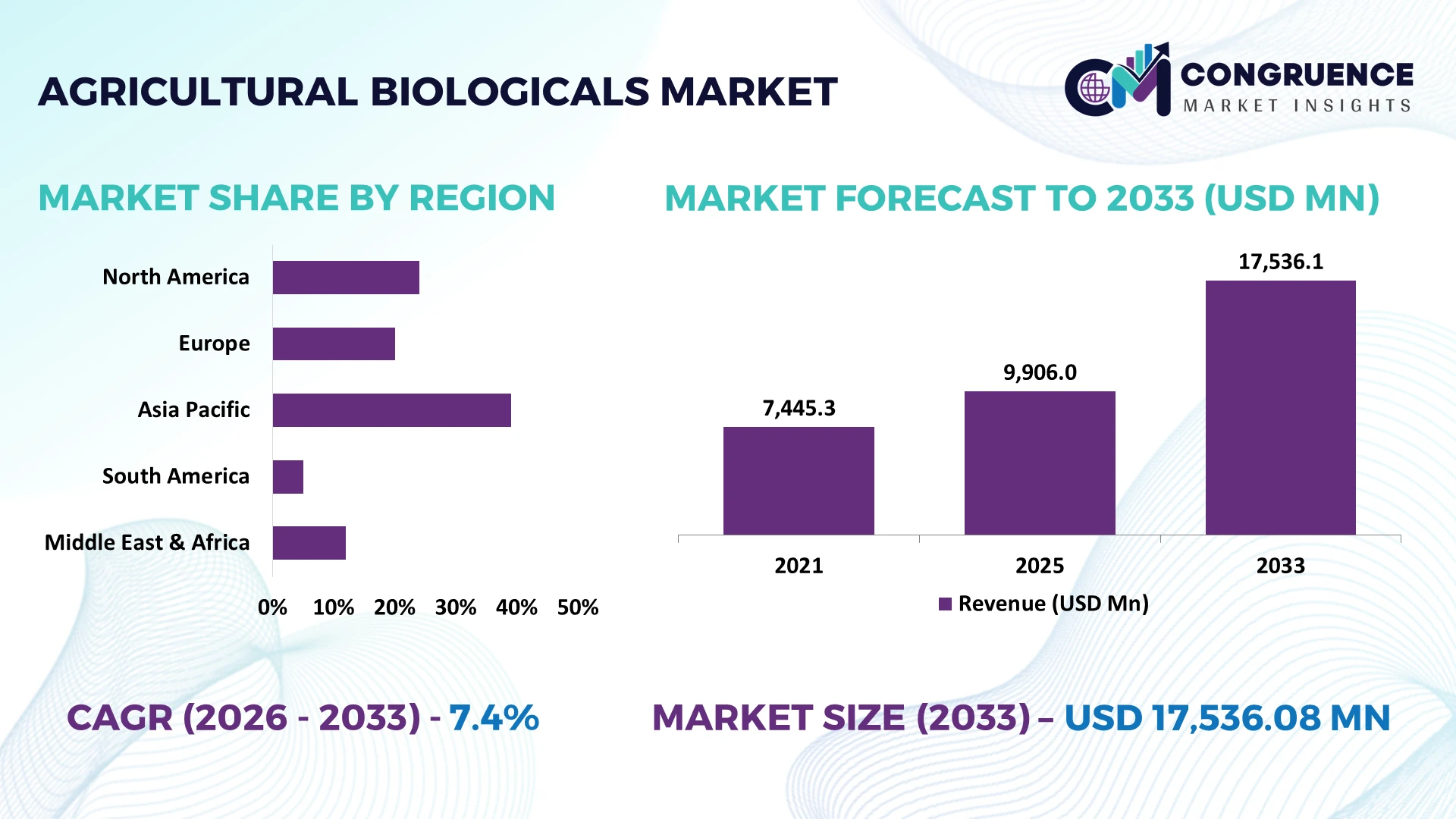
The Global Agricultural Biologicals Market was valued at USD 9906 Million in 2025 and is anticipated to reach a value of USD 17536.08 Million by 2033 expanding at a CAGR of 7.4% between 2026 and 2033. Growth is driven by accelerating adoption of microbial crop protection, residue-free farming practices, precision agriculture integration, and expanding regulatory support for sustainable biological inputs across commercial farming systems.
The United States remains the dominant country, accounting for approximately 32% of global agricultural biologicals adoption, supported by advanced row-crop farming, large-scale investments in biological crop protection, and over 68% precision agriculture integration across commercial farms. Compared with Brazil, where biological input adoption exceeds 24% in soybean cultivation due to expanding export-oriented agriculture, the U.S. benefits from stronger R&D commercialization and manufacturing capacity. Continued supply-chain diversification following global fertilizer disruptions has further accelerated biological product deployment across high-value crops and grain production.
Strategically, companies expanding localized production, microbial innovation, and region-specific biological formulations are positioned to strengthen long-term competitive advantage across global agricultural markets.
Market Size & Growth: USD 9906 Million in 2025, reaching USD 17536.08 Million by 2033 at a 7.4% CAGR, driven by rapid commercialization of advanced microbial crop solutions.
Top Growth Drivers: Biological seed treatment adoption +21%, precision farming integration +18%, residue-free crop production demand +16% across commercial agriculture.
Short-Term Forecast: By 2028, biological crop protection programs improve input-use efficiency by 14% while reducing chemical application costs by 11%.
Emerging Technologies: AI-enabled crop analytics, microbial formulation engineering, and precision application systems improve field performance by approximately 20%.
Regional Leaders: North America approaches USD 5.8 Billion, Europe USD 4.2 Billion, Asia-Pacific USD 3.9 Billion, supported by sustainable farming expansion and localized biological adoption.
Consumer/End-User Trends: More than 46% of commercial growers integrate biological products into integrated crop management programs for higher productivity and soil resilience.
Pilot/Case Example: In 2026, integrated biological crop management programs improved disease control efficiency by 19% while reducing synthetic pesticide dependence by 15%.
Competitive Landscape: The leading supplier holds approximately 12% global market share, with competition strengthened by BASF, Bayer, Syngenta, Corteva, and UPL.
Regulatory & ESG Impact: Sustainable agriculture initiatives reduced conventional chemical input intensity by nearly 13%, accelerating biological product registrations across key farming regions.
Investment & Funding: More than USD 2.3 Billion supports manufacturing expansion, strategic partnerships, and microbial technology commercialization amid ongoing regional supply-chain diversification.
Innovation & Future Outlook: Next-generation microbial consortia, RNA-based biological solutions, and digital agronomy platforms accelerate productivity while strengthening climate-resilient agricultural production.
Agricultural biologicals are increasingly deployed across cereals, fruits, vegetables, oilseeds, and specialty crops as growers prioritize higher productivity with lower environmental impact. Advanced microbial formulations, biological seed treatments, and precision application technologies have improved field performance by nearly 18%. Expanding regulatory acceptance and resilient agricultural supply chains continue to accelerate commercialization, setting the foundation for the strategic market assessment that follows.
Agricultural biologicals have become a strategic priority as global farming systems shift toward resilient, input-efficient production while regulatory frameworks increasingly favor sustainable crop protection. Competitive advantage now depends on combining biological solutions with precision agriculture, digital crop monitoring, and localized manufacturing. Supply-chain restructuring following fertilizer and agrochemical disruptions has accelerated investment in domestic microbial production, reducing procurement risks and improving product availability for commercial growers.
Modern microbial formulations and precision application technologies deliver approximately 18% higher field efficacy than conventional biological products while reducing application losses by nearly 15% through targeted deployment. The United States leads large-scale commercialization with extensive integration into high-value crop production, whereas Brazil records faster adoption across soybean and sugarcane cultivation driven by expanding biological input programs. Over the next two to three years, digital agronomy platforms are expected to support biological decision-making across more than 40% of commercial farms in advanced agricultural markets, improving treatment timing and operational consistency.
Commercial fruit producers increasingly deploy biological seed treatments, biostimulants, and microbial crop protection together to improve soil performance while lowering synthetic input dependence. Companies are expanding fermentation capacity, forming biotechnology partnerships, and strengthening regional distribution networks to accelerate commercialization. Organizations that integrate innovation, localized production, and digital agronomic services will secure stronger competitive positioning through higher operational resilience and differentiated product portfolios.
Commercial agriculture is rapidly replacing portions of conventional chemical inputs with biological alternatives as residue regulations tighten and soil health becomes an operational priority. Biological seed treatment adoption has increased by approximately 21%, while integrated pest management programs incorporating biological products have expanded by nearly 18%. In the United States, stricter environmental compliance requirements are encouraging greater deployment of microbial crop protection across specialty crops. This structural transition improves input efficiency, strengthens export compliance, and supports long-term soil productivity. Companies are responding by expanding fermentation facilities, investing in microbial strain development, and forming biotechnology partnerships to deliver crop-specific biological solutions. The strongest competitive advantage is shifting toward firms capable of combining scientific innovation with scalable manufacturing and localized technical support.
Maintaining consistent biological performance across different climates, soil conditions, and crop systems remains a significant operational limitation. Manufacturing quality assurance can account for nearly 14% of production costs, while cold-chain logistics increase distribution expenses by approximately 11% for temperature-sensitive formulations. India and several emerging agricultural economies continue to face infrastructure gaps affecting storage stability and timely product delivery. These limitations reduce deployment consistency and complicate large-scale commercialization for multinational suppliers. Companies are reducing operational risk through localized production facilities, diversified microbial sourcing, long-term contract manufacturing, and improved formulation technologies with extended shelf life. Operational excellence in manufacturing reliability is becoming as important as biological efficacy for sustained market competitiveness.
Artificial intelligence, precision agriculture, and genomic microbial screening are creating new commercial opportunities beyond traditional crop protection. AI-assisted biological application planning can improve treatment precision by approximately 17%, while advanced microbial consortia enhance nutrient utilization by nearly 20% under commercial field conditions. Australia and the United States are expanding digital agriculture ecosystems that integrate biological performance analytics with farm management platforms. Companies are increasing investment in predictive agronomy software, collaborative biotechnology research, and customized biological formulations designed for specific crop environments. An emerging strategic opportunity lies in subscription-based agronomic advisory services that combine biological products with real-time field intelligence, strengthening customer retention while improving measurable farm productivity.
Expanding biological solutions from controlled field trials to broad commercial deployment requires consistent performance across highly variable farming environments. Yield response differences of 12% to 16% between climatic zones complicate product standardization, while more than 30% of commercial growers still require specialized technical guidance for optimal biological application. Brazil's tropical production systems and the United States' temperate farming conditions demand different formulation strategies and deployment protocols. Companies must strengthen agronomic training, invest in regional field validation programs, and expand digital decision-support infrastructure to maintain product reliability. Long-term competitiveness will depend on converting biological innovation into repeatable field performance across diverse crops, climates, and commercial farming systems without sacrificing operational scalability.
Precision Microbial Application Expands Precision application platforms integrated with biological inputs have increased field deployment by approximately 24%, while variable-rate spraying reduces input waste by nearly 16%. Large farming enterprises in the United States are combining satellite imagery with biological recommendations to optimize treatment timing. Companies are expanding digital agronomy partnerships and embedding application analytics into commercial crop management systems, improving operational efficiency and reducing unnecessary field interventions.
Localized Manufacturing Gains Momentum Supply-chain restructuring has encouraged biological manufacturers to establish regional fermentation and formulation facilities, reducing delivery times by nearly 20% and logistics costs by around 12%. Brazil and India are strengthening domestic production capacity to reduce import dependency. Companies are restructuring manufacturing networks, expanding contract production, and increasing local technical support to improve product availability during peak planting seasons.
Advanced Multi-Strain Formulations Rise Multi-strain microbial products have demonstrated approximately 18% higher nutrient utilization and 15% stronger stress tolerance than single-strain alternatives under commercial farming conditions. Increasing regulatory preference for environmentally responsible crop inputs is accelerating product development. Companies are investing in microbial discovery programs, licensing biotechnology platforms, and expanding specialized formulation capabilities to differentiate increasingly competitive product portfolios.
Integrated Crop Programs Accelerate Commercial growers are adopting combined biological seed treatments, foliar solutions, and soil applications, increasing integrated biological program usage by approximately 22% while lowering conventional pesticide dependence by about 14%. Labor shortages and operational efficiency targets are encouraging simplified treatment programs. Companies are launching bundled biological portfolios, strengthening distributor training, and expanding agronomic advisory services to improve deployment consistency and customer retention.
Biopesticides remain the leading segment, accounting for approximately 41% of market deployment because of their broad compatibility with integrated pest management, established regulatory acceptance, and effectiveness across fruits, vegetables, cereals, and oilseed crops. Their scalable production and compatibility with precision spraying systems strengthen adoption among commercial growers seeking lower chemical residues. Biofertilizers continue to hold an important position by improving nutrient efficiency and reducing dependence on synthetic fertilizers, while bioinoculants gain traction in legumes and row crops where nitrogen fixation delivers measurable agronomic value. Companies are expanding microbial production facilities and introducing crop-specific biological portfolios to strengthen market penetration.
Biostimulants represent the fastest-growing segment as demand rises for climate-resilient crop management and improved abiotic stress tolerance. Adoption has increased by nearly 23% across intensive horticulture, while integrated biological programs have expanded by approximately 19% on commercial farms. Companies are prioritizing product innovation, licensing advanced microbial technologies, and forming research partnerships to strengthen differentiated product offerings. Investment is increasingly shifting toward multifunctional biological solutions that combine crop protection, nutrition, and plant resilience within a single application strategy.
Crop Protection remains the dominant application, representing approximately 38% of overall biological deployment due to increasing demand for residue-compliant farming and integrated pest management strategies. Commercial fruit and vegetable production relies heavily on biological crop protection to satisfy export standards while improving operational sustainability. Soil Treatment continues to expand through microbial soil conditioning, whereas Seed Treatment delivers consistent early-stage crop establishment with reduced disease pressure. Companies are strengthening product integration across multiple application stages to improve field performance and simplify farm operations.
Foliar Spray is emerging as the fastest-growing application because of improved formulation stability, precision spraying technologies, and compatibility with digital agriculture platforms. Adoption has increased by nearly 21%, while targeted application methods improve biological utilization efficiency by approximately 17%. Post-Harvest biological applications remain a specialized segment supporting shelf-life extension and disease management for high-value crops. Companies are scaling automated application systems, expanding precision spray technologies, and collaborating with equipment manufacturers to improve deployment consistency and operational efficiency across commercial agriculture.
Commercial Growers account for approximately 45% of biological product demand due to large cultivation areas, advanced mechanization, and greater investment capacity for integrated crop management technologies. Large farming enterprises prioritize biological solutions to improve productivity, reduce residue risks, and strengthen export competitiveness. Farmers remain an essential customer group through expanding adoption of biological seed treatments and soil health products, while Agricultural Cooperatives improve access by providing technical guidance and collective purchasing advantages. Companies are expanding demonstration farms, customized agronomic services, and distributor partnerships to strengthen customer engagement.
Greenhouse Operators represent the fastest-growing end-user segment as controlled-environment agriculture increasingly adopts biological crop protection and microbial nutrition systems. Biological deployment within greenhouse production has expanded by approximately 24%, while precision environmental controls improve treatment consistency by nearly 18%. Seed Companies continue integrating biological coatings into premium seed portfolios, supporting stronger germination performance and crop establishment. Companies are introducing tailored product packages, flexible pricing models, and collaborative ecosystem partnerships to strengthen long-term customer retention across specialized agricultural production systems.
North America accounted for the largest market share at 36.8% in 2025 however, Asia-Pacific is expected to register the fastest growth, expanding at a 9.2% CAGR between 2026 and 2033.

Advanced Biological Integration Across Commercial Farming
North America maintains the highest deployment concentration for agricultural biologicals through large-scale commercial farming, advanced precision agriculture, and established microbial manufacturing capabilities. The region contributes approximately 36.8% of global market demand, supported by extensive adoption across corn, soybean, specialty crop, and horticultural production. Biological crop protection is increasingly integrated into digital agronomy platforms, enabling more accurate application timing and reducing unnecessary chemical usage. During 2026, several manufacturers expanded domestic fermentation capacity by nearly 18%, strengthening supply resilience and reducing delivery lead times. Strong collaboration between biotechnology firms, distributors, and precision agriculture providers continues to accelerate commercialization while supporting sustainable production practices and higher operational efficiency across large farming enterprises.
United States Market Outlook: The United States leads regional adoption through extensive commercial agriculture, advanced biological research, and a mature distribution ecosystem. More than 68% of large commercial farms utilize precision agriculture technologies that increasingly support biological product deployment. Strong biotechnology investment, streamlined commercialization pathways, and continuous product innovation allow manufacturers to expand crop-specific biological portfolios while strengthening domestic production capacity and technical support services.
Regulatory Alignment Accelerates Sustainable Crop Protection
Europe continues strengthening agricultural biological deployment through sustainability-focused agricultural policies, integrated pest management programs, and reduced reliance on conventional chemical inputs. The region represents approximately 28% of global deployment, supported by advanced horticulture, specialty crop production, and strict environmental compliance standards. Biological seed treatments and microbial crop protection are increasingly incorporated into commercial farming systems to improve residue compliance and export competitiveness. Manufacturers continue expanding formulation facilities while collaborative research initiatives improve biological efficacy across diverse climatic conditions. Strategic investment in precision farming infrastructure further strengthens operational consistency and encourages wider adoption among commercial producers.
Germany Market Outlook: Germany remains the regional technology leader through advanced agricultural research, precision farming infrastructure, and strong industrial biotechnology capabilities. Approximately 46% of large commercial farming operations incorporate digital crop management systems supporting biological applications. Domestic manufacturers continue investing in formulation innovation, sustainable production technologies, and collaborative research programs to strengthen product performance and regulatory compliance.
Manufacturing Expansion Supports Large-Scale Adoption
Asia-Pacific is emerging as the fastest-expanding regional market because of rising food security priorities, expanding agricultural modernization, and increasing domestic biological manufacturing. The region accounts for roughly 24% of global deployment while rapidly increasing localized production capacity. Governments and private enterprises continue supporting microbial manufacturing infrastructure, reducing import dependence and improving product accessibility for commercial agriculture. During 2026, biological formulation capacity expanded by approximately 20% across several manufacturing clusters, improving regional supply resilience. Growing integration of precision agriculture and digital advisory platforms further strengthens biological adoption across diversified crop production systems.
China Market Outlook: China leads regional manufacturing through large-scale microbial production, biotechnology investment, and expanding agricultural modernization initiatives. Biological input utilization across commercial crop production continues increasing as precision farming technologies become more widely deployed. National investment in fermentation infrastructure and agricultural biotechnology enables domestic manufacturers to strengthen export competitiveness while supporting broader adoption across grain, fruit, and vegetable production.
Export Agriculture Drives Biological Adoption
South America is strengthening its position through export-oriented agriculture, expanding biological crop protection programs, and increasing investment in sustainable production systems. The region contributes approximately 8% of global deployment while demonstrating strong adoption across soybean, sugarcane, coffee, and maize cultivation. Commercial producers increasingly integrate biological products into crop management to satisfy export quality standards and improve long-term soil productivity. New regional manufacturing partnerships have shortened biological product distribution cycles by nearly 15%, improving seasonal availability. Although logistics infrastructure remains uneven across remote agricultural zones, continued investment in localized production supports stronger commercialization and operational reliability.
Brazil Market Outlook: Brazil represents the largest agricultural biological market in South America due to extensive soybean cultivation, advanced integrated pest management, and growing domestic biological manufacturing. Biological treatment adoption exceeds 24% across commercial soybean production, supported by strong collaboration between biotechnology firms, agricultural cooperatives, and commercial growers seeking improved productivity with lower chemical dependence.
Agricultural Modernization Strengthens Biological Investment
The Middle East & Africa region is gradually expanding agricultural biological deployment through food security initiatives, irrigation modernization, and investment in climate-resilient farming systems. The region accounts for approximately 3.2% of global demand, with adoption concentrated in high-value horticulture and controlled-environment agriculture. Governments continue encouraging sustainable agricultural inputs while commercial producers integrate microbial technologies to improve soil productivity under water-constrained conditions. Several agricultural modernization programs increased protected cultivation capacity by approximately 14% during 2026, creating additional opportunities for biological products. Private investment and international technology partnerships continue improving product availability despite infrastructure disparities.
Saudi Arabia Market Outlook: Saudi Arabia leads regional modernization through protected agriculture, advanced irrigation infrastructure, and government-supported agricultural transformation programs. Greenhouse cultivation continues expanding alongside precision farming technologies that improve biological application efficiency. Strategic investment in controlled-environment agriculture and sustainable crop production strengthens long-term demand for microbial crop protection, biostimulants, and biological nutrient management solutions.
The agricultural biologicals market is led by BASF SE, Bayer AG, Syngenta Group, Corteva Agriscience, UPL Ltd., and FMC Corporation, competing directly with specialized biological innovators and regional microbial manufacturers. The top five players collectively control approximately 44% of global market activity, while regional suppliers compete through localized formulations and faster commercialization. Competition increasingly centers on microbial technology performance, formulation stability, and distribution efficiency rather than price alone. Advanced formulations improve field consistency by nearly 18%, while localized manufacturing reduces logistics costs by around 12%. Leading companies are expanding fermentation capacity, acquiring biotechnology platforms, forming research partnerships, and integrating biological products with digital agronomy services. The competitive landscape is shifting toward technology-led differentiation as proprietary microbial strains and integrated crop management solutions become stronger value drivers. Regulatory approval complexity and large-scale fermentation capabilities remain significant entry barriers. Success increasingly depends on combining scientific innovation, manufacturing scale, agronomic expertise, and localized customer support.
BASF SE
Bayer AG
Syngenta Group
Corteva Agriscience
UPL Ltd.
FMC Corporation
Novonesis
Valent BioSciences LLC
Koppert Biological Systems
Bioceres Crop Solutions
Certis Biologicals
Lallemand Plant Care
Andermatt Group
Rizobacter Argentina S.A.
Current agricultural biologicals technologies center on advanced microbial fermentation, precision seed treatment, and stabilized biological formulations that improve field consistency and product shelf life. Fermentation-based production enhances manufacturing efficiency by approximately 15%, while encapsulated microbial formulations increase field performance by nearly 18% compared with conventional biological products. Around 46% of large commercial growers now integrate biologicals into precision farming programs, enabling targeted deployment and lower application waste. Companies investing in scalable fermentation infrastructure and formulation science gain stronger production flexibility, faster commercialization, and improved supply reliability.
Emerging technologies are transforming biological performance through artificial intelligence-assisted strain discovery, genomic screening, RNA-enabled crop protection research, and digital agronomy platforms. AI-driven microbial selection reduces product development timelines by roughly 20%, while predictive application tools improve treatment precision by approximately 17%. Adoption of digital biological recommendation systems has exceeded 38% among advanced commercial farming enterprises. Compared with legacy trial-and-error biological development, AI-supported discovery delivers nearly 25% faster optimization, allowing technology leaders to accelerate differentiated product launches and strengthen competitive positioning.
Disruptive innovation between 2026 and 2028 will focus on multi-strain microbial consortia, autonomous precision application equipment, and cloud-connected biological performance analytics. Integrated biological ecosystems are expected to improve nutrient utilization by approximately 20% while reducing operational application costs by nearly 12%. Global technology leaders combining biotechnology, digital agriculture, and localized manufacturing will outperform formulation-only competitors. Organizations acting now will secure stronger distribution partnerships, proprietary biological platforms, and sustainable operational advantages before technology adoption reaches mainstream commercial agriculture.
May 2026: BASF Agricultural Solutions commissioned its BioHub fermentation plant in Ludwigshafen, bringing biological active ingredient production in-house to strengthen supply-chain resilience and manufacturing flexibility through a high double-digit million-euro investment. Business impact: faster commercialization of biological crop protection.
April 2026: BASF Agricultural Solutions completed the acquisition of AgBiTech, expanding its biological insect control portfolio after receiving regulatory approvals. Business impact: broader biological insect control deployment and stronger global market reach.
December 2025: Corteva Agriscience and Hexagon Bio formed a multi-million-dollar joint venture using AI, microbial genetics, and synthetic biology to develop next-generation crop protection molecules. Business impact: accelerated biological innovation pipeline and faster discovery capabilities. Source: Midland Daily News
December 2025: BASF Agricultural Solutions and ADAMA signed a co-development agreement for Gilboa® fungicide technology, targeting resistance management and broader commercialization across European cereal production. Business impact: expanded innovation pipeline and improved farmer access to advanced disease-control solutions. Source: BASF
The report provides comprehensive coverage of agricultural biologicals across biopesticides, biofertilizers, biostimulants, and bioinoculants, together with detailed analysis of seed treatment, foliar spray, soil treatment, post-harvest, and crop protection applications. It evaluates demand across farmers, commercial growers, greenhouse operators, agricultural cooperatives, and seed companies while examining deployment patterns, technology adoption, and competitive strategies across North America, Europe, Asia-Pacific, South America, and the Middle East & Africa. More than 40% of the assessment emphasizes operational deployment trends and enterprise adoption.
The study further examines microbial fermentation, precision agriculture integration, AI-enabled biological development, digital agronomy platforms, and next-generation formulation technologies shaping industry transformation between 2026 and 2033. It delivers strategic intelligence on competitive positioning, regional expansion, manufacturing localization, partnership activity, and innovation priorities, enabling stakeholders to strengthen investment planning, optimize product portfolios, identify high-potential market segments, and evaluate emerging niche opportunities with greater operational confidence.
| Report Attribute/Metric | Report Details |
|---|---|
Market Revenue in 2025 | USD 9906 Million |
Market Revenue in 2033 | USD 17536.08 Million |
CAGR (2026 - 2033) | 7.4% |
Base Year | 2025 |
Forecast Period | 2026 - 2033 |
Historic Period | 2021 - 2025 |
Segments Covered | By Type
By Application
By End-User
|
Key Report Deliverable | Revenue Forecast, Growth Trends, Market Dynamics, Segmental Overview, Regional and Country-wise Analysis, Competition Landscape |
Region Covered | North America, Europe, Asia-Pacific, South America, Middle East, Africa |
Key Players Analyzed | BASF SE, Bayer AG, Syngenta Group, Corteva Agriscience, UPL Ltd., FMC Corporation, Novonesis, Valent BioSciences LLC, Koppert Biological Systems, Bioceres Crop Solutions, Certis Biologicals, Lallemand Plant Care, Andermatt Group, Rizobacter Argentina S.A. |
Customization & Pricing | Available on Request (10% Customization is Free) |




