
Reports
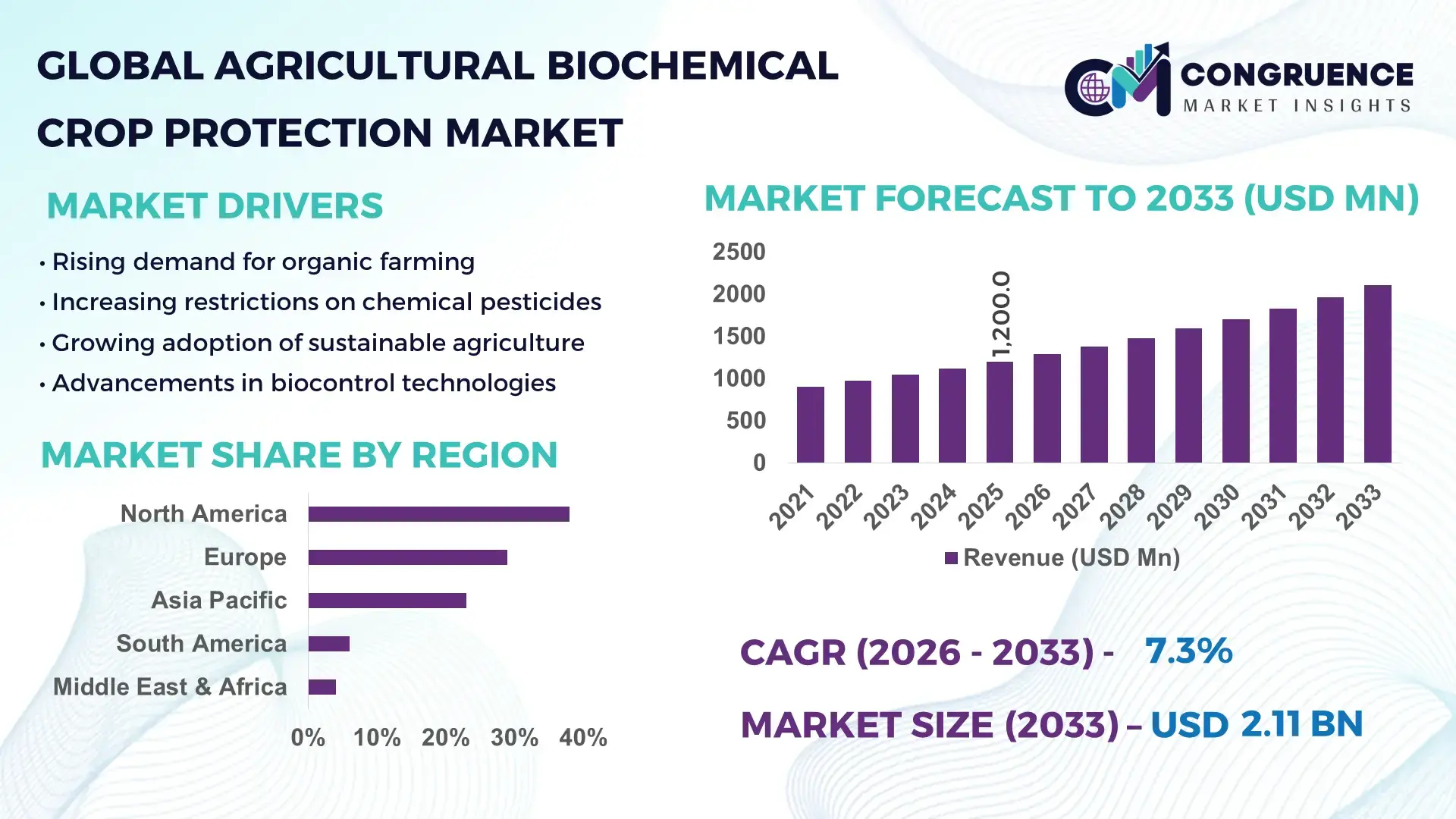
The Global Agricultural Biochemical Crop Protection Market was valued at USD 1,200.0 Million in 2025 and is anticipated to reach a value of USD 2,108.5 Million by 2033 expanding at a CAGR of 7.3% between 2026 and 2033, according to an analysis by Congruence Market Insights. Growth is primarily driven by increasing adoption of eco-friendly crop protection solutions to meet sustainable agriculture goals.
The United States leads the Agricultural Biochemical Crop Protection Market with strong production capacity, exceeding 35% of global biopesticide manufacturing output supported by over 250 registered biochemical formulations. Annual investments in agricultural biological R&D exceed USD 1.5 billion, with more than 60% directed toward microbial and biochemical crop protection innovations. Over 48% of large-scale farms in the country have adopted biochemical inputs as part of integrated pest management systems. Precision agriculture technologies integrated with biochemical applications have improved crop yield efficiency by nearly 22%, while regulatory approvals for low-toxicity active ingredients have increased by over 30% in the past five years.
Market Size & Growth: USD 1,200.0 Million in 2025, projected to reach USD 2,108.5 Million by 2033 at 7.3% CAGR, driven by rising demand for sustainable crop protection solutions.
Top Growth Drivers: 42% increase in organic farming adoption, 35% improvement in pest resistance management efficiency, 28% rise in regulatory approvals for bio-based products.
Short-Term Forecast: By 2028, biochemical solutions are expected to reduce synthetic pesticide usage by 25% while improving crop productivity by 18%.
Emerging Technologies: RNA-based biocontrols, precision spraying systems, AI-driven pest monitoring platforms.
Regional Leaders: North America projected at USD 720 Million by 2033 with high-tech adoption, Europe at USD 610 Million driven by sustainability mandates, Asia-Pacific at USD 540 Million due to expanding agricultural base.
Consumer/End-User Trends: Over 52% of commercial farmers prefer integrated pest management combining biochemical and synthetic solutions.
Pilot or Case Example: In 2025, a large-scale US farming pilot achieved 27% pesticide reduction using AI-enabled biochemical spraying systems.
Competitive Landscape: Market leader holds ~18% share, followed by 3–5 major players with strong R&D capabilities and global distribution networks.
Regulatory & ESG Impact: Over 65% of new product registrations align with environmental compliance frameworks and low-residue standards.
Investment & Funding Patterns: More than USD 2.3 billion invested globally in agricultural biological startups and R&D initiatives in recent years.
Innovation & Future Outlook: Integration of digital farming tools with biochemical solutions is expected to enhance crop protection efficiency and sustainability outcomes.
Agricultural biochemical crop protection solutions are widely used across cereals (38%), fruits and vegetables (34%), and oilseeds (18%). Innovations such as enzyme-based pesticides and plant-derived extracts are improving efficacy by over 20%. Regulatory shifts toward residue-free farming and increased adoption in Asia-Pacific markets, accounting for over 30% consumption growth, are shaping future demand.
The Agricultural Biochemical Crop Protection Market holds significant strategic relevance as global agriculture transitions toward sustainability, food security, and regulatory compliance. Biochemical crop protection products, including plant extracts, pheromones, and natural compounds, are increasingly replacing synthetic pesticides in integrated pest management systems. These solutions reduce environmental impact while maintaining crop productivity, making them essential for long-term agricultural resilience. Studies indicate that biochemical-based pest control improves soil health metrics by over 25% compared to traditional chemical inputs, enhancing long-term yield stability.
Precision agriculture technologies combined with biochemical inputs are redefining application efficiency. AI-driven pest detection systems deliver 30% improvement compared to conventional manual monitoring methods. North America dominates in volume due to large-scale mechanized farming, while Europe leads in adoption with over 58% of farms integrating biochemical crop protection into their practices. By 2028, AI-enabled spraying technologies are expected to reduce chemical usage by 20% while improving pest control accuracy by 35%.
From a compliance and ESG perspective, firms are committing to sustainability targets such as 40% reduction in chemical pesticide usage by 2030. Governments are also enforcing stricter residue limits, accelerating biochemical adoption. In 2025, a leading agricultural company in the United States achieved a 26% reduction in pesticide residues through AI-assisted biochemical application systems, demonstrating measurable benefits.
Looking ahead, the Agricultural Biochemical Crop Protection Market is positioned as a critical pillar supporting sustainable agriculture, regulatory compliance, and long-term productivity, ensuring resilience against climate challenges and evolving food demand patterns.
The Agricultural Biochemical Crop Protection Market is evolving rapidly, driven by increasing global emphasis on sustainable farming practices and reduced reliance on synthetic agrochemicals. Rising environmental concerns, including soil degradation and water contamination, are encouraging farmers to adopt biochemical solutions such as plant-based extracts and pheromone-based pest control systems. Approximately 45% of modern farms globally are integrating at least one form of biological or biochemical crop protection input, highlighting a significant shift in agricultural practices.
Technological advancements are further influencing market dynamics, particularly the integration of precision agriculture tools that enable targeted application of biochemical products. Digital monitoring systems have improved pest detection accuracy by nearly 30%, allowing farmers to optimize resource usage and reduce input costs. Additionally, regulatory frameworks promoting low-toxicity and residue-free farming practices are accelerating product approvals and adoption rates. However, variability in product effectiveness across different climatic conditions and crop types remains a critical factor influencing market penetration. Increasing investments in research and development are expected to address these challenges and enhance product consistency, driving broader adoption across diverse agricultural ecosystems.
The growing global emphasis on sustainable agriculture is a primary driver of the Agricultural Biochemical Crop Protection Market. Over 50% of agricultural land in developed economies is now managed under sustainability-focused frameworks, increasing demand for eco-friendly crop protection solutions. Biochemical products, derived from natural sources, reduce chemical residues in food by up to 40%, making them highly attractive for both producers and consumers. Additionally, the global organic farming area has expanded by more than 20% in the past five years, directly increasing the need for biochemical pest control solutions. Farmers adopting integrated pest management practices have reported up to 25% improvement in crop quality and reduced environmental impact. Government incentives supporting sustainable inputs, including subsidies covering up to 30% of product costs in certain regions, are further accelerating adoption. These factors collectively position biochemical crop protection as a critical component of future agricultural systems.
One of the major restraints in the Agricultural Biochemical Crop Protection Market is the inconsistent performance of biochemical products under varying environmental conditions. Unlike synthetic pesticides, which offer predictable results, biochemical solutions can be affected by factors such as temperature, humidity, and soil composition. Field studies indicate that efficacy variations of up to 20% can occur across different climatic zones, limiting farmer confidence in these products. Additionally, shorter shelf life and sensitivity to storage conditions pose logistical challenges. Nearly 35% of distributors report difficulties in maintaining product stability during transportation and storage. Farmers also face knowledge gaps regarding proper application techniques, resulting in suboptimal outcomes. These challenges are further compounded by limited awareness in developing regions, where over 40% of small-scale farmers still rely on conventional chemical inputs. Addressing these issues through improved formulations and farmer education programs is essential for market expansion.
The integration of precision agriculture technologies presents significant opportunities for the Agricultural Biochemical Crop Protection Market. Advanced tools such as drone-based spraying systems and IoT-enabled sensors allow for targeted application, improving efficiency by up to 35%. These technologies enable farmers to apply biochemical products precisely where needed, reducing waste and enhancing effectiveness. Furthermore, the adoption of AI-driven analytics platforms is increasing, with over 30% of large-scale farms utilizing digital tools for pest monitoring and crop management. This integration supports optimized application schedules and dosage levels, leading to improved crop protection outcomes. Emerging markets in Asia-Pacific are witnessing rapid adoption of such technologies, with over 25% growth in smart farming solutions. These advancements create a strong foundation for expanding the use of biochemical crop protection products across diverse agricultural systems.
Regulatory complexities remain a significant challenge for the Agricultural Biochemical Crop Protection Market. While biochemical products are generally considered safer, obtaining approvals can still be time-consuming due to varying standards across regions. On average, product registration timelines can extend up to 3–5 years, delaying market entry and innovation cycles. Additionally, differences in regulatory frameworks across countries create barriers for global manufacturers. Nearly 40% of companies report challenges in aligning product formulations with diverse compliance requirements. Labeling standards, residue limits, and environmental impact assessments further complicate the approval process. Smaller companies, which account for a significant portion of innovation in this sector, often face resource constraints in navigating these regulations. Streamlining approval processes and harmonizing global standards could significantly accelerate market growth.
Increased Adoption of Bio-Based Active Ingredients: Over 48% of newly registered crop protection products in 2025 are based on natural compounds such as plant extracts and pheromones. These products have demonstrated up to 30% improvement in pest targeting efficiency while reducing environmental toxicity levels by nearly 40%.
Expansion of Precision Application Technologies: Nearly 37% of large-scale farms have adopted drone-based or automated spraying systems, improving application accuracy by 32% and reducing input wastage by 28%. These systems are increasingly integrated with biochemical formulations for optimized crop protection.
Growth in Integrated Pest Management Practices: More than 52% of commercial farms globally are implementing integrated pest management strategies combining biochemical and synthetic inputs. This approach has reduced chemical pesticide usage by approximately 25% while maintaining crop yield stability.
Rising Demand in Emerging Economies: Agricultural biochemical adoption in Asia-Pacific has increased by over 33%, driven by government incentives and expanding agricultural activities. Smallholder farmers account for nearly 45% of this adoption, reflecting a shift toward sustainable practices in developing regions.
The Agricultural Biochemical Crop Protection Market is segmented based on type, application, and end-user, reflecting diverse usage patterns across agricultural systems. Product types include plant extracts, pheromones, and other biochemical agents, each catering to specific pest control requirements. Applications span cereals, fruits and vegetables, oilseeds, and specialty crops, with varying adoption rates depending on crop value and sensitivity to chemical residues.
End-user segmentation highlights commercial farms, small-scale farmers, and agricultural cooperatives as key contributors to market demand. Approximately 50% of total demand originates from large-scale commercial farms due to their higher adoption of advanced crop protection technologies. Meanwhile, smallholder farmers are increasingly adopting biochemical solutions, particularly in emerging economies, supported by government initiatives and awareness programs. The segmentation landscape underscores the growing importance of sustainable and targeted crop protection strategies across different agricultural segments.
The Agricultural Biochemical Crop Protection Market by type includes plant extracts, pheromones, and other biochemical agents such as enzymes and natural compounds. Plant extracts dominate the segment, accounting for approximately 46% of total adoption due to their broad-spectrum pest control capabilities and compatibility with organic farming practices. These products are widely used in fruits and vegetables, where residue-free protection is critical. Pheromones hold around 32% share and are extensively used for pest monitoring and mating disruption techniques, particularly in high-value crops. However, the fastest-growing segment is enzyme-based biochemical solutions, expected to expand at a CAGR of 8.1%, driven by advancements in biotechnology and improved product efficiency. These solutions offer targeted pest control with minimal environmental impact. Other biochemical agents collectively account for nearly 22% of the market, serving niche applications such as soil health improvement and disease control.
• In 2025, a government-backed agricultural research program deployed pheromone-based pest control systems across over 1 million hectares, reducing pest infestation levels by 28% in key crop regions.
Applications of Agricultural Biochemical Crop Protection span cereals, fruits and vegetables, oilseeds, and specialty crops. Fruits and vegetables lead the segment with approximately 41% share due to their high sensitivity to chemical residues and strong demand for organic produce. Cereals account for around 29% of usage, benefiting from increasing adoption of integrated pest management practices. Oilseeds represent about 18% of applications, while specialty crops contribute nearly 12%. The fastest-growing application segment is specialty crops, expanding at a CAGR of 7.8%, driven by rising demand for high-value produce and export-oriented agriculture. Consumer adoption trends indicate that over 55% of farmers growing fruits and vegetables prefer biochemical solutions to meet export quality standards. Additionally, nearly 38% of global agricultural enterprises have implemented biochemical inputs as part of sustainability initiatives.
• In 2025, a large-scale agricultural initiative implemented biochemical crop protection across 200,000 hectares of fruit farms, improving crop quality compliance rates by 24%.
End-users in the Agricultural Biochemical Crop Protection Market include commercial farms, smallholder farmers, and agricultural cooperatives. Commercial farms dominate with approximately 52% share due to their ability to invest in advanced technologies and large-scale adoption of integrated pest management systems. These farms benefit from improved efficiency and reduced environmental impact. Smallholder farmers account for around 33% of the market and represent the fastest-growing segment, with a CAGR of 7.9%, driven by government subsidies and increasing awareness of sustainable practices. Agricultural cooperatives contribute the remaining 15%, facilitating access to biochemical products for smaller producers. Adoption trends show that over 40% of small-scale farmers in emerging economies have started using biochemical solutions, supported by training programs and financial incentives. Additionally, 47% of agricultural enterprises globally report integrating biochemical products into their sustainability strategies.
• In 2025, a national agricultural program enabled over 500,000 smallholder farmers to adopt biochemical crop protection methods, improving crop yield efficiency by 19%.
North America accounted for the largest market share at 38% in 2025 however, Asia-Pacific is expected to register the fastest growth, expanding at a CAGR of 8.1% between 2026 and 2033.

North America’s dominance is driven by high adoption of precision agriculture and biochemical crop protection technologies across more than 60% of large-scale farms. Europe follows with a 29% share, supported by stringent environmental regulations and sustainability initiatives. Asia-Pacific holds approximately 23% share, with rapid adoption in countries like China and India due to expanding agricultural activities. South America contributes around 6%, while Middle East & Africa accounts for nearly 4%. Increasing government support, rising organic farming practices, and growing awareness of eco-friendly solutions are key factors influencing regional market dynamics.
North America holds approximately 38% share of the Agricultural Biochemical Crop Protection Market, driven by advanced farming infrastructure and high adoption of precision agriculture technologies. Key industries such as large-scale grain production and horticulture significantly contribute to demand. Regulatory frameworks promoting low-residue farming have increased biochemical product approvals by over 30% in recent years. Technological advancements, including AI-driven pest monitoring and automated spraying systems, have improved application efficiency by nearly 35%. A notable example includes a leading agricultural company implementing digital crop protection systems across 500,000 hectares, enhancing yield efficiency by 22%. Consumer behavior indicates that over 60% of farmers prioritize sustainable solutions, reflecting strong market demand for biochemical crop protection products.
Europe accounts for around 29% of the Agricultural Biochemical Crop Protection Market, with major contributions from Germany, France, and the UK. Stringent regulations under sustainability initiatives have driven adoption of eco-friendly crop protection solutions, with over 55% of farms integrating biochemical inputs. Emerging technologies such as bio-based formulations and precision application tools are gaining traction, improving pest control efficiency by 28%. Local players are actively investing in R&D to develop innovative biochemical products aligned with regulatory standards. Consumer behavior shows a strong preference for residue-free produce, with over 50% of consumers favoring organically grown crops, further supporting market growth.
Asia-Pacific represents approximately 23% of the Agricultural Biochemical Crop Protection Market and ranks as the fastest-growing region. Key countries including China, India, and Japan are leading adoption due to expanding agricultural activities and government support for sustainable farming. Infrastructure development and increasing use of smart farming technologies have improved crop protection efficiency by nearly 30%. Local companies are investing in cost-effective biochemical solutions to cater to smallholder farmers. Consumer behavior indicates that nearly 45% of farmers are transitioning toward eco-friendly inputs, driven by rising awareness and export requirements.
South America accounts for around 6% of the Agricultural Biochemical Crop Protection Market, with Brazil and Argentina as key contributors. Large-scale farming operations in these countries drive demand for efficient crop protection solutions. Government incentives supporting sustainable agriculture have increased adoption rates by approximately 20%. Infrastructure improvements and export-oriented agriculture further support market growth. Local players are focusing on developing region-specific biochemical products to address diverse climatic conditions. Consumer trends indicate growing awareness of sustainable farming practices, contributing to increased adoption.
The Middle East & Africa region holds nearly 4% of the Agricultural Biochemical Crop Protection Market, with growth concentrated in countries such as UAE and South Africa. Demand is driven by increasing agricultural modernization and adoption of sustainable practices. Technological advancements, including irrigation-based application systems, have improved efficiency by 18%. Government initiatives promoting food security and sustainable agriculture are supporting market expansion. Local players are gradually introducing biochemical solutions tailored to regional conditions. Consumer behavior reflects a growing shift toward eco-friendly farming methods, particularly in high-value crop segments.
United States – 34% Market share: Strong production capacity and high adoption of precision agriculture technologies
Germany – 18% Market share: Robust regulatory framework and high demand for sustainable farming solutions
The Agricultural Biochemical Crop Protection Market exhibits a moderately fragmented competitive landscape, with over 120 active global and regional players contributing to innovation and product development. The top five companies collectively account for approximately 42% of the market share, indicating a mix of established leaders and emerging participants. Key players focus heavily on research and development, with average R&D investments exceeding 10% of annual operational budgets to enhance product efficacy and expand portfolios.
Strategic initiatives such as partnerships, mergers, and product launches are prevalent, with more than 25 notable collaborations recorded in the past two years. Companies are increasingly investing in bio-based formulations and precision agriculture integration to gain competitive advantage. Innovation trends include the development of enzyme-based pest control solutions and AI-enabled application systems, improving efficiency by up to 30%. Additionally, expansion into emerging markets is a key focus, with over 35% of new product launches targeting Asia-Pacific and Latin America. These dynamics highlight the competitive intensity and continuous evolution within the market.
Syngenta Group
BASF SE
Corteva Agriscience
UPL Limited
FMC Corporation
Marrone Bio Innovations
Koppert Biological Systems
Valent BioSciences
Certis USA LLC
Novozymes A/S
Isagro S.p.A.
Bioworks Inc.
Andermatt Biocontrol AG
Technological advancements are significantly transforming the Agricultural Biochemical Crop Protection Market, enabling higher efficiency, precision, and scalability. One of the most impactful developments is the integration of artificial intelligence and machine learning in pest detection and crop monitoring systems. These technologies improve detection accuracy by nearly 30%, allowing farmers to apply biochemical solutions more effectively and reduce input wastage by up to 25%.
Drone-based spraying systems are another key innovation, with adoption rates exceeding 35% among large-scale farms. These systems enable targeted application, reducing chemical exposure and improving crop protection efficiency. Additionally, advancements in biotechnology have led to the development of enzyme-based and RNA-based biochemical products, offering highly specific pest control mechanisms with minimal environmental impact.
IoT-enabled sensors and data analytics platforms are also gaining traction, with over 40% of commercial farms utilizing digital tools for real-time monitoring. These technologies provide actionable insights, enabling optimized application schedules and improved crop yield outcomes. Furthermore, the use of nano-formulations in biochemical products is enhancing stability and effectiveness, addressing challenges related to environmental variability.
Overall, the convergence of digital agriculture and biochemical innovations is creating a robust ecosystem for sustainable crop protection, positioning the market for long-term growth and technological evolution.
• In June 2025, Syngenta announced the expansion of its biologicals portfolio and opened a 22,000 m² production facility in South Carolina with capacity to produce 16,000 tons of biostimulants annually, strengthening global manufacturing and accelerating development of nature-based crop protection solutions. Source: www.syngenta.com
• In December 2024, Syngenta completed the acquisition of Intrinsyx Bio, a U.S.-based biologicals company specializing in nutrient-use efficiency technologies, enhancing its biological crop protection and plant health pipeline with advanced microbial and biochemical innovations.
• In April 2024, Bayer entered into an agreement with AlphaBio Control to develop a novel biological insecticide targeting arable crops, securing exclusive commercialization rights and advancing its pipeline of environmentally sustainable pest control solutions.
• In May 2025, BASF strengthened its biological crop protection pipeline through strategic collaborations focused on microbial seed treatment technologies and biostimulants, aimed at improving soil health, crop resilience, and sustainable pest management practices.
The Agricultural Biochemical Crop Protection Market Report provides a comprehensive analysis of key market segments, including product types such as plant extracts, pheromones, and enzyme-based biochemical solutions. It covers applications across major crop categories, including cereals, fruits and vegetables, oilseeds, and specialty crops, highlighting usage patterns and adoption rates across different agricultural systems.
Geographically, the report spans North America, Europe, Asia-Pacific, South America, and the Middle East & Africa, offering detailed insights into regional demand trends, production capacities, and technological adoption levels. North America and Europe are analyzed for their advanced regulatory frameworks and high adoption rates, while Asia-Pacific is examined for its rapid agricultural expansion and increasing demand for sustainable solutions.
The report also explores end-user segments, including commercial farms, smallholder farmers, and agricultural cooperatives, providing insights into adoption behavior and technological integration. Additionally, it examines emerging technologies such as AI-driven pest monitoring, drone-based application systems, and bioengineered crop protection solutions, which are shaping the future of the market.
Furthermore, the report includes analysis of industry trends, competitive landscape, and innovation strategies, offering a holistic view of the market. It is designed to support decision-makers in understanding market dynamics, identifying growth opportunities, and formulating strategic initiatives in the Agricultural Biochemical Crop Protection Market.
| Report Attribute / Metric | Details |
|---|---|
| Market Revenue (2025) | USD 1,200.0 Million |
| Market Revenue (2033) | USD 2,108.5 Million |
| CAGR (2026–2033) | 7.3% |
| Base Year | 2025 |
| Forecast Period | 2026–2033 |
| Historic Period | 2021–2025 |
| Segments Covered |
By Type
By Application
By End-User Insights
|
| Key Report Deliverables | Revenue Forecast; Market Trends; Growth Drivers & Restraints; Technology Insights; Segmentation Analysis; Regional Insights; Competitive Landscape; Regulatory & ESG Overview; Recent Developments |
| Regions Covered | North America; Europe; Asia-Pacific; South America; Middle East & Africa |
| Key Players Analyzed | Bayer AG; Syngenta Group; BASF SE; Corteva Agriscience; UPL Limited; FMC Corporation; Marrone Bio Innovations; Koppert Biological Systems; Valent BioSciences; Certis USA LLC; Novozymes A/S; Isagro S.p.A.; Bioworks Inc.; Andermatt Biocontrol AG |
| Customization & Pricing | Available on Request (10% Customization Free) |




