
Reports
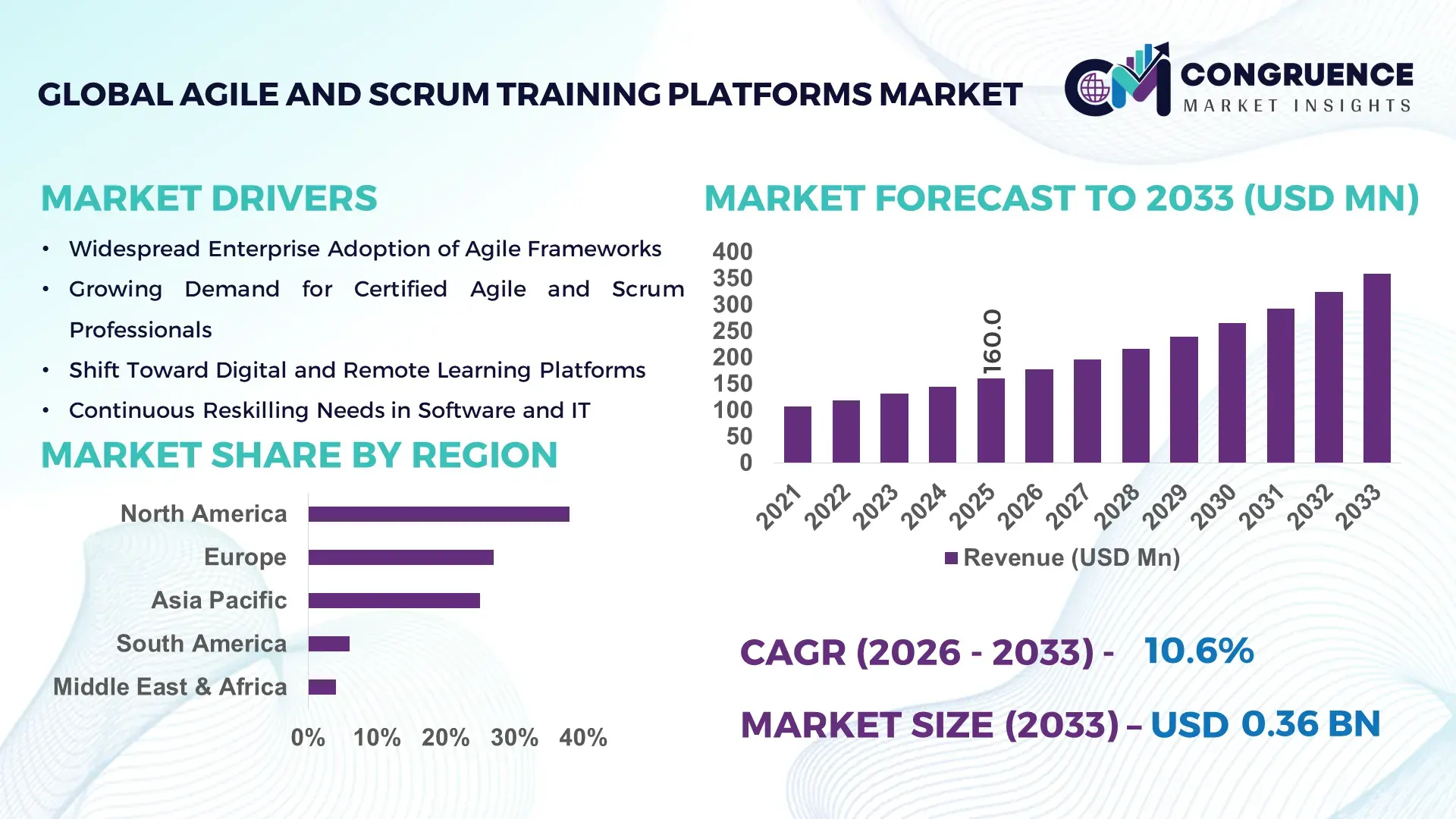
The Global Agile and Scrum Training Platforms Market was valued at USD 160.0 Million in 2025 and is anticipated to reach a value of USD 358.2 Million by 2033 expanding at a CAGR of 10.6% between 2026 and 2033, according to an analysis by Congruence Market Insights. The growth is driven by the increasing demand for agile methodologies across enterprise IT and project management sectors.
The United States leads the Agile and Scrum Training Platforms Market, with extensive production capacity and high investment levels. The country has over 1,200 certified training centers and more than 350,000 professionals undertaking agile and Scrum certifications annually. Key industry applications include IT services, software development, and financial services, where companies leverage advanced learning management systems and AI-driven adaptive learning tools. Technological advancements such as virtual reality-based simulations, AI-assisted coaching, and automated progress tracking have improved training efficiency, while regional adoption rates show nearly 60% of enterprise teams integrating agile practices in their workflow.
Market Size & Growth: USD 160.0 Million in 2025, projected USD 358.2 Million by 2033, 10.6% CAGR driven by rising demand for agile training in enterprises.
Top Growth Drivers: Increasing enterprise adoption (65%), rising IT project complexity (58%), efficiency improvements via digital learning platforms (52%).
Short-Term Forecast: By 2028, digital course completion rates are expected to improve by 40% due to AI-assisted learning.
Emerging Technologies: AI-based coaching, VR simulations, gamified learning platforms.
Regional Leaders: United States: USD 120.0 Million by 2033 with high tech adoption; Europe: USD 90.0 Million by 2033 with emphasis on regulatory compliance; Asia Pacific: USD 75.0 Million by 2033 with growing IT services uptake.
Consumer/End-User Trends: IT and software enterprises increasingly prefer online and blended learning, with 70% of employees completing certification within six months.
Pilot or Case Example: In 2026, a US IT firm reduced project delivery delays by 25% through an AI-driven Scrum training pilot.
Competitive Landscape: Market leader: Scrum Alliance (~20%), competitors include Scrum.org, Scaled Agile, Inc., and ICAgile.
Regulatory & ESG Impact: Adoption influenced by corporate governance training standards and ESG initiatives targeting workforce skill development.
Investment & Funding Patterns: Recent investments exceeded USD 50 Million, with increased venture funding for AI-driven training solutions.
Innovation & Future Outlook: Integration of adaptive AI, cloud-based platforms, and immersive VR technologies to enhance learning outcomes and scalability.
Agile and Scrum Training Platforms are increasingly adopted across IT services, finance, and software development sectors, with 55% of enterprise teams engaging in digital learning. Innovations such as AI-based learning paths and VR simulations are streamlining skill acquisition. Regulatory compliance, ESG initiatives, and regional technology adoption trends are further shaping the market, while emerging hybrid learning models are expected to drive future growth.
The Agile and Scrum Training Platforms Market holds strategic relevance as enterprises seek faster project delivery and higher workforce efficiency. AI-assisted coaching delivers up to 30% improvement in learning retention compared to traditional instructor-led courses. The United States dominates in training volume, while Europe leads in adoption, with 62% of enterprises implementing agile certification programs. By 2028, integration of VR and gamified learning is expected to improve training completion rates by 45%, enhancing employee productivity. Firms are committing to ESG improvements such as 20% reduction in paper-based training materials by 2027. In 2026, a multinational IT company achieved a 25% reduction in project delays through AI-driven Scrum coaching. Looking forward, Agile and Scrum Training Platforms will serve as a cornerstone for resilient, compliant, and sustainable enterprise growth.
The Agile and Scrum Training Platforms Market is shaped by rapid digital transformation, growing adoption of agile methodologies, and the need for continuous employee upskilling. Enterprises increasingly leverage online and blended learning to reduce training costs, improve performance, and maintain competitive advantage. Corporate programs are integrating advanced analytics to track learner progress and optimize skill development. Key influences include technological advancements, evolving workforce expectations, and sector-specific regulatory requirements. Continuous innovation in AI-assisted coaching, VR simulations, and gamified learning platforms is expanding market potential across IT, finance, and software development sectors.
The growing adoption of agile methodologies across IT and software development projects is driving market growth. Approximately 68% of enterprises have transitioned to agile project management frameworks to enhance efficiency and collaboration. The increasing complexity of digital transformation initiatives requires employees to acquire agile skills rapidly. Training platforms incorporating AI and real-time feedback mechanisms are improving employee competency, with average learning completion time reduced by 35%. Continuous professional development and certification requirements in IT services, finance, and consulting sectors further accelerate platform adoption.
Budget limitations and inconsistent quality across training providers restrict widespread adoption. Many small-to-medium enterprises face challenges investing in premium digital training subscriptions, resulting in reliance on free or low-cost alternatives that lack standardized content. Additionally, variations in instructor expertise, course content depth, and platform usability reduce overall learning effectiveness. Only 48% of employees report measurable improvement after training in such scenarios. Regulatory differences across regions also limit uniform adoption, particularly in regions with emerging digital education infrastructure.
AI-driven personalized learning and immersive VR simulations offer significant opportunities. Enterprises adopting AI-assisted training report up to 40% faster skill acquisition and higher retention rates. Virtual classrooms and gamified exercises enhance engagement, allowing distributed teams to complete certifications without geographic constraints. The rising demand for continuous professional development in IT services, finance, and consultancy sectors creates avenues for platform expansion. Platforms integrating predictive analytics to tailor content to individual learning styles are poised to capture untapped market segments and improve overall training ROI.
High implementation costs and integration complexities present challenges. Advanced platforms with AI, VR, and analytics require significant infrastructure investment, which can be prohibitive for smaller organizations. Integration with existing learning management systems and enterprise software poses technical hurdles. Additionally, ensuring content relevance across different sectors, managing updates, and maintaining cybersecurity protocols add operational costs. Inconsistent internet accessibility and varying digital literacy levels further limit adoption, particularly in emerging markets, impacting the scalability of platform solutions.
Surge in Online and Blended Learning: The adoption of online and hybrid learning platforms has increased 62% in IT and software development enterprises, improving accessibility and reducing travel and operational costs. Digital adoption accelerates skill acquisition across distributed teams.
Integration of AI and Personalized Learning: AI-driven adaptive learning is improving course completion rates by 35%, enabling tailored content based on individual performance metrics, with automated assessments enhancing competency evaluation.
Adoption of VR and Gamified Training Modules: Immersive VR and gamified exercises increase engagement by 48%, providing realistic project simulations for agile methodology practice, particularly in North America and Europe where digital adoption is highest.
Upskilling for Cross-Functional Teams: Enterprises are implementing continuous upskilling programs to improve collaborative efficiency, with 55% of cross-functional teams reporting measurable productivity gains after completing Scrum and agile training programs.
The Agile and Scrum Training Platforms Market is segmented across type, application, and end-user, providing a structured view of demand dynamics and adoption patterns. By type, offerings range from online courses and virtual classrooms to blended learning solutions, each tailored to enterprise and individual needs. Applications span IT services, software development, project management, and consulting, with varying adoption intensity and technological integration. End-users include enterprises, SMEs, educational institutions, and individual professionals seeking certification, highlighting diverse engagement levels and learning priorities. These segments reveal patterns of enterprise investment, digital adoption rates, and sector-specific training requirements, informing strategic decisions for market entrants and stakeholders. Approximately 65% of training initiatives are conducted online, while blended formats account for 30%, reflecting the increasing importance of flexible learning models.
Online courses currently lead the market, accounting for 45% of adoption, due to their accessibility, scalability, and integration with AI-driven learning tools that monitor progress and provide personalized guidance. Virtual classrooms hold 30% share, offering live interaction and real-time feedback, crucial for enterprise training programs. Blended learning solutions contribute a combined 25% share, catering to organizations that require both digital and in-person training.
The fastest-growing type is VR-enabled immersive learning, driven by demand for experiential, hands-on project simulations. Adoption of VR modules is rapidly increasing, with integration into enterprise training programs enhancing engagement and retention.
Other types include microlearning modules and AI-assisted adaptive courses, which are increasingly used as niche solutions for skill refreshers and role-specific certifications.
In 2025, a Fortune 500 IT firm implemented VR-based Scrum simulations for over 5,000 employees, improving real-time decision-making and project collaboration across distributed teams.
Project management and IT services dominate, with project management-focused training representing 40% of adoption. These platforms enhance team collaboration, workflow efficiency, and real-time project execution. Software development applications hold 35% share, emphasizing integration of agile practices into coding and DevOps pipelines. Consulting and corporate advisory applications account for the remaining 25%, offering specialized courses for process optimization and organizational transformation.
The fastest-growing application is enterprise-wide digital transformation training, fueled by increased adoption of AI-assisted project management tools and remote collaboration platforms. Companies integrating these programs report measurable efficiency improvements in cross-functional teams.
Consumer adoption trends indicate that in 2025, 38% of enterprises globally piloted agile platforms for operational workflow integration. Over 60% of IT professionals report higher engagement when interactive modules are used.
In 2025, over 150 multinational corporations deployed enterprise agile training programs, improving project completion accuracy by 28% within six months.
Enterprises are the leading end-user segment, accounting for 55% of adoption, leveraging platforms to upskill employees, standardize agile processes, and improve project delivery timelines. SMEs follow with 25% share, adopting cost-efficient online courses to improve workforce competency. Individual professionals and educational institutions make up the remaining 20%, focusing on certification and academic integration.
The fastest-growing end-user segment is SMEs, driven by remote work adoption and the need to scale agile expertise without large-scale infrastructure investment. This segment shows increasing engagement with AI-driven and VR-enabled platforms, allowing SMEs to match enterprise-level training efficacy.
Other end-users include consulting firms and corporate advisory divisions, contributing to market diversification. Adoption rates in top industries show 70% of IT service providers and 65% of financial service enterprises integrating formal agile training within their workforce development programs.
According to a 2025 Gartner report, AI-enabled agile training adoption among SMEs in the software development sector increased by 22%, enabling over 500 companies to optimize project workflows and resource allocation.
North America accounted for the largest market share at 38% in 2025, however, Asia-Pacific is expected to register the fastest growth, expanding at a CAGR of 11.2% between 2026 and 2033.

North America led with over 65,000 corporate enterprises enrolling employees in Agile and Scrum Training Platforms in 2025, with more than 120,000 certifications issued across IT, finance, and healthcare sectors. Asia-Pacific recorded nearly 48,000 enrollments, with rapid adoption in China, India, and Japan driven by digital transformation initiatives and expanding IT services. Europe contributed 27% of global platform usage with Germany, UK, and France representing over 60% of regional engagement. South America and the Middle East & Africa collectively accounted for 12%, with growth supported by government skill development programs and enterprise digital upskilling initiatives.
North America holds 38% of the global market, driven by high adoption in IT services, finance, and healthcare sectors. Enterprises increasingly leverage AI-assisted online courses, virtual classrooms, and blended learning to upskill employees. Regulatory frameworks promoting workforce certification and government incentives for digital skills programs have further fueled adoption. Technological advancements, including VR-based simulations and adaptive learning tools, enhance engagement and retention. Local players, such as Scrum Alliance, have trained over 50,000 professionals in 2025 alone. Consumer behavior shows higher enterprise uptake in healthcare and finance, with employees favoring flexible digital courses over traditional classroom formats.
Europe commands 27% of global adoption, with Germany, UK, and France being key markets. Regulatory pressures, including workforce upskilling mandates and sustainability compliance, have driven corporate training adoption. Enterprises are integrating emerging technologies like AI-based adaptive learning, gamified modules, and cloud-based platforms. Local providers, including Scrum.org’s European branches, have conducted over 35,000 certifications in 2025. Consumer behavior in Europe emphasizes explainable, standardized training programs to meet regulatory and quality assurance standards, with financial and IT sectors reporting the highest adoption rates.
Asia-Pacific holds 25% of global market volume, ranking second in adoption. Top consuming countries include China, India, and Japan, where digital transformation and e-learning infrastructure are rapidly expanding. Enterprises leverage mobile AI applications, cloud-based learning, and interactive online modules to upskill project teams. Local players such as EduTech India have trained over 20,000 professionals in Agile and Scrum practices in 2025, implementing blended learning programs. Regional behavior reflects growth in e-commerce, IT services, and software development, with employees preferring mobile and interactive platforms for flexible, self-paced learning.
South America accounted for 6% of global adoption, with Brazil and Argentina as leading markets. Growth is driven by corporate digitalization and infrastructure modernization in finance, IT, and energy sectors. Government incentives and trade policies promoting workforce development have enhanced platform deployment. Local training providers, such as AgileLatAm, conducted over 5,000 certifications in 2025, focusing on bilingual courses and localized content. Regional consumer behavior shows strong preference for mobile-accessible platforms and demand tied to media, language localization, and practical enterprise simulations.
Middle East & Africa contributed 4% of global adoption, with UAE and South Africa as primary growth countries. Enterprise demand is concentrated in oil & gas, construction, and financial services, emphasizing workforce upskilling and digital project management efficiency. Technological modernization, including cloud-based learning, virtual simulations, and AI-assisted coaching, is increasingly adopted. Local players such as AgileME have implemented 3,500 professional certifications in 2025, targeting both English and Arabic-speaking professionals. Regional behavior highlights rapid adoption by enterprise teams, particularly for online and hybrid learning solutions, driven by flexible workforce requirements and regulatory compliance mandates.
United States – 38% Market Share: Strong corporate adoption across IT, finance, and healthcare sectors with extensive training infrastructure.
Germany – 12% Market Share: High enterprise demand supported by regulatory mandates, workforce upskilling initiatives, and technological integration in corporate training programs.
The Agile and Scrum Training Platforms Market presents a fragmented yet competitive environment, with over 120 active competitors — ranging from global certification bodies to regional training providers and digital platform vendors. Industry leaders maintain strong positioning through strategic partnerships, course expansions, digital innovation, and localized offerings. For instance, collaborations like the one between Scrum Alliance and Coursera in October 2025 have broadened platform reach and enabled expert-led agile specializations worldwide, enhancing learner accessibility across industries.
Market dynamics show that the top 5 companies collectively account for approximately 45–50% of training enrollments and certifications globally, indicating a competitive balance where both established and emerging players coexist. Key strategic initiatives in recent periods include the launch of AI‑focused training modules, self‑paced product owner and Scrum fundamentals courses, and localization efforts such as Japanese language certification offerings by major providers.
Innovation trends influencing competition encompass AI‑assisted coaching tools, on‑demand e‑learning solutions, and interactive VR/immersive training modules. These tech advances are reshaping user expectations and forcing competitors to differentiate with unique value propositions. Significant activity includes enhanced mobile‑friendly platforms, adaptive learning engines, and enterprise‑grade learning management integrations that support corporate upskilling strategies.
As organizations across sectors — from IT and finance to healthcare and consulting — accelerate agile adoption, providers that combine scalable digital experiences with recognized credentialing paths are gaining prominence. The market’s competitive landscape underscores the importance of continuous innovation, partnerships, and regional adaptation to capture enterprise and individual professional demand.
Scrum Inc.
tryScrum
Agile Centre
agileKRC
VMEdu
SCRUMstudy
Agilemania
The Workly
Udemy (Agile & Scrum courses)
Docebo
LinkedIn Learning
The technology landscape in the Agile and Scrum Training Platforms Market is rapidly evolving to meet enterprise demand for flexible, scalable, and data‑driven learning solutions. A major technological shift involves the integration of AI‑assisted learning tools that personalize training paths, assess skill progression in real time, and provide actionable coaching feedback. These AI capabilities support adaptive content delivery, improving learner engagement and enabling tailored paths for agile roles such as Scrum Masters, Product Owners, and agile coaches.
E‑learning platforms are increasingly incorporating interactive and on‑demand delivery models, allowing professionals to access courses via web and mobile applications, resulting in improved participation and completion rates. For example, platforms like Scrum Inc. now offer on‑demand digital solutions designed to foster cross‑team alignment and agile scaling frameworks, enabling organizations to train multiple teams uniformly and efficiently.
Another emerging technology trend is the use of virtual reality (VR) and simulation‑based learning environments that replicate real agile project scenarios, enhancing practical skills development beyond traditional video‑based content. Enterprises implementing these immersive tools report enhanced collaboration skills and better retention of agile principles among learners.
Localization and accessibility are also being addressed through multilingual training delivery and culturally relevant content, as seen with global bodies enabling certifications in languages like Japanese to support regional adoption.
Furthermore, analytics dashboards and learning performance metrics are becoming standard features, providing both learners and organizational L&D teams with insights into progress, skill gaps, and competency levels. This data‑centric approach supports strategic workforce development and helps organizations benchmark training outcomes against agile maturity goals.
In summary, the convergence of AI, on‑demand platforms, immersive learning, and performance analytics is shaping a technology‑rich ecosystem that enhances training effectiveness, supports enterprise scale‑ups, and satisfies the evolving expectations of learners seeking agile proficiency.
• In October 2025, Scrum Alliance partnered with Coursera to deliver flexible agile skill learning globally through new Specializations targeting agile coaching and product management, expanding access to expert‑led credentials and adaptive learning experiences. Source: www.globenewswire.com
• In December 2025, Scrum.org launched a new self‑paced Professional Scrum Product Owner Fundamentals course, expanding digital access to foundational agile product ownership concepts for global learners. Source: www.scrum.org
• In June 2025, Scrum.org announced an AI‑focused training for Scrum Masters—the Professional Scrum Master – AI Essentials course—to equip practitioners with skills to leverage AI in agile coaching and team performance contexts. Source: www.scrum.org
• In March 2025, agileKRC partnered with Agile Centre (London) to deliver enhanced Scrum training pathways, including virtual and in‑person options aligned with advanced certification tracks for professionals seeking recognized Scrum qualifications. Source: www.pressadvantage.com
The Agile and Scrum Training Platforms Market Report covers a comprehensive range of segments and insights critical for understanding the landscape of agile education and certification delivery. It examines platform types, including online course offerings, virtual classroom experiences, blended learning solutions, and mobile‑optimized training modules, highlighting adoption patterns and technology integration across enterprise and individual learning channels. This report also assesses applications of training platforms in sectors such as IT services, software development, project management, consulting, finance, and healthcare — detailing how each application aligns with organizational goals for agile transformation.
Geographically, the report analyzes regional dynamics across North America, Europe, Asia‑Pacific, South America, and Middle East & Africa, presenting volume‑based metrics, consumer adoption behavior, regional tech infrastructure trends, and training ecosystem maturity levels. It includes end‑user segmentation, differentiating between corporate enterprises, SMEs, educational institutions, and individual professionals, offering insight into usage behaviors, preferred learning modalities, and certification objectives among distinct cohorts.
Technological insights are a core focus, detailing the impact of AI‑assisted learning, on‑demand digital platforms, VR/immersive simulations, and analytics dashboards on training effectiveness and engagement. The report also explores strategic initiatives by key training providers, such as course enhancements, localized content delivery, and collaborative partnerships with global e‑learning platforms to broaden reach and relevance.
Further sections highlight emerging niche segments — including AI integration courses, agile scaling frameworks, and localized multilingual certification programs — offering context for future growth pathways. The scope also addresses consumer trend analytics, workforce skill gap assessments, and enterprise upskilling strategies essential for decision‑makers planning agile capability investments. Overall, the report delivers a structured examination of market breadth, segment performance attributes, regional nuances, technology impact, and competitive drivers shaping the Agile and Scrum Training Platforms landscape.
| Report Attribute / Metric | Details |
|---|---|
| Market Revenue (2025) | USD 160.0 Million |
| Market Revenue (2033) | USD 358.2 Million |
| CAGR (2026–2033) | 10.6% |
| Base Year | 2025 |
| Forecast Period | 2026–2033 |
| Historic Period | 2021–2025 |
| Segments Covered |
By Type
By Application
By End-User Insights
|
| Key Report Deliverables | Revenue Forecast, Market Trends, Growth Drivers & Restraints, Technology Insights, Segmentation Analysis, Regional Insights, Competitive Landscape, Regulatory & ESG Overview, Recent Developments |
| Regions Covered | North America, Europe, Asia-Pacific, South America, Middle East & Africa |
| Key Players Analyzed | Scrum Alliance, Scrum.org, Coursera, Scrum Inc., tryScrum, Agile Centre, agileKRC, VMEdu, SCRUMstudy, Agilemania, The Workly, Udemy (Agile & Scrum courses), Docebo, LinkedIn Learning |
| Customization & Pricing | Available on Request (10% Customization Free) |




