
Reports
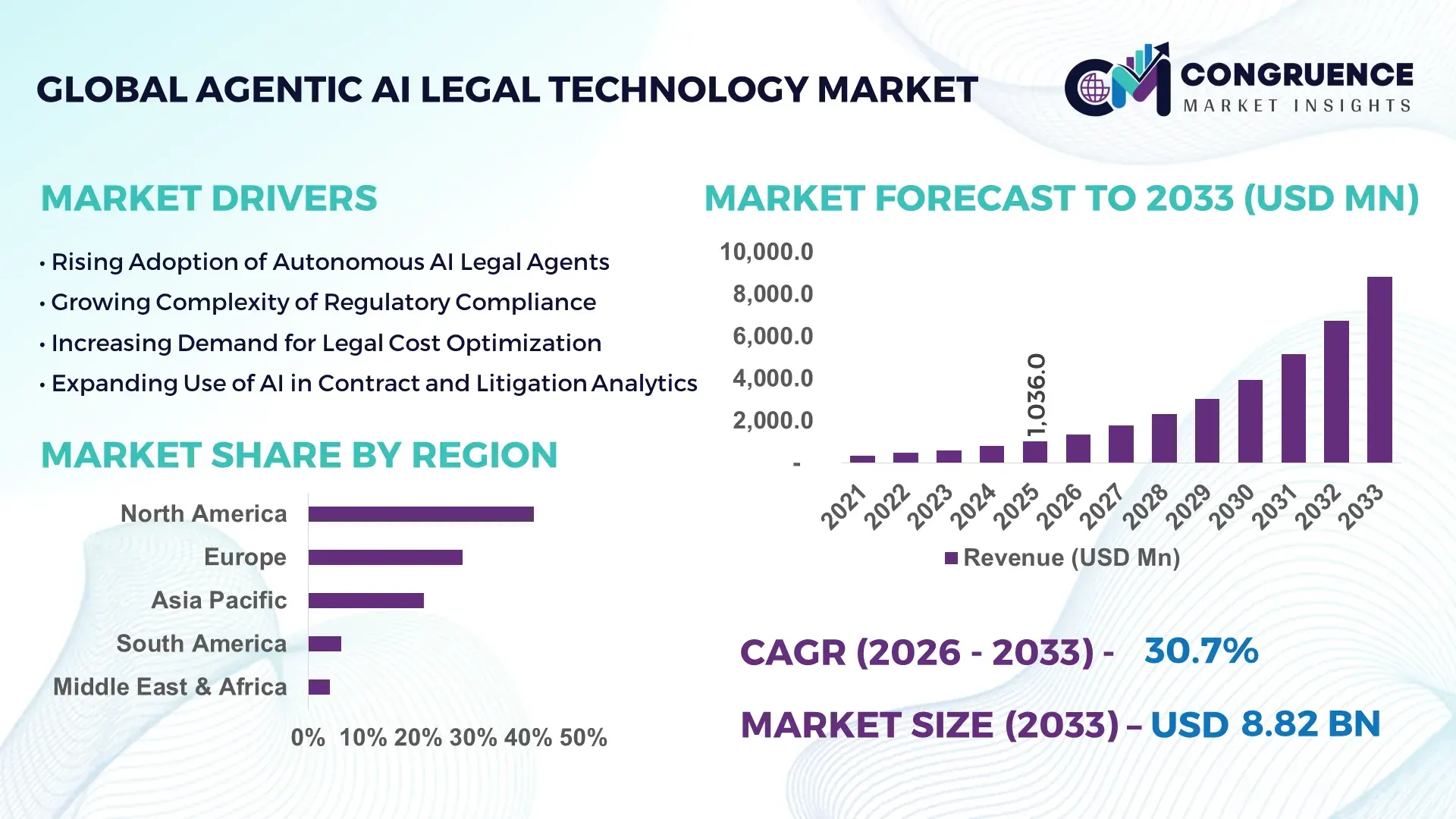
The Global Agentic AI Legal Technology Market was valued at USD 1,036.0 Million in 2025 and is anticipated to reach a value of USD 8,821.9 Million by 2033 expanding at a CAGR of 30.7% between 2026 and 2033, according to an analysis by Congruence Market Insights. The growth is primarily driven by the rapid integration of autonomous AI agents capable of independently performing legal research, contract analysis, compliance monitoring, and litigation support with minimal human intervention.
The United States represents the dominant country in the Agentic AI Legal Technology Market, supported by strong legal infrastructure and advanced AI development capabilities. Over 65% of Am Law 200 firms have integrated AI-driven document review and e-discovery systems into daily workflows. The U.S. legal services industry, valued at over USD 400 billion annually, has accelerated AI investment, with more than USD 2.5 billion directed toward legal-tech startups between 2022 and 2025. Major technology hubs such as California, New York, and Texas host over 1,200 legal-tech firms focusing on AI-powered contract lifecycle management, predictive analytics, and compliance automation. Additionally, federal courts process more than 350,000 civil cases annually, creating high-volume use cases for agentic AI solutions in litigation analytics, regulatory filings, and case outcome prediction systems.
Market Size & Growth: USD 1,036.0 Million (2025) projected to reach USD 8,821.9 Million by 2033 at 30.7% CAGR, driven by automation of high-volume legal workflows and compliance digitization.
Top Growth Drivers: 72% law firm AI adoption rate; 60% reduction in document review time; 45% operational cost optimization through AI agents.
Short-Term Forecast: By 2028, AI-driven contract analytics platforms are expected to reduce legal processing turnaround time by 40%.
Emerging Technologies: Multi-agent AI systems, retrieval-augmented generation (RAG), and explainable AI compliance engines transforming autonomous legal reasoning.
Regional Leaders: North America projected at USD 3,950.0 Million by 2033 with enterprise-wide adoption; Europe at USD 2,430.0 Million driven by GDPR-compliant AI frameworks; Asia-Pacific at USD 1,980.0 Million with rapid digital court modernization.
Consumer/End-User Trends: Corporate legal departments account for over 48% of deployments, followed by law firms (38%) and government agencies (14%).
Pilot or Case Example: In 2024, a U.S.-based multinational deployed agentic AI for compliance monitoring, achieving 35% faster audit cycles and 28% reduction in manual review errors.
Competitive Landscape: Market leader holds approximately 18% share, followed by key players including enterprise AI-legal platform providers and compliance automation specialists.
Regulatory & ESG Impact: Increasing AI governance frameworks and data privacy mandates influencing over 70% of enterprise procurement decisions.
Investment & Funding Patterns: Over USD 2.5 Billion invested in AI-legal startups between 2022–2025, with rising venture funding for autonomous contract lifecycle solutions.
Innovation & Future Outlook: Integration of AI copilots with enterprise resource planning (ERP) and case management systems to enable end-to-end autonomous legal operations.
Corporate legal departments contribute nearly 48% of total deployments, followed by law firms at 38% and public sector agencies at 14%. Innovations in autonomous contract lifecycle management and AI-driven litigation analytics are reshaping compliance operations. Data privacy mandates and digital court reforms accelerate demand in North America and Europe, while Asia-Pacific witnesses rapid adoption through judicial modernization programs. Increasing cross-border regulatory complexity and AI governance frameworks remain central growth catalysts for long-term expansion.
The Agentic AI Legal Technology Market holds strategic relevance as organizations transition from reactive legal management to predictive, autonomous legal intelligence systems. Enterprises are embedding multi-agent AI architectures capable of executing contract negotiations, compliance audits, and risk assessments with minimal supervision. Advanced agentic AI platforms deliver approximately 60% faster legal research cycles compared to traditional manual review processes and 35% greater accuracy in clause identification compared to rule-based software tools.
North America dominates in deployment volume due to large-scale enterprise adoption, while Europe leads in regulatory-aligned AI adoption with over 58% of enterprises implementing AI systems designed to comply with GDPR and emerging AI governance regulations. By 2028, autonomous compliance monitoring systems are expected to reduce regulatory penalty exposure by 30% through real-time risk detection and reporting automation.
Firms are committing to ESG-aligned AI governance metrics, including 25% reduction in paper-based documentation by 2027 through digital contract ecosystems. In 2025, a major U.S. legal services provider achieved a 32% reduction in litigation preparation time by implementing AI-driven predictive case analytics integrated with internal knowledge databases.
Looking ahead, integration with enterprise cybersecurity, blockchain-based contract validation, and cross-border regulatory intelligence platforms positions the Agentic AI Legal Technology Market as a core pillar supporting resilience, compliance transparency, and sustainable operational growth in global legal ecosystems.
The Agentic AI Legal Technology Market is characterized by rapid digital transformation within legal ecosystems, driven by increasing litigation volumes, expanding regulatory frameworks, and growing enterprise demand for cost-efficient legal operations. More than 70% of large enterprises now prioritize AI-enabled compliance tools in procurement strategies. The market is influenced by digital court initiatives, cross-border regulatory complexity, and the need for real-time legal analytics. Additionally, the rise of generative AI models trained on legal datasets enhances predictive case outcome modeling and automated contract drafting. Integration with enterprise resource planning and governance-risk-compliance (GRC) systems further strengthens adoption across multinational corporations, financial institutions, and government agencies.
Global regulatory frameworks have expanded significantly, with multinational corporations managing compliance across more than 50 jurisdictions on average. Regulatory change volumes have increased by nearly 40% over the past five years, compelling enterprises to adopt automated compliance monitoring. Agentic AI systems process thousands of regulatory updates in real time, reducing manual review workloads by up to 60%. Financial institutions alone face over 200 daily regulatory alerts, making autonomous AI-driven compliance engines essential for maintaining audit readiness and mitigating legal exposure.
Over 65% of enterprises cite data security risks as a primary barrier to AI adoption in legal workflows. Legal datasets often contain confidential client information, intellectual property, and litigation records requiring strict compliance with data protection regulations. More than 45% of organizations report concerns regarding AI hallucination risks and explainability limitations in autonomous systems. Additionally, regulatory uncertainty around AI governance standards increases implementation complexity, delaying procurement cycles and increasing compliance validation costs for AI-legal technology providers.
Over 30 countries have initiated digital court transformation programs since 2020, enabling electronic filings, remote hearings, and AI-supported case management. More than 55% of civil court filings in advanced economies are now processed digitally, creating high-volume datasets for predictive analytics. Agentic AI platforms can automate docket analysis, case scheduling, and document classification, reducing administrative burdens by up to 35%. Expansion of online dispute resolution systems further unlocks opportunities for AI-driven settlement recommendation engines and real-time legal advisory bots.
Legal enterprises operate legacy case management systems that are often incompatible with modern AI architectures. Approximately 50% of large law firms still rely on on-premise document management platforms requiring extensive customization for AI integration. Implementation timelines can extend beyond 12 months due to system interoperability issues and cybersecurity audits. Additionally, training AI agents on jurisdiction-specific legal precedents requires high-quality annotated datasets, which remain limited in emerging markets, increasing deployment costs and technical complexity.
72% Enterprise Adoption of AI-Driven Contract Lifecycle Management: Large enterprises are accelerating deployment of autonomous contract review systems, with 72% of Fortune 500 legal departments integrating AI tools into procurement and vendor negotiations. Automated clause extraction has improved processing speed by 58%, while error detection accuracy has increased by 33%, significantly enhancing risk mitigation efficiency.
45% Reduction in Litigation Preparation Time Through Predictive Analytics: Agentic AI litigation platforms now analyze over 10,000 historical case documents within minutes, delivering 45% faster case strategy preparation. Law firms using AI-driven outcome prediction models report 29% higher settlement optimization rates compared to traditional manual assessment approaches.
60% Growth in Multi-Agent Compliance Automation Systems: Enterprises deploying multi-agent AI architectures for regulatory tracking have reduced compliance reporting time by 40%. Over 68% of multinational corporations utilize AI dashboards for cross-border compliance monitoring, improving audit transparency and reducing manual reconciliation efforts by 31%.
35% Increase in AI-Integrated Digital Court Platforms: Digital judiciary initiatives have led to a 35% rise in AI-supported case management systems globally. Automated document classification tools now process up to 85% of filings without human intervention, cutting administrative overhead by 28% and accelerating case resolution timelines.
The Agentic AI Legal Technology Market is segmented across type, application, and end-user categories, reflecting the diverse deployment of autonomous AI agents within legal ecosystems. By type, the market spans contract lifecycle management agents, litigation analytics agents, compliance monitoring agents, legal research assistants, and document automation systems. Contract-focused and compliance-driven AI agents collectively account for over 60% of enterprise deployments due to high transaction volumes and regulatory complexity. By application, compliance automation and contract review dominate usage patterns, representing nearly half of all AI-driven legal workflows, followed by litigation strategy optimization and risk assessment analytics. Increasing digitization of court systems and cross-border regulatory mandates further expands application diversity. From an end-user perspective, corporate legal departments lead adoption, followed by law firms and government agencies. Large enterprises demonstrate higher deployment intensity, with more than 70% integrating AI-driven legal analytics within governance, risk, and compliance frameworks, signaling strong enterprise-centric segmentation trends.
The Agentic AI Legal Technology Market by type includes Contract Lifecycle Management (CLM) Agents, Litigation Analytics Agents, Compliance Monitoring Agents, Legal Research Assistants, and Document Automation & E-Discovery Agents. Contract Lifecycle Management agents currently account for approximately 34% of total adoption, making them the leading type. Their dominance is supported by high contract volumes across multinational corporations, where enterprises manage an average of 20,000–40,000 contracts annually. Automated clause extraction and risk scoring improve review efficiency by up to 58%, driving widespread deployment. Compliance Monitoring agents represent 26% of adoption, particularly strong in regulated industries such as banking and healthcare. However, Litigation Analytics agents are the fastest-growing segment, expanding at an estimated CAGR of 32.5%, driven by predictive case outcome modeling and AI-assisted legal strategy planning. Legal Research Assistants and Document Automation tools collectively contribute nearly 20% of deployments, serving niche but critical functions in knowledge management and large-scale document classification.
In 2025, the Administrative Office of the U.S. Courts reported increased implementation of AI-assisted document classification systems across federal districts, enabling automated processing of thousands of electronic filings daily and reducing administrative workload by over 30%.
By application, Compliance & Regulatory Automation leads with approximately 31% share, supported by the rising complexity of multi-jurisdictional regulations. Enterprises face an average of 200+ regulatory updates annually, necessitating real-time AI monitoring systems. Contract Review & Negotiation accounts for 27% of deployments, driven by procurement digitization and vendor risk management. Litigation Analytics & Case Prediction follows at 22%, while Legal Research Automation and Intellectual Property (IP) Management collectively contribute around 20%. While compliance currently leads, Litigation Analytics is the fastest-growing application segment, expanding at nearly 33% CAGR due to increased reliance on predictive analytics and data-driven litigation strategies. In 2025, more than 41% of global enterprises reported piloting AI-powered compliance dashboards within governance frameworks. Additionally, 63% of corporate legal teams indicated improved decision-making confidence when AI-based risk scoring tools were integrated into daily operations.
In 2024, the European Commission’s digital justice initiative expanded AI-supported e-filing and case management systems across multiple member states, enabling automated processing for millions of civil case documents annually.
Corporate Legal Departments dominate the Agentic AI Legal Technology Market, accounting for approximately 48% of total adoption. Large multinational enterprises integrate AI agents within governance, risk, and compliance ecosystems to streamline internal audits and cross-border regulatory oversight. Law Firms follow with 38% share, particularly among Am Law 200 firms, where over 65% have integrated AI-assisted document review tools into litigation workflows. Government & Judicial Bodies represent about 14% of deployments, primarily through digital court modernization initiatives. However, government adoption is expanding at the fastest pace, with an estimated CAGR of 31.8%, driven by electronic case filing systems and AI-supported administrative automation. In 2025, nearly 44% of enterprises globally reported expanding AI usage beyond pilot phases into full-scale legal operations. Furthermore, over 52% of mid-sized law firms indicated that AI adoption directly improved billable-hour optimization and client response time efficiency.
In 2025, a report by a leading global IT advisory firm highlighted that AI adoption among public sector legal departments increased by 24% year-over-year, enabling more than 300 government entities to automate compliance review and public records management systems.
North America accounted for the largest market share at 41% in 2025 however, Asia-Pacific is expected to register the fastest growth, expanding at a CAGR of 32.4% between 2026 and 2033.
North America’s leadership is supported by high enterprise AI penetration, with over 68% of large corporations integrating AI-driven compliance and contract automation tools. Europe follows with a 28% market share, driven by cross-border regulatory complexity and digital justice modernization across more than 20 jurisdictions. Asia-Pacific holds approximately 21% share, supported by rapid digital court reforms and AI innovation hubs in China, India, Japan, and Singapore. South America represents 6% of the global market, while the Middle East & Africa accounts for 4%, reflecting growing but still emerging adoption patterns. Across all regions, more than 55% of enterprises prioritize AI-enabled governance, risk, and compliance systems as part of digital transformation initiatives.
North America holds approximately 41% of the global Agentic AI Legal Technology Market share, reflecting strong enterprise integration and advanced digital infrastructure. The United States and Canada collectively host over 1,500 legal-tech startups, with more than 65% of Am Law 200 firms deploying AI-powered document review and litigation analytics tools. Key demand comes from financial services, healthcare, technology, and government sectors, where compliance monitoring systems process over 250 regulatory alerts per day in large institutions. Recent policy developments emphasize responsible AI frameworks and federal AI governance standards, accelerating procurement of explainable AI systems. Digital transformation trends include integration of agentic AI with enterprise resource planning and cybersecurity platforms. A leading U.S.-based AI legal solutions provider expanded its autonomous contract lifecycle platform in 2025, enabling automation of over 1 million contracts annually. Regional consumer behavior reflects higher enterprise adoption in finance and healthcare, where over 70% of large organizations report active AI-driven compliance deployment.
Europe accounts for nearly 28% of the Agentic AI Legal Technology Market share, led by Germany, the United Kingdom, and France. Over 58% of enterprises in Western Europe deploy AI tools aligned with strict data protection frameworks. Regulatory oversight from EU-level digital governance initiatives has accelerated adoption of explainable AI compliance systems. More than 40% of large enterprises integrate AI into cross-border contract management and regulatory tracking processes. Emerging technologies such as retrieval-augmented legal research and AI-powered multilingual contract analytics are gaining traction due to cross-border trade complexity. A prominent UK-based legal AI firm recently expanded predictive litigation analytics across multiple EU jurisdictions, enhancing case assessment accuracy by 30%. Regional behavior trends indicate strong demand for transparent, auditable AI systems, as 62% of corporate legal teams prioritize explainability and regulatory alignment in procurement decisions.
Asia-Pacific holds approximately 21% of the global market and ranks as the fastest-growing regional segment. China, India, Japan, and Singapore are the top consuming countries, collectively accounting for more than 75% of regional deployments. Over 30 countries in the region have implemented digital court modernization programs, enabling electronic filings and AI-supported case management systems. Infrastructure expansion includes smart judiciary platforms and AI research hubs in Beijing, Bengaluru, Tokyo, and Singapore. In 2025, an India-based legal analytics startup expanded AI-powered compliance automation across 200+ enterprise clients, reducing contract review time by 35%. Regional adoption is influenced by rapid enterprise digitization and mobile-first AI applications, with more than 60% of mid-sized enterprises piloting AI-assisted legal advisory tools to manage regulatory complexity in cross-border trade.
South America represents approximately 6% of the global Agentic AI Legal Technology Market, led by Brazil and Argentina. Brazil accounts for nearly 55% of regional deployments due to its high litigation volume and digital judiciary initiatives processing millions of electronic filings annually. Infrastructure modernization in public administration and financial services sectors drives AI integration. Government-backed digital transformation strategies and trade modernization programs encourage automation in compliance reporting. A Brazil-based legal-tech firm recently deployed AI-driven case triage systems across multiple state courts, reducing administrative review time by 28%. Regional consumer behavior shows growing demand for language-localized AI platforms, as over 50% of enterprises prioritize Portuguese and Spanish NLP capabilities for contract analytics and litigation support.
The Middle East & Africa accounts for nearly 4% of the global market, with the UAE and South Africa leading regional demand. Over 45% of large enterprises in the UAE have adopted AI-driven compliance monitoring tools within financial and energy sectors. Oil & gas, construction, and public infrastructure projects generate high regulatory documentation volumes, encouraging AI-based contract and risk analytics deployment. Technological modernization includes smart government programs and digital courts, particularly in Gulf Cooperation Council countries. A UAE-based AI solutions provider introduced autonomous legal document validation systems in 2025, improving regulatory review efficiency by 30%. Regional behavior trends show strong interest in secure cloud-based AI platforms, especially among multinational corporations operating across multiple jurisdictions.
United States – 38% Market Share: It leads due to high enterprise AI adoption, advanced digital court infrastructure, and over 65% integration among top-tier law firms.
Germany – 12% Market Share: It is driven by strong regulatory compliance demand, advanced industrial enterprise adoption, and integration of explainable AI systems aligned with EU digital governance frameworks.
The Agentic AI Legal Technology Market is moderately fragmented, with more than 120 active global and regional vendors competing across contract lifecycle management, litigation analytics, compliance automation, and AI-powered legal research. The top five companies collectively account for approximately 46% of the total market share, reflecting a competitive yet innovation-driven landscape. Market leaders typically hold individual shares ranging between 8% and 14%, supported by strong enterprise client bases and integrated AI ecosystems.
Competition is increasingly shaped by strategic partnerships between AI developers and established legal information providers. Over 35% of leading vendors announced product upgrades in 2024–2025 focused on multi-agent orchestration, retrieval-augmented generation (RAG), and explainable AI dashboards. Mergers and acquisitions activity has accelerated, with more than 18 legal-tech acquisitions recorded globally between 2024 and 2025 to expand NLP capabilities and regulatory intelligence datasets.
Product differentiation centers on automation depth, integration flexibility, cybersecurity standards, and regulatory compliance readiness. More than 60% of vendors now offer API-based integration with enterprise governance, risk, and compliance (GRC) platforms. Cloud-based deployment dominates with nearly 72% preference among large enterprises, intensifying competition around data privacy certifications and enterprise-grade security architecture. Innovation velocity and domain-specific AI model training remain decisive competitive factors for long-term positioning.
Harvey AI
Casetext
Everlaw
DISCO
Ironclad
Clio
Luminance
Evisort
LawGeex
Kira Systems
Onit
Icertis
The Agentic AI Legal Technology Market is driven by advancements in large language models (LLMs), retrieval-augmented generation (RAG), multi-agent orchestration frameworks, and domain-specific natural language processing (NLP). Over 70% of enterprise AI-legal deployments now integrate transformer-based LLM architectures fine-tuned on proprietary legal datasets exceeding millions of annotated case files and contracts.
Multi-agent AI systems enable distributed task handling, where separate agents manage clause extraction, compliance validation, litigation risk scoring, and reporting automation. These systems demonstrate up to 45% improvement in workflow efficiency compared to single-agent models. Explainable AI modules have become critical, with 62% of enterprises requiring transparent reasoning trails for audit and regulatory validation.
RAG architectures improve legal research precision by 35%, combining internal document repositories with verified external knowledge databases. Additionally, AI-powered contract lifecycle platforms now achieve 90%+ clause detection accuracy and reduce manual review time by more than 50%.
Cloud-native deployment models dominate, with 72% of large organizations opting for SaaS-based AI-legal solutions integrated into enterprise resource planning and cybersecurity ecosystems. Emerging technologies include blockchain-enabled smart contract validation, AI-driven risk heatmaps, and automated regulatory change monitoring systems capable of processing over 10,000 policy updates monthly. Cybersecurity enhancements, including zero-trust architectures and encrypted model training pipelines, are increasingly embedded to meet enterprise-grade compliance standards.
• In June 2025, LexisNexis and Harvey announced a strategic alliance to integrate LexisNexis generative AI technology, U.S. case law content, and Shepard’s® Citations into the Harvey AI platform, enabling customers to access citation-backed legal research and advanced legal workflows such as Motion to Dismiss and Summary Judgment generation directly within Harvey. Source: www.lexisnexis.com
• In August 2025, Thomson Reuters launched CoCounsel Legal, a next-generation agentic AI solution featuring Deep Research — an AI research capability embedded within Westlaw — enabling legal professionals to delegate complex tasks across litigation, regulatory analysis, and transactional workflows at scale. Source: www.thomsonreuters.com
• In November 2025, Thomson Reuters unveiled enhanced agentic AI capabilities for CoCounsel Legal, including beta releases for autonomous execution of complex legal workflows, customizable agentic plans, and bulk document review of up to 10,000 documents, marking a significant extension of agentic execution beyond research. Source: www.thomsonreuters.com
• In January 2026, Thomson Reuters announced access for over 120,000 law students to CoCounsel Legal and Deep Research tools across more than 200 U.S. law schools, extending agentic AI education and adoption among future legal professionals and reinforcing its position as a technology partner for legal education. Source: www.thomsonreuters.com
The Agentic AI Legal Technology Market Report provides a comprehensive analysis of autonomous AI systems deployed across legal research, contract lifecycle management, litigation analytics, compliance monitoring, and digital court modernization. The report covers segmentation by type, including contract AI agents, litigation prediction engines, compliance automation systems, research assistants, and document intelligence platforms. Application analysis spans regulatory compliance, contract negotiation, case strategy optimization, intellectual property management, and enterprise governance integration.
Geographically, the report evaluates North America, Europe, Asia-Pacific, South America, and the Middle East & Africa, covering more than 25 key countries representing over 90% of global legal-tech deployments. End-user analysis includes corporate legal departments, law firms, government agencies, financial institutions, healthcare organizations, and multinational enterprises.
Technology coverage incorporates large language models, retrieval-augmented generation, multi-agent orchestration, explainable AI frameworks, blockchain-enabled validation, and cybersecurity-enhanced AI architectures. The report also examines enterprise deployment models, including cloud-based systems (over 70% preference) and hybrid/on-premise integrations for high-security environments.
Additionally, the scope includes competitive benchmarking of more than 120 active vendors, strategic partnerships, regulatory alignment frameworks, AI governance trends, ESG compliance metrics, and digital justice modernization initiatives. Emerging niches such as AI-enabled online dispute resolution and cross-border regulatory intelligence platforms are also assessed to provide forward-looking strategic insights for industry stakeholders and decision-makers.
| Report Attribute / Metric | Details |
|---|---|
| Market Revenue (2025) | USD 1,036.0 Million |
| Market Revenue (2033) | USD 8,821.9 Million |
| CAGR (2026–2033) | 30.7% |
| Base Year | 2025 |
| Forecast Period | 2026–2033 |
| Historic Period | 2021–2025 |
| Segments Covered |
By Type
By Application
By End-User Insights
|
| Key Report Deliverables | Revenue Forecast; Market Trends; Growth Drivers & Restraints; Technology Insights; Segmentation Analysis; Regional Insights; Competitive Landscape; Regulatory & ESG Overview; Recent Developments |
| Regions Covered | North America; Europe; Asia-Pacific; South America; Middle East & Africa |
| Key Players Analyzed | Relativity; LexisNexis; Thomson Reuters; Harvey AI; Casetext; Everlaw; DISCO; Ironclad; Clio; Luminance; Evisort; LawGeex; Kira Systems; Onit; Icertis |
| Customization & Pricing | Available on Request (10% Customization Free) |




