
Reports
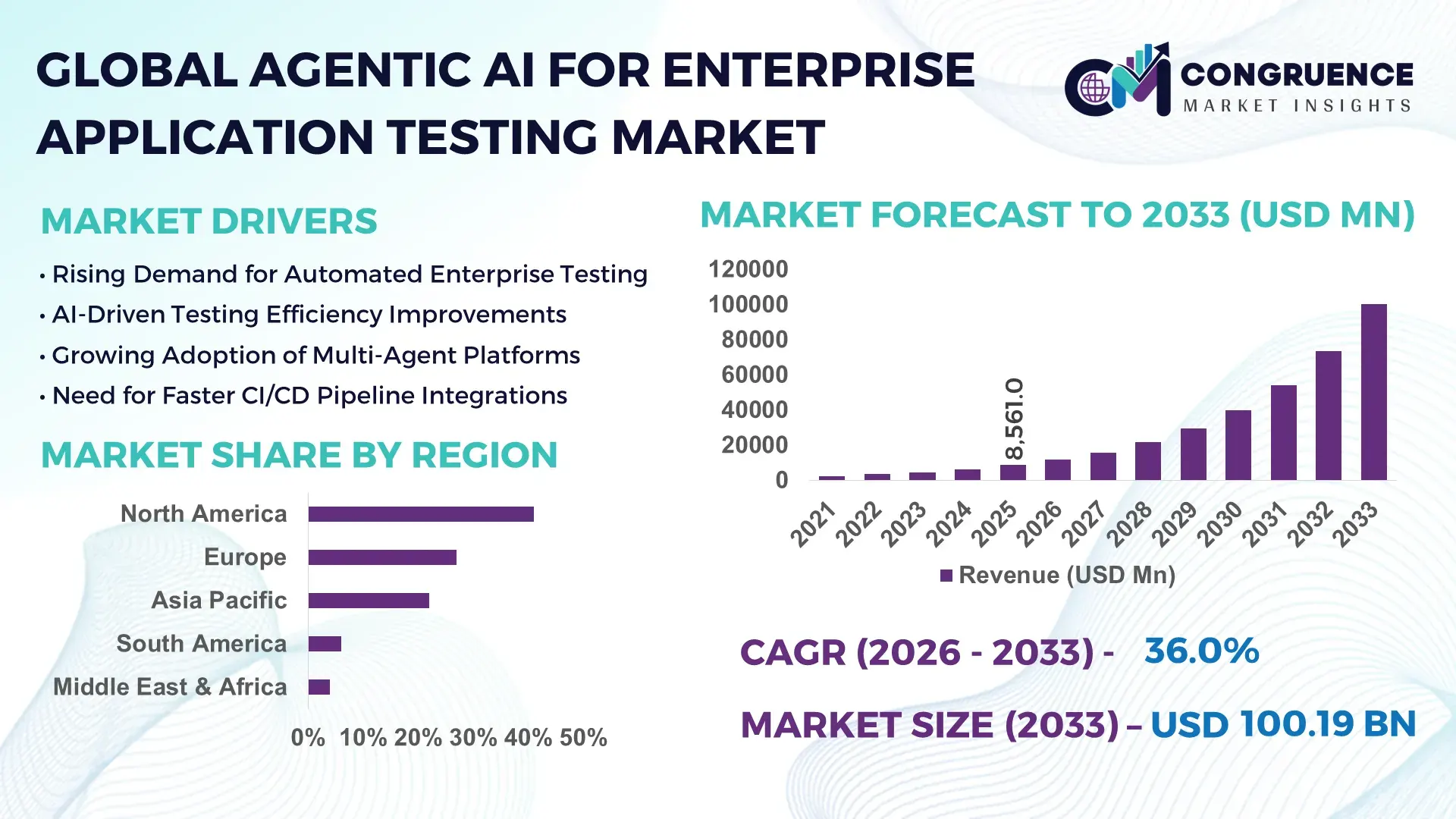
The Global Agentic AI For Enterprise Application Testing Market was valued at USD 8,561.0 Million in 2025 and is anticipated to reach a value of USD 100,192.6 Million by 2033 expanding at a CAGR of 36% between 2026 and 2033, according to an analysis by Congruence Market Insights. This growth is driven by accelerating enterprise demand for autonomous testing agents that reduce software release cycles, improve test coverage, and optimize QA costs across complex digital ecosystems.
The United States dominates the Agentic AI For Enterprise Application Testing Market through its advanced production capacity, sustained enterprise investment, and deep integration of agentic AI across large-scale application environments. Over 72% of Fortune 500 enterprises deploy AI-driven or agent-based testing tools across ERP, CRM, and cloud-native platforms. Annual enterprise AI software spending in the U.S. exceeded USD 95 billion in 2024, with quality assurance and DevOps automation accounting for nearly 18%. The country leads in autonomous test generation, self-healing test scripts, and AI-driven defect triaging, supported by over 65% adoption of CI/CD pipelines and more than 60% enterprise cloud workload penetration.
Market Size & Growth: Valued at USD 8.56 Billion in 2025 and projected to reach USD 100.19 Billion by 2033, expanding at a 36% CAGR, driven by enterprise-scale automation and autonomous QA adoption.
Top Growth Drivers: Autonomous test execution adoption (48%), reduction in manual QA effort (42%), improvement in release velocity (37%).
Short-Term Forecast: By 2028, agentic AI-based testing is expected to reduce enterprise application testing costs by 30%.
Emerging Technologies: Multi-agent orchestration frameworks, reinforcement learning-based test optimization, generative AI-driven test case synthesis.
Regional Leaders: North America (USD 38.4 Billion by 2033 – enterprise SaaS testing focus), Europe (USD 27.6 Billion – regulatory-driven QA automation), Asia Pacific (USD 24.1 Billion – rapid digital platform scaling).
Consumer/End-User Trends: Large enterprises account for over 62% of deployments, with BFSI and IT services as primary adopters.
Pilot or Case Example: In 2024, a U.S.-based bank reduced regression testing cycles by 41% using agentic AI-driven test orchestration.
Competitive Landscape: Market leader holds ~18% share, followed by Tricentis, Testim, Functionize, mabl, and Sauce Labs.
Regulatory & ESG Impact: Increased compliance with data integrity and software validation standards is accelerating AI-based testing adoption.
Investment & Funding Patterns: Over USD 6.8 Billion invested globally in AI testing platforms between 2022–2024, led by venture-backed SaaS models.
Innovation & Future Outlook: Integration of agentic AI with DevSecOps and AIOps platforms is shaping next-generation autonomous testing ecosystems.
Agentic AI For Enterprise Application Testing is increasingly embedded across BFSI (28%), IT & telecom (24%), retail & e-commerce (17%), and healthcare IT (14%). Recent innovations include autonomous defect root-cause analysis, adaptive test prioritization, and policy-aware testing agents. Regulatory focus on software reliability, rising cloud adoption in Asia Pacific, and enterprise modernization initiatives are accelerating consumption, while future outlook centers on fully self-governing QA pipelines.
The Agentic AI For Enterprise Application Testing Market is becoming strategically critical as enterprises transition toward continuous digital delivery, complex microservices architectures, and always-on customer platforms. Agentic AI introduces autonomous decision-making into testing workflows, enabling systems to design, execute, optimize, and heal test processes without human intervention. Compared to traditional rule-based automation, multi-agent AI testing frameworks deliver up to 45% improvement in defect detection accuracy compared to legacy scripted testing tools.
Strategically, this market supports enterprise objectives around speed, resilience, and compliance. North America dominates in deployment volume, while Europe leads in adoption intensity, with over 54% of large enterprises actively using AI-driven testing to meet regulatory and data integrity requirements. By 2027, self-learning testing agents are expected to improve release cycle efficiency by 35% through predictive test prioritization and environment-aware execution.
From a compliance and ESG perspective, firms are committing to digital efficiency targets such as 25% reduction in infrastructure waste and 30% lower rework-related compute usage by 2030, supported by autonomous testing optimization. In 2023, a U.S.-based cloud service provider achieved a 39% reduction in production defects by deploying agentic AI across its enterprise application testing pipeline.
Looking forward, the Agentic AI For Enterprise Application Testing Market is positioned as a core pillar of enterprise resilience, regulatory compliance, and sustainable digital growth, enabling organizations to scale innovation without compromising software quality or governance.
The Agentic AI For Enterprise Application Testing Market is shaped by rapid enterprise digitization, increasing software complexity, and the shift toward autonomous IT operations. Enterprises are managing distributed architectures spanning cloud, edge, and on-premise environments, driving demand for intelligent testing agents capable of contextual decision-making. The integration of agentic AI with CI/CD pipelines, DevOps platforms, and enterprise application suites is transforming QA from a reactive function into a predictive, continuous capability. Market dynamics also reflect rising regulatory scrutiny, cybersecurity risks, and the need for faster release cycles without compromising reliability.
Modern enterprises operate applications composed of hundreds of microservices, APIs, and third-party integrations. Over 68% of enterprise applications now follow cloud-native or hybrid architectures, significantly increasing testing complexity. Agentic AI enables autonomous test planning, environment-aware execution, and adaptive coverage, reducing dependency on manual intervention. Organizations deploying agentic testing report up to 40% fewer post-release defects and a 33% reduction in regression testing effort, making software complexity a key growth driver.
Despite strong adoption momentum, enterprises face concerns around data privacy, explainability, and governance of autonomous testing agents. Approximately 46% of enterprises cite limited transparency in AI-driven decision-making as a barrier to full-scale deployment. In regulated industries, compliance requirements demand traceable test outcomes, which can be challenging for self-learning agents. Integration with legacy systems and inconsistent test data quality further restrain adoption, particularly among mid-sized organizations.
DevSecOps adoption is accelerating, with over 60% of enterprises embedding security and quality checks into continuous delivery pipelines. Agentic AI presents opportunities to automate security testing, compliance validation, and vulnerability regression across application lifecycles. Autonomous agents can dynamically adapt tests based on threat intelligence and code changes, enabling faster remediation. This creates strong opportunities in regulated sectors such as BFSI, healthcare IT, and government platforms.
Successful deployment of agentic AI requires skilled teams capable of managing AI models, test orchestration logic, and enterprise integration. Over 52% of organizations report shortages in AI and advanced QA skillsets, slowing implementation. Operational readiness challenges include aligning agentic systems with existing workflows, managing model drift, and ensuring consistent performance across environments, which increases deployment complexity and onboarding timelines.
Rapid Shift Toward Fully Autonomous Test Orchestration: Enterprises are moving beyond assisted automation to fully autonomous testing agents capable of end-to-end test lifecycle management. Over 47% of large organizations now deploy agentic systems that independently generate, execute, and optimize test suites, reducing human QA involvement by 38% and improving test coverage by 29%.
Integration of Agentic AI with DevSecOps Pipelines: Agentic AI is increasingly embedded within DevSecOps workflows, enabling continuous quality and security validation. Around 58% of enterprises integrating agentic testing report a 34% reduction in production incidents and a 27% improvement in deployment frequency across cloud-native applications.
Expansion of Generative AI–Driven Test Design: Generative models are being combined with agentic frameworks to create adaptive test cases from requirements, logs, and user behavior. This trend has improved test scenario creation speed by 44% and reduced requirements-to-test translation errors by 31%, particularly in large ERP and CRM platforms.
Rising Adoption Across Regulated Industries: BFSI, healthcare IT, and government sectors are accelerating adoption of agentic AI testing to meet compliance and audit demands. Nearly 51% of regulated enterprises report improved audit readiness, while automated validation reduced compliance-related rework by 36%, reinforcing the market’s strategic relevance.
The Agentic AI For Enterprise Application Testing Market is segmented based on type, application, and end-user, reflecting how autonomous AI capabilities are deployed across enterprise software ecosystems. By type, the market spans rule-augmented agents, learning-based agents, multi-agent orchestration systems, and hybrid agentic testing platforms, each addressing different levels of automation and complexity. Application-wise, demand is concentrated around continuous integration testing, regression and functional testing, security and compliance validation, and performance testing, aligned with the rise of DevOps and cloud-native architectures. End-user segmentation highlights strong adoption among large enterprises, followed by mid-sized enterprises and technology service providers, with sectoral usage concentrated in BFSI, IT & telecom, retail, and healthcare IT. These segments collectively illustrate a shift from manual and scripted QA toward adaptive, self-governing testing systems that operate across distributed application environments.
The market by type is led by learning-based autonomous testing agents, which currently account for approximately 44% of overall adoption. These agents leverage machine learning and reinforcement learning to dynamically generate test cases, adapt to code changes, and self-heal failing scripts, making them highly effective in agile and CI/CD-driven environments. Rule-augmented agentic testing systems follow with around 26% adoption, primarily used in regulated industries where deterministic behavior and traceability are required. However, multi-agent orchestration platforms represent the fastest-growing type, expanding at an estimated 41% CAGR, driven by their ability to coordinate multiple testing agents across microservices, APIs, and cloud workloads simultaneously.
Hybrid agentic testing platforms and intent-based agents together contribute a combined 30% share, serving niche use cases such as legacy system validation and cross-platform enterprise application testing. These solutions are particularly relevant for organizations transitioning from traditional automation frameworks to fully autonomous QA systems.
In 2025, a major global cloud services provider deployed multi-agent testing systems to validate over 12,000 microservices daily, reducing test execution conflicts by 35% and improving deployment stability across enterprise applications.
By application, continuous integration and regression testing dominates the market, accounting for approximately 39% of total adoption, as enterprises prioritize faster release cycles and stable production environments. Security and compliance testing represents around 24%, driven by increasing regulatory scrutiny and the need for automated validation of data handling and access controls. Performance and load testing follows with nearly 18%, particularly relevant for large-scale customer-facing enterprise platforms. While smaller today, end-to-end functional testing across distributed systems is the fastest-growing application, advancing at an estimated 38% CAGR, supported by rising microservices adoption and API-driven architectures.
Consumer and enterprise adoption indicators reinforce these trends. In 2025, more than 41% of global enterprises reported piloting agentic AI testing within DevOps pipelines. Additionally, over 58% of digital-native companies indicated higher confidence in release quality after integrating autonomous testing agents into application lifecycle management.
In 2024, a national digital infrastructure program implemented agentic AI-based security and regression testing across government applications, reducing critical vulnerabilities by 32% during pre-release validation.
From an end-user perspective, large enterprises lead the market with approximately 52% adoption, reflecting their complex application landscapes, higher testing volumes, and greater investment capacity. Mid-sized enterprises account for around 27%, increasingly adopting agentic AI to compensate for limited QA resources and accelerate digital transformation. IT service providers and system integrators collectively contribute about 21%, embedding agentic testing into managed services and enterprise modernization projects. Among these, IT service providers represent the fastest-growing end-user group, expanding at an estimated 34% CAGR, fueled by demand for scalable, repeatable testing frameworks across multiple client environments.
Industry-specific adoption data further highlights usage patterns. In 2025, 46% of BFSI enterprises reported using autonomous testing agents for core banking and payment platforms, while 38% of healthcare IT organizations applied agentic AI to validate electronic health record systems and interoperability workflows.
In 2025, a multinational IT services firm deployed agentic AI testing across more than 300 enterprise clients, achieving an average 29% reduction in defect leakage during production rollouts.
North America accounted for the largest market share at 41% in 2025; however, Asia-Pacific is expected to register the fastest growth, expanding at a CAGR of 39% between 2026 and 2033.
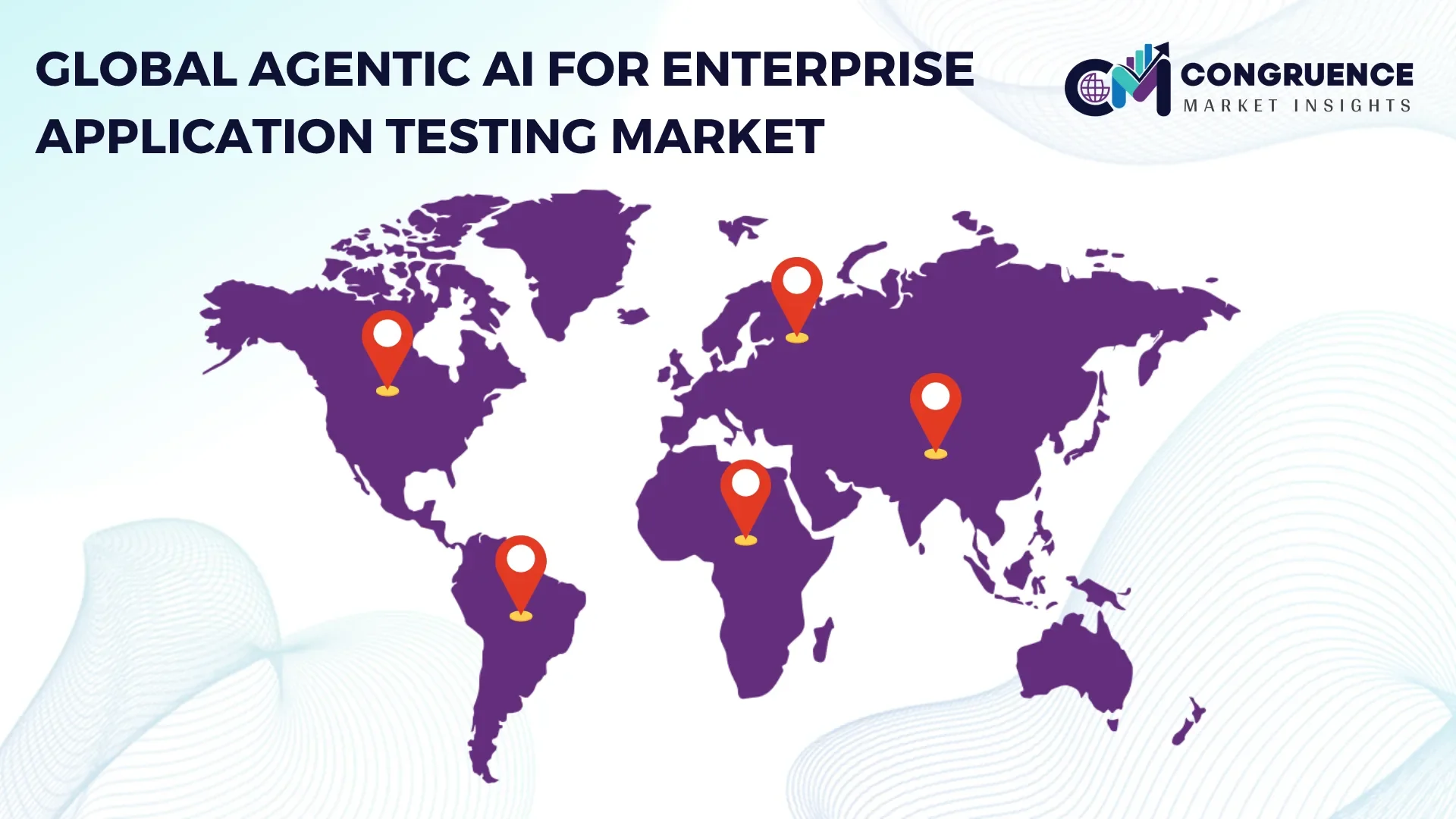
North America’s leadership is supported by high enterprise AI penetration, with over 72% of large organizations integrating autonomous testing tools into DevOps pipelines. Europe followed with nearly 27% share, driven by regulatory-compliant and explainable AI testing demand. Asia-Pacific captured around 22%, reflecting rapid digital platform expansion, while South America and Middle East & Africa jointly accounted for approximately 10%, supported by emerging enterprise digitization initiatives. Increasing cloud workload migration—exceeding 65% globally—and enterprise application modernization across regions continue to reshape regional demand patterns, with adoption intensity and maturity varying significantly by geography.
North America represents approximately 41% of the Agentic AI For Enterprise Application Testing Market, reflecting deep integration of autonomous QA solutions across large-scale enterprise environments. Key demand originates from BFSI, healthcare IT, SaaS, and cloud service providers, where over 58% of enterprises use AI-driven testing to support continuous delivery. Regulatory developments around data integrity and software validation have reinforced demand for traceable, policy-aware testing agents. Technological trends include widespread CI/CD adoption—exceeding 70% among large enterprises—and strong uptake of multi-agent orchestration platforms. A leading regional player has expanded agentic testing to validate more than 15,000 daily application builds, reducing defect leakage by 33%. Regional consumer behavior shows higher adoption in healthcare and finance, where reliability and compliance are critical.
Europe holds close to 27% market share, with Germany, the UK, and France serving as primary demand centers. Regulatory bodies emphasize explainable and auditable AI systems, driving adoption of transparent agentic testing platforms. Over 49% of European enterprises prioritize AI tools with built-in compliance reporting. Sustainability initiatives and digital sovereignty frameworks further influence platform selection. Emerging technologies such as explainable AI agents and rule-governed testing bots are increasingly deployed across financial services and public-sector IT. A regional testing software provider recently enabled autonomous validation for over 1,200 enterprise applications, improving audit readiness by 28%. Consumer behavior reflects strong regulatory pressure, increasing demand for explainable and controllable agentic AI systems.
Asia-Pacific ranks third by market volume with approximately 22% share, yet leads in growth momentum. China, India, and Japan collectively account for over 68% of regional consumption, driven by e-commerce, fintech, and telecom platform expansion. Infrastructure modernization and rapid cloud adoption—exceeding 60% among large enterprises—are accelerating demand for scalable testing agents. Regional innovation hubs are advancing multi-language and mobile-first agentic testing capabilities. A regional technology firm implemented agentic AI testing across 500+ mobile applications, reducing release cycle delays by 31%. Consumer behavior shows strong demand linked to e-commerce platforms and mobile AI-driven services.
South America accounts for nearly 6% of the global market, with Brazil and Argentina leading adoption. Demand is tied to enterprise IT modernization, media platforms, and financial digitization. Infrastructure upgrades and cloud migration initiatives support autonomous testing deployment. Government incentives for digital transformation have encouraged enterprise software upgrades, with over 37% of large organizations piloting AI-based QA tools. A regional software services firm has deployed agentic testing to support multilingual application validation across 12 countries, improving localization accuracy by 26%. Consumer behavior highlights demand driven by media platforms and language localization needs.
Middle East & Africa represents around 4% of global demand, with UAE and South Africa as primary growth countries. Regional demand is driven by oil & gas digitalization, smart city projects, and government IT modernization. Technological modernization initiatives emphasize automation, cybersecurity, and reliability testing. Local regulations promoting digital governance and cross-border trade partnerships encourage standardized testing frameworks. A UAE-based technology provider applied agentic AI testing to national digital platforms, reducing system downtime by 22%. Consumer behavior varies widely, with higher enterprise adoption in government and energy sectors.
United States – 36% Market Share: Strong enterprise AI investment, advanced CI/CD adoption, and large-scale application environments drive dominance.
China – 14% Market Share: High-volume digital platforms, rapid enterprise software deployment, and large AI engineering workforce support market leadership.
The Agentic AI For Enterprise Application Testing Market is characterized by moderate fragmentation, with a mix of established enterprise testing vendors and fast-growing AI-native specialists competing across global and regional markets. More than 45 active vendors operate globally, ranging from full-suite QA platform providers to niche agentic AI startups focused on autonomous test orchestration, self-healing scripts, and generative test creation. The top five companies collectively account for approximately 48–52% of total market activity, indicating competitive intensity alongside consolidation momentum.
Competition is shaped by rapid innovation cycles, with over 60% of leading vendors launching AI-augmented or agentic testing features between 2023 and 2025. Strategic initiatives include platform integrations with CI/CD tools, cloud service providers, and DevSecOps frameworks, as well as partnerships with enterprise SaaS vendors. Mergers and capability-driven acquisitions have increased, particularly around AI model orchestration and test intelligence layers. Product differentiation increasingly centers on autonomous decision-making depth, explainability, security compliance, and scalability across distributed enterprise environments. Vendors offering multi-agent coordination, natural language-driven test authoring, and adaptive regression testing are gaining stronger enterprise traction, especially among BFSI, healthcare IT, and large SaaS providers.
Sauce Labs
mabl
Functionize
SmartBear
Keysight Technologies (Eggplant)
AccelQ
Katalon
Parasoft
PractiTest
Infostretch
QualityLogic
Technological evolution in the Agentic AI For Enterprise Application Testing Market is centered on autonomy, intelligence, and orchestration. Modern platforms increasingly deploy multi-agent architectures, where specialized agents handle test generation, execution, failure diagnosis, and optimization concurrently. Over 55% of enterprise deployments now use AI-driven self-healing mechanisms that automatically adapt test scripts when UI elements or APIs change, reducing manual maintenance by more than 30%.
Generative AI is transforming test design through natural language processing, enabling test cases to be authored directly from business requirements, user stories, or production logs. Reinforcement learning models are being applied to optimize test prioritization, allowing systems to focus on high-risk application areas based on historical defect patterns. Additionally, explainable AI layers are gaining importance, particularly in regulated industries, ensuring that autonomous testing decisions remain auditable and compliant.
Integration with DevSecOps platforms has become standard, with agentic testing tools embedded into pipelines that support continuous validation across cloud, containerized, and hybrid environments. Security-focused agents capable of autonomously executing vulnerability regression tests are increasingly deployed, with over 40% of enterprises using AI-driven security testing alongside functional QA. Edge testing, API virtualization, and environment simulation technologies further enhance agentic testing’s role in large-scale enterprise software delivery.
In June 2025, BrowserStack officially launched BrowserStack AI, a suite of purpose-built AI agents integrated throughout the software testing lifecycle. This agent suite accelerates test planning, authoring, maintenance, accessibility checks, and visual reviews, enabling up to 90% faster test creation with 91% accuracy and 92% coverage compared to traditional methods. This initiative aims to boost release velocity and test effectiveness for QA teams globally. Source: www.browserstack.com
In November 2025, Sauce Labs introduced Sauce AI for Insights, a new AI-driven analytics capability designed to transform complex test execution data into actionable quality intelligence. Engineering teams using the tool reported debugging time reductions and near-instant root-cause identification, dramatically improving test pipeline visibility for developers, QA leads, and executives alike. Source: www.saucelabs.com
In June 2025, Tricentis unveiled major agentic AI innovations, including remote Model Context Protocol (MCP) servers and Tricentis Agentic Test Automation. These features allow AI agents to generate complete test cases from natural language prompts and integrate securely with enterprise testing stacks, delivering significant productivity gains and helping customers accelerate quality engineering workflows. The solutions were slated for general availability in mid-2025. Source: www.tricentis.com
In June 2025, mabl rolled out advanced agentic AI capabilities at multiple AI & Software Quality Summit events, including autonomous test creation agents, automated root-cause failure analysis, and visual assist features. Early adopters highlighted how semantically indexed test assets and visual agent frameworks improved stability and reduced test maintenance overhead. Adoption of mabl’s AI features saw significant growth, reinforcing their impact on enterprise QA workflows. Source: www.mabl.com
The Agentic AI For Enterprise Application Testing Market Report provides a comprehensive evaluation of autonomous AI-driven testing solutions deployed across enterprise software environments. The scope covers multiple technology types, including learning-based agents, multi-agent orchestration systems, hybrid rule-based AI testing platforms, and generative AI-powered test design tools. Application coverage spans regression testing, continuous integration testing, security and compliance validation, performance testing, and end-to-end functional testing across cloud-native, on-premise, and hybrid architectures.
Geographically, the report analyzes market activity across North America, Europe, Asia-Pacific, South America, and Middle East & Africa, incorporating regional adoption patterns, enterprise maturity levels, and technology penetration indicators. End-user analysis includes large enterprises, mid-sized organizations, IT service providers, and sector-specific users across BFSI, healthcare IT, retail, telecom, government, and SaaS industries. The report also evaluates emerging niches such as AI-driven DevSecOps testing, low-code/no-code agentic QA platforms, and autonomous testing for microservices and API ecosystems.
Additionally, the scope encompasses competitive benchmarking, innovation trends, deployment models, and operational use cases, offering decision-makers a structured understanding of how agentic AI is reshaping enterprise application testing strategies globally.
| Report Attribute / Metric | Details |
|---|---|
| Market Revenue (2025) | USD 8,561.0 Million |
| Market Revenue (2033) | USD 100,192.6 Million |
| CAGR (2026–2033) | 36.0% |
| Base Year | 2025 |
| Forecast Period | 2026–2033 |
| Historic Period | 2021–2025 |
| Segments Covered |
By Type
By Application
By End-User Insights
|
| Key Report Deliverables | Revenue Forecast, Market Trends, Growth Drivers & Restraints, Technology Insights, Segmentation Analysis, Regional Insights, Competitive Landscape, Regulatory & ESG Overview, Recent Developments |
| Regions Covered | North America, Europe, Asia-Pacific, South America, Middle East & Africa |
| Key Players Analyzed | BrowserStack; LambdaTest; Tricentis; Sauce Labs; mabl; Functionize; SmartBear; Keysight Technologies (Eggplant); AccelQ; Katalon; Parasoft; PractiTest; Infostretch; QualityLogic |
| Customization & Pricing | Available on Request (10% Customization Free) |




