
Reports
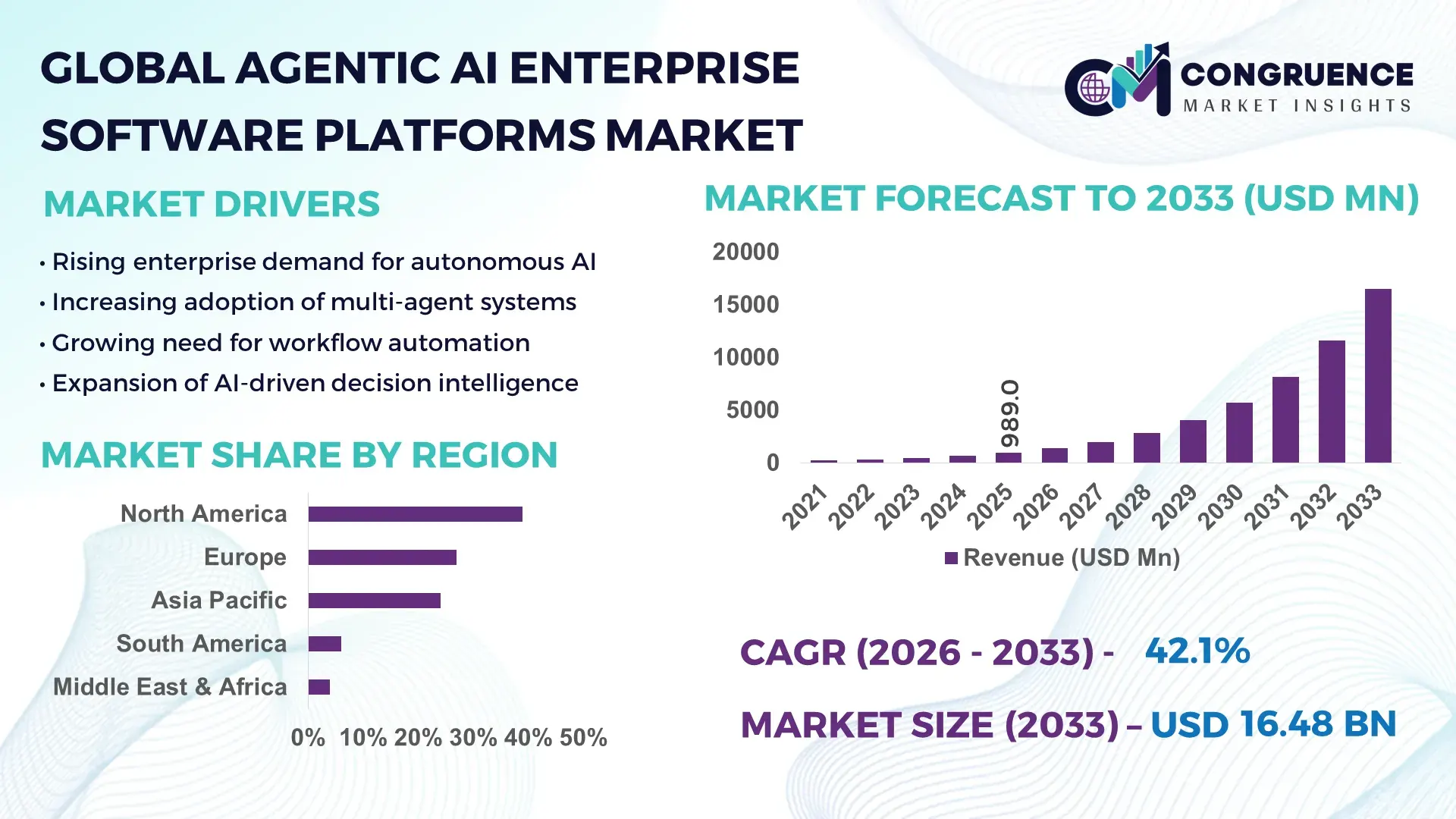
The Global Agentic AI Enterprise Software Platforms Market was valued at USD 989.0 Million in 2025 and is anticipated to reach a value of USD 16,478.8 Million by 2033 expanding at a CAGR of 42.14% between 2026 and 2033, according to an analysis by Congruence Market Insights. This growth is primarily driven by increasing enterprise demand for autonomous decision-making systems and intelligent workflow automation.
The United States leads the Agentic AI Enterprise Software Platforms Market with strong enterprise-scale deployment capabilities and high R&D investment intensity. Over 62% of Fortune 500 companies have integrated AI-driven automation platforms into at least one business function, with 38% deploying agentic AI for multi-step decision-making tasks. The country accounts for more than 45% of global AI infrastructure investments, exceeding USD 120 billion annually across cloud and enterprise AI solutions. Key applications include finance (algorithmic trading systems handling over 70% of equity trades), healthcare (AI-driven diagnostics used in over 35% of hospitals), and supply chain automation. Additionally, over 55% of U.S.-based enterprises are piloting autonomous AI agents for IT operations, customer service, and process optimization, reflecting a mature ecosystem supported by advanced semiconductor capacity and AI model deployment frameworks.
Market Size & Growth: Valued at USD 989.0 Million in 2025, projected to reach USD 16,478.8 Million by 2033 at 42.14% CAGR, driven by enterprise automation demand.
Top Growth Drivers: 68% enterprise AI adoption increase, 45% workflow efficiency improvement, 52% cost optimization in operations.
Short-Term Forecast: By 2028, enterprises expected to achieve 35% reduction in manual process time through agentic AI integration.
Emerging Technologies: Multi-agent orchestration systems, LLM-powered autonomous agents, AI-driven decision intelligence platforms.
Regional Leaders: North America USD 7.2B by 2033 with enterprise SaaS dominance; Asia-Pacific USD 4.8B with mobile-first AI adoption; Europe USD 3.9B with regulatory-driven AI deployment.
Consumer/End-User Trends: BFSI and healthcare sectors account for over 48% usage, with increasing adoption in IT operations and customer experience.
Pilot or Case Example: In 2025, a global bank implemented agentic AI reducing fraud detection response time by 42%.
Competitive Landscape: Market leader holds ~18% share; key players include Microsoft, Google, IBM, Salesforce, Oracle.
Regulatory & ESG Impact: Over 60% enterprises aligning with AI governance frameworks and ethical AI compliance mandates.
Investment & Funding Patterns: Over USD 25 billion invested globally in AI enterprise platforms between 2023–2025.
Innovation & Future Outlook: Integration of generative AI with enterprise systems enabling fully autonomous business processes.
Enterprise demand spans BFSI (32%), healthcare (16%), and IT services (21%), driven by automation and decision intelligence adoption. Over 58% of enterprises prioritize AI-driven workflow orchestration platforms. Regulatory compliance frameworks and data governance mandates influence deployment. Emerging trends include multi-agent ecosystems and domain-specific AI copilots, with increased adoption across Asia-Pacific and Europe shaping future enterprise AI strategies.
The Agentic AI Enterprise Software Platforms Market is strategically positioned as a transformative layer in enterprise digital ecosystems, enabling autonomous decision-making, real-time process optimization, and intelligent orchestration across industries. Enterprises are increasingly shifting from rule-based automation to agentic AI systems capable of executing complex multi-step workflows independently. For instance, multi-agent systems deliver 40% improvement in operational efficiency compared to traditional robotic process automation (RPA), significantly enhancing productivity across finance, IT, and customer service operations.
North America dominates in volume, while Asia-Pacific leads in adoption with over 54% enterprises actively deploying AI-driven enterprise tools, particularly in China and India where digital transformation initiatives are accelerating. By 2028, autonomous AI agents are expected to reduce enterprise operational costs by 30% through predictive analytics, automated decision-making, and adaptive workflows. Organizations are integrating AI platforms with ERP, CRM, and supply chain systems to create unified intelligent ecosystems.
From an ESG and compliance perspective, firms are committing to AI governance frameworks targeting 25% improvement in transparency and explainability metrics by 2030. This is particularly critical in regulated industries such as banking and healthcare, where algorithm accountability is essential. In 2025, a U.S.-based enterprise achieved a 37% reduction in IT incident resolution time through deployment of agentic AI in IT service management systems, demonstrating measurable operational impact.
Looking ahead, the Agentic AI Enterprise Software Platforms Market is expected to evolve into a foundational pillar supporting resilient, compliant, and sustainable enterprise operations, enabling organizations to adapt dynamically to changing business environments while optimizing efficiency and innovation outcomes.
The Agentic AI Enterprise Software Platforms Market is experiencing rapid transformation driven by increasing enterprise digitalization, growing reliance on automation, and advancements in artificial intelligence technologies. Enterprises are moving toward autonomous systems capable of decision-making without human intervention, particularly in sectors such as finance, healthcare, manufacturing, and IT services. Over 60% of large enterprises are now investing in AI-driven platforms to enhance operational efficiency and reduce dependency on manual processes. Additionally, the convergence of cloud computing, big data analytics, and machine learning is accelerating the adoption of agentic AI solutions. The market is also influenced by regulatory frameworks around AI ethics, data privacy, and algorithm transparency, which are shaping deployment strategies. With increasing investments in AI infrastructure and talent, the market is poised for continuous innovation and expansion across both developed and emerging economies.
The growing need for autonomous decision-making systems is significantly driving the adoption of agentic AI enterprise platforms. Enterprises are increasingly dealing with complex datasets and real-time decision requirements, where traditional automation tools fall short. Over 65% of organizations report improved operational efficiency after deploying AI-based decision systems, while 48% indicate enhanced predictive capabilities in business processes. In sectors such as BFSI, more than 70% of transactions are now monitored using AI-based systems, reducing fraud risks and improving response times. Additionally, IT service management platforms powered by agentic AI have reduced incident resolution times by up to 40%, demonstrating tangible productivity gains. The ability of these platforms to continuously learn and adapt makes them highly valuable for dynamic business environments, further accelerating their adoption across enterprises.
Data privacy concerns and regulatory complexities present significant barriers to the widespread adoption of agentic AI platforms. With over 70% of enterprises handling sensitive customer data, compliance with data protection regulations such as GDPR and similar frameworks has become a critical challenge. Approximately 52% of organizations cite data governance issues as a primary concern when deploying AI solutions. The need for transparent and explainable AI models adds another layer of complexity, especially in regulated sectors like healthcare and finance. Additionally, cross-border data transfer restrictions impact multinational enterprises, limiting seamless deployment of AI platforms. These challenges increase implementation costs and extend deployment timelines, slowing market penetration despite strong demand for advanced AI solutions.
Integration with enterprise ecosystems such as ERP, CRM, and supply chain platforms presents significant growth opportunities for agentic AI solutions. Over 58% of enterprises are actively seeking integrated AI solutions that can seamlessly connect with existing systems, enabling unified data flows and enhanced decision-making capabilities. The rise of cloud-native architectures and API-driven platforms is facilitating easier integration, reducing deployment complexity. In manufacturing, AI-integrated supply chains have improved forecasting accuracy by 35%, while in retail, AI-driven personalization has increased customer engagement by 28%. The ability to embed agentic AI into existing workflows enables organizations to maximize ROI on digital transformation investments. This creates substantial opportunities for vendors to develop scalable, interoperable solutions tailored to specific industry needs.
High implementation costs and the shortage of skilled AI professionals pose significant challenges to the adoption of agentic AI platforms. Approximately 60% of enterprises report difficulty in finding qualified AI talent capable of managing complex AI systems. The cost of deploying enterprise-grade AI platforms, including infrastructure, integration, and training, can be prohibitive for small and medium-sized enterprises. Additionally, the need for continuous model training and updates increases operational expenses. Organizations also face challenges in aligning AI initiatives with business objectives, leading to underutilization of deployed systems. These factors collectively hinder the pace of adoption, particularly in developing regions where access to advanced technology and skilled workforce is limited.
Surge in Autonomous Multi-Agent Systems: Over 48% of enterprises are deploying multi-agent AI systems to automate complex workflows, improving task completion rates by 37% and reducing human intervention by 42% across IT and operations environments.
Expansion of AI-Powered Enterprise Copilots: Around 55% of enterprises are integrating AI copilots into CRM and ERP systems, leading to a 33% improvement in decision accuracy and a 29% reduction in response time for customer queries.
Increased Adoption in IT Operations (AIOps): Nearly 62% of large enterprises utilize agentic AI in IT operations, achieving 40% faster incident resolution and reducing downtime by 28% through predictive analytics.
Growth of Industry-Specific AI Platforms: Approximately 46% of vendors are developing domain-specific agentic AI platforms, with healthcare and BFSI sectors reporting 35% higher efficiency gains compared to generic AI solutions.
The Agentic AI Enterprise Software Platforms Market is segmented based on type, application, and end-user, reflecting diverse enterprise needs and adoption patterns. Different types of AI platforms cater to varying levels of autonomy and complexity, while applications span across business functions such as customer service, operations, and analytics. End-users range from large enterprises to SMEs across industries including BFSI, healthcare, retail, and IT services. Adoption trends indicate that enterprises are prioritizing scalable, interoperable solutions capable of integrating with existing systems. Increasing demand for automation, decision intelligence, and real-time analytics is shaping segmentation dynamics, with certain segments demonstrating higher adoption due to their ability to deliver measurable efficiency improvements and operational cost reductions.
The market includes multi-agent orchestration platforms, single-agent systems, domain-specific AI platforms, and hybrid AI frameworks. Multi-agent orchestration platforms lead the segment, accounting for approximately 44% of adoption due to their ability to manage complex workflows involving multiple autonomous agents. These systems enable enterprises to coordinate tasks across departments, improving operational efficiency by over 35%. Single-agent systems hold around 26% share, primarily used for specific automation tasks such as chatbots and process automation. However, hybrid AI frameworks are the fastest-growing segment, expected to expand at a CAGR of 46%, driven by their flexibility in combining rule-based and learning-based approaches. Domain-specific AI platforms contribute the remaining 30%, offering tailored solutions for industries such as healthcare and finance.
Key applications include customer experience management, IT operations, finance automation, supply chain management, and healthcare analytics. Customer experience management leads with approximately 31% share due to widespread adoption of AI-driven chatbots and virtual assistants. IT operations follow with 24%, leveraging agentic AI for incident management and predictive maintenance. Finance automation is the fastest-growing application, projected to expand at a CAGR of 44%, driven by increasing use of AI in fraud detection and risk management. Other applications such as supply chain and healthcare analytics collectively account for 45% of the market. In 2025, over 42% of enterprises globally reported piloting agentic AI systems for customer experience platforms, while 60% of digital-native companies integrated AI into their operational workflows.
Large enterprises dominate the market with approximately 63% share due to higher investment capacity and advanced digital infrastructure. SMEs account for around 37%, increasingly adopting cloud-based AI platforms to enhance operational efficiency. The fastest-growing segment is SMEs, expected to expand at a CAGR of 45%, driven by affordable SaaS-based AI solutions. Key industries include BFSI (32%), IT services (21%), healthcare (16%), and retail (14%), with the remaining 17% distributed across manufacturing and logistics. In 2025, more than 38% of enterprises globally reported piloting agentic AI systems for workflow automation, while over 58% of digital enterprises prioritized AI integration for decision intelligence.
North America accounted for the largest market share at 39% in 2025 however, Asia-Pacific is expected to register the fastest growth, expanding at a CAGR of 45% between 2026 and 2033.
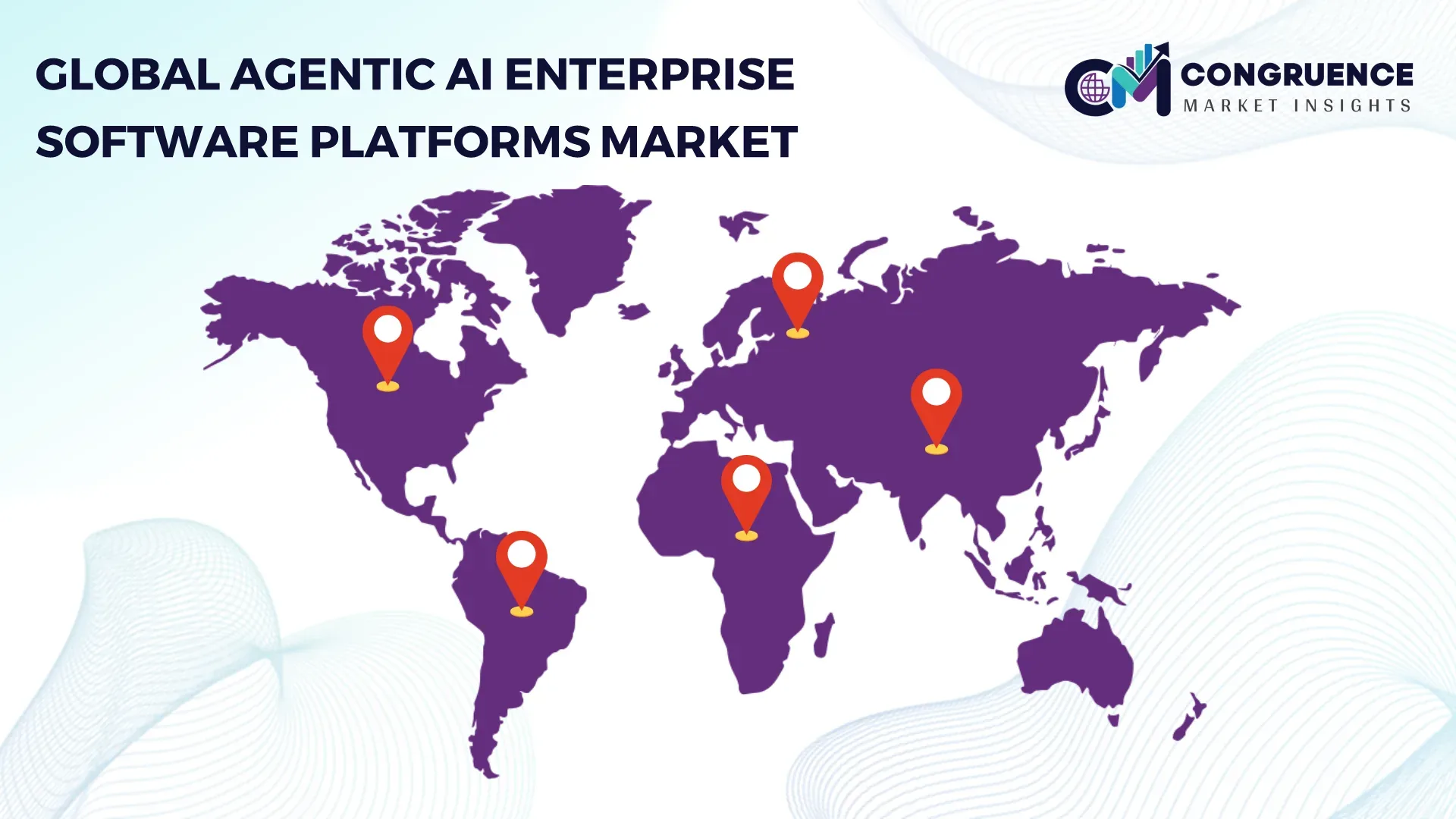
North America leads due to high enterprise AI adoption, with over 60% of organizations deploying AI platforms. Europe holds around 27% share, driven by regulatory frameworks and digital transformation initiatives. Asia-Pacific accounts for 24%, with rapid adoption in China, India, and Japan supported by expanding IT infrastructure and cloud adoption. South America and Middle East & Africa collectively contribute 10%, with increasing investments in digital transformation. Over 55% of global AI investments are concentrated in North America, while Asia-Pacific shows the highest enterprise adoption growth rates exceeding 50% in emerging economies.
North America holds approximately 39% of the global market share, driven by strong adoption in BFSI, healthcare, and IT sectors. Over 62% of enterprises in the region have implemented AI-based enterprise platforms. Government initiatives supporting AI innovation and regulatory frameworks around data privacy are shaping market dynamics. The region is witnessing rapid adoption of AI-driven digital transformation strategies, particularly in enterprise SaaS platforms. A leading technology company has deployed agentic AI to optimize cloud operations, reducing system downtime by 35%. Consumer behavior reflects high adoption in healthcare and finance, with enterprises prioritizing automation and decision intelligence.
Europe accounts for approximately 27% of the market, with key countries including Germany, the UK, and France driving adoption. Regulatory frameworks such as AI governance policies are influencing enterprise deployment strategies. Around 48% of enterprises in Europe are adopting AI platforms to comply with regulatory requirements. The region emphasizes explainable AI and ethical deployment, leading to increased demand for transparent AI systems. A European firm implemented agentic AI in supply chain management, improving efficiency by 29%. Consumer behavior indicates strong demand for compliant and secure AI solutions.
Asia-Pacific represents around 24% of the market and is the fastest-growing region in terms of adoption. China, India, and Japan are key contributors, with over 50% of enterprises investing in AI technologies. The region benefits from rapid digital infrastructure development and increasing cloud adoption. Innovation hubs in China and India are driving advancements in AI technologies. A regional company deployed AI platforms to enhance e-commerce operations, increasing customer engagement by 31%. Consumer behavior highlights strong adoption driven by mobile-first strategies and digital transformation initiatives.
South America accounts for approximately 6% of the market, with Brazil and Argentina leading adoption. Increasing investments in digital infrastructure and government incentives are supporting market growth. Enterprises are adopting AI platforms to improve operational efficiency in sectors such as retail and finance. A regional company implemented AI-driven analytics, improving customer targeting accuracy by 26%. Consumer behavior shows growing demand for localized AI solutions, particularly in media and language processing applications.
The Middle East & Africa region holds around 4% of the market, with UAE and South Africa leading adoption. Demand is driven by sectors such as oil & gas, construction, and finance. Governments are investing in AI strategies to modernize infrastructure and diversify economies. A regional firm deployed AI platforms for predictive maintenance, reducing operational downtime by 30%. Consumer behavior reflects increasing adoption of AI-driven solutions for operational efficiency and digital transformation.
United States – 35% Market share: Driven by high enterprise AI adoption and strong investment in AI infrastructure
China – 18% Market share: Supported by rapid digital transformation and large-scale enterprise deployments
The Agentic AI Enterprise Software Platforms Market is moderately consolidated, with the top five companies accounting for approximately 52% of the global market share. The market consists of over 120 active competitors, ranging from large technology firms to emerging AI startups. Leading players are focusing on strategic partnerships, product innovation, and acquisitions to strengthen their market position. Over 40% of companies are investing in multi-agent orchestration technologies, reflecting the shift toward autonomous AI systems. Major players are also expanding their cloud-based AI offerings to enhance scalability and accessibility. Innovation trends include integration of generative AI with enterprise platforms and development of domain-specific AI solutions. Competitive dynamics are further influenced by increasing demand for AI governance and compliance solutions, prompting companies to invest in explainable AI technologies.
IBM
Salesforce
Oracle
SAP
Amazon Web Services
NVIDIA
Palantir Technologies
ServiceNow
C3.ai
UiPath
DataRobot
H2O.ai
The Agentic AI Enterprise Software Platforms Market is driven by rapid advancements in artificial intelligence technologies, particularly in large language models, multi-agent systems, and decision intelligence frameworks. Over 65% of enterprises are integrating LLM-based systems into their operations, enabling advanced natural language processing and automated decision-making. Multi-agent orchestration platforms are gaining traction, with 48% of organizations deploying systems capable of coordinating multiple AI agents for complex workflows.
Cloud computing plays a critical role, with over 70% of deployments occurring on cloud-based platforms, ensuring scalability and flexibility. Edge AI is also emerging as a key trend, with 32% of enterprises adopting edge-based AI solutions for real-time processing. Integration with enterprise systems such as ERP and CRM platforms is increasing, with 58% of organizations prioritizing interoperability.
Another significant trend is the adoption of explainable AI, with 60% of enterprises focusing on transparency and accountability in AI decision-making. Advances in AI model training and optimization are improving performance, reducing processing time by up to 35%. Additionally, the use of AI-driven automation tools is enhancing productivity across industries, enabling enterprises to achieve higher efficiency and cost savings. These technological advancements are shaping the future of the market, driving innovation and adoption across various sectors.
• In May 2025, Microsoft introduced major agentic AI advancements at its Build conference, expanding AI agents across Azure, Windows, GitHub, and Microsoft 365. The update enabled autonomous coding agents capable of generating pull requests and handling development tasks independently, improving software development workflows significantly. Source: www.microsoft.com
• In November 2025, Microsoft announced new multi-agent capabilities within Microsoft 365 Copilot at Ignite, including “Agent Mode” and dedicated AI agents for Word, Excel, and PowerPoint. These agents enable multi-step task execution, document generation, and workflow automation, with over 90% of Fortune 500 already using Copilot.
• In February 2024, Salesforce launched Einstein Copilot, an enterprise-grade generative AI assistant integrated into its CRM platform. The system enables task automation, content generation, and real-time decision support using enterprise data while maintaining strict data governance and security controls.
• In 2025, Google expanded its agentic AI ecosystem through Gemini-based models and enterprise development platforms, including AI-agent-powered environments enabling autonomous task execution and reasoning-based workflows. These systems support advanced enterprise automation and developer productivity through integrated AI agents.
The Agentic AI Enterprise Software Platforms Market Report provides a comprehensive analysis of the global market, covering key segments including type, application, end-user, and region. The report examines various platform types such as multi-agent systems, single-agent platforms, and hybrid AI frameworks, highlighting their adoption patterns and industry relevance. Applications analyzed include customer experience management, IT operations, finance automation, supply chain optimization, and healthcare analytics, reflecting the diverse use cases of agentic AI solutions.
The report also offers detailed insights into end-user industries such as BFSI, healthcare, IT services, retail, and manufacturing, providing a clear understanding of adoption trends and industry-specific requirements. Geographic coverage includes North America, Europe, Asia-Pacific, South America, and the Middle East & Africa, with analysis of regional trends, adoption rates, and technological advancements.
Additionally, the report explores emerging technologies such as multi-agent orchestration, large language models, and edge AI, which are shaping the future of the market. It highlights investment trends, regulatory frameworks, and innovation patterns influencing market dynamics. The scope further includes analysis of competitive landscape, key players, and strategic initiatives, providing valuable insights for decision-makers. The report is designed to support business strategies, investment decisions, and market entry planning by offering a holistic view of the evolving agentic AI enterprise software ecosystem.
| Report Attribute / Metric | Details |
|---|---|
| Market Revenue (2025) | USD 989.0 Million |
| Market Revenue (2033) | USD 16,478.8 Million |
| CAGR (2026–2033) | 42.14% |
| Base Year | 2025 |
| Forecast Period | 2026–2033 |
| Historic Period | 2021–2025 |
| Segments Covered |
By Type
By Application
By End-User Insights
|
| Key Report Deliverables | Revenue Forecast; Market Trends; Growth Drivers & Restraints; Technology Insights; Segmentation Analysis; Regional Insights; Competitive Landscape; Regulatory & ESG Overview; Recent Developments |
| Regions Covered | North America; Europe; Asia-Pacific; South America; Middle East & Africa |
| Key Players Analyzed | Microsoft; Google; IBM; Salesforce; Oracle; SAP; Amazon Web Services; NVIDIA; Palantir Technologies; ServiceNow; C3.ai; UiPath; DataRobot; H2O.ai |
| Customization & Pricing | Available on Request (10% Customization Free) |




