
Reports
The Global Agent Performance Optimization (APO) Market was valued at USD 2,457.6 Million in 2025 and is anticipated to reach a value of USD 8,396.5 Million by 2033 expanding at a CAGR of 16.6% between 2026 and 2033. Growth is driven by enterprise-wide AI integration, omnichannel customer engagement, workforce analytics, and real-time agent coaching across contact center operations.
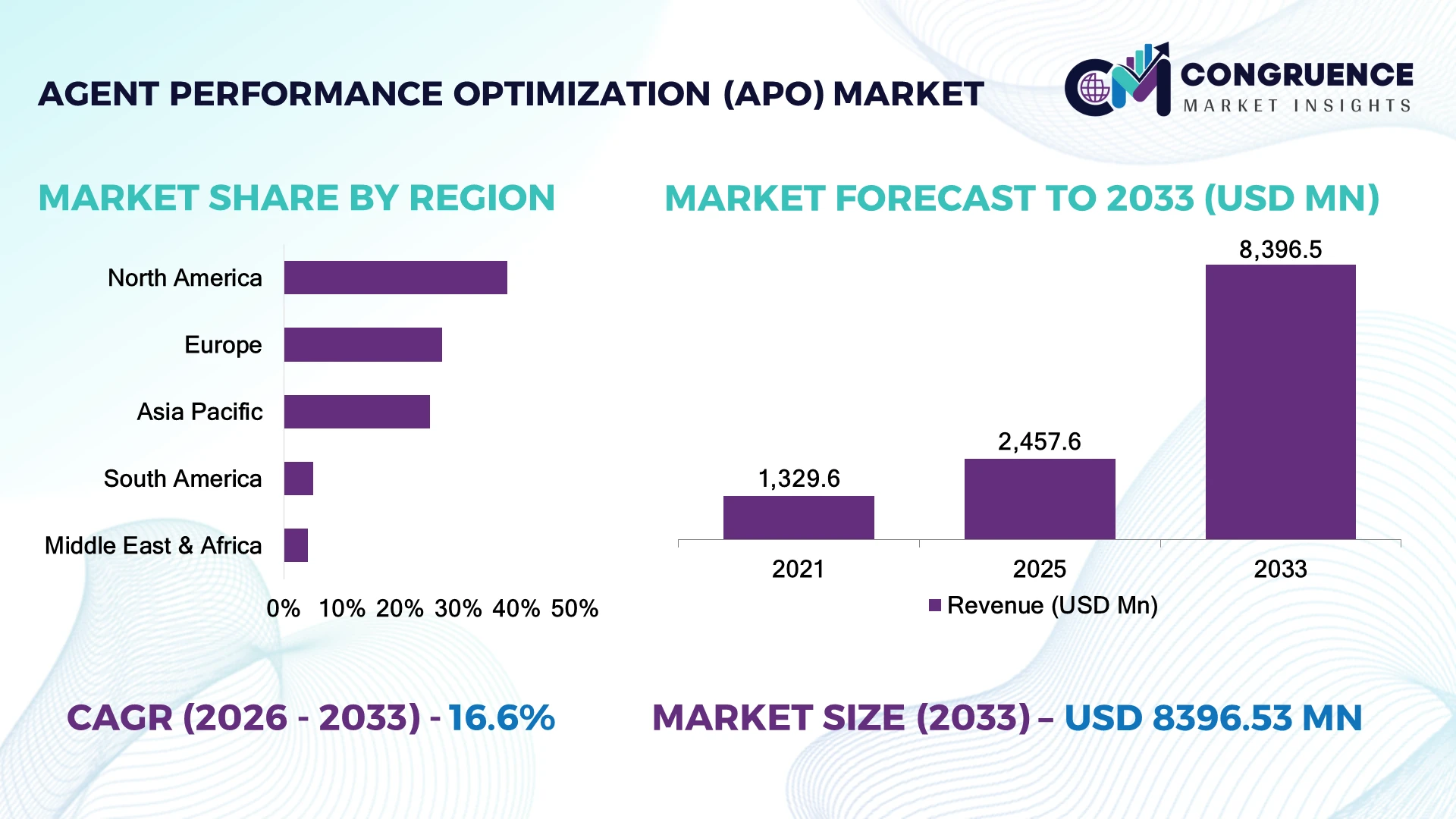
The United States leads the global Agent Performance Optimization (APO) market with approximately 41% market share, supported by large-scale cloud contact center deployments across banking, healthcare, telecommunications, and retail enterprises. Compared with India, which continues expanding outsourced customer service operations, the United States demonstrates higher adoption of AI-driven workforce optimization platforms, with nearly 68% of enterprise contact centers deploying real-time agent guidance solutions. Ongoing data governance initiatives and AI policy discussions following rapid generative AI adoption are accelerating enterprise investment in intelligent performance management platforms.
Organizations investing in AI-powered performance optimization, predictive analytics, and integrated workforce intelligence platforms are securing measurable operational advantages in customer experience and workforce productivity.
Market Size & Growth: USD 2,457.6 million (2025) to USD 8,396.5 million (2033) at 16.6% CAGR, driven by AI-enabled customer experience transformation.
Top Growth Drivers: AI adoption (+38%), cloud migration (+34%), omnichannel engagement (+29%).
Short-Term Forecast: By 2028, average handling time declines 18% while first-contact resolution improves 21%.
Emerging Technologies: Generative AI, conversational analytics, predictive workforce optimization, and intelligent automation accelerate deployment.
Regional Leaders: North America (~USD 3.2 billion), Europe (~USD 1.9 billion), Asia-Pacific (~USD 2.4 billion), supported by cloud contact center expansion.
Consumer/End-User Trends: More than 64% of enterprises prioritize AI-assisted agent coaching and performance analytics.
Pilot/Case Example: A 2026 enterprise deployment improved agent productivity by 24% through real-time guidance.
Competitive Landscape: Top providers hold approximately 48% market share, led by NICE, Verint, Genesys, Five9, and Calabrio.
Regulatory & ESG Impact: AI governance initiatives improve compliance monitoring efficiency by approximately 19%.
Investment & Funding: More than USD 5.8 billion supports AI customer experience platforms and workforce intelligence expansion.
Innovation & Future Outlook: Autonomous coaching and predictive performance optimization redefine enterprise contact center operations.
Agent Performance Optimization solutions are becoming integral to digital customer engagement by combining AI coaching, speech analytics, workforce management, and quality monitoring into unified platforms. Nearly 62% of enterprise contact centers now prioritize predictive performance insights to improve customer satisfaction and agent retention. Strengthening AI governance frameworks and expanding cloud infrastructure continue accelerating enterprise adoption, setting the stage for broader strategic transformation.
Agent Performance Optimization has become a strategic investment area as enterprises compete through superior customer experience, workforce efficiency, and data-driven operational intelligence. Organizations are replacing fragmented quality monitoring tools with unified AI-powered platforms capable of delivering continuous performance insights across voice, chat, email, and digital engagement channels. The rapid expansion of cloud-native customer experience ecosystems and evolving AI governance requirements are accelerating enterprise modernization strategies.
Modern AI-driven APO platforms improve agent productivity by approximately 26% while reducing manual quality evaluation effort by nearly 42% compared with conventional rule-based monitoring systems. North American enterprises lead adoption through advanced AI deployment and integrated cloud ecosystems, while India continues expanding intelligent workforce optimization across outsourced customer service operations. Over the next two to three years, more than 70% of large enterprise contact centers are expected to integrate predictive coaching, automated quality assurance, and conversational intelligence into daily operations.
Financial institutions, healthcare providers, and telecommunications companies are expanding investments through cloud migration, strategic technology partnerships, and enterprise-wide AI integration. Real-time coaching engines, behavioral analytics, and automated compliance monitoring are becoming standard operational capabilities across customer service environments. Organizations capable of combining workforce intelligence, responsible AI governance, and seamless omnichannel optimization will establish stronger competitive positioning, improve customer outcomes, and sustain long-term operational excellence.
Enterprise-wide deployment of AI-powered customer engagement platforms is becoming the primary driver for Agent Performance Optimization adoption. Nearly 69% of large organizations now integrate workforce analytics with quality management, while real-time coaching improves agent productivity by approximately 25% and first-contact resolution by nearly 18%. The rapid implementation of generative AI governance frameworks in the United States is encouraging enterprises to deploy compliant performance intelligence rather than standalone monitoring tools. This shift is increasing demand for unified APO platforms capable of delivering continuous analytics across omnichannel interactions. Technology providers are responding through AI model enhancements, cloud platform expansion, strategic partnerships, and embedded automation capabilities. Competitive differentiation increasingly depends on measurable workforce intelligence rather than conventional reporting functions.
Integrating APO platforms with legacy contact center infrastructure, CRM applications, and workforce management systems remains a significant structural limitation. Approximately 43% of enterprises continue operating hybrid communication environments, while integration projects increase implementation timelines by nearly 27% and deployment costs by approximately 18%. Financial institutions in Germany face additional compliance requirements that complicate AI deployment across customer interaction systems. These interoperability constraints reduce scalability and delay enterprise-wide optimization initiatives. Vendors are reducing deployment risks through open API architectures, cloud-native integration frameworks, standardized connectors, and strategic implementation partnerships. Organizations increasingly prioritize interoperability capabilities during platform selection to minimize operational disruption and accelerate digital transformation.
Autonomous AI assistants, predictive workforce optimization, and behavioral intelligence platforms are creating new value beyond traditional quality management. Predictive coaching reduces agent onboarding time by approximately 24%, while AI-generated performance recommendations improve customer satisfaction scores by nearly 19%. Japan is accelerating enterprise adoption of multilingual AI agents capable of supporting increasingly complex customer interactions across digital channels. Vendors are investing in conversational intelligence, digital employee assistants, and ecosystem partnerships to expand platform capabilities. A significant strategic opportunity lies in delivering personalized coaching recommendations based on real-time behavioral analytics, allowing enterprises to improve workforce performance without proportionally increasing supervisory resources.
Maintaining transparency, security, and governance across AI-powered performance evaluation systems represents a growing long-term execution challenge. Approximately 37% of enterprise decision-makers identify algorithm transparency as a key adoption concern, while AI governance requirements increase implementation effort by nearly 21%. The European Union's evolving AI regulatory framework is compelling technology providers to strengthen explainability, auditability, and human oversight capabilities within performance optimization platforms. Companies must invest in responsible AI architectures, secure cloud environments, continuous model validation, and cross-functional governance frameworks to sustain enterprise trust. Long-term market leadership will depend on balancing intelligent automation with transparent, compliant, and scalable workforce decision-making.
Real-Time AI Coaching Expands: Enterprises are replacing post-call evaluations with live AI guidance, improving agent adherence by approximately 23% and reducing average handling time by nearly 17%. Tight labor markets and increasing customer expectations are accelerating deployment. Vendors are embedding conversational intelligence directly into agent desktops and expanding cloud-native coaching capabilities.
Unified Experience Platforms Grow: Organizations are consolidating quality management, workforce optimization, and analytics into integrated platforms, reducing software administration effort by approximately 20% while increasing operational visibility by nearly 26%. Enterprise platform consolidation is reshaping procurement strategies. Technology providers are strengthening strategic alliances and expanding unified customer experience ecosystems.
Compliance Automation Accelerates: Automated compliance monitoring now evaluates more than 90% of customer interactions in leading deployments, reducing manual audit workloads by approximately 35%. Expanding AI governance requirements are driving demand for explainable decision models. Companies are enhancing policy engines, audit reporting, and real-time risk detection to strengthen regulatory readiness.
Behavioral Analytics Mature: Enterprises increasingly analyze customer sentiment, agent behavior, and conversation dynamics simultaneously, improving coaching precision by approximately 22% and reducing repeat customer contacts by nearly 16%. The non-obvious shift is moving performance measurement from scorecards to predictive behavioral intelligence. Vendors are scaling machine learning models and industry-specific optimization frameworks to deliver measurable operational improvements.
Cloud-based Agent Performance Optimization solutions account for approximately 66% of the global market due to rapid deployment, seamless scalability, lower infrastructure costs, and continuous AI feature updates. Enterprises increasingly prefer cloud-native platforms because they integrate easily with CCaaS, CRM, and workforce engagement applications while supporting distributed workforces. On-premises deployments remain relevant for government agencies, financial institutions, and highly regulated industries requiring greater control over sensitive customer data and internal compliance frameworks.
Cloud-based APO is also the fastest-growing segment as organizations accelerate digital workplace transformation and AI-driven customer engagement strategies. Cloud deployments improve implementation speed by approximately 35%, reduce infrastructure management costs by nearly 28%, and shorten software update cycles by around 40% compared with traditional environments. Vendors are expanding SaaS portfolios, strengthening hyperscaler partnerships, and embedding generative AI capabilities into cloud platforms. Investment priorities continue shifting toward unified cloud ecosystems that combine workforce optimization, conversational intelligence, and performance analytics within a single enterprise platform.
According to a 2026 enterprise technology survey by IDC, more than 72% of large organizations planning contact center modernization selected cloud-native workforce optimization and performance management platforms as their preferred deployment model.
Performance Management represents the largest application segment with approximately 38% market share as enterprises prioritize continuous agent evaluation, productivity benchmarking, and customer experience improvement. Organizations increasingly deploy AI-assisted performance scoring, automated coaching, and behavioral analytics to improve workforce efficiency across voice and digital channels. Workforce Management remains a mature operational function, while Quality Management continues evolving through automated interaction analysis and compliance monitoring.
Real-Time Agent Coaching is the fastest-growing application as generative AI enables contextual guidance during live customer interactions. AI-assisted coaching improves first-contact resolution by approximately 22% while reducing average handling time by nearly 18%. Automated Quality Management and Speech Analytics are also gaining momentum through enterprise-wide AI integration and omnichannel engagement strategies. Platform providers are expanding intelligent workflow automation, integrating predictive analytics, and strengthening cloud deployment capabilities. Demand is shifting toward unified applications capable of delivering performance intelligence, coaching, compliance, and workforce optimization from a single operational environment.
A 2025 global enterprise customer experience study conducted by Deloitte found that organizations expanding AI-enabled real-time coaching reported significantly higher workforce productivity and customer satisfaction than those relying on traditional post-interaction evaluations.
Large enterprises account for approximately 71% of global APO deployments because of extensive customer service operations, complex compliance requirements, and large-scale omnichannel engagement infrastructure. Banking, telecommunications, healthcare, retail, and business process outsourcing organizations continue investing heavily in AI-powered workforce optimization to improve operational consistency and customer experience. Small and medium-sized enterprises increasingly adopt subscription-based APO platforms as cloud delivery models reduce implementation complexity and upfront investment requirements.
Business Process Outsourcing (BPO) providers represent the fastest-growing end-user segment as global outsourcing firms expand multilingual customer support and AI-enabled service delivery. Advanced APO platforms improve agent productivity by approximately 24% while reducing quality monitoring effort by nearly 31%. Vendors are introducing industry-specific deployment packages, flexible subscription pricing, and strategic implementation partnerships to address evolving enterprise requirements. Competitive positioning increasingly depends on delivering scalable, AI-enabled workforce intelligence tailored to different operational environments and regulatory expectations.
According to a 2026 enterprise survey published by the International Customer Management Institute (ICMI), large contact center operators increasingly prioritize AI-powered performance optimization platforms to improve workforce productivity, quality assurance, and employee retention across omnichannel operations.
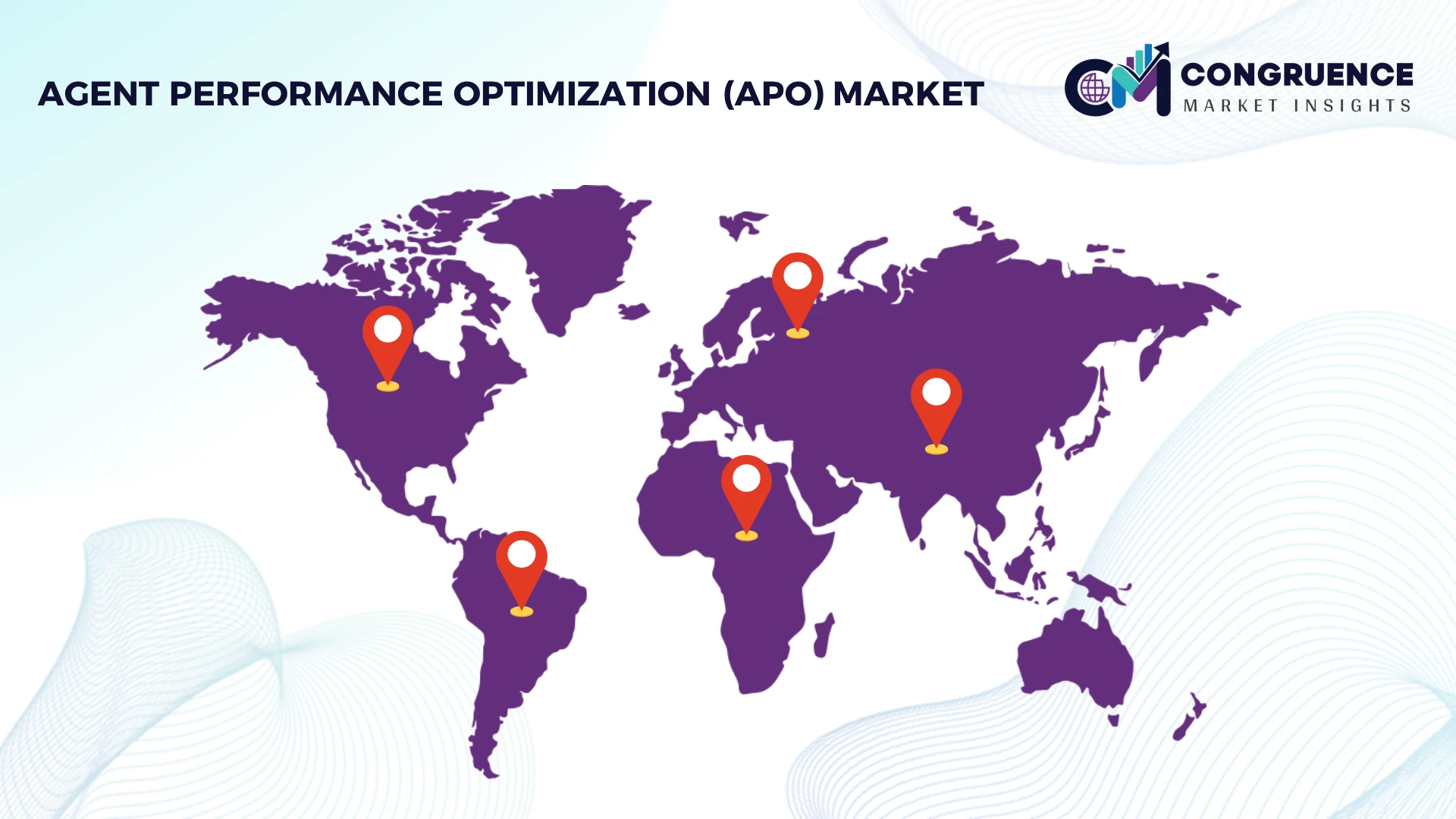
North America accounted for the largest market share at 38.4% in 2025 however, Asia-Pacific is expected to register the fastest growth, expanding at a CAGR of 18.2% between 2026 and 2033.
AI-Native Contact Centers Accelerate Enterprise Transformation
North America leads the Agent Performance Optimization market through widespread adoption of cloud contact centers, enterprise AI integration, and mature customer experience infrastructure. The region contributes approximately 38.4% of global demand, driven by financial services, healthcare, retail, and telecommunications organizations modernizing workforce operations. Nearly 71% of large enterprise contact centers now deploy AI-enabled performance optimization capabilities integrated with conversational intelligence and workforce management platforms. Increasing enterprise investment in responsible AI, automated quality assurance, and real-time coaching continues strengthening platform adoption. Technology vendors are expanding cloud infrastructure, enhancing AI governance capabilities, and forming strategic ecosystem partnerships to deliver unified customer experience solutions across large-scale enterprise environments.
United States Market Outlook: The United States remains the dominant national market due to its concentration of enterprise software providers, hyperscale cloud infrastructure, and large customer service organizations. More than 74% of Fortune 500 contact centers have initiated AI-powered workforce optimization programs, integrating real-time coaching, speech analytics, and predictive quality management into daily operations. Strong investment in generative AI, compliance technologies, and cloud-native customer engagement platforms continues reinforcing the country's leadership in enterprise APO deployment.
Responsible AI Governance Shapes Platform Adoption
Europe continues expanding APO deployment through enterprise digital transformation supported by strong regulatory oversight and customer data governance. Approximately 27% of regional enterprise contact centers have upgraded to AI-driven workforce optimization platforms over the past two years, with financial institutions and telecommunications providers leading modernization efforts. Organizations increasingly prioritize explainable AI, automated compliance monitoring, and multilingual conversational analytics. Technology vendors are strengthening localized cloud deployments, expanding compliance capabilities, and investing in enterprise-grade security architectures to support evolving regulatory requirements and cross-border customer engagement.
Germany Market Outlook: Germany leads the European APO market through its advanced enterprise software ecosystem, digital manufacturing sector, and highly regulated financial and industrial enterprises. AI-powered workforce optimization is increasingly deployed across customer support, insurance, and industrial service operations. More than 58% of large German enterprises now evaluate AI governance capabilities alongside operational performance when selecting enterprise customer experience platforms.
Digital Service Expansion Drives Large-Scale Deployment
Asia-Pacific is experiencing rapid APO adoption as enterprises modernize contact center operations and expand digital customer engagement across banking, e-commerce, telecommunications, and business process outsourcing. Large-scale cloud migration and AI deployment are reshaping workforce optimization strategies, while approximately 66% of newly established enterprise contact centers adopt cloud-native performance management platforms from implementation. Technology providers continue expanding regional cloud infrastructure, multilingual AI capabilities, and strategic implementation partnerships to support increasing enterprise demand for scalable customer experience solutions.
India Market Outlook: India represents the region's most strategically important market due to its global leadership in business process outsourcing and digital customer service operations. Large outsourcing providers continue integrating AI-assisted coaching, automated quality monitoring, and workforce analytics across multilingual service environments. More than 68% of newly modernized enterprise contact centers incorporate intelligent performance optimization capabilities to improve service consistency, employee productivity, and international client delivery standards.
Cloud Migration Strengthens Customer Operations
South America is steadily advancing APO adoption through cloud-based customer service modernization and expanding digital banking, telecommunications, and retail operations. Brazil, Chile, and Colombia continue investing in customer experience technologies to improve workforce productivity and operational efficiency. Approximately 44% of enterprise contact center modernization projects now include AI-enabled quality management and workforce optimization capabilities. While infrastructure maturity varies across the region, increasing cloud availability and strategic technology partnerships continue improving deployment scalability and reducing implementation complexity for enterprise organizations.
Brazil Market Outlook: Brazil leads the regional market through its large financial services sector, expanding digital commerce ecosystem, and growing enterprise cloud adoption. Banks, telecom operators, and retail enterprises increasingly implement AI-powered workforce optimization to improve customer engagement quality and operational consistency. Enterprise investment in multilingual conversational analytics and cloud contact center modernization continues strengthening APO deployment across the country's largest service organizations.
Digital Government Initiatives Expand Enterprise Adoption
The Middle East & Africa market is progressing through digital transformation programs, cloud infrastructure investment, and modernization of customer service operations across government, banking, telecommunications, and utilities. Organizations increasingly deploy AI-powered workforce optimization to improve service quality while supporting multilingual customer engagement. Approximately 39% of newly upgraded enterprise customer service platforms now integrate performance analytics and automated quality management capabilities. Global technology providers are expanding regional cloud partnerships and implementation networks to accelerate enterprise deployment and strengthen long-term digital transformation initiatives.
United Arab Emirates Market Outlook: The United Arab Emirates leads regional adoption through strong government-backed digital transformation, advanced cloud infrastructure, and widespread enterprise AI investment. Financial institutions, airlines, telecommunications providers, and public sector organizations increasingly deploy intelligent workforce optimization platforms to enhance customer experience and operational efficiency. More than half of large enterprise customer engagement projects now include AI-enabled performance optimization and automated compliance monitoring as core deployment requirements.
Global workforce engagement leaders NICE, Verint, Genesys, Five9, and Playvox compete with cloud-native customer experience platforms, while AI-first innovators challenge established workforce optimization vendors through automation and predictive intelligence. The top five providers collectively control approximately 49% of the global market. Competition is driven by AI accuracy, platform integration, deployment speed, and analytics depth rather than licensing price alone. AI-powered coaching improves supervisor productivity by approximately 27%, cloud deployment shortens implementation time by nearly 31%, and unified workforce platforms reduce administrative effort by around 22%. Market leaders are expanding AI portfolios, strengthening hyperscaler partnerships, acquiring specialist workforce intelligence capabilities, and embedding generative AI into customer engagement workflows. Competition is shifting from standalone workforce management toward autonomous performance optimization platforms. Enterprise integration complexity, regulatory compliance, and proprietary AI models remain key entry barriers. Sustainable leadership requires explainable AI, seamless enterprise integration, measurable productivity gains, and continuous innovation.
NICE Ltd.
Verint
Genesys
Five9
Playvox
CallMiner
Alvaria
Observe.AI
Cresta
Talkdesk
Cisco
Salesforce
Assembled
Generative AI, conversational intelligence, and real-time agent assistance are redefining Agent Performance Optimization across enterprise contact centers. AI-powered coaching improves agent productivity by approximately 26%, while automated interaction analysis reduces manual quality monitoring by nearly 41%. Around 68% of large cloud contact centers now deploy AI-assisted performance management integrated with workforce engagement, quality assurance, and omnichannel customer experience platforms, creating faster operational feedback loops and stronger service consistency.
Emerging technologies include agentic AI, predictive workforce optimization, emotion analytics, digital twins for workforce planning, and multilingual large language models. Compared with conventional scorecard-based quality management, AI-driven optimization improves coaching precision by approximately 34% while reducing supervisor workload by nearly 29%. Enterprise software leaders benefit by embedding AI across unified customer experience platforms, while cloud-native providers compete through faster innovation cycles, lower implementation complexity, and industry-specific automation capabilities.
Between 2026 and 2028, autonomous quality assurance, adaptive AI coaching, and predictive workforce orchestration will become core enterprise capabilities. Organizations investing now in explainable AI, responsible governance frameworks, and integrated workforce intelligence will strengthen customer experience, accelerate employee development, and sustain competitive differentiation as enterprises increasingly optimize both human and AI-assisted agents within unified operational ecosystems.
July 2024 – Calabrio expanded its integration with Five9 through VoiceStream real-time audio and metadata streaming, enabling live quality management and analytics while accelerating AI-powered workforce optimization for cloud contact centers. Source: Calabrio
November 2025 – Verint completed its transaction with Calabrio, creating a combined workforce engagement platform serving more than 10,000 organizations and strengthening AI-driven workforce optimization capabilities across global enterprise contact centers. Source: Verint
March 2026 – Verint extended its AI Bot portfolio to former Calabrio customers, allowing organizations to deploy AI-powered automation without platform migration and accelerating workforce productivity improvements across the combined customer base. Source: Business Wire
May 2026 – Calabrio achieved ISO 42001:2023 certification for responsible AI governance, strengthening enterprise confidence in AI-enabled workforce optimization and reinforcing compliance-focused deployment strategies. Source: Calabrio corporate announcement.
This report provides comprehensive analysis of the global Agent Performance Optimization (APO) market across deployment models, applications, end-user industries, and major geographic markets. It evaluates enterprise adoption across cloud and on-premises platforms, workforce performance management, quality monitoring, real-time coaching, workforce engagement, and conversational intelligence. The assessment also examines deployment maturity, AI adoption patterns, cloud migration trends, and competitive positioning across financial services, healthcare, retail, telecommunications, business process outsourcing, and public sector organizations.
The report further analyzes generative AI, predictive analytics, speech analytics, workforce intelligence, automated quality management, and responsible AI frameworks shaping enterprise customer experience strategies between 2026 and 2033. More than 65% of large enterprise deployments now combine multiple workforce optimization functions within unified cloud platforms. Strategic insights support technology investment, platform selection, partnership evaluation, competitive benchmarking, expansion planning, and operational transformation by identifying high-value deployment opportunities, evolving enterprise buying behavior, and emerging AI-driven workforce optimization priorities.
| Report Attribute/Metric | Report Details |
|---|---|
|
Market Revenue in 2025 |
USD 2,457.6 Million |
|
Market Revenue in 2033 |
USD 8,396.5 Million |
|
CAGR (2026 - 2033) |
16.6% |
|
Base Year |
2025 |
|
Forecast Period |
2026 - 2033 |
|
Historic Period |
2021 - 2025 |
|
Segments Covered |
By Type
By Application
By End-User
|
|
Key Report Deliverable |
Revenue Forecast, Growth Trends, Market Dynamics, Segmental Overview, Regional and Country-wise Analysis, Competition Landscape |
|
Region Covered |
North America, Europe, Asia-Pacific, South America, Middle East, Africa |
|
Key Players Analyzed |
NICE Ltd., Verint, Genesys, Five9, Playvox, CallMiner, Alvaria, Observe.AI, Cresta, Talkdesk, Cisco, Salesforce, Assembled |
|
Customization & Pricing |
Available on Request (10% Customization is Free) |




