Global Aerosol Filling Machines Market Report Overview
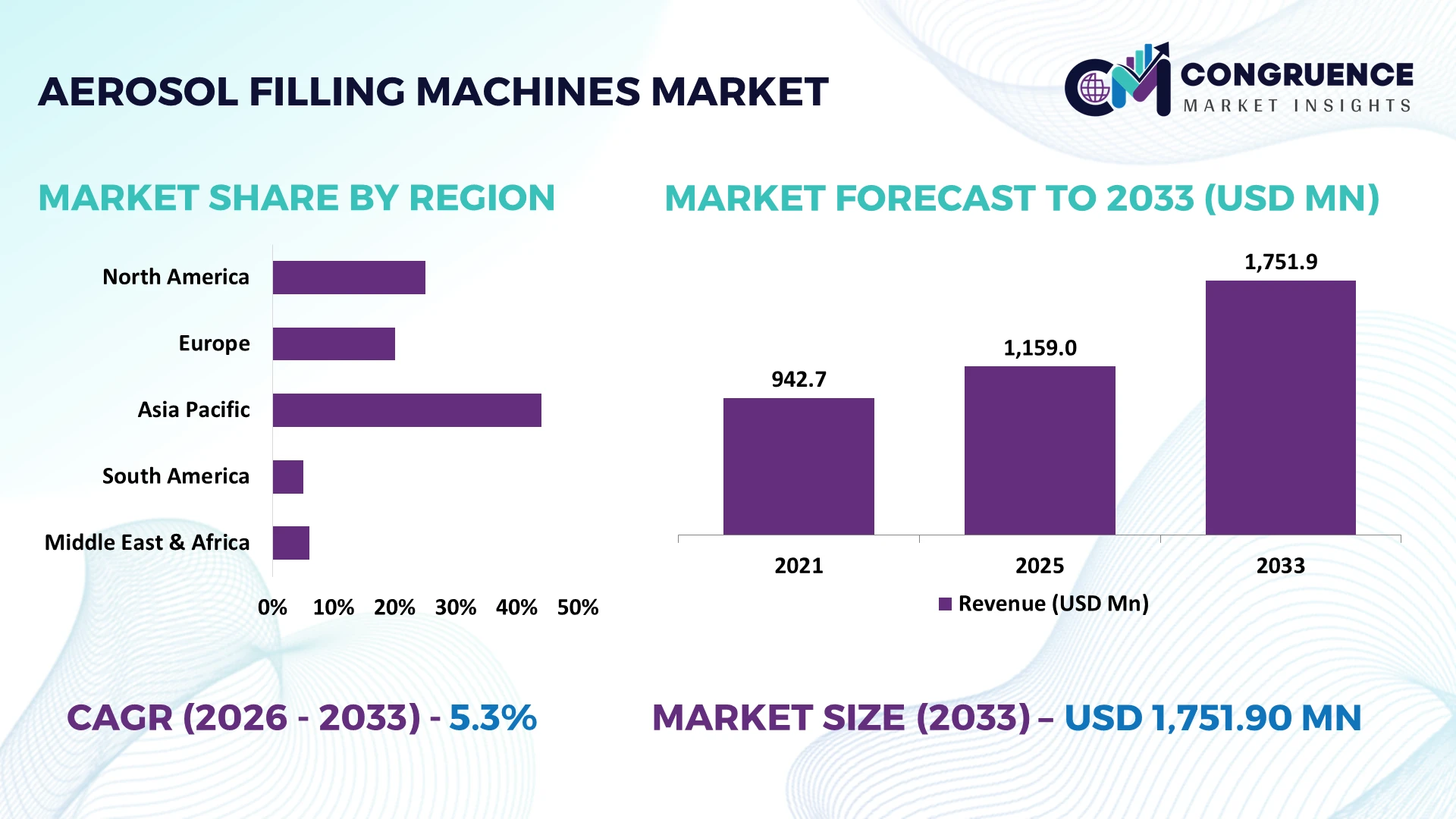
The Global Aerosol Filling Machines Market was valued at USD 1159.03 Million in 2025 and is anticipated to reach a value of USD 1751.9 Million by 2033 expanding at a CAGR of 5.3% between 2026 and 2033. Growth is driven by automated precision filling, rising aerosol packaging volumes, pharmaceutical production requirements, and machinery conversion for alternative propellants.
Germany is a leading European manufacturing hub for aerosol filling machinery, supported by personal care, household chemicals, automotive products, and pharmaceutical packaging. Reported 2025 aerosol production reached approximately 934 million units in Germany, compared with 694 million in France and 569.7 million in Italy. Germany's output was approximately 34.6% higher than France's, supporting demand for high-speed filling, valve crimping, and automated inspection systems. The European Union's fluorinated greenhouse gas regulations are accelerating machinery upgrades for alternative propellants and leak-tight packaging.
Strategic implication: Equipment manufacturers should prioritize high-throughput filling platforms, multi-format changeover capabilities, and propellant-compatible machinery to strengthen their position in European and international procurement programs.
Key Highlights of the Global Aerosol Filling Machines Market
-
Market Size & Growth: USD 1,159.03 million in 2025, reaching USD 1,751.9 million by 2033 at 5.3% CAGR, supported by precision filling and alternative-propellant conversion.
-
Top Growth Drivers: Personal care accounts for 49%, household products 17.4%, and automotive and industrial aerosols 11.4% of EU production, directing machinery requirements.
-
Short-Term Forecast: By 2028, calculated market value reaches approximately USD 1,353 million, prioritizing automated crimping, dosing accuracy, and shorter production changeovers.
-
Emerging Technologies: Three technologies—servo-controlled filling, machine-vision inspection, and automated leak detection—support precision dosing and consistent aerosol packaging quality.
-
Regional Leaders: Europe produced 3.45 billion aerosol units in 2025, the United States approximately 3.75 billion, and China 2.61 billion, supporting distinct equipment investment requirements.
-
End-User Trends: Germany's personal care aerosol production reached 609 million units in 2025, increasing 4.1%, reinforcing high-volume filling equipment utilization.
-
Pilot/Case Example: Germany's 2025 hair mousse production increased 8.3% to 26 million units, demonstrating the need for adaptable filling and formulation handling.
-
Competitive Landscape: Pamasol, Coster, R.A Jones, Terco, and other machinery specialists compete; verified global equipment market-share percentages remain unavailable.
-
Regulatory & ESG Impact: US HFC allowances operate at 60% of baseline during 2024–2028, increasing the importance of alternative-propellant-compatible filling equipment.
-
Investment & Funding: Germany's 934 million aerosol units in 2025 represent a substantial production base for equipment replacement; aggregate machinery investment remains undisclosed.
-
Innovation & Future Outlook: China's 2.61 billion aerosol units and Brazil's estimated 1.29 billion in 2025 highlight opportunities for modular automation and localized servicing.
The aerosol filling machines market serves personal care, household cleaning, automotive maintenance, industrial coatings, and pharmaceutical packaging manufacturers. EU production reached 3.45 billion units in 2025, with personal care and household applications jointly representing 66.4% of output. Manufacturers are adopting servo-controlled dosing, automated valve insertion, crimp inspection, and integrated leak testing to maintain filling consistency across different container formats. France's household aerosol production increased 16% in 2025 despite a 4% decline in total output, highlighting divergent product requirements. Alternative-propellant regulations further strengthen the strategic importance of flexible, validated filling systems.
What Is the Strategic Relevance and Future Pathways of the Aerosol Filling Machines Market?
Aerosol filling machinery is becoming strategically important as manufacturers restructure production around alternative propellants, automated quality control, and increasingly diversified packaging formats. European aerosol production reached approximately 3.45 billion units in 2025, with personal care and household applications accounting for 66.4% of output. Regulatory restrictions on fluorinated gases are changing equipment specifications, particularly for pressure control, leak detection, and propellant compatibility. Manufacturers including Pamasol and Coster are positioned to address these requirements through modular filling systems and integrated inspection technologies.
Servo-controlled dosing offers measurable advantages over conventional mechanically adjusted filling systems. For a line producing 30 million containers annually, reducing product overfill from 2% to 1% saves approximately 300,000 container-equivalents of formulation. Germany emphasizes high-throughput personal care production, while China's approximately 2.61 billion aerosol units reflect substantial requirements for scalable manufacturing equipment. Pharmaceutical applications prioritize validated filling accuracy, contamination control, and documented batch traceability.
Between 2026 and 2028, investment priorities will shift toward automated changeovers, continuous weight verification, and flexible propellant handling. A 300-container-per-minute line operating for 16 hours processes 288,000 units daily, making small dosing improvements commercially significant. Suppliers integrating filling, crimping, inspection, and digital records will secure stronger competitive positions through measurable material savings and operational reliability.
Aerosol Filling Machines Market Dynamics
DRIVER:
High-Volume Personal Care Production and Precision Filling
Personal care aerosol manufacturing remains a major driver of advanced filling equipment procurement. The category represented approximately 49% of European aerosol production in 2025, while household products contributed 17.4%, concentrating machinery utilization in high-volume consumer packaging. Germany's personal care aerosol production increased approximately 4.1%, reinforcing demand for consistent dosing, rapid valve placement, and automated container inspection. The transition toward diversified deodorant, haircare, and household formulations requires equipment capable of handling different viscosities and propellant combinations. Manufacturers including Coster and Pamasol are developing integrated filling, crimping, and quality-control platforms. For operators, reducing formulation overfill by one percentage point directly improves material efficiency, making precision dosing a competitive procurement criterion rather than merely a packaging specification.
RESTRAINT:
Propellant Compliance Costs and Equipment Conversion Constraints
Alternative-propellant regulations are increasing the complexity of aerosol filling equipment procurement and modernization. The United States' hydrofluorocarbon allowance system operates at 60% of its historical baseline during 2024–2028, while the long-term phasedown targets an 85% reduction by 2036. Existing machinery designed around conventional propellants often requires revised seals, pressure controls, ventilation, and explosion-protection arrangements before alternative formulations can be introduced. Germany's approximately 934 million aerosol units illustrate the scale of production potentially affected by changing technical requirements. Equipment conversion also creates temporary capacity constraints when production lines require qualification and safety testing. Manufacturers are reducing exposure through modular propellant circuits, compatible valve technologies, and standardized retrofit packages. The principal purchasing constraint is validated process compatibility, not filling speed alone.
OPPORTUNITY:
Modular Automation and High-Accuracy Contract Filling
Contract manufacturers offer an attractive opportunity for flexible aerosol filling platforms capable of processing smaller batches without sacrificing dosing consistency. China's approximately 2.61 billion aerosol units demonstrate the scale of manufacturing activity, while European personal care products represent around 49% of regional production. Modular equipment combining servo dosing, automatic valve insertion, and digital recipe management supports multiple formulations on shared production infrastructure. A facility reducing changeover duration from 60 to 45 minutes achieves a 25% improvement, releasing additional production capacity without installing another line. Suppliers are positioning through interchangeable filling heads, automated cleaning systems, and software-controlled operating parameters. The strongest opportunity lies in serving manufacturers with frequent product launches, where changeover economics and formulation traceability determine equipment investment returns.
CHALLENGE:
Integrated Quality Validation and Operational Consistency
Maintaining consistent filling accuracy across different formulations, container sizes, and propellant pressures presents a long-term engineering challenge. At 300 containers per minute, a 0.5% rejection rate produces 24 rejected units during every 16-minute operating period, illustrating how small process deviations accumulate at industrial speeds. Increasing first-pass acceptance from 98% to 99% reduces rejected containers by 50%, provided production volume remains unchanged. Pharmaceutical aerosol manufacturing adds stringent requirements for dose uniformity, contamination control, and validated production records. Integrating checkweighers, leak detectors, crimp inspection systems, and manufacturing execution software requires reliable data synchronization. Equipment suppliers must strengthen sensor calibration, automated rejection systems, operator training, and digital validation capabilities. Sustained competitiveness depends on maintaining product integrity while accommodating increasingly complex formulations and regulatory requirements.
Aerosol Filling Machines Market Latest Trends
-
Inline Inspection Becomes Production Standard: Aerosol manufacturers are integrating checkweighers, crimp-height sensors, and automated leak detectors directly into filling lines. At 200 containers per minute, equipment processes 12,000 units hourly, making immediate defect isolation essential. Increasing first-pass acceptance from 98% to 99% halves rejection volumes. Pamasol and Coster are strengthening inspection integration to reduce downstream rework and improve batch documentation.
-
Hydrocarbon Safety Engineering Gains Priority: Propane and butane filling requires explosion-protected equipment, controlled ventilation, and continuous gas monitoring. The US hydrofluorocarbon allowance system limits consumption and production to 60% of baseline during 2024–2028, increasing attention to alternative formulations. Machinery suppliers are adapting filling chambers, gas detection systems, and pressure-control components. The operational advantage comes from maintaining propellant flexibility without compromising production safety.
-
Compact Lines Target Specialized Production: Pharmaceutical, veterinary, and niche consumer aerosol manufacturers are investing in compact filling configurations rather than exclusively high-speed rotary systems. A 40-container-per-minute line produces 19,200 units during an eight-hour shift, compared with 144,000 units at 300 containers per minute. Equipment manufacturers are offering smaller footprints, integrated controls, and specialized tooling to support controlled production volumes and frequent formulation changes.
-
Digital Traceability Extends Across Packaging: Filling equipment increasingly connects product dosing, valve crimping, leak testing, and container identification through electronic batch records. At 99.5% first-pass acceptance, a 100,000-unit production run generates approximately 500 rejected units requiring documented disposition. Pharmaceutical manufacturers are emphasizing validated data capture and audit trails. Equipment suppliers are integrating programmable controllers and manufacturing execution interfaces to improve deviation investigation and quality accountability.
Segmentation Analysis
By Type
Automatic Filling Machines Lead Integrated Production
Automatic Aerosol Filling Machines represent the leading equipment category, supported by their suitability for continuous production, integrated quality inspection, and reduced manual handling. A verified global market share percentage for this segment is unavailable. Automatic platforms coordinate product dosing, propellant charging, valve placement, and container discharge through synchronized controls. Rotary Aerosol Filling Machines serve high-volume production, with advanced configurations reaching approximately 600 containers per minute. Semi-Automatic Aerosol Filling Machines remain relevant for medium-volume operations requiring operator-assisted loading, while Manual Aerosol Filling Machines serve laboratory development, sampling, and specialized low-volume applications.
Bag-on-Valve Filling Machines represent an important emerging category because they separate the formulation from the propellant and support specialized dispensing requirements. Compared with conventional systems, bag-on-valve configurations can achieve product evacuation rates approaching 99% under suitable formulation and package conditions. Manufacturers are expanding compatible valve tooling, filling heads, and pressure-monitoring capabilities. Equipment procurement increasingly reflects formulation characteristics, container compatibility, and validation requirements. Suppliers offering flexible automation architectures gain advantages among manufacturers operating multiple aerosol packaging formats.
- The European Aerosol Federation's 2025 production statistics indicate approximately 3.45 billion aerosol units manufactured across Europe. This production scale reinforces the importance of high-throughput automatic and rotary filling equipment for maintaining consistent packaging quality.
By Application
Personal Care Products Dominate Filling Requirements
Personal Care Products represent the leading application for aerosol filling machinery, reflecting high production volumes across deodorants, hairsprays, shaving products, and related formulations. The category accounted for approximately 49% of European aerosol production in 2025, although this production share does not directly represent global machinery revenue. Household Cleaning Products contributed approximately 17.4%, supporting demand for adaptable filling systems handling disinfectants, air fresheners, and cleaning formulations. Automotive Aerosols require equipment compatible with lubricants, maintenance sprays, and specialized propellants, while Industrial Aerosols involve technical coatings, adhesives, and protective chemicals.
Pharmaceutical Aerosols represent a strategically important emerging application because inhalation products require precise dosing, controlled filling environments, and validated process documentation. Food-Grade Aerosols also require hygienic equipment construction and appropriate material-contact specifications. Manufacturers are adapting filling technology through servo-controlled dosing, specialized sealing systems, and automated inspection. Equipment investment priorities increasingly differentiate high-volume consumer packaging from applications requiring tighter quality assurance and specialized production controls.
- The European Aerosol Federation reported that personal care and household products collectively represented approximately 66.4% of European aerosol production in 2025. This concentration supports continued demand for automated filling, crimping, and inspection equipment.
By End-User
Personal Care Manufacturers Lead Equipment Procurement
Personal Care Manufacturers represent the dominant end-user category because deodorants, hairsprays, and other aerosol cosmetics require high-volume production and consistent filling performance. Their exact global equipment purchasing share is not independently established. European personal care aerosol output represented approximately 49% of regional production in 2025, illustrating the scale of machinery utilization associated with this buyer group. Household Products Manufacturers prioritize flexible filling equipment for cleaning sprays, air fresheners, and disinfectants. Automotive Care Manufacturers require machinery compatible with specialized chemical formulations, while Industrial Chemical Manufacturers emphasize pressure control, corrosion resistance, and safe propellant handling.
Pharmaceutical Companies represent a high-value equipment modernization segment because product validation, filling accuracy, and electronic documentation influence machinery selection. Food and Beverage Manufacturers require hygienic equipment configurations and food-contact compliance. Suppliers are differentiating through modular filling platforms, application-specific tooling, and maintenance support. Competitive positioning increasingly depends on matching machine specifications with formulation requirements, production volumes, and regulatory obligations rather than offering identical equipment configurations across industries.
- The European Aerosol Federation's 2025 data show pharmaceutical and veterinary aerosols accounting for approximately 2% of European output. Although comparatively small in volume, these products require specialized filling validation and quality-control capabilities.
Region-Wise Market Insights
North America accounted for the largest market share at an indicative 32% in 2025 however, Asia-Pacific is expected to register the fastest growth, expanding at a CAGR of an indicative 7.0% between 2026 and 2033.

North America Aerosol Filling Machines Market
Alternative-Propellant Conversion Reshapes Filling Equipment Procurement
North America represents an indicative 32% of global aerosol filling machinery demand in 2025, supported by established personal care, household chemical, pharmaceutical, and industrial aerosol production. The United States dominates regional equipment procurement through high-volume contract manufacturers and branded consumer product producers. The US hydrofluorocarbon allowance system restricts production and consumption to 60% of baseline during 2024–2028, increasing requirements for compatible filling equipment, pressure-control systems, and leak detection. Canadian manufacturers contribute demand for automated filling platforms serving personal care and industrial chemical applications. Mexico supports regional production through packaging operations and cross-border manufacturing networks. Equipment suppliers are prioritizing modular propellant handling, automated crimping, and electronic batch documentation. Manufacturers capable of integrating alternative formulations without extensive production interruptions gain stronger positions in equipment replacement and modernization contracts.
United States Market Outlook: The United States benefits from extensive aerosol packaging infrastructure, advanced pharmaceutical manufacturing, and established machinery service networks. Domestic aerosol production has exceeded 3 billion containers annually, supporting high equipment utilization. The American Innovation and Manufacturing Act targets an 85% hydrofluorocarbon phasedown by 2036, encouraging manufacturers to evaluate alternative propellants, filling accuracy, and equipment safety certification.
Europe Aerosol Filling Machines Market
High-Volume Consumer Packaging Strengthens Automation Investment
Europe accounts for an indicative 29% of global aerosol filling machinery demand, supported by concentrated manufacturing operations and established packaging equipment engineering capabilities. Germany, France, Italy, and the United Kingdom represent important aerosol production and equipment procurement markets. European aerosol production reached approximately 3.45 billion units in 2025, with personal care representing 49% and household products contributing 17.4%. These production characteristics favor automated filling, valve insertion, crimping, and inspection systems capable of continuous operation. European machinery suppliers compete through precision engineering, equipment flexibility, and integrated quality assurance. The European Union's revised fluorinated greenhouse gas framework also influences propellant selection and equipment specifications. Manufacturers are upgrading production lines with programmable filling controls, automated inspection, and compatible pressure-management components to preserve operating efficiency while meeting changing product requirements.
Germany Market Outlook: Germany is a leading aerosol production and machinery engineering center, with approximately 934 million aerosol units manufactured in 2025. The country's established personal care and household chemical industries support demand for high-throughput filling systems. Domestic engineering expertise, precision component manufacturing, and specialized automation suppliers strengthen equipment development and technical servicing capabilities.
Asia-Pacific Aerosol Filling Machines Market
Manufacturing Scale and Localized Machinery Production Strengthen Adoption
Asia-Pacific represents an indicative 27% of global aerosol filling equipment demand, supported by extensive consumer goods manufacturing, industrial chemical production, and growing pharmaceutical packaging requirements. China dominates regional production capacity, manufacturing approximately 2.61 billion aerosol units in 2025. Japan and South Korea contribute demand for precision equipment serving cosmetics, healthcare, and specialized chemical formulations. India represents an expanding manufacturing base for personal care and household products, supporting procurement of modular automatic filling lines. Chinese equipment manufacturers compete through scalable production systems and locally available components, while Japanese suppliers emphasize precision engineering and process reliability. Regional machinery procurement increasingly balances equipment acquisition costs with filling accuracy, maintenance requirements, and production flexibility. Manufacturers are strengthening domestic service networks and expanding automated quality-control capabilities to support increasingly diversified aerosol formulations.
China Market Outlook: China benefits from extensive machinery manufacturing capacity, integrated component supply chains, and large-scale aerosol packaging operations. Domestic manufacturers supply automatic filling machines, rotary systems, and valve-crimping equipment across multiple production capacities. China's approximately 2.61 billion aerosol units in 2025 demonstrate substantial equipment utilization, supporting demand for machinery upgrades, localized spare parts, and automated inspection technology.
South America Aerosol Filling Machines Market
Consumer Product Manufacturing Supports Equipment Modernization
South America represents an indicative 8% of global aerosol filling machinery demand, with Brazil accounting for the region's largest concentration of consumer aerosol manufacturing. Brazilian production is estimated at approximately 1.29 billion aerosol units in 2025, supporting equipment utilization across personal care, household cleaning, and automotive maintenance applications. Argentina, Colombia, and Chile contribute additional demand through domestic consumer goods and industrial chemical manufacturing. Regional operators prioritize machinery capable of handling multiple container formats and different propellant formulations. Imported precision components and exchange-rate volatility influence equipment acquisition and maintenance costs, encouraging longer service agreements and local spare parts inventories. Equipment suppliers are expanding distributor partnerships and offering semi-automatic and modular filling configurations suited to different production scales. Production flexibility remains important where manufacturers serve both branded products and contract packaging requirements.
Brazil Market Outlook: Brazil benefits from an established aerosol packaging industry and extensive personal care manufacturing. Domestic manufacturers require equipment for deodorants, insecticides, air fresheners, and automotive products. Local production capabilities support demand for filling, crimping, and leak-testing machinery, while imported high-speed systems serve larger facilities. Suppliers offering Portuguese-language technical support and locally available replacement components strengthen their competitive positioning.
Middle East & Africa Aerosol Filling Machines Market
Industrial Diversification Expands Local Filling Infrastructure
The Middle East & Africa represents an indicative 4% of global aerosol filling equipment demand, supported by industrial diversification, domestic consumer product manufacturing, and pharmaceutical packaging investment. Saudi Arabia and the United Arab Emirates are developing local manufacturing capabilities through industrial investment programs and supply-chain localization initiatives. South Africa maintains established aerosol production operations serving household products, automotive maintenance, and personal care applications. Equipment procurement increasingly focuses on automatic filling platforms, safe propellant handling, and reliable maintenance support. Regional production facilities often require flexible machinery capable of accommodating multiple product formulations without extensive infrastructure expansion. Equipment manufacturers are developing distributor relationships and technical service arrangements to address imported component dependence. Industrial localization programs create opportunities for modular equipment installation, operator training, and integrated packaging line development.
Saudi Arabia Market Outlook: Saudi Arabia's Vision 2030 industrial diversification agenda supports domestic manufacturing across chemicals, consumer products, and pharmaceuticals. The National Industrial Development and Logistics Program prioritizes industrial capacity expansion and supply-chain localization. Aerosol manufacturers benefit from established petrochemical infrastructure and access to packaging materials, supporting investment in automated filling equipment, pressure-control systems, and quality assurance technologies.
Market Competition Landscape
Pamasol, Coster, R.A Jones, Terco, and MBC Aerosol compete through filling precision, production speed, propellant compatibility, and integrated packaging automation. The combined global market share of the five leading manufacturers is not publicly established, reflecting fragmented equipment categories and limited supplier disclosures. Pamasol emphasizes precision filling and modular engineering, while Coster competes through valve technology and integrated production systems. R.A Jones targets automated packaging integration, whereas Terco serves specialized filling applications. Rotary equipment reaching 600 containers per minute competes against smaller systems offering lower installation complexity. Reducing formulation overfill from 2% to 1% halves excess material consumption, strengthening the business case for servo-controlled dosing. Manufacturers are expanding automated inspection, digital recipe management, and alternative-propellant compatibility. Specialized pressure engineering, safety certification, and technical servicing create entry barriers. Competitive success depends on validated filling accuracy, flexible machinery configurations, dependable aftersales support, and demonstrable production efficiency across different formulations and packaging formats.
Companies Profiled in the Aerosol Filling Machines Market Report
-
Pamasol Willi Mäder AG
-
Coster Tecnologie Speciali S.p.A.
-
R.A Jones
-
Terco, Inc.
-
MBC Aerosol
-
Adelphi Manufacturing Company Limited
-
Wimco Limited
-
Wejing Machinery Co., Ltd.
-
Aerosol Systems Company
-
Jrpacking Machinery Co., Ltd.
-
Yeto Machinery Co., Ltd.
-
Feige FILLING GmbH
Technology Insights for the Aerosol Filling Machines Market
Servo-controlled dosing, automated valve placement, and electronic crimp inspection are transforming aerosol packaging operations. High-speed rotary filling platforms can process 600 containers per minute, supporting production of 36,000 units hourly. Integrated checkweighers detect underfilled and overfilled containers before secondary packaging, reducing material losses. Compared with conventional filling systems operating at 2% formulation overfill, precision-controlled equipment achieving 1% overfill delivers a 50% reduction in excess material consumption. Manufacturers prioritize synchronized filling, propellant charging, and inspection systems to maintain product consistency across continuous production schedules.
Emerging technologies include machine-vision inspection, automated recipe management, and connected production monitoring. Increasing first-pass acceptance from 98% to 99% reduces rejection volumes by 50%, provided production conditions remain comparable. Bag-on-valve equipment supports product evacuation approaching 99% under suitable packaging conditions, improving formulation utilization. Pamasol and Coster benefit from precision engineering and integrated filling capabilities, while specialized suppliers compete through compact machinery, interchangeable tooling, and flexible production configurations.
Between 2026 and 2028, investment will emphasize alternative-propellant compatibility, electronic batch records, and predictive maintenance. Pharmaceutical manufacturers require validated process documentation, while consumer product producers prioritize throughput stability. Equipment suppliers combining accurate dosing with automated quality verification will strengthen competitiveness through lower material waste and dependable operations.
Recent Developments in the Global Aerosol Filling Machines Market
-
March 2025: Coster Group announced its new manufacturing facility in Cabreúva, Brazil, covering 18,000 square metres. The expansion strengthens regional production of aerosol valves, actuators, and pumps, improving component availability and reducing supply lead times for packaging manufacturers. Source: coster.com
-
June 2024: Bespak announced the arrival of high-speed commercial aerosol filling equipment at Holmes Chapel, supporting production with 2 alternative propellants. Fully reserved initial capacity demonstrated pharmaceutical demand and strengthened its ability to supply lower-impact inhaler manufacturing programs. Source: bespak.com
-
October 2024: Bespak and H&T Presspart introduced a GMP pilot filling line supporting 2 low-impact propellants, HFA-152a and HFO-1234ze. Their partnership enables clinical-scale inhaler production, accelerating formulation qualification before commercial manufacturing and reducing development bottlenecks for pharmaceutical customers. Source: manufacturingchemist.com
-
August 2025: Aerosol Service launched production modernization at its Polish facility, incorporating upgraded filling equipment and renewable infrastructure. The project targets at least 30% higher energy efficiency, reducing operating costs while strengthening manufacturing flexibility and environmental performance. Source: worldaerosols.com
Scope of the Aerosol Filling Machines Market Report
The Aerosol Filling Machines Market Report examines developments from 2026 to 2033 across five equipment categories: Automatic, Semi-Automatic, Manual, Bag-on-Valve, and Rotary Aerosol Filling Machines. Application coverage includes Personal Care Products, Household Cleaning Products, Pharmaceutical Aerosols, Automotive Aerosols, Industrial Aerosols, and Food-Grade Aerosols. Six end-user categories are evaluated, covering corresponding consumer goods, pharmaceutical, automotive care, industrial chemical, and food manufacturing operations.
Regional analysis covers North America, Europe, Asia-Pacific, South America, and the Middle East & Africa, evaluating manufacturing concentration, equipment adoption, and regulatory requirements. Competitive assessment examines 12 machinery suppliers alongside precision dosing, propellant compatibility, automated inspection, and digital traceability. High-speed rotary equipment operating at up to 500 containers per minute provides a production-capacity benchmark. Findings support investment planning, supplier selection, modernization priorities, and international expansion strategies.
Aerosol Filling Machines Market Report Summary
| Report Attribute/Metric | Report Details |
|---|
Market Revenue in 2025 | USD 1159.03 Million |
Market Revenue in 2033 | USD 1751.9 Million |
CAGR (2026 - 2033) | 5.3% |
Base Year | 2025 |
Forecast Period | 2026 - 2033 |
Historic Period | 2021 - 2025 |
Segments Covered | By TypeAutomatic Aerosol Filling Machines Semi-Automatic Aerosol Filling Machines Manual Aerosol Filling Machines Bag-on-Valve Filling Machines Rotary Aerosol Filling Machines
By ApplicationHousehold Cleaning Products
By End-UserPersonal Care Manufacturers Household Products Manufacturers Automotive Care Manufacturers Industrial Chemical Manufacturers Food and Beverage Manufacturers
|
Key Report Deliverable | Revenue Forecast, Growth Trends, Market Dynamics, Segmental Overview, Regional and Country-wise Analysis, Competition Landscape |
Region Covered | North America, Europe, Asia-Pacific, South America, Middle East, Africa |
Key Players Analyzed | Pamasol Willi Mäder AG, Coster Tecnologie Speciali S.p.A., R.A Jones, Terco, Inc., MBC Aerosol, Adelphi Manufacturing Company Limited, Wimco Limited, Wejing Machinery Co., Ltd., Aerosol Systems Company, Jrpacking Machinery Co., Ltd., Yeto Machinery Co., Ltd., Feige FILLING GmbH |
Customization & Pricing | Available on Request (10% Customization is Free) |