
Reports
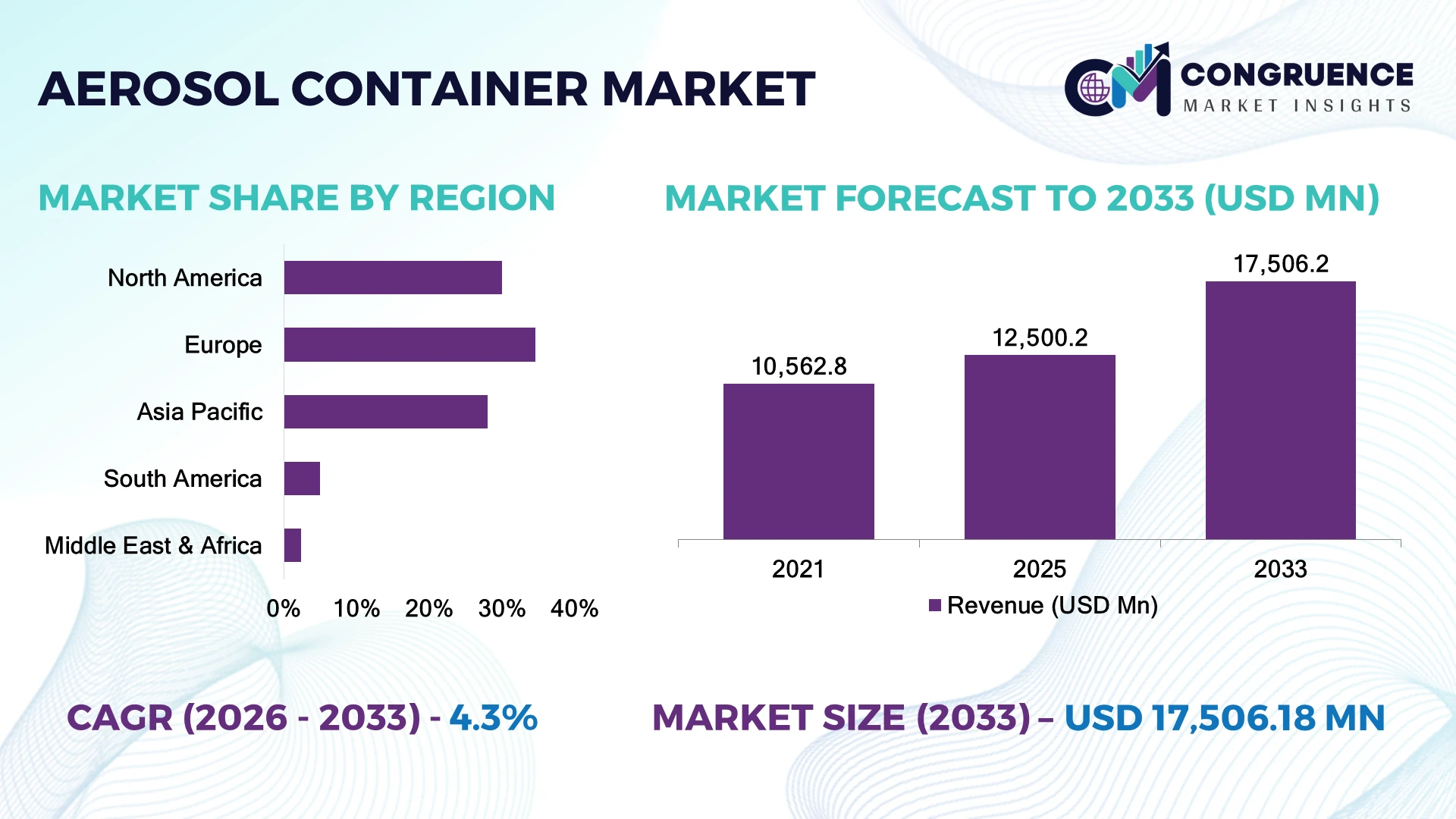
The Global Aerosol Container Market was valued at USD 12,500.2 Million in 2025 and is anticipated to reach a value of USD 17,506.2 Million by 2033 expanding at a CAGR of 4.3% between 2026 and 2033. Growth is driven by rising consumption of aerosol-based personal care and household products, demand for precision dispensing, and the transition toward lightweight, recyclable metal containers and lower-impact propellant systems.
The United States remains a major market, supported by established personal care, household chemicals, automotive maintenance, and pharmaceutical industries. China benefits from large-scale metal processing and consumer-goods manufacturing, while India offers expansion opportunities through growing packaged-product consumption and domestic manufacturing investment. In 2026, changing trade policies and metal-input costs are reinforcing regional sourcing strategies. Manufacturers are prioritizing material efficiency, automated production, and recycling-compatible designs to strengthen supply reliability and manage input-cost exposure.
Prioritize material efficiency, pressure-tested container designs, regional manufacturing capabilities, and diversified metal procurement to protect margins and secure long-term customer contracts.
Market Size & Growth: USD 12,500.2 million in 2025, reaching USD 17,506.2 million by 2033 at a 4.3% CAGR, supported by personal care, household products, and industrial spray applications.
Top Growth Drivers: Three structural drivers are recyclable packaging, precision dispensing, and expanding aerosol use across personal care and industrial maintenance; their individual contributions require separate measurement.
Short-Term Forecast: By 2028, manufacturers should target 5–10% lower material use per container through lightweighting and process optimization, subject to pressure-resistance and product-protection requirements.
Emerging Technologies: Digital inspection, automated forming, recycled aluminum, and improved internal coatings are strengthening quality consistency and material efficiency.
Regional Leaders: Asia-Pacific, North America, and Europe remain key markets, supported by manufacturing scale, established aerosol applications, and increasing investment in recycling-compatible packaging.
Consumer/End-User Trends: Personal care remains a major application, with deodorants, hair sprays, and shaving products benefiting from convenient, controlled dispensing and portable packaging.
Pilot/Case Example: A 2027 lightweighting pilot targeting a 10% reduction in aluminum per can would proportionately reduce metal consumption per unit, provided structural integrity and filling-line compatibility remain unchanged.
Competitive Landscape: Ball Corporation, Crown Holdings, Trivium Packaging, CCL Industries, and Ardagh Metal Packaging compete through manufacturing scale, container engineering, supply reliability, and customer-specific designs.
Regulatory & ESG Impact: European packaging requirements are increasing pressure to improve recyclability and reduce packaging waste, encouraging material redesign and stronger recycled-content sourcing practices.
Investment & Funding: Investment priorities include can-forming automation, quality inspection, lightweighting, and recycling-compatible designs; a consolidated global investment total specific to aerosol containers is not established.
Innovation & Future Outlook: By 2030, competitive differentiation will increasingly depend on material efficiency, recyclable structures, reliable pressure performance, and regional supply resilience rather than container price alone.
The Aerosol Container Market is evolving through lightweight aluminum designs, recyclable steel packaging, precision valves, and improved internal coatings. Personal care, household cleaning, automotive maintenance, and pharmaceutical applications require reliable dispensing and pressure integrity. A 10% reduction in container weight is a practical engineering target for selected designs, subject to safety validation. In 2026, metal-price volatility and packaging regulations are strengthening the business case for material optimization and regional sourcing.
The Aerosol Container Market is becoming strategically important as brand owners seek packaging that combines dispensing precision, product protection, recyclability, and manufacturing efficiency. Container specifications directly affect filling-line performance, transport costs, product compatibility, and regulatory compliance. Suppliers that deliver consistent quality at scale are better positioned to secure long-term contracts with personal care, household chemical, automotive, and pharmaceutical manufacturers.
Technology investment is shifting toward automated forming, in-line dimensional inspection, coating validation, and digital defect detection. Compared with manual sampling, integrated inspection systems can identify dimensional deviations and coating defects earlier, reducing rework and improving batch consistency. A 5–10% improvement in inspection-related throughput is a reasonable facility-level target for evaluation, rather than a verified industry-wide outcome. Europe emphasizes recyclability and packaging compliance, while China combines manufacturing scale with extensive downstream consumer-goods production. North American buyers prioritize specification consistency, supplier qualification, and dependable delivery.
During 2026–2028, manufacturers should prioritize lightweighting trials, recycled-metal qualification, predictive maintenance, and diversified sourcing for aluminum, steel, valves, and coatings. A practical deployment involves redesigning a high-volume deodorant container, validating pressure resistance and corrosion performance, and testing the revised specification on existing filling lines before commercial rollout. Suppliers are strengthening partnerships with metal producers and brand owners to align material availability with packaging redesign. Competitive advantage will depend on delivering measurable material savings without compromising safety, production speed, or dispensing reliability.
Demand for lightweight aluminum containers and reliable dispensing systems is strengthening as personal care, household chemicals, and industrial maintenance products require portable, leak-resistant packaging. Aluminum lightweighting programs target 5–10% material reductions in selected container designs, subject to pressure and deformation testing. Automated forming and filling-line integration also support consistent dimensions and higher production throughput. In the United States, established personal care and household-product manufacturers continue to require dependable container specifications across high-volume product lines. Companies are responding through engineering partnerships, automated inspection, and investment in material-efficient designs. The key operational advantage is that reducing metal consumption can lower unit costs without sacrificing performance when container geometry and pressure resistance are validated together.
Aluminum and steel price fluctuations directly affect aerosol container manufacturing because metal inputs represent a substantial portion of material expenditure. A 5–10% increase in metal procurement costs can place immediate pressure on unit margins when customer contracts restrict price adjustments; this is an illustrative sensitivity scenario, not an industry-wide measurement. Energy-intensive forming processes, protective coatings, valves, and quality testing add further cost exposure. Manufacturers dependent on imported metal or specialized components also face currency and transportation risks. Companies are reducing exposure through supplier diversification, indexed pricing agreements, regional procurement, and material-efficient designs. The strategic priority is to manage input-cost volatility without compromising wall thickness, corrosion resistance, pressure integrity, or production-line compatibility.
Recyclable aluminum, improved steel recovery, and packaging lightweighting create opportunities to reduce material consumption while meeting brand-owner sustainability requirements. A 10–15% reduction in metal use is a potential engineering target for selected container formats, subject to structural validation and product compatibility. European packaging requirements are encouraging manufacturers to assess recyclability, material composition, and waste reduction earlier in product development. India and China offer opportunities to expand efficient manufacturing and serve growing consumer-goods production networks. Companies are investing in recycled-metal qualification, coating innovation, and collaborative design programs with filling companies and consumer brands. An important opportunity lies in optimizing container geometry and valve compatibility together, allowing material savings without creating filling inefficiencies or compromising dispensing performance.
Lightweight aerosol containers require precise control of wall thickness, forming tolerances, seam integrity, corrosion resistance, and internal pressure performance. A 5–10% reduction in material thickness or weight cannot be applied uniformly across container designs because product formulation, propellant pressure, diameter, and operating conditions influence structural requirements. Manufacturers introducing new materials must also validate compatibility with existing filling equipment and inspection systems. In 2026, increasing emphasis on recycled content adds qualification requirements for material consistency and supplier documentation. Companies need advanced forming controls, pressure testing, coating validation, and stronger engineering collaboration with brand owners. The central challenge is achieving repeatable material savings at commercial scale while maintaining safety, regulatory compliance, and consistent performance throughout the product lifecycle.
Lightweighting Reduces Material Intensity: Manufacturers are redesigning aluminum and steel containers to lower metal consumption while preserving pressure resistance. A 5–10% reduction in material use is a practical engineering target for selected designs, subject to validation. Lower material intensity can reduce procurement exposure and transport weight. Companies are combining container-geometry optimization with forming-process adjustments to maintain dimensional consistency and filling-line performance.
Recyclability Influences Packaging Specifications: Packaging redesign is gaining priority as European requirements increase attention to recyclability and waste reduction. Manufacturers are assessing metal recovery, coatings, labels, and component compatibility earlier in product development. A 10% reduction in packaging material is a measurable design objective for suitable formats, rather than a verified market-wide achievement. Suppliers are collaborating with brand owners to balance environmental objectives with corrosion protection and dispensing reliability.
Automated Inspection Improves Production Control: Aerosol manufacturers are integrating machine vision, dimensional measurement, and automated defect detection into production workflows. Facilities can evaluate a 5–10% improvement in inspection throughput as an operational target, depending on baseline processes and equipment configuration. Earlier detection of forming defects and coating inconsistencies reduces rework and strengthens batch traceability. Manufacturers are prioritizing integrated quality systems where high-volume production makes manual inspection less efficient.
Regional Sourcing Gains Strategic Importance: Trade-policy uncertainty and metal-price fluctuations are encouraging manufacturers to diversify suppliers and evaluate regional sourcing. Companies are reviewing alternative metal suppliers, contract structures, and inventory policies to reduce exposure to delivery disruptions. A 5–10% improvement in forecast accuracy is a practical planning target, not an established industry average. Better demand visibility helps coordinate metal procurement, can production, and customer delivery schedules, reducing the risk of excess inventory or production interruptions.
Aluminum aerosol containers represent a leading product type, accounting for an indicative 45–50% of global demand, supported by lightweight construction, corrosion-resistant design options, premium appearance, and compatibility with personal-care applications. Steel aerosol containers remain important for cost-sensitive household, industrial, and automotive products where strength and established manufacturing infrastructure influence purchasing decisions. Plastic aerosol containers serve selected applications requiring specialized dispensing or material compatibility, although pressure resistance, barrier performance, and recyclability requirements limit their suitability for certain formulations. Companies are balancing material costs against container weight, filling-line performance, and end-of-life recovery. Aluminum producers are emphasizing lightweight designs and recycled-metal integration, while steel-container manufacturers compete through production efficiency and dependable high-volume supply. The leading material choice varies by application, formulation pressure, and target price rather than following a single universal specification.
Aluminum containers offer opportunities for premiumization and weight reduction, while steel remains commercially relevant for larger-volume and cost-sensitive formats. Composite and specialized polymer-based aerosol containers occupy narrower niches where product compatibility, dispensing requirements, and applicable pressure-vessel regulations permit their use. An engineering target of 5–10% lower container weight is relevant for selected designs, but requires pressure, deformation, leakage, and compatibility validation. Mature markets prioritize established specifications and recycling performance, whereas emerging manufacturing markets emphasize production economics and reliable metal supply. Suppliers are investing in forming automation, coating quality, and material optimization to strengthen competitiveness. The strategic priority is to select materials according to total lifecycle cost, product safety, and recovery infrastructure rather than purchase price alone.
Personal care represents the leading application of aerosol containers, accounting for an indicative 40–45% of global demand through deodorants, body sprays, hair styling products, shaving foams, and related products. Recurring consumption, extensive retail distribution, and established filling infrastructure support this position. Household applications, including air fresheners, insect-control products, and cleaning sprays, provide another significant demand base. Automotive maintenance, industrial lubricants, paints, food products, and pharmaceutical sprays serve specialized requirements involving chemical compatibility, dispensing accuracy, and product protection. Manufacturers are developing application-specific valves, internal coatings, and container geometries to meet these different requirements. Personal-care customers generally prioritize appearance, unit cost, and filling-line throughput, whereas industrial and pharmaceutical buyers place greater emphasis on formulation compatibility, controlled dispensing, and technical qualification.
Pharmaceutical and healthcare applications offer a specialized growth opportunity as inhalation products, topical treatments, and antiseptic sprays require dependable delivery systems and stringent product compatibility. A 5–10% improvement in filling-line throughput is a potential operational target when container tolerances and inspection systems are optimized, rather than a verified industry-wide result. Mature personal-care applications emphasize manufacturing scale and cost efficiency, while healthcare applications require more extensive testing and documentation. Household and industrial uses continue to depend on durable, application-specific packaging. Companies are expanding technical partnerships with formulators, valve suppliers, and filling operations to validate container performance before commercialization. Investment is shifting toward application-specific engineering that improves reliability without adding unnecessary material or production complexity.
Personal care and cosmetics manufacturers represent the leading end-user group, accounting for an indicative 40–45% of global aerosol container demand. Deodorants, hair sprays, body sprays, and shaving products generate recurring procurement requirements supported by established filling operations and broad retail distribution. Household-product manufacturers form another important buyer group through air fresheners, cleaning products, and insect-control sprays. Automotive, industrial, food, and pharmaceutical companies purchase containers according to specialized requirements for chemical compatibility, corrosion resistance, pressure performance, and dispensing accuracy. Large consumer-goods manufacturers prioritize supply continuity, production-line compatibility, and competitive unit costs, while specialist brands require customized dimensions, finishes, and dispensing characteristics. Suppliers are responding through long-term supply agreements, integrated design support, and production schedules aligned with customers' filling requirements.
Pharmaceutical and healthcare manufacturers constitute a strategically important specialized buyer group because aerosol delivery systems require stringent material qualification, documented quality controls, and application-specific performance testing. An indicative planning scenario assumes healthcare-oriented applications could gain 2–3 percentage points in selected suppliers' portfolios over the medium term; this is not a verified global end-user forecast. Established personal-care buyers continue to prioritize production scale and procurement efficiency, whereas pharmaceutical buyers emphasize traceability, formulation compatibility, and qualification procedures. Household and industrial customers focus on durability and cost-effective performance. Suppliers are strengthening partnerships with formulators and filling companies, improving quality assurance, and offering differentiated technical specifications. Competitive positioning depends on matching container engineering to buyer requirements while maintaining dependable production and delivery.
Europe accounted for the largest market share at an estimated 34.6% in 2025; however, Asia-Pacific is expected to register the fastest growth, supported by expanding manufacturing capacity, consumer-product demand, and investment in modern aerosol packaging. Regional shares are indicative estimates and should be reconciled with the finalized market-sizing model.

Advanced Manufacturing and Supply Reliability Shape Competition
North America represents an estimated 29–31% of global aerosol container demand, supported by established personal care, household chemicals, automotive maintenance, and pharmaceutical industries. The United States accounts for most regional consumption, while Canada contributes through consumer-goods manufacturing and retail distribution. Container suppliers compete through automated production, dimensional accuracy, pressure integrity, and dependable delivery to high-volume filling facilities. Aluminum lightweighting, improved internal coatings, and automated defect detection support material efficiency and manufacturing consistency. Companies are also evaluating regional metal sourcing and supplier diversification amid trade-policy uncertainty and fluctuating input costs. The commercial priority is to protect long-term contracts through reliable production and specification compliance rather than compete exclusively on unit price.
United States Market Outlook: The United States offers a substantial demand base through established personal-care brands, household-product manufacturers, industrial maintenance suppliers, and pharmaceutical companies. Its developed filling infrastructure supports large production runs and application-specific container requirements. Suppliers benefit from established metalworking capabilities and customer qualification systems. Companies are prioritizing automated inspection, material-efficient designs, and diversified sourcing to protect production continuity. Pharmaceutical applications require additional attention to product compatibility and quality documentation, while consumer-goods buyers focus on cost, appearance, and reliable replenishment.
Recycling Infrastructure and Packaging Compliance Drive Redesign
Europe represents an estimated 34–35% of global aerosol container demand and benefits from established metal-packaging manufacturing, recycling infrastructure, and strong personal-care production. European industry data recorded approximately 3.45 billion aerosol units produced in the EU in 2025, demonstrating the scale of its manufacturing base. Personal care remains the principal application, while household, automotive, industrial, food, and pharmaceutical products diversify demand. Packaging redesign is increasingly influenced by waste-reduction and recyclability requirements. Manufacturers are reviewing container materials, coatings, labels, and recycled-metal sourcing to balance environmental objectives with pressure resistance and product protection. Germany, France, and Italy remain important production centers, encouraging suppliers to prioritize regional customer relationships, engineering support, and dependable metal procurement.
Germany Market Outlook: Germany is a leading European aerosol manufacturing center, producing approximately 934 million aerosol units in 2025, equivalent to around 27% of EU production. Its established metalworking industry, engineering capabilities, and consumer-goods manufacturing base support large-scale container production. Suppliers are investing in production efficiency, automated quality controls, and packaging designs compatible with recycling systems. Germany's position also creates opportunities for partnerships with personal-care and household-product manufacturers seeking dependable local supply. Companies must maintain strong process controls while adapting specifications to changing packaging requirements.
Manufacturing Scale and Consumer-Goods Expansion Strengthen Demand
Asia-Pacific accounts for an estimated 27–30% of global aerosol container demand and benefits from expanding consumer-goods manufacturing, large domestic markets, and established metal-processing capabilities. China is an important production center, while India offers opportunities through expanding personal-care consumption and industrial manufacturing. Japan and South Korea contribute through advanced packaging engineering and specialized product development. Manufacturers are scaling automated forming, improving filling-line integration, and adapting container specifications to local brand requirements. Cost competitiveness remains important, but quality consistency and dependable delivery increasingly influence supplier selection. Regional producers are strengthening relationships with multinational customers while expanding domestic distribution. Investment priorities include efficient metal utilization, production automation, and container designs that accommodate changing product formulations.
China Market Outlook: China offers a strong combination of metal-processing capacity, extensive consumer-goods manufacturing, and established domestic personal-care brands. Its manufacturing ecosystem supports large production volumes and supplier coordination across containers, valves, coatings, and filling equipment. Companies are improving production automation and developing lightweight packaging to manage metal costs and strengthen competitiveness. Domestic market access also supports product customization for deodorants, hair sprays, household products, and industrial applications. Suppliers that combine manufacturing scale with consistent quality and reliable delivery are positioned to serve domestic brands and export-oriented customers.
Brazilian Manufacturing Supports Regional Supply Development
South America represents an estimated 6–8% of global aerosol container demand, with Brazil serving as the principal market through its established cosmetics, household-product, and industrial manufacturing sectors. Argentina, Chile, and Colombia contribute additional demand through personal care, cleaning products, and automotive maintenance applications. Local manufacturing and regional distribution help suppliers serve customers while managing transportation costs and import exposure. However, currency volatility, financing constraints, and fluctuations in imported metal prices can complicate procurement planning. Manufacturers are prioritizing flexible production schedules, distributor partnerships, and locally adapted packaging specifications. Brazil's established consumer-goods industry provides a foundation for container demand, while broader regional expansion depends on affordability, consistent supply, and the ability to compete with imported packaging.
Brazil Market Outlook: Brazil is the most strategically significant market in South America because of its large consumer-goods industry and established personal-care manufacturing base. Its cosmetics and household-product producers require dependable aerosol containers across multiple price points and product categories. Suppliers are strengthening local customer relationships, improving production planning, and evaluating regional sourcing arrangements to manage metal-price and currency exposure. The opportunity lies in serving multinational brands and domestic manufacturers with reliable container specifications, competitive pricing, and consistent filling-line compatibility.
Import Diversification and Industrial Development Shape Market Access
The Middle East and Africa account for an estimated 4–6% of global aerosol container demand, supported by personal care, household products, automotive maintenance, and industrial applications. Saudi Arabia and the United Arab Emirates provide important commercial hubs through organized retail, consumer-goods distribution, and industrial investment, while South Africa supports established regional manufacturing and distribution networks. Many markets remain dependent on imported containers or metal inputs, increasing exposure to freight costs, currency movements, and delivery delays. Suppliers are strengthening distributor partnerships, evaluating regional filling relationships, and adapting pack formats to local purchasing power. Investment opportunities include regional contract manufacturing, reliable component sourcing, and technical support for local brands. Commercial success depends on balancing market access with production scale, regulatory compliance, and predictable replenishment.
Saudi Arabia Market Outlook: Saudi Arabia offers opportunities through expanding consumer-goods manufacturing, modern retail infrastructure, and industrial diversification initiatives. Personal-care and household-product suppliers require reliable packaging that meets product compatibility and safety requirements. Container manufacturers can strengthen market access through distributor agreements, partnerships with local fillers, and regional supply arrangements. Investment decisions should consider demand concentration, imported metal exposure, and the economics of local production. Suppliers offering dependable delivery, appropriate container specifications, and competitive total procurement costs are better positioned to serve established brands and emerging domestic manufacturers.
The aerosol container market is moderately concentrated, with the five leading manufacturers estimated to account for approximately 55% of global volume. Ball Corporation, Crown Holdings, Trivium Packaging, Ardagh Metal Packaging, and CCL Industries compete through material expertise, customer relationships, production scale, and regional reach; regional manufacturers challenge them on pricing and localized delivery.
Competition differs by format: Ball and Trivium emphasize aluminum-container innovation, while Crown and Ardagh bring broad metal-packaging capabilities; CCL targets specialized aluminum containers and demanding applications. Lightweighting can reduce container material use by 10–25% in selected designs, while recycled-aluminum production can consume up to 95% less energy than virgin production, strengthening sustainability-led differentiation.
Players are responding through recycled-content partnerships, redesigned cans, coating optimization, and closer collaboration with personal-care brands. Trivium’s reported 25% weight reduction in an award-winning design illustrates how engineering can improve material efficiency without sacrificing performance. Competitive pressure is shifting from unit price alone toward verified carbon performance and supply resilience. High capital requirements, technical qualification, and customer approval create entry barriers. Winning requires dependable scale, competitive conversion costs, proven product safety, and measurable sustainability improvements tailored to brand-owner specifications.
Lightweight aluminum forming, precision wall-thickness control, and advanced internal coatings are immediate priorities because they reduce material consumption while maintaining pressure resistance and product compatibility. Trivium reported a 25% weight reduction in an award-winning aerosol design, alongside a 50% reduction in internal coating. Such gains can lower metal and coating demand, shipping weight, and selected production-related emissions. Conventional steel cans remain competitive where strength and cost outweigh premium appearance or lightweighting benefits.
Recycled-content and lower-carbon aluminum are emerging differentiators. Ball’s 2025 collaboration with Alcoa and Unilever introduced personal-care packaging using 50% ELYSIS-produced aluminum and 50% post-consumer recycled content. Recycling aluminum can require up to 95% less energy than producing primary aluminum, making reliable scrap collection and material traceability commercially important. Adoption remains uneven across suppliers and regions; brands increasingly assess recycled content, certification, and lifecycle performance rather than relying on material claims alone.
Automation, in-line inspection, digital print control, and data-linked quality monitoring can reduce defects, changeover losses, and rework. Even a 1–2% improvement in yield or line efficiency can materially affect high-volume operations, although realized gains depend on equipment and baseline performance. During 2026–2028, investment should prioritize measurable lightweighting, coating reduction, recycled-metal access, and flexible production lines. Global manufacturers with engineering resources and secure material supply are best positioned, while regional producers can compete through specialized formats, faster customization, and responsive local service.
The report examines the global aerosol container market across aluminum, steel, and specialty container formats; personal-care, household, automotive and industrial, pharmaceutical, and other applications; and the manufacturers purchasing packaging for these uses. Geographic coverage includes North America, Europe, Asia-Pacific, South America, and the Middle East and Africa, with country-level analysis of demand patterns, manufacturing footprints, and competitive positioning.
Technology coverage includes lightweighting, recycled-metal content, low-impact coatings, forming and decoration processes, production automation, and packaging formats designed for specialized product compatibility. The report evaluates the leading suppliers, regional manufacturers, material and supply-chain pressures, and the growing strategic importance of documented sustainability performance. Segment estimates and regional comparisons support investment screening, capacity planning, market-entry decisions, supplier selection, and differentiation strategies. Forward-looking analysis for 2026–2033 highlights where demand mix, production efficiency, customization, and material sourcing may reshape competitive priorities, while identifying niche opportunities in healthcare, premium personal care, and specialized industrial applications.
| Report Attribute/Metric | Report Details |
|---|---|
|
Market Revenue in 2025 |
USD 12,500.2 Million |
|
Market Revenue in 2033 |
USD 17,506.2 Million |
|
CAGR (2026 - 2033) |
4.3% |
|
Base Year |
2025 |
|
Forecast Period |
2026 - 2033 |
|
Historic Period |
2021 - 2025 |
|
Segments Covered |
By Type
By Application
By End-User
|
|
Key Report Deliverable |
Revenue Forecast, Growth Trends, Market Dynamics, Segmental Overview, Regional and Country-wise Analysis, Competition Landscape |
|
Region Covered |
North America, Europe, Asia-Pacific, South America, Middle East, Africa |
|
Key Players Analyzed |
Ball Corporation, Crown Holdings, Inc., Trivium Packaging, Ardagh Metal Packaging, CCL Industries Inc., EXAL Corporation, Montebello Packaging, Toyo Seikan Group Holdings, Ltd., Nampak Limited, Colep Packaging, DS Containers, Inc., LINHARDT GmbH, TUBEX GmbH, Hindustan Tin Works Limited |
|
Customization & Pricing |
Available on Request (10% Customization is Free) |




