
Reports
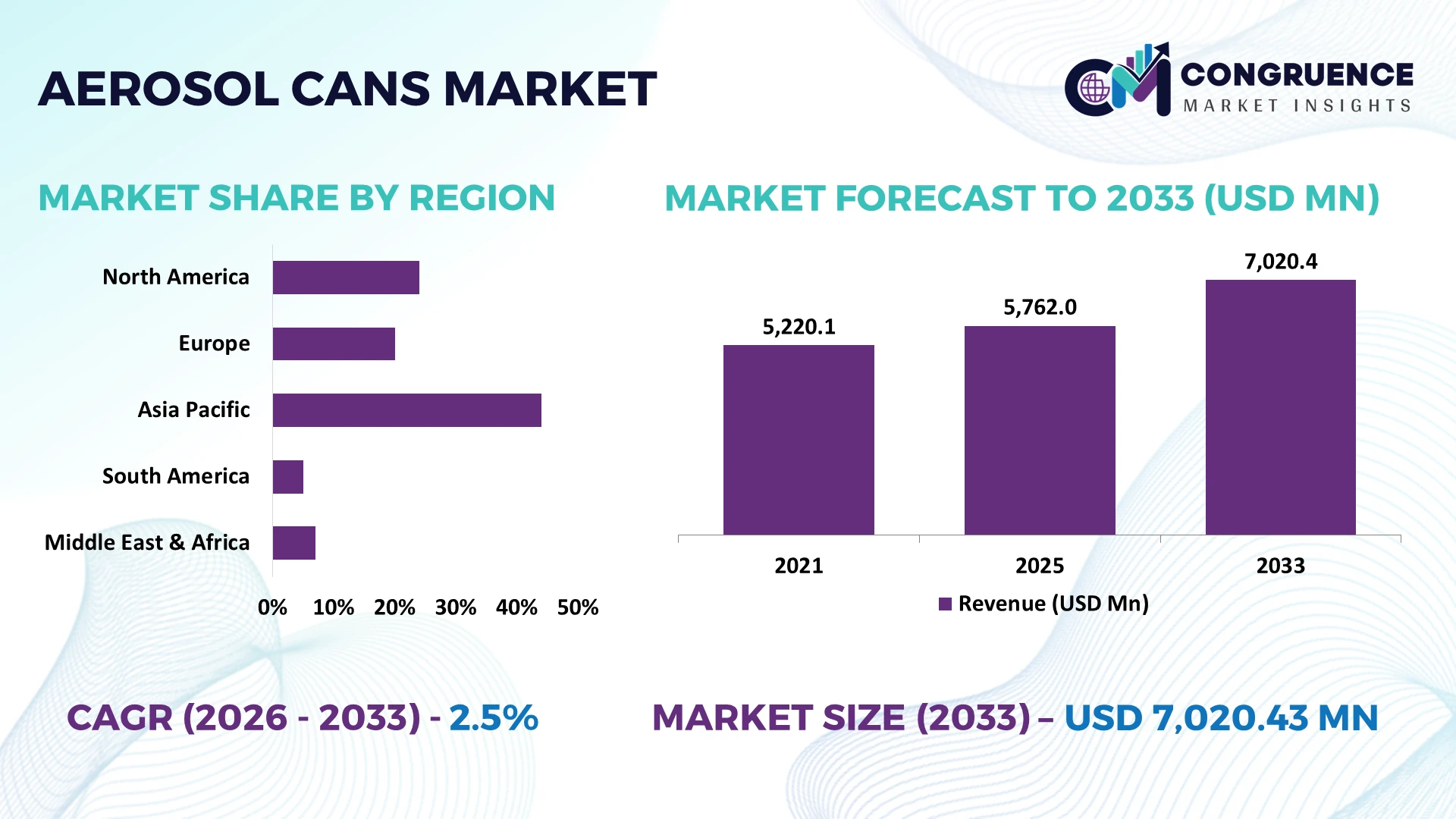
The Global Aerosol Cans Market was valued at USD 5762 Million in 2025 and is anticipated to reach a value of USD 7020.43 Million by 2033 expanding at a CAGR of 2.5% between 2026 and 2033. Growth is supported by increasing demand for recyclable metal packaging, expansion of personal care and household products, and wider adoption of lightweight high-pressure can manufacturing technologies.
Germany remains the leading production hub, accounting for approximately 18% of global aerosol can manufacturing capacity, supported by strong automotive coatings, industrial chemicals, and personal care industries, while China contributes nearly 16% through high-volume packaging investments and automated metal forming facilities. In 2026, European industrial decarbonization initiatives accelerated recyclable aluminum adoption by over 12%, strengthening competitive manufacturing efficiency despite ongoing global raw material supply adjustments.
Manufacturers investing in advanced production automation, lightweight materials, and regional supply diversification are positioned to strengthen long-term competitiveness and operational resilience.
Market Size & Growth: USD 5762 Million in 2025, projected to reach USD 7020.43 Million by 2033 at a CAGR of 2.5%, driven by advanced recyclable metal packaging and lightweight manufacturing.
Top Growth Drivers: Recycled aluminum usage increased 14%, automated filling efficiency improved 11%, and premium personal care packaging demand expanded 9%.
Short-Term Forecast: By 2028, production waste declines 10% while manufacturing throughput improves approximately 8% through automated quality inspection.
Emerging Technologies: AI-enabled defect detection, digital production monitoring, and lightweight alloy engineering improve production precision by nearly 12%.
Regional Leaders: Europe approaches USD 2250 Million, Asia Pacific exceeds USD 2100 Million, and North America reaches nearly USD 1650 Million, supported by regional manufacturing expansion and localized supply chains.
Consumer/End-User Trends: Over 58% of premium personal care brands prioritize recyclable aerosol packaging with higher recycled metal content.
Pilot/Case Example: In 2026, automated can-line modernization reduced inspection defects by 15% while increasing production consistency across high-volume facilities.
Competitive Landscape: Ball Corporation leads with an estimated 17% market share alongside Crown Holdings, Trivium Packaging, Ardagh Metal Packaging, and CCL Container.
Regulatory & ESG Impact: Circular packaging initiatives increased recycled material utilization by approximately 13%, accelerating compliance with stricter environmental standards.
Investment & Funding: More than USD 1.2 billion supports manufacturing expansion, production automation, and regional capacity diversification amid global supply chain realignment.
Innovation & Future Outlook: Next-generation lightweight aluminum designs and smart manufacturing platforms strengthen production flexibility while reducing material consumption by around 10%.
Demand for aerosol cans continues to strengthen across personal care, pharmaceutical, food, and industrial coating applications as manufacturers introduce lightweight aluminum designs, higher recycled-content packaging, and AI-enabled quality inspection systems. Around 15% faster automated production cycles improve operational efficiency, while evolving packaging regulations and regional supply-chain localization strategies encourage resilient manufacturing networks, setting the stage for broader strategic market developments.
The Aerosol Cans Market has become strategically important as manufacturers prioritize resilient packaging ecosystems, localized production, and circular material flows to strengthen competitive positioning. Supply-chain restructuring following continued metal sourcing adjustments has encouraged producers to diversify procurement while expanding regional manufacturing footprints. Demand from personal care, pharmaceuticals, food products, and industrial coatings is accelerating investments in high-speed filling lines and recyclable aluminum packaging that align with tightening environmental compliance and operational efficiency targets.
Modern AI-enabled vision inspection and automated filling systems improve production efficiency by approximately 12% compared with conventional manual quality inspection while reducing defect rates by nearly 15%. Germany continues to lead in precision manufacturing and sustainable metal packaging innovation, whereas China expands large-scale automated production capacity with faster deployment of digitally integrated manufacturing facilities. Over the next two to three years, automated production lines are expected to exceed 45% adoption among major manufacturers, improving throughput consistency and reducing maintenance downtime.
A leading packaging producer recently expanded automated aerosol can manufacturing using lightweight aluminum technology, lowering material consumption by around 10% while strengthening production flexibility for premium consumer brands. Companies are increasing investments in recycling infrastructure, regional partnerships, and smart manufacturing platforms to improve supply security and operational resilience. Businesses that integrate automation, sustainable materials, and diversified production networks will secure stronger competitive differentiation and long-term strategic relevance.
Rising adoption of recyclable metal packaging across consumer goods and industrial applications is strengthening demand for advanced aerosol can manufacturing. Recycled aluminum utilization has increased by approximately 14%, while automated production lines improve output efficiency by nearly 11% and reduce material waste by around 9%. Germany continues expanding closed-loop recycling infrastructure to support packaging circularity, encouraging manufacturers to increase domestic sourcing and reduce exposure to imported raw materials. These structural improvements enhance supply reliability and production consistency. Leading companies are responding through investments in lightweight can technologies, automated forming equipment, and partnerships with recycling networks, creating stronger operational efficiency while improving environmental performance and strengthening long-term competitiveness across premium packaging segments.
Persistent volatility in aluminum and steel procurement continues to pressure manufacturing economics and production planning. Metal input costs fluctuate by approximately 10–15% during supply disruptions, while energy-intensive manufacturing raises production expenses by nearly 8% in several industrial markets. China remains a major supplier of processed metals, making downstream manufacturers vulnerable to trade policy changes and logistics disruptions. These constraints reduce pricing flexibility and complicate long-term customer contracts, particularly for high-volume packaging producers. Companies are mitigating risks by diversifying suppliers, increasing localized procurement, securing multi-year material agreements, and expanding recycled metal utilization to stabilize production costs while maintaining delivery reliability and operational continuity.
Digital manufacturing technologies and advanced material engineering are creating new competitive opportunities throughout the aerosol can value chain. AI-based predictive maintenance reduces equipment downtime by nearly 18%, while lightweight aluminum designs lower raw material consumption by approximately 10%. India is expanding domestic packaging production through industrial modernization initiatives, creating opportunities for automated manufacturing investments and regional supplier development. Companies are strengthening R&D collaborations to commercialize high-recycled-content cans and digitally monitored production systems that improve traceability and quality assurance. A less obvious opportunity lies in integrating digital production analytics with circular packaging strategies, enabling manufacturers to optimize resource efficiency while strengthening relationships with multinational consumer goods companies seeking sustainable packaging partners.
Expanding highly automated aerosol can manufacturing while maintaining consistent product quality remains a significant execution challenge. Advanced production facilities require approximately 20% higher initial capital investment, while demand for skilled automation technicians has increased by nearly 16%. Japan's precision manufacturing standards continue to raise expectations for defect-free production, requiring manufacturers worldwide to modernize inspection systems and process controls. Integrating robotics, AI inspection, and digital production management across legacy facilities creates operational complexity and longer implementation timelines. Companies must strengthen workforce training, invest in modular manufacturing platforms, establish technology partnerships, and upgrade factory infrastructure to achieve scalable production while maintaining sustainability objectives, consistent quality performance, and long-term competitive resilience.
Advanced Lightweight Can Engineering Manufacturers are accelerating lightweight aluminum can development, reducing material consumption by nearly 10% while improving production throughput by approximately 8%. Rising pressure to optimize metal utilization and comply with stricter packaging sustainability requirements is driving redesign initiatives across Germany and Italy. Companies are expanding high-speed forming capacity and strengthening partnerships with recycled metal suppliers, lowering manufacturing costs and improving supply resilience without compromising container strength or filling performance.
AI-Driven Production Optimization Smart manufacturing deployment continues to reshape aerosol can operations as AI-enabled inspection systems reduce defect rates by around 15% and predictive maintenance lowers unexpected downtime by nearly 18%. Labor availability challenges and increasing quality expectations are encouraging digital factory investments, particularly in Japan and South Korea. Leading manufacturers are integrating machine vision, automated process controls, and real-time production analytics to improve operational consistency while shortening maintenance cycles and reducing product rejection.
Regional Supply Chain Localization Companies are restructuring procurement strategies as localized sourcing expands by approximately 13% and average logistics lead times decline by nearly 11%. Continued geopolitical trade adjustments and shipping uncertainty have encouraged manufacturers in India and Mexico to establish regional supply partnerships. This operational shift strengthens inventory planning, improves delivery reliability, and reduces exposure to cross-border raw material disruptions while supporting faster customer response times.
Premium Functional Packaging Expansion Demand for differentiated aerosol packaging continues to increase, with premium dispensing systems growing nearly 12% and recyclable packaging adoption exceeding 60% among major personal care product launches. Brand owners are emphasizing ergonomic valves, controlled dispensing technologies, and customized decorative finishes to strengthen product positioning. Manufacturers are responding through specialized production lines, collaborative product development, and flexible manufacturing platforms that support shorter product launch cycles and higher-value packaging portfolios.
Aluminum remains the dominant material, accounting for approximately 58% of the global aerosol cans market due to its lightweight structure, corrosion resistance, and high recyclability. Its compatibility with high-speed automated filling lines and premium packaging applications makes it the preferred choice for personal care and pharmaceutical manufacturers. Steel continues serving cost-sensitive industrial applications with durable performance, while tinplate maintains relevance where pressure resistance and product stability are operational priorities. Manufacturers are increasing recycled aluminum content, improving production efficiency by nearly 10% and reducing material waste by around 9%.
Plastic represents the fastest-growing type as innovation focuses on lightweight, specialized dispensing applications requiring design flexibility and lower transportation weight. Although its market share remains comparatively smaller, product engineering improvements and selective industrial adoption continue expanding its commercial relevance. Companies are investing in advanced aluminum alloys, expanding recycling partnerships, and refining steel processing technologies while selectively developing engineered plastic packaging for niche applications. Investment priorities increasingly favor scalable, recyclable materials that balance operational efficiency with evolving sustainability requirements.
Personal Care represents the largest application, contributing approximately 46% of aerosol can consumption due to extensive use in deodorants, hair sprays, shaving products, and cosmetic formulations. Premium product launches and greater emphasis on sustainable packaging continue strengthening demand. Household Products maintain stable consumption through cleaning sprays and disinfectants, while Paints & Coatings benefit from industrial maintenance and automotive refinishing requirements. Manufacturers are expanding automated filling capacity and increasing production flexibility to support diversified consumer product portfolios with improved efficiency.
Pharmaceuticals is the fastest-growing application as demand increases for inhalation therapies, topical sprays, and sterile dispensing solutions. Automated quality inspection has improved production consistency by approximately 14%, while lightweight packaging solutions reduce logistics costs by nearly 8%. Companies are investing in precision filling technologies, expanding pharmaceutical-grade production capabilities, and collaborating with healthcare product manufacturers to meet stricter regulatory and quality expectations. Demand is increasingly shifting toward technically advanced, high-value aerosol applications requiring consistent product performance.
Personal Care remains the leading end-user, representing approximately 42% of total aerosol can demand due to continuous product innovation, premium packaging requirements, and extensive retail distribution networks. High-volume production supports economies of scale while encouraging manufacturers to optimize lightweight metal packaging and automated filling operations. Food & Beverage maintains stable adoption through whipped toppings and specialty food sprays, whereas Industrial users continue relying on aerosol packaging for lubricants, cleaners, and maintenance chemicals with strong operational consistency.
Healthcare is the fastest-growing end-user as demand for respiratory therapies and medical spray products expands across developed healthcare systems. Automated pharmaceutical packaging lines improve production efficiency by nearly 13%, while quality inspection accuracy increases by approximately 15%. Automotive manufacturers continue using aerosol solutions for coatings and maintenance products, emphasizing precision dispensing and product durability. Companies are strengthening customer-specific packaging solutions, expanding strategic partnerships, and introducing customized dispensing technologies to capture higher-value applications while reinforcing competitive differentiation across multiple industrial sectors.
Europe accounted for the largest market share at 34.8% in 2025 however, Asia-Pacific is expected to register the fastest growth, expanding at a 3.4% between 2026 and 2033.
Advanced Manufacturing and Sustainable Packaging Integration
North America represents approximately 27% of global aerosol can demand, supported by mature personal care, pharmaceutical, food, and industrial packaging sectors. Manufacturers continue modernizing production through AI-enabled inspection systems, high-speed filling technologies, and greater recycled aluminum utilization. Automation deployment across major facilities has improved production efficiency by nearly 12%, while localized metal sourcing has strengthened supply resilience against logistics disruptions. Strong collaboration between packaging producers and consumer goods companies continues accelerating premium aerosol packaging development. Investment in digital manufacturing platforms and lightweight container engineering is improving production flexibility, reducing waste generation, and supporting compliance with evolving environmental packaging standards across large-scale manufacturing operations.
United States Market Outlook: The United States remains the largest national market due to extensive consumer goods manufacturing, pharmaceutical production, and advanced packaging infrastructure. More than 60% of North American premium aerosol packaging capacity is concentrated within the country, supported by automated manufacturing investments and strong recycling capabilities. Companies continue expanding smart production facilities, improving operational productivity through digital quality control while strengthening partnerships with personal care and healthcare product manufacturers seeking reliable domestic packaging supply.
Circular Economy Driving Packaging Modernization
Europe leads the global aerosol cans market through highly developed recycling infrastructure, advanced manufacturing technologies, and strict environmental regulations encouraging recyclable metal packaging. The region contributes nearly 35% of global production capacity, supported by integrated supply chains across Germany, France, Italy, and the United Kingdom. Recycled aluminum utilization has increased by approximately 14%, while automated production systems continue improving operational consistency and reducing manufacturing waste. Packaging producers are expanding circular material partnerships and investing in lightweight metal technologies to strengthen competitiveness while complying with increasingly stringent sustainability targets.
Germany Market Outlook: Germany serves as Europe's manufacturing hub through advanced metal forming expertise, industrial automation, and established packaging engineering capabilities. Approximately 18% of global aerosol can manufacturing capacity is linked to German production facilities. Companies continue investing in digital manufacturing systems, recycled aluminum processing, and precision forming technologies, strengthening export competitiveness while supporting multinational consumer product manufacturers with high-quality, sustainable aerosol packaging solutions.
Large-Scale Manufacturing and Capacity Expansion
Asia-Pacific continues strengthening its position through expanding manufacturing infrastructure, growing domestic consumption, and cost-efficient industrial production. The region contributes approximately 31% of global aerosol can output, supported by rapidly expanding personal care, household products, and pharmaceutical manufacturing sectors. Automated production capacity has increased by nearly 16% across leading manufacturing hubs, while export-oriented packaging investments continue accelerating. Companies are expanding localized supply chains, increasing smart factory deployment, and strengthening partnerships with consumer goods manufacturers to improve production responsiveness and reduce logistics dependence.
China Market Outlook: China remains the region's manufacturing powerhouse with extensive metal packaging infrastructure and integrated raw material supply networks. Large-scale production facilities support approximately 16% of global aerosol can manufacturing capacity. Domestic companies continue expanding automated production lines, improving manufacturing efficiency through AI-assisted inspection technologies, and increasing premium packaging capabilities for export markets while supporting multinational consumer product companies operating across Asia.
Consumer Goods Demand Supporting Industrial Expansion
South America maintains stable aerosol can demand through expanding personal care, household products, and industrial maintenance sectors. The region accounts for approximately 5.8% of global market activity, with production increasingly supported by domestic packaging manufacturers seeking greater supply-chain independence. Modern filling equipment deployment has improved operational efficiency by nearly 9%, while localized metal procurement initiatives continue reducing import dependence. Infrastructure limitations remain evident in selected markets, encouraging manufacturers to prioritize regional production expansion and strategic partnerships that strengthen operational continuity and improve delivery performance.
Brazil Market Outlook: Brazil dominates regional production through its extensive consumer goods industry, established packaging manufacturers, and growing industrial coatings sector. Domestic investments in automated filling technologies and recyclable aluminum packaging continue improving manufacturing competitiveness. Production modernization initiatives have increased operating efficiency by approximately 10%, encouraging companies to strengthen local supply networks while supporting expanding demand from national personal care and household product manufacturers.
Industrial Diversification Supporting Packaging Investments
The Middle East & Africa market continues evolving through industrial diversification, packaging modernization, and expanding consumer goods manufacturing. The region contributes approximately 2.9% of global aerosol can demand while benefiting from new industrial investment programs and localized packaging production. Manufacturing productivity has improved by nearly 8% through facility modernization and greater automation deployment. Companies are establishing regional production partnerships and investing in packaging infrastructure that supports personal care, food, and industrial product manufacturing while reducing dependence on imported finished packaging.
Saudi Arabia Market Outlook: Saudi Arabia leads regional industrial development through expanding manufacturing zones, diversified investment strategies, and packaging sector modernization. Industrial development initiatives continue encouraging domestic aerosol packaging production, supported by advanced manufacturing facilities and logistics infrastructure. Companies are strengthening partnerships with international packaging technology providers while increasing localized production capabilities to improve supply security and support growing consumer goods manufacturing across the Kingdom.
The aerosol cans market is led by Ball Corporation, Crown Holdings, Trivium Packaging, Ardagh Metal Packaging, CCL Container, and Tubex, with global manufacturers competing directly against agile regional packaging specialists. The top five players collectively control approximately 56% of market activity through manufacturing scale, long-term customer contracts, and integrated supply networks. Competition increasingly centers on lightweight metal engineering, production automation, recycled-content capability, and delivery reliability rather than price alone. Automated production improves operational efficiency by roughly 12%, while lightweight designs reduce material usage by nearly 10%, creating measurable competitive advantages. Leading companies are expanding regional manufacturing capacity, strengthening recycling partnerships, investing in digital quality inspection, and vertically integrating material procurement to secure supply continuity. Regional manufacturers compete through customized packaging, shorter lead times, and flexible production runs. High capital requirements, precision manufacturing expertise, and established customer relationships create significant entry barriers. Sustained success depends on combining operational efficiency, sustainable packaging innovation, resilient supply chains, and advanced manufacturing capabilities.
Ball Corporation
Crown Holdings, Inc.
Trivium Packaging
Ardagh Metal Packaging
CCL Container
Tubex GmbH
Colep Packaging
Massilly Holding SAS
EXAL Corporation
Bharat Containers
Linhardt GmbH & Co. KG
Nussbaum Group
Envases Group
Montebello Packaging Inc.
Automation and precision manufacturing remain the core technologies transforming aerosol can production. AI-enabled visual inspection, servo-controlled impact extrusion, and high-speed filling systems improve manufacturing efficiency by approximately 12% while reducing defect rates by nearly 15%. Around 48% of large production facilities have deployed digital production monitoring to optimize throughput and minimize downtime. Integrated robotics also improves production consistency, enabling manufacturers to shorten changeover cycles and strengthen supply reliability for personal care and pharmaceutical customers.
Emerging technologies focus on lightweight aluminum alloys, digital twin manufacturing, and advanced recycled-metal processing. Lightweight can engineering lowers raw material consumption by approximately 10%, while predictive maintenance reduces unexpected equipment downtime by nearly 18%. Adoption of high-recycled-content aluminum now exceeds 55% among premium aerosol packaging programs. Compared with conventional extrusion systems, AI-assisted production delivers roughly 14% higher operational productivity through continuous process optimization and automated quality verification. Leading multinational packaging manufacturers gain a competitive advantage through faster product launches, lower waste generation, and improved regulatory compliance.
Between 2026 and 2028, disruptive technologies including smart factory integration, machine-learning process optimization, and next-generation low-carbon aluminum production will accelerate industry modernization. Connected manufacturing platforms are expected to exceed 60% deployment among major global producers, strengthening real-time production visibility and inventory planning. Companies investing early in intelligent manufacturing, circular material technologies, and digitally integrated production networks will achieve stronger operational resilience, superior customer responsiveness, and sustainable competitive differentiation.
November 2024 Ball Corporation completed the acquisition of Alucan, adding manufacturing facilities in Spain and Belgium to expand impact-extruded aluminum aerosol packaging capabilities and strengthen European production flexibility. Business impact: broader specialty packaging capacity and faster customer delivery.
January 2025 Ball Corporation and Henkel received the ADF Sustainable Innovation Award for the ReAl Gen 2 lightweight 150 ml aluminum aerosol can, delivering measurable packaging weight reduction while maintaining performance standards. Business impact: accelerated commercialization of lightweight sustainable packaging.
April 2025 Ball Corporation and Beiersdorf won the CanTech Grand Tour Aerosols Award after increasing recycled aluminum content in selected NIVEA Men aerosol cans from 50% to 100%. Business impact: strengthened circular packaging leadership for premium consumer brands. Source: ball.com
March 2026 Trivium Packaging received the World Aluminium Aerosol Can Award 2025 from AEROBAL for its Adidas by Coty prototype, recognizing advanced aluminum aerosol packaging innovation. Business impact: reinforced premium design differentiation and innovation leadership. Source: triviumpackaging.com.
This report provides comprehensive strategic analysis of the global aerosol cans market across Aluminum, Steel, Tinplate, and Plastic product categories, together with Personal Care, Household Products, Paints & Coatings, and Pharmaceuticals applications. End-user assessment covers Personal Care, Healthcare, Automotive, Food & Beverage, and Industrial sectors across North America, Europe, Asia-Pacific, South America, and the Middle East & Africa. More than 55% of industry activity is concentrated in recyclable metal packaging, while automated production adoption continues expanding across major manufacturing hubs.
The study evaluates manufacturing modernization, AI-enabled quality inspection, lightweight material engineering, digital production systems, recycling technologies, and supply-chain transformation shaping market development between 2026 and 2033. It assesses competitive positioning, regional deployment patterns, operational benchmarks, investment priorities, and technology adoption trends to support expansion planning, product portfolio optimization, partnership strategies, and long-term business decisions. The report also examines emerging niche applications, sustainable packaging innovation, and evolving customer requirements that influence future competitive advantage across global aerosol can manufacturing ecosystems.
| Report Attribute/Metric | Report Details |
|---|---|
Market Revenue in 2025 | USD 5762 Million |
Market Revenue in 2033 | USD 7020.43 Million |
CAGR (2026 - 2033) | 2.5% |
Base Year | 2025 |
Forecast Period | 2026 - 2033 |
Historic Period | 2021 - 2025 |
Segments Covered | By Type
By Application
By End-User
|
Key Report Deliverable | Revenue Forecast, Growth Trends, Market Dynamics, Segmental Overview, Regional and Country-wise Analysis, Competition Landscape |
Region Covered | North America, Europe, Asia-Pacific, South America, Middle East, Africa |
Key Players Analyzed | Ball Corporation, Crown Holdings, Inc., Trivium Packaging, Ardagh Metal Packaging, CCL Container, Tubex GmbH, Colep Packaging, Massilly Holding SAS, EXAL Corporation, Bharat Containers, Linhardt GmbH & Co. KG, Nussbaum Group, Envases Group, Montebello Packaging Inc. |
Customization & Pricing | Available on Request (10% Customization is Free) |




