
Reports
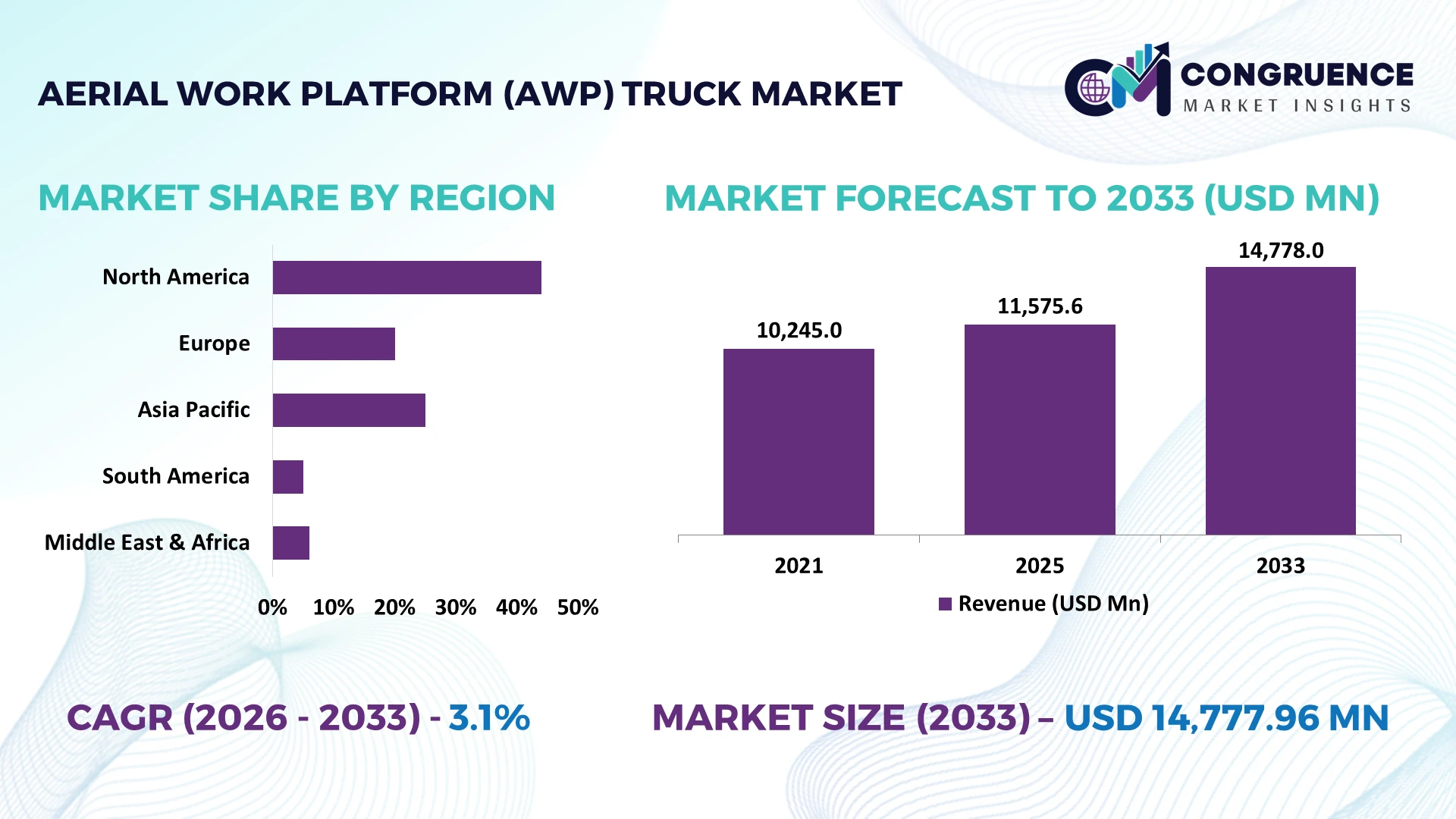
The Global Aerial Work Platform (AWP) Truck Market was valued at USD 11575.64 Million in 2025 and is anticipated to reach a value of USD 14777.96 Million by 2033 expanding at a CAGR of 3.1% between 2026 and 2033. Growth is driven by utility-grid modernization, telecom maintenance, data-center construction, urban infrastructure renewal, and replacement of conventional access equipment with electric, hybrid, and digitally monitored truck-mounted platforms.
The United States remains the dominant demand center, supported by an MEWP rental fleet of approximately 875,000 units in 2025, up 2% year-on-year, with utilization near 70%. Data-center projects, electrical utilities, facilities management, telecom networks, and highway maintenance sustain high equipment deployment. India recorded 14% fleet expansion, while Saudi Arabia posted 67% fleet growth as Vision 2030 megaprojects accelerated elevated-access requirements. Tariff uncertainty and higher financing costs have simultaneously increased emphasis on fleet utilization and lifecycle economics.
Strategically, manufacturers and rental operators should prioritize electric powertrains, telematics-enabled fleet management, compact vehicle-mounted configurations, and high-utilization infrastructure markets.
Market Size & Growth: USD 11,575.64 million in 2025 advances to USD 14,777.96 million by 2033 at 3.1% CAGR, supported by utility, telecom, data-center, and infrastructure maintenance.
Top Growth Drivers: Utility modernization, data-center construction, and rental penetration lead demand, while the U.S. MEWP fleet expanded 2% in 2025.
Short-Term Forecast: By 2027, telematics-led fleet optimization is positioned to push utilization above the 70% U.S. benchmark through improved dispatching, maintenance scheduling, and asset visibility.
Emerging Technologies: Battery-electric drivetrains, AI-enabled diagnostics, IoT telematics, and automated stabilization are reshaping advanced AWP truck design and reducing dependence on conventional hydraulic-only operating architectures.
Regional Leaders: North America anchors global demand with approximately 875,000 U.S. rental units; Europe maintains 64% utilization benchmarks, while India recorded 14% fleet expansion.
Consumer/End-User Trends: Rental operators increasingly prioritize compact scissors, low-level access equipment, vehicle-mounted platforms, and specialist machines as utilization economics outweigh fleet expansion strategies.
Pilot/Case Example: In 2025, the U.S. MEWP rental fleet increased 2% to approximately 875,000 units while utilization remained around 70%, demonstrating sustained project absorption.
Competitive Landscape: Terex, Oshkosh/JLG, Altec, Palfinger, and Time Manufacturing compete through working-height coverage, electrification, service networks, telematics, and application-specific truck integration.
Regulatory & ESG Impact: European fleet investment declined 6% in 2024 as operators prioritized replacement economics, while electrification increasingly targets applications where utilization and total ownership cost justify conversion.
Investment & Funding: U.S. fleet investment growth moderated to 5% in 2024 versus 13% previously, reinforcing a global shift from aggressive capacity additions toward selective fleet renewal.
Innovation & Future Outlook: Saudi Arabia's MEWP fleet expanded 67% in 2025, highlighting how infrastructure megaprojects and regional expansion are creating high-growth opportunities for connected, electric, and specialized AWP trucks.
The Aerial Work Platform (AWP) Truck Market is increasingly concentrated around utility maintenance, telecom infrastructure, data-center campuses, municipal services, tree care, and large construction projects requiring rapid mobile deployment. Battery-electric powertrains, hybrid systems, remote diagnostics, load sensing, automated outriggers, and fleet telematics are improving equipment availability and operating precision. U.S. MEWP utilization remained approximately 70% in 2025, reinforcing the importance of fleet productivity over simple capacity expansion. Meanwhile, Vision 2030 construction activity in Saudi Arabia is accelerating specialist access-equipment deployment, positioning technology differentiation and application-specific fleet strategies at the center of competitive planning.
Aerial work platform trucks are becoming strategically important as utilities, telecom operators, data-center contractors, municipalities, and rental companies prioritize safer mobile access with higher asset productivity. The U.S. MEWP rental fleet reached approximately 875,000 units in 2025, increasing 2%, while utilization remained near 70%. The key market shift is from fleet-volume expansion toward utilization, connected maintenance, and application-specific equipment, reinforced by tariff uncertainty and financing costs affecting capital-allocation decisions.
Electrified and telematics-equipped platforms increasingly outperform legacy diesel-only machines in urban and indoor operations by reducing idling, improving maintenance visibility, and lowering energy-intensive operating hours. Europe illustrates a mature operating environment, with fleet utilization around 64% in 2024 and investment declining 6%, whereas India's fleet expanded 24% as construction adoption accelerated. Saudi Arabia provides an even sharper contrast, with fleet size increasing 67% in 2025 amid megaproject deployment.
A practical example is U.S. data-center construction, where rental fleets provide flexible high-reach access without contractors maintaining permanently owned equipment. Through 2026–2028, operators will prioritize connected fleet management, electrified units, specialist booms, and disciplined replacement cycles. Competitive advantage will increasingly depend on utilization economics, service responsiveness, and technology-enabled lifecycle management rather than fleet scale alone.
Utility modernization, data-center construction, telecom maintenance, and complex infrastructure projects are strengthening demand for mobile elevated access. India's MEWP rental fleet expanded 24% in 2024, while utilization increased 4%, reflecting deeper substitution of scaffolding and manual access methods on construction sites. Saudi Arabia recorded 18% fleet expansion during the same period as Vision 2030 projects including NEOM, Qiddiya, and Riyadh infrastructure increased high-reach equipment requirements. In the U.S., fleet size subsequently rose 2% in 2025 despite elevated financing costs. Contractors gain faster site repositioning and eliminate repeated scaffold assembly, while rental companies capture higher equipment turnover. Manufacturers are responding with compact truck-mounted booms, higher working-height configurations, electrified platforms, telematics, and expanded service networks tailored to infrastructure-intensive applications.
High equipment acquisition costs, financing pressure, tariff exposure, and uneven rental pricing restrict aggressive fleet expansion, particularly among independent operators. U.S. MEWP fleet investment growth dropped from 13% in 2023 to 5% in 2024 as higher interest rates tightened capital allocation, while fleet growth stalled at approximately 857,000 units. European fleet investment simultaneously declined 6%, and rental rates increased only 1%, limiting operators' ability to recover higher equipment and financing costs through pricing. Tariffs introduced on competitively priced Chinese equipment further complicated European sourcing economics. The operational implication is significant: underutilized specialized trucks can dilute return on invested capital faster than standard rental assets. Operators are therefore extending replacement cycles, consolidating procurement, negotiating longer OEM agreements, and prioritizing fleet renewal over speculative capacity additions.
Electric powertrains, predictive diagnostics, geofencing, remote fleet monitoring, and automated stabilization create opportunities beyond conventional equipment replacement. U.S. fleet utilization remained approximately 70% in 2025, making incremental improvements in dispatch efficiency and downtime strategically valuable across an installed rental fleet of roughly 875,000 units. India's fleet expanded 24% in 2024, demonstrating substantial headroom for digitally managed rental models as formal powered-access adoption increases. Saudi Arabia presents another differentiated opportunity: MEWP fleet size surged 67% in 2025 as megaproject activity intensified. Battery-electric AWP trucks also strengthen positioning for low-emission municipal, warehouse, airport, and enclosed-site applications. OEMs and rental companies are investing in telematics integration, charging-compatible platforms, localized service capacity, and specialist fleets, turning equipment data into a recurring source of utilization and lifecycle-cost advantage.
Scaling connected and electrified AWP truck fleets requires technicians capable of servicing battery systems, electronic controls, sensors, telematics, and increasingly software-dependent safety functions. The challenge becomes more pronounced as fleet expansion outpaces local technical capacity: Saudi Arabia's MEWP fleet increased 67% in 2025, while India's fleet expanded 24% in 2024. In mature markets, U.S. utilization remained near 70%, meaning service interruptions directly threaten fleet economics and customer availability. Cybersecurity also becomes operationally relevant as connected machines transmit location, diagnostics, access-control, and utilization data across rental networks. Companies must therefore develop technician certification pipelines, standardized diagnostic architectures, secure over-the-air systems, spare-parts networks, and OEM-rental partnerships. Long-term competitiveness will depend on supporting increasingly sophisticated equipment consistently, not simply deploying more machines.
Fleet Utilization Replaces Volume Expansion: Rental operators are shifting from aggressive fleet additions toward productivity optimization. U.S. MEWP fleet growth moderated to roughly 2% in 2025 while utilization remained near 70%; European utilization stood near 64%. Operators are using telematics, centralized dispatch, and predictive servicing to increase revenue-generating hours without proportional fleet additions. Higher financing costs reinforce this asset-sweating strategy, prompting major rental groups to tighten procurement and selectively replace underperforming equipment.
Compact Equipment Gains Deployment Share: Low-level access, vertical-mast, and compact scissor configurations are gaining operational relevance on warehouses, commercial interiors, and congested construction sites. India's MEWP fleet expanded about 24% in 2024, with utilization improving roughly 4%, reflecting broader mechanization of elevated work. Manufacturers are shortening machine footprints, improving maneuverability, and expanding electric configurations, enabling contractors to replace labor-intensive ladders and scaffolding while reducing repositioning time.
Rental Pricing Discipline Intensifies: European rental rates increased only around 1% while fleet investment declined approximately 6%, creating stronger pressure on residual values, maintenance spending, and procurement discipline. Rather than transferring equipment-cost inflation fully to customers, operators are restructuring fleet mixes around higher-utilization categories and consolidating OEM purchasing. This shift makes lifecycle economics increasingly influential in platform selection.
Megaproject Fleets Become Specialized: Saudi Arabia's MEWP fleet expanded approximately 67% in 2025 following about 18% growth in 2024 as Vision 2030 construction accelerated. Large projects increasingly require high-reach booms, rough-terrain platforms, and application-specific equipment instead of standardized fleets. Suppliers are expanding local service coverage, technical support, parts inventories, and project-oriented rental partnerships to secure equipment availability.
Scissor lifts represent the leading type, accounting for an estimated 38% of AWP demand, supported by high fleet density, standardized operation, relatively low ownership costs, and extensive deployment across construction and maintenance workflows. Electric scissor platforms increasingly dominate indoor and slab applications where zero-emission operation, compact dimensions, and high utilization improve rental economics. Telescopic booms hold approximately 22% share and remain critical for long-reach outdoor work, while articulating booms gain preference where obstacles require multidirectional positioning.
Truck-mounted lifts are positioned as the fastest-growing type as utilities, telecom contractors, municipalities, and vegetation-management companies require road-mobile elevated access without equipment trailers. Their ability to combine transportation and lifting into one asset improves crew deployment speed. Vertical mast platforms remain strategically relevant for confined indoor environments. Manufacturers are consequently directing engineering toward lightweight booms, electric powertrains, automated outriggers, enhanced load sensing, and telematics, while expanding truck-chassis partnerships to address application-specific configurations.
Construction remains the largest application, representing approximately 42% of AWP truck and related elevated-access deployment, driven by commercial buildings, industrial projects, data centers, logistics facilities, and large infrastructure programs. Scissor and boom equipment provide repeatable elevated access across structural installation, mechanical systems, façade work, and fit-outs. Building maintenance contributes an estimated 18% of demand, supported by recurring inspection, cleaning, repair, and facilities-management requirements. Industrial maintenance remains comparatively mature, emphasizing equipment reliability and controlled access around production assets.
Utility work is the fastest-growing application as grid reinforcement, renewable-energy interconnection, storm restoration, and distribution-network upgrades increase demand for insulated and truck-mounted aerial devices. Telecommunications applications remain important as operators densify fiber and wireless networks, while maintenance fleets increasingly integrate telematics and location tracking. OEMs are adapting through insulated booms, higher payload capacities, automated stabilization, hybrid-electric systems, and application-specific bodies. Investment is consequently shifting toward machines capable of combining mobility, safety compliance, and high daily utilization.
Rental companies constitute the dominant end-user group, representing an estimated 45% of addressable AWP deployment because contractors increasingly prefer variable equipment access over ownership, particularly when working-height, terrain, and project-duration requirements change between sites. U.S. rental fleet utilization remained near 70% in 2025, demonstrating the operating intensity supporting this model. Construction contractors remain major customers but increasingly combine owned specialist machines with rented platforms, reducing capital tied to intermittently utilized assets.
Utility companies represent the fastest-growing end-user group as grid modernization, vegetation management, storm-response capability, and distribution-system hardening expand requirements for insulated truck-mounted lifts. Telecommunications companies favor road-mobile units for fiber and network maintenance, while industrial facilities emphasize compact electric platforms for recurring plant access. Manufacturers and rental groups are responding with utility-specific configurations, national service agreements, telematics packages, flexible rental contracts, and lifecycle-support programs. Competitive positioning is therefore shifting toward uptime guarantees and specialized fleet availability rather than equipment supply alone.
North America accounted for the largest market share at 30.0% in 2025 however, Asia-Pacific is expected to register the fastest growth, expanding at a CAGR of over 7.5% between 2026 and 2033.
Rental Scale and Infrastructure Maintenance Dominate
North America maintains the strongest AWP truck market position, accounting for approximately 30% of global demand in 2025, supported by extensive utility networks, mature equipment rental infrastructure, telecommunications maintenance, data-center construction, and regulated work-at-height practices. The U.S. MEWP rental fleet reached approximately 875,000 units in 2025, expanding 2% after remaining flat during 2024, while utilization settled near 70%. Facilities management and large data-center projects absorbed substantial rental capacity despite elevated financing costs and tariff uncertainty. Fleet operators are increasingly concentrating procurement on vehicle-mounted platforms, compact equipment, connected diagnostics, and specialist machines rather than indiscriminate capacity additions. OSHA-driven safety requirements reinforce mechanized elevated access, while established dealer and aftermarket networks reduce downtime. The commercial advantage increasingly rests on utilization, fleet availability, and rapid field service rather than equipment ownership alone.
United States Market Outlook: The United States combines the region's deepest rental ecosystem with large utility, broadband, data-center, municipal, and infrastructure maintenance requirements. Rental rates increased approximately 2% in 2025 while fleet utilization remained 70%, demonstrating resilient equipment absorption. National rental companies and OEM service networks increasingly use telematics and predictive diagnostics to improve dispatch efficiency and protect equipment uptime.
Fleet Optimization Replaces Aggressive Expansion
Europe represents a mature AWP truck environment where fleet economics, emissions requirements, safety compliance, and replacement discipline increasingly determine purchasing decisions. The MEWP rental fleet expanded only 1% in 2025 as operators shifted capital from capacity additions toward replacement and optimization. Rental rates increased approximately 1%, while Spain, Italy, and Nordic markets outperformed Germany, France, the Netherlands, and the UK. Demand remains comparatively resilient for vehicle-mounted platforms, compact scissors, low-level access equipment, and specialist spider lifts, whereas larger booms face greater utilization pressure. Electrification continues, but procurement has become more selective: rental companies increasingly evaluate duty cycle, charging availability, residual value, and total ownership cost before replacing combustion equipment. OEMs are strengthening distributor coverage and application-specific product availability; Palfinger's 2026 UK distribution partnership with Access Platform Sales illustrates this channel-led approach.
United Kingdom Market Outlook: The UK combines a mature rental sector with significant building maintenance, utility, telecom, and municipal access requirements. Palfinger appointed Access Platform Sales as its UK aerial-platform distribution partner in March 2026, strengthening equipment availability and technical support. Fleet buyers increasingly emphasize compact footprints, low-emission operation, serviceability, and specialized vehicle-mounted configurations suited to dense urban operating environments.
Mechanization Expands Beyond Mature Construction Hubs
Asia-Pacific is transitioning from equipment-volume expansion toward differentiated adoption across China, India, Japan, and developed industrial markets. China remains the region's manufacturing and installed-fleet heavyweight, but its rental sector entered correction during 2025 as oversupply and pricing pressure forced leading operators to halt procurement, dispose of assets, and rationalize branches. India followed the opposite trajectory: its MEWP market expanded 18% in 2025, supported by 14% fleet growth and improving utilization as government and private construction sites adopted mechanized access more widely. This divergence is redirecting supplier priorities toward lifecycle economics in China and dealer, rental, training, and service-network expansion in India. Japanese manufacturers retain advantages in engineering reliability and truck integration, while Chinese OEMs increasingly compete internationally through electric platforms, broader working-height portfolios, and aggressive distribution strategies. Safety formalization is becoming a decisive adoption catalyst across developing markets.
China Market Outlook: China combines extensive domestic manufacturing capability with one of the world's largest MEWP ecosystems, giving local OEMs advantages in component sourcing, scale, and product iteration. The 2025 rental correction is forcing operators away from fleet accumulation toward utilization and profitability. Manufacturers are consequently emphasizing electric platforms, export channels, aftermarket services, and higher-value machines rather than relying exclusively on domestic volume.
Infrastructure Maintenance Broadens Rental Demand
South America's AWP truck demand is concentrated in Brazil, where construction, electricity distribution, telecommunications, industrial maintenance, logistics facilities, and municipal services provide recurring applications for mobile elevated access. Rental remains strategically important because contractors can match working height and platform configuration to individual projects without absorbing full equipment ownership costs. Brazil's continuing renewable-energy and transmission build-out increases requirements for utility-oriented access equipment, while metropolitan telecom and building-maintenance activity supports compact truck-mounted platforms. Unlike the U.S. and Europe, however, fragmented service coverage, imported-component exposure, financing costs, and uneven operator training limit rapid fleet standardization. Distributors are therefore strengthening parts inventories, technician support, and rental partnerships rather than relying solely on direct equipment sales. Local service capability becomes particularly important for sophisticated hydraulic, electronic-control, and insulated aerial systems operating far from major industrial centers.
Brazil Market Outlook: Brazil provides the strongest operational base in South America through its extensive electricity network, large construction sector, telecom infrastructure, and concentrated industrial corridors around São Paulo, Minas Gerais, and Paraná. Renewable generation supplies more than 80% of domestic electricity, reinforcing maintenance requirements across geographically dispersed power assets where truck-mounted access provides mobility and rapid crew deployment.
Megaproject Deployment Reshapes Fleet Requirements
Middle East & Africa demand is increasingly concentrated around Gulf infrastructure programs, where construction scale and compressed project schedules require large fleets of specialized access equipment. Saudi Arabia became the standout deployment market in 2025: its MEWP rental sector expanded 49%, driven by a 67% increase in fleet size. NEOM, The Line, Riyadh Expo preparations, and FIFA World Cup-related infrastructure encouraged rental operators to add equipment rapidly, strengthening demand for high-reach booms, rough-terrain platforms, and truck-mounted configurations. UAE construction, facilities management, aviation, logistics, and utility projects provide an additional established equipment base. Across Africa, adoption remains more project-specific because financing, service coverage, and replacement-parts availability vary significantly. Suppliers are responding through Gulf distribution hubs, local service capacity, operator training, parts inventories, and rental partnerships designed to maintain uptime on capital-intensive projects.
Saudi Arabia Market Outlook: Saudi Arabia is the region's strongest near-term deployment center, with fleet expansion of 67% in 2025 demonstrating exceptional equipment mobilization. Vision 2030 projects are changing purchasing requirements from standard construction fleets toward high-reach, rough-terrain, and specialist platforms. Rental companies are consequently prioritizing local workshops, technician capacity, spare-parts availability, and rapid equipment redeployment between megaproject sites.
Global leaders JLG, Terex, Haulotte, Skyjack, and Dingli compete on broad fleet coverage, while Altec, Palfinger, Bronto Skylift, and CTE emphasize truck-mounted, utility, and specialist access applications. The five largest AWP manufacturers control approximately 55% of industry sales, giving scale leaders procurement, dealer, and aftermarket advantages. JLG and Terex together represent roughly 34% of the broader AWP market, while European specialists defend positions through customization and high-reach engineering. Competition is shifting from purchase price toward lifecycle economics: U.S. rental rates increased only 2% in 2025, while European fleet growth slowed to 1%, forcing OEMs to prove utilization and service value. Manufacturers are expanding electric platforms, telematics, distribution partnerships, and localized support; Palfinger's UK partnership illustrates channel expansion. Consolidation is also strengthening specialist portfolios. Certification, engineering capability, chassis integration, and service infrastructure remain formidable entry barriers. Winning requires application-specific equipment, dependable uptime, connected lifecycle support, and competitive total ownership cost.
Altec Industries, Inc.
Aichi Corporation
Bronto Skylift Oy Ab
CTE S.p.A.
Palfinger AG
Tadano Ltd.
Terex Corporation
TIME Manufacturing Company
Multitel Pagliero S.p.A.
SOCAGE S.r.l.
TEUPEN Maschinenbau GmbH
KLUBB Group
Zhejiang Dingli Machinery Co., Ltd.
RUNSHARE Heavy Industry Co., Ltd.
Current AWP truck technology is shifting toward electric drivetrains, electro-hydraulic controls, telematics, automatic stabilization, and high-strength lightweight structures. CTE’s use of 1.5-mm high-strength steel reduced upper-structure weight 20%, from roughly 1,250 kg to 1,000 kg, while preserving structural performance. Connected diagnostics increasingly support rental fleets operating near 70% utilization, enabling maintenance teams to prioritize faults, schedule service, and protect revenue-generating availability.
Emerging systems combine lithium-ion propulsion, regenerative energy management, load sensing, geofencing, remote diagnostics, and sensor-assisted collision protection. Compared with legacy 3–4-mm structural steel designs, advanced high-strength steel delivers approximately 20% lower upper-structure mass, increasing payload flexibility without sacrificing reach. JLG’s electric EC600AJ integrates two 10.7-kWh batteries, four-wheel AC drive, and 40% gradeability, demonstrating how electric platforms are moving beyond indoor duty into demanding construction applications.
Disruptive development through 2026–2028 will center on fully electric truck-platform integration, predictive maintenance, cloud fleet management, and increasingly automated setup. Bronto’s fully electric truck-mounted platform demonstrates chassis-platform electrification, while digital control architectures improve positioning and utilization visibility. Rental companies, utilities, and municipal fleets gain most because higher uptime and quieter operation improve asset economics. Early investment now secures service expertise, charging readiness, data capabilities, and differentiated low-emission fleets before these capabilities become procurement standards.
March 2024 – CTE’s MP 20 Ev, a 100% electric truck-and-platform configuration, won the IAPA Sustainability Award among 130 entries across 13 categories, validating zero-emission vehicle-mounted access technology for urban operations and accelerating commercial fleet electrification strategies globally. Source: IPAF
October 2024 – British Airways received the first three of four CTE MP 24 C truck-mounted platforms for aircraft maintenance across Edinburgh, Glasgow, Gatwick and Manchester, standardizing high-access maintenance workflows across four major UK airport maintenance locations nationwide. Source: AccessBriefing
April 2025 – Bronto Skylift confirmed JaloBMS as the first customer for its S70XT1-J, ordering two units for 2026 delivery; the platform delivers 230-foot working height and 108-foot outreach, strengthening specialist high-reach rental fleet capability internationally for contractors. Source: BrontoSkylift
March 2026 – PALFINGER appointed Access Platform Sales as its UK aerial-platform distribution partner effective April 1, extending sales and after-sales coverage through APS’s 35 years of market experience and strengthening localized customer support capabilities nationwide at scale. Source: PALFINGER
The report evaluates the Aerial Work Platform (AWP) Truck Market across telescopic boom, articulating boom, scissor lift, vertical mast, and truck-mounted lift configurations. Application coverage includes construction, building maintenance, utility work, telecommunications, and industrial maintenance, alongside demand from contractors, utilities, rental companies, telecom operators, and industrial facilities. Analysis spans North America, Europe, Asia-Pacific, South America, and Middle East & Africa, capturing mature rental ecosystems and emerging mechanized-access markets.
Technology coverage examines electrified drivetrains, telematics, automated stabilization, predictive maintenance, lightweight high-strength structures, sensor-based safety, and connected fleet management. With U.S. rental utilization near 70% and Saudi fleet deployment expanding sharply, the report assesses utilization economics alongside equipment volume. The 2026–2033 framework supports investment planning, geographic expansion, product positioning, partnership strategy, fleet optimization, and identification of specialized opportunities across utility, urban-access, low-emission, and high-reach applications.
| Report Attribute/Metric | Report Details |
|---|---|
Market Revenue in 2025 | USD 11575.64 Million |
Market Revenue in 2033 | USD 14777.96 Million |
CAGR (2026 - 2033) | 3.1% |
Base Year | 2025 |
Forecast Period | 2026 - 2033 |
Historic Period | 2021 - 2025 |
Segments Covered | By Type
By Application
By End-User
|
Key Report Deliverable | Revenue Forecast, Growth Trends, Market Dynamics, Segmental Overview, Regional and Country-wise Analysis, Competition Landscape |
Region Covered | North America, Europe, Asia-Pacific, South America, Middle East, Africa |
Key Players Analyzed | Altec Industries, Inc., Aichi Corporation, Bronto Skylift Oy Ab, CTE S.p.A., Palfinger AG, Tadano Ltd., Terex Corporation, TIME Manufacturing Company, Multitel Pagliero S.p.A., SOCAGE S.r.l., TEUPEN Maschinenbau GmbH, KLUBB Group, Zhejiang Dingli Machinery Co., Ltd., RUNSHARE Heavy Industry Co., Ltd. |
Customization & Pricing | Available on Request (10% Customization is Free) |




