
Reports
The Global Advanced Transportation Pricing System Market was valued at USD 5358.2 Million in 2025 and is anticipated to reach a value of USD 10598.49 Million by 2033 expanding at a CAGR of 8.9% between 2026 and 2033. Growth is driven by multi-lane free-flow tolling, congestion charging, GNSS-based road pricing, cloud back-office migration, AI-driven dynamic tariffs, and cashless highway-payment mandates.
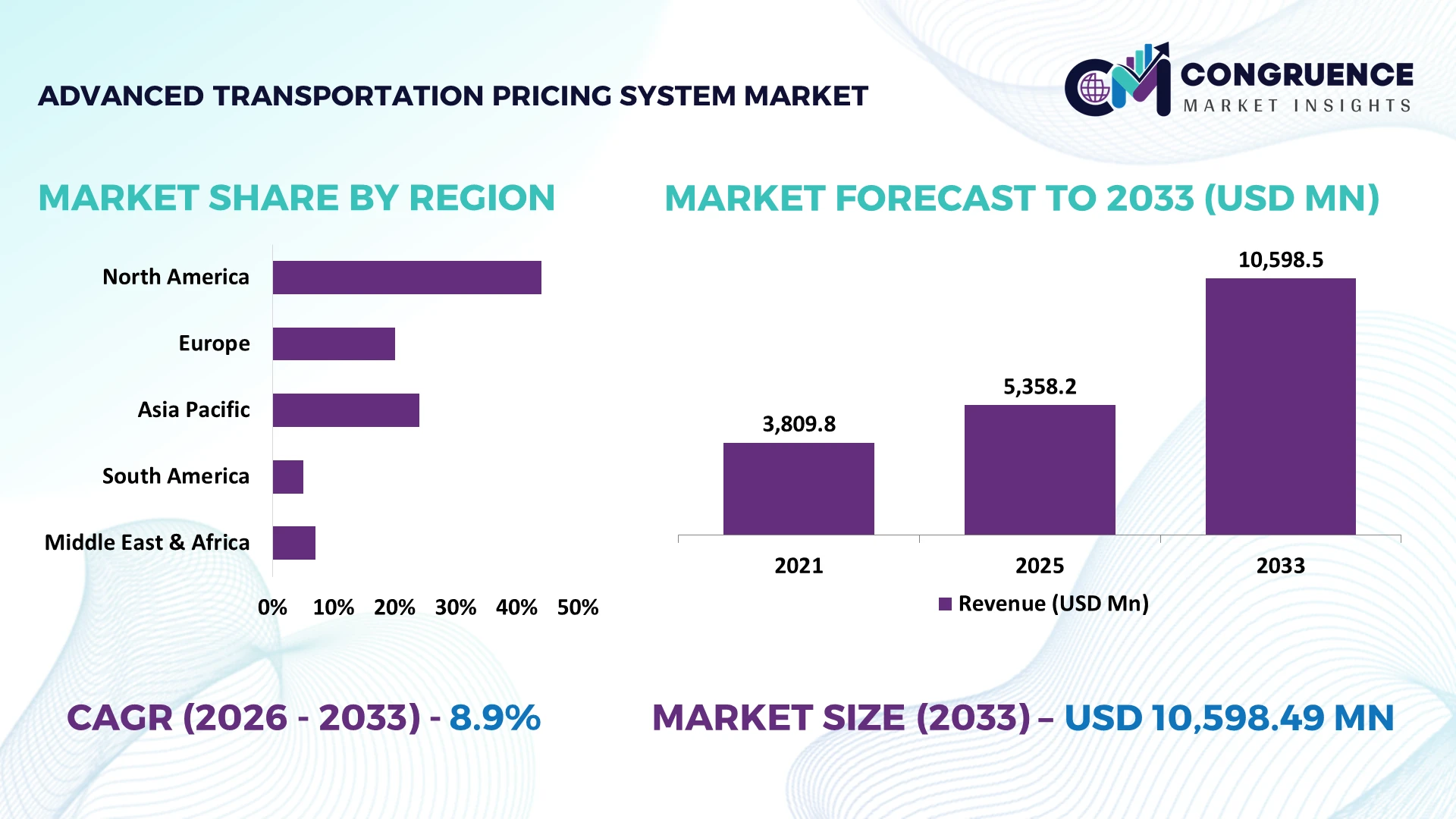
The United States leads the advanced transportation pricing ecosystem with roughly 22% market participation, supported by managed lanes, electronic tolling, VMT pilots, and USD 50 million annual federal congestion-relief funding. New York’s 2025 congestion-pricing program reduced zone entries by about 11%, while India’s FASTag network exceeds 98% penetration. Singapore provides a technology comparison, with more than 96% of vehicles equipped for GNSS-based ERP 2 deployment amid wider cross-border mobility digitalization.
Strategically, vendors combining cloud transaction processing, GNSS accuracy, interoperable payments, dynamic pricing algorithms, and regulatory integration will control the highest-value transportation modernization programs.
Market Size & Growth: USD 5.36 billion in 2025 reaches USD 10.60 billion by 2033 at 8.9%, supported by congestion charging and free-flow tolling.
Top Growth Drivers: Cloud deployment holds about 66%, India’s FASTag penetration exceeds 98%, and highway applications represent roughly 68% of electronic tolling activity.
Short-Term Forecast: By 2028, automated pricing and AI traffic analytics can reduce manual transaction handling by 20–30% across high-volume tolling operations.
Emerging Technologies: GNSS road pricing, AI dynamic tariffs, ANPR, and cloud payment orchestration are replacing fixed-gantry and fragmented back-office architectures.
Regional Leaders: By 2033, deployment-weighted estimates place North America near USD 3.7 billion, Asia-Pacific around USD 3.0 billion, and Europe near USD 2.5 billion.
Consumer/End-User Trends: India’s electronic highway payment penetration exceeds 98%, demonstrating motorists’ rapid transition toward account-based, frictionless road charging.
Pilot/Case Example: New York’s 2025 congestion-pricing deployment reduced daily entries into Manhattan’s charging zone by approximately 11%, or about 70,000 vehicles.
Competitive Landscape: ViaPlus holds roughly 6% share, competing with Conduent, Kapsch TrafficCom, TransCore, and Cubic across tolling software, payments, and managed services.
Regulatory & ESG Impact: Singapore’s ERP 2 rollout has equipped over 96% of registered vehicles, supporting GNSS-based charging and more precise congestion-management policies.
Investment & Funding: U.S. congestion-relief programs provide USD 50 million annually for integrated pricing, multimodal management, parking charging, and roadway-use initiatives.
Innovation & Future Outlook: Singapore transitions to GNSS-based ERP 2 in 2027, eliminating reliance on physical charging gantries and advancing location-sensitive road-pricing architecture.
Advanced Transportation Pricing Systems are becoming essential across electronic tolling, congestion management, managed lanes, parking, and distance-based road charging as governments digitize transport payments. Cloud platforms already represent about 66% of deployment, while GNSS, AI pricing engines, ANPR, and account-based payments are improving operational flexibility. Fuel-tax pressure and urban congestion are now accelerating the shift toward usage-based mobility pricing, setting up the strategic discussion.
Advanced transportation pricing is becoming strategic infrastructure as governments move from fixed toll plazas toward account-based, congestion-sensitive, and distance-based charging. India’s FASTag penetration exceeds 98%, while Singapore has equipped over 96% of registered vehicles for its next-generation ERP platform. This digital transition redirects investment from physical collection infrastructure toward cloud back offices, GNSS positioning, ANPR, payment orchestration, and real-time pricing engines.
Multi-lane free-flow systems eliminate tollbooth stopping and can reduce transaction-processing time by more than 30% compared with staffed collection workflows. New York’s congestion-pricing implementation provides a practical operational example: entries into the charging zone fell about 11%, equivalent to roughly 70,000 fewer vehicles daily. North America emphasizes congestion and managed-lane pricing, while Singapore advances GNSS road charging and India operates electronic tolling at national scale.
Through 2026–2028, pricing platforms will increasingly integrate AI traffic forecasting, digital wallets, connected vehicles, and location-based charging. Operators are restructuring technology contracts around interoperable cloud platforms and managed services rather than isolated tolling hardware. Competitive advantage will belong to providers combining transaction accuracy, cybersecurity, dynamic tariff management, and cross-network payment interoperability within one scalable platform.
The transition from manual toll collection toward barrier-free electronic charging is the strongest structural driver. India’s FASTag penetration exceeds 98%, transforming highway payments into an account-based digital workflow, while Singapore has equipped more than 96% of registered vehicles for its next-generation ERP system. New York’s congestion-pricing program has reduced charging-zone entries by approximately 11%, demonstrating that pricing technology influences traffic behavior as well as payment efficiency. Governments are consequently connecting tolling with congestion management, emissions policy, and road-network optimization. Technology suppliers are expanding cloud transaction platforms, ANPR accuracy, GNSS capabilities, and digital-payment integrations. The strategic shift is significant: future contracts increasingly reward vendors capable of managing complete pricing ecosystems rather than supplying standalone roadside collection equipment.
Legacy tolling infrastructure remains highly fragmented across tags, payment accounts, roadside equipment, enforcement rules, and jurisdiction-specific back offices. Even with India achieving more than 98% FASTag penetration, operators still manage reconciliation, disputed transactions, vehicle classification, and cross-network settlement complexity. In New York, approximately 11% fewer vehicles entering the priced zone changes traffic distribution beyond the charging boundary, requiring broader network monitoring. Singapore’s transition involving more than 96% of registered vehicles illustrates the scale of migration required when replacing established infrastructure. These integration requirements raise conversion costs and slow deployment across jurisdictions with older toll assets. Operators are mitigating disruption through phased migrations, open APIs, interoperable payment standards, and long-term system-integration contracts. The key constraint is increasingly software compatibility rather than roadside hardware availability.
GNSS-based road charging creates a major opportunity to replace location-specific tolling with distance, time, congestion, and vehicle-class pricing across entire networks. Singapore has already equipped over 96% of registered vehicles for its ERP 2 architecture, while India’s electronic toll-payment penetration above 98% provides a substantial digital foundation for future distance-based charging. Compared with fixed gantries, satellite positioning can reduce dependence on extensive roadside collection hardware by more than 20% across suitable network configurations. Between 2026 and 2028, connected-vehicle data, AI traffic forecasting, and digital wallets will make tariffs increasingly dynamic. Suppliers are investing in positioning accuracy, cloud billing, fraud analytics, and mobility-account platforms. The non-obvious opportunity lies in converting tolling infrastructure into continuous transportation-demand-management services.
Large-scale transportation pricing creates an expanding cybersecurity and data-governance challenge because payment credentials, vehicle identities, location histories, and enforcement records converge within connected platforms. India’s network operates at more than 98% electronic toll penetration, while Singapore’s ERP migration encompasses over 96% of registered vehicles, magnifying the operational consequences of system outages or compromised credentials. New York’s roughly 11% traffic reduction also demonstrates how pricing platforms influence network-wide mobility, making service continuity critical. GNSS spoofing, ANPR errors, account fraud, and cross-border privacy requirements add complexity beyond conventional toll collection. Operators must invest in encrypted credentials, redundant cloud infrastructure, automated fraud detection, and independent cybersecurity testing. Long-term leadership will depend on maintaining payment accuracy and public trust while processing increasingly granular mobility data at national scale.
Pricing Becomes Behavior Responsive: Singapore adjusted ERP charges across six locations and 14 time periods during late 2025, while increasing charges at four locations across nine periods when traffic speeds deteriorated. Operators are moving toward traffic-responsive tariff workflows, expanding automated monitoring and pricing analytics to maintain road throughput without adding physical capacity.
Vehicle Hardware Gains Service Functions: Singapore’s ERP 2 rollout moved from 65% vehicle installation in August 2025 to 87% by December and exceeded 96% in 2026. OBUs now deliver incident, flood, and speed-camera alerts alongside charging. Technology providers are consequently redesigning pricing hardware as recurring connected-mobility service platforms.
Policy Rebalances Electric-Vehicle Discounts: London increased its daily Congestion Charge from £15 to £18 in January 2026 while replacing the 100% cleaner-vehicle exemption with a 25% discount for qualifying electric cars. Pricing authorities are restructuring exemptions as EV adoption expands, protecting congestion-management effectiveness while maintaining differentiated incentives through automated accounts.
Subscription Tolling Changes User Economics: India launched the FASTag Annual Pass across approximately 1,150 toll plazas in August 2025; adoption exceeded 1.3 million users and 10 million transactions within that month. With FASTag penetration above 98%, operators are shifting from transaction-only tolling toward subscription-style products that improve payment predictability and customer retention.
Dynamic Pricing represents the leading type, accounting for an estimated 31–34% of market activity as transportation operators increasingly adjust tariffs using congestion levels, time windows, traffic speeds, and network conditions. Its advantage lies in extracting more operational value from existing road capacity without constructing additional lanes. Time-Based Pricing remains established, particularly in congestion-management schemes, while Zone-Based Pricing supports dense urban charging environments. Demand-Based Pricing increasingly integrates predictive analytics to refine tariffs according to changing network utilization.
Distance-Based Pricing is the fastest-growing type, with an estimated 18–21% positioning as GNSS technology reduces dependence on physical charging points. Singapore’s ERP 2 transition demonstrates this architectural shift, with more than 96% of registered vehicles equipped with next-generation OBUs by 2026. Suppliers are prioritizing satellite positioning, cloud billing, vehicle classification, and configurable pricing engines. Investment is consequently moving from fixed charging infrastructure toward software-controlled platforms capable of supporting multiple pricing methodologies.
Road Tolling remains the leading application, representing approximately 42–45% of advanced transportation pricing activity because national highways, expressways, bridges, and managed lanes generate continuous transaction volumes. India demonstrates the scale advantage, with FASTag penetration exceeding 98% across electronic highway tolling. Public Transit Fare Management follows through account-based ticketing and multimodal payments, while Parking Pricing increasingly uses occupancy data and digital payments to optimize curb and facility utilization.
Congestion Pricing is the fastest-growing application, representing an estimated 17–20% of market activity as cities increasingly use charges to influence traffic behavior rather than solely collect road fees. London raised its daily congestion charge 20%, from £15 to £18, in January 2026 while restructuring EV discounts. Ride-Hailing Pricing remains algorithmically mature but operationally distinct, using real-time supply-demand signals. Technology providers are integrating ANPR, payment accounts, traffic analytics, and enforcement engines, making centralized pricing orchestration increasingly important across transportation modes.
Toll Road Operators represent the leading end-user group, accounting for an estimated 35–38% of demand because continuous highway transactions require large-scale RFID, ANPR, lane equipment, account management, enforcement, and reconciliation infrastructure. Public Transit Authorities represent another established buyer group as fare systems transition toward contactless and account-based architectures. Parking Operators increasingly procure dynamic-pricing software, while Ride-Hailing Companies maintain sophisticated algorithmic pricing capabilities focused on balancing driver availability with passenger demand.
Government Transportation Agencies are the fastest-growing end-user group, representing approximately 22–25% of market activity as pricing becomes integrated with congestion policy, network management, and mobility planning. Singapore’s government-directed ERP 2 migration has already reached more than 96% of registered vehicles, illustrating public-sector influence over technology adoption. Vendors are targeting agencies through managed-service contracts, cloud platforms, policy-configurable tariff engines, and interoperability partnerships. Competitive positioning increasingly depends on supporting multiple transport modes through a common transaction and analytics architecture.
North America accounted for the largest market share at 34.8% in 2025 however, Asia-Pacific is expected to register the fastest growth, expanding at a CAGR of 11.6% between 2026 and 2033.
Congestion Pricing Reshapes Urban Mobility Economics
North America leads advanced transportation pricing through mature electronic tolling, managed lanes, congestion management, and increasingly cloud-based transaction platforms. The region accounts for approximately 34.8% of the market, with the United States concentrating deployment across interstate toll roads and major metropolitan corridors. New York’s congestion-pricing program provides a major operational benchmark: traffic entering Manhattan’s charging zone declined roughly 11%, equivalent to around 70,000 fewer vehicles daily during initial implementation. Transportation agencies are increasingly linking ANPR, digital accounts, traffic analytics, enforcement, and variable tariffs within unified platforms. Federal programs also support pricing-based congestion reduction, accelerating procurement of interoperable back-office technology. Operators are prioritizing multi-lane free-flow infrastructure and managed services as conventional tollbooth workflows lose operational relevance.
United States Market Outlook: The United States combines large toll-road networks with sophisticated managed-lane and urban-pricing deployments. New York demonstrates the behavioral impact of congestion charging, while states including Texas, Florida and Virginia operate extensive electronic tolling ecosystems. Federal congestion-relief programs provide approximately USD 50 million annually, supporting pricing, parking, multimodal management, and integrated transportation-demand initiatives.
Policy-Led Charging Moves Beyond Tolling
Europe combines mature motorway charging with increasingly sophisticated congestion, emissions, and distance-sensitive pricing frameworks. The region represents approximately 27.5% of market activity, supported by electronic toll collection in Germany, France, Italy, Austria, and other high-traffic networks. London illustrates the transition from simple congestion charging toward differentiated vehicle pricing: its daily Congestion Charge increased 20%, from £15 to £18, in January 2026, while qualifying electric cars moved from full exemption to a 25% discount. European interoperability requirements are simultaneously encouraging account portability and cross-border electronic toll services. Operators and technology suppliers are strengthening ANPR, vehicle classification, cloud settlement, and policy-configurable tariff engines. The structural shift increasingly favors platforms capable of administering road-use, congestion, and environmental pricing through common digital infrastructure.
United Kingdom Market Outlook: The United Kingdom remains strategically important because London operates one of the world’s most established urban road-pricing environments alongside extensive cashless road charging. The 2026 tariff restructuring demonstrates how authorities can recalibrate incentives as vehicle fleets change. This policy flexibility creates sustained requirements for vehicle classification, automated enforcement, account management, analytics, and configurable pricing software.
National-Scale Digital Tolling Accelerates Pricing Innovation
Asia-Pacific combines the world’s largest electronic tolling user bases with advanced GNSS and urban road-pricing experimentation. The region accounts for approximately 25.2% of the market, with India, China, Singapore, Japan, and South Korea driving deployment. India had issued 118.6 million FASTags by December 2025, with electronic collection exceeding 98% of National Highway user fees. Its Annual Pass reached roughly 4.2 million activations and processed more than 190 million transactions by year-end, showing how established toll-payment infrastructure can support new subscription pricing models. Singapore complements this scale with ERP 2, where more than 96% of registered vehicles have received next-generation onboard units. Suppliers are consequently expanding cloud billing, GNSS, ANPR, account-based payments, and barrier-free tolling platforms.
India Market Outlook: India provides the region’s strongest transaction-scale opportunity. FASTag’s greater than 98% collection penetration creates a nationwide digital foundation for barrier-less tolling and future distance-sensitive charging. The Annual Pass is already used for approximately 25% of non-commercial vehicle FASTag transactions, pushing technology providers toward higher-capacity reconciliation, fraud detection, mobile-account management, and automated vehicle identification.
Free-Flow Tolling Replaces Physical Plazas
South America is moving from conventional plaza-based tolling toward barrier-free road charging, with Brazil providing the strongest deployment base. The region represents approximately 6.9% of market activity, supported by highway concessions, urban mobility modernization, and growing electronic-payment adoption. Brazil’s federal free-flow framework uses gantries equipped with electronic tags, ANPR cameras, and vehicle sensors, eliminating mandatory stops and enabling eventual distance-proportional charging. By 2026, federal deployments covered 52 free-flow gantries across nine road sections, eight concessionaires, and six states. The Presidente Dutra corridor introduced 10 gantries across its São Paulo metropolitan section, illustrating deployment beyond isolated pilots. Concessionaires are restructuring toll operations around digital accounts, automated enforcement, and centralized transaction processing, although uneven road digitization still constrains broader regional replication.
Brazil Market Outlook: Brazil is the regional technology and regulatory reference point as ANTT progressively embeds free-flow requirements into federal highway concessions. Operational deployment now extends across major corridors including BR-101, BR-116, BR-381 and BR-364. The transition enables concessionaires to replace fixed plazas with scalable gantries while preparing for kilometer-based charging, creating demand for ANPR, tags, payment reconciliation, and enforcement platforms.
Variable Pricing Expands Mobility Platforms
Middle East & Africa accounts for approximately 5.6% of market activity, with advanced deployment concentrated in the United Arab Emirates and selected Gulf transportation networks. Dubai has moved decisively beyond fixed toll tariffs: Salik introduced variable pricing across its toll gates in January 2025, differentiating peak, off-peak, and zero-charge overnight periods. Total trips reached 852.7 million during 2025, while registered active vehicles increased 8.7% to approximately 4.8 million. The same payment ecosystem is expanding into barrier-free parking, demonstrating how toll accounts can become broader mobility-payment platforms. By the end of 2025, Salik-enabled parking covered 110 locations through its Parkonic partnership. This convergence is encouraging technology providers to integrate road pricing, parking, digital wallets, ANPR, and mobility services within unified customer accounts.
United Arab Emirates Market Outlook: The UAE leads regional deployment through Dubai’s high-volume digital tolling ecosystem and rapid smart-mobility integration. Salik operates 10 toll gates and processed 639.1 million chargeable trips during 2025. Variable tariffs and expansion into barrier-free parking demonstrate a broader strategy: using established vehicle accounts as infrastructure for multiple transport-payment services rather than limiting them to road toll collection.
Kapsch TrafficCom, Conduent Transportation, TransCore, Q-Free, and Cubic Transportation Systems compete for tolling, congestion-pricing, and mobility-payment contracts, while regional integrators challenge them through localized deployment and lower implementation costs. The top five suppliers collectively represent approximately 32% of market activity, reflecting fragmented procurement across transportation authorities. Technology increasingly outweighs hardware pricing: multi-lane free-flow systems can improve vehicle throughput by 20–30%, cloud back-office automation reduces manual processing requirements by approximately 15–25%, and ANPR platforms increasingly exceed 95% recognition accuracy under controlled conditions. Kapsch and Q-Free emphasize connected-road platforms; Conduent and TransCore compete through transaction processing and managed services; Cubic integrates multimodal payments. Competition is shifting from tolling equipment toward cloud-native pricing, GNSS, AI analytics, and account-based mobility platforms. Certification, installed infrastructure, transaction reliability, cybersecurity, and government procurement cycles remain entry barriers. Winning requires interoperable technology, proven high-volume processing, configurable tariffs, local implementation capacity, and long-term operating support.
Kapsch TrafficCom AG
Conduent Incorporated
TransCore
Q-Free ASA
Cubic Transportation Systems
Thales Group
Indra Sistemas, S.A.
Siemens Mobility
Yunex Traffic
Neology, Inc.
T-Systems International GmbH
Verra Mobility Corporation
SkyToll
Efkon GmbH
Current technology is centered on RFID electronic toll collection, ANPR, multi-lane free-flow gantries, cloud transaction processing, and account-based payments. India’s FASTag penetration exceeds 98%, demonstrating mature electronic-payment adoption at national scale. Modern ANPR systems can exceed 95% recognition accuracy under controlled conditions, while automated back-office workflows reduce manual transaction handling by approximately 15–25%, improving reconciliation speed, enforcement, and operating efficiency.
Emerging platforms combine GNSS positioning, AI traffic forecasting, dynamic tariff engines, digital wallets, and connected-vehicle data. Singapore’s ERP 2 deployment has equipped over 96% of registered vehicles with next-generation OBUs. Compared with legacy toll-plaza collection, barrier-free pricing can improve vehicle throughput by 20–30% by eliminating stopping and manual payment processes. Kapsch, Conduent, TransCore, and Q-Free benefit as agencies prioritize integrated software and managed services.
Between 2026 and 2028, disruptive development will center on distance-based road charging, predictive congestion pricing, AI enforcement, and unified mobility accounts spanning roads, parking, and transit. Cloud-native architectures will increasingly separate pricing logic from roadside hardware, accelerating tariff changes and system expansion. Suppliers securing GNSS accuracy, cybersecurity, interoperability, and scalable transaction processing now gain stronger positions as transportation agencies replace infrastructure-centric procurement with software-controlled mobility-pricing ecosystems.
July 2024 Conduent completed modernization of Ohio Turnpike tolling infrastructure, upgrading 216 lanes across the 241-mile corridor with open-road E-ZPass and automated payment options. The deployment expands cashless throughput while reducing dependence on conventional staffed toll-plaza operations significantly. Source: Conduent
May 2025 Q-Free secured a three-year agreement with Via Verde Portugal to supply 2.4 million interoperable tolling transponders. Devices operate across Portugal, Spain, and France, strengthening cross-border electronic tolling scale and reducing friction for motorists using multiple national networks significantly. Source: Q-Free
September 2025 MTA reported 17.6 million fewer vehicles had entered Manhattan’s congestion-pricing zone since January, a 12% reduction. The operational shift improved key crossing speeds while demonstrating how digital road pricing can actively reshape urban traffic demand and network performance. Source: Reuters
February 2026 Kapsch TrafficCom won Lithuania’s satellite tolling project covering 2,851 kilometers of roads for vehicles above 3.5 tons. The smartphone-enabled, distance-based system replaces vignette charging, establishing an infrastructure-light model for national road pricing and more precise usage-based collection. Source: Kapsch
The Advanced Transportation Pricing System Market report covers Dynamic Pricing, Demand-Based Pricing, Distance-Based Pricing, Time-Based Pricing, and Zone-Based Pricing. Application analysis includes Public Transit Fare Management, Road Tolling, Congestion Pricing, Parking Pricing, and Ride-Hailing Pricing, while end-user coverage evaluates transit authorities, toll road operators, parking operators, ride-hailing companies, and government transportation agencies.
Regional coverage spans North America, Europe, Asia-Pacific, South America, and Middle East & Africa, assessing regulatory frameworks, digital-payment maturity, infrastructure modernization, and deployment models. Technology analysis includes RFID, ANPR, multi-lane free-flow tolling, GNSS road charging, AI pricing engines, cloud back offices, and account-based mobility payments. With electronic toll penetration exceeding 98% in India and GNSS-ready vehicle deployment surpassing 96% in Singapore, the report supports investment planning, geographic expansion, technology partnerships, competitive benchmarking, and strategic positioning through 2026–2033.
| Report Attribute/Metric | Report Details |
|---|---|
Market Revenue in 2025 | USD 5358.2 Million |
Market Revenue in 2033 | USD 10598.49 Million |
CAGR (2026 - 2033) | 8.9% |
Base Year | 2025 |
Forecast Period | 2026 - 2033 |
Historic Period | 2021 - 2025 |
Segments Covered | By Type
By Application
By End-User
|
Key Report Deliverable | Revenue Forecast, Growth Trends, Market Dynamics, Segmental Overview, Regional and Country-wise Analysis, Competition Landscape |
Region Covered | North America, Europe, Asia-Pacific, South America, Middle East, Africa |
Key Players Analyzed | Kapsch TrafficCom AG, Conduent Incorporated, TransCore, Q-Free ASA, Cubic Transportation Systems, Thales Group, Indra Sistemas, S.A., Siemens Mobility, Yunex Traffic, Neology, Inc., T-Systems International GmbH, Verra Mobility Corporation, SkyToll, Efkon GmbH |
Customization & Pricing | Available on Request (10% Customization is Free) |




