
Reports
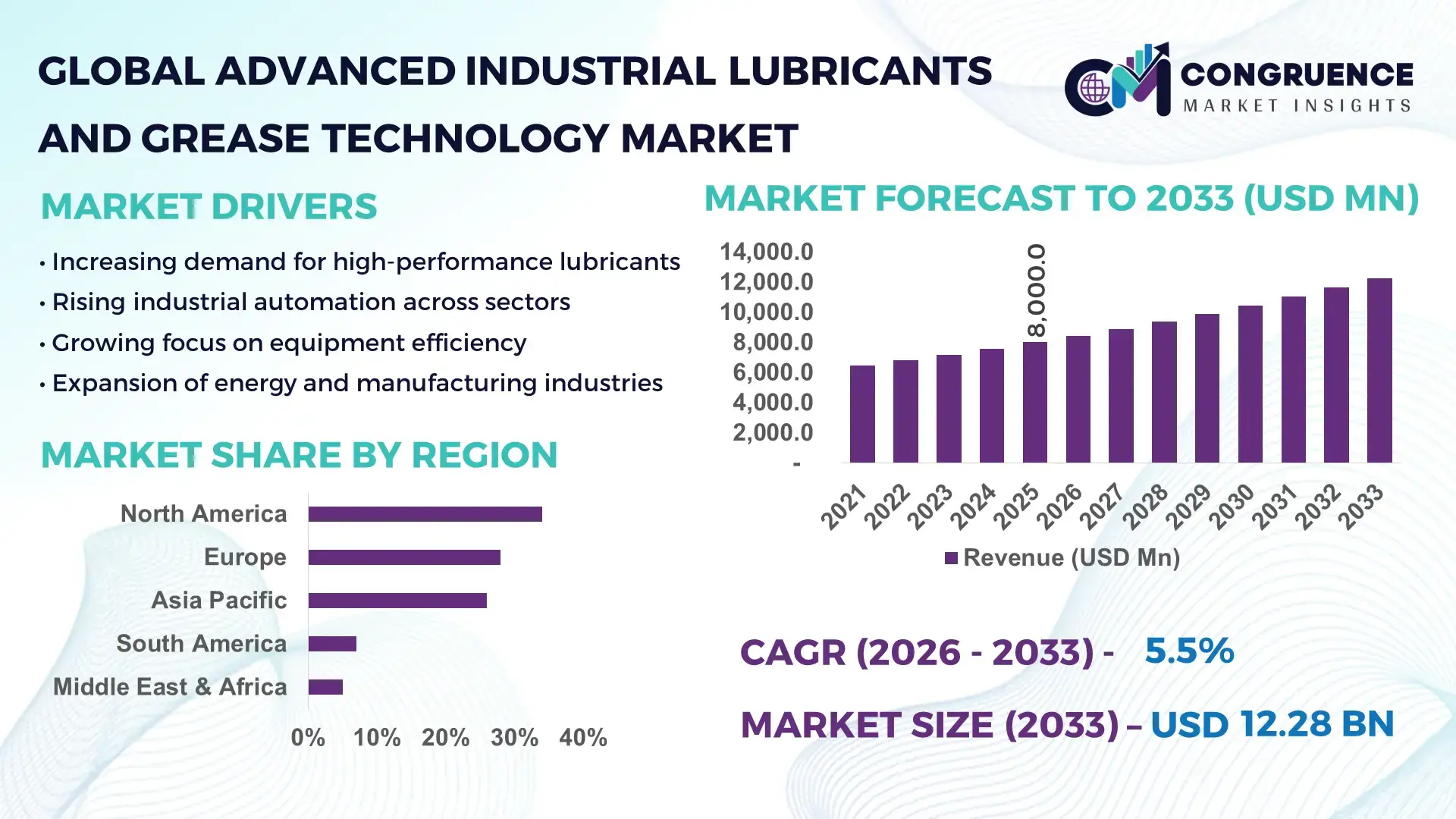
The Global Advanced Industrial Lubricants and Grease Technology Market was valued at USD 8,000.0 Million in 2025 and is anticipated to reach a value of USD 12,277.5 Million by 2033 expanding at a CAGR of 5.5% between 2026 and 2033, according to an analysis by Congruence Market Insights. Increasing demand for high-performance lubrication solutions across heavy industries is driving market expansion.
The United States leads the Advanced Industrial Lubricants and Grease Technology Market with over 28% of global production capacity concentrated in high-performance synthetic lubricants. The country processes more than 1.2 million metric tons of industrial lubricants annually, with approximately 35% dedicated to advanced formulations such as bio-based and nano-enhanced greases. Over 60% of large-scale manufacturing facilities in sectors such as aerospace, automotive, and energy utilize advanced lubrication technologies to enhance operational efficiency and reduce downtime. Investments exceeding USD 2.5 billion have been directed toward R&D in tribology and lubricant chemistry over the past five years, resulting in over 120 patented innovations annually. Industrial automation adoption in over 55% of U.S. manufacturing plants has further accelerated demand for precision lubrication systems integrated with IoT monitoring technologies.
Market Size & Growth: USD 8,000.0 Million in 2025, projected to reach USD 12,277.5 Million by 2033, growing at 5.5% CAGR driven by industrial automation expansion.
Top Growth Drivers: 42% adoption of synthetic lubricants, 35% efficiency improvement in machinery, 28% reduction in maintenance cycles.
Short-Term Forecast: By 2028, predictive lubrication systems expected to reduce downtime by 30%.
Emerging Technologies: Nano-lubricants, IoT-enabled lubrication monitoring, bio-based synthetic formulations.
Regional Leaders: North America (USD 4.2B by 2033, automation-driven), Europe (USD 3.1B, sustainability-driven), Asia-Pacific (USD 3.8B, manufacturing expansion).
Consumer/End-User Trends: 65% of manufacturers prioritize energy-efficient lubricants; 48% adopt condition-based monitoring.
Pilot or Case Example: In 2025, a smart factory reduced lubrication-related downtime by 27% using AI-based monitoring.
Competitive Landscape: Leader holds ~18% share; key players include Shell, ExxonMobil, TotalEnergies, Chevron, Fuchs.
Regulatory & ESG Impact: 40% industries shifting to bio-based lubricants to meet emission targets.
Investment & Funding Patterns: Over USD 3.5 billion invested in advanced lubrication R&D and smart systems.
Innovation & Future Outlook: Integration of AI-driven lubrication analytics and sustainable chemistry innovations shaping future growth.
The market is influenced by automotive (32%), manufacturing (28%), and energy sectors (18%) contributing to total demand. Advanced synthetic lubricants with nano-additives have improved equipment efficiency by up to 25%. Regulatory pressure for eco-friendly lubricants has increased adoption by 40% across Europe. Asia-Pacific consumption accounts for over 36% due to industrial growth. Future trends include smart lubrication systems and bio-based product innovation.
The Advanced Industrial Lubricants and Grease Technology Market plays a critical role in enabling operational efficiency, asset longevity, and sustainability across industrial sectors. The integration of nano-lubrication technology delivers 22% higher friction reduction compared to conventional mineral-based lubricants, significantly improving machinery performance and reducing wear rates. As industries adopt automation and Industry 4.0 frameworks, lubrication systems are evolving into intelligent, data-driven solutions capable of predictive maintenance and real-time performance optimization.
Asia-Pacific dominates in volume due to large-scale manufacturing output, while North America leads in adoption with over 58% of enterprises implementing smart lubrication monitoring systems. The convergence of IoT and AI technologies is transforming traditional lubrication practices into proactive asset management tools. By 2028, AI-powered lubrication systems are expected to improve equipment uptime by 35% and reduce maintenance costs by 25%, particularly in high-load industrial environments such as mining and energy production.
Sustainability initiatives are also shaping market strategies, with firms committing to 30% reduction in carbon emissions through the use of biodegradable and low-viscosity lubricants by 2030. In 2025, a major manufacturing firm in Germany achieved a 26% reduction in energy consumption through the adoption of advanced synthetic lubricants integrated with predictive analytics. The Advanced Industrial Lubricants and Grease Technology Market is increasingly positioned as a cornerstone for resilient, compliant, and sustainable industrial operations globally.
The Advanced Industrial Lubricants and Grease Technology Market is shaped by increasing industrialization, stringent environmental regulations, and the need for enhanced machinery efficiency. Rising demand from sectors such as automotive, energy, mining, and manufacturing is driving innovation in lubricant formulations. Approximately 62% of industrial facilities globally are transitioning toward high-performance lubricants to improve equipment reliability. Technological advancements such as nano-additives and synthetic base oils have enhanced lubrication efficiency by over 20%, while IoT-enabled monitoring systems are being adopted by nearly 45% of large enterprises. Additionally, sustainability requirements are pushing companies toward bio-based lubricants, which have seen a 38% increase in adoption across developed economies. The growing emphasis on predictive maintenance and digital transformation continues to redefine lubrication strategies across industries.
The rapid adoption of industrial automation is significantly increasing the demand for advanced lubrication technologies. Over 55% of manufacturing plants globally have implemented automated systems requiring high-precision lubrication to maintain efficiency and minimize downtime. Automated machinery operates under higher stress conditions, necessitating lubricants with superior thermal stability and wear resistance. Advanced lubricants improve machine lifespan by up to 30% and reduce friction losses by approximately 18%. Additionally, robotics deployment has increased by 25% annually in key industries, further accelerating demand for specialized greases. The integration of smart lubrication systems with sensors enables real-time monitoring, reducing maintenance frequency by nearly 35%. These advancements collectively enhance productivity and operational reliability, making advanced lubricants essential in automated environments.
The higher cost of synthetic and advanced lubricants compared to conventional mineral oils remains a significant barrier to widespread adoption. Advanced lubricants can cost 30% to 50% more than traditional alternatives, limiting their use among small and medium enterprises. Additionally, the need for specialized storage and handling increases operational costs by approximately 15%. In emerging economies, nearly 48% of industries still rely on conventional lubricants due to cost sensitivity. Limited awareness about long-term cost savings and efficiency benefits further restricts adoption. Furthermore, fluctuating raw material prices and supply chain disruptions have increased production costs by over 20%, creating pricing challenges for manufacturers and slowing market penetration in cost-sensitive regions.
Sustainability initiatives are creating significant opportunities for the development of eco-friendly lubricants. Bio-based lubricants have witnessed a 40% increase in adoption due to stringent environmental regulations and corporate sustainability goals. These lubricants reduce carbon emissions by up to 25% and improve biodegradability by over 60%. Industries such as marine and agriculture are increasingly adopting environmentally safe lubricants to comply with regulations. Additionally, advancements in green chemistry have enabled the development of high-performance bio-lubricants with comparable efficiency to synthetic variants. Government incentives supporting sustainable manufacturing have further accelerated adoption. The growing emphasis on circular economy practices and resource efficiency presents long-term growth opportunities for manufacturers focusing on eco-friendly product innovation.
Advanced lubricants often face performance variability under extreme operating conditions such as high temperatures, heavy loads, and corrosive environments. Approximately 35% of industrial equipment operates under such conditions, requiring highly specialized formulations. Inconsistent performance can lead to equipment failure rates increasing by up to 12%, impacting productivity. Developing lubricants that maintain stability across diverse conditions requires extensive R&D investments, which have increased by 18% in recent years. Additionally, compatibility issues with existing machinery systems create adoption barriers. Testing and certification processes for high-performance lubricants are complex and time-consuming, delaying product launches. These challenges necessitate continuous innovation and quality assurance, increasing overall development costs and slowing market expansion.
Increasing adoption of nano-lubricants: Over 42% of industrial users are adopting nano-enhanced lubricants that improve friction reduction by 25% and extend equipment life by 30%, particularly in high-load applications such as mining and heavy manufacturing.
Growth in IoT-enabled lubrication systems: Around 48% of large-scale industries are integrating IoT sensors into lubrication systems, enabling real-time monitoring and reducing maintenance frequency by 35% while improving operational efficiency by 20%.
Shift toward bio-based lubricants: Approximately 40% of manufacturers in Europe and North America are transitioning to bio-based lubricants, reducing environmental impact by 25% and meeting regulatory compliance requirements.
Expansion of predictive maintenance technologies: Nearly 50% of industrial facilities are implementing predictive maintenance strategies, resulting in downtime reduction of 30% and maintenance cost savings of 22% through advanced lubrication analytics.
The Advanced Industrial Lubricants and Grease Technology Market is segmented based on type, application, and end-user, reflecting diverse industrial requirements. Synthetic lubricants dominate due to their superior performance characteristics, while bio-based variants are gaining traction due to environmental regulations. Applications span across automotive, manufacturing, energy, and mining sectors, with manufacturing accounting for the highest usage due to continuous machinery operations. End-users include heavy industries, SMEs, and energy producers, with large enterprises leading adoption due to higher capital investment capabilities. Approximately 65% of demand is driven by high-load industrial applications, while precision engineering accounts for nearly 20%. The segmentation highlights the increasing importance of specialized lubrication solutions tailored to specific industrial needs.
Synthetic lubricants account for approximately 48% of total adoption due to their superior thermal stability and extended lifecycle, while mineral-based lubricants hold around 32%. However, bio-based lubricants are the fastest-growing segment, expected to expand at a CAGR of 6.8% due to rising environmental concerns and regulatory mandates. Greases with advanced additives contribute nearly 20% and are widely used in heavy-load applications. Synthetic lubricants dominate due to their ability to reduce friction by up to 25% and extend equipment life by 30%. Bio-based lubricants are gaining traction due to their biodegradability and lower toxicity levels, making them suitable for environmentally sensitive applications.
• In 2025, a national research institute reported that nano-enhanced synthetic lubricants improved industrial machine efficiency by over 22% in high-temperature environments.
Manufacturing applications account for approximately 38% of total usage, followed by automotive at 26% and energy sector at 18%. However, the renewable energy segment is the fastest-growing, expanding at a CAGR of 6.2% due to increased wind and solar installations requiring specialized lubricants. Over 52% of manufacturing plants rely on advanced lubricants for continuous operations. Around 45% of automotive OEMs have adopted synthetic lubricants for improved engine efficiency.
• In 2025, over 40% of global wind turbines utilized advanced lubrication systems, improving operational efficiency by 28%.
Large enterprises dominate with 55% adoption due to higher investment capacity, while SMEs account for 30%. The energy sector is the fastest-growing end-user, expanding at a CAGR of 6.5% due to increasing renewable energy installations. Approximately 60% of oil & gas companies utilize advanced lubricants for high-load operations.
• In 2025, a major industrial firm improved equipment lifespan by 27% through advanced lubrication systems implementation.
North America accounted for the largest market share at 34% in 2025 however, Asia-Pacific is expected to register the fastest growth, expanding at a CAGR of 6.2% between 2026 and 2033.
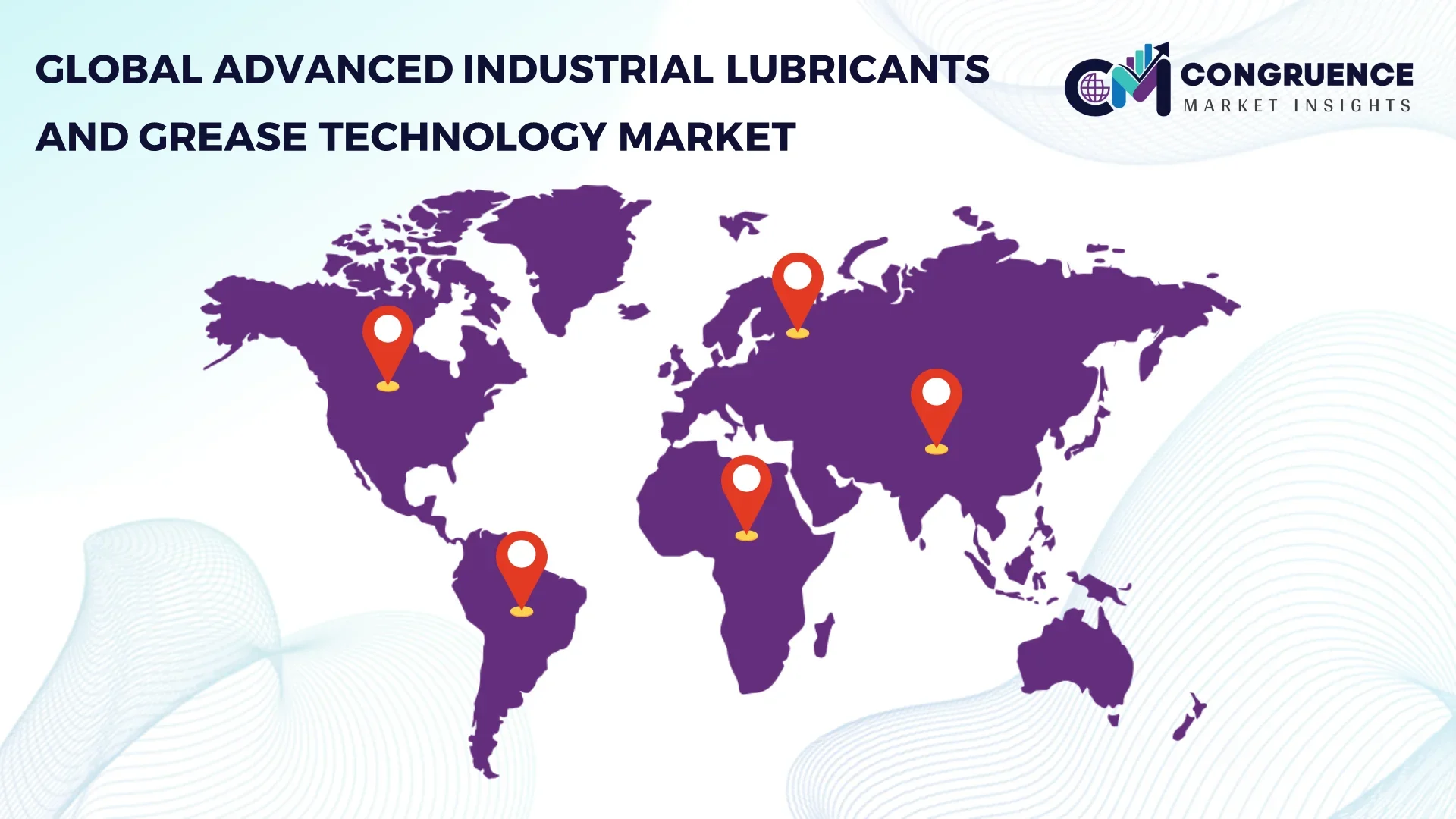
North America processes over 1.5 million metric tons of industrial lubricants annually, while Asia-Pacific accounts for over 26% of total consumption due to manufacturing expansion. Europe contributes approximately 28% driven by sustainability initiatives. Latin America and Middle East & Africa together account for nearly 12%, supported by energy and infrastructure sectors. Industrial automation adoption exceeds 55% in developed regions, while emerging economies are witnessing a 40% increase in advanced lubricant usage.
North America holds approximately 34% market share driven by advanced manufacturing and energy sectors. The U.S. leads with over 60% adoption of synthetic lubricants. Regulatory frameworks promoting energy efficiency and sustainability are accelerating demand for bio-based lubricants. Over 55% of industries use IoT-based lubrication systems. A major player has introduced AI-based lubrication monitoring, reducing downtime by 28%. Consumer behavior reflects high preference for performance-enhancing solutions.
Europe accounts for around 28% of the market with strong presence in Germany, UK, and France. Over 45% of companies have shifted to eco-friendly lubricants. Regulatory pressure from environmental agencies is driving innovation. Advanced technologies such as nano-lubricants are adopted by 38% of industries. A regional manufacturer has invested heavily in biodegradable lubricants. Consumer behavior emphasizes sustainability compliance.
Asia-Pacific leads in consumption with over 26% share driven by China, India, and Japan. Manufacturing output contributes significantly to demand. Over 50% of new industrial projects incorporate advanced lubrication technologies. A leading regional player expanded production capacity by 20%. Consumer behavior is driven by cost-efficiency and industrial expansion.
South America holds around 7% share led by Brazil and Argentina. Energy and mining sectors drive demand with over 40% usage. Government policies supporting industrial development are boosting adoption. A local player increased production capacity by 15%. Consumer behavior is influenced by infrastructure and energy sector needs.
Middle East & Africa accounts for nearly 5% share driven by oil & gas and construction sectors. UAE and South Africa are key markets. Over 50% demand comes from energy sector. Technological modernization is increasing adoption of advanced lubricants. A regional player introduced high-performance greases improving efficiency by 20%. Consumer behavior is driven by industrial expansion.
United States – 28% Market share: Strong industrial base and high adoption of advanced lubrication technologies
China – 22% Market share: Large-scale manufacturing and infrastructure development driving demand
The Advanced Industrial Lubricants and Grease Technology Market is moderately fragmented with over 120 active global and regional competitors. The top five companies collectively account for approximately 52% of the market, indicating a semi-consolidated structure. Leading players focus on product innovation, sustainability, and strategic partnerships to strengthen market position. Over 65% of companies are investing in R&D for advanced formulations such as nano-lubricants and bio-based products.
Mergers and acquisitions have increased by 18% over the past three years, enabling companies to expand geographic presence and technological capabilities. Additionally, partnerships with industrial automation firms are enabling integration of smart lubrication systems. Competitive differentiation is largely driven by performance efficiency, environmental compliance, and digital integration capabilities.
ExxonMobil
Chevron
TotalEnergies
Fuchs Petrolub
BP Lubricants
Valvoline
PetroChina Lubricants
Idemitsu Kosan
Lukoil Lubricants
Phillips 66 Lubricants
Indian Oil Corporation
Petronas Lubricants
Sinopec Lubricants
Advanced technologies are transforming the lubrication landscape with significant improvements in efficiency and sustainability. Nano-lubricants enhance friction reduction by up to 25% and improve thermal stability by 30%. IoT-enabled lubrication systems are adopted by over 45% of large enterprises, enabling real-time monitoring and predictive maintenance. AI-driven analytics optimize lubrication schedules, reducing downtime by 35% and maintenance costs by 22%. Bio-based lubricants are gaining traction, with adoption increasing by 40% due to environmental regulations.
Advanced additive technologies improve wear resistance by 20% and extend equipment lifespan. Digital twins and simulation tools are being used to test lubricant performance, improving efficiency by 18%. These technological advancements are driving innovation and competitiveness in the market.
• In November 2025, Shell confirmed it retained its position as the world’s leading finished lubricants supplier for the 19th consecutive year, with an estimated 11.6% global share across automotive and industrial segments, supported by continuous investment in premium and high-efficiency lubricant technologies. Source: www.shell.com
• In 2025, Shell Lubricants India launched a new portfolio of advanced lubricant products designed for industrial and automotive applications, incorporating next-generation additive technologies aimed at improving equipment protection, extending oil drain intervals, and enhancing energy efficiency across diverse operating environments.
• In 2025, ExxonMobil advanced its specialty products segment by expanding high-value lubricant-related production capacity, including the startup of new processing technologies at its Singapore facility that convert lower-value feedstocks into premium lubricant base stocks and performance materials.
• In 2025, ExxonMobil reported expansion of advanced recycling and performance chemical capabilities, increasing processing capacity to over 250 million pounds annually, enabling production of higher-value materials used in lubricant formulations and supporting circular economy initiatives in industrial applications.
The Advanced Industrial Lubricants and Grease Technology Market Report provides a comprehensive analysis of market segments including type, application, and end-user industries. It covers synthetic, mineral-based, and bio-based lubricants, along with specialized greases used in heavy industrial applications. The report examines key industries such as automotive, manufacturing, energy, mining, and aerospace, which collectively account for over 80% of total demand. Regional analysis includes North America, Europe, Asia-Pacific, South America, and Middle East & Africa, highlighting consumption patterns and industrial trends.
The scope also includes technological advancements such as nano-lubricants, IoT-enabled monitoring systems, and AI-driven predictive maintenance solutions. It evaluates regulatory frameworks influencing market adoption, including environmental standards promoting sustainable lubricants. The report further explores emerging trends such as digital transformation and smart manufacturing, which are reshaping lubrication strategies. Additionally, it provides insights into competitive landscape, innovation strategies, and investment patterns. The report serves as a strategic tool for decision-makers to understand market dynamics, identify growth opportunities, and formulate long-term business strategies.
| Report Attribute / Metric | Details |
|---|---|
| Market Revenue (2025) | USD 8,000.0 Million |
| Market Revenue (2033) | USD 12,277.5 Million |
| CAGR (2026–2033) | 5.50% |
| Base Year | 2025 |
| Forecast Period | 2026–2033 |
| Historic Period | 2021–2025 |
| Segments Covered |
By Type
By Application
By End-User Insights
|
| Key Report Deliverables | Revenue Forecast; Market Trends; Growth Drivers & Restraints; Technology Insights; Segmentation Analysis; Regional Insights; Competitive Landscape; Regulatory & ESG Overview; Recent Developments |
| Regions Covered | North America; Europe; Asia-Pacific; South America; Middle East & Africa |
| Key Players Analyzed | Shell; ExxonMobil; Chevron; TotalEnergies; Fuchs Petrolub; BP Lubricants; Valvoline; PetroChina Lubricants; Idemitsu Kosan; Lukoil Lubricants; Phillips 66 Lubricants; Indian Oil Corporation; Petronas Lubricants; Sinopec Lubricants |
| Customization & Pricing | Available on Request (10% Customization Free) |




