
Reports
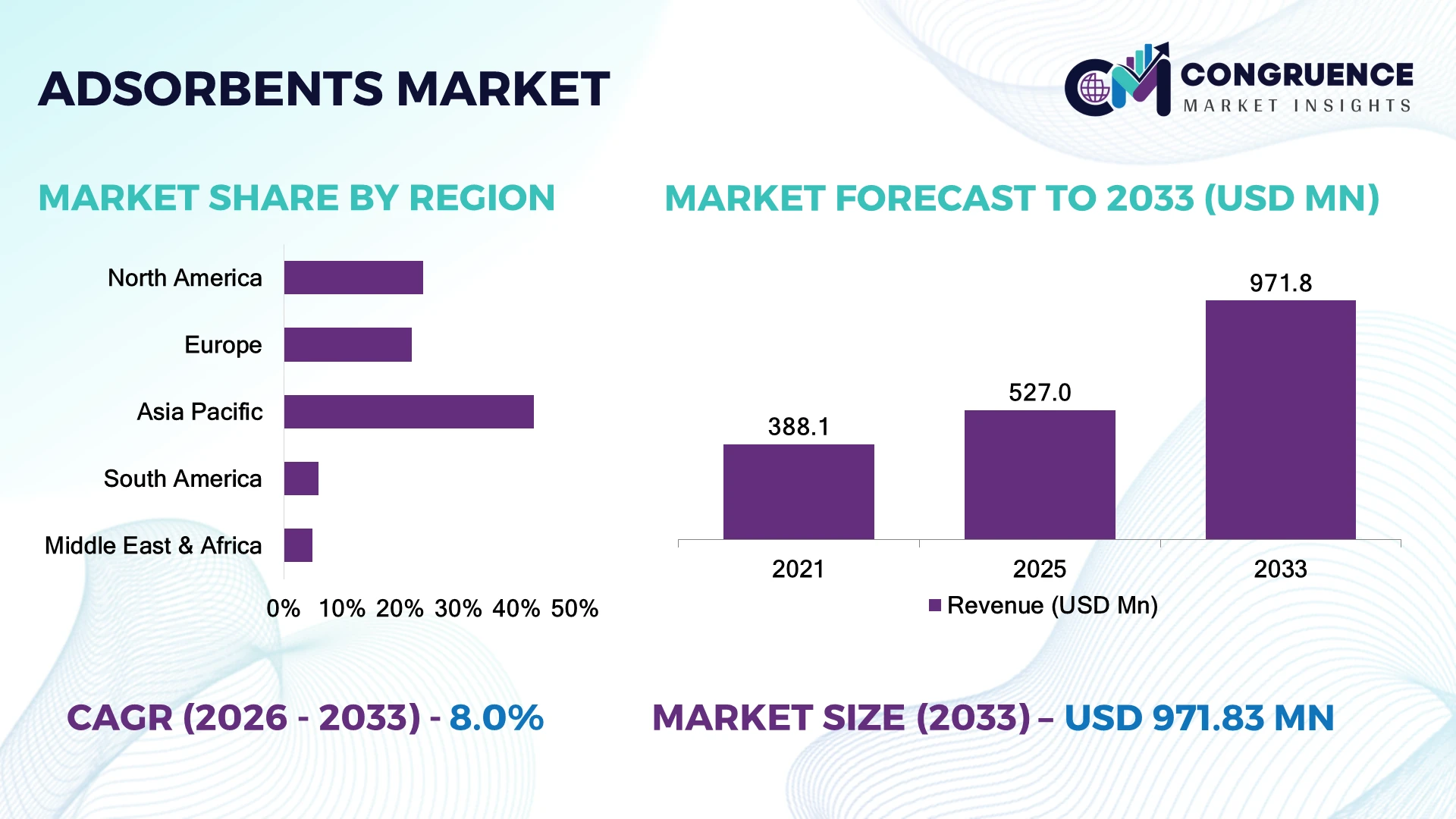
The Global Adsorbents Market was valued at USD 527.0 Million in 2025 and is anticipated to reach a value of USD 971.8 Million by 2033 expanding at a CAGR of 7.95% between 2026 and 2033. Tightening industrial emission standards and large-scale investments in gas purification, water treatment, and petrochemical processing are accelerating deployment of advanced adsorbent materials across high-volume industrial operations.
China remains the dominant country in the global adsorbents market, accounting for approximately 34% of global production capacity, supported by over USD 15 billion in petrochemical and industrial air-quality investments. The country processes more than 60% of global rare-earth materials used in specialty adsorption applications and operates one of the world's largest refining sectors. Compared with Germany, where advanced molecular sieve adoption exceeds 45% in specialty manufacturing, China leads on scale while Germany leads on process efficiency. Ongoing industrial modernization and environmental compliance programs continue strengthening China's market position.
Strategic implication companies that secure feedstock access, localized manufacturing, and advanced adsorption technologies will gain stronger pricing power and long-term industrial contracts.
Market Size & Growth: USD 527.0 Million in 2025 is projected to reach USD 971.8 Million by 2033, supported by rapid expansion of gas separation, industrial purification, and emission-control infrastructure.
Top Growth Drivers: Industrial air treatment demand contributes nearly 38% of incremental adoption, water purification 31%, and petrochemical processing 24%, reflecting diversified high-growth demand streams.
Short-Term Forecast: By 2028, adsorption system efficiency is expected to improve by 18% while industrial purification operating costs decline by approximately 12% through material optimization.
Emerging Technologies: AI-driven process monitoring, engineered molecular sieves, and high-capacity activated carbon solutions are increasing adsorption performance by 15–20% in industrial deployments.
Regional Leaders: Asia Pacific is projected to exceed USD 420 Million, North America USD 240 Million, and Europe USD 180 Million, driven by environmental compliance and industrial modernization initiatives.
Consumer/End-User Trends: More than 55% of new industrial purification projects now prioritize high-efficiency adsorbent systems to reduce downtime and improve process consistency.
Pilot/Case Example: In 2024, an industrial gas purification project in China reported a 17% reduction in contaminant breakthrough rates after deploying advanced molecular sieve technologies.
Competitive Landscape: The leading supplier controls approximately 11% market share, while key participants include BASF, Honeywell, Arkema, Clariant, and Calgon Carbon.
Regulatory & ESG Impact: Stricter emission-control policies have increased industrial adsorption technology deployment by nearly 22% across major manufacturing economies.
Investment & Funding: More than USD 3 billion has been allocated toward purification infrastructure, specialty materials expansion, and strategic partnerships amid supply-chain realignment.
Innovation & Future Outlook: Next-generation hybrid adsorbents and circular-material regeneration technologies are improving material utilization rates by over 20%, strengthening long-term operational efficiency.
The Adsorbents Market is being reshaped by rising demand from industrial gas processing, wastewater treatment, renewable fuels, and semiconductor manufacturing. Advanced molecular sieves, activated carbon innovations, and regenerable adsorption systems are improving contaminant removal efficiency while reducing operational downtime. Nearly 30% of newly commissioned purification facilities now incorporate higher-capacity adsorption technologies. As environmental compliance requirements tighten and supply chains prioritize cleaner processing methods, adoption is increasingly shifting toward performance-optimized materials, setting the stage for deeper strategic transformation across industrial value chains.
Adsorbents have become strategically important because they sit at the center of industrial purification, environmental compliance, and resource-efficiency initiatives. Companies across refining, chemicals, natural gas, electronics, and water treatment increasingly depend on adsorption technologies to meet stricter performance requirements. Supply-chain restructuring and growing investment in domestic processing capacity are further elevating the importance of reliable adsorbent supply networks.
Modern engineered molecular sieves deliver up to 25% higher contaminant capture efficiency than conventional adsorption materials while reducing regeneration frequency by approximately 15%. This operational advantage improves throughput and lowers maintenance interruptions. China continues to dominate production scale through integrated manufacturing ecosystems, while Germany and Japan focus on specialty adsorbents, advanced process control, and high-value industrial applications. This contrast is creating distinct competitive strategies centered on either volume leadership or technology differentiation.
Over the next two to three years, industrial purification upgrades and clean-manufacturing projects are expected to accelerate adoption. For example, gas processing facilities are increasingly integrating smart monitoring systems that improve adsorption bed utilization by more than 10%. Companies are responding through capacity expansion, technology partnerships, and specialty material development. Organizations that combine supply security with high-performance adsorption solutions will secure stronger competitive positioning and long-term industrial relevance.
Stricter emission-control requirements and growing investment in industrial purification infrastructure remain the primary drivers of adsorbent adoption. More than 40% of new refinery modernization projects now include upgraded adsorption systems, while industrial water treatment installations have increased by nearly 18% over the past three years. China continues expanding petrochemical and gas-processing capacity, creating sustained demand for activated carbon and molecular sieve technologies. The direct impact is higher utilization of advanced purification systems across manufacturing operations. In response, companies are expanding production facilities, investing in specialty materials, and forming technology partnerships to improve adsorption efficiency. A notable strategic insight is that buyers increasingly prioritize lifecycle performance rather than upfront material costs, reshaping supplier competition around operational value and process reliability.
Adsorbent manufacturers face persistent pressure from feedstock volatility and energy-intensive production processes. Production costs for certain specialty adsorbents can fluctuate by 15–20% depending on raw material availability, while energy expenses account for more than 25% of operating costs in several manufacturing facilities. Supply concentration in China for critical materials creates procurement risks during trade disruptions and logistics bottlenecks. These constraints directly affect profitability, pricing stability, and production planning. Companies are reducing exposure through localized sourcing, long-term supply agreements, and investment in regeneration technologies that extend material lifespan. A key operational insight is that firms with diversified supplier networks are maintaining more consistent delivery performance despite global supply-chain disruptions.
Emerging opportunities are developing around advanced gas separation, carbon management, hydrogen processing, and circular manufacturing systems. High-performance adsorbents can improve separation efficiency by more than 20%, while regenerated materials reduce replacement requirements by approximately 30%. Japan and South Korea are accelerating investment in next-generation purification technologies supporting semiconductor and clean-energy supply chains. Companies are positioning through R&D collaborations, specialty product launches, and ecosystem partnerships focused on process optimization. A particularly valuable opportunity lies in smart adsorption systems integrated with digital monitoring platforms that enhance material utilization and reduce operational waste. Organizations that combine advanced materials with predictive process management are expected to capture premium industrial contracts.
The biggest long-term challenge involves scaling advanced adsorption technologies while maintaining performance consistency across diverse industrial environments. Specialty adsorbents often require highly controlled production conditions, and quality deviations as small as 5–8% can significantly affect separation performance. Growing complexity in semiconductor, hydrogen, and specialty chemical applications is increasing technical qualification requirements. The result is longer deployment cycles and higher operational validation costs. Companies must invest in manufacturing precision, process automation, and specialized workforce development to maintain competitiveness. A critical strategic insight is that future market leaders will be defined not only by material innovation but by their ability to deliver reliable performance at industrial scale across multiple end-use sectors.
Advanced Molecular Sieve Scaling Industrial gas processors are increasing molecular sieve deployment, with adsorption-cycle efficiency improving by 18% and contaminant removal rates rising by nearly 22%. Semiconductor and hydrogen facilities in Japan are accelerating adoption of high-purity separation systems. The shift is reducing regeneration frequency and improving throughput consistency, prompting suppliers to expand specialty manufacturing capacity and technology partnerships.
Regeneration-Centric Operating Models Regenerated adsorbents now account for approximately 28% of industrial replacement volumes, while material lifecycle utilization has improved by 20% in large processing facilities. Rising energy costs and sustainability targets are driving this transition. Companies are restructuring service offerings around regeneration programs, lowering disposal requirements and reducing procurement volatility across purification-intensive operations.
Digital Adsorption Process Control Smart monitoring platforms are increasing adsorption bed utilization by 12–15% while reducing unplanned maintenance events by nearly 10%. Chinese petrochemical operators are integrating sensor-based process analytics into purification workflows. The result is faster operational decision-making and more predictable performance. Suppliers are responding through automation investments, software integration, and predictive maintenance partnerships.
Localized Supply Network Expansion Supply-chain disruptions have pushed manufacturers to diversify sourcing, with localized procurement activity increasing by roughly 25% and inventory buffer strategies expanding by 15%. Industrial buyers are prioritizing supply security alongside performance specifications. A notable shift is that procurement teams increasingly evaluate resilience metrics before price benchmarks, leading companies to establish regional production hubs and long-term feedstock agreements.
Molecular sieves account for approximately 41% of the global adsorbents market, making them the leading type segment due to exceptional adsorption selectivity, thermal stability, and efficiency in gas separation, dehydration, and petrochemical purification. Their widespread use across natural gas processing, hydrogen purification, and air separation facilities supports continued dominance. Activated carbon follows with nearly 29% share, benefiting from increasing deployment in industrial emission control and water treatment systems. Silica gel maintains a stable position in pharmaceutical packaging, electronics, and moisture-control applications, while activated alumina remains critical for fluoride removal and industrial drying operations.
Activated alumina is emerging as the fastest-growing type segment as industrial users seek higher-performance solutions for water purification and specialty processing applications. Demand for advanced adsorbent formulations has increased by nearly 18%, while regeneration-focused technologies have improved material utilization rates by approximately 15%. Companies are expanding specialty production lines, investing in high-capacity adsorption materials, and developing customized solutions for energy and environmental applications. Investment priorities are gradually shifting from conventional bulk materials toward engineered adsorbents capable of delivering longer operational cycles and lower maintenance requirements.
Petroleum refining represents the largest application segment with an estimated market share of 34%, supported by continuous demand for dehydration, contaminant removal, sulfur reduction, and process purification across refining operations. Adsorbents remain operationally critical for maintaining product quality and processing efficiency. Chemicals and petrochemicals account for approximately 26% of demand, benefiting from expanding production capacities in China, India, and the Middle East. Gas refining continues to gain strategic importance as operators focus on cleaner fuel processing and enhanced separation performance.
Water treatment is the fastest-growing application segment, driven by stricter environmental compliance requirements and industrial wastewater management initiatives. Adoption of advanced adsorption systems in treatment facilities has increased by nearly 20% over the past three years, while contaminant-removal efficiency improvements frequently exceed 25% compared with legacy treatment methods. Companies are responding through capacity expansion, integrated purification platforms, and advanced regeneration technologies. Mature refining applications continue generating volume demand, whereas water treatment and specialty purification applications are becoming increasingly important for future investment and innovation strategies.
Industrial end users account for approximately 38% of total market demand, making them the largest buyer group due to extensive utilization of adsorbents across manufacturing, processing, utilities, and environmental management operations. Continuous purification requirements, operational reliability targets, and process-efficiency objectives sustain high purchasing volumes. Petrochemical companies follow with nearly 27% share, supported by expanding refining, gas processing, and chemical production infrastructure. Commercial users maintain steady demand through air purification, packaging, and environmental applications, while pharmaceutical companies rely on high-purity adsorption materials for production and separation processes.
Pharmaceutical end users represent the fastest-growing segment as bioprocessing, specialty therapeutics, and high-purity manufacturing requirements continue expanding. Adoption of advanced purification materials has increased by approximately 16%, while investment in contamination-control technologies has risen by nearly 20%. Companies are targeting this segment through customized product portfolios, long-term supply agreements, and technical support partnerships. Industrial buyers continue prioritizing operational efficiency and lifecycle value, whereas pharmaceutical customers increasingly focus on purity standards, validation requirements, and performance consistency, creating differentiated competitive strategies across end-user categories.
Asia-Pacific accounted for the largest market share at 43% in 2025 however, North America is expected to register the fastest growth, expanding at a CAGR of 8.4% between 2026 and 2033.
North America represents approximately 24% of global adsorbents demand, supported by extensive deployment across refining, natural gas processing, industrial water treatment, and specialty manufacturing. The United States continues to lead regional consumption due to large-scale petrochemical infrastructure and growing investment in high-purity gas separation technologies. Industrial operators are increasingly replacing legacy purification systems with engineered molecular sieves and advanced activated carbon solutions to improve efficiency and reduce operational interruptions. More than 35% of recent industrial purification upgrades have incorporated digital monitoring capabilities to optimize adsorption performance. Strong collaboration between industrial manufacturers and technology providers is accelerating deployment of high-capacity adsorption systems across energy, chemical, and environmental applications.
United States Market Outlook: The United States remains the region’s most influential market due to its extensive refining network, advanced chemical manufacturing base, and growing focus on industrial emission control. The country operates one of the world's largest natural gas processing infrastructures, creating sustained demand for molecular sieves and activated alumina products. Over 60% of regional adsorption system installations are concentrated in the U.S., supported by modernization projects, environmental compliance requirements, and investment in specialty materials manufacturing. Domestic suppliers are also expanding regeneration and recycling capabilities to improve supply security and lifecycle efficiency.
Europe accounts for approximately 22% of global market demand, driven by stringent environmental regulations, advanced manufacturing standards, and widespread adoption of resource-efficiency technologies. Industrial facilities across chemicals, pharmaceuticals, and specialty processing industries continue integrating advanced adsorption systems to improve purification performance and reduce emissions. Regulatory pressure has accelerated replacement cycles for older treatment infrastructure, while industrial water reuse initiatives are expanding demand for activated carbon and specialty adsorbents. Recent investments in sustainable processing technologies have increased adsorption-system deployment across industrial facilities by nearly 15%. Companies are emphasizing regeneration technologies and circular material utilization to align with operational sustainability objectives.
Germany Market Outlook: Germany serves as the strategic center of the European adsorbents market due to its leadership in specialty chemicals, industrial engineering, and advanced manufacturing. The country maintains a strong concentration of adsorption technology suppliers and industrial end users requiring high-performance purification solutions. Nearly 40% of industrial facilities implementing advanced separation technologies in Central Europe are located in Germany. Strong integration between industrial automation systems and adsorption processes continues enhancing operational efficiency, while investment in sustainable manufacturing strengthens long-term adoption of advanced adsorbent materials.
Asia-Pacific commands approximately 43% of global market activity and remains the industry's largest production and consumption hub. Strong petrochemical expansion, industrial infrastructure investment, and rapid manufacturing growth continue driving demand for adsorption technologies. China, India, Japan, and South Korea collectively account for the majority of regional industrial purification deployments. Industrial gas processing, refining, and wastewater treatment projects remain major demand centers. Regional production capacity expansion has increased specialty adsorbent output by nearly 20% over recent years, supporting both domestic consumption and export activity. Large-scale industrial modernization programs are further accelerating adoption of advanced molecular sieves and activated carbon technologies across multiple sectors.
China Market Outlook: China represents the most strategically significant market globally due to its dominant manufacturing ecosystem, extensive refining capacity, and large-scale industrial infrastructure. The country accounts for more than one-third of global adsorbent production capacity and maintains strong positions across activated carbon, molecular sieves, and specialty adsorption materials. Industrial environmental compliance programs continue stimulating demand for purification technologies. Major enterprises are investing in advanced production facilities and higher-value specialty materials, strengthening China's role as both a leading producer and consumer within the global adsorbents value chain.
South America accounts for approximately 6% of global adsorbents demand, supported primarily by mining, refining, water treatment, and industrial processing activities. Infrastructure modernization initiatives and growing environmental compliance requirements are encouraging broader deployment of adsorption technologies. Water treatment remains a particularly important application as utilities and industrial operators seek improved contaminant-removal performance. Several industrial projects have incorporated advanced activated carbon systems capable of improving treatment efficiency by more than 15%. While infrastructure limitations and uneven industrial investment continue affecting adoption rates, increasing emphasis on operational reliability is strengthening long-term demand fundamentals across key sectors.
Brazil Market Outlook: Brazil remains the largest market in South America due to its industrial scale, mining sector, refining infrastructure, and expanding environmental management initiatives. Industrial wastewater treatment projects are generating significant demand for activated carbon and specialty purification materials. The country accounts for nearly half of regional industrial output, creating substantial requirements for process purification solutions. Investment in municipal water treatment upgrades and industrial environmental compliance programs continues expanding opportunities for advanced adsorption technologies across both public and private sector projects.
The Middle East & Africa region represents approximately 5% of global demand and is increasingly influenced by large-scale investments in refining, gas processing, and industrial infrastructure. Energy-sector modernization remains the primary catalyst for adsorption technology deployment, particularly in gas dehydration, sulfur removal, and hydrocarbon purification applications. Industrial operators are investing in advanced purification systems to improve process reliability and meet evolving operational requirements. Several major energy projects have integrated next-generation adsorption technologies capable of extending operational cycles by over 10%. Infrastructure expansion and industrial diversification strategies continue strengthening the long-term market outlook despite varying adoption levels across countries.
Saudi Arabia Market Outlook: Saudi Arabia is the most strategically important market in the region due to its extensive refining operations, petrochemical complexes, and natural gas processing infrastructure. Large-scale industrial diversification initiatives continue driving demand for advanced purification technologies across energy and manufacturing sectors. The country hosts some of the region’s largest hydrocarbon-processing facilities, where adsorption systems play a critical operational role. Ongoing investments in downstream industrial development, specialty chemicals, and gas-processing capacity are reinforcing demand for high-performance adsorbent materials while supporting technology adoption across multiple industrial value chains.
The competitive landscape is led by BASF, Honeywell UOP, Clariant, Arkema, and Calgon Carbon, with global technology leaders competing directly against regional activated carbon manufacturers and low-cost adsorption material suppliers. The top five players collectively control approximately 46% of market activity, creating a moderately consolidated structure. Competition centers on adsorption efficiency, regeneration capability, feedstock security, and customization. Advanced molecular sieve products deliver up to 20% longer operating cycles, while regenerated adsorbents can reduce lifecycle costs by nearly 15%. Supply reliability influences over 30% of industrial procurement decisions. Companies are expanding specialty production, forming purification technology partnerships, and strengthening vertical integration across raw materials and regeneration services. The current shift favors engineered adsorbents and application-specific solutions rather than commodity materials alone. High qualification requirements, process validation timelines, and manufacturing expertise remain significant entry barriers. Winning requires superior performance, resilient supply chains, technical support depth, and scalable specialty-material innovation.
Honeywell UOP
Clariant AG
Arkema S.A.
Calgon Carbon Corporation
Cabot Corporation
W. R. Grace & Co.
Zeochem AG
Sorbead India
Zeolyst International
Kuraray Co., Ltd.
Tosoh Corporation
Axens Group
Purolite Corporation
Adsorption technology is rapidly transitioning from conventional activated carbon systems toward engineered molecular sieves, advanced zeolites, and high-selectivity adsorbent materials. Modern molecular sieve solutions improve contaminant capture efficiency by approximately 20–25% compared with legacy adsorption media while reducing regeneration frequency. More than 45% of newly commissioned industrial gas purification projects now incorporate advanced adsorption materials. This shift provides operators with longer service intervals, lower maintenance requirements, and greater process consistency in refining, hydrogen, and specialty chemical applications.
Emerging technologies focus on smart adsorption management, digital process monitoring, and predictive optimization platforms. Sensor-enabled systems improve adsorption bed utilization by 12–15% and reduce unplanned maintenance events by nearly 10%. Artificial intelligence is increasingly used to optimize adsorption cycles and material replacement schedules. Companies operating large purification networks benefit most because operational data creates measurable efficiency advantages and improves asset utilization. Digital integration is becoming a key differentiator for premium suppliers competing against lower-cost material providers.
Disruptive innovation is centered on carbon-capture sorbents, hybrid adsorbent structures, and regenerable high-capacity materials. Compared with conventional systems, next-generation adsorption technologies can reduce energy consumption by roughly 18%. Adoption remains below 20% but is accelerating across industrial decarbonization projects. Between 2026 and 2028, organizations investing early in advanced adsorption platforms, digital optimization, and specialty materials will strengthen competitive positioning through higher process efficiency, lower operating costs, and improved environmental performance.
February 2026 – Calgon Carbon announced a major expansion of drinking-water carbon reactivation operations in Ohio, investing nearly USD 100 million and adding approximately 27 million pounds of annual capacity. The project strengthens PFAS-treatment supply availability and expands domestic regeneration infrastructure. Source: Calgon Carbon
January 2025 – Calgon Carbon finalized a long-term supply agreement with American Water to support PFAS treatment programs across 10 U.S. states. The partnership expands deployment of activated-carbon purification systems and strengthens municipal treatment readiness ahead of tightening water-quality requirements. Source: Calgon Carbon
March 2025 – Honeywell partnered with Blue Spruce Operating to deploy carbon-capture and gas-processing technologies at the Dry Piney Helium Project. The development supports one of North America’s largest helium initiatives while improving carbon-management efficiency and increasing domestic helium production capacity. Source: Honeywell
July 2024 – Clariant reported volume growth of 5% within its Adsorbents & Additives business and continued expansion of advanced materials operations. Improved utilization and stronger demand in purification applications enhanced operating performance while reinforcing specialty adsorbent market positioning. Source: Clariant Update
This report provides comprehensive coverage of the global adsorbents market across major product categories including molecular sieves, activated carbon, silica gel, activated alumina, and other specialty adsorption materials. The analysis evaluates key applications such as petroleum refining, gas processing, chemical manufacturing, water treatment, pharmaceutical processing, and environmental purification. Assessment spans industrial, petrochemical, commercial, pharmaceutical, and utility end users across North America, Europe, Asia-Pacific, South America, and the Middle East & Africa.
The study examines competitive positioning, technology adoption, production trends, supply-chain developments, and deployment patterns shaping industry evolution between 2026 and 2033. More than 40% of market activity remains concentrated in industrial purification and processing applications, while advanced adsorption technologies continue expanding across high-value sectors. The report supports investment planning, market-entry assessment, capacity expansion decisions, partnership evaluation, and long-term strategic positioning through detailed insights into emerging technologies, operational trends, competitive dynamics, and future demand shifts.
| Report Attribute / Metric | Details |
|---|---|
| Market Revenue (2025) | USD 527.0 Million |
| Market Revenue (2033) | USD 971.8 Million |
| CAGR (2026–2033) | 7.95% |
| Base Year | 2025 |
| Forecast Period | 2026–2033 |
| Historic Period | 2021–2025 |
| Segments Covered |
By Type
By Application
By End-User
|
| Key Deliverables | Revenue Forecast; Market Trends; Growth Drivers & Restraints; Technology Insights; Segmentation Analysis; Regional Insights; Competitive Landscape; Regulatory & ESG Overview; Recent Developments |
| Regions Covered | North America; Europe; Asia-Pacific; South America; Middle East & Africa |
| Companies Profiled | BASF SE; Honeywell UOP; Clariant AG; Arkema S.A.; Calgon Carbon Corporation; Cabot Corporation; W. R. Grace & Co.; Zeochem AG; Zeolyst International; Kuraray Co., Ltd.; Tosoh Corporation; Axens Group; Sorbead India; Purolite Corporation |
| Customization & Pricing | Available on Request (10% Customization Free) |




