
Reports
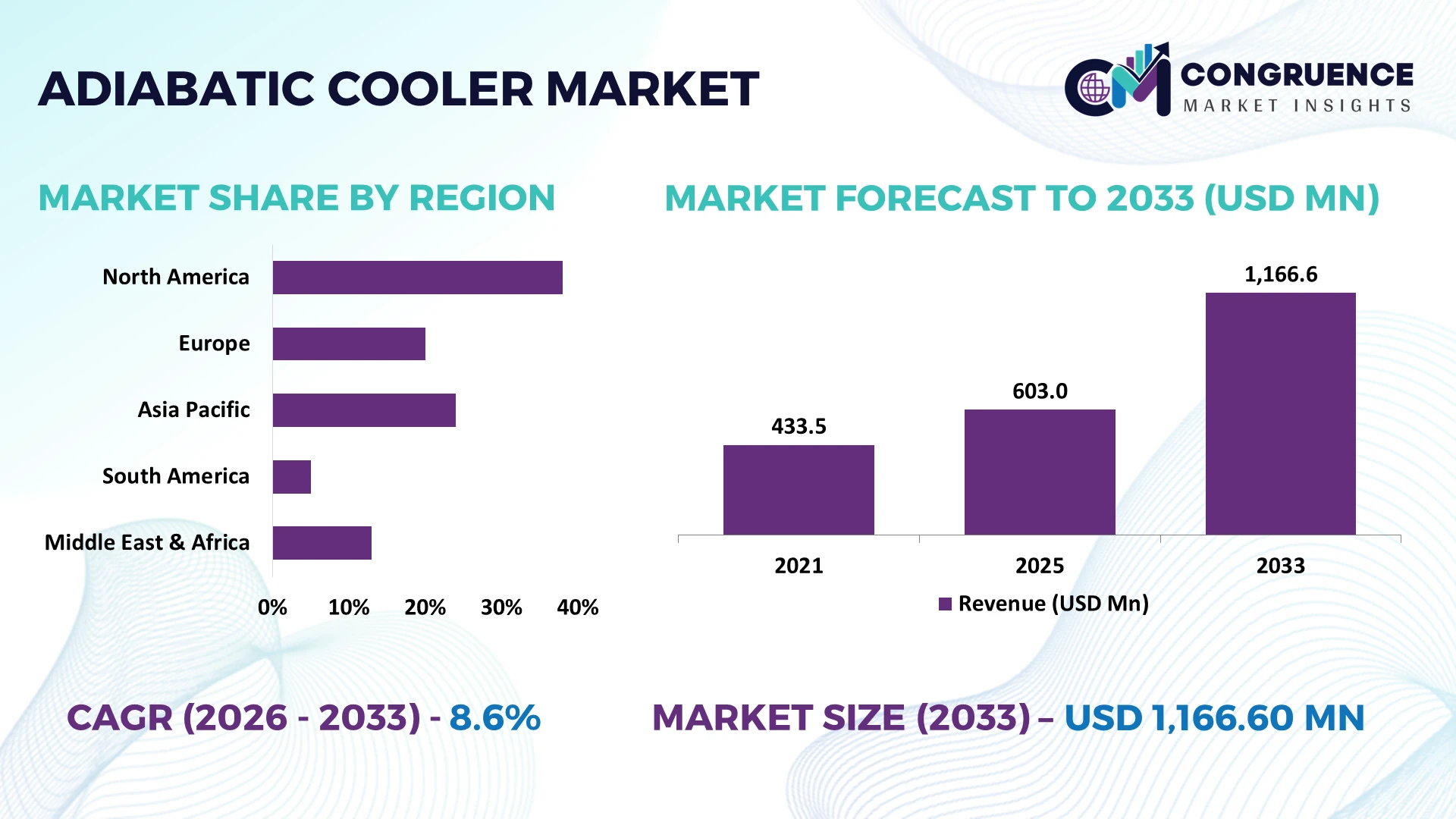
The Global Adiabatic Cooler Market was valued at USD 603 Million in 2025 and is anticipated to reach a value of USD 1166.6 Million by 2033 expanding at a CAGR of 8.6% between 2026 and 2033. Growth is driven by hyperscale data center expansion, industrial process cooling modernization, water conservation requirements, and increasing adoption of hybrid dry-wet heat rejection systems.
The United States holds a leading position in the global adiabatic cooler market, with an indicative 30% market share in 2025. Data centers, industrial refrigeration, and food processing facilities underpin demand. US data centers consumed 4.4% of national electricity in 2023, with the latest federal projections reaching 9.5%–15.3% by 2030. Compared with China's manufacturing-focused cooling installations, American investment emphasizes high-density digital infrastructure. Güntner's California installation demonstrated 80% lower water consumption, highlighting the operational advantages of advanced adiabatic cooling technology.
Strategic implication: Manufacturers should prioritize water-efficient cooling systems, intelligent fan controls, and modular equipment to secure data center and industrial modernization contracts.
Market Size & Growth: USD 603 million in 2025, reaching USD 1,166.6 million by 2033 at 8.6% CAGR, supported by water-efficient industrial cooling adoption.
Top Growth Drivers: Indicative demand contributions include data centers at 35%, industrial refrigeration at 30%, and commercial HVAC modernization at 20%.
Short-Term Forecast: By 2028, modeled smart-control deployment targets 15% lower cooling energy consumption and 20% fewer unnecessary spray cycles.
Emerging Technologies: EC fans offer up to 25% lower power consumption; intelligent refrigeration controls target 30% energy savings, alongside predictive monitoring.
Regional Leaders: Indicative 2033 allocations place North America at USD 408.3 million, Europe at USD 350.0 million, and Asia-Pacific at USD 326.6 million, reflecting different infrastructure priorities.
Consumer/End-User Trends: Data centers represent an estimated 35% of demand, prioritizing water-efficient heat rejection and high-density equipment cooling.
Pilot/Case Example: Frigel's 2025 Atlantic Grupa installation in Slovenia demonstrated 89% lower water consumption and 58% lower energy usage.
Competitive Landscape: Güntner holds an indicative 15% market share, competing with BAC, EVAPCO, Kelvion, and LU-VE through efficiency and service capabilities.
Regulatory & ESG Impact: Güntner's California installation demonstrated 80% water savings and 45% lower combined energy and water costs.
Investment & Funding: Market-specific investment totals remain unavailable; illustrative allocation priorities assign 40% to data center cooling, 35% to industrial modernization, and 25% to HVAC retrofits.
Innovation & Future Outlook: The market expands approximately 93.5% between 2025 and 2033, reinforcing investment in adaptive controls, modular cooling, and water-efficient heat exchangers.
The adiabatic cooler market is increasingly shaped by water-efficient thermal management across data centers, industrial refrigeration, food processing, pharmaceutical manufacturing, and commercial HVAC infrastructure. Modern systems combine dry cooling with controlled evaporative assistance, reducing water consumption during variable ambient conditions. Frigel's industrial installation achieved 89% water savings and 58% lower energy consumption compared with its previous cooling configuration. Intelligent spray modulation, EC fans, and automated temperature controls improve equipment efficiency and operational flexibility. Growing pressure on industrial water resources and expanding digital infrastructure are shifting procurement toward hybrid cooling systems, establishing the foundation for long-term competitive and investment strategies.
Adiabatic coolers are becoming strategically important as data center operators and industrial manufacturers balance heat rejection capacity, water availability, and energy efficiency. Infrastructure modernization is shifting procurement from conventional cooling towers toward hybrid dry-wet systems with adaptive controls. US data centers accounted for 4.4% of national electricity consumption in 2023, strengthening scrutiny of cooling infrastructure. European operators face tighter water management expectations, while India's expanding digital infrastructure creates opportunities for climate-adapted cooling configurations.
Adiabatic technology delivers measurable operational advantages over conventional evaporative cooling. Frigel's Atlantic Grupa installation demonstrated 89% lower water consumption and 58% lower energy usage against its previous configuration. Such results depend on climate, operating conditions, and equipment design. Manufacturers are integrating electronically commutated fans, variable-speed drives, and automated spray modulation to reduce unnecessary water consumption while maintaining thermal performance. These capabilities support equipment modernization without sacrificing process temperature stability.
Between 2026 and 2028, suppliers will prioritize modular heat exchangers, predictive maintenance, and integrated cooling controls. A modeled 15% reduction in fan electricity consumption provides a measurable retrofit target. Manufacturers are strengthening engineering partnerships and regional servicing capabilities. Competitive advantage will depend on verified lifecycle savings, dependable thermal performance, and application-specific system integration.
Hyperscale data center development is increasing requirements for efficient heat rejection systems capable of supporting continuous computing operations. US data centers consumed 4.4% of national electricity in 2023, with federal projections indicating a substantially higher contribution by 2030. Data centers represent an indicative 35% of adiabatic cooler demand, reflecting their growing infrastructure requirements. A modeled 20% reduction in cooling-water consumption improves operational economics where conventional evaporative systems face water availability constraints. Virginia's data center concentration and expanding facilities in Texas are strengthening interest in hybrid cooling architectures. Manufacturers are developing modular adiabatic equipment, intelligent spray controls, and higher-capacity heat exchangers. Suppliers offering predictable water consumption and reliable peak-temperature performance gain procurement advantages.
Adiabatic cooling systems require reliable water treatment, corrosion-resistant materials, and controlled spray distribution, creating equipment and maintenance cost pressures. Mineral scaling and biological contamination risks increase servicing requirements when water quality varies across industrial locations. In a modeled equipment cost structure, heat exchangers and fan assemblies represent 45% of manufacturing expenditure. A 12% increase in component prices raises total equipment costs by approximately 5.4%, assuming unchanged proportions. Water treatment and filtration can account for an illustrative 10% of annual maintenance expenditure. Manufacturers are reducing exposure through diversified component sourcing, modular replacement assemblies, and local servicing partnerships. Competitive positioning increasingly depends on managing lifecycle costs rather than minimizing initial equipment prices.
Industrial facilities are creating opportunities for adiabatic cooling through equipment retrofits, digital temperature management, and reduced dependence on continuously evaporative systems. Germany's industrial refrigeration and process manufacturing sectors provide applications for hybrid heat rejection technology. A modeled 25% reduction in water consumption and 15% improvement in fan energy efficiency strengthen retrofit economics under suitable operating conditions. Predictive control platforms can adjust spray activation according to ambient temperature, humidity, and process heat loads. Manufacturers are developing sensor-integrated heat exchangers, remote diagnostics, and configurable cooling modules. Partnerships with industrial engineering contractors improve retrofit execution. A strategic opportunity lies in upgrading existing dry coolers with controlled adiabatic assistance rather than replacing entire cooling infrastructures.
Adiabatic cooler deployment requires accurate coordination of ambient conditions, process temperatures, airflow, and water distribution across different operating environments. High humidity reduces evaporative cooling effectiveness, while extreme heat increases demand for reliable peak-load performance. A modeled 10% reduction in effective cooling capacity during unfavorable weather conditions can influence equipment sizing and operational reliability. Improving control accuracy by 15% and reducing unplanned downtime by 20% represent practical engineering targets. In India, seasonal temperature and humidity variations complicate standardized cooling system configurations. Manufacturers must invest in climate-specific performance testing, integrated control software, and commissioning expertise. Long-term competitiveness depends on dependable thermal performance across variable conditions and consistent integration with industrial cooling infrastructure.
• Water Accounting Reshapes Equipment Procurement: Data center operators increasingly evaluate water usage effectiveness alongside energy performance when selecting cooling equipment. A documented Güntner installation achieved 80% lower water consumption and 45% lower combined energy and water costs. Manufacturers are introducing water metering, automated spray scheduling, and performance reporting to demonstrate lifecycle savings rather than relying exclusively on nominal cooling capacity.
• Factory-Assembled Cooling Packages Gain Preference: Industrial refrigeration operators are prioritizing packaged adiabatic systems that simplify installation and commissioning. In an illustrative deployment scenario, factory-integrated controls reduce site installation labor by 20%, while standardized electrical connections shorten commissioning by 15%. Equipment manufacturers are expanding modular product configurations and installer partnerships, reducing project coordination requirements and improving delivery predictability.
• Low-Maintenance Media Designs Advance: Equipment suppliers are refining wetted media, spray distribution, and drainage arrangements to address mineral deposition and maintenance interruptions. Under modeled operating conditions, improved water distribution reduces unnecessary spray consumption by 18%, while accessible media assemblies shorten maintenance interventions by 25%. Manufacturers are investing in replaceable components and automated flushing, particularly for facilities operating with variable water quality.
• Digital Performance Verification Becomes Standard: Commercial building operators increasingly request measured cooling performance instead of relying solely on design specifications. An illustrative monitoring program targets 10% fewer temperature deviations and 15% faster fault identification through connected sensors. Manufacturers are integrating remote diagnostics, trend reporting, and commissioning analytics, strengthening service differentiation and enabling performance-based maintenance agreements across distributed cooling installations.
Indirect Adiabatic Coolers account for an indicative 42% of the global adiabatic cooler market in 2025, supported by their ability to improve heat rejection while separating the primary cooling circuit from evaporative water contact. This configuration is particularly relevant for industrial refrigeration, process cooling, and installations requiring controlled fluid quality. Direct Adiabatic Coolers represent approximately 33% of modeled demand, supported by comparatively straightforward construction and effective evaporative assistance in suitable climates. Manufacturers are improving heat exchanger geometry, spray distribution, and fan control to strengthen thermal performance. For buyers, indirect systems provide an attractive balance between equipment protection, water management, and operational flexibility.
Hybrid Adiabatic Coolers represent the fastest-growing type, with an indicative 25% market share, as operators seek equipment capable of switching between dry and evaporative operating modes. Under illustrative operating conditions, intelligent hybrid controls target 20% lower water consumption compared with continuously assisted configurations. Suppliers are expanding modular hybrid portfolios, integrating variable-speed fans, and developing automated operating-mode selection. Investment priorities increasingly favor configurable equipment that balances peak cooling capacity, annual water usage, and maintenance requirements.
Data Center Cooling represents the leading application, accounting for an indicative 35% of the global adiabatic cooler market in 2025. High-density computing infrastructure requires reliable heat rejection, particularly where cooling capacity must accommodate changing server loads and ambient temperatures. Industrial Process Cooling represents approximately 30% of modeled demand, supported by manufacturing facilities requiring stable operating temperatures. Data center operators increasingly specify modular equipment, integrated monitoring, and water consumption reporting. Manufacturers are responding through higher-capacity heat exchangers, intelligent fan control, and cooling infrastructure partnerships. The operational priority is maintaining thermal reliability while controlling electricity and water usage across continuous operating cycles.
Data Center Cooling is also the fastest-growing application as hyperscale development accelerates equipment procurement and thermal management modernization. HVAC Systems account for an indicative 25% of demand, reflecting commercial cooling upgrades and building efficiency requirements. Power Generation Cooling represents approximately 10%, supporting specialized heat rejection applications. A modeled 15% reduction in cooling electricity consumption improves operating economics for suitable installations. Suppliers are expanding application-specific equipment configurations and integrated control platforms, strengthening differentiation through measurable lifecycle performance.
Data Centers represent the leading end-user segment, accounting for an indicative 35% of global adiabatic cooler demand in 2025. Continuous computing operations, high equipment density, and infrastructure expansion support substantial investment in heat rejection systems. Manufacturing Plants represent approximately 27% of modeled demand, driven by process temperature control and industrial refrigeration requirements. Food and Beverage Facilities account for an indicative 18%, reflecting cooling requirements across processing, storage, and production operations. Manufacturers are developing modular cooling packages, corrosion-resistant components, and automated temperature controls to address differing operational conditions. Procurement decisions increasingly consider annual water consumption, service availability, and equipment performance under peak ambient temperatures.
Data Centers also represent the fastest-growing end-user category, supported by hyperscale construction and increasing computing intensity. Commercial Buildings contribute an indicative 12% of demand, while Power Plants represent approximately 8%. A modeled 20% reduction in water consumption strengthens equipment selection economics in water-constrained locations. Suppliers are expanding engineering partnerships, application-specific configurations, and remote monitoring capabilities. Manufacturing customers emphasize process stability, whereas data center operators prioritize cooling redundancy and measurable resource efficiency. Competitive positioning depends on delivering dependable performance across distinct operating environments.
North America accounted for the largest market share at an estimated 35% in 2025 however, Asia-Pacific is expected to register the fastest growth, expanding at an indicative CAGR of 10.2% between 2026 and 2033.
Hyperscale Infrastructure Expansion and Water-Efficient Cooling Adoption
North America represents an indicative 35% of the global adiabatic cooler market in 2025, supported by hyperscale data centers, industrial refrigeration, and commercial HVAC infrastructure. The United States leads regional demand through concentrated digital infrastructure investment, while Canada contributes industrial cooling and food processing applications. Data center operators increasingly evaluate water usage effectiveness alongside energy performance when specifying heat rejection equipment. The US Department of Energy estimated that data centers consumed 4.4% of national electricity in 2023, demonstrating the scale of associated thermal management requirements. Manufacturers are expanding modular adiabatic cooling portfolios, variable-speed fan technology, and intelligent spray controls. Regional procurement emphasizes dependable peak-load performance, cooling redundancy, and predictable maintenance expenditure. Suppliers offering integrated engineering support and documented water conservation benefits are strengthening their position in major infrastructure projects.
United States Market Outlook: The United States remains the leading national market through extensive data center construction in Virginia, Texas, and Arizona. Güntner's California cooling installation demonstrated approximately 80% lower water consumption and 45% lower combined energy and water costs under its documented operating conditions. These results reinforce procurement interest in hybrid heat rejection equipment, automated water management, and application-specific thermal engineering.
Industrial Decarbonization and Hybrid Cooling Modernization
Europe accounts for an indicative 30% of global adiabatic cooler demand in 2025, supported by industrial refrigeration, commercial building modernization, and data center infrastructure. Germany, France, Italy, and the Netherlands maintain substantial requirements for efficient heat rejection across manufacturing and controlled-temperature operations. European water management policies and industrial energy efficiency objectives are influencing cooling equipment specifications. Manufacturers are prioritizing hybrid systems that minimize evaporative operation during favorable ambient conditions. In suitable installations, modeled operating strategies target 20% lower annual water consumption compared with less adaptive configurations. European suppliers are strengthening heat exchanger efficiency, electronically commutated fan integration, and automated control capabilities. Procurement increasingly considers equipment lifecycle performance, refrigerant compatibility, and maintenance requirements. Competitive advantage depends on balancing cooling efficiency with water conservation and dependable industrial operating conditions.
Germany Market Outlook: Germany benefits from advanced industrial refrigeration, mechanical engineering, and precision manufacturing infrastructure. Companies such as Güntner and Kelvion support heat exchanger development and specialized cooling equipment integration. Industrial facilities increasingly prioritize variable-speed fans and intelligent temperature regulation. Under modeled conditions, optimized fan operation targets 15% lower electricity consumption, strengthening retrofit economics across manufacturing and process cooling applications.
Manufacturing Scale and Climate-Adaptive Cooling Infrastructure
Asia-Pacific represents an indicative 28% of the global adiabatic cooler market in 2025 and is positioned for the fastest expansion. China, India, Japan, and South Korea support demand through electronics manufacturing, industrial refrigeration, commercial construction, and digital infrastructure development. China's industrial manufacturing scale creates requirements for dependable process cooling, while India's expanding data center ecosystem strengthens interest in efficient heat rejection. High ambient temperatures and seasonal humidity variations influence equipment selection, making climate-specific engineering essential. Manufacturers are developing modular cooling configurations, corrosion-resistant heat exchangers, and intelligent spray systems. Under illustrative operating conditions, adaptive controls target 18% lower water consumption compared with fixed spray schedules. Regional suppliers are expanding local assembly, technical partnerships, and maintenance capabilities to improve installation responsiveness and lifecycle support.
China Market Outlook: China maintains a significant industrial cooling equipment base through manufacturing clusters in Guangdong, Jiangsu, and Zhejiang. Its extensive electronics and industrial production infrastructure supports demand for process heat rejection and temperature control systems. China accounted for approximately 54% of global industrial robot installations in 2024, highlighting manufacturing automation intensity. Cooling suppliers are strengthening local production, digital control integration, and application-specific equipment customization.
Food Processing Refrigeration and Industrial Water Conservation
South America represents an indicative 4% of global adiabatic cooler demand in 2025, with Brazil accounting for the largest regional industrial application base. Food processing, beverage manufacturing, cold storage, and commercial refrigeration generate requirements for dependable heat rejection equipment. Argentina contributes agricultural processing and industrial refrigeration applications, while Chile supports specialized cooling requirements across food production and industrial facilities. Water availability and variable electricity costs influence equipment selection across different locations. Under modeled operating conditions, hybrid cooling systems target 25% lower water consumption than conventional evaporative configurations. Manufacturers are strengthening distributor partnerships, regional installation capabilities, and maintenance support. Imported component costs and limited specialized servicing infrastructure constrain adoption. Equipment suppliers offering straightforward maintenance, corrosion-resistant construction, and predictable lifecycle costs gain advantages in price-sensitive industrial applications.
Brazil Market Outlook: Brazil leads regional demand through food processing, beverage production, and industrial manufacturing infrastructure. São Paulo and Paraná maintain substantial refrigeration and production facilities requiring reliable temperature management. Brazil produced approximately 2.5 million motor vehicles in 2024, demonstrating broader manufacturing activity. Cooling equipment suppliers are expanding local engineering partnerships and service capabilities to address industrial heat rejection requirements and maintenance constraints.
High-Temperature Infrastructure and Industrial Cooling Modernization
The Middle East & Africa accounts for an indicative 3% of global adiabatic cooler demand in 2025, supported by commercial infrastructure, industrial processing, and specialized cooling installations. Saudi Arabia and the United Arab Emirates are investing in digital infrastructure and advanced manufacturing, strengthening requirements for efficient thermal management. South Africa contributes industrial refrigeration and commercial HVAC applications. Extreme ambient temperatures create substantial cooling loads, while water scarcity requires careful evaluation of evaporative assistance. Under illustrative conditions, intelligent spray modulation targets 20% lower water consumption compared with continuously assisted operation. Manufacturers are developing high-temperature equipment configurations, corrosion-resistant materials, and remote monitoring capabilities. Regional partnerships support installation, commissioning, and servicing. Competitive differentiation depends on reliable peak-temperature performance, water management, and equipment durability under demanding environmental conditions.
Saudi Arabia Market Outlook: Saudi Arabia represents a strategic market through Vision 2030 infrastructure development, industrial diversification, and expanding digital facilities. Summer temperatures frequently exceed 40°C, increasing cooling equipment performance requirements. Water availability makes controlled evaporative operation particularly important. Manufacturers are strengthening regional engineering partnerships, high-temperature equipment testing, and automated water management capabilities to support industrial and commercial cooling installations.
The adiabatic cooler market features competition between global heat rejection specialists and regional cooling equipment manufacturers. Güntner, Baltimore Aircoil Company, EVAPCO, Kelvion, and LU-VE collectively hold an indicative 55% market share, reflecting established engineering capabilities and distribution networks. Güntner and Kelvion emphasize heat exchanger performance, while Baltimore Aircoil Company and EVAPCO compete through evaporative cooling expertise. LU-VE strengthens competition through industrial refrigeration equipment and modular configurations. Documented installations demonstrate water savings reaching 80%, while modeled intelligent controls target 15% lower fan electricity consumption and 20% fewer unnecessary spray cycles. Manufacturers are expanding localized production, engineering partnerships, and automated monitoring capabilities. Competition is shifting toward lifecycle efficiency, water accounting, and integrated thermal management. Heat exchanger engineering, application testing, and regional servicing requirements create entry barriers.
Güntner GmbH & Co. KG
Baltimore Aircoil Company
EVAPCO, Inc.
Kelvion Holding GmbH
LU-VE Group
SPX Cooling Technologies
Frigel Firenze S.p.A.
MITA Cooling Technologies S.r.l.
Airedale International Air Conditioning Ltd.
Thermofin GmbH
Jaeggi Hybridtechnologie AG
HRS Heat Exchangers Ltd.
Oxycom Fresh Air B.V.
Current adiabatic cooling technology combines finned heat exchangers, electronically commutated fans, evaporative assistance, and programmable temperature controls. Indirect Adiabatic Coolers represent an indicative 42% of market demand, reflecting established industrial deployment. Variable speed fan operation reduces unnecessary electricity consumption during partial loads. Compared with conventional fixed speed arrangements, optimized fan controls target a modeled 15% reduction in electricity usage. Manufacturers integrating precision spray distribution and corrosion resistant components improve operating reliability while reducing maintenance requirements.
Emerging technologies include adaptive wetting controls, IoT sensors, and predictive thermal management software. These systems adjust evaporative assistance according to ambient humidity, fluid temperature, and process loads. A modeled 20% reduction in water consumption improves lifecycle economics compared with continuous spray operation. Hybrid Adiabatic Coolers hold an indicative 25% share, signaling adoption of flexible operating modes. Data center operators benefit from coordinated cooling control, while industrial refrigeration suppliers differentiate through modular equipment and remote diagnostics.
Between 2026 and 2028, disruptive developments will emphasize digital twins, automated water quality management, and AI assisted cooling optimization. Predictive algorithms can identify fouling and abnormal fan performance before failures escalate. A modeled 25% reduction in maintenance interventions strengthens equipment availability. Suppliers combining verified thermal performance, intelligent controls, and regional engineering support will secure competitive advantages across critical cooling infrastructure.
October 2025: Frigel documented its Ecodry installation at Atlantic Grupa's Slovenian factory, recording 89% lower water consumption and 58% lower energy use after one year. The results demonstrate retrofit savings and strengthen demand for closed-loop adiabatic systems. Source: frigel.com
March 2025: MITA Cooling Technologies expanded its PAD-XL adiabatic dry cooler range to 2,500 kW, incorporating configurations with up to 20 fans. The larger platform addresses high-capacity industrial installations and supports expansion into international cooling infrastructure projects. Source: mitacoolingtechnologies.com
May 2026: Güntner Group established its dedicated Data Center Solutions division, combining Güntner and JAEGGI expertise. Its installed portfolio exceeds 1,600 units and 4.5 gigawatts of cooling capacity, strengthening coordinated delivery to hyperscale operators across multiple continents. Source: go.pandct.com
January 2024: SPX Cooling Technologies introduced OlympusV adiabatic systems across three product configurations: CO2 cooler, condenser, and fluid cooler. The portfolio broadens application coverage for industrial refrigeration and HVAC, allowing customers to select water-saving heat rejection equipment. Source: refindustry.com
The Adiabatic Cooler Market Report examines cooling equipment demand, technology adoption, and competitive positioning between 2026 and 2033. Type segmentation covers Direct Adiabatic Coolers, Indirect Adiabatic Coolers, and Hybrid Adiabatic Coolers. Application analysis includes Data Center Cooling, Industrial Process Cooling, HVAC Systems, and Power Generation Cooling. End-user coverage evaluates Data Centers, Manufacturing Plants, Power Plants, Commercial Buildings, and Food and Beverage Facilities. Indirect Adiabatic Coolers represent an indicative 42% of market demand, reflecting established industrial deployment.
Regional analysis covers North America, Europe, Asia-Pacific, South America, and the Middle East & Africa. Technology assessment includes intelligent spray controls, variable-speed fans, hybrid heat exchangers, and predictive maintenance. The report evaluates water efficiency, equipment performance, supplier capabilities, and infrastructure modernization opportunities, supporting investment planning, market expansion, strategic partnerships, and competitive differentiation.
| Report Attribute/Metric | Report Details |
|---|---|
Market Revenue in 2025 | USD 603 Million |
Market Revenue in 2033 | USD 1166.6 Million |
CAGR (2026 - 2033) | 8.6% |
Base Year | 2025 |
Forecast Period | 2026 - 2033 |
Historic Period | 2021 - 2025 |
Segments Covered | By Type
By Application
By End-User
|
Key Report Deliverable | Revenue Forecast, Growth Trends, Market Dynamics, Segmental Overview, Regional and Country-wise Analysis, Competition Landscape |
Region Covered | North America, Europe, Asia-Pacific, South America, Middle East, Africa |
Key Players Analyzed | Güntner GmbH & Co. KG, Baltimore Aircoil Company, EVAPCO, Inc., Kelvion Holding GmbH, LU-VE Group, SPX Cooling Technologies, Frigel Firenze S.p.A., MITA Cooling Technologies S.r.l., Airedale International Air Conditioning Ltd., Thermofin GmbH, Jaeggi Hybridtechnologie AG, HRS Heat Exchangers Ltd., Oxycom Fresh Air B.V. |
Customization & Pricing | Available on Request (10% Customization is Free) |




