
Reports
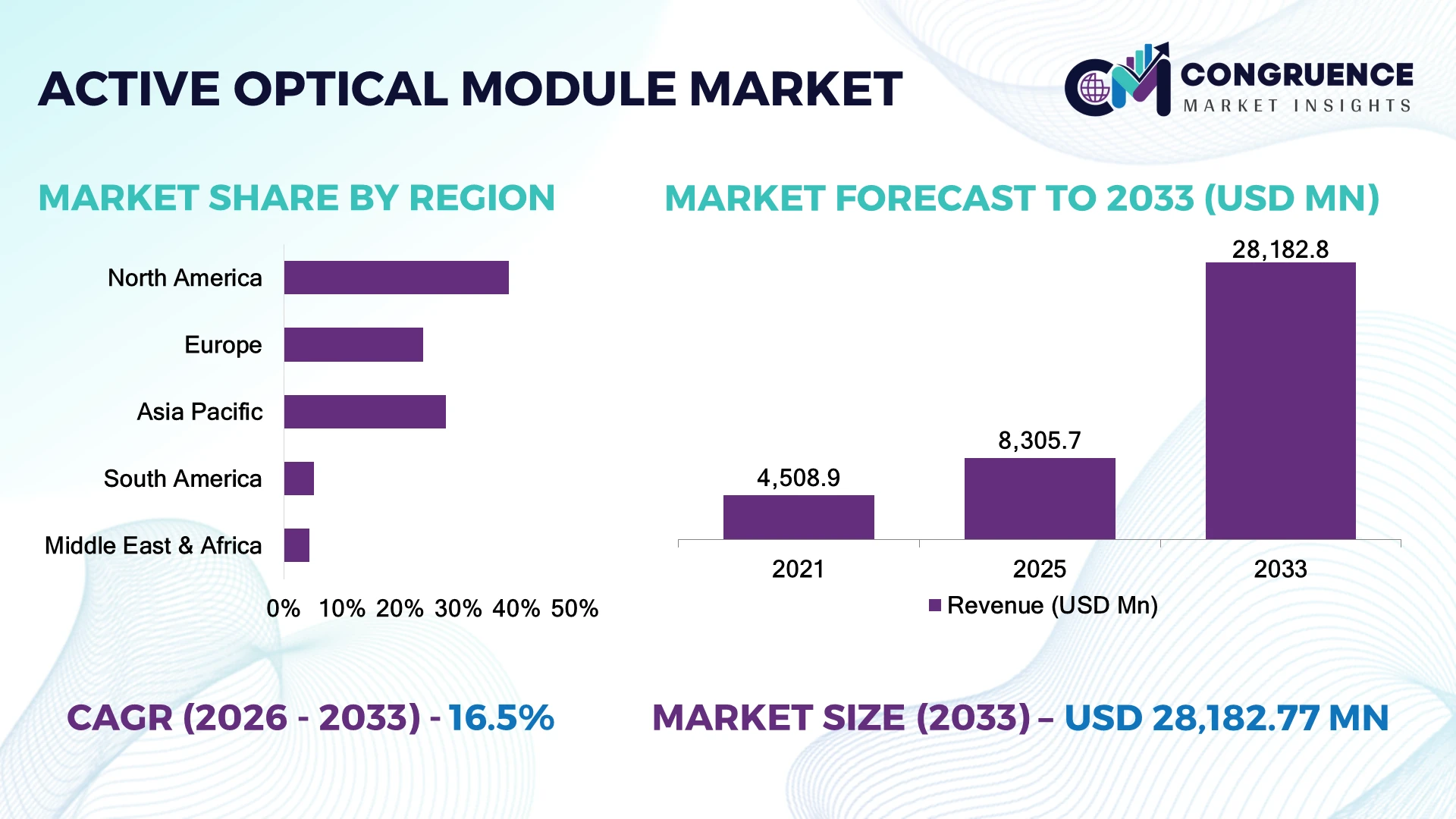
The Global Active Optical Module Market was valued at USD 8,305.7 Million in 2025 and is anticipated to reach a value of USD 28,182.8 Million by 2033 expanding at a CAGR of 16.5% between 2026 and 2033. Rapid deployment of AI data centers, 800G/1.6T optical interconnects, hyperscale cloud expansion, and high-bandwidth networking infrastructure is accelerating demand for advanced active optical modules across telecom and enterprise ecosystems.
China remains the dominant country, accounting for approximately 36% of global optical module manufacturing capacity, supported by large-scale investments in AI infrastructure, hyperscale cloud facilities, and vertically integrated photonics production. Over 65% of worldwide 400G and higher-speed optical module shipments originate from Chinese manufacturing ecosystems, while the United States leads in advanced optical networking innovation and silicon photonics deployment for hyperscale data centers. Ongoing technology competition and semiconductor supply-chain realignment continue reshaping investment priorities across major economies.
Organizations prioritizing high-speed optical networking and resilient supply chains are positioned to capture long-term competitive advantages as AI-driven bandwidth requirements continue accelerating.
Market Size & Growth: USD 8,305.7 million (2025) to USD 28,182.8 million (2033), CAGR 16.5%, driven by AI data center expansion and 800G optical networking.
Top Growth Drivers: AI workloads (+42%), hyperscale cloud expansion (+35%), and 5G transport deployment (+28%) fuel demand.
Short-Term Forecast: By 2028, network latency drops 22% while optical link efficiency improves 18%.
Emerging Technologies: Silicon photonics, co-packaged optics, and 1.6T modules reshape high-speed connectivity.
Regional Leaders: North America, Asia-Pacific, and Europe lead adoption through hyperscale investment and telecom modernization.
Consumer/End-User Trends: More than 68% of hyperscale facilities prioritize 400G and higher optical modules.
Pilot/Case Example: 2026 AI cluster deployment increased interconnect throughput by 35% using advanced optical modules.
Competitive Landscape: Leading suppliers collectively hold about 56% share, led by Coherent, Innolight, Lumentum, Eoptolink, and Broadcom.
Regulatory & ESG Impact: Energy-efficient optical designs reduce network power consumption by nearly 20%.
Investment & Funding: Over USD 5 billion supports photonics capacity expansion and advanced packaging initiatives.
Innovation & Future Outlook: AI-native optical switching and co-packaged optics strengthen next-generation data center architectures.
Active Optical Module technology is becoming indispensable for hyperscale cloud platforms, AI clusters, telecom backhaul, and high-performance computing. Silicon photonics integration and low-power transceivers improve transmission efficiency by approximately 25%, while increasing adoption of 800G modules reflects the industry's transition toward bandwidth-intensive computing amid evolving semiconductor supply-chain strategies, setting the foundation for the strategic discussion.
The Active Optical Module market has become strategically significant because AI computing, cloud-native infrastructure, and high-performance networking require substantially higher bandwidth with lower latency and improved energy efficiency. Rapid expansion of hyperscale data centers and digital infrastructure modernization is reshaping procurement priorities, while semiconductor supply-chain diversification following recent geopolitical developments is encouraging regional manufacturing expansion and greater investment in optical networking ecosystems.
Compared with conventional electrical interconnects, advanced active optical modules deliver nearly 40% greater transmission distance while reducing power consumption by approximately 25% at equivalent bandwidth. North America leads in AI-driven deployment and optical networking innovation, whereas Asia-Pacific dominates manufacturing scale and production efficiency. More than 70% of newly commissioned hyperscale facilities are integrating 400G and 800G optical modules, with 1.6T deployments entering early commercialization during the next two to three years.
Cloud providers and telecom operators are accelerating strategic partnerships with optical component manufacturers to secure high-speed interconnect capacity for AI infrastructure expansion. Investments increasingly target silicon photonics, co-packaged optics, and advanced packaging capabilities to improve supply resilience and deployment speed. Organizations capable of combining technological leadership with scalable manufacturing and reliable supply networks will establish durable competitive advantages in the next generation of optical connectivity.
AI cluster expansion and hyperscale cloud investment are fundamentally reshaping Active Optical Module deployment priorities. More than 72% of newly commissioned AI-ready data centers are integrating 400G and 800G optical modules, while optical interconnect density has increased by nearly 35% over the past two years to support GPU-intensive workloads. The United States continues expanding AI infrastructure following major cloud investment programs, driving sustained demand for high-speed optical connectivity. Higher bandwidth requirements improve network scalability, prompting module manufacturers to expand production capacity, strengthen silicon photonics partnerships, and accelerate 1.6T product development. A key strategic shift is the growing preference for vertically integrated optical supply chains, enabling faster product qualification and reducing deployment lead times for hyperscale customers.
High-performance Active Optical Modules depend on precision lasers, DSP chips, advanced packaging, and optical engines, creating supply-chain sensitivity and elevated production costs. Approximately 58% of manufacturing cost is concentrated in optical components and semiconductor devices, while qualification cycles for carrier-grade deployments often extend beyond 9 months. Export controls affecting advanced semiconductor technologies continue increasing procurement complexity for manufacturers operating across China and the United States. These constraints delay capacity expansion, reduce pricing flexibility, and complicate delivery schedules for large infrastructure projects. Companies are mitigating risks through supplier diversification, regional manufacturing expansion, long-term wafer procurement agreements, and increased investment in standardized optical platforms that reduce dependency on single-source components.
The transition toward silicon photonics and co-packaged optics is creating significant opportunities for performance optimization across AI infrastructure and cloud networking. Silicon photonics can reduce power consumption by nearly 30% while increasing integration density by approximately 40% compared with conventional discrete optical architectures. Japan and the United States are expanding research and manufacturing initiatives supporting advanced photonic integration, encouraging broader commercialization between 2026 and 2028. Companies are strengthening R&D partnerships with semiconductor foundries, investing in automated photonic packaging, and developing modular optical engines for scalable deployment. An emerging strategic opportunity lies in supplying standardized optical modules for enterprise AI clusters, a segment currently underserved compared with hyperscale deployments.
Transitioning from 400G to 800G and 1.6T optical modules significantly increases manufacturing complexity, testing requirements, and thermal management challenges. Production yields for advanced photonic assemblies remain approximately 10–15% lower than mature optical products, while validation procedures can account for nearly 20% of total production time. Taiwan's advanced semiconductor packaging ecosystem highlights the increasing importance of precision manufacturing for next-generation optical devices. Inconsistent yields, interoperability verification, and workforce shortages in photonic engineering directly affect deployment reliability and product competitiveness. Manufacturers must expand automated testing, invest in AI-assisted production inspection, strengthen ecosystem partnerships, and develop highly skilled engineering teams to sustain large-scale commercialization while maintaining product quality.
AI Network Scaling AI-driven infrastructure is rapidly increasing deployment of 800G optical modules, with adoption rising nearly 45% across newly commissioned hyperscale facilities. GPU clusters require significantly higher fiber density, prompting manufacturers to expand automated assembly lines and strengthen partnerships with cloud providers to accelerate qualification cycles and improve deployment speed.
Silicon Photonics Integration Silicon photonics adoption has surpassed 38% across advanced optical module development programs, reducing power consumption by approximately 25% while improving signal integrity. Semiconductor packaging innovations and continued investment in photonic integration are enabling suppliers to consolidate optical components into compact, high-performance modules for AI and cloud networking applications.
Automated Manufacturing Expansion Optical module manufacturers are deploying AI-enabled inspection systems that improve defect detection rates by approximately 30% while reducing production downtime by nearly 18%. Rising labor costs and stricter quality requirements are accelerating factory automation, encouraging suppliers to modernize manufacturing operations and strengthen operational consistency for high-volume deployments.
Regional Supply Diversification Companies are expanding manufacturing footprints beyond traditional production hubs, reducing single-country sourcing dependence by nearly 20%. Ongoing semiconductor supply-chain restructuring and resilience initiatives are driving investments in localized assembly, strategic component partnerships, and geographically distributed production networks that improve delivery reliability for global cloud and telecom customers.
400G Active Optical Modules accounted for approximately 41% of the market in 2025, making them the leading segment due to widespread deployment across hyperscale data centers, AI clusters, and cloud infrastructure. Their balance of bandwidth, power efficiency, and interoperability makes them the preferred choice for next-generation network upgrades. Meanwhile, 800G modules represent the fastest-growing segment, supported by rising AI training workloads and high-performance computing environments. More than 62% of newly designed AI networking platforms are already optimized for 800G-ready architectures, encouraging manufacturers to prioritize advanced DSP integration and silicon photonics.
100G modules continue serving enterprise and telecom modernization projects, while 200G variants remain important for transitional upgrades where cost optimization outweighs peak bandwidth requirements. Early commercialization of 1.6T modules is shifting investment toward future-ready optical ecosystems, particularly in the United States and Japan. Companies are expanding high-speed product portfolios, increasing automated manufacturing capacity, and forming ecosystem partnerships to secure long-term positions in AI-driven optical networking.
According to findings published by the Ethernet Alliance in 2025, more than 70% of hyperscale network expansion projects evaluated 800G Ethernet infrastructure as the preferred upgrade path for AI-centric data center deployments.
Data centers accounted for nearly 52% of global demand in 2025, supported by hyperscale cloud expansion, AI infrastructure investment, and accelerating deployment of high-speed optical interconnects. The segment maintains leadership because optical modules are essential for low-latency, high-bandwidth communication between servers, switches, and storage systems. High-performance computing represents the fastest-growing application as GPU-intensive AI workloads increase optical connectivity requirements by more than 35%. Suppliers are introducing higher-density optical modules and automated network management solutions to meet these evolving performance demands.
Telecommunications remains a mature application, driven by 5G transport network modernization and metro backbone upgrades. Enterprise networking continues expanding through digital transformation initiatives, while industrial networking is emerging as manufacturers adopt advanced automation requiring reliable high-speed communication. Companies are scaling production, strengthening telecom partnerships, and optimizing optical module platforms for application-specific deployment, ensuring stronger competitive positioning across multiple network environments.
According to a 2026 enterprise infrastructure assessment published by the Uptime Institute, hyperscale and large enterprise facilities continue allocating the largest share of network upgrade budgets toward higher-speed optical interconnect deployment.
Hyperscale cloud providers represented approximately 46% of total Active Optical Module demand in 2025 due to continuous expansion of AI-ready data centers, cloud computing infrastructure, and high-density networking environments. Their purchasing scale, infrastructure intensity, and rapid technology refresh cycles maintain market leadership. Telecom operators constitute the fastest-growing end-user group as 5G transport networks, edge computing, and fiber backbone modernization increase deployment of high-capacity optical modules. More than 58% of new backbone infrastructure projects now specify 400G or higher optical connectivity, encouraging suppliers to expand carrier-grade product offerings.
Large enterprises remain important buyers as digital transformation accelerates migration toward cloud-native infrastructure and high-performance networking. Government and research organizations continue investing in supercomputing and national digital infrastructure, while colocation service providers expand capacity to support enterprise AI workloads. Companies are responding through customized optical platforms, long-term supply agreements, and strategic collaborations with cloud operators and telecom infrastructure providers to strengthen customer retention and long-term competitiveness.
A 2025 industry survey conducted by the Telecom Infra Project indicated that network operators increasingly prioritize high-speed optical connectivity for next-generation transport infrastructure, with AI traffic emerging as a major capacity planning driver.
North America accounted for the largest market share at 38.6% in 2025 however, Asia-Pacific is expected to register the fastest growth, expanding at a CAGR of 18.3% between 2026 and 2033.

AI infrastructure investment drives high-speed optical networking leadership
North America leads the Active Optical Module market through rapid expansion of hyperscale cloud campuses, AI computing clusters, and advanced networking infrastructure. The region accounts for nearly 39% of global deployment, supported by aggressive investments from cloud service providers and semiconductor companies. More than 75% of newly commissioned hyperscale data centers incorporate 400G or higher optical interconnects, accelerating demand for advanced optical modules. Ongoing deployment of AI servers and high-capacity switching platforms is increasing adoption of silicon photonics and co-packaged optics. Suppliers continue expanding manufacturing partnerships, strengthening domestic supply resilience, and investing in advanced optical packaging capabilities to shorten qualification cycles and improve delivery performance.
United States Market Outlook: The United States dominates regional demand through leadership in hyperscale cloud computing, AI infrastructure, and semiconductor innovation. Major cloud operators continue expanding high-density data center campuses requiring large-scale deployment of 800G optical modules and advanced photonic networking. More than 70% of AI infrastructure investments announced across North America are concentrated in the United States, encouraging suppliers to establish local engineering centers, strengthen photonics research, and expand strategic collaborations with semiconductor and networking equipment manufacturers.
Digital infrastructure modernization strengthens optical connectivity
Europe is advancing Active Optical Module deployment through telecom modernization, cloud expansion, and digital sovereignty initiatives. The region represents approximately 24% of global demand, supported by investments in high-capacity fiber infrastructure, enterprise cloud migration, and AI-ready digital facilities. Large-scale rollout of 400G transport networks is improving backbone capacity while encouraging adoption of energy-efficient optical technologies. European equipment suppliers increasingly collaborate with semiconductor and photonics companies to improve supply resilience and accelerate qualification of next-generation optical networking platforms.
Germany Market Outlook: Germany serves as the region's principal industrial and networking hub, supported by advanced manufacturing, enterprise digitalization, and expanding cloud infrastructure. Industrial enterprises continue upgrading private data centers with high-speed optical networking to support automation and AI workloads. Strong engineering capabilities, photonics expertise, and investments in digital infrastructure position Germany as a strategic market for advanced optical module deployment.
Manufacturing scale accelerates global supply leadership
Asia-Pacific is the fastest-growing market, combining large-scale optical module manufacturing with rapidly expanding cloud infrastructure and AI investment. The region contributes over 48% of global production capacity, supported by integrated semiconductor, packaging, and photonics ecosystems. More than 65% of worldwide optical module exports originate from Asia-Pacific manufacturing facilities, while domestic hyperscale expansion continues strengthening regional demand. Companies are expanding automated production, investing in advanced packaging technologies, and increasing capacity for 800G and emerging 1.6T optical modules to support global customers.
China Market Outlook: China remains the world's largest manufacturing base for Active Optical Modules through vertically integrated optical component production, extensive supplier ecosystems, and continuous hyperscale data center expansion. Leading manufacturers are investing in silicon photonics, automated assembly, and advanced testing capabilities. Large domestic cloud providers continue deploying AI infrastructure at scale, reinforcing China's leadership in both production capacity and high-volume optical networking deployment.
Telecom modernization expands enterprise connectivity
South America is experiencing steady demand growth as telecom operators modernize backbone networks and enterprises increase investment in cloud connectivity. The region represents a developing deployment market where optical networking supports expanding fiber infrastructure and digital transformation initiatives. Network operators are increasing adoption of higher-speed optical modules to improve capacity and latency across metropolitan and long-haul communication networks. Although infrastructure investment remains uneven, strategic partnerships with global networking vendors are improving technology availability and accelerating enterprise deployment.
Brazil Market Outlook: Brazil leads regional adoption through continued fiber broadband expansion, cloud investment, and enterprise digital transformation. Major telecommunications operators are upgrading transport networks with higher-capacity optical equipment to support increasing data traffic. Growth in hyperscale data center construction and enterprise cloud migration is creating sustained demand for advanced optical modules across metropolitan infrastructure and national backbone networks.
Digital transformation investments reshape connectivity infrastructure
The Middle East & Africa market is expanding through national digital transformation programs, cloud infrastructure development, and next-generation telecom investment. Governments and enterprise operators are increasing deployment of high-capacity optical networking to strengthen regional connectivity and support emerging AI infrastructure. Modern data center projects, fiber expansion initiatives, and smart city developments continue creating opportunities for advanced Active Optical Modules. Strategic partnerships between telecom operators and international technology providers are improving deployment capabilities and strengthening long-term infrastructure resilience.
United Arab Emirates Market Outlook: The United Arab Emirates has established itself as the region's leading market through significant investment in hyperscale data centers, cloud services, and smart infrastructure. National digital transformation strategies continue driving deployment of advanced optical networking technologies across public and private sectors. The country's strong international connectivity, expanding AI ecosystem, and business-friendly investment environment position it as a strategic gateway for advanced optical module adoption across the Middle East.
Competition is led by Coherent, Lumentum, Innolight, Eoptolink, and Broadcom, with global technology innovators competing against high-volume Asian manufacturers while integrated photonics suppliers compete with cost-focused module assemblers. The top five companies collectively control approximately 56% of the global market. Performance leadership depends on transmission efficiency, manufacturing scale, and rapid qualification, while pricing differences between standardized and premium AI-optimized modules typically range between 18% and 25%. Suppliers achieving production yields above 95% gain significant delivery advantages for hyperscale contracts. Companies are expanding through AI-focused capacity investments, silicon photonics partnerships, vertical integration of lasers and packaging, and long-term supply agreements with cloud operators. Competition is shifting toward 800G and 1.6T platforms, where co-packaged optics and advanced photonic integration redefine product differentiation. The primary entry barrier remains high investment in photonics manufacturing, DSP expertise, and customer qualification. Winning requires scalable production, advanced optical innovation, and resilient global supply networks.
Coherent Corp.
Lumentum Holdings Inc.
Innolight Technology
Eoptolink Technology Inc.
Broadcom Inc.
Accelink Technologies Co., Ltd.
Source Photonics Holdings
Cisco Systems, Inc. (Acacia Communications)
Fujitsu Optical Components Limited
Sumitomo Electric Industries, Ltd.
Hisense Broadband Multimedia Technologies Co., Ltd.
CIG (Cambridge Industries Group)
NEC Corporation
Marvell Technology, Inc.
Silicon photonics, 800G pluggable optics, and advanced DSP architectures define current technology leadership in the Active Optical Module market. Silicon photonics reduces power consumption by approximately 25% while improving integration density by nearly 35% compared with conventional discrete optical designs. More than 45% of next-generation hyperscale optical module development programs now incorporate silicon photonics platforms. This transition enables lower thermal loads, higher port density, and improved scalability for AI infrastructure, providing competitive advantages to manufacturers with integrated photonic design and packaging capabilities.
Emerging technologies include co-packaged optics (CPO), linear pluggable optics (LPO), and 1.6T optical modules designed for AI clusters. Compared with traditional pluggable architectures, co-packaged optics can reduce electrical interconnect losses by approximately 40% while improving overall system efficiency by nearly 20%. Around 30% of hyperscale development programs are actively evaluating these architectures for future deployment. Companies investing early in photonic packaging, optical engines, and automated testing are securing stronger design wins with cloud operators.
Between 2026 and 2028, optical innovation will increasingly focus on 200G-per-lane transmission, advanced external laser integration, and AI-assisted manufacturing inspection. Suppliers capable of combining silicon photonics, automated assembly, and scalable production will outperform competitors by reducing qualification time and improving delivery consistency. Technology leadership is shifting from bandwidth alone toward integrated optical ecosystems capable of supporting next-generation AI networking at commercial scale.
March 2024: Innolight partnered with Marvell to launch 800G ZR/ZR+ coherent Active Optical Modules using 800Gbps DSP technology, reducing data center interconnect complexity while lowering system power consumption for hyperscale networks. Source: innolight.com (InnoLight Technology)
September 2024: Marvell, Lumentum, and Coherent successfully demonstrated interoperable 800G ZR/ZR+ pluggable optical modules transmitting across distances up to 500 km, validating multivendor interoperability for AI-era cloud data center interconnects. Source: marvell.com (Marvell)
March 2026: NVIDIA announced strategic investments of USD 2 billion each in Lumentum and Coherent to expand U.S. photonics manufacturing and accelerate AI optical networking capacity, strengthening long-term supply resilience. Source: reuters.com (Reuters)
April 2026: Lumentum showcased live 1.6T optical transceiver demonstrations supporting 200G-per-lane architectures and early 3.2T development, highlighting practical deployment readiness for hyperscale AI infrastructure. Source: Lumentum corporate communications. (Lumentum)
The report provides comprehensive analysis of the Active Optical Module market across major product types, applications, end-users, technologies, and regional markets. It evaluates deployment trends spanning 100G through emerging 1.6T optical modules, covering data centers, telecommunications, high-performance computing, enterprise networking, and industrial applications. Regional assessment includes North America, Europe, Asia-Pacific, South America, and the Middle East & Africa, supported by detailed evaluation of manufacturing concentration, adoption patterns, and technology positioning. More than 14 leading companies are assessed for product strategy, innovation, and competitive positioning.
The study delivers strategic insights into silicon photonics, co-packaged optics, advanced DSP integration, automated manufacturing, and next-generation optical networking. It analyzes evolving deployment patterns, enterprise investment priorities, and supply-chain transformation while highlighting business opportunities across hyperscale cloud infrastructure, AI networking, telecom modernization, and emerging optical ecosystems. The report supports product development, investment planning, expansion strategy, competitive benchmarking, and long-term market positioning throughout the 2026–2033 forecast period.
| Report Attribute/Metric | Report Details |
|---|---|
|
Market Revenue in 2025 |
USD 8,305.7 Million |
|
Market Revenue in 2033 |
USD 28,182.8 Million |
|
CAGR (2026 - 2033) |
16.5% |
|
Base Year |
2025 |
|
Forecast Period |
2026 - 2033 |
|
Historic Period |
2021 - 2025 |
|
Segments Covered |
By Type
By Application
By End-User
|
|
Key Report Deliverable |
Revenue Forecast, Growth Trends, Market Dynamics, Segmental Overview, Regional and Country-wise Analysis, Competition Landscape |
|
Region Covered |
North America, Europe, Asia-Pacific, South America, Middle East, Africa |
|
Key Players Analyzed |
Coherent Corp., Lumentum Holdings Inc., Innolight Technology, Eoptolink Technology Inc., Broadcom Inc., Accelink Technologies Co., Ltd., Source Photonics Holdings, Cisco Systems, Inc. (Acacia Communications), Fujitsu Optical Components Limited, Sumitomo Electric Industries, Ltd., Hisense Broadband Multimedia Technologies Co., Ltd., CIG (Cambridge Industries Group), NEC Corporation, Marvell Technology, Inc. |
|
Customization & Pricing |
Available on Request (10% Customization is Free) |




