
Reports
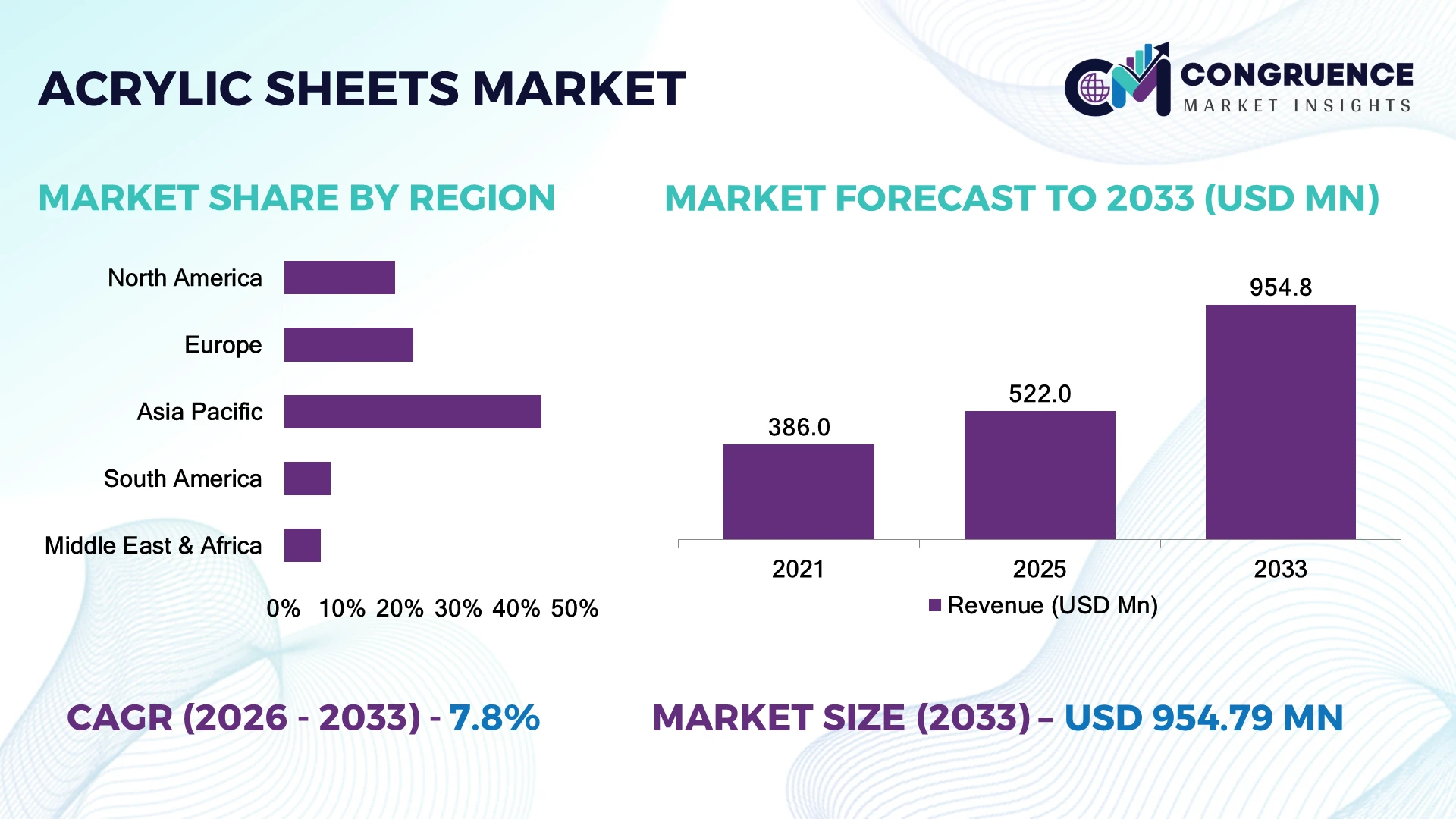
The Global Acrylic Sheets Market was valued at USD 522.0 Million in 2025 and is anticipated to reach a value of USD 954.8 Million by 2033 expanding at a CAGR of 7.84% between 2026 and 2033. Growth is being driven by the shift toward lightweight, high-transparency materials in EV lighting, LED displays, architectural glazing, and advanced retail fixtures, where PMMA provides up to 92% visible-light transmission while weighing nearly half as much as equivalent glass.
China dominates the acrylic sheets landscape, supported by a large PMMA manufacturing base and strong construction, signage, electronics, and automotive demand; China accounted for roughly 96% of domestic PMMA capacity concentrated in Eastern China in 2024. India is emerging faster, with vehicle production reaching 3.10 million units in FY2024–25, compared with 2.84 million a year earlier, while China's cast-acrylic market is projected to grow at 8.0%, versus 7.4% in India. The U.S. remains strategically important for premium applications and localized feedstock supply.
The strategic priority is to secure differentiated PMMA grades and localized supply capacity near high-growth automotive, electronics, construction, and display clusters.
Market Size & Growth: The market stands at USD 522.0 million in 2025 and is projected to reach USD 954.8 million by 2033, expanding at 7.84% CAGR, supported by lightweight material substitution and advanced LED/display applications.
Top Growth Drivers: Automotive lightweighting: 8.57%, electrical/electronics adoption: 8.73%, and Asia-Pacific market expansion: 8.53% are strengthening high-growth acrylic applications.
Short-Term Forecast: By 2028, manufacturers are positioned to improve sheet-processing productivity by approximately 5–10% through automated cutting, digital nesting, and tighter extrusion controls, reducing material waste and production variability.
Emerging Technologies: AI-assisted fabrication, automated laser cutting, and specialty UV/impact-resistant PMMA are accelerating customization, optical precision, and application-specific product development.
Regional Leaders: By 2033, Asia-Pacific could represent approximately USD 422.6 million, North America USD 238.7 million, and Europe USD 171.9 million based on current regional positioning; Asian adoption is shifting toward automotive, electronics, LED displays, and architectural applications.
Consumer/End-User Trends: Signage and display represented 31.45% of the 2025 market, while building and construction accounted for 29.83%, reinforcing demand for illuminated, weather-resistant, lightweight visual and architectural surfaces.
Pilot/Case Example: In 2025, Röhm's ACRYLITE Optical HT was specified for the Lancia Ypsilon EV light guides, demonstrating the shift toward optically engineered PMMA in electric-vehicle lighting rather than conventional commodity applications.
Competitive Landscape: Mitsubishi Chemical, Röhm, CHIMEI, Sumitomo Chemical, and Arkema remain prominent participants, while cast acrylic held approximately 54.72% of the 2025 market, making optical quality and specialty grades key competitive differentiators.
Regulatory & ESG Impact: Green-building specifications increasingly favor materials supporting daylighting and energy-performance objectives; PMMA can transmit up to 92% visible light, compared with approximately 88–90% for standard glass, strengthening its positioning in daylight-oriented architectural designs.
Investment & Funding: Capacity expansion is increasingly focused on regional feedstock security and specialty grades; Röhm's Bay City, Texas facility reached full four-reactor MMA production in April 2026, reinforcing North American supply-chain localization.
Innovation & Future Outlook: The market is moving toward recycled-content, bio-based MMA, anti-reflective, antimicrobial, UV-blocking, and light-diffusing grades, shifting competition from commodity sheet volume toward engineered performance and lower-carbon material solutions.
Acrylic sheet demand is increasingly concentrated in LED signage, architectural interiors, EV lighting, electronics, and lightweight glazing, with signage and display already accounting for 31.45% of the market. Product innovation is moving toward UV-stabilized, light-diffusing, impact-modified, and recycled-content grades as manufacturers respond to tighter sustainability requirements and regional supply-chain restructuring.
Acrylic sheets are becoming strategically important because manufacturers are shifting from commodity plastics toward optically precise, lightweight, application-engineered materials. PMMA transmits up to 92% visible light and weighs nearly half as much as equivalent glass, creating measurable advantages for LED systems, architectural glazing, displays, and mobility components. This shift is particularly relevant as manufacturers redesign products around weight, optical performance, and fabrication flexibility.
Supply-chain restructuring is also changing competitive priorities. China retains substantial production depth, while North American producers are strengthening local MMA availability; Röhm's Bay City facility reached full four-reactor production in 2026. Over the next 2–3 years, automated cutting, extrusion monitoring, and digital fabrication should deliver approximately 5–10% productivity improvements for converters that modernize production lines.
Regional strategies remain distinct: China prioritizes scale and export manufacturing, India is gaining momentum through automotive and infrastructure expansion, while Japan, South Korea, Europe, and North America emphasize premium optical and specialty applications. Companies are responding through localized capacity, specialty-grade R&D, and OEM partnerships. The strategic winners will be suppliers that combine feedstock security, application-specific engineering, and rapid customization rather than compete solely on sheet volume.
The strongest structural driver is substitution of heavier glazing and conventional plastics with lightweight PMMA in EV lighting, retail displays, architectural panels, and electronics. PMMA provides up to 92% light transmission and weighs nearly half as much as equivalent glass, while automotive and transportation applications are projected to expand at 8.57% through 2031. Electrical and electronics applications are advancing at 8.73%, reinforcing demand for precision grades. China's automotive and electronics manufacturing clusters are accelerating application engineering, while India's vehicle production reached 3.10 million units in FY2024–25. Producers are responding with UV-resistant, light-diffusing, optical, and impact-modified grades, creating a strategic shift from commodity sheet production toward engineered material portfolios.
Feedstock economics remain a major constraint because acrylic sheet converters are exposed to methyl methacrylate (MMA) pricing and regional supply imbalances. China increased PMMA capacity by 22.72% between 2020 and 2024, but production remained heavily concentrated, with approximately 96% of national capacity located in Eastern China, creating logistical concentration despite broader domestic supply. Specialty cast grades can command a 15–30% premium over equivalent extruded products, but this premium also increases price sensitivity among cost-focused fabricators. Companies are reducing exposure through backward integration, longer-term feedstock contracts, geographic diversification, and higher-value specialty products. The key operational issue is margin protection: manufacturers with localized feedstock access have greater pricing flexibility than converters dependent on spot-market inputs.
The strongest opportunity lies in premium PMMA grades engineered for EV optics, digital signage, electronics, and sustainable construction. Specialty grades are gaining traction, while automotive and transportation applications are forecast to expand at 8.57% and electrical/electronics at 8.73% through 2031. Chemical-recycling feedstock and bio-based MMA are also emerging as strategic pathways for reducing embodied carbon and managing raw-material volatility. India offers a particularly attractive expansion platform, with vehicle production reaching 3.10 million units in FY2024–25. Companies that combine recycled-content materials with anti-reflective, UV-blocking, antimicrobial, and light-diffusing technologies can capture higher-value applications while building differentiation beyond conventional transparent sheets.
Long-term competitiveness increasingly depends on consistent optical, dimensional, and surface performance across customized sheet formats. Cast acrylic represented 54.72% of the 2025 market, while specialty grades are expanding as customers demand tighter performance specifications. At the same time, electrical and electronics applications require material characteristics such as very high volume resistivity, while automotive components face demanding thermal, optical, and durability requirements. Manufacturers therefore face rising requirements for automated inspection, precision extrusion, advanced surface treatment, and application-specific testing. Companies must invest in digital process control, skilled fabrication teams, OEM qualification programs, and localized technical support. The non-obvious competitive risk is not material availability alone but inconsistent quality across customized batches, which can delay qualification and weaken supplier positioning in automotive and electronics programs.
Precision Fabrication Is Accelerating: Automated CNC routing, laser cutting, and digital nesting are reducing fabrication waste by roughly 5–10%, while tighter thickness control is improving repeatability for display and architectural components. U.S. fabricators are increasingly pairing automated cutting with digital job scheduling, shifting acrylic processing from labor-intensive workflows toward shorter production cycles and higher customization capacity.
Digital Signage Is Becoming Smarter: Retailers are combining acrylic light-diffusion panels with AI-enabled digital displays and dynamic content systems. A 2025 enterprise study reported 29.5% higher sales and a 52% increase in ad recall after digital-signage deployment, while 70% of customers said signage influenced purchasing decisions. Companies are therefore redesigning acrylic display systems around modular, replaceable panels rather than static installations.
Supply Chains Are Localizing: MMA and PMMA supply concentration is pushing producers toward regional manufacturing and longer-term feedstock arrangements. China's PMMA capacity increased 22.72% from 2020–2024, while Eastern China held about 96% of national capacity, exposing converters to geographic concentration. Producers are responding with localized capacity, dual sourcing, and inventory buffers, making supply resilience an increasingly important procurement criterion.
EV Qualification Is Expanding: Acrylic components are moving into more demanding vehicle lighting and glazing programs as electric vehicles reshape automotive platforms. Global EV sales exceeded 20 million units in 2025, representing 25% of new-car sales, while China approached 55% EV penetration. Automotive suppliers are consequently qualifying optical-grade PMMA, hard-coated surfaces, and thermally stable sheets earlier in vehicle-development cycles, raising the technical threshold for competing suppliers.
Cast acrylic sheets led the market with approximately 54.72% share in 2025, supported by superior optical consistency, customized thickness capability, and performance in architectural glazing, aquariums, premium displays, and specialty components. Its higher-value positioning keeps it ahead of extruded grades in applications where surface quality and optical precision outweigh processing cost. Cast products typically command a 15–30% price premium over comparable extruded sheets, encouraging manufacturers to protect margins through specialty coatings and application-specific formulations.
Extruded acrylic sheets represent the principal volume challenger and the faster-moving type, with adoption supported by lower production costs, consistent thickness, easier thermoforming, and high-throughput fabrication. The segment is projected to expand at approximately 8.2%, as signage, protective glazing, retail fixtures, and enclosure manufacturers prioritize throughput. Companies are therefore expanding extrusion capacity while retaining cast production for premium specifications. The non-obvious shift is the convergence of both formats through hard coatings and optical enhancements, allowing extruded sheets to compete in applications historically dominated by cast grades.
Signage and display represented approximately 31.45% of the market in 2025, making it the leading application. Demand remains concentrated in illuminated channel letters, LED light guides, retail fixtures, poster boxes, and display panels because acrylic combines high optical transmission with easy fabrication and weather resistance. Retail modernization is also increasing demand for replaceable and light-diffusing panels. Companies are responding with UV-stabilized, anti-glare, and diffusion-enhanced grades rather than competing solely on standard transparent sheets.
Automotive and transportation is the fastest-growing application, advancing at approximately 8.57%, as PMMA moves into EV light guides, door visors, glazing elements, panoramic components, and instrument-related parts. Electronics remains strategically important for backlight covers and display protection, while architecture and interior design continues to absorb acrylic for partitions, skylights, and decorative surfaces. The contrast is increasingly clear: signage prioritizes cost-efficient visual performance, whereas automotive demands tighter thermal, optical, and durability specifications. Suppliers are therefore shifting investment toward OEM qualification and application engineering.
Building and construction was the largest end-user industry, accounting for approximately 29.83% share in 2025. Demand is anchored in commercial facades, skylights, greenhouse panels, sound barriers, partitions, and decorative architectural elements, where acrylic reduces weight while maintaining high transparency. Construction buyers emphasize sheet availability, weatherability, thickness consistency, and fabrication compatibility. Companies are responding through localized distribution, larger standard formats, and application-specific grades.
Electrical and electronics is the fastest-growing end-user segment, advancing at approximately 8.73%, driven by display covers, diffusers, panels, enclosures, and insulating components. Automotive and transportation remains an important specialized buyer, while retail and advertising, healthcare, and industrial manufacturing sustain more application-specific demand. The purchasing contrast is significant: construction remains volume-driven, whereas electronics increasingly evaluates optical precision, surface protection, dimensional stability, and electrical properties. Manufacturers are consequently strengthening technical partnerships with electronics OEMs and expanding precision-processing capabilities rather than relying on conventional sheet distribution.
Asia-Pacific accounted for the largest market share at 44.3% in 2025 however, Asia-Pacific is expected to register the fastest growth, expanding at a CAGR of 8.53% between 2026 and 2033.

North America represents approximately 19.1% of the global acrylic sheet landscape, with demand concentrated in automotive components, architectural glazing, retail displays, electronics, and specialty fabrication. The region is shifting from dependence on imported PMMA toward more resilient domestic feedstock and downstream processing. In the U.S., Röhm’s Bay City, Texas facility reached full four-reactor MMA production in April 2026, strengthening local availability for downstream acrylic applications. The U.S. also faces tighter trade conditions following PMMA-related tariff actions, encouraging buyers to diversify sourcing and prioritize domestic supply. Compared with Mexico and Canada, the U.S. maintains the deepest concentration of automotive, electronics, aerospace, and advanced fabrication demand. Manufacturers are consequently emphasizing specialty optical grades, localized inventory, and OEM qualification rather than competing primarily through commodity volumes.
U.S. Market Outlook: The U.S. remains the region's most strategically significant market because of its advanced manufacturing base and strong concentration of automotive, electronics, construction, and retail infrastructure. Domestic MMA availability is improving following the Bay City expansion, while specialized fabrication increasingly favors precision-cut, coated, and engineered acrylic products. The country's emphasis on supply-chain resilience is also encouraging longer-term supplier relationships and regional inventory strategies.
Europe represents approximately 22.2% of global demand, with Germany, France, Italy, and the U.K. forming major consumption and processing centers. The region's market is increasingly shaped by energy efficiency, circular-material requirements, automotive lightweighting, and modernization of commercial infrastructure. Germany holds a significant position because its automotive industry uses acrylic materials in customized vehicle components and glazing-related applications. European manufacturers are also placing greater emphasis on recycled-content PMMA, traceability, and lower-impact production as sustainability requirements become embedded in procurement decisions. Compared with North America, Europe places greater weight on environmental documentation and material circularity, while maintaining strong demand for premium architectural and automotive grades. Producers are responding with recycling partnerships, specialty formulations, and higher-performance surface treatments.
Germany Market Outlook: Germany provides the strongest industrial platform in Europe because of its automotive manufacturing depth, engineering capabilities, and established specialty-chemicals ecosystem. Acrylic sheet demand benefits from vehicle-component development, commercial construction, retail modernization, and precision fabrication. The country's automotive orientation gives suppliers an important qualification pathway into higher-value applications where optical consistency, dimensional stability, surface durability, and lightweight construction carry greater purchasing weight.
Asia-Pacific held approximately 44.3% of the global acrylic sheets market in 2025, establishing a substantial lead over North America and Europe. China anchors the regional supply chain through integrated MMA-to-PMMA production and extensive downstream sheet fabrication, while India, Vietnam, and Indonesia are expanding consumption through construction, retail, signage, automotive, and electronics. China also has a major production advantage, although its acrylic supply chain remains geographically concentrated; approximately 96% of Chinese PMMA capacity was concentrated in Eastern China, creating both scale benefits and logistics exposure. India produced 3.10 million vehicles in FY2024–25, strengthening its position as an emerging downstream demand center. Manufacturers are therefore balancing China's production scale with localized conversion capacity across India and Southeast Asia.
China Market Outlook: China remains the region's decisive market because it combines large-scale PMMA production, extensive acrylic-sheet fabrication, and dense downstream demand from construction, electronics, automotive, retail, and signage. Its integrated chemical supply chain enables faster material availability and competitive manufacturing economics. However, production concentration in Eastern China is encouraging suppliers to strengthen logistics networks, inventory planning, and export diversification to reduce exposure to localized disruptions.
South America accounts for roughly 8.0% of global acrylic-sheet demand when Latin American market activity is considered, with Brazil representing the principal industrial and commercial hub. Demand is concentrated in construction, retail signage, interior design, transportation, and fabricated displays, while import dependence remains more pronounced than in China, North America, or Europe. Acrylic suppliers are increasingly using distributor networks and project-based contracts to manage delivery uncertainty and currency-sensitive procurement. The region's relatively smaller manufacturing base makes reliable imported material availability strategically important, particularly for specialty grades. Brazil's large construction and automotive ecosystems provide the strongest platform for higher-volume applications, while Argentina, Chile, and Colombia offer more targeted opportunities. Compared with mature markets, South American buyers remain more price-sensitive, encouraging suppliers to emphasize standardized dimensions, inventory availability, and application-specific technical support.
Brazil Market Outlook: Brazil offers the strongest South American opportunity because of its large industrial base, automotive manufacturing ecosystem, construction activity, and extensive retail infrastructure. Local fabricators increasingly use acrylic for signage, displays, partitions, furniture components, and architectural applications. Import-oriented supply chains remain important, making dependable distributor relationships and inventory positioning critical. Suppliers that establish regional warehousing and technical fabrication support can improve delivery reliability and capture higher-value projects.
The Middle East & Africa market remains smaller than the major manufacturing regions at 6.4% but is gaining strategic relevance through large-scale construction, tourism, retail, healthcare, and urban-development programs. Saudi Arabia and the UAE are the principal demand centers, with acrylic sheets used extensively in architectural interiors, facades, signage, displays, partitions, and transportation applications. Middle Eastern cast acrylic demand is closely tied to construction modernization, with the sector benefiting from major infrastructure and commercial developments. Saudi Arabia's acrylic polymer-sheet imports reached 8.28 kilotons during January–July 2025, up approximately 13.4% year over year, demonstrating stronger project-linked procurement activity. Suppliers are responding through distributor partnerships, customized finishes, UV-resistant grades, and project-specific inventory planning.
Saudi Arabia Market Outlook: Saudi Arabia is the region's most strategically important market because Vision 2030-linked construction, tourism, entertainment, and infrastructure programs are creating sustained demand for lightweight decorative and architectural materials. Acrylic sheets are increasingly specified for signage, partitions, interior features, and display systems. Imports reached 8.28 kilotons in the first seven months of 2025, highlighting active procurement momentum. Suppliers are strengthening local distribution and project partnerships to secure large construction and commercial-development contracts.
Röhm and Mitsubishi Chemical compete as integrated global premium suppliers, while Plaskolite, 3A Composites, and Palram compete through regional scale, fabrication breadth, and application specialization. The top five manufacturers control approximately 48% of global capacity, creating a moderately concentrated structure. Competition centers on specialty performance, price, supply reliability, customization, and technical support. Specialty grades command roughly 15–30% premiums, while tariff-driven cost adjustments reached 7% for selected Röhm grades in 2025. Röhm is expanding engineered outdoor and automotive offerings; Mitsubishi Chemical is emphasizing SHINKOLITE applications; and Asian producers compete aggressively on cost and delivery speed. Chemical recycling is becoming a decisive competitive axis, with Sumitomo Chemical commercializing recycled PMMA and Röhm advancing industrial-scale recycling. Entry barriers remain high because optical-grade qualification, MMA integration, technical certification, and OEM relationships require substantial investment. Winning requires combining supply control, application engineering, customization, and validated sustainability performance rather than competing on price alone.
Mitsubishi Chemical Corporation
Arkema S.A.
Evonik Industries AG
Plaskolite, LLC
Trinseo S.A.
3A Composites GmbH
Chi Mei Corporation
Sumitomo Chemical Co., Ltd.
Palram Industries Ltd.
Arla Plast AB
Spartech LLC
Asia Poly Holdings Berhad
PT Astari Niagara Internasional
Acrylic-sheet production is shifting toward automated extrusion, inline optical inspection, digital color matching, and precision CNC fabrication. Inline inspection can reduce defect-related waste by approximately 5–10%, while automated cutting and nesting improve material utilization by roughly 5–8% versus manual workflows. Adoption is strongest among large converters supplying automotive, electronics, and architectural customers, where consistency directly affects qualification and rework costs.
The most disruptive transition is chemical recycling of PMMA into MMA, replacing linear disposal with feedstock recovery. Sumitomo Chemical’s commercialized process targets polymer made from chemically recycled MMA, while its PMMA recycling technology is designed to deliver material quality equivalent to fossil-based grades. Its collaboration with Lummus advances commercial-scale licensing, with lifecycle GHG reduction estimated at approximately 50%. This gives integrated chemical producers a stronger sustainability advantage than conventional sheet converters.
From 2026–2028, AI-assisted production monitoring, recycled-content certification, optical sensors, and automated surface treatment will increasingly differentiate suppliers. Compared with conventional manual inspection, digital inspection can improve process consistency by approximately 10%, while reducing downstream rework. Global integrated producers benefit most because they control MMA, PMMA formulation, processing technology, and customer qualification. Companies that delay automation risk higher scrap, slower customization, and weaker OEM positioning.
March 2025 — Sumitomo Chemical: Began commercial sales of chemically recycled PMMA made from recycled MMA, with LG Display and Nissan selecting the material. The move converts recycling from pilot activity into commercial supply for electronics and automotive applications. Source: Sumitomo Chemical
April 2025 — Röhm: Announced worldwide price adjustments for affected PMMA molding compounds because of new tariffs, effective April 14, 2025. The action demonstrates how geopolitical trade measures were directly feeding into acrylic-material procurement costs and supplier pricing strategies. Source: Röhm
March 2026 — Röhm: Introduced ACRYLITE SunResist, incorporating an ultra-thin co-extruded PMMA protective layer that blocks harmful UV wavelengths up to 400 nm. The technology strengthens durability for outdoor windows, façades, decking, and furniture while expanding premium acrylic applications. Source: Röhm
February 2026 — Sumitomo Chemical and Lummus Technology: Began commercial-scale licensing of PMMA chemical-recycling technology after validation at Sumitomo Chemical’s Ehime demonstration facility. The process is designed to recover MMA efficiently and cut lifecycle GHG emissions by approximately 50%, creating a scalable circular-feedstock pathway. Source: Sumitomo Chemical
The report provides a structured assessment of the Global Acrylic Sheets Market across type, application, and end-user dimensions. Type coverage evaluates cast and extruded acrylic sheets, while application analysis examines signage and displays, building and construction, automotive and transportation, electronics, and other established uses. End-user coverage focuses on construction, electrical and electronics, automotive and transportation, retail and advertising, healthcare, and industrial manufacturing, capturing both volume-intensive and specification-driven demand.
Geographically, the analysis covers North America, Europe, Asia-Pacific, South America, and Middle East & Africa, with country-level emphasis on major production and consumption centers. The report evaluates optical-grade materials, UV-resistant formulations, recycled PMMA, automated fabrication, precision inspection, and chemical-recycling technologies. Competitive coverage includes leading integrated producers and regional sheet manufacturers, supporting 2026–2033 investment planning, capacity expansion, sourcing decisions, product positioning, partnership strategy, and technology prioritization across mature and emerging application clusters.
| Report Attribute / Metric | Details |
|---|---|
| Market Revenue (2025) | USD 522.0 Million |
| Market Revenue (2033) | USD 954.8 Million |
| CAGR (2026–2033) | 7.84% |
| Base Year | 2025 |
| Forecast Period | 2026–2033 |
| Historic Period | 2021–2025 |
| Segments Covered |
By Type
By Application
By End-User
|
| Key Deliverables | Revenue Forecast; Market Trends; Growth Drivers & Restraints; Technology Insights; Segmentation Analysis; Regional Insights; Competitive Landscape; Regulatory & ESG Overview; Recent Developments |
| Regions Covered | North America; Europe; Asia-Pacific; South America; Middle East & Africa |
| Companies Profiled | Röhm GmbH; Mitsubishi Chemical Corporation; Arkema S.A.; Evonik Industries AG; Plaskolite, LLC; Trinseo S.A.; 3A Composites GmbH; Chi Mei Corporation; Sumitomo Chemical Co., Ltd.; Palram Industries Ltd.; Arla Plast AB; Spartech LLC; Asia Poly Holdings Berhad; PT Astari Niagara Internasional |
| Customization & Pricing | Available on Request (10% Customization Free) |




